Japneet	
  Kaur	


n Introduc/on	
  
n Composi/on	
  
n Problems	
  
n Detec/on	
  
n Solu/ons	
  
n Wastewater	
  management	
  encompasses	
  a	
  
broad	
  range	
  of	
  efforts	
  that	
  promote	
  	
  
n Effec/ve	
  and	
  responsible	
  water	
  use	
  
n Proper	
  Water	
  treatment	
  
n Proper	
  Water	
  disposal	
  	
  
n Encourage	
  the	
  protec/on	
  and	
  restora/on	
  of	
  our	
  
na/on's	
  watersheds.	


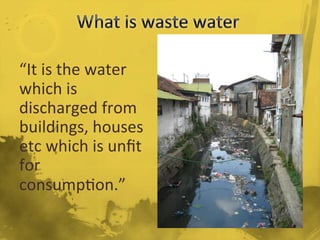
“It	
  is	
  the	
  water	
  
which	
  is	
  
discharged	
  from	
  
buildings,	
  houses	
  
etc	
  which	
  is	
  unfit	
  
for	
  
consump/on.”	


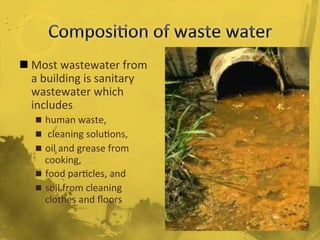
n Most	
  wastewater	
  from	
  
a	
  building	
  is	
  sanitary	
  
wastewater	
  which	
  
includes	
  
n  human	
  waste,	
  
n  	
  cleaning	
  solu/ons,	
  	
  
n  oil	
  and	
  grease	
  from	
  
cooking,	
  	
  
n  food	
  par/cles,	
  and	
  	
  
n  soil	
  from	
  cleaning	
  
clothes	
  and	
  floors	


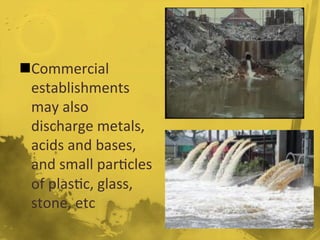
n Commercial	
  
establishments	
  
may	
  also	
  
discharge	
  metals,	
  
acids	
  and	
  bases,	
  
and	
  small	
  par/cles	
  
of	
  plas/c,	
  glass,	
  
stone,	
  etc	
  
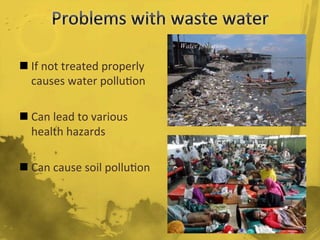
n If	
  not	
  treated	
  properly	
  
causes	
  water	
  pollu/on	
  
n Can	
  lead	
  to	
  various	
  
health	
  hazards	
  
n Can	
  cause	
  soil	
  pollu/on	
  
n Any	
  oxidizable	
  material	
  present	
  in	
  a	
  natural	
  
waterway	
  or	
  in	
  an	
  industrial	
  wastewater	
  will	
  
be	
  oxidized	
  both	
  by	
  biochemical	
  (bacterial)	
  or	
  
chemical	
  processes.	


n Since	
  all	
  natural	
  waterways	
  contain	
  bacteria	
  
and	
  nutrients,	
  almost	
  any	
  waste	
  compounds	
  
introduced	
  into	
  such	
  waterways	
  will	
  ini/ate	
  
biochemical	
  reac/ons	
  
n Those	
  biochemical	
  reac/ons	
  create	
  what	
  is	
  
measured	
  in	
  the	
  laboratory	
  as	
  the	
  
Biochemical	
  oxygen	
  demand	
  (BOD)	
  and	
  
Chemical	
  oxygen	
  demand	
  (COD)	


n Both	
  have	
  been	
  widely	
  adopted	
  as	
  a	
  measure	
  
of	
  pollu/on.	
  
n REUSE	
  
n RECYCLE	
  
n WATER	
  TREATMENT	
  
n Some relatively
clean wastewater
can be reused
without treatment
n Graywater is
wastewater
generated by
washing, laundry,
and bathing (not
from toilets)
n  50-80% of domestic
wastewater
n  Reused for irrigation
or flushing toilets
n Closed-loop
treatment systems
n  Used to capture, treat,
and reuse waste water
on-site
n  E.g Car wash System
n Wastewater
reclamation
n  Treats waste water and
use it for a different
purpose
n  E.g MC waste water
treatment and use for
irrigating parks	
  
n Wastewater is
transported to an
(on-site or off-site)
treatment facility,
treated, and
discharged into a
water body
n Used	
  for	
  drinking	
  
purposes	
  
Waste water management

Waste water management

  • 1.
                                                           Japneet  Kaur                                          
  • 2.
    n Introduc/on   n Composi/on   n Problems   n Detec/on   n Solu/ons  
  • 3.
    n Wastewater  management  encompasses  a   broad  range  of  efforts  that  promote     n Effec/ve  and  responsible  water  use   n Proper  Water  treatment   n Proper  Water  disposal     n Encourage  the  protec/on  and  restora/on  of  our   na/on's  watersheds.    
  • 4.
    “It  is  the  water   which  is   discharged  from   buildings,  houses   etc  which  is  unfit   for   consump/on.”      
  • 5.
    n Most  wastewater  from   a  building  is  sanitary   wastewater  which   includes   n  human  waste,   n   cleaning  solu/ons,     n  oil  and  grease  from   cooking,     n  food  par/cles,  and     n  soil  from  cleaning   clothes  and  floors    
  • 6.
    n Commercial   establishments   may  also   discharge  metals,   acids  and  bases,   and  small  par/cles   of  plas/c,  glass,   stone,  etc  
  • 7.
    n If  not  treated  properly   causes  water  pollu/on   n Can  lead  to  various   health  hazards   n Can  cause  soil  pollu/on  
  • 8.
    n Any  oxidizable  material  present  in  a  natural   waterway  or  in  an  industrial  wastewater  will   be  oxidized  both  by  biochemical  (bacterial)  or   chemical  processes.     n Since  all  natural  waterways  contain  bacteria   and  nutrients,  almost  any  waste  compounds   introduced  into  such  waterways  will  ini/ate   biochemical  reac/ons  
  • 9.
    n Those  biochemical  reac/ons  create  what  is   measured  in  the  laboratory  as  the   Biochemical  oxygen  demand  (BOD)  and   Chemical  oxygen  demand  (COD)     n Both  have  been  widely  adopted  as  a  measure   of  pollu/on.  
  • 10.
  • 11.
    n Some relatively clean wastewater canbe reused without treatment n Graywater is wastewater generated by washing, laundry, and bathing (not from toilets) n  50-80% of domestic wastewater n  Reused for irrigation or flushing toilets
  • 12.
    n Closed-loop treatment systems n  Usedto capture, treat, and reuse waste water on-site n  E.g Car wash System n Wastewater reclamation n  Treats waste water and use it for a different purpose n  E.g MC waste water treatment and use for irrigating parks  
  • 13.
    n Wastewater is transported toan (on-site or off-site) treatment facility, treated, and discharged into a water body n Used  for  drinking   purposes