BIOMEDICAL
WASTE
MANAGEMENT
Let the waste of the “sick”
not contaminate the lives of
“The Healthy”
CONTENT
• Definition
• Categories of Biomedical Waste
• Problem associated with Biomedical waste
• Need for Biomedical Waste Management
• Step to manage hazardous waste
• Treatment techniques
• Biomedical waste management in India
• Environmental legislation
• Conclusion
• Summary
Biomedical Waste (BMW)
is…
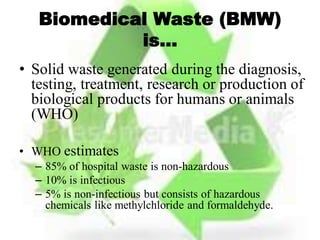
• Solid waste generated during the diagnosis,
testing, treatment, research or production of
biological products for humans or animals
(WHO)
• WHO estimates
– 85% of hospital waste is non-hazardous
– 10% is infectious
– 5% is non-infectious but consists of hazardous
chemicals like methylchloride and formaldehyde.
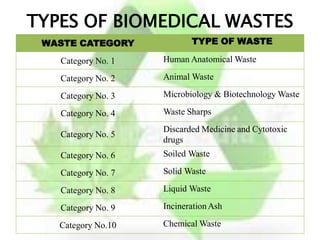
TYPES OF BIOMEDICAL WASTES
WASTE CATEGORY TYPE OF WASTE
Category No. 1 Human Anatomical Waste
Category No. 2 Animal Waste
Category No. 3 Microbiology & Biotechnology Waste
Category No. 4 Waste Sharps
Category No. 5
Discarded Medicine and Cytotoxic
drugs
Category No. 6 Soiled Waste
Category No. 7 Solid Waste
Category No. 8 Liquid Waste
Category No. 9 IncinerationAsh
Category No.10 Chemical Waste
Waste Sharps eg: Needles
Human anatomical waste
Discarded medicines
Solid waste eg: cotton swabs
Pharmaceutical Waste
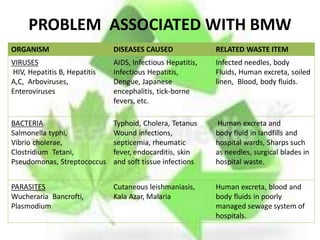
PROBLEM ASSOCIATED WITH BMW
ORGANISM DISEASES CAUSED RELATED WASTE ITEM
VIRUSES
HIV, Hepatitis B, Hepatitis
A,C, Arboviruses,
Enteroviruses
AIDS, Infectious Hepatitis,
Infectious Hepatitis,
Dengue, Japanese
encephalitis, tick-borne
fevers, etc.
Infected needles, body
Fluids, Human excreta, soiled
linen, Blood, body fluids.
BACTERIA
Salmonella typhi,
Vibrio cholerae,
Clostridium Tetani,
Pseudomonas, Streptococcus
Typhoid, Cholera, Tetanus
Wound infections,
septicemia, rheumatic
fever, endocarditis, skin
and soft tissue infections
Human excreta and
body fluid in landfills and
hospital wards, Sharps such
as needles, surgical blades in
hospital waste.
PARASITES
Wucheraria Bancrofti,
Plasmodium
Cutaneous leishmaniasis,
Kala Azar, Malaria
Human excreta, blood and
body fluids in poorly
managed sewage system of
hospitals.
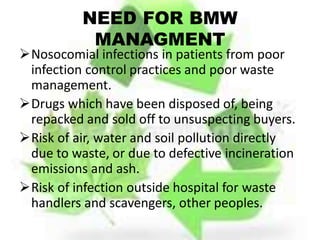
NEED FOR BMW
MANAGMENT
Nosocomial infections in patients from poor
infection control practices and poor waste
management.
Drugs which have been disposed of, being
repacked and sold off to unsuspecting buyers.
Risk of air, water and soil pollution directly
due to waste, or due to defective incineration
emissions and ash.
Risk of infection outside hospital for waste
handlers and scavengers, other peoples.
TECHNIQUES
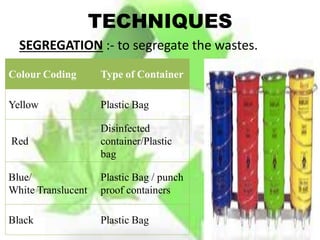
SEGREGATION :- to segregate the wastes.
Colour Coding Type of Container
Yellow Plastic Bag
Red
Disinfected
container/Plastic
bag
Blue/
White Translucent
Plastic Bag / punch
proof containers
Black Plastic Bag
TRANSPORTATION
• Transportation of BMW can be divided into
internal and external transportation.
• INTERNAL: it is for yellow ,red ,blue and white
bags.
• EXTERNAL: it is for the general waste collected
in the black coloured plastic bags.
TREATMENT AND DISPOSAL
PROCEDURES MAIN FUNCTION
Incineration burn trash and other types of waste
until it is reduced to ash.
Autoclaving and Shredding It uses a combination of heat, steam
and pressure.
Chemical treatment Using sodium hypochlorite
solution, bleaching powder, savlon
and then discharged into
drains/sewers
Irradiation technique Involve the expose to UV radiation
and ionizing radiation
Bio medical waste
management in India
Biomedical waste (management and handling) rule
1998, prescribed by The Ministry of Environment and
Forests, Govt of India, came into force on 20th July
1998.
 This rule applies to those who generate, collect,
receive, store, dispose, treat or handle bio medical
waste in any manner.
Thus bio medical waste should be segregated into
containers/bags at the point of generation of waste.
Thus Colour Coding & type of containers used for
disposal of waste is came into existence which is
shown as follows. 12
13
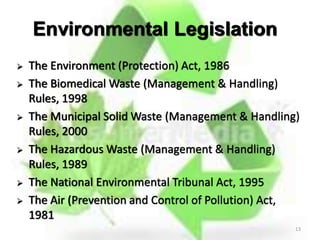
Environmental Legislation
 The Environment (Protection) Act, 1986
 The Biomedical Waste (Management & Handling)
Rules, 1998
 The Municipal Solid Waste (Management & Handling)
Rules, 2000
 The Hazardous Waste (Management & Handling)
Rules, 1989
 The National Environmental Tribunal Act, 1995
 The Air (Prevention and Control of Pollution) Act,
1981
CONCLUSION
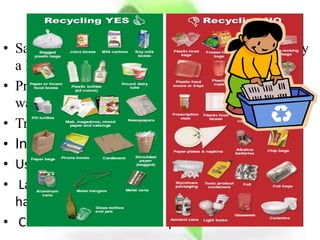
• Safe and effective management of waste is not only
a legal necessity but also a social responsibility.
• Proper collection and segregation of biomedical
waste.
• Try to reduce the waste generation.
• Individual awareness and participation.
• Use recycle products.
• Label with agent, concentration and
hazard warnings.
• Communicate about workplace hazards.
• PRESENTED BY:
• RASHMI VAISH , MBA-HAHC (II Tri)
• DIBYA DWIVEDI , MBA-FM (II Tri)

biomedicalwastemanagementpptfinal1-121014044223-phpapp01-130801200431-phpapp01.pdf

  • 1.
  • 2.
    Let the wasteof the “sick” not contaminate the lives of “The Healthy”
  • 3.
    CONTENT • Definition • Categoriesof Biomedical Waste • Problem associated with Biomedical waste • Need for Biomedical Waste Management • Step to manage hazardous waste • Treatment techniques • Biomedical waste management in India • Environmental legislation • Conclusion • Summary
  • 4.
    Biomedical Waste (BMW) is… •Solid waste generated during the diagnosis, testing, treatment, research or production of biological products for humans or animals (WHO) • WHO estimates – 85% of hospital waste is non-hazardous – 10% is infectious – 5% is non-infectious but consists of hazardous chemicals like methylchloride and formaldehyde.
  • 5.
    TYPES OF BIOMEDICALWASTES WASTE CATEGORY TYPE OF WASTE Category No. 1 Human Anatomical Waste Category No. 2 Animal Waste Category No. 3 Microbiology & Biotechnology Waste Category No. 4 Waste Sharps Category No. 5 Discarded Medicine and Cytotoxic drugs Category No. 6 Soiled Waste Category No. 7 Solid Waste Category No. 8 Liquid Waste Category No. 9 IncinerationAsh Category No.10 Chemical Waste
  • 6.
    Waste Sharps eg:Needles Human anatomical waste Discarded medicines Solid waste eg: cotton swabs Pharmaceutical Waste
  • 7.
    PROBLEM ASSOCIATED WITHBMW ORGANISM DISEASES CAUSED RELATED WASTE ITEM VIRUSES HIV, Hepatitis B, Hepatitis A,C, Arboviruses, Enteroviruses AIDS, Infectious Hepatitis, Infectious Hepatitis, Dengue, Japanese encephalitis, tick-borne fevers, etc. Infected needles, body Fluids, Human excreta, soiled linen, Blood, body fluids. BACTERIA Salmonella typhi, Vibrio cholerae, Clostridium Tetani, Pseudomonas, Streptococcus Typhoid, Cholera, Tetanus Wound infections, septicemia, rheumatic fever, endocarditis, skin and soft tissue infections Human excreta and body fluid in landfills and hospital wards, Sharps such as needles, surgical blades in hospital waste. PARASITES Wucheraria Bancrofti, Plasmodium Cutaneous leishmaniasis, Kala Azar, Malaria Human excreta, blood and body fluids in poorly managed sewage system of hospitals.
  • 8.
    NEED FOR BMW MANAGMENT Nosocomialinfections in patients from poor infection control practices and poor waste management. Drugs which have been disposed of, being repacked and sold off to unsuspecting buyers. Risk of air, water and soil pollution directly due to waste, or due to defective incineration emissions and ash. Risk of infection outside hospital for waste handlers and scavengers, other peoples.
  • 9.
    TECHNIQUES SEGREGATION :- tosegregate the wastes. Colour Coding Type of Container Yellow Plastic Bag Red Disinfected container/Plastic bag Blue/ White Translucent Plastic Bag / punch proof containers Black Plastic Bag
  • 10.
    TRANSPORTATION • Transportation ofBMW can be divided into internal and external transportation. • INTERNAL: it is for yellow ,red ,blue and white bags. • EXTERNAL: it is for the general waste collected in the black coloured plastic bags.
  • 11.
    TREATMENT AND DISPOSAL PROCEDURESMAIN FUNCTION Incineration burn trash and other types of waste until it is reduced to ash. Autoclaving and Shredding It uses a combination of heat, steam and pressure. Chemical treatment Using sodium hypochlorite solution, bleaching powder, savlon and then discharged into drains/sewers Irradiation technique Involve the expose to UV radiation and ionizing radiation
  • 12.
    Bio medical waste managementin India Biomedical waste (management and handling) rule 1998, prescribed by The Ministry of Environment and Forests, Govt of India, came into force on 20th July 1998.  This rule applies to those who generate, collect, receive, store, dispose, treat or handle bio medical waste in any manner. Thus bio medical waste should be segregated into containers/bags at the point of generation of waste. Thus Colour Coding & type of containers used for disposal of waste is came into existence which is shown as follows. 12
  • 13.
    13 Environmental Legislation  TheEnvironment (Protection) Act, 1986  The Biomedical Waste (Management & Handling) Rules, 1998  The Municipal Solid Waste (Management & Handling) Rules, 2000  The Hazardous Waste (Management & Handling) Rules, 1989  The National Environmental Tribunal Act, 1995  The Air (Prevention and Control of Pollution) Act, 1981
  • 14.
    CONCLUSION • Safe andeffective management of waste is not only a legal necessity but also a social responsibility. • Proper collection and segregation of biomedical waste. • Try to reduce the waste generation. • Individual awareness and participation. • Use recycle products. • Label with agent, concentration and hazard warnings. • Communicate about workplace hazards.
  • 15.
    • PRESENTED BY: •RASHMI VAISH , MBA-HAHC (II Tri) • DIBYA DWIVEDI , MBA-FM (II Tri)