Objectives of theUnit
Content:
Understand the importance of water supply infrastructure.
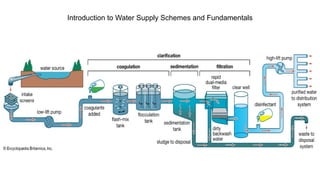
Learn the components and layout of water supply schemes.
Explore data collection, design periods, and factors affecting them.
Analyze water quantity requirements and population forecasting.
Study water quality parameters and standards (IS 10500-2012).
4.
Importance of WaterSupply Infrastructure
Why is it important?
Essential for human survival, health, and economic
development.
Supports domestic, industrial, agricultural, and recreational
needs.
Ensures public health by providing safe and adequate
water.
5.
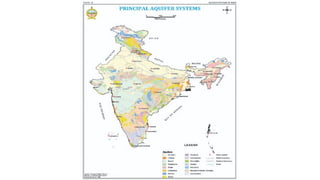
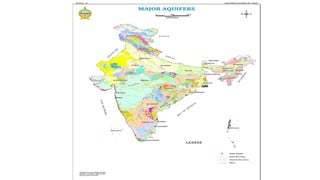
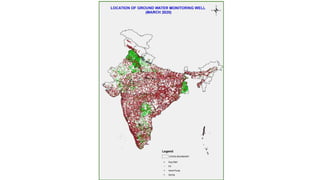
Water Infrastructure inIndia:
Overview: India’s water supply challenges (e.g., population growth, urbanization,
water scarcity).
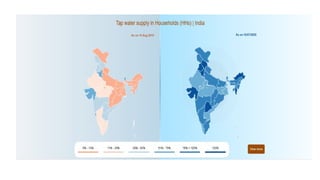
Key programs: Jal Jeevan Mission (aims to provide piped water to all households
by 2024).
Challenges: Aging infrastructure, water losses, and unequal distribution.
13.
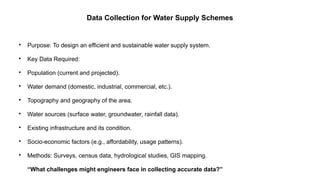
Data Collection forWater Supply Schemes
Purpose: To design an efficient and sustainable water supply system.
Key Data Required:
Population (current and projected).
Water demand (domestic, industrial, commercial, etc.).
Topography and geography of the area.
Water sources (surface water, groundwater, rainfall data).
Existing infrastructure and its condition.
Socio-economic factors (e.g., affordability, usage patterns).
Methods: Surveys, census data, hydrological studies, GIS mapping.
“What challenges might engineers face in collecting accurate data?”
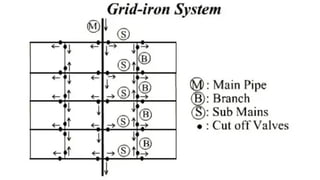
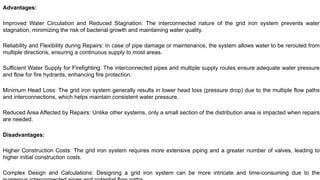
Advantages:
Improved Water Circulationand Reduced Stagnation: The interconnected nature of the grid iron system prevents water
stagnation, minimizing the risk of bacterial growth and maintaining water quality.
Reliability and Flexibility during Repairs: In case of pipe damage or maintenance, the system allows water to be rerouted from
multiple directions, ensuring a continuous supply to most areas.
Sufficient Water Supply for Firefighting: The interconnected pipes and multiple supply routes ensure adequate water pressure
and flow for fire hydrants, enhancing fire protection.
Minimum Head Loss: The grid iron system generally results in lower head loss (pressure drop) due to the multiple flow paths
and interconnections, which helps maintain consistent water pressure.
Reduced Area Affected by Repairs: Unlike other systems, only a small section of the distribution area is impacted when repairs
are needed.
Disadvantages:
Higher Construction Costs: The grid iron system requires more extensive piping and a greater number of valves, leading to
higher initial construction costs.
Complex Design and Calculations: Designing a grid iron system can be more intricate and time-consuming due to the
18.
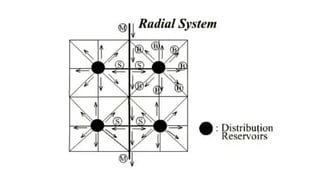
Advantages:
Simplicity and Easeof Installation: The radial system is straightforward to design and install, especially in
areas with a central source of water.
Low Initial Cost: Compared to more complex systems, the radial system generally has a lower initial
investment cost.
Easy Maintenance: Maintenance can be simpler because the system is relatively straightforward, and
individual zones can be isolated for maintenance without affecting the entire system.
Suitable for Remote Areas: The system can be effective in areas with a single, centralized water source,
making it suitable for remote locations.
Good for Limited Areas: It works well when the area to be supplied with water is relatively small and compact.
Disadvantages:
Susceptibility to Failures: A major drawback is that if the central source or any major feeder line fails, it can
interrupt the water supply to a large portion of the area.
Voltage Fluctuations: Consumers at the far end of the distribution lines may experience significant voltage
19.
Not Ideal forLarge, Complex Areas: It may not be the most efficient or reliable solution for large,
geographically spread-out areas with multiple water sources.
Potential for Overloading: The section of the distribution line closest to the water source may experience
higher demand and potential overloading.
21.
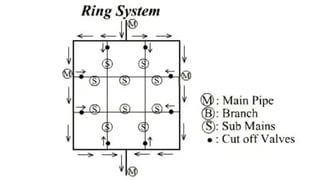
Advantages:
High Reliability: Ina ring system, water can reach any point from at least two directions. This ensures a
continuous water supply even if one section of the ring is damaged or undergoing maintenance.
Reduced Stagnation: The continuous flow in a ring system minimizes water stagnation, which can improve
water quality and reduce the risk of bacterial growth.
Improved Pressure: The ring configuration helps maintain consistent water pressure throughout the
distribution area, especially in well-planned areas.
Efficient Maintenance: Repairs can be performed on a section of the ring without completely shutting off the
water supply to the entire area.
Disadvantages:
Higher Initial Cost: Laying out a ring system requires more piping and is more complex than other systems
like the dead-end or gridiron system, leading to higher initial installation costs.
More Valves: Ring systems generally require a greater number of valves to control the flow and isolate
sections for maintenance or repairs.
23.
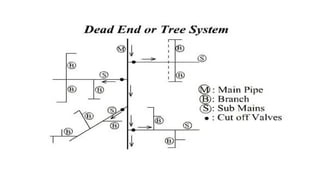
Benefits:
Simplicity and Cost-Effectiveness:Dead-end systems are relatively simple to design, install, and maintain,
making them a budget-friendly option, especially in areas with less complex infrastructure.
Easier Calculations: Determining flow rates and pressures is generally simpler in dead-end systems due to
the straightforward flow path.
Fewer Valves: Fewer control valves are needed compared to more complex systems like looped systems,
which can reduce maintenance and operation costs.
Drawbacks:
Stagnation and Water Quality Issues: Water can stagnate in dead-ends, leading to sediment accumulation
and bacterial growth, potentially affecting water quality and taste.
Lower Pressure in Remote Areas: Pressure can be significantly lower in the farthest reaches of a dead-end
system, especially during peak demand or when fire hydrants are in use.
Limited Firefighting Capability: The limited water flow and pressure in dead-end systems can hinder
firefighting efforts.
24.
Risk of WaterHammer: Sudden changes in flow (e.g., due to pump start/stop) can cause water hammer,
potentially damaging pipes.
Increased Maintenance: Dead-end systems require more frequent flushing and cleaning to remove
accumulated sediment.
In essence, while the dead-end system offers simplicity and cost advantages, its drawbacks related to water
quality and pressure can make it unsuitable for larger, more complex areas, especially where reliable and
consistent water supply is crucial.
25.
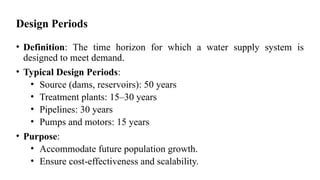
Design Periods
• Definition:The time horizon for which a water supply system is
designed to meet demand.
• Typical Design Periods:
• Source (dams, reservoirs): 50 years
• Treatment plants: 15–30 years
• Pipelines: 30 years
• Pumps and motors: 15 years
• Purpose:
• Accommodate future population growth.
• Ensure cost-effectiveness and scalability.
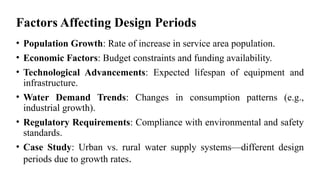
26.
Factors Affecting DesignPeriods
• Population Growth: Rate of increase in service area population.
• Economic Factors: Budget constraints and funding availability.
• Technological Advancements: Expected lifespan of equipment and
infrastructure.
• Water Demand Trends: Changes in consumption patterns (e.g.,
industrial growth).
• Regulatory Requirements: Compliance with environmental and safety
standards.
• Case Study: Urban vs. rural water supply systems—different design
periods due to growth rates.
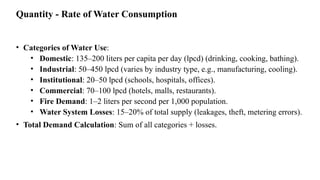
27.
Quantity - Rateof Water Consumption
• Categories of Water Use:
• Domestic: 135–200 liters per capita per day (lpcd) (drinking, cooking, bathing).
• Industrial: 50–450 lpcd (varies by industry type, e.g., manufacturing, cooling).
• Institutional: 20–50 lpcd (schools, hospitals, offices).
• Commercial: 70–100 lpcd (hotels, malls, restaurants).
• Fire Demand: 1–2 liters per second per 1,000 population.
• Water System Losses: 15–20% of total supply (leakages, theft, metering errors).
• Total Demand Calculation: Sum of all categories + losses.
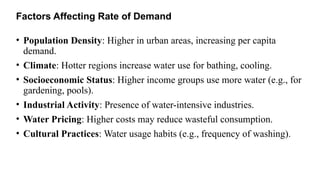
28.
Factors Affecting Rateof Demand
• Population Density: Higher in urban areas, increasing per capita
demand.
• Climate: Hotter regions increase water use for bathing, cooling.
• Socioeconomic Status: Higher income groups use more water (e.g., for
gardening, pools).
• Industrial Activity: Presence of water-intensive industries.
• Water Pricing: Higher costs may reduce wasteful consumption.
• Cultural Practices: Water usage habits (e.g., frequency of washing).
29.
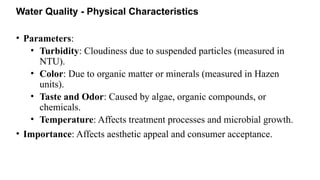
Water Quality -Physical Characteristics
• Parameters:
• Turbidity: Cloudiness due to suspended particles (measured in
NTU).
• Color: Due to organic matter or minerals (measured in Hazen
units).
• Taste and Odor: Caused by algae, organic compounds, or
chemicals.
• Temperature: Affects treatment processes and microbial growth.
• Importance: Affects aesthetic appeal and consumer acceptance.
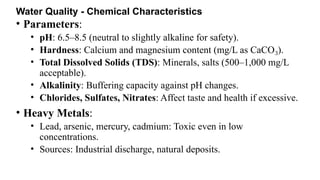
30.
Water Quality -Chemical Characteristics
• Parameters:
• pH: 6.5–8.5 (neutral to slightly alkaline for safety).
• Hardness: Calcium and magnesium content (mg/L as CaCO ).
₃
• Total Dissolved Solids (TDS): Minerals, salts (500–1,000 mg/L
acceptable).
• Alkalinity: Buffering capacity against pH changes.
• Chlorides, Sulfates, Nitrates: Affect taste and health if excessive.
• Heavy Metals:
• Lead, arsenic, mercury, cadmium: Toxic even in low
concentrations.
• Sources: Industrial discharge, natural deposits.
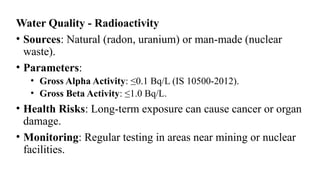
31.
Water Quality -Radioactivity
• Sources: Natural (radon, uranium) or man-made (nuclear
waste).
• Parameters:
• Gross Alpha Activity: ≤0.1 Bq/L (IS 10500-2012).
• Gross Beta Activity: ≤1.0 Bq/L.
• Health Risks: Long-term exposure can cause cancer or organ
damage.
• Monitoring: Regular testing in areas near mining or nuclear
facilities.
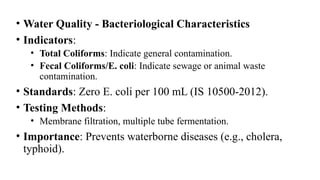
32.
• Water Quality- Bacteriological Characteristics
• Indicators:
• Total Coliforms: Indicate general contamination.
• Fecal Coliforms/E. coli: Indicate sewage or animal waste
contamination.
• Standards: Zero E. coli per 100 mL (IS 10500-2012).
• Testing Methods:
• Membrane filtration, multiple tube fermentation.
• Importance: Prevents waterborne diseases (e.g., cholera,
typhoid).
33.
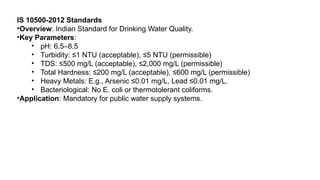
IS 10500-2012 Standards
•Overview:Indian Standard for Drinking Water Quality.
•Key Parameters:
• pH: 6.5–8.5
• Turbidity: ≤1 NTU (acceptable), ≤5 NTU (permissible)
• TDS: ≤500 mg/L (acceptable), ≤2,000 mg/L (permissible)
• Total Hardness: ≤200 mg/L (acceptable), ≤600 mg/L (permissible)
• Heavy Metals: E.g., Arsenic ≤0.01 mg/L, Lead ≤0.01 mg/L.
• Bacteriological: No E. coli or thermotolerant coliforms.
•Application: Mandatory for public water supply systems.