DROUGHT STRESS
SUBMITTED BY: MUZAMIL TASSEN
ROLLNO: IUBC1IBB112
4th semester2016-20
Islamia university Bahawalpur
Introduction
 Drought is a period or condition of unusually dry weather
within a geographic area where there is a lack of precipitation.
 The characteristics features of drought stress is low water
potential due to high solute concentration.
 Low water supply causes soil mineral toxicities and can make
a plant more susceptible to damage from high irradiance.
MECHANISM OF DROUGHT STRESS
 DROUGHT ESCAPE: It is defined as the ability of a plant
to complete its life cycle before supply of water in soil is depleted
and form dormant seeds before the onset of dry season. These
plants are known as drought escapers since they escape drought
by rapid development.
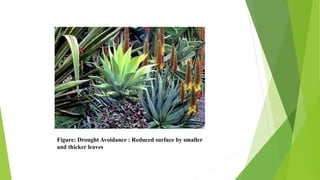
 DROUGHT AVOIDANCE: It is the ability of plants to
maintain relatively high tissue- water potential despite a shortage
of soil moisture. Drought avoidance is performed by maintenance
of turgor through roots grow deeper in the soil, stomatal control
of transpiration and by reduction of water loss through reduced
epidermal i.e. reduced surface by smaller and thicker leaves.
 DROUGHT TOLERANCE: It is the ability to withstand
water deficit with low tissue water potential. Drought tolerance is
the maintenance of turgor through osmotic adjustment (a process
which induces solute accumulation in cell), increase in elasticity
in the cell and decrease in cell size.
Figure: Drought Avoidance : Reduced surface by smaller
and thicker leaves
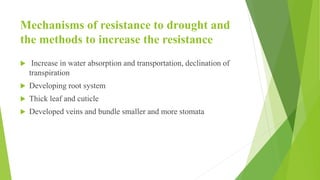
Mechanisms of resistance to drought and
the methods to increase the resistance
 Increase in water absorption and transportation, declination of
transpiration
 Developing root system
 Thick leaf and cuticle
 Developed veins and bundle smaller and more stomata
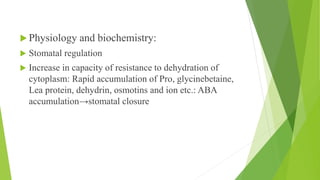
 Physiology and biochemistry:
 Stomatal regulation
 Increase in capacity of resistance to dehydration of
cytoplasm: Rapid accumulation of Pro, glycinebetaine,
Lea protein, dehydrin, osmotins and ion etc.: ABA
accumulation→stomatal closure
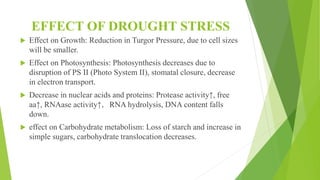
EFFECT OF DROUGHT STRESS
 Effect on Growth: Reduction in Turgor Pressure, due to cell sizes
will be smaller.
 Effect on Photosynthesis: Photosynthesis decreases due to
disruption of PS II (Photo System II), stomatal closure, decrease
in electron transport.
 Decrease in nuclear acids and proteins: Protease activity↑, free
aa↑, RNAase activity↑,RNA hydrolysis, DNA content falls
down.
 effect on Carbohydrate metabolism: Loss of starch and increase in
simple sugars, carbohydrate translocation decreases.
Drought stress

Drought stress

  • 1.
    DROUGHT STRESS SUBMITTED BY:MUZAMIL TASSEN ROLLNO: IUBC1IBB112 4th semester2016-20 Islamia university Bahawalpur
  • 2.
    Introduction  Drought isa period or condition of unusually dry weather within a geographic area where there is a lack of precipitation.  The characteristics features of drought stress is low water potential due to high solute concentration.  Low water supply causes soil mineral toxicities and can make a plant more susceptible to damage from high irradiance.
  • 3.
    MECHANISM OF DROUGHTSTRESS  DROUGHT ESCAPE: It is defined as the ability of a plant to complete its life cycle before supply of water in soil is depleted and form dormant seeds before the onset of dry season. These plants are known as drought escapers since they escape drought by rapid development.
  • 4.
     DROUGHT AVOIDANCE:It is the ability of plants to maintain relatively high tissue- water potential despite a shortage of soil moisture. Drought avoidance is performed by maintenance of turgor through roots grow deeper in the soil, stomatal control of transpiration and by reduction of water loss through reduced epidermal i.e. reduced surface by smaller and thicker leaves.
  • 5.
     DROUGHT TOLERANCE:It is the ability to withstand water deficit with low tissue water potential. Drought tolerance is the maintenance of turgor through osmotic adjustment (a process which induces solute accumulation in cell), increase in elasticity in the cell and decrease in cell size.
  • 6.
    Figure: Drought Avoidance: Reduced surface by smaller and thicker leaves
  • 7.
    Mechanisms of resistanceto drought and the methods to increase the resistance  Increase in water absorption and transportation, declination of transpiration  Developing root system  Thick leaf and cuticle  Developed veins and bundle smaller and more stomata
  • 8.
     Physiology andbiochemistry:  Stomatal regulation  Increase in capacity of resistance to dehydration of cytoplasm: Rapid accumulation of Pro, glycinebetaine, Lea protein, dehydrin, osmotins and ion etc.: ABA accumulation→stomatal closure
  • 9.
    EFFECT OF DROUGHTSTRESS  Effect on Growth: Reduction in Turgor Pressure, due to cell sizes will be smaller.  Effect on Photosynthesis: Photosynthesis decreases due to disruption of PS II (Photo System II), stomatal closure, decrease in electron transport.  Decrease in nuclear acids and proteins: Protease activity↑, free aa↑, RNAase activity↑,RNA hydrolysis, DNA content falls down.  effect on Carbohydrate metabolism: Loss of starch and increase in simple sugars, carbohydrate translocation decreases.