Water &Sanitation
DONE BY :
NOEL CHRISTIAN
Introduction
 Water is a transparent and nearly colorless chemical substance
that is the main constituent of Earth's streams, lakes, and oceans,
and the fluids of most living organisms.
 Water covers 71% of the Earth's surface. It is vital for all known
forms of life.
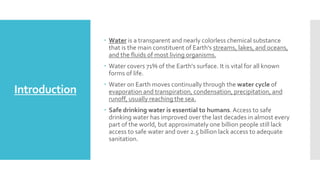
 Water on Earth moves continually through the water cycle of
evaporation and transpiration, condensation, precipitation, and
runoff, usually reaching the sea.
 Safe drinking water is essential to humans.Access to safe
drinking water has improved over the last decades in almost every
part of the world, but approximately one billion people still lack
access to safe water and over 2.5 billion lack access to adequate
sanitation.
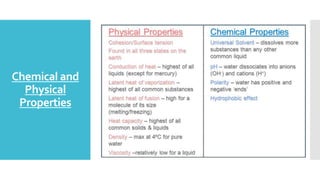
Chemical and
Physical
Properties
Health and
Pollution
 Water fit for human consumption is called drinking water or
potable water.
 Chlorine is a skin and mucous membrane irritant that is used to
make water safe for bathing or drinking.
 Poor water quality and bad sanitation are deadly; some 5 million
deaths a year are caused by polluted drinking water.
 TheWorld Health Organization estimates that safe water could
prevent 1.4 million child deaths from diarrhea each year.
Human uses
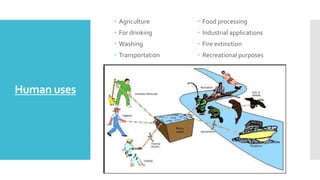
 Agriculture
 For drinking
 Washing
 Transportation
 Food processing
 Industrial applications
 Fire extinction
 Recreational purposes
Waterborne
Diseases
 Cholera
 Cryptosporidium
 Cylcosporiasis
 Diarrheal Disease
 Dysentery
 Gastroenteritis
 Giardiasis
 GuineaWorm
 Hepatitis E
 Typhoid Fever
Sanitation
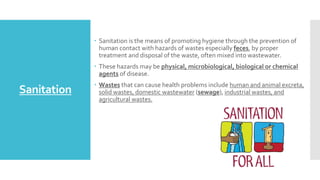
 Sanitation is the means of promoting hygiene through the prevention of
human contact with hazards of wastes especially feces, by proper
treatment and disposal of the waste, often mixed into wastewater.
 These hazards may be physical, microbiological, biological or chemical
agents of disease.
 Wastes that can cause health problems include human and animal excreta,
solid wastes, domestic wastewater (sewage), industrial wastes, and
agricultural wastes.
 Hygienic means of prevention may involve :
- Engineering solutions (e.g., sanitary sewers, sewage treatment,
surface runoff management, solid waste management, excreta
management)
- Simple technologies (e.g., pit latrines, dry toilets, urine-diverting
dry toilets, septic tanks), or
- Behavior changes in personal hygiene practices, such as hand
washing with soap.
 The main objective of a sanitation system is to protect and promote human
health by providing a clean environment and breaking the cycle of disease.
 Lack of improved sanitation access have serious health impact on human
kind.
 One of the main challenge of sanitation is sustainability.
Health
Aspects
 For any social and economic development, adequate sanitation
with good hygiene and safe water are essential to good health.
 Diseases resulting from sanitation have a direct relation to
poverty.
 The lack of clean water and poor sanitation causes many
diseases and the spread of diseases.
 It is estimated that up to 5 million people die each year from
waterborne diseases, as a result of inadequate sanitation and
hygiene practices.
 Sanitation is a necessity for a healthy life.
 Diarrhea : Deaths resulting from diarrhea are estimated to be
between 1.6 and 2.5 million deaths every year. Most of the
affected are young children below the ages of 5.
 Malnutrition and stunting : caused by unsafe water, sanitation
and hygiene practices. 860,000 deaths per year in children under
5 years of age
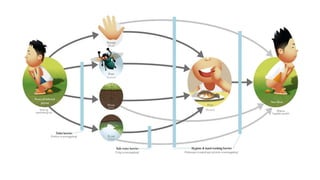
 Lack of sanitation : Lack of sanitation refers to the absence of
sanitation. Means lack of toilets or lack of hygienic toilets that
anybody would want to use voluntarily. The result of lack of
sanitation is usually open defecation.
List of
diseases
caused by lack
of sanitation
 Waterborne diseases, which can contaminate drinking water.
 Diseases transmitted by the fecal-oral route.
 Infections with intestinal helminths (worms) - approximately 2 billion
people are infected with soil-transmitted helminths worldwide; they are
transmitted by eggs present in human feces which in turn contaminate
soil in areas where sanitation is poor.
 Stunted growth in children.
 Malnutrition, particularly in children.
Example, In India,
15 diseases have
been listed which
could be eliminated
by improving
sanitation:
 Anaemia, malnutrition
 Ascariasis (a type of intestinal
worm infection)
 Campylobacteriosis
 Cholera
 Cyanobacteria toxins
 Dengue
 Hepatitis
 Japanese encephalitis (JE)
 Leptospirosis
 Malaria
 Ringworm orTinea (a type of
intestinal worm infection)
 Scabies
 Schistosomiasis
 Trachoma
 Typhoid and paratyphoid
enteric fevers
*Polio is another disease which is related to improper sanitation and hygiene.
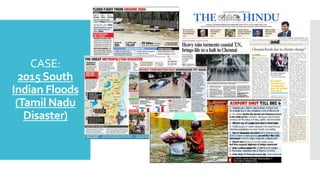
CASE:
2015South
Indian Floods
(Tamil Nadu
Disaster)
CHENNAI
FLOODS
2015
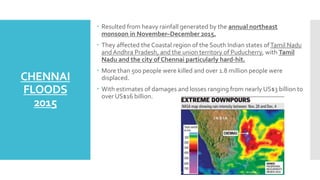
 Resulted from heavy rainfall generated by the annual northeast
monsoon in November–December 2015.
 They affected the Coastal region of the South Indian states ofTamil Nadu
andAndhra Pradesh, and the union territory of Puducherry, with Tamil
Nadu and the city of Chennai particularly hard-hit.
 More than 500 people were killed and over 1.8 million people were
displaced.
 With estimates of damages and losses ranging from nearly US$3 billion to
over US$16 billion.
 Between 9–10 November 2015, Neyveli received 483 mm (19.0 in)
of rainfall; rains continued to lash Cuddalore, Chidambaram and
Chennai.
 Continuing rains led to Chennai becoming flooded by 13
November, resulting in, evacuation of over 10,000 people from
their homes.
 The flooding in Chennai city was worsened by years of illegal
development and inadequate levels of flood preparedness.
Much of the city remained flooded on 17 November, though
rainfall had largely ceased.
 Chennai received 1,049 mm (41.3 in) of rainfall in November,
the highest recorded since November 1918 when 1,088 mm (42.8
in) in of rainfall was recorded. The flooding in Chennai city was
described as the worst in a century.
 Fishermen were warned against sailing because of high waters
and rough seas.
 On 1 December, heavy rains led to flooding in many areas of
Chennai. By afternoon, power supplies were suspended to 60%
of the city while several city hospitals stopped functioning.
 For the first time since its founding in 1878, the major newspaper
The Hindu did not publish a print edition on 2 December, as
workers were unable to reach the press building.
 The Southern Railways cancelled major train services and
Chennai International Airport was closed until 6 December.
 Chennai was officially declared a disaster area on the evening
of 2 December.
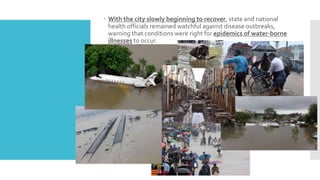
 With the city slowly beginning to recover, state and national
health officials remained watchful against disease outbreaks,
warning that conditions were right for epidemics of water-borne
illnesses to occur.
Consequences
of flooding
 Supplies of basic necessities, including milk, water and
vegetables, were affected due to logistical difficulties.
 During the December floods in Chennai and the adjoining areas,
milk packets sold for ₹100 (US$1.60), five times more than their
usual cost.
 Water bottles and cans were sold at prices between ₹100
(US$1.60) to ₹150 (US$2.30).
 Vegetables were sold at least ₹10 (16$ US) to ₹20 (31$ US) over
and above their normal average cost at the wholesale level.
Numbers
 It was reported on 18 November that 55,000 people acrossTamil
Nadu had been screened for water- and vector-borne diseases in
medical camps, while a further 402 mobile medical units were
operating.
 Relief operations in Chennai were largely concluded by 19
December, by which time 12.8 million food packets had been
distributed, 186,000 tonnes of garbage collected and 1.679 million
people screened at 10,833 medical camps.
Aftermath
 By the end of December 2015, most hospitals in Chennai had
wholly or partially restored services.
 State health authorities inTamil Nadu reported post-flooding
sanitation efforts had been successful, and there had not been
any flood-related outbreaks of disease.
 While floodwaters had largely receded by 19 December, areas of
stagnant water covered parts ofTamil Nadu into January 2016.
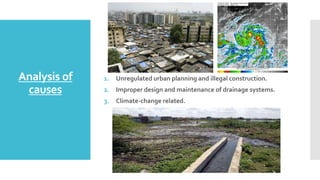
Analysis of
causes
1. Unregulated urban planning and illegal construction.
2. Improper design and maintenance of drainage systems.
3. Climate-change related.
Precaution:
Immunizations
 Outbreaks of communicable diseases after floods are unusual.
 However, the rates of diseases that were present before a flood
may increase because of decreased sanitation or overcrowding
among displaced persons.
 If you receive a puncture wound or a wound contaminated with
feces, soil, or saliva, have a doctor or health department
determine whether a tetanus booster is necessary based on
individual records.
 Specific recommendations for vaccinations should be made on a
case-by-case basis, or as determined by local and state health
departments.
Precaution:
Clean-up
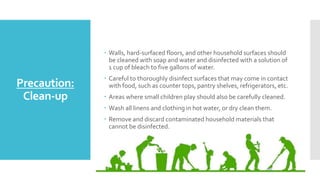
 Walls, hard-surfaced floors, and other household surfaces should
be cleaned with soap and water and disinfected with a solution of
1 cup of bleach to five gallons of water.
 Careful to thoroughly disinfect surfaces that may come in contact
with food, such as counter tops, pantry shelves, refrigerators, etc.
 Areas where small children play should also be carefully cleaned.
 Wash all linens and clothing in hot water, or dry clean them.
 Remove and discard contaminated household materials that
cannot be disinfected.
Water & Sanitation

Water & Sanitation

  • 1.
    Water &Sanitation DONE BY: NOEL CHRISTIAN
  • 2.
    Introduction  Water isa transparent and nearly colorless chemical substance that is the main constituent of Earth's streams, lakes, and oceans, and the fluids of most living organisms.  Water covers 71% of the Earth's surface. It is vital for all known forms of life.  Water on Earth moves continually through the water cycle of evaporation and transpiration, condensation, precipitation, and runoff, usually reaching the sea.  Safe drinking water is essential to humans.Access to safe drinking water has improved over the last decades in almost every part of the world, but approximately one billion people still lack access to safe water and over 2.5 billion lack access to adequate sanitation.
  • 4.
  • 5.
    Health and Pollution  Waterfit for human consumption is called drinking water or potable water.  Chlorine is a skin and mucous membrane irritant that is used to make water safe for bathing or drinking.  Poor water quality and bad sanitation are deadly; some 5 million deaths a year are caused by polluted drinking water.  TheWorld Health Organization estimates that safe water could prevent 1.4 million child deaths from diarrhea each year.
  • 6.
    Human uses  Agriculture For drinking  Washing  Transportation  Food processing  Industrial applications  Fire extinction  Recreational purposes
  • 7.
    Waterborne Diseases  Cholera  Cryptosporidium Cylcosporiasis  Diarrheal Disease  Dysentery  Gastroenteritis  Giardiasis  GuineaWorm  Hepatitis E  Typhoid Fever
  • 8.
    Sanitation  Sanitation isthe means of promoting hygiene through the prevention of human contact with hazards of wastes especially feces, by proper treatment and disposal of the waste, often mixed into wastewater.  These hazards may be physical, microbiological, biological or chemical agents of disease.  Wastes that can cause health problems include human and animal excreta, solid wastes, domestic wastewater (sewage), industrial wastes, and agricultural wastes.
  • 9.
     Hygienic meansof prevention may involve : - Engineering solutions (e.g., sanitary sewers, sewage treatment, surface runoff management, solid waste management, excreta management) - Simple technologies (e.g., pit latrines, dry toilets, urine-diverting dry toilets, septic tanks), or - Behavior changes in personal hygiene practices, such as hand washing with soap.  The main objective of a sanitation system is to protect and promote human health by providing a clean environment and breaking the cycle of disease.  Lack of improved sanitation access have serious health impact on human kind.  One of the main challenge of sanitation is sustainability.
  • 10.
    Health Aspects  For anysocial and economic development, adequate sanitation with good hygiene and safe water are essential to good health.  Diseases resulting from sanitation have a direct relation to poverty.  The lack of clean water and poor sanitation causes many diseases and the spread of diseases.  It is estimated that up to 5 million people die each year from waterborne diseases, as a result of inadequate sanitation and hygiene practices.  Sanitation is a necessity for a healthy life.
  • 11.
     Diarrhea :Deaths resulting from diarrhea are estimated to be between 1.6 and 2.5 million deaths every year. Most of the affected are young children below the ages of 5.  Malnutrition and stunting : caused by unsafe water, sanitation and hygiene practices. 860,000 deaths per year in children under 5 years of age  Lack of sanitation : Lack of sanitation refers to the absence of sanitation. Means lack of toilets or lack of hygienic toilets that anybody would want to use voluntarily. The result of lack of sanitation is usually open defecation.
  • 13.
    List of diseases caused bylack of sanitation  Waterborne diseases, which can contaminate drinking water.  Diseases transmitted by the fecal-oral route.  Infections with intestinal helminths (worms) - approximately 2 billion people are infected with soil-transmitted helminths worldwide; they are transmitted by eggs present in human feces which in turn contaminate soil in areas where sanitation is poor.  Stunted growth in children.  Malnutrition, particularly in children.
  • 14.
    Example, In India, 15diseases have been listed which could be eliminated by improving sanitation:  Anaemia, malnutrition  Ascariasis (a type of intestinal worm infection)  Campylobacteriosis  Cholera  Cyanobacteria toxins  Dengue  Hepatitis  Japanese encephalitis (JE)  Leptospirosis  Malaria  Ringworm orTinea (a type of intestinal worm infection)  Scabies  Schistosomiasis  Trachoma  Typhoid and paratyphoid enteric fevers *Polio is another disease which is related to improper sanitation and hygiene.
  • 15.
  • 16.
    CHENNAI FLOODS 2015  Resulted fromheavy rainfall generated by the annual northeast monsoon in November–December 2015.  They affected the Coastal region of the South Indian states ofTamil Nadu andAndhra Pradesh, and the union territory of Puducherry, with Tamil Nadu and the city of Chennai particularly hard-hit.  More than 500 people were killed and over 1.8 million people were displaced.  With estimates of damages and losses ranging from nearly US$3 billion to over US$16 billion.
  • 17.
     Between 9–10November 2015, Neyveli received 483 mm (19.0 in) of rainfall; rains continued to lash Cuddalore, Chidambaram and Chennai.  Continuing rains led to Chennai becoming flooded by 13 November, resulting in, evacuation of over 10,000 people from their homes.  The flooding in Chennai city was worsened by years of illegal development and inadequate levels of flood preparedness. Much of the city remained flooded on 17 November, though rainfall had largely ceased.  Chennai received 1,049 mm (41.3 in) of rainfall in November, the highest recorded since November 1918 when 1,088 mm (42.8 in) in of rainfall was recorded. The flooding in Chennai city was described as the worst in a century.  Fishermen were warned against sailing because of high waters and rough seas.
  • 18.
     On 1December, heavy rains led to flooding in many areas of Chennai. By afternoon, power supplies were suspended to 60% of the city while several city hospitals stopped functioning.  For the first time since its founding in 1878, the major newspaper The Hindu did not publish a print edition on 2 December, as workers were unable to reach the press building.  The Southern Railways cancelled major train services and Chennai International Airport was closed until 6 December.  Chennai was officially declared a disaster area on the evening of 2 December.
  • 19.
     With thecity slowly beginning to recover, state and national health officials remained watchful against disease outbreaks, warning that conditions were right for epidemics of water-borne illnesses to occur.
  • 20.
    Consequences of flooding  Suppliesof basic necessities, including milk, water and vegetables, were affected due to logistical difficulties.  During the December floods in Chennai and the adjoining areas, milk packets sold for ₹100 (US$1.60), five times more than their usual cost.  Water bottles and cans were sold at prices between ₹100 (US$1.60) to ₹150 (US$2.30).  Vegetables were sold at least ₹10 (16$ US) to ₹20 (31$ US) over and above their normal average cost at the wholesale level.
  • 21.
    Numbers  It wasreported on 18 November that 55,000 people acrossTamil Nadu had been screened for water- and vector-borne diseases in medical camps, while a further 402 mobile medical units were operating.  Relief operations in Chennai were largely concluded by 19 December, by which time 12.8 million food packets had been distributed, 186,000 tonnes of garbage collected and 1.679 million people screened at 10,833 medical camps.
  • 22.
    Aftermath  By theend of December 2015, most hospitals in Chennai had wholly or partially restored services.  State health authorities inTamil Nadu reported post-flooding sanitation efforts had been successful, and there had not been any flood-related outbreaks of disease.  While floodwaters had largely receded by 19 December, areas of stagnant water covered parts ofTamil Nadu into January 2016.
  • 23.
    Analysis of causes 1. Unregulatedurban planning and illegal construction. 2. Improper design and maintenance of drainage systems. 3. Climate-change related.
  • 24.
    Precaution: Immunizations  Outbreaks ofcommunicable diseases after floods are unusual.  However, the rates of diseases that were present before a flood may increase because of decreased sanitation or overcrowding among displaced persons.  If you receive a puncture wound or a wound contaminated with feces, soil, or saliva, have a doctor or health department determine whether a tetanus booster is necessary based on individual records.  Specific recommendations for vaccinations should be made on a case-by-case basis, or as determined by local and state health departments.
  • 25.
    Precaution: Clean-up  Walls, hard-surfacedfloors, and other household surfaces should be cleaned with soap and water and disinfected with a solution of 1 cup of bleach to five gallons of water.  Careful to thoroughly disinfect surfaces that may come in contact with food, such as counter tops, pantry shelves, refrigerators, etc.  Areas where small children play should also be carefully cleaned.  Wash all linens and clothing in hot water, or dry clean them.  Remove and discard contaminated household materials that cannot be disinfected.