ENVIRONMENT AND
HEALTH
Dr.Suresh Babu
Professor
Dept of Public Health Dentistry
Navodaya Dental College
Environment is defined as, all the physical,
chemical and Biological factors external to
a person and all the related behaviors”
-WHO Report 2006
(i) Physical - Water, air, soil, housing, wastes,
radiation, etc.
(ii) Biologic - Plant and animal life including
bacteria, viruses, insects, rodents
and animals.
(iii) Social - Customs, culture, habits, income,
Occupation, religion, etc.
 Much of man's ill-health can be traced to
adverse environmental factors
 Pollution of environment
Sanitation
 Being a way of life it must come from with in
the people, it is nourished by knowledge and
grow as an obligation and an ideal in human
relation.
WHO defines the environmental sanitation
as, “The control of all those factors in
man’s physical environment, which
exercise or may exercise a deleterious
effect on his Physical development, health
and survival”.
 The term sanitation covers the whole field of
controlling the environment with a view to
prevent disease and promote health
 Man has already controlled many factors
 The attainment of healthy environment is
becoming more and more complex
The term environmental sanitation is now
being replaced by environmental health.
 Proper environmental health now requires the
services of the public health qualified doctor,
the epidemiologist, the public health
engineer, the town planner, the sociologist,
the economist, and the health inspector
 The purpose of environmental health is to
create and maintain ecological conditions that
will promote health and thus prevent disease
 Two of the changes needed to achieve
Health for All are concerned with a healthy
environment and healthy lifestyle and require
initiatives by the individual, the family and the
community
 In India, much of ill health is due to poor
environmental sanitation
 Improvement of environmental sanitation is
crucial for prevention of disease and
promotion of health
WATER
 There can be no state of positive health and
well-being without safe water
 Water is not only a vital environmental factor
to all forms of life, but it has also a great role
to play in socio-economic development of
human population.
 In 1980, the United Nations General
Assembly launched
the International Drinking Water Supply
and Sanitation Decade,
1981-1990
--- the aim being to provide all people with
adequate supplies of safe water and
sanitation by 1990.
 In 1981, the 34th World Health Assembly
in a resolution emphasized that
safe drinking water is a basic element of
"primary health care"
which is the key to the attainment of
"Health for All by the year 2000 AD".
Safe & wholesome water
 Free from pathogenic agent
 Free from harmful chemical substances
 Pleasant to the taste
 Usable for domestic purposes
Water pollution is a growing hazard in
many developing countries due to human
activity.
Without ample and safe drinking water,
we cannot provide health care to the
community.
Water requirement
Basic physiological requirement
- 2 litres / head / day
 Urban domestic purpose - 150-200 litres.
 Rural India - 40 litres
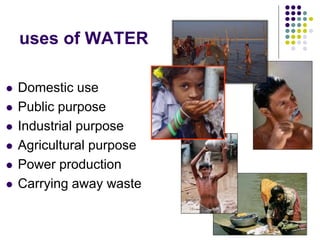
uses of WATER
 Domestic use
 Public purpose
 Industrial purpose
 Agricultural purpose
 Power production
 Carrying away waste
sources of WATER supply
1)Rain water
2)Surface water-
Impounding reservoirs, rivers & streams,
tanks, ponds & lakes
3)Ground water-
shallow wells, deep wells, springs.
i. Rain
 Prime source of all water
 3 ways of distribution- water cycle
Characteristics of rain water
 Physically
 Chemically
 bacteriologically
Impurities of rain water
ACID RAIN.
ii. Surface water
 Originates from rain water
 Prone to contamination
 Unsafe for consumption- highest organic,
bacterial, viral contamination
a. Impounding reservoirs
Artificial lakes
Chennai. mumbai. Nagpur
Storing water for long duration
Characteristics:
 Fairly good quality of water next to rain water.
 Soft and free from pathogenic organism
Impurities:
 Impurity is from “catchment area”-human habilitation and
animal keeping.
b. Rivers
 Many rivers furnish a dependable supply of
water.
 Delhi, Kolkata, Allahabad
 Grossly polluted
 CHARACTERISTICS:
River water is turbid during rainy season
Contains dissolved and suspended
impurities of all kinds
The bacterial count may be very high
 IMPURITIES : Rivers are described as a
direct connection between the alimentary
canal of the people living upstream and the
mouths of those below.
 Self purification
c. Tanks
 Large excavations
 Indian villages
 highly susceptible to contamination
 Tank water is drunk
Improvement of tanks
 Elevated edges
 Fenced
 No one should get into tank
 Elevated platform to draw water.
 Weeds s/b removed
 Cleaned at the end of dry season.
 Sand filtration.
 Addition of Chlorine
d. Sea water
 Plentiful but not potable
 3.5% of salts in solution
 30-36 g/litre of salt concentration
 19 gm chloride,10.6 gm of sodium,1.2 gm of
magnesium / litre of water
iii. Ground water
 Cheapest and most practical
 Ground water is superior to surface water
Advantages
Disadvantages
The usual ground water sources are wells and
springs.
a. Wells
Traditionally wells are an important source of
water supply.
Types: (Technically)
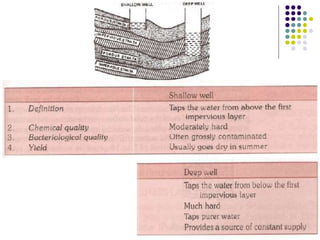
Shallow:
Most of the wells in India are of the shallow
type
Shallow wells are liable to pollution from
neighboring sources of contamination
Deep:
Deep wells are usually machine-dug and
may be several hundred meters deep
Furnish safest water
Artesian well water rises above ground level.
Saline intrusion
Classified according to the method of
construction
1. Dug well – i. unlined katcha well
ii. Masonry / pucca well.
2. Tube well
SANITARY WELL
A sanitary well is one which is properly located,
well constructed and protected against
contamination with a view to yield a supply of
safe water
 LOCATION – 50 feet
 LINING- 20 feet
 PARAPET WALL – 28 inches
 PLATFORM – 3 feet
 COVERING
 HAND-PUMP
 CONSUMER RESPONSIBILITY
b. Springs
 When ground water comes to the surface and
flows freely under natural pressure, it is
called a "spring"
 shallow springs
 deep springs
WATER POLLUTION
 Pure uncontaminated water does not occur in
nature.
Natural
 Dissolved gases, minerals, suspended
impurities and microorganisms.
human activity
 Sewage –decomposable organic matter
and pathogenic agents
 Industrial and trade waste- metal salts,
chemicals
 Agricultural pollutants- fertilizers, pesticides.
 Physical pollutants: heat and radioactive
pollutants.
Water related disease
A. Biological (water borne disease)
i. Those caused by the presence of an infective agent
 Viral - hepatitis A and E, polio, rotavirus,
diarrhoea in infants
 Bacterial - Typhoid and Paratyphoid fever,
Bacillary dysentery, E.Coli diarrhoea & cholera,
 Protozoal - amoebiasis, giardiasis.
 Helminthic - round worm, threadworm, hydatid
disease
 Leptospiral- weil’s disease
ii. Those due to the presence of an aquatic host
 Snail- Schistosomiasis
 Cyclops- guineaworm, fish tape worm.
B.Chemical
 Detergent solvents, cyanides, heavy metals,
minerals, organic acids, nitrogenous
substances, bleaching agents,
dyes,pigments,sulphides & ammonia.
 Dental health
 Cyanosis in infant: high nitrate content
 Cardiovascular diseases: hardness is
beneficial
 Inadequate use of water : Conjunctivitis,
scabies, ascariasis, shigellosis, trachoma
 Insects breeding in water : Malaria, filaria,
arboviruses, African trypanosomiasis.
Pollution seems to be an inevitable consequence
of modern industrial technology,
the problem now is
To determine the level of pollution that permits
economic and social development without
presenting hazards to health,
 The evaluation of the health effects of
environmental pollutants is currently being
carried out as part of the WHO Environmental
Health Criteria Programme
Water pollution law
 Parliament in 1974 passed water [prevention
and control of pollution] act
 It provides for the constitution of Central and
State Water boards and Joint Water Boards
capable with wide powers for controlling
pollution.
Purification
 On a large scale
 On a small scale
PURIFICATION OF WATER
(A)LARGE SCALE
Storage
Filtration
Slow sand filters
Rapid sand filters
Disinfection
(B) SMALL SCALE
 House hold purification
Boiling
Filtration
Chemical disinfection
 Disinfection of wells
 DOUBLE-POT method
Purification of water on a
large scale
 The components of a typical water purification
system comprise one or more of the following
measures
Storage
Filtration
Disinfection
STORAGE
 Storage provides a reserve of water from
which further pollution is excluded
 This is natural purification, and we may look
at it from three points of view
Physical
Chemical
Biological
FILTRATION
 98-99 per cent of the bacteria are removed
by filtration apart from other impurities.
 Two types of filters :
Biological
Mechanical
BIOLOGICAL OR SLOW SAND
FILTERS
 1804 in Scotland
 Accepted as the standard method of water
purification
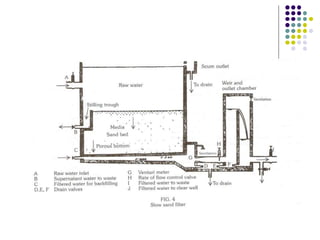
Elements of a slow sand filter
 supernatant (raw) water
 A bed of graded sand
 Under-drainage system
 System of filter control valves.
supernatant (raw) water
 Constant head of water
 Waiting period
 Sedimentation
 Oxidation
 agglomeration
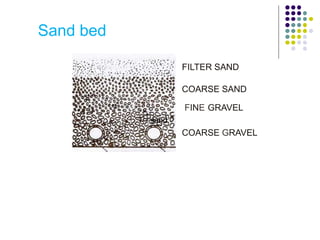
FILTER SAND
COARSE SAND
FINE GRAVEL
COARSE GRAVEL
sand
Sand bed
The sand bed presents a vast surface area; one
cubic metre of filter sand presents some
15,000 sq. metres of surface area
The designed rate of filtration of water normally
lies between 0.1 and 0.4 m3/hour/per square
metre of sand bed surface.
Vital layer
 Very soon, the surface of the sand bed gets
covered with a slimy growth known as
"Schmutzdecke", vital layer, zoogleal layer or
biological layer.
 This layer is slimy and gelatinous
 The formation of vital layer is known as
"ripening" of the filter
 The vital layer is the "heart" of the slow sand
filter.
 It removes organic matter, holds back
bacteria and oxidizes ammonical nitrogen
into nitrates and helps in yielding a bacteria-
free water.
 Until the vital layer is fully formed, the first
few days filtrate is usually run to waste.
Under-drainage system
 At the bottom of the filter bed is the under-
drainage
 Filter box:
 Filter box consists from top to bottom:
Supernatant water 1 to 1.5 metre
Sand bed 1.2 metre
Gravel support 0.30 metre
Filter bottom 0.16 metre
Filter control
 The purpose of these devices is to maintain a
constant rate of filtration
 An important component of the regulation
system is the "Venturi meter" which
measures the bed resistance or "loss of
head".
 Loss of head exceeds 1.3 mts
Filter cleaning
 When the bed resistance increases to such
an extent that the regulating valve has to be
kept fully open, it is time to clean the filter
bed, since any further increase in resistance
is bound to reduce the filtration rate.
Advantages
 Simple to construct and operate
 The cost of construction is cheaper
 The physical, chemical and bacteriological
quality of filtered water is very high.
Slow sand filters have been shown to
reduce total bacterial counts by 99.9 to 99.99
per cent and E. coli by 99 to 99.9 per cent.
RAPID SAND OR MECHANICAL
FILTERS
 In 1885, the first rapid sand filters were
installed in the USA
 Two types
Gravity type e.g. Paterson's filter
The pressure type e.g. Candy's filter
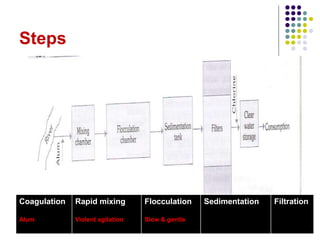
Steps
Coagulation
Alum
Rapid mixing
Violent agitation
Flocculation
Slow & gentle
Sedimentation Filtration
Filter beds
 The "effective size" of the sand particles is
between 0.4-0.7 mm.
 The depth of the sand bed is usually about 1
metre .
 Below the sand bed is a layer of graded
gravel, 30 to 40 cm. deep.
 The depth of the water on the top of the sand
bed is 1.0 to 1.5 m. The under-drains at the
bottom of the filter beds collect the filtered
water.
 The rate of filtration is 5-15 m3/m2/hour.
Filtration
 It forms a slimy layer
 It adsorbs bacteria from the water and effects
purification. Oxidation of ammonia also takes
place during the passage of water through
the filters.
 The filters soon become dirty and begin to
lose their efficiency.
Back-washing
 Back-washing dislodges the impurities and
cleans up the sand bed.
 The washing is stopped when clear sand is
visible and the wash water is sufficiently
clear.
 The whole process of washing takes about
15 minutes.
Advantages
 Rapid sand filter can deal with raw water
directly. No preliminary storage is needed
 The filter beds occupy less space
 Filtration is rapid, 40-50 times that of a slow
sand filter
 The washing of the filter is easy
 There is more flexibility in operation.
DISINFECTION
 Criteria
 It should be capable of destroying the pathogenic
organisms present
 Should not leave products of reaction
 Have ready and dependable availability at reasonable
cost
 Possess the property of leaving residual concentration
 Be amenable to detection by practical, rapid and simple
analytical techniques
CHLORINATION
 It is supplement
 Chlorine kills pathogenic bacteria
 Chlorine has several important secondary
properties of value in water treatment
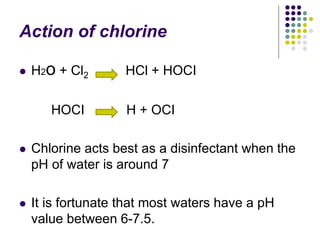
Action of chlorine
 H2o + Cl2 HCl + HOCI
HOCI H + OCI
 Chlorine acts best as a disinfectant when the
pH of water is around 7
 It is fortunate that most waters have a pH
value between 6-7.5.
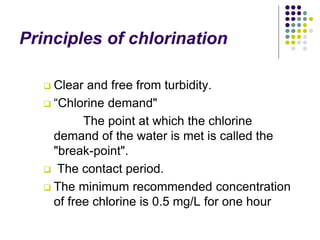
Principles of chlorination
 Clear and free from turbidity.
 “Chlorine demand"
The point at which the chlorine
demand of the water is met is called the
"break-point".
 The contact period.
 The minimum recommended concentration
of free chlorine is 0.5 mg/L for one hour
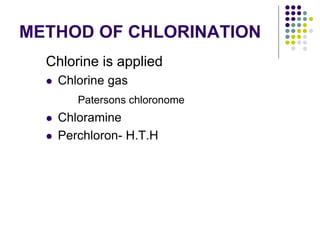
METHOD OF CHLORINATION
Chlorine is applied
 Chlorine gas
Patersons chloronome
 Chloramine
 Perchloron- H.T.H
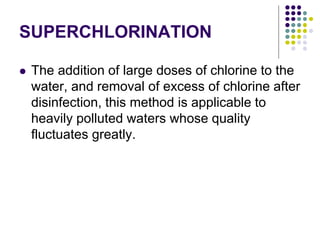
SUPERCHLORINATION
 The addition of large doses of chlorine to the
water, and removal of excess of chlorine after
disinfection, this method is applicable to
heavily polluted waters whose quality
fluctuates greatly.
Purification of water on a
small scale
 Household purification of water
 BOILING
 CHEMICAL DISINFECTION
 FILTRATION
 Disinfection of wells
BOILING
 “rolling boil’’ for 5 to 10 minutes.
 It kills all bacteria, spores, cysts and ova
 Boiling also removes temporary hardness by
driving off carbon dioxide and precipitating
the calcium carbonate
CHEMICAL DISINFECTION
 Bleaching powder
 Bleaching powder or chlorinated lime
(CaOCl2) is a white amorphous powder with
a pungent smell of chlorine.
 When freshly made, it contains about 33 per
cent of "available chlorine".
 But when mixed with excess of lime, it
retains its strength; this is called "stabilized
bleach."
 Chlorine solution
 If 4 kg of bleaching powder with 25 per cent
available chlorine is mixed with 20 litres of
water- 5% soln of chlorine
 High test hypochlorite
 It is more stable than bleaching powder and
deteriorates much less on storage.
 Solution prepared from HTH are also used
for water purification
 Chlorine tablets
 They are quite good for disinfecting small
quantities of water, but they are costly.
 The NEERI, Nagpur
 A single tablet of 0.5 g is sufficient to
disinfect 20 lts of water.
 Iodine
 Iodine may be used for emergency
disinfection of water.
 A contact time of 20 to 30 minutes is needed
for effective disinfection.
 High costs and the fact that the element is
physiologically active (thyroid activity) are its
major disadvantages
 Potassium permanganate
 Once widely used it is no longer
recommended for water disinfection.
 Although a powerful oxidizing agent, it is not
a satisfactory agent for disinfecting water.
 It may kill cholera vibrios, but is of little use
against other disease organisms.
 It has other draw-backs such as altering the
colour, smell and taste of water.
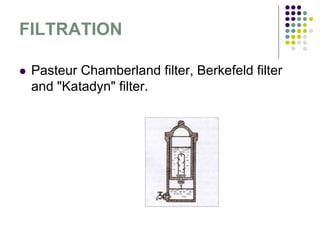
FILTRATION
 Pasteur Chamberland filter, Berkefeld filter
and "Katadyn" filter.
Disinfection of wells
 The main source of water supply in the rural
areas.
 The most effective and cheapest method of
disinfecting wells is by bleaching powder.
 STEPS IN WELL DISINFECTION
 Find the volume of water in a well
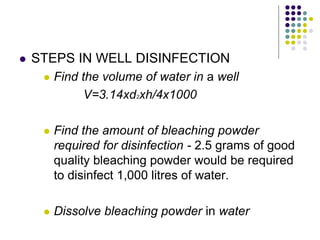
V=3.14xd2xh/4x1000
 Find the amount of bleaching powder
required for disinfection - 2.5 grams of good
quality bleaching powder would be required
to disinfect 1,000 litres of water.
 Dissolve bleaching powder in water
 Delivery of chlorine solution into the well
 Contact period
Hardness of water
 Soap-destroying power of water.
Calcium bicarbonate
Magnesium bicarbonate
Calcium sulphate
Magnesium sulphate
 Chlorides and nitrates of calcium and
magnesium
 Iron, manganese and aluminium compounds
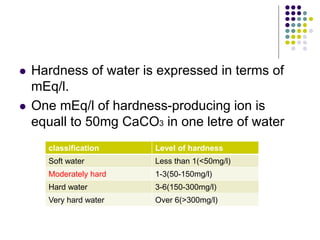
 Hardness of water is expressed in terms of
mEq/l.
 One mEq/l of hardness-producing ion is
equall to 50mg CaCO3 in one letre of water
classification Level of hardness
Soft water Less than 1(<50mg/l)
Moderately hard 1-3(50-150mg/l)
Hard water 3-6(150-300mg/l)
Very hard water Over 6(>300mg/l)
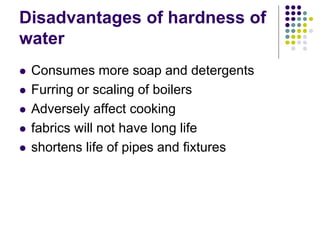
Disadvantages of hardness of
water
 Consumes more soap and detergents
 Furring or scaling of boilers
 Adversely affect cooking
 fabrics will not have long life
 shortens life of pipes and fixtures
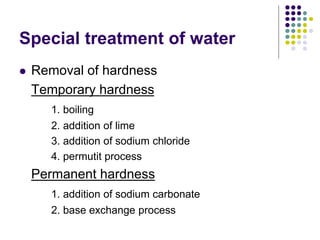
Special treatment of water
 Removal of hardness
Temporary hardness
1. boiling
2. addition of lime
3. addition of sodium chloride
4. permutit process
Permanent hardness
1. addition of sodium carbonate
2. base exchange process
 Fluoridation
 Defluridation

ENVIRONMENT AND HEALTH.ppt 1.ppt

  • 1.
    ENVIRONMENT AND HEALTH Dr.Suresh Babu Professor Deptof Public Health Dentistry Navodaya Dental College
  • 2.
    Environment is definedas, all the physical, chemical and Biological factors external to a person and all the related behaviors” -WHO Report 2006
  • 3.
    (i) Physical -Water, air, soil, housing, wastes, radiation, etc. (ii) Biologic - Plant and animal life including bacteria, viruses, insects, rodents and animals. (iii) Social - Customs, culture, habits, income, Occupation, religion, etc.
  • 4.
     Much ofman's ill-health can be traced to adverse environmental factors  Pollution of environment
  • 5.
    Sanitation  Being away of life it must come from with in the people, it is nourished by knowledge and grow as an obligation and an ideal in human relation.
  • 6.
    WHO defines theenvironmental sanitation as, “The control of all those factors in man’s physical environment, which exercise or may exercise a deleterious effect on his Physical development, health and survival”.
  • 7.
     The termsanitation covers the whole field of controlling the environment with a view to prevent disease and promote health  Man has already controlled many factors  The attainment of healthy environment is becoming more and more complex
  • 8.
    The term environmentalsanitation is now being replaced by environmental health.  Proper environmental health now requires the services of the public health qualified doctor, the epidemiologist, the public health engineer, the town planner, the sociologist, the economist, and the health inspector
  • 9.
     The purposeof environmental health is to create and maintain ecological conditions that will promote health and thus prevent disease  Two of the changes needed to achieve Health for All are concerned with a healthy environment and healthy lifestyle and require initiatives by the individual, the family and the community
  • 10.
     In India,much of ill health is due to poor environmental sanitation  Improvement of environmental sanitation is crucial for prevention of disease and promotion of health
  • 11.
  • 12.
     There canbe no state of positive health and well-being without safe water  Water is not only a vital environmental factor to all forms of life, but it has also a great role to play in socio-economic development of human population.
  • 13.
     In 1980,the United Nations General Assembly launched the International Drinking Water Supply and Sanitation Decade, 1981-1990 --- the aim being to provide all people with adequate supplies of safe water and sanitation by 1990.
  • 14.
     In 1981,the 34th World Health Assembly in a resolution emphasized that safe drinking water is a basic element of "primary health care" which is the key to the attainment of "Health for All by the year 2000 AD".
  • 15.
    Safe & wholesomewater  Free from pathogenic agent  Free from harmful chemical substances  Pleasant to the taste  Usable for domestic purposes
  • 16.
    Water pollution isa growing hazard in many developing countries due to human activity. Without ample and safe drinking water, we cannot provide health care to the community.
  • 17.
    Water requirement Basic physiologicalrequirement - 2 litres / head / day  Urban domestic purpose - 150-200 litres.  Rural India - 40 litres
  • 18.
    uses of WATER Domestic use  Public purpose  Industrial purpose  Agricultural purpose  Power production  Carrying away waste
  • 19.
    sources of WATERsupply 1)Rain water 2)Surface water- Impounding reservoirs, rivers & streams, tanks, ponds & lakes 3)Ground water- shallow wells, deep wells, springs.
  • 20.
    i. Rain  Primesource of all water  3 ways of distribution- water cycle Characteristics of rain water  Physically  Chemically  bacteriologically
  • 21.
    Impurities of rainwater ACID RAIN.
  • 22.
    ii. Surface water Originates from rain water  Prone to contamination  Unsafe for consumption- highest organic, bacterial, viral contamination
  • 23.
    a. Impounding reservoirs Artificiallakes Chennai. mumbai. Nagpur Storing water for long duration
  • 24.
    Characteristics:  Fairly goodquality of water next to rain water.  Soft and free from pathogenic organism Impurities:  Impurity is from “catchment area”-human habilitation and animal keeping.
  • 25.
    b. Rivers  Manyrivers furnish a dependable supply of water.  Delhi, Kolkata, Allahabad  Grossly polluted
  • 26.
     CHARACTERISTICS: River wateris turbid during rainy season Contains dissolved and suspended impurities of all kinds The bacterial count may be very high
  • 27.
     IMPURITIES :Rivers are described as a direct connection between the alimentary canal of the people living upstream and the mouths of those below.  Self purification
  • 28.
    c. Tanks  Largeexcavations  Indian villages  highly susceptible to contamination  Tank water is drunk
  • 29.
    Improvement of tanks Elevated edges  Fenced  No one should get into tank  Elevated platform to draw water.  Weeds s/b removed  Cleaned at the end of dry season.  Sand filtration.  Addition of Chlorine
  • 30.
    d. Sea water Plentiful but not potable  3.5% of salts in solution  30-36 g/litre of salt concentration  19 gm chloride,10.6 gm of sodium,1.2 gm of magnesium / litre of water
  • 31.
    iii. Ground water Cheapest and most practical  Ground water is superior to surface water
  • 32.
    Advantages Disadvantages The usual groundwater sources are wells and springs.
  • 33.
    a. Wells Traditionally wellsare an important source of water supply. Types: (Technically) Shallow: Most of the wells in India are of the shallow type Shallow wells are liable to pollution from neighboring sources of contamination
  • 34.
    Deep: Deep wells areusually machine-dug and may be several hundred meters deep Furnish safest water Artesian well water rises above ground level. Saline intrusion
  • 36.
    Classified according tothe method of construction 1. Dug well – i. unlined katcha well ii. Masonry / pucca well. 2. Tube well
  • 37.
    SANITARY WELL A sanitarywell is one which is properly located, well constructed and protected against contamination with a view to yield a supply of safe water  LOCATION – 50 feet  LINING- 20 feet  PARAPET WALL – 28 inches  PLATFORM – 3 feet  COVERING  HAND-PUMP  CONSUMER RESPONSIBILITY
  • 38.
    b. Springs  Whenground water comes to the surface and flows freely under natural pressure, it is called a "spring"  shallow springs  deep springs
  • 39.
    WATER POLLUTION  Pureuncontaminated water does not occur in nature. Natural  Dissolved gases, minerals, suspended impurities and microorganisms.
  • 40.
    human activity  Sewage–decomposable organic matter and pathogenic agents  Industrial and trade waste- metal salts, chemicals  Agricultural pollutants- fertilizers, pesticides.  Physical pollutants: heat and radioactive pollutants.
  • 41.
  • 42.
    A. Biological (waterborne disease) i. Those caused by the presence of an infective agent  Viral - hepatitis A and E, polio, rotavirus, diarrhoea in infants  Bacterial - Typhoid and Paratyphoid fever, Bacillary dysentery, E.Coli diarrhoea & cholera,  Protozoal - amoebiasis, giardiasis.  Helminthic - round worm, threadworm, hydatid disease  Leptospiral- weil’s disease
  • 43.
    ii. Those dueto the presence of an aquatic host  Snail- Schistosomiasis  Cyclops- guineaworm, fish tape worm.
  • 44.
    B.Chemical  Detergent solvents,cyanides, heavy metals, minerals, organic acids, nitrogenous substances, bleaching agents, dyes,pigments,sulphides & ammonia.
  • 45.
     Dental health Cyanosis in infant: high nitrate content  Cardiovascular diseases: hardness is beneficial  Inadequate use of water : Conjunctivitis, scabies, ascariasis, shigellosis, trachoma  Insects breeding in water : Malaria, filaria, arboviruses, African trypanosomiasis.
  • 46.
    Pollution seems tobe an inevitable consequence of modern industrial technology, the problem now is To determine the level of pollution that permits economic and social development without presenting hazards to health,
  • 47.
     The evaluationof the health effects of environmental pollutants is currently being carried out as part of the WHO Environmental Health Criteria Programme
  • 48.
    Water pollution law Parliament in 1974 passed water [prevention and control of pollution] act  It provides for the constitution of Central and State Water boards and Joint Water Boards capable with wide powers for controlling pollution.
  • 49.
    Purification  On alarge scale  On a small scale
  • 50.
    PURIFICATION OF WATER (A)LARGESCALE Storage Filtration Slow sand filters Rapid sand filters Disinfection (B) SMALL SCALE  House hold purification Boiling Filtration Chemical disinfection  Disinfection of wells  DOUBLE-POT method
  • 51.
    Purification of wateron a large scale  The components of a typical water purification system comprise one or more of the following measures Storage Filtration Disinfection
  • 52.
    STORAGE  Storage providesa reserve of water from which further pollution is excluded  This is natural purification, and we may look at it from three points of view Physical Chemical Biological
  • 53.
    FILTRATION  98-99 percent of the bacteria are removed by filtration apart from other impurities.  Two types of filters : Biological Mechanical
  • 54.
    BIOLOGICAL OR SLOWSAND FILTERS  1804 in Scotland  Accepted as the standard method of water purification
  • 55.
    Elements of aslow sand filter  supernatant (raw) water  A bed of graded sand  Under-drainage system  System of filter control valves.
  • 57.
    supernatant (raw) water Constant head of water  Waiting period  Sedimentation  Oxidation  agglomeration
  • 58.
    FILTER SAND COARSE SAND FINEGRAVEL COARSE GRAVEL sand Sand bed
  • 59.
    The sand bedpresents a vast surface area; one cubic metre of filter sand presents some 15,000 sq. metres of surface area The designed rate of filtration of water normally lies between 0.1 and 0.4 m3/hour/per square metre of sand bed surface.
  • 60.
    Vital layer  Verysoon, the surface of the sand bed gets covered with a slimy growth known as "Schmutzdecke", vital layer, zoogleal layer or biological layer.  This layer is slimy and gelatinous  The formation of vital layer is known as "ripening" of the filter
  • 61.
     The vitallayer is the "heart" of the slow sand filter.  It removes organic matter, holds back bacteria and oxidizes ammonical nitrogen into nitrates and helps in yielding a bacteria- free water.  Until the vital layer is fully formed, the first few days filtrate is usually run to waste.
  • 62.
    Under-drainage system  Atthe bottom of the filter bed is the under- drainage  Filter box:  Filter box consists from top to bottom: Supernatant water 1 to 1.5 metre Sand bed 1.2 metre Gravel support 0.30 metre Filter bottom 0.16 metre
  • 63.
    Filter control  Thepurpose of these devices is to maintain a constant rate of filtration  An important component of the regulation system is the "Venturi meter" which measures the bed resistance or "loss of head".  Loss of head exceeds 1.3 mts
  • 64.
    Filter cleaning  Whenthe bed resistance increases to such an extent that the regulating valve has to be kept fully open, it is time to clean the filter bed, since any further increase in resistance is bound to reduce the filtration rate.
  • 65.
    Advantages  Simple toconstruct and operate  The cost of construction is cheaper  The physical, chemical and bacteriological quality of filtered water is very high. Slow sand filters have been shown to reduce total bacterial counts by 99.9 to 99.99 per cent and E. coli by 99 to 99.9 per cent.
  • 66.
    RAPID SAND ORMECHANICAL FILTERS  In 1885, the first rapid sand filters were installed in the USA  Two types Gravity type e.g. Paterson's filter The pressure type e.g. Candy's filter
  • 67.
  • 68.
    Filter beds  The"effective size" of the sand particles is between 0.4-0.7 mm.  The depth of the sand bed is usually about 1 metre .  Below the sand bed is a layer of graded gravel, 30 to 40 cm. deep.
  • 69.
     The depthof the water on the top of the sand bed is 1.0 to 1.5 m. The under-drains at the bottom of the filter beds collect the filtered water.  The rate of filtration is 5-15 m3/m2/hour.
  • 70.
    Filtration  It formsa slimy layer  It adsorbs bacteria from the water and effects purification. Oxidation of ammonia also takes place during the passage of water through the filters.  The filters soon become dirty and begin to lose their efficiency.
  • 71.
    Back-washing  Back-washing dislodgesthe impurities and cleans up the sand bed.  The washing is stopped when clear sand is visible and the wash water is sufficiently clear.  The whole process of washing takes about 15 minutes.
  • 72.
    Advantages  Rapid sandfilter can deal with raw water directly. No preliminary storage is needed  The filter beds occupy less space  Filtration is rapid, 40-50 times that of a slow sand filter  The washing of the filter is easy  There is more flexibility in operation.
  • 73.
    DISINFECTION  Criteria  Itshould be capable of destroying the pathogenic organisms present  Should not leave products of reaction  Have ready and dependable availability at reasonable cost  Possess the property of leaving residual concentration  Be amenable to detection by practical, rapid and simple analytical techniques
  • 74.
    CHLORINATION  It issupplement  Chlorine kills pathogenic bacteria  Chlorine has several important secondary properties of value in water treatment
  • 75.
    Action of chlorine H2o + Cl2 HCl + HOCI HOCI H + OCI  Chlorine acts best as a disinfectant when the pH of water is around 7  It is fortunate that most waters have a pH value between 6-7.5.
  • 76.
    Principles of chlorination Clear and free from turbidity.  “Chlorine demand" The point at which the chlorine demand of the water is met is called the "break-point".  The contact period.  The minimum recommended concentration of free chlorine is 0.5 mg/L for one hour
  • 77.
    METHOD OF CHLORINATION Chlorineis applied  Chlorine gas Patersons chloronome  Chloramine  Perchloron- H.T.H
  • 78.
    SUPERCHLORINATION  The additionof large doses of chlorine to the water, and removal of excess of chlorine after disinfection, this method is applicable to heavily polluted waters whose quality fluctuates greatly.
  • 79.
    Purification of wateron a small scale  Household purification of water  BOILING  CHEMICAL DISINFECTION  FILTRATION  Disinfection of wells
  • 80.
    BOILING  “rolling boil’’for 5 to 10 minutes.  It kills all bacteria, spores, cysts and ova  Boiling also removes temporary hardness by driving off carbon dioxide and precipitating the calcium carbonate
  • 81.
    CHEMICAL DISINFECTION  Bleachingpowder  Bleaching powder or chlorinated lime (CaOCl2) is a white amorphous powder with a pungent smell of chlorine.  When freshly made, it contains about 33 per cent of "available chlorine".  But when mixed with excess of lime, it retains its strength; this is called "stabilized bleach."
  • 82.
     Chlorine solution If 4 kg of bleaching powder with 25 per cent available chlorine is mixed with 20 litres of water- 5% soln of chlorine
  • 83.
     High testhypochlorite  It is more stable than bleaching powder and deteriorates much less on storage.  Solution prepared from HTH are also used for water purification
  • 84.
     Chlorine tablets They are quite good for disinfecting small quantities of water, but they are costly.  The NEERI, Nagpur  A single tablet of 0.5 g is sufficient to disinfect 20 lts of water.
  • 85.
     Iodine  Iodinemay be used for emergency disinfection of water.  A contact time of 20 to 30 minutes is needed for effective disinfection.  High costs and the fact that the element is physiologically active (thyroid activity) are its major disadvantages
  • 86.
     Potassium permanganate Once widely used it is no longer recommended for water disinfection.  Although a powerful oxidizing agent, it is not a satisfactory agent for disinfecting water.  It may kill cholera vibrios, but is of little use against other disease organisms.  It has other draw-backs such as altering the colour, smell and taste of water.
  • 87.
    FILTRATION  Pasteur Chamberlandfilter, Berkefeld filter and "Katadyn" filter.
  • 88.
    Disinfection of wells The main source of water supply in the rural areas.  The most effective and cheapest method of disinfecting wells is by bleaching powder.
  • 89.
     STEPS INWELL DISINFECTION  Find the volume of water in a well V=3.14xd2xh/4x1000  Find the amount of bleaching powder required for disinfection - 2.5 grams of good quality bleaching powder would be required to disinfect 1,000 litres of water.  Dissolve bleaching powder in water
  • 90.
     Delivery ofchlorine solution into the well  Contact period
  • 91.
    Hardness of water Soap-destroying power of water. Calcium bicarbonate Magnesium bicarbonate Calcium sulphate Magnesium sulphate  Chlorides and nitrates of calcium and magnesium  Iron, manganese and aluminium compounds
  • 92.
     Hardness ofwater is expressed in terms of mEq/l.  One mEq/l of hardness-producing ion is equall to 50mg CaCO3 in one letre of water classification Level of hardness Soft water Less than 1(<50mg/l) Moderately hard 1-3(50-150mg/l) Hard water 3-6(150-300mg/l) Very hard water Over 6(>300mg/l)
  • 93.
    Disadvantages of hardnessof water  Consumes more soap and detergents  Furring or scaling of boilers  Adversely affect cooking  fabrics will not have long life  shortens life of pipes and fixtures
  • 94.
    Special treatment ofwater  Removal of hardness Temporary hardness 1. boiling 2. addition of lime 3. addition of sodium chloride 4. permutit process Permanent hardness 1. addition of sodium carbonate 2. base exchange process
  • 95.