SEMESTER-III
ENVIRONMENT, HEALTH
AND
SAFETYMANAGEMENT
DSC301
Col. (Prof.) Rajive Kohli, Ph.D.
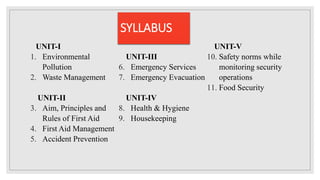
SYLLABUS
UNIT-I
1. Environmental
Pollution
2. Waste Management
UNIT-II
3. Aim, Principles and
Rules of First Aid
4. First Aid Management
5. Accident Prevention
UNIT-III
6. Emergency Services
7. Emergency Evacuation
UNIT-IV
8. Health & Hygiene
9. Housekeeping
UNIT-V
10. Safety norms while
monitoring security
operations
11. Food Security
1. ENVIRONMENTAL POLLUTION
UNDERSTANDING
ENVIRONMENTAL POLLUTION
04 September 2020
ENVIRONMENTAL POLLUTION - DEFINITION
Contamination of the physical and biological
components of the earth/ atmosphere system
to such an extent that
normal environmental processes are
adversely affected
ENVIRONMENTAL POLLUTION
Environmental Pollution: any undesirable change in physical,
chemical, or biological characteristics of any component of the
environment i.e. air, water, soil which can cause harmful effects on
various forms of life orproperty.
Pollutant: Any substance causing nuisance or harmful effects or
uneasiness to the organisms, then that particular substance may be
called as the pollutant.
Pollution: Influence of any substance causing nuisance, harmful
effects, and uneasiness to the organisms
TYPES OF POLLUTION
Pollution can be of different types depending on the part of the environment that is getting
polluted
1. Air Pollution
2. Water Pollution
3. Land / soil Pollution
4. Noise Pollution
5. Plastic Pollution
6. Thermal Pollution
7. Visual Pollution
8. Radioactive
Contamination
9. Light Pollution
10. Littering
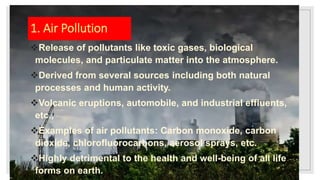
1. Air Pollution
Release of pollutants like toxic gases, biological
molecules, and particulate matter into the atmosphere.
Derived from several sources including both natural
processes and human activity.
Volcanic eruptions, automobile, and industrial effluents,
etc.,
Examples of air pollutants: Carbon monoxide, carbon
dioxide, chlorofluorocarbons, aerosol sprays, etc.
Highly detrimental to the health and well-being of all life
forms on earth.
2. Water Pollution
Contamination of water bodies likes lakes, rivers, ponds, aquifers, etc.,
Most harmful types of pollution, have extremely disastrous consequences for
all living beings using the contaminated water.
Major volume of the all the pollutants produced on land end up in water bodies.
Toxic wastes released by industries, pathogens released in sewage, harmful
chemicals present in agricultural runoffs, etc.
Contamination of water can lead to epidemics and even pandemics that can
wipe out the population of an entire species or even more than one species.
Thus, it has a highly adverse impact on the environment, society, and economy
of a place.
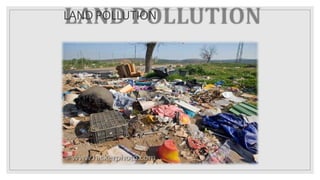
3. Land/ Soil Pollution
Leads to soil pollution or land degradation.
Soil is essential to the growth of all plants including crops.
Thus, a degradation in the soil quality translates to lower
yields and poor health of crops grown on such soil.
Industrial and agricultural chemicals are the common
pollutants contaminating the soil.
4. Noise Pollution
 Environment is filled with unnecessary or unpleasant sounds
that are harmful to animals and plants.
 Common sources: Transport vehicles, machinery, industries,
loud music, people yelling, etc.
 In long-term can give rise to chronic diseases like
cardiovascular diseases.
 Psychological health of people can also be affected by noise.
5. Plastic Pollution
Caused by plastic accumulation in the environment.
Plastic, a non-biodegradable substance, is extremely harmful to all life on
earth.
Every year, thousands of animals lose their lives due to plastic pollution by
its ingestion or entanglement in plastic objects.
Most of the plastic waste generated in the world end up in the oceans
where they cause great harm to the marine ecosystem.
7. Visual Pollution
 Everyone loves to see clean and green spaces and beautiful
vistas.
 When human activity installs ugly barriers to this vision of
open and clutter-free landscapes.
 Installation of billboards, open storage of trash, networks of
electric wires crisscrossing each other above the street, etc.,
create visual pollution.
 This type of pollution generates distraction, eye fatigues,
diversity in opinions, and other psychological problems.
8. Radioactive Contamination
 Radioactive substances are present in areas where their presence is
undesirable or unintended.
 Such substances are highly toxic to all life on earth.
 Radioactive substances trigger mutations in the genetic material of
living organisms, leading to different types of cancers.
 Exposure to such toxins can also adversely impact the different
systems of the body.
 Death or disfiguration are common effects of exposure to radioactive
waste.
 Irresponsible management of such wastes or radioactive disasters are
the common causes of radioactive contamination.
9. Light Pollution
The pollution of the night environment by
anthropogenic and artificial light.
Caused by an excessive lighting of the streets, flood
lights used in stadiums, lights used in an industrial
area, etc.
Negative effects include the spoilage of the aesthetic
environment of a place, creating disturbances in the
ecosystem, harming the health of living creatures.
10. Littering
Waste products generated by humans is not disposed of properly.
Waste can include anything that is discarded by humans after use like
bottles, glass, packaging material, electronic waste, metal waste, etc.
Some of these pollutants like electronics, batteries, tires, etc., are
hazardous to the health of the environment.
Chemicals from such wastes leach into the soil or enter the water bodies,
they cause soil contamination and water pollution. Finally, these
chemicals enter the bodies of organisms to cause disease and death.
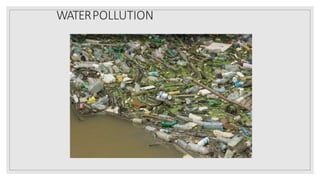
WATERPOLLUTION
 Water Pollution can be defined as alteration in
physical, chemical, or biological characteristics of
water through natural or human activities and
making it unsuitable for its designateduse.
 Fresh Water present on the earth surface is put to
many uses. It is used for drinking, domestic and
municipal uses, agricultural, irrigation,industries,
navigatio n, recreation. The used water becomes
contaminated and is called waste water.
SOURCES OF WATERPOLLUTION
 Most of Water Pollution is man made It may also occur
naturally by addition of soil particles through erosion animal
wastes and leaching of minerals from rocks
 The sources of water pollution can be classified as
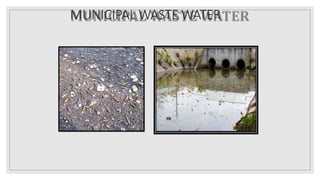
Municipal WasteWater
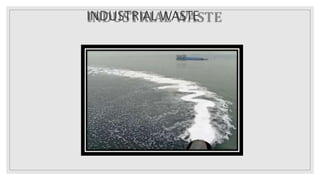
Industrial Waste
Inorganic Pollutants
Organic Pollutants
Agricultural Wastes
Marine Pollution
Thermal pollution
MUNICIPAL WASTE WATER
INDUSTRIAL WASTE
◦The major source of water pollution is the waste water discharged from industries and commercial bodies, these industries are
metallurgical, food processing
They
chemical,
industries,
discharge
textile,
several
paper industries.
organic and inorganic
pollutants. That prove highly toxic to living
beings.
INDUSTRIAL WASTE
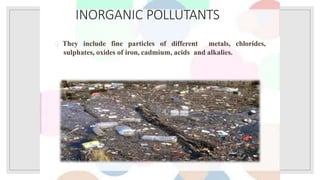
INORGANIC POLLUTANTS
They include fine particles of different metals, chlorides,
sulphates, oxides of iron, cadmium, acids and alkalies.
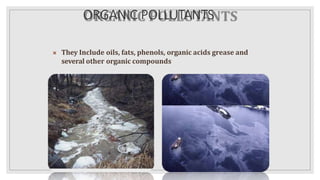
ORGANIC POLLUTANTS
 They Include oils, fats, phenols, organic acids grease and
several other organic compounds
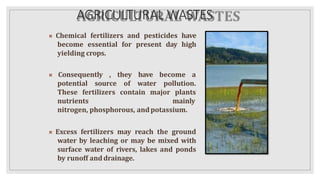
AGRICULTURAL WASTES
 Chemical fertilizers and pesticides have
become essential for present day high
yielding crops.
 Consequently , they have become a
potential source of water pollution.
These fertilizers contain major plants
nutrients mainly
nitrogen, phosphorous, andpotassium.
 Excess fertilizers may reach the ground
water by leaching or may be mixed with
surface water of rivers, lakes and ponds
by runoff anddrainage.
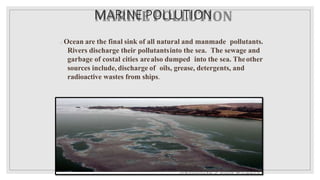
MARINE POLLUTION
Ocean are the final sink of all natural and manmade pollutants.
Rivers discharge their pollutantsinto the sea. The sewage and
garbage of costal cities arealso dumped into the sea. Theother
sources include, discharge of oils, grease, detergents, and
radioactive wastes from ships.
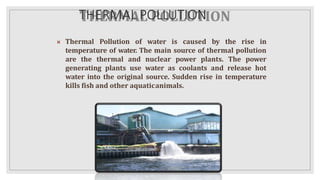
THERMAL POLLUTION
 Thermal Pollution of water is caused by the rise in
temperature of water. The main source of thermal pollution
are the thermal and nuclear power plants. The power
generating plants use water as coolants and release hot
water into the original source. Sudden rise in temperature
kills fish and other aquaticanimals.
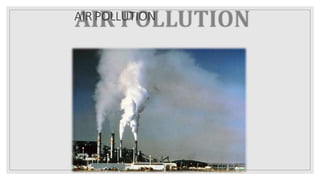
AIR POLLUTION
 Air pollution is the introduction of
chemicals, particulate matter, orbiological
materials that cause harm or discomfort to humans
or other living organisms, or cause damage to the
natural environment or built environment, into the
atmosphere.
 A substance in the air that can cause harm to
humans and the environment is known as anair
pollutant.
CAUSES OF AIR POLLUTION
 Carbon dioxide-this happens becauseof
Deforestation and fossil fuel burning.
 Sulfur dioxide –Due to the burning of sulfur
containing compounds of fossil fuels.
 Sulfur oxides- very dangerous to humans at a
high concentration. Sulfur in the atmosphere
is responsible for acid rain.
CONSEQUENCES OF AIR POLLUTION
 CO2 is a good transmitter of sunlight, but it also
partially restricts infrared radiation going back from
the earth into space, which producesthe so- called
greenhouse effect that prevents a drastic cooling of
the Earth during the night.
 CO2 in atmosphere --> GLOBALWARMING
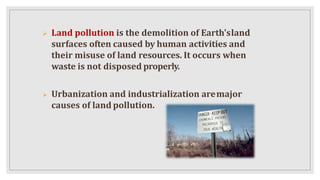
LAND POLLUTION
 Land pollution is the demolition of Earth'sland
surfaces often caused by human activities and
their misuse of land resources. It occurs when
waste is not disposed properly.
 Urbanization and industrialization aremajor
causes of land pollution.
CAUSES OF LAND POLLUTION
Four Main causes of landpollution:
 Construction
 Agriculture
 Domestic waste
 Industrial Waste
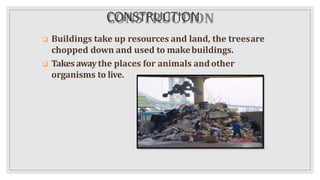
CONSTRUCTION
 Buildings take up resources and land, the treesare
chopped down and used to makebuildings.
 Takesawaythe places for animals andother
organisms to live.
AGRICULTURE
 As there are more and more people inhabiting the
earth, food is in higher demand and so forests are
chopped down and turned intofarmland
 In addition, herbicides, pesticides, artificial
fertilizers, animal manure are washed intothe
soil and pollute it.
DOMESTIC WASTE
 Tonsof domestic waste is dumped every day.Somewaste
from homes, offices and industries can be recycled or
burnt in incinerators .
 There is still a lot of garbage, such as refrigerators and
washing machines that are dumped in landfills simply
because they cannot be reused in anyway,nor recycled .
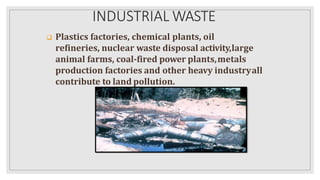
INDUSTRIAL WASTE
 Plastics factories, chemical plants, oil
refineries, nuclear waste disposal activity,large
animal farms, coal-fired power plants,metals
production factories and other heavy industryall
contribute to land pollution.
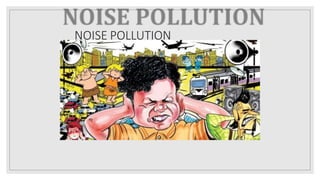
NOISE POLLUTION
 Noise pollution is excessive, displeasing human, animal,
or machine-created environmental noise that disrupts
the activity or balance of human or animal life.
 Sound becomes undesirable when it disturbs the
normal activities such as working, sleeping, and
during conversations.
 World Health Organization stated that “Noisemust
be recognized as a major threat to human well-
being”
SOURCES OF NOISE POLLUTION
 Transportation systems are the main source of noise
pollution in urban areas.
 Construction of buildings, highways, and streets cause alot
of noise, due to the usage of air compressors, bulldozers,
loaders, dump trucks, and pavement breakers.
 Industrial noise also adds to the alreadyunfavorable
state of noise pollution.
 Loud speakers, plumbing, boilers, generators, air
conditioners, fans, and vacuum cleaners add to theexisting
noise pollution.
EFFECTS OF NOISE POLLUTION
 According to the USEPA, there are direct links between noise and
health. Also, noise pollution adverselyaffects the lives of millions
of people.
 Noise pollution can damage physiological and
psychological health.
 High blood pressure, stress related illness, sleep disruption,
hearing loss, and productivity loss are the problems related to noise
pollution.
 It can also cause memory loss, severe depression, and panic
attacks.
SOLUTIONS FOR NOISE POLLUTION
 Planting bushes and trees in and around sound
generating sources is an effective solution for noise
pollution.
 Regular servicing and tuning of automobiles can
effectively reduce the noise pollution
 Social awareness programs should be taken up to educate the
public about the causes and effects of noise pollution.
 Workers should be provided with equipments such as ear
plugs and earmuffs for hearing protection.
 Similar to automobiles, lubrication of themachinery
and servicing should be done to minimize noise
generation.
 Soundproof doors and windows can be installedto
block unwanted noise fromoutside.
 Regulations should be imposed to restrict the usage of
play loudspeakers in crowded areas and public places.
 Factories and industries should be located far from
the residential areas.
WAYS TO STOP POLLUTION
 Webelieve that it is the responsible thing to do to
increase recycling.
 It is just like doing laundry and separatingblacks
and colors.
 The residents of the country should also try and do
their part and put in at least one day of litter picking
up.
10 Most Polluted Countries
1. Bangladesh: Main pollutants are air and water pollution, groundwater contamination, noise
pollution, and solid wastes. Dhaka City is one of the most polluted cities in the world. Air pollution
brickmaking industry.
2. Pakistan: growing number of vehicles on the roads, large-scale losses of trees, smoke from
bricks kiln and steel mills, and the burning of garbage
3. India: 21 of 30 most polluted cities are in India. Most polluted city in the world is Kanpur,
medical college receives about 600 respiratory illness patients per month. Sources vehicles,
burning of coal and wood, dust storms, and forest fires. Rural areas rely on wood and dung for
cooking and heating, burning of crop stubble.
4. Afghanistan: air pollution, drinking water polluted
5. Bahrain: air pollution from dust and sand storms
6. Mongolia: burning coal and other biomass, such as wood or crop residue, in stoves.
7. Kuwait 8. Nepal 9. United Arab Emirates 10. Nigeria
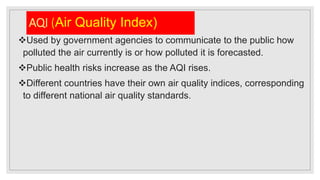
AQI (Air Quality Index)
Used by government agencies to communicate to the public how
polluted the air currently is or how polluted it is forecasted.
Public health risks increase as the AQI rises.
Different countries have their own air quality indices, corresponding
to different national air quality standards.
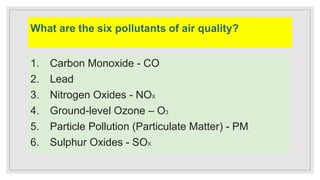
What are the six pollutants of air quality?
1. Carbon Monoxide - CO
2. Lead
3. Nitrogen Oxides - NOX
4. Ground-level Ozone – O3
5. Particle Pollution (Particulate Matter) - PM
6. Sulphur Oxides - SOX
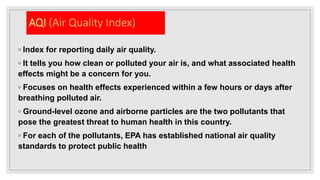
AQI (Air Quality Index)
◦ Index for reporting daily air quality.
◦ It tells you how clean or polluted your air is, and what associated health
effects might be a concern for you.
◦ Focuses on health effects experienced within a few hours or days after
breathing polluted air.
◦ Ground-level ozone and airborne particles are the two pollutants that
pose the greatest threat to human health in this country.
◦ For each of the pollutants, EPA has established national air quality
standards to protect public health
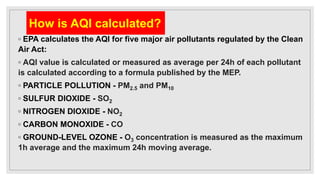
How is AQI calculated?
◦ EPA calculates the AQI for five major air pollutants regulated by the Clean
Air Act:
◦ AQI value is calculated or measured as average per 24h of each pollutant
is calculated according to a formula published by the MEP.
◦ PARTICLE POLLUTION - PM2.5 and PM10
◦ SULFUR DIOXIDE - SO2
◦ NITROGEN DIOXIDE - NO2
◦ CARBON MONOXIDE - CO
◦ GROUND-LEVEL OZONE - O3 concentration is measured as the maximum
1h average and the maximum 24h moving average.
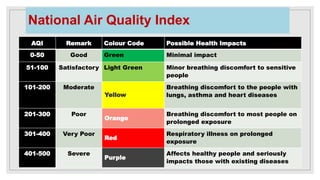
National Air Quality Index
AQI Remark Colour Code Possible Health Impacts
0-50 Good Green Minimal impact
51-100 Satisfactory Light Green Minor breathing discomfort to sensitive
people
101-200 Moderate
Yellow
Breathing discomfort to the people with
lungs, asthma and heart diseases
201-300 Poor
Orange
Breathing discomfort to most people on
prolonged exposure
301-400 Very Poor
Red
Respiratory illness on prolonged
exposure
401-500 Severe
Purple
Affects healthy people and seriously
impacts those with existing diseases
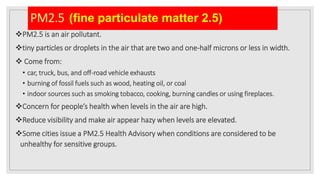
PM2.5 (fine particulate matter 2.5)
PM2.5 is an air pollutant.
tiny particles or droplets in the air that are two and one-half microns or less in width.
 Come from:
• car, truck, bus, and off-road vehicle exhausts
• burning of fossil fuels such as wood, heating oil, or coal
• indoor sources such as smoking tobacco, cooking, burning candles or using fireplaces.
Concern for people’s health when levels in the air are high.
Reduce visibility and make air appear hazy when levels are elevated.
Some cities issue a PM2.5 Health Advisory when conditions are considered to be
unhealthy for sensitive groups.
o The Central Pollution Control Board (CPCB), was constituted in
September, 1974 under the Water (Prevention and Control of
Pollution) Act, 1974.
o Further, CPCB was entrusted with the powers and functions under the
Air (Prevention and Control of Pollution) Act, 1981.
Central Pollution Control Board (CPCB)
◦ statutory organisation, was constituted in September, 1974 under the Water
(Prevention and Control of Pollution) Act, 1974
◦ entrusted with the powers and functions under the Air (Prevention and Control of
Pollution) Act, 1981.
◦ It serves as a field formation and also provides technical services to the Ministry of
Environment and Forests of the provisions of the Environment (Protection) Act, 1986
Functions of Pollution Control Board
Principal Functions of the CPCB, as per Water (Prevention and
Control of Pollution) Act, 1974, and the Air (Prevention and
Control of Pollution) Act, 1981. Its function are:
(i) To promote cleanliness of streams and wells in
different areas of the States by prevention, control and
abatement of water pollution.
(ii) To improve the quality of air and to prevent,
control or abate air pollution in the country.
Functions of Central Pollution Control Board:
1) Advice the Central Government, on any matter concerning the
improvement of the quality of air and prevention control or abatement
of air pollution/water pollution.
2) Provide technical assistance and guidance to the state boards carry
out and sponsor investigations and research relating to problems of air
pollution/water pollution and its control and abatement.
3) Plan and cause to be execute a nation-wide programme
through mass media for the provision, control or abatement of
air/water pollution.
4) Organize through mass media a comprehensive
programme towards prevention, control and abatement of
air pollution or water pollution.
5) Collect, compile and publish technical and statistical data
relating to air pollution/water pollution and the measures
devised for its effective prevention, control and abatement
and prepared manuals.
6)Collect and disseminate information in respect of
matters relating to air/water pollution.
Functions of State Pollution Control Board:
1) To collect information relating water/air pollution and to
encourage, conduct, participate in investigations and
research relating to problems of water pollutions.
2) To plan a comprehensive programme through
mass media for prevention, control or abatement of
air /water pollution.
3) To advice the Central and State Government, in any
matter concerning the prevention, control or abatement of
air/water pollution.
4)To inspect sewage or trade effluents, works and plants
for the treatment of sewage or trade effluent.
5) To evolve economical and reliable methods of
effluents of sewage and trade effluents.
6) To evolve methods of utilization of sewage and
suitable trade effluents in agriculture.
Functions of state Pollution Control Board contd.
7) To evolve efficient methods of disposal of sewage
and trade effluents on land
8) To lay down standards of treatment of sewage
and trade effluents, to be discharged into any
particular stream
(prevention, control, abatement of discharged of wastes
into stream or wells)
Functions of state Pollution Control Board contd.
Environmental Acts & Rules
1. The Environment (Protection) Act, 1986: for protection and improvement of
the environment
Empowers the Central Government to establish authorities with the mandate of
preventing environmental pollution in all its forms and
To tackle specific environmental problems that are peculiar to different parts of
the country.
2. The Water (Prevention and Control of Pollution) Act, 1974: for prevention
and control of water pollution, and for maintaining or restoring of
wholesomeness of water in the country.
3. The Water (Prevention and Control of Pollution) Cess Act, 1977: to levy and
collection of a cess on water consumed by persons operating and carrying
on certain types of industrial activities. Collected to augment the resources
of the Central Board and the State Boards for the prevention and control of
water pollution constituted under the Water (Prevention and Control of
Pollution) Act, 1974.
5. Air (Prevention and Control of Pollution) Act, 1981 to provide for the
prevention, control and abatement of air pollution in India.
6. Noise Pollution (Regulation and Control) Rules, 2000 under the Environment (Protection)
Act, 1986. to regulate and control noise producing and generating sources for maintaining
the ambient air quality standards in respect of noise
increasing ambient noise levels in public places
various sources like industrial activity, construction activity, fire crackers, sound
producing instruments, generator sets, loud speakers, public address systems, music
systems, vehicular horns and other mechanical devices
have harmful effects on human health and the psychological well being of the people
Ways to reduce pollution on earth
◦ 1. Practice the 3Rs Concept.
◦ Reduce usage of air-conditioners as it will release harmful gases, for ozone-depleting
chlorofluorocarbons which will result in reducing air pollution.
◦ Reuse reusable items like plastic bags, bottles, boxes etc.
◦ Recycle recyclable items such as glass, cans, and newspapers.
◦ 2. Reducing the usage of vehicles on road. The more the usage of vehicles, the more the
harmful gases released into the air such as hydrocarbons, nitrogen oxides, carbon monoxides, and
sulphur dioxides. Walk, cycle, car-pooling, usage of public transport.
◦ 3. Create awareness among the citizens. Awareness campaigns eg “Go Green”, “Earth Hour”;
education
◦ 4. Enforcing the laws. government role, penalties to offenders, strict monitor

Ehs1. environmental pollution

  • 1.
  • 2.
    SYLLABUS UNIT-I 1. Environmental Pollution 2. WasteManagement UNIT-II 3. Aim, Principles and Rules of First Aid 4. First Aid Management 5. Accident Prevention UNIT-III 6. Emergency Services 7. Emergency Evacuation UNIT-IV 8. Health & Hygiene 9. Housekeeping UNIT-V 10. Safety norms while monitoring security operations 11. Food Security
  • 3.
  • 4.
  • 5.
    ENVIRONMENTAL POLLUTION -DEFINITION Contamination of the physical and biological components of the earth/ atmosphere system to such an extent that normal environmental processes are adversely affected
  • 6.
    ENVIRONMENTAL POLLUTION Environmental Pollution:any undesirable change in physical, chemical, or biological characteristics of any component of the environment i.e. air, water, soil which can cause harmful effects on various forms of life orproperty. Pollutant: Any substance causing nuisance or harmful effects or uneasiness to the organisms, then that particular substance may be called as the pollutant. Pollution: Influence of any substance causing nuisance, harmful effects, and uneasiness to the organisms
  • 7.
    TYPES OF POLLUTION Pollutioncan be of different types depending on the part of the environment that is getting polluted 1. Air Pollution 2. Water Pollution 3. Land / soil Pollution 4. Noise Pollution 5. Plastic Pollution 6. Thermal Pollution 7. Visual Pollution 8. Radioactive Contamination 9. Light Pollution 10. Littering
  • 8.
    1. Air Pollution Releaseof pollutants like toxic gases, biological molecules, and particulate matter into the atmosphere. Derived from several sources including both natural processes and human activity. Volcanic eruptions, automobile, and industrial effluents, etc., Examples of air pollutants: Carbon monoxide, carbon dioxide, chlorofluorocarbons, aerosol sprays, etc. Highly detrimental to the health and well-being of all life forms on earth.
  • 9.
    2. Water Pollution Contaminationof water bodies likes lakes, rivers, ponds, aquifers, etc., Most harmful types of pollution, have extremely disastrous consequences for all living beings using the contaminated water. Major volume of the all the pollutants produced on land end up in water bodies. Toxic wastes released by industries, pathogens released in sewage, harmful chemicals present in agricultural runoffs, etc. Contamination of water can lead to epidemics and even pandemics that can wipe out the population of an entire species or even more than one species. Thus, it has a highly adverse impact on the environment, society, and economy of a place.
  • 10.
    3. Land/ SoilPollution Leads to soil pollution or land degradation. Soil is essential to the growth of all plants including crops. Thus, a degradation in the soil quality translates to lower yields and poor health of crops grown on such soil. Industrial and agricultural chemicals are the common pollutants contaminating the soil.
  • 11.
    4. Noise Pollution Environment is filled with unnecessary or unpleasant sounds that are harmful to animals and plants.  Common sources: Transport vehicles, machinery, industries, loud music, people yelling, etc.  In long-term can give rise to chronic diseases like cardiovascular diseases.  Psychological health of people can also be affected by noise.
  • 12.
    5. Plastic Pollution Causedby plastic accumulation in the environment. Plastic, a non-biodegradable substance, is extremely harmful to all life on earth. Every year, thousands of animals lose their lives due to plastic pollution by its ingestion or entanglement in plastic objects. Most of the plastic waste generated in the world end up in the oceans where they cause great harm to the marine ecosystem.
  • 13.
    7. Visual Pollution Everyone loves to see clean and green spaces and beautiful vistas.  When human activity installs ugly barriers to this vision of open and clutter-free landscapes.  Installation of billboards, open storage of trash, networks of electric wires crisscrossing each other above the street, etc., create visual pollution.  This type of pollution generates distraction, eye fatigues, diversity in opinions, and other psychological problems.
  • 14.
    8. Radioactive Contamination Radioactive substances are present in areas where their presence is undesirable or unintended.  Such substances are highly toxic to all life on earth.  Radioactive substances trigger mutations in the genetic material of living organisms, leading to different types of cancers.  Exposure to such toxins can also adversely impact the different systems of the body.  Death or disfiguration are common effects of exposure to radioactive waste.  Irresponsible management of such wastes or radioactive disasters are the common causes of radioactive contamination.
  • 15.
    9. Light Pollution Thepollution of the night environment by anthropogenic and artificial light. Caused by an excessive lighting of the streets, flood lights used in stadiums, lights used in an industrial area, etc. Negative effects include the spoilage of the aesthetic environment of a place, creating disturbances in the ecosystem, harming the health of living creatures.
  • 16.
    10. Littering Waste productsgenerated by humans is not disposed of properly. Waste can include anything that is discarded by humans after use like bottles, glass, packaging material, electronic waste, metal waste, etc. Some of these pollutants like electronics, batteries, tires, etc., are hazardous to the health of the environment. Chemicals from such wastes leach into the soil or enter the water bodies, they cause soil contamination and water pollution. Finally, these chemicals enter the bodies of organisms to cause disease and death.
  • 17.
  • 18.
     Water Pollutioncan be defined as alteration in physical, chemical, or biological characteristics of water through natural or human activities and making it unsuitable for its designateduse.  Fresh Water present on the earth surface is put to many uses. It is used for drinking, domestic and municipal uses, agricultural, irrigation,industries, navigatio n, recreation. The used water becomes contaminated and is called waste water.
  • 19.
    SOURCES OF WATERPOLLUTION Most of Water Pollution is man made It may also occur naturally by addition of soil particles through erosion animal wastes and leaching of minerals from rocks  The sources of water pollution can be classified as Municipal WasteWater Industrial Waste Inorganic Pollutants Organic Pollutants Agricultural Wastes Marine Pollution Thermal pollution
  • 20.
  • 21.
    INDUSTRIAL WASTE ◦The majorsource of water pollution is the waste water discharged from industries and commercial bodies, these industries are metallurgical, food processing They chemical, industries, discharge textile, several paper industries. organic and inorganic pollutants. That prove highly toxic to living beings.
  • 22.
  • 23.
    INORGANIC POLLUTANTS They includefine particles of different metals, chlorides, sulphates, oxides of iron, cadmium, acids and alkalies.
  • 24.
    ORGANIC POLLUTANTS  TheyInclude oils, fats, phenols, organic acids grease and several other organic compounds
  • 25.
    AGRICULTURAL WASTES  Chemicalfertilizers and pesticides have become essential for present day high yielding crops.  Consequently , they have become a potential source of water pollution. These fertilizers contain major plants nutrients mainly nitrogen, phosphorous, andpotassium.  Excess fertilizers may reach the ground water by leaching or may be mixed with surface water of rivers, lakes and ponds by runoff anddrainage.
  • 26.
    MARINE POLLUTION Ocean arethe final sink of all natural and manmade pollutants. Rivers discharge their pollutantsinto the sea. The sewage and garbage of costal cities arealso dumped into the sea. Theother sources include, discharge of oils, grease, detergents, and radioactive wastes from ships.
  • 27.
    THERMAL POLLUTION  ThermalPollution of water is caused by the rise in temperature of water. The main source of thermal pollution are the thermal and nuclear power plants. The power generating plants use water as coolants and release hot water into the original source. Sudden rise in temperature kills fish and other aquaticanimals.
  • 28.
  • 29.
     Air pollutionis the introduction of chemicals, particulate matter, orbiological materials that cause harm or discomfort to humans or other living organisms, or cause damage to the natural environment or built environment, into the atmosphere.  A substance in the air that can cause harm to humans and the environment is known as anair pollutant.
  • 30.
    CAUSES OF AIRPOLLUTION  Carbon dioxide-this happens becauseof Deforestation and fossil fuel burning.  Sulfur dioxide –Due to the burning of sulfur containing compounds of fossil fuels.  Sulfur oxides- very dangerous to humans at a high concentration. Sulfur in the atmosphere is responsible for acid rain.
  • 31.
    CONSEQUENCES OF AIRPOLLUTION  CO2 is a good transmitter of sunlight, but it also partially restricts infrared radiation going back from the earth into space, which producesthe so- called greenhouse effect that prevents a drastic cooling of the Earth during the night.  CO2 in atmosphere --> GLOBALWARMING
  • 32.
  • 33.
     Land pollutionis the demolition of Earth'sland surfaces often caused by human activities and their misuse of land resources. It occurs when waste is not disposed properly.  Urbanization and industrialization aremajor causes of land pollution.
  • 34.
    CAUSES OF LANDPOLLUTION Four Main causes of landpollution:  Construction  Agriculture  Domestic waste  Industrial Waste
  • 35.
    CONSTRUCTION  Buildings takeup resources and land, the treesare chopped down and used to makebuildings.  Takesawaythe places for animals andother organisms to live.
  • 36.
    AGRICULTURE  As thereare more and more people inhabiting the earth, food is in higher demand and so forests are chopped down and turned intofarmland  In addition, herbicides, pesticides, artificial fertilizers, animal manure are washed intothe soil and pollute it.
  • 37.
    DOMESTIC WASTE  Tonsofdomestic waste is dumped every day.Somewaste from homes, offices and industries can be recycled or burnt in incinerators .  There is still a lot of garbage, such as refrigerators and washing machines that are dumped in landfills simply because they cannot be reused in anyway,nor recycled .
  • 38.
    INDUSTRIAL WASTE  Plasticsfactories, chemical plants, oil refineries, nuclear waste disposal activity,large animal farms, coal-fired power plants,metals production factories and other heavy industryall contribute to land pollution.
  • 39.
  • 40.
     Noise pollutionis excessive, displeasing human, animal, or machine-created environmental noise that disrupts the activity or balance of human or animal life.  Sound becomes undesirable when it disturbs the normal activities such as working, sleeping, and during conversations.  World Health Organization stated that “Noisemust be recognized as a major threat to human well- being”
  • 41.
    SOURCES OF NOISEPOLLUTION  Transportation systems are the main source of noise pollution in urban areas.  Construction of buildings, highways, and streets cause alot of noise, due to the usage of air compressors, bulldozers, loaders, dump trucks, and pavement breakers.  Industrial noise also adds to the alreadyunfavorable state of noise pollution.  Loud speakers, plumbing, boilers, generators, air conditioners, fans, and vacuum cleaners add to theexisting noise pollution.
  • 42.
    EFFECTS OF NOISEPOLLUTION  According to the USEPA, there are direct links between noise and health. Also, noise pollution adverselyaffects the lives of millions of people.  Noise pollution can damage physiological and psychological health.  High blood pressure, stress related illness, sleep disruption, hearing loss, and productivity loss are the problems related to noise pollution.  It can also cause memory loss, severe depression, and panic attacks.
  • 43.
    SOLUTIONS FOR NOISEPOLLUTION  Planting bushes and trees in and around sound generating sources is an effective solution for noise pollution.  Regular servicing and tuning of automobiles can effectively reduce the noise pollution  Social awareness programs should be taken up to educate the public about the causes and effects of noise pollution.  Workers should be provided with equipments such as ear plugs and earmuffs for hearing protection.
  • 44.
     Similar toautomobiles, lubrication of themachinery and servicing should be done to minimize noise generation.  Soundproof doors and windows can be installedto block unwanted noise fromoutside.  Regulations should be imposed to restrict the usage of play loudspeakers in crowded areas and public places.  Factories and industries should be located far from the residential areas.
  • 45.
    WAYS TO STOPPOLLUTION  Webelieve that it is the responsible thing to do to increase recycling.  It is just like doing laundry and separatingblacks and colors.  The residents of the country should also try and do their part and put in at least one day of litter picking up.
  • 46.
    10 Most PollutedCountries 1. Bangladesh: Main pollutants are air and water pollution, groundwater contamination, noise pollution, and solid wastes. Dhaka City is one of the most polluted cities in the world. Air pollution brickmaking industry. 2. Pakistan: growing number of vehicles on the roads, large-scale losses of trees, smoke from bricks kiln and steel mills, and the burning of garbage 3. India: 21 of 30 most polluted cities are in India. Most polluted city in the world is Kanpur, medical college receives about 600 respiratory illness patients per month. Sources vehicles, burning of coal and wood, dust storms, and forest fires. Rural areas rely on wood and dung for cooking and heating, burning of crop stubble. 4. Afghanistan: air pollution, drinking water polluted 5. Bahrain: air pollution from dust and sand storms 6. Mongolia: burning coal and other biomass, such as wood or crop residue, in stoves. 7. Kuwait 8. Nepal 9. United Arab Emirates 10. Nigeria
  • 47.
    AQI (Air QualityIndex) Used by government agencies to communicate to the public how polluted the air currently is or how polluted it is forecasted. Public health risks increase as the AQI rises. Different countries have their own air quality indices, corresponding to different national air quality standards.
  • 48.
    What are thesix pollutants of air quality? 1. Carbon Monoxide - CO 2. Lead 3. Nitrogen Oxides - NOX 4. Ground-level Ozone – O3 5. Particle Pollution (Particulate Matter) - PM 6. Sulphur Oxides - SOX
  • 49.
    AQI (Air QualityIndex) ◦ Index for reporting daily air quality. ◦ It tells you how clean or polluted your air is, and what associated health effects might be a concern for you. ◦ Focuses on health effects experienced within a few hours or days after breathing polluted air. ◦ Ground-level ozone and airborne particles are the two pollutants that pose the greatest threat to human health in this country. ◦ For each of the pollutants, EPA has established national air quality standards to protect public health
  • 50.
    How is AQIcalculated? ◦ EPA calculates the AQI for five major air pollutants regulated by the Clean Air Act: ◦ AQI value is calculated or measured as average per 24h of each pollutant is calculated according to a formula published by the MEP. ◦ PARTICLE POLLUTION - PM2.5 and PM10 ◦ SULFUR DIOXIDE - SO2 ◦ NITROGEN DIOXIDE - NO2 ◦ CARBON MONOXIDE - CO ◦ GROUND-LEVEL OZONE - O3 concentration is measured as the maximum 1h average and the maximum 24h moving average.
  • 51.
    National Air QualityIndex AQI Remark Colour Code Possible Health Impacts 0-50 Good Green Minimal impact 51-100 Satisfactory Light Green Minor breathing discomfort to sensitive people 101-200 Moderate Yellow Breathing discomfort to the people with lungs, asthma and heart diseases 201-300 Poor Orange Breathing discomfort to most people on prolonged exposure 301-400 Very Poor Red Respiratory illness on prolonged exposure 401-500 Severe Purple Affects healthy people and seriously impacts those with existing diseases
  • 52.
    PM2.5 (fine particulatematter 2.5) PM2.5 is an air pollutant. tiny particles or droplets in the air that are two and one-half microns or less in width.  Come from: • car, truck, bus, and off-road vehicle exhausts • burning of fossil fuels such as wood, heating oil, or coal • indoor sources such as smoking tobacco, cooking, burning candles or using fireplaces. Concern for people’s health when levels in the air are high. Reduce visibility and make air appear hazy when levels are elevated. Some cities issue a PM2.5 Health Advisory when conditions are considered to be unhealthy for sensitive groups.
  • 53.
    o The CentralPollution Control Board (CPCB), was constituted in September, 1974 under the Water (Prevention and Control of Pollution) Act, 1974. o Further, CPCB was entrusted with the powers and functions under the Air (Prevention and Control of Pollution) Act, 1981.
  • 54.
    Central Pollution ControlBoard (CPCB) ◦ statutory organisation, was constituted in September, 1974 under the Water (Prevention and Control of Pollution) Act, 1974 ◦ entrusted with the powers and functions under the Air (Prevention and Control of Pollution) Act, 1981. ◦ It serves as a field formation and also provides technical services to the Ministry of Environment and Forests of the provisions of the Environment (Protection) Act, 1986
  • 55.
    Functions of PollutionControl Board Principal Functions of the CPCB, as per Water (Prevention and Control of Pollution) Act, 1974, and the Air (Prevention and Control of Pollution) Act, 1981. Its function are: (i) To promote cleanliness of streams and wells in different areas of the States by prevention, control and abatement of water pollution. (ii) To improve the quality of air and to prevent, control or abate air pollution in the country.
  • 56.
    Functions of CentralPollution Control Board: 1) Advice the Central Government, on any matter concerning the improvement of the quality of air and prevention control or abatement of air pollution/water pollution. 2) Provide technical assistance and guidance to the state boards carry out and sponsor investigations and research relating to problems of air pollution/water pollution and its control and abatement.
  • 57.
    3) Plan andcause to be execute a nation-wide programme through mass media for the provision, control or abatement of air/water pollution. 4) Organize through mass media a comprehensive programme towards prevention, control and abatement of air pollution or water pollution.
  • 58.
    5) Collect, compileand publish technical and statistical data relating to air pollution/water pollution and the measures devised for its effective prevention, control and abatement and prepared manuals. 6)Collect and disseminate information in respect of matters relating to air/water pollution.
  • 59.
    Functions of StatePollution Control Board: 1) To collect information relating water/air pollution and to encourage, conduct, participate in investigations and research relating to problems of water pollutions. 2) To plan a comprehensive programme through mass media for prevention, control or abatement of air /water pollution. 3) To advice the Central and State Government, in any matter concerning the prevention, control or abatement of air/water pollution.
  • 60.
    4)To inspect sewageor trade effluents, works and plants for the treatment of sewage or trade effluent. 5) To evolve economical and reliable methods of effluents of sewage and trade effluents. 6) To evolve methods of utilization of sewage and suitable trade effluents in agriculture. Functions of state Pollution Control Board contd.
  • 61.
    7) To evolveefficient methods of disposal of sewage and trade effluents on land 8) To lay down standards of treatment of sewage and trade effluents, to be discharged into any particular stream (prevention, control, abatement of discharged of wastes into stream or wells) Functions of state Pollution Control Board contd.
  • 62.
    Environmental Acts &Rules 1. The Environment (Protection) Act, 1986: for protection and improvement of the environment Empowers the Central Government to establish authorities with the mandate of preventing environmental pollution in all its forms and To tackle specific environmental problems that are peculiar to different parts of the country. 2. The Water (Prevention and Control of Pollution) Act, 1974: for prevention and control of water pollution, and for maintaining or restoring of wholesomeness of water in the country. 3. The Water (Prevention and Control of Pollution) Cess Act, 1977: to levy and collection of a cess on water consumed by persons operating and carrying on certain types of industrial activities. Collected to augment the resources of the Central Board and the State Boards for the prevention and control of water pollution constituted under the Water (Prevention and Control of Pollution) Act, 1974.
  • 63.
    5. Air (Preventionand Control of Pollution) Act, 1981 to provide for the prevention, control and abatement of air pollution in India. 6. Noise Pollution (Regulation and Control) Rules, 2000 under the Environment (Protection) Act, 1986. to regulate and control noise producing and generating sources for maintaining the ambient air quality standards in respect of noise increasing ambient noise levels in public places various sources like industrial activity, construction activity, fire crackers, sound producing instruments, generator sets, loud speakers, public address systems, music systems, vehicular horns and other mechanical devices have harmful effects on human health and the psychological well being of the people
  • 64.
    Ways to reducepollution on earth ◦ 1. Practice the 3Rs Concept. ◦ Reduce usage of air-conditioners as it will release harmful gases, for ozone-depleting chlorofluorocarbons which will result in reducing air pollution. ◦ Reuse reusable items like plastic bags, bottles, boxes etc. ◦ Recycle recyclable items such as glass, cans, and newspapers. ◦ 2. Reducing the usage of vehicles on road. The more the usage of vehicles, the more the harmful gases released into the air such as hydrocarbons, nitrogen oxides, carbon monoxides, and sulphur dioxides. Walk, cycle, car-pooling, usage of public transport. ◦ 3. Create awareness among the citizens. Awareness campaigns eg “Go Green”, “Earth Hour”; education ◦ 4. Enforcing the laws. government role, penalties to offenders, strict monitor