Environmental Issues
Mohammad Mohaiminul Islam
Dept. of Geography and Environmental Studies
Faculty of Biological Science
University of Chittagong
mmohaiminul@yahoo.com
What are Environmental Issues?
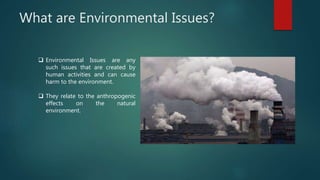
 Environmental Issues are any
such issues that are created by
human activities and can cause
harm to the environment.
 They relate to the anthropogenic
effects on the natural
environment.
Major Environmental Issues
Human
overpopulation
Hydrological issues
Nuclear issues Land use issues
Major Environmental Issues
Intensive farming and
agriculture
Climate change
Environmental health Hazards
Environmental Pollution and
Degradation
Human Overpopulation
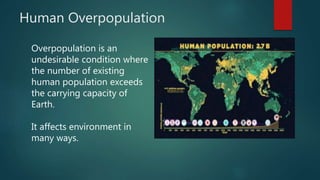
Overpopulation is an
undesirable condition where
the number of existing
human population exceeds
the carrying capacity of
Earth.
It affects environment in
many ways.
Human Overpopulation
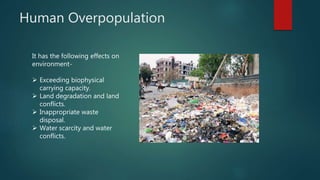
It has the following effects on
environment-
 Exceeding biophysical
carrying capacity.
 Land degradation and land
conflicts.
 Inappropriate waste
disposal.
 Water scarcity and water
conflicts.
Hydrological Issues
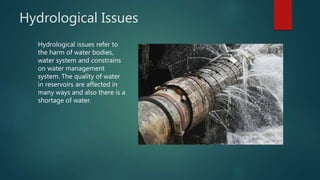
Hydrological issues refer to
the harm of water bodies,
water system and constrains
on water management
system. The quality of water
in reservoirs are affected in
many ways and also there is a
shortage of water.
Hydrological Issues
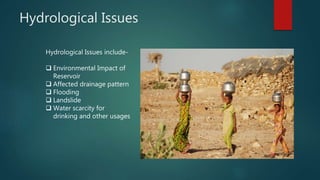
Hydrological Issues include-
 Environmental Impact of
Reservoir
 Affected drainage pattern
 Flooding
 Landslide
 Water scarcity for
drinking and other usages
Nuclear Issues
The uprising usage of nuclear energy
is not only an alternative of energy
resources, it is also a threat to
environment for many reasons. And
the possibility of mass destruction of
life and environmental wealth due to
the possibility of nuclear war cannot
be ignored.
Nuclear Issues
The enlistments of nuclear issues
are-
 Nuclear fallout
 Nuclear meltdown
 Nuclear radiation
 Nuclear accidents
 Radioactive waste management
 Nuclear power and weapons
Land Use Issues
Land use has been defined as "the
arrangements, activities and inputs
people undertake in a certain land cover
type to produce, change or maintain it."
(FAO‚1997)
The most wide land use sectors in
Bangladesh are agriculture and
settlement.
Land Use Issues
The land use issues are-
 Widening the built in environment
 Desertification
 Habitat loss
 Land degradation and pollution
 Urban sprawl
 Urban heat island
 Deforestation
Intensive Farming and Agriculture
Intensive Farming or agriculture is a
kind of farming or agriculture where a
lot of money and labour are used to
increase the yield that can be
obtained per area of land. The use of
large amounts of pesticides for crops,
and of medication for animal stocks is
common.
Intensive Farming and Agriculture
Intensive Farming and Agriculture are
associated with the following
environmental issues-
 Overgrazing
 Plasticulture
 Over usage of pesticides
 Over usage of fertile land
 Tile drainage
Climate Change
Climate change is a change in global or
regional climate patterns, in particular a
change apparent from the mid to late 20th
century onwards and attributed largely to the
increased levels of atmospheric carbon
dioxide produced by the use of fossil fuels.
Climate Change
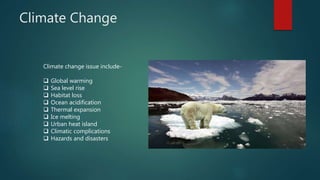
Climate change issue include-
 Global warming
 Sea level rise
 Habitat loss
 Ocean acidification
 Thermal expansion
 Ice melting
 Urban heat island
 Climatic complications
 Hazards and disasters
Environmental Health
Environmental health refers to the
influences human health and disease.
“Environment,” in this context, means
things in the natural environment like
air, water and soil, and also all the
physical, chemical, biological and
social features of our surroundings.
Environmental Health
Environmental health includes-
 Asthma
 Birth defect
 Developmental disability
 Endocrine disruptors
 Lead poisoning
 Radiation risk etc.
Hazards
Hazard is an agent which has the
potentiality to cause harm to a
vulnerable target.
Hazards can be of 3 types-
1. Hydrological Hazards
2. Meteorological Hazards
3. Geological Hazards
Apart from these, there can be several
sorts of man made hazards.
Examples of Hazards
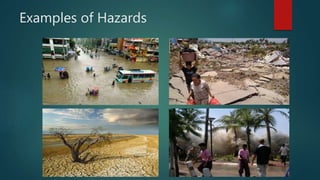
Some examples of hazards are-
1. Hydrological: Floods, water logging
2. Meteorological: blizzard, cyclones,
droughts, hailstorms, heat waves,
hurricanes, floods (caused by rain), and
tornadoes
3. Geologic: volcanic eruptions, earthquakes,
tsunamis, erosion, and landslides.
Examples of Hazards
Environmental Pollution and
Degradation
 Pollution is viewed as the release of substances and energy as waste
products of human activities which result in harmful changes within the
natural environment (Sharma and Kaur, 1994).
 Environmental degradation is the deterioration of the environment
through depletion of resources such as air, water and soil; the destruction
of ecosystems; habitat destruction; the extinction of wildlife; and pollution.
It is defined as any change or disturbance to the environment perceived to
be deleterious or undesirable (Johnshon et al., 1997).
Types of Environmental Pollution
Air pollution
Water
pollution
Land
pollution
Noise
pollution
Heat
pollution
Radioactive
pollution
Air pollution
 Air pollution refers to the entrance
of foreign elements into the
atmosphere.
 Industries, vehicles and agricultural
emissions are the prime source of
air pollution.
 Respiratory problems, heart
diseases, acid rain, eutrophication,
ozone layer depletion etc. are the
effects.
Water pollution
 The deterioration of the water
quality due to the changes of water
quality parameters.
 Parameters are- PH, DO, TDS,
temperature, nutrient elements,
electric conductivity, nutrient
elements etc.
 Effects are- lack of fresh drinking
water, arsenic poisoning, water
contaminated diseases, destruction
of ecosystem etc.
Land pollution
 Mostly occur due to the land
filling of non degradable
elements, solid waste disposal,
emission of toxic chemicals etc.
 As a result, soil fertility is lost,
soil ecosystem is hampered,
human health is affected and
many more.
Noise pollution
 Noise pollution is the disturbing
of noise with harmful impact on
the activity of human or animal
life.
 The source of outdoor noise
worldwide is mainly caused by
the machines, Transport and
transportation systems, motor
vehicles engines, trains, etc.
 Hearing problems, sleeping
disorder, cardiovascular issues
etc. are the impacts.
Heat Pollution
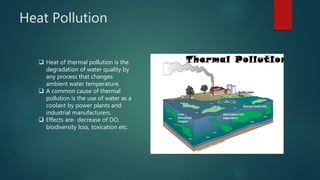
 Heat of thermal pollution is the
degradation of water quality by
any process that changes
ambient water temperature.
 A common cause of thermal
pollution is the use of water as a
coolant by power plants and
industrial manufacturers.
 Effects are- decrease of DO,
biodiversity loss, toxication etc.
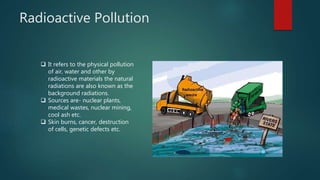
Radioactive Pollution
 It refers to the physical pollution
of air, water and other by
radioactive materials the natural
radiations are also known as the
background radiations.
 Sources are- nuclear plants,
medical wastes, nuclear mining,
cool ash etc.
 Skin burns, cancer, destruction
of cells, genetic defects etc.
THANK YOU

Environmental issues

  • 1.
    Environmental Issues Mohammad MohaiminulIslam Dept. of Geography and Environmental Studies Faculty of Biological Science University of Chittagong mmohaiminul@yahoo.com
  • 2.
    What are EnvironmentalIssues?  Environmental Issues are any such issues that are created by human activities and can cause harm to the environment.  They relate to the anthropogenic effects on the natural environment.
  • 3.
  • 4.
    Major Environmental Issues Intensivefarming and agriculture Climate change Environmental health Hazards Environmental Pollution and Degradation
  • 5.
    Human Overpopulation Overpopulation isan undesirable condition where the number of existing human population exceeds the carrying capacity of Earth. It affects environment in many ways.
  • 6.
    Human Overpopulation It hasthe following effects on environment-  Exceeding biophysical carrying capacity.  Land degradation and land conflicts.  Inappropriate waste disposal.  Water scarcity and water conflicts.
  • 7.
    Hydrological Issues Hydrological issuesrefer to the harm of water bodies, water system and constrains on water management system. The quality of water in reservoirs are affected in many ways and also there is a shortage of water.
  • 8.
    Hydrological Issues Hydrological Issuesinclude-  Environmental Impact of Reservoir  Affected drainage pattern  Flooding  Landslide  Water scarcity for drinking and other usages
  • 9.
    Nuclear Issues The uprisingusage of nuclear energy is not only an alternative of energy resources, it is also a threat to environment for many reasons. And the possibility of mass destruction of life and environmental wealth due to the possibility of nuclear war cannot be ignored.
  • 10.
    Nuclear Issues The enlistmentsof nuclear issues are-  Nuclear fallout  Nuclear meltdown  Nuclear radiation  Nuclear accidents  Radioactive waste management  Nuclear power and weapons
  • 11.
    Land Use Issues Landuse has been defined as "the arrangements, activities and inputs people undertake in a certain land cover type to produce, change or maintain it." (FAO‚1997) The most wide land use sectors in Bangladesh are agriculture and settlement.
  • 12.
    Land Use Issues Theland use issues are-  Widening the built in environment  Desertification  Habitat loss  Land degradation and pollution  Urban sprawl  Urban heat island  Deforestation
  • 13.
    Intensive Farming andAgriculture Intensive Farming or agriculture is a kind of farming or agriculture where a lot of money and labour are used to increase the yield that can be obtained per area of land. The use of large amounts of pesticides for crops, and of medication for animal stocks is common.
  • 14.
    Intensive Farming andAgriculture Intensive Farming and Agriculture are associated with the following environmental issues-  Overgrazing  Plasticulture  Over usage of pesticides  Over usage of fertile land  Tile drainage
  • 15.
    Climate Change Climate changeis a change in global or regional climate patterns, in particular a change apparent from the mid to late 20th century onwards and attributed largely to the increased levels of atmospheric carbon dioxide produced by the use of fossil fuels.
  • 16.
    Climate Change Climate changeissue include-  Global warming  Sea level rise  Habitat loss  Ocean acidification  Thermal expansion  Ice melting  Urban heat island  Climatic complications  Hazards and disasters
  • 17.
    Environmental Health Environmental healthrefers to the influences human health and disease. “Environment,” in this context, means things in the natural environment like air, water and soil, and also all the physical, chemical, biological and social features of our surroundings.
  • 18.
    Environmental Health Environmental healthincludes-  Asthma  Birth defect  Developmental disability  Endocrine disruptors  Lead poisoning  Radiation risk etc.
  • 19.
    Hazards Hazard is anagent which has the potentiality to cause harm to a vulnerable target. Hazards can be of 3 types- 1. Hydrological Hazards 2. Meteorological Hazards 3. Geological Hazards Apart from these, there can be several sorts of man made hazards.
  • 20.
    Examples of Hazards Someexamples of hazards are- 1. Hydrological: Floods, water logging 2. Meteorological: blizzard, cyclones, droughts, hailstorms, heat waves, hurricanes, floods (caused by rain), and tornadoes 3. Geologic: volcanic eruptions, earthquakes, tsunamis, erosion, and landslides.
  • 21.
  • 22.
    Environmental Pollution and Degradation Pollution is viewed as the release of substances and energy as waste products of human activities which result in harmful changes within the natural environment (Sharma and Kaur, 1994).  Environmental degradation is the deterioration of the environment through depletion of resources such as air, water and soil; the destruction of ecosystems; habitat destruction; the extinction of wildlife; and pollution. It is defined as any change or disturbance to the environment perceived to be deleterious or undesirable (Johnshon et al., 1997).
  • 23.
    Types of EnvironmentalPollution Air pollution Water pollution Land pollution Noise pollution Heat pollution Radioactive pollution
  • 24.
    Air pollution  Airpollution refers to the entrance of foreign elements into the atmosphere.  Industries, vehicles and agricultural emissions are the prime source of air pollution.  Respiratory problems, heart diseases, acid rain, eutrophication, ozone layer depletion etc. are the effects.
  • 25.
    Water pollution  Thedeterioration of the water quality due to the changes of water quality parameters.  Parameters are- PH, DO, TDS, temperature, nutrient elements, electric conductivity, nutrient elements etc.  Effects are- lack of fresh drinking water, arsenic poisoning, water contaminated diseases, destruction of ecosystem etc.
  • 26.
    Land pollution  Mostlyoccur due to the land filling of non degradable elements, solid waste disposal, emission of toxic chemicals etc.  As a result, soil fertility is lost, soil ecosystem is hampered, human health is affected and many more.
  • 27.
    Noise pollution  Noisepollution is the disturbing of noise with harmful impact on the activity of human or animal life.  The source of outdoor noise worldwide is mainly caused by the machines, Transport and transportation systems, motor vehicles engines, trains, etc.  Hearing problems, sleeping disorder, cardiovascular issues etc. are the impacts.
  • 28.
    Heat Pollution  Heatof thermal pollution is the degradation of water quality by any process that changes ambient water temperature.  A common cause of thermal pollution is the use of water as a coolant by power plants and industrial manufacturers.  Effects are- decrease of DO, biodiversity loss, toxication etc.
  • 29.
    Radioactive Pollution  Itrefers to the physical pollution of air, water and other by radioactive materials the natural radiations are also known as the background radiations.  Sources are- nuclear plants, medical wastes, nuclear mining, cool ash etc.  Skin burns, cancer, destruction of cells, genetic defects etc.
  • 30.