Introduction to IWRM
SAURABH SINGH
B.TEC CIVIL ENGINEERING
A7615810020
Before we start….
• The basis of IWRM is that different uses of water are
interdependent
• Integrated management means that all the different uses of
water resources are considered together
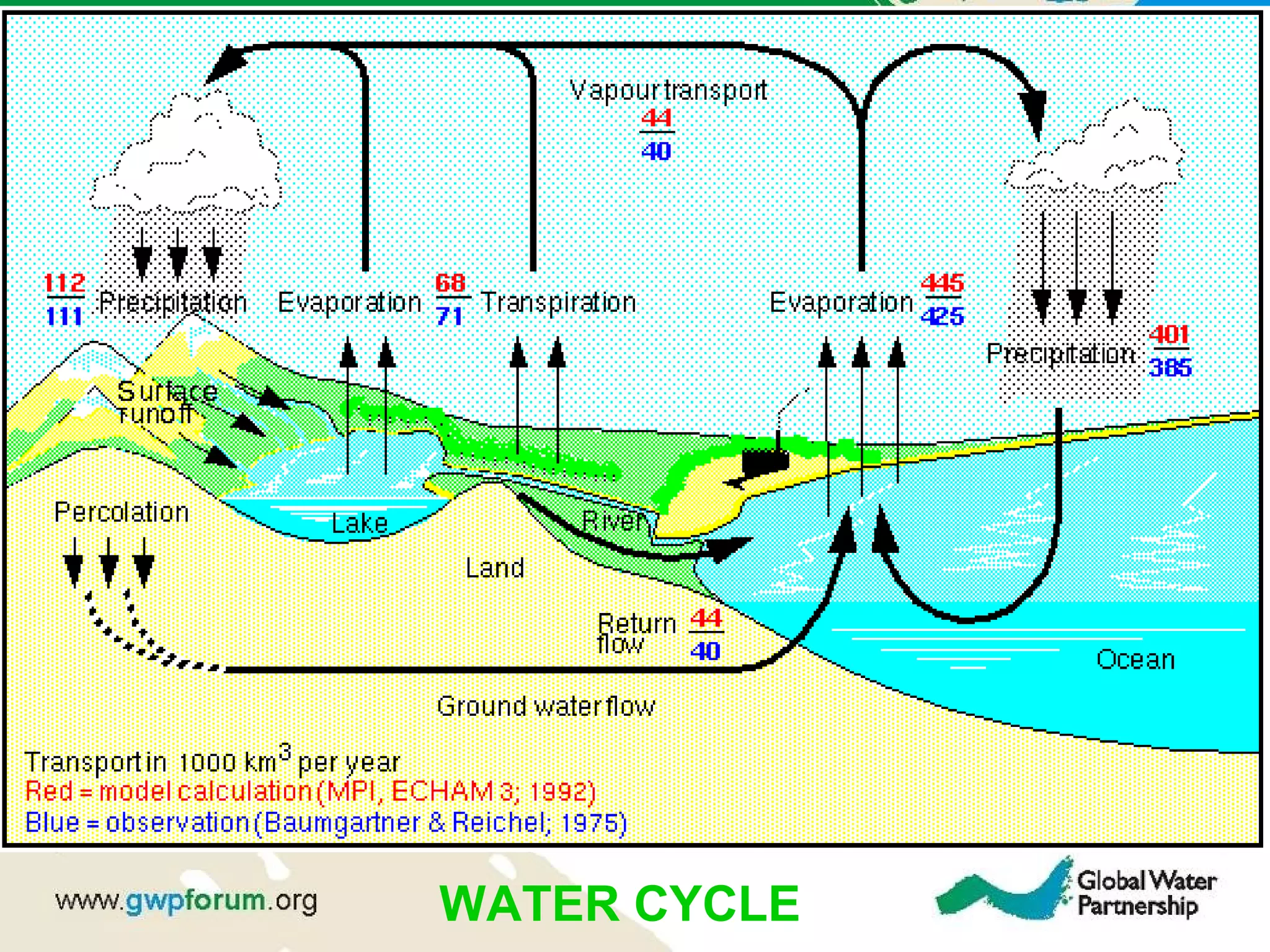
WATER CYCLE
Driving forces on water resources
• Population growth: demands for more water and producing more waste
water and pollution
• Urbanization: migration from rural to urban areas which increases the
current level of difficulty in water delivery and waste water treatment
• Economic growth: mainly in developing countries with large populations
contributes to increased demand for economic activities
• Globalization of trade: production is relocated to “labor-cheap” areas that
takes place without consideration for water resources
• Climate variability: more intense floods and droughts increase vulnerability
of people
• Climate change: increase uncertainty about water cycle regimes
WHICH OF THE FOLLOWING ISSUES ARE
THE MAIN TOPICS IN YOUR JOB?
IWRM concept is
• an empirical concept which is built up from the on-the-ground experience
of practitioners,
• a flexible approach to water management that can adapt to diverse national
and local contexts,
• thus
• it is not a scientific theory that needs to be proved or disproved by scholars.
• and (but)
• it requires policy-makers to make judgments about which reforms and
measures, management tools and institutional arrangements are most
appropriate in a particular cultural, social, political, economic and
environmental context.
IWRM definition
IWRM is a process which promotes the
coordinated development and
management of water, land and related
resources, in order to maximize the
resultant economic and social welfare
in an equitable manner without
compromising the sustainability of vital
ecosystems.
GWP, TEC Background Paper No. 4:
Integrated Water Resources
Management
IWRM:
What does it really mean?
• More coordinated development and management of:
– Land and water
– Surface water and ground water
– Upstream and downstream interests
Discussion questions:
Who should propose measures to protect against floods?
Who should bear a cost to implement measures to mitigate
floods?
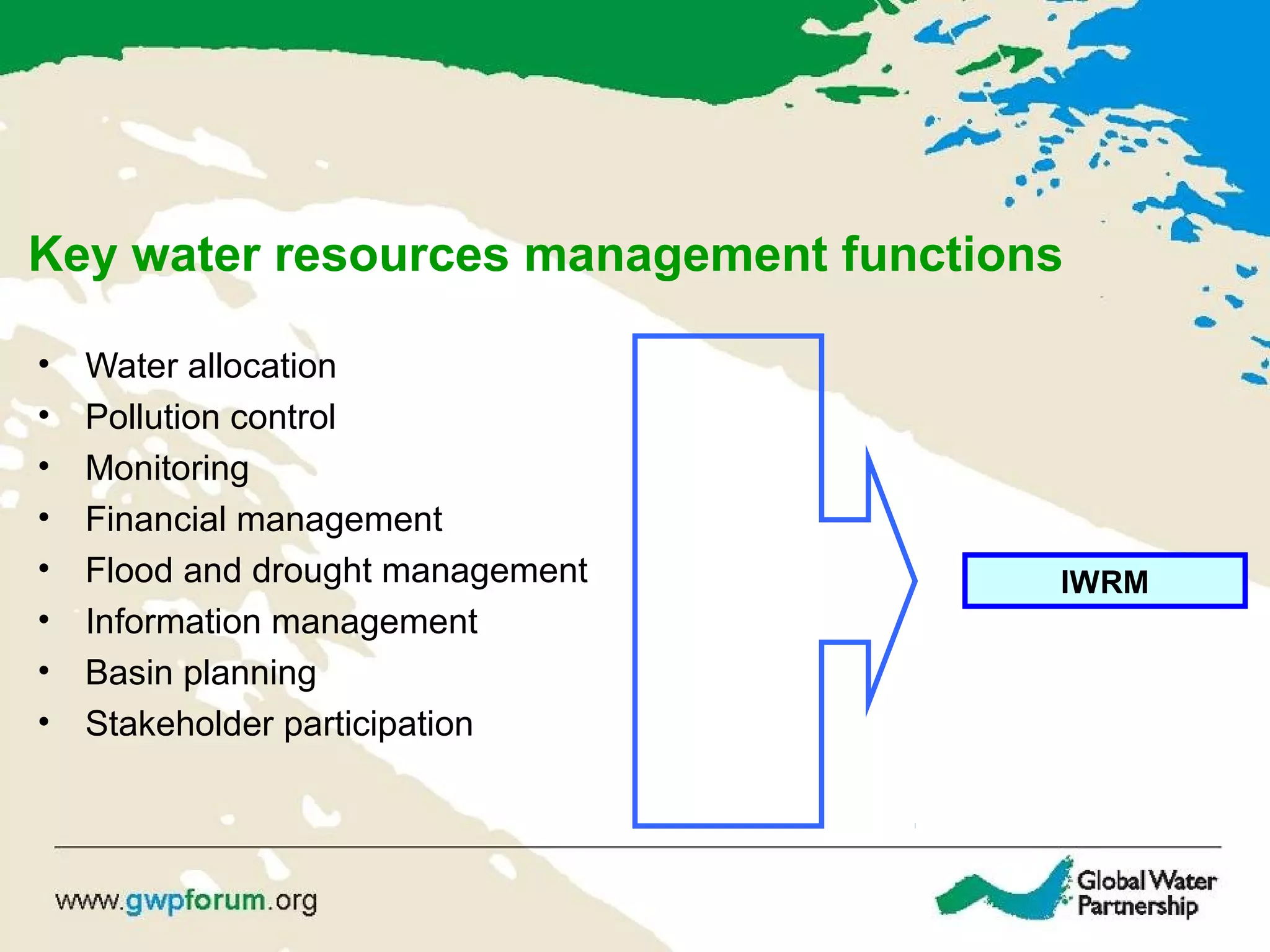
Key water resources management functions
• Water allocation
• Pollution control
• Monitoring
• Financial management
• Flood and drought management
• Information management
• Basin planning
• Stakeholder participation
IWRM
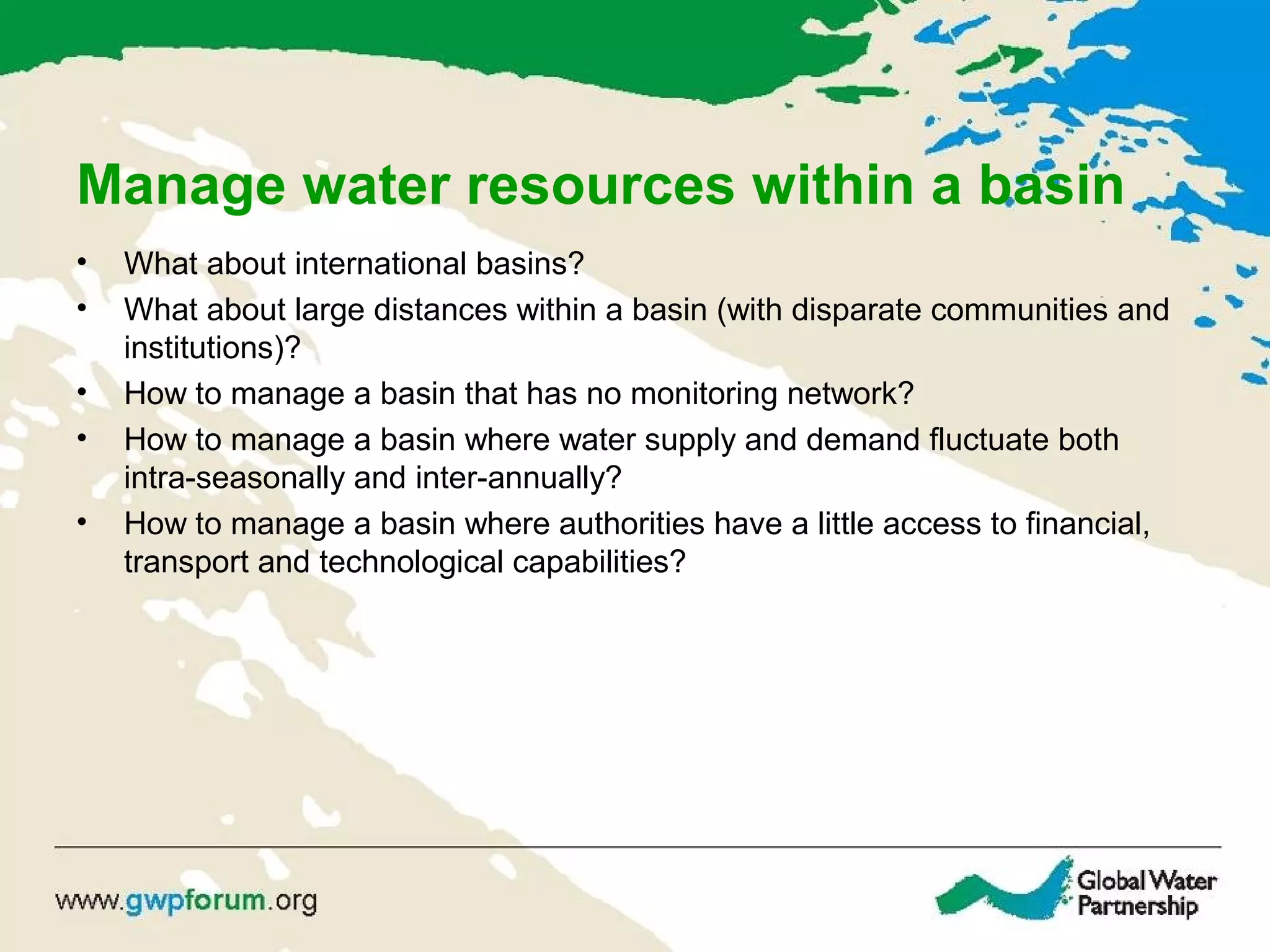
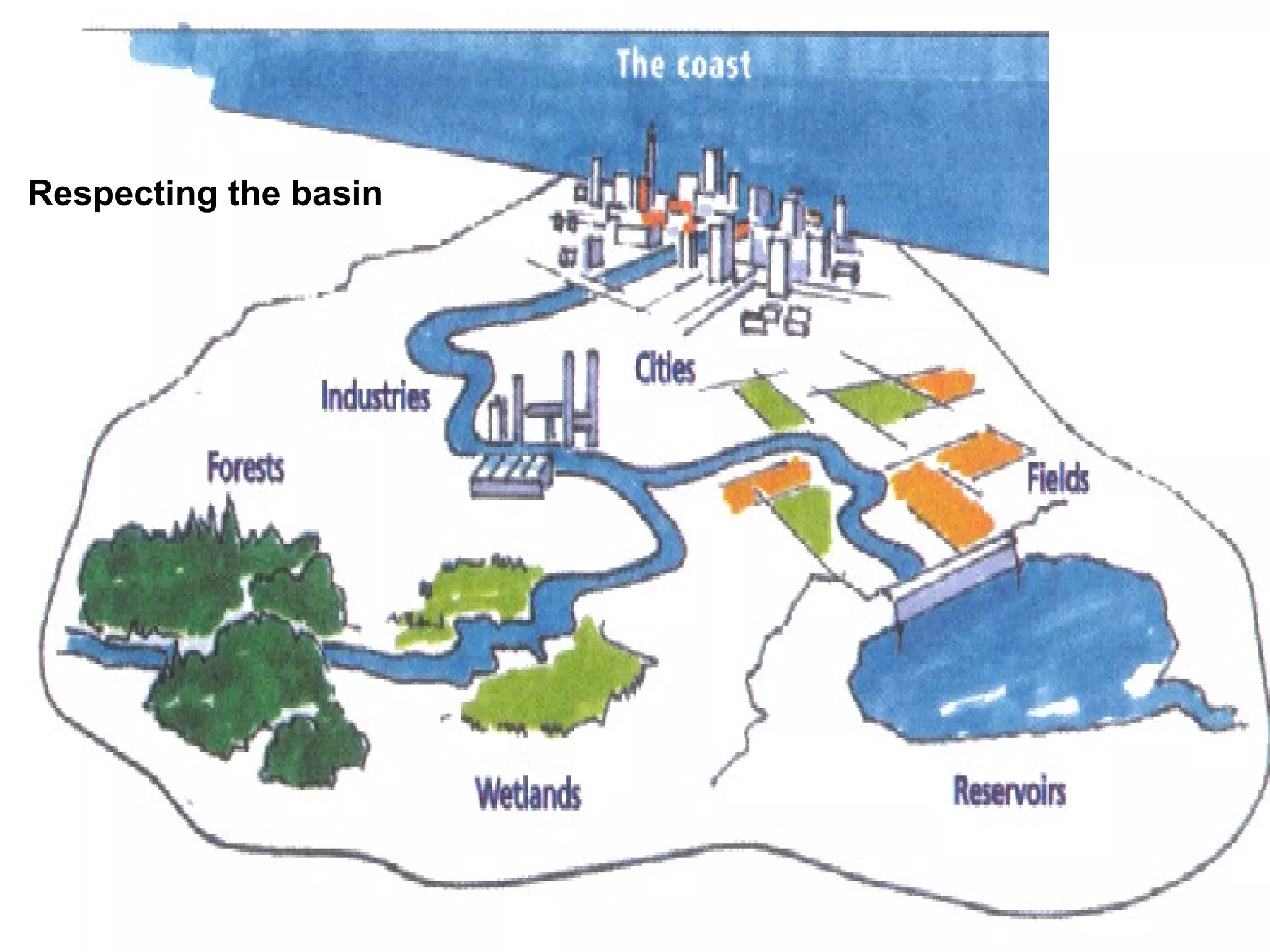
Manage water resources within a basin
• What about international basins?
• What about large distances within a basin (with disparate communities and
institutions)?
• How to manage a basin that has no monitoring network?
• How to manage a basin where water supply and demand fluctuate both
intra-seasonally and inter-annually?
• How to manage a basin where authorities have a little access to financial,
transport and technological capabilities?
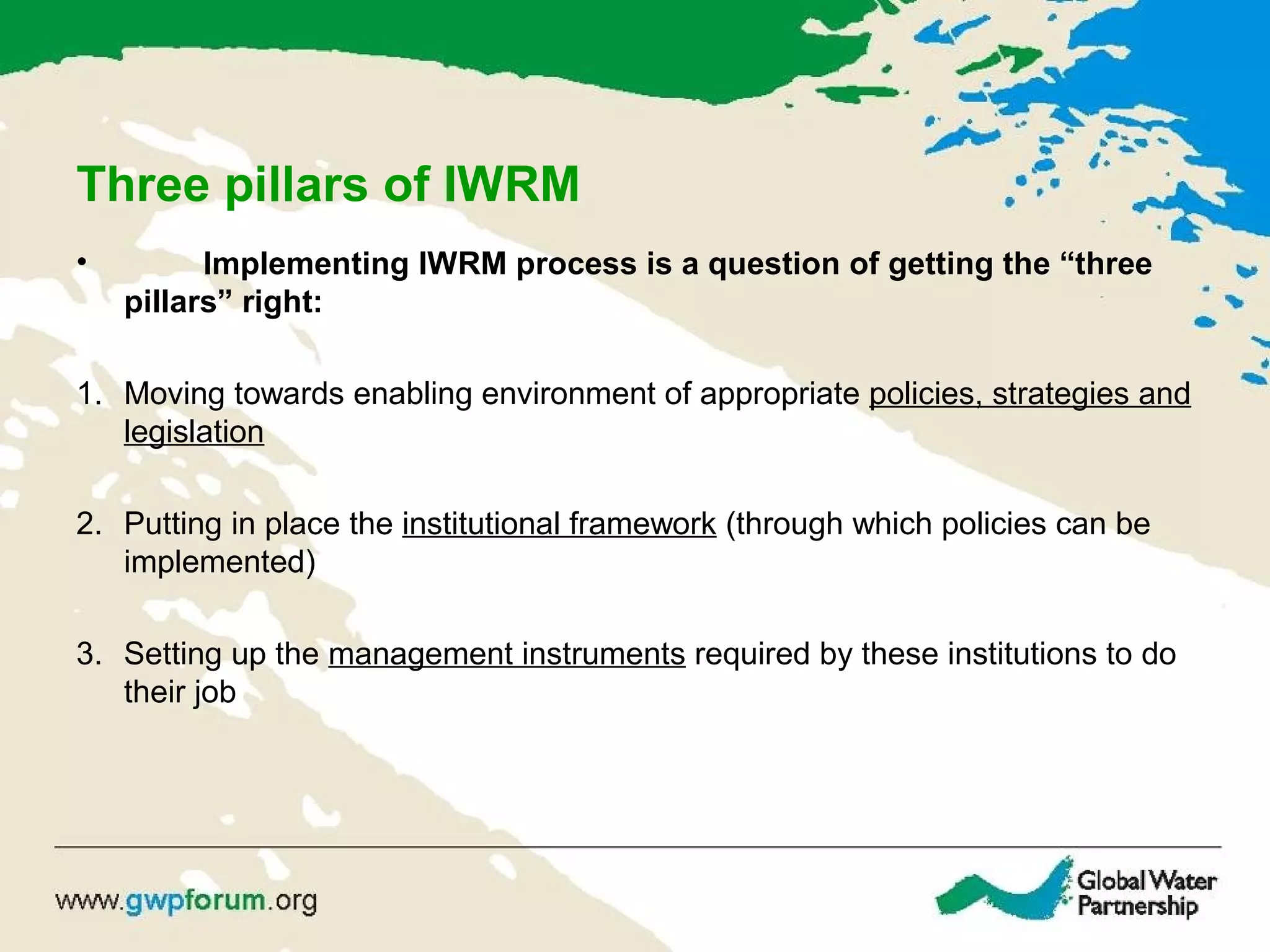
Three pillars of IWRM
• Implementing IWRM process is a question of getting the “three
pillars” right:
1. Moving towards enabling environment of appropriate policies, strategies and
legislation
2. Putting in place the institutional framework (through which policies can be
implemented)
3. Setting up the management instruments required by these institutions to do
their job
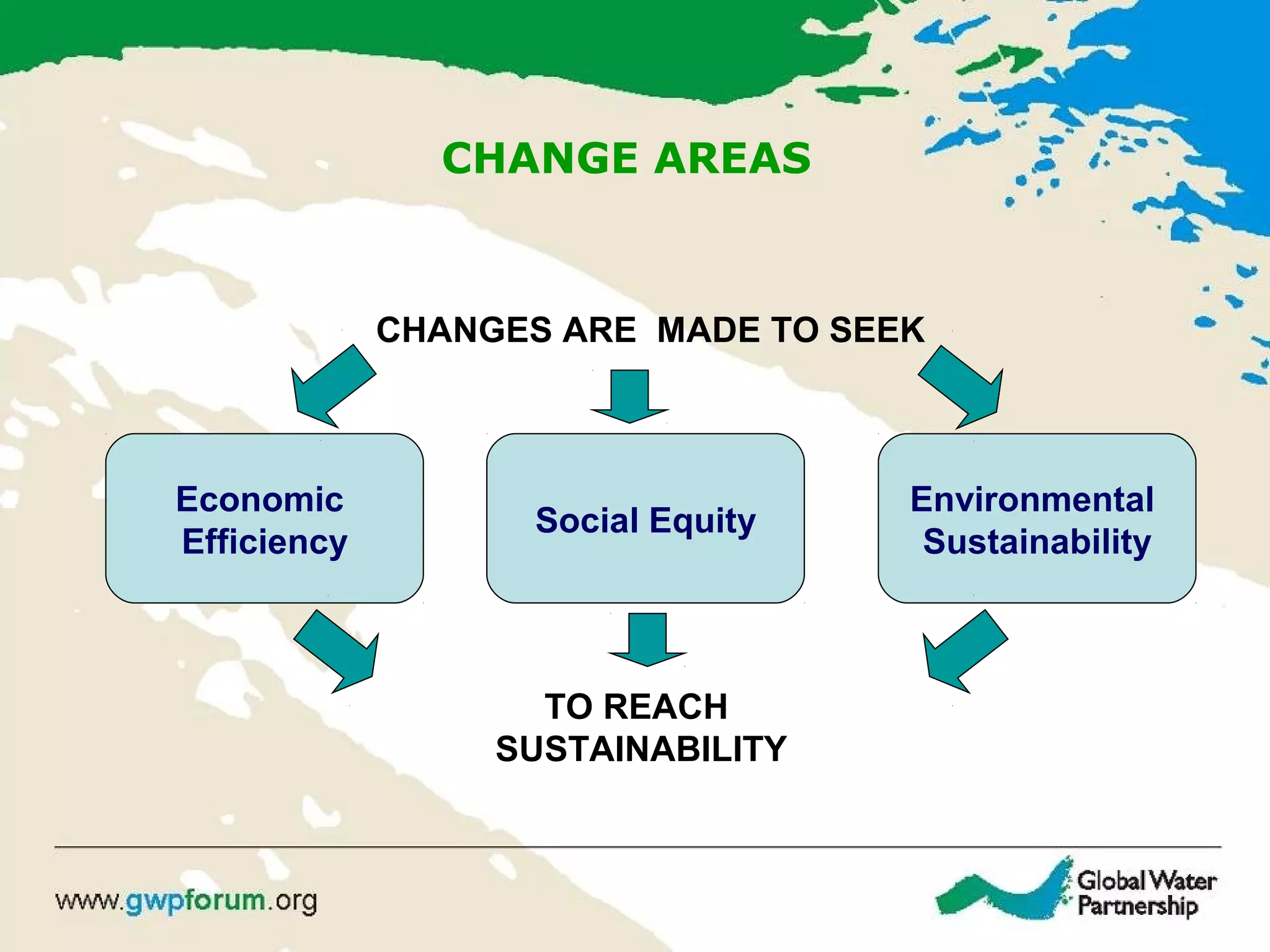
CHANGE AREAS
Environmental
Sustainability
Economic
Efficiency
Social Equity
CHANGES ARE MADE TO SEEK
TO REACH
SUSTAINABILITY
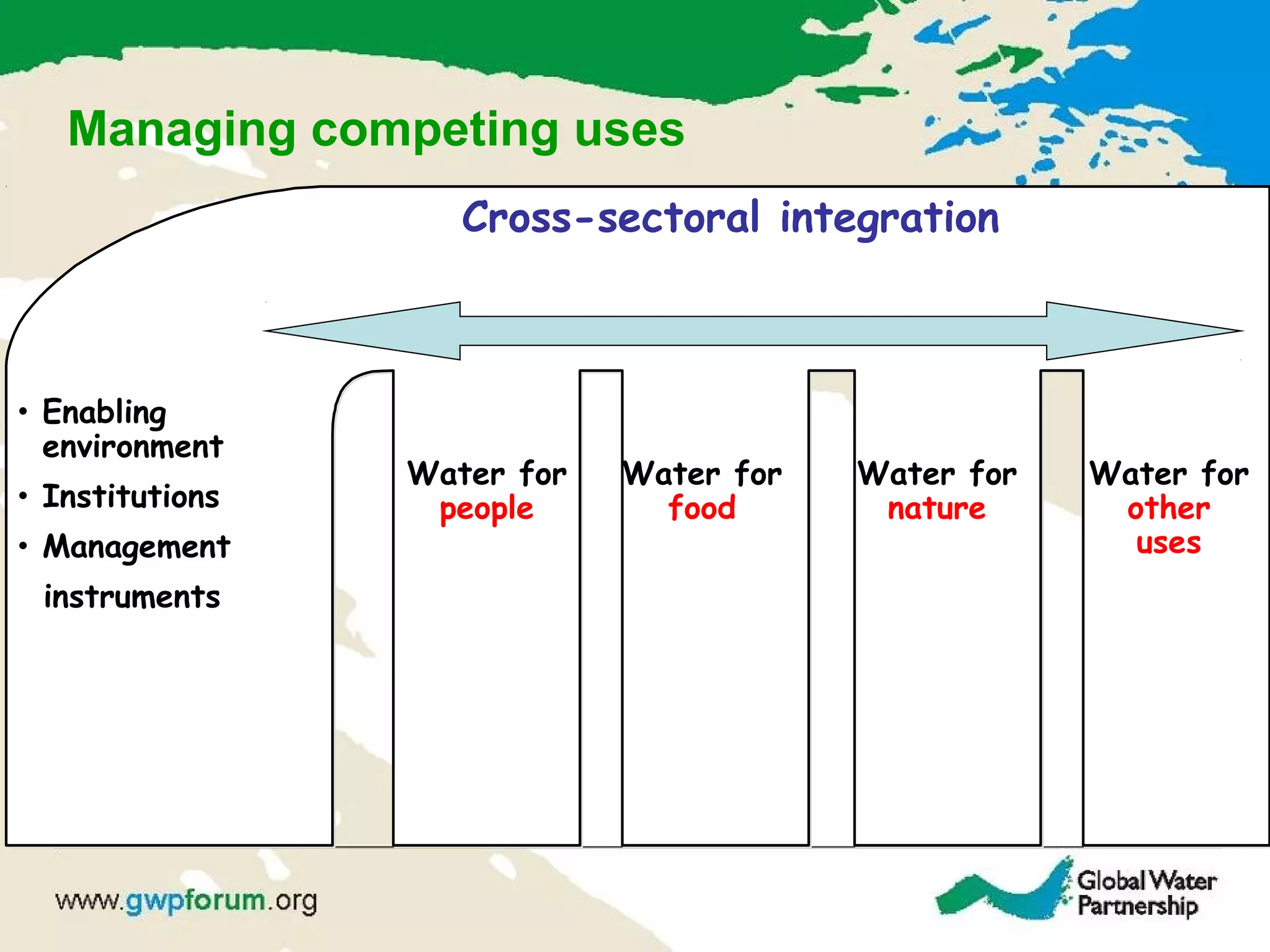
Managing competing uses
Water for
people
Water for
food
Water for
nature
Water for
other
uses
Cross-sectoral integration
• Enabling
environment
• Institutions
• Management
instruments
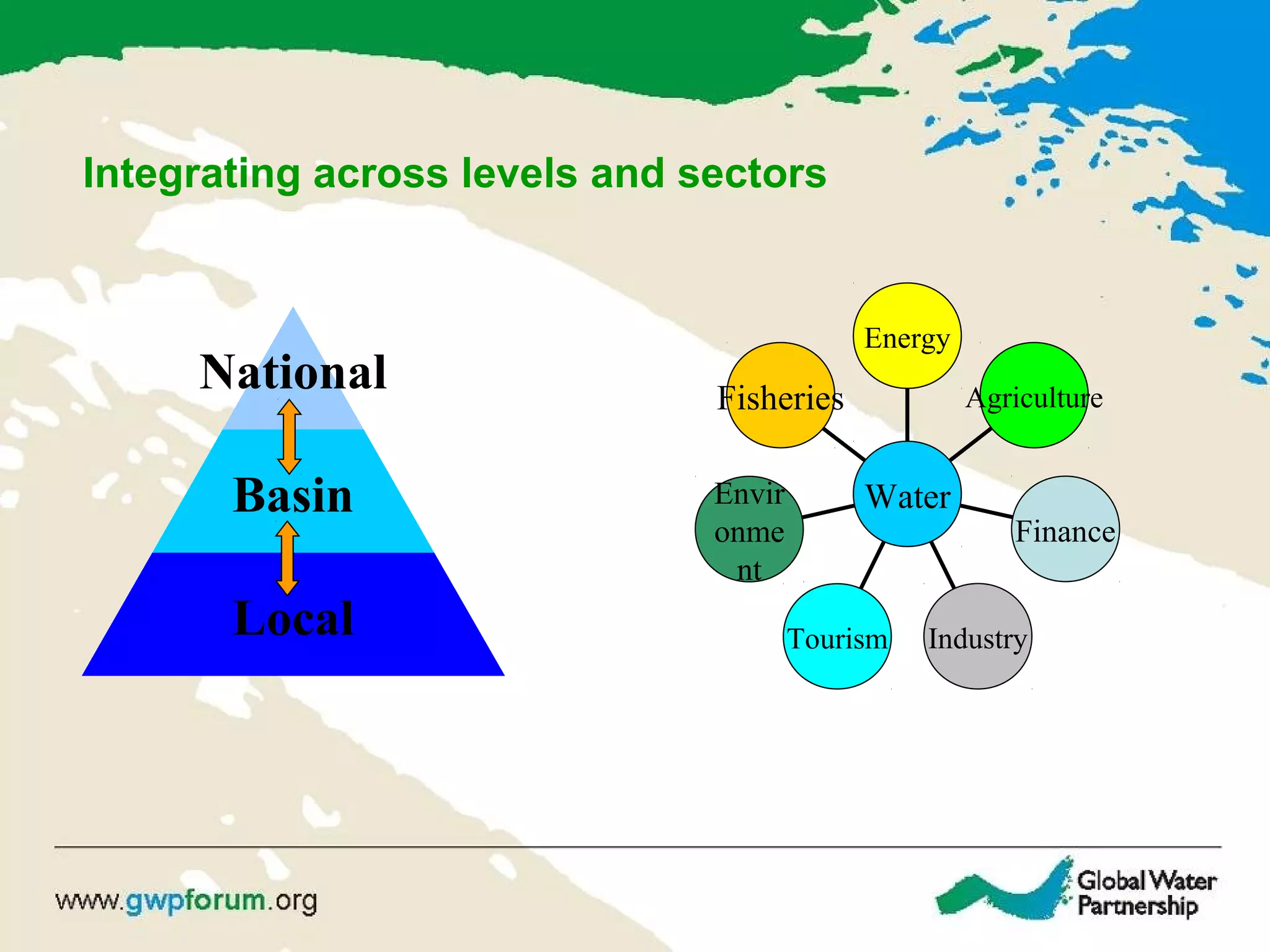
Integrating across levels and sectors
National
Basin
Local
Fisheries
Envir
onme
nt
Tourism Industry
Finance
Agriculture
Energy
Water
IWRM PRINCIPLES
• Fresh water is a finite and vulnerable resource, essential to sustain
life, development and the environment.
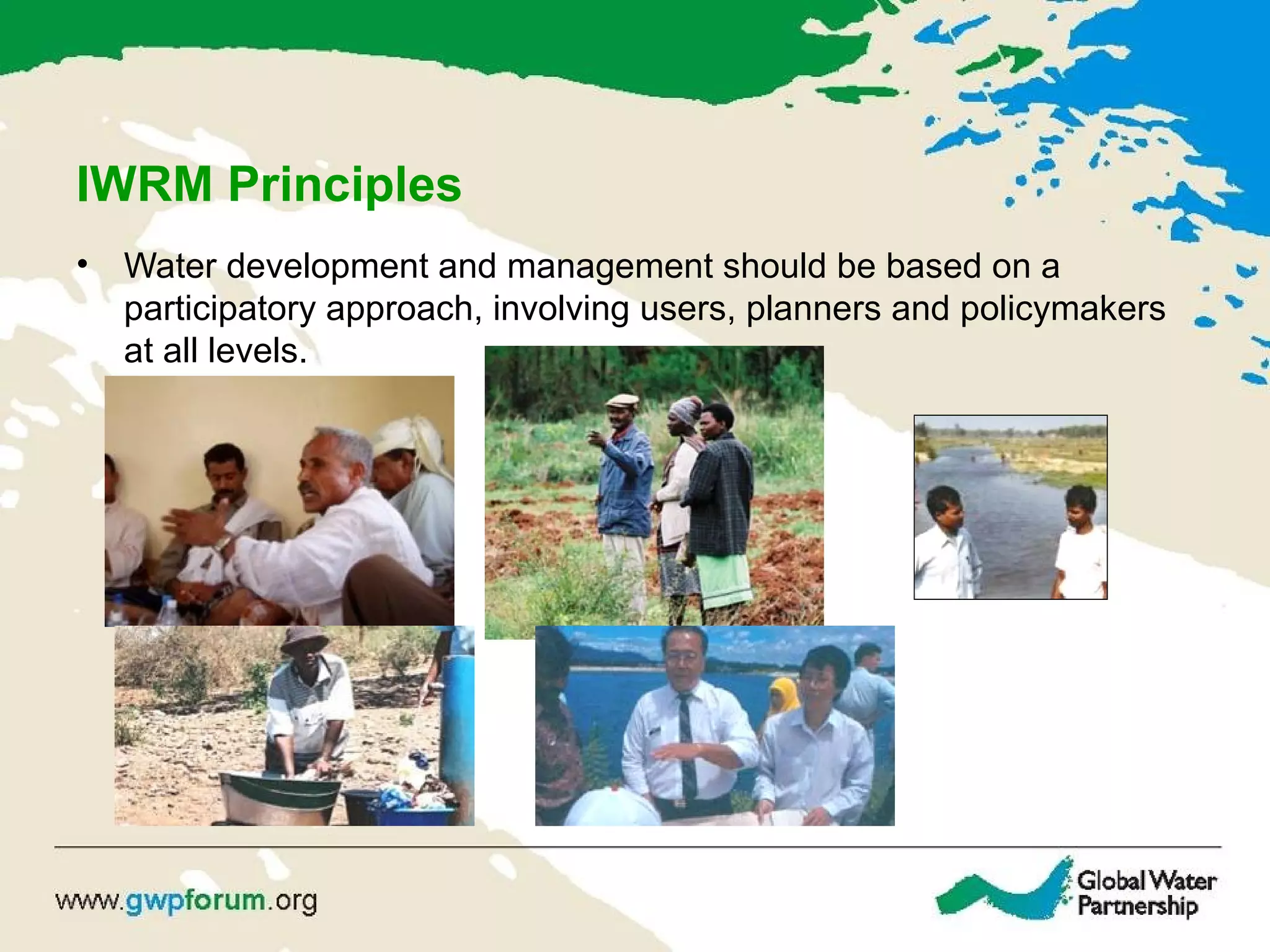
• Water development and management should be based on a
participatory approach, involving users, planners and policymakers
at all levels.
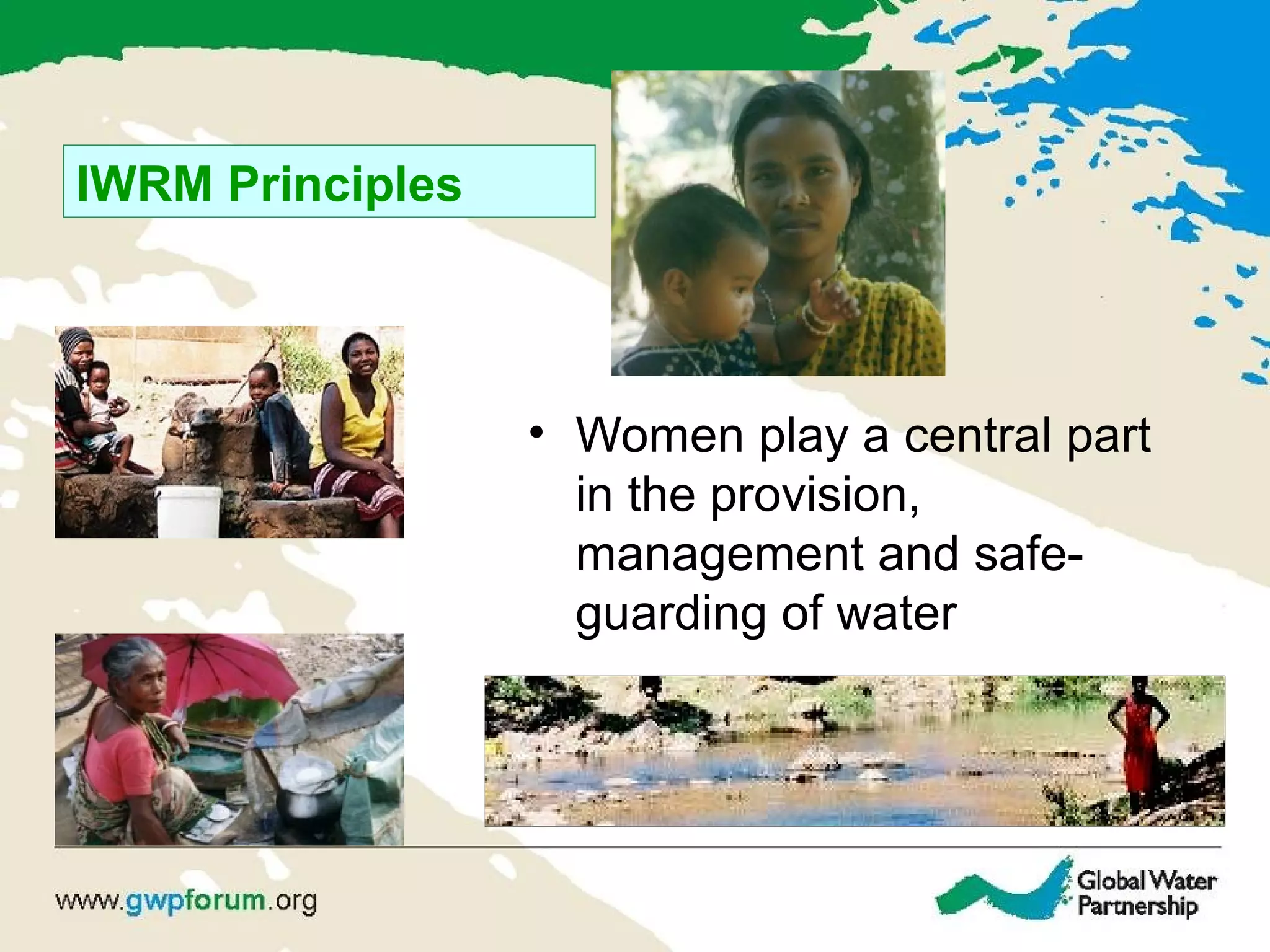
• Women play a central part in the provision, management and safe-
guarding of water.
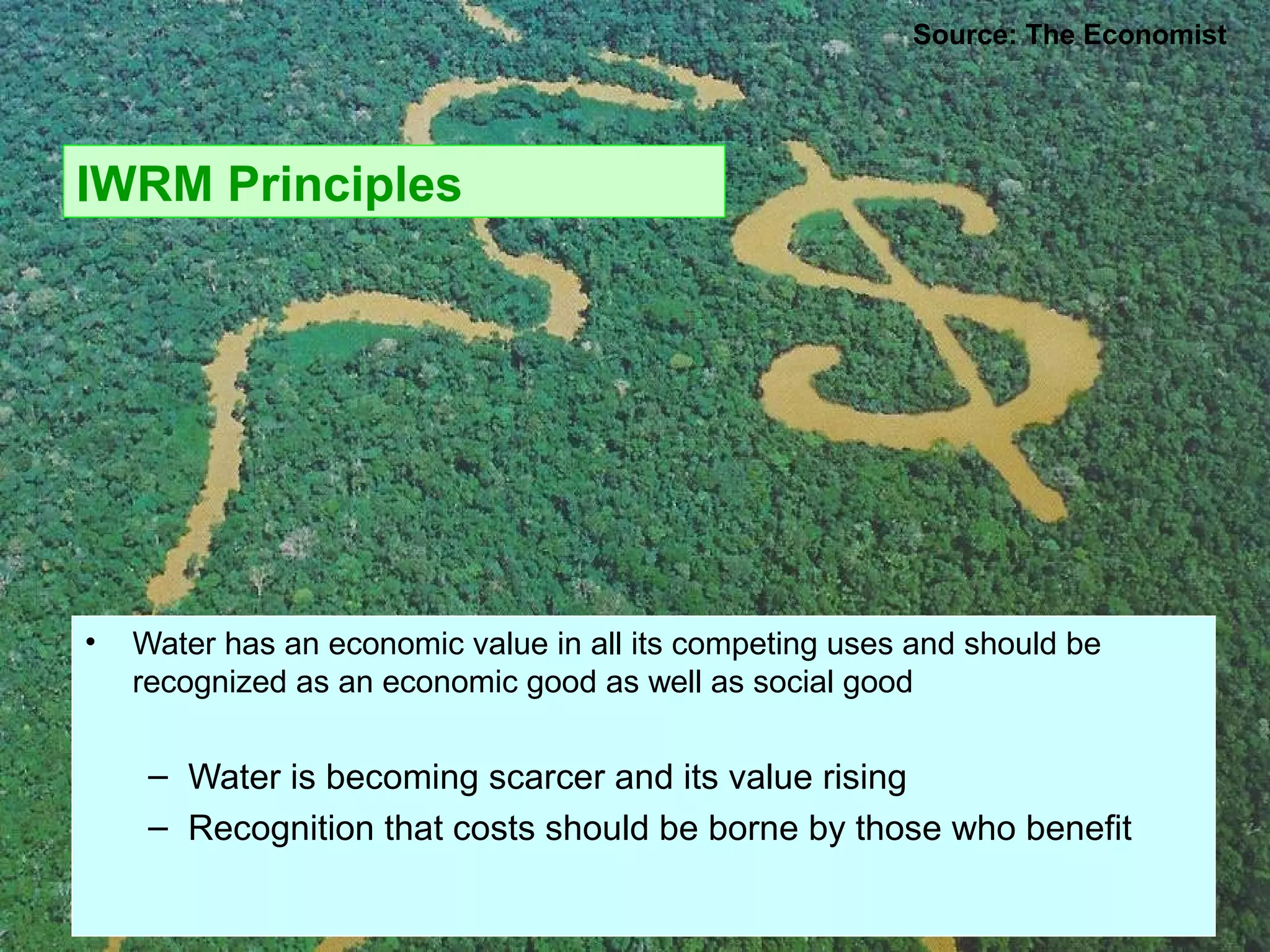
• Water has an economic value in all its competing uses and should
be recognized as an economic good as well as social good.
Dublin, 1992
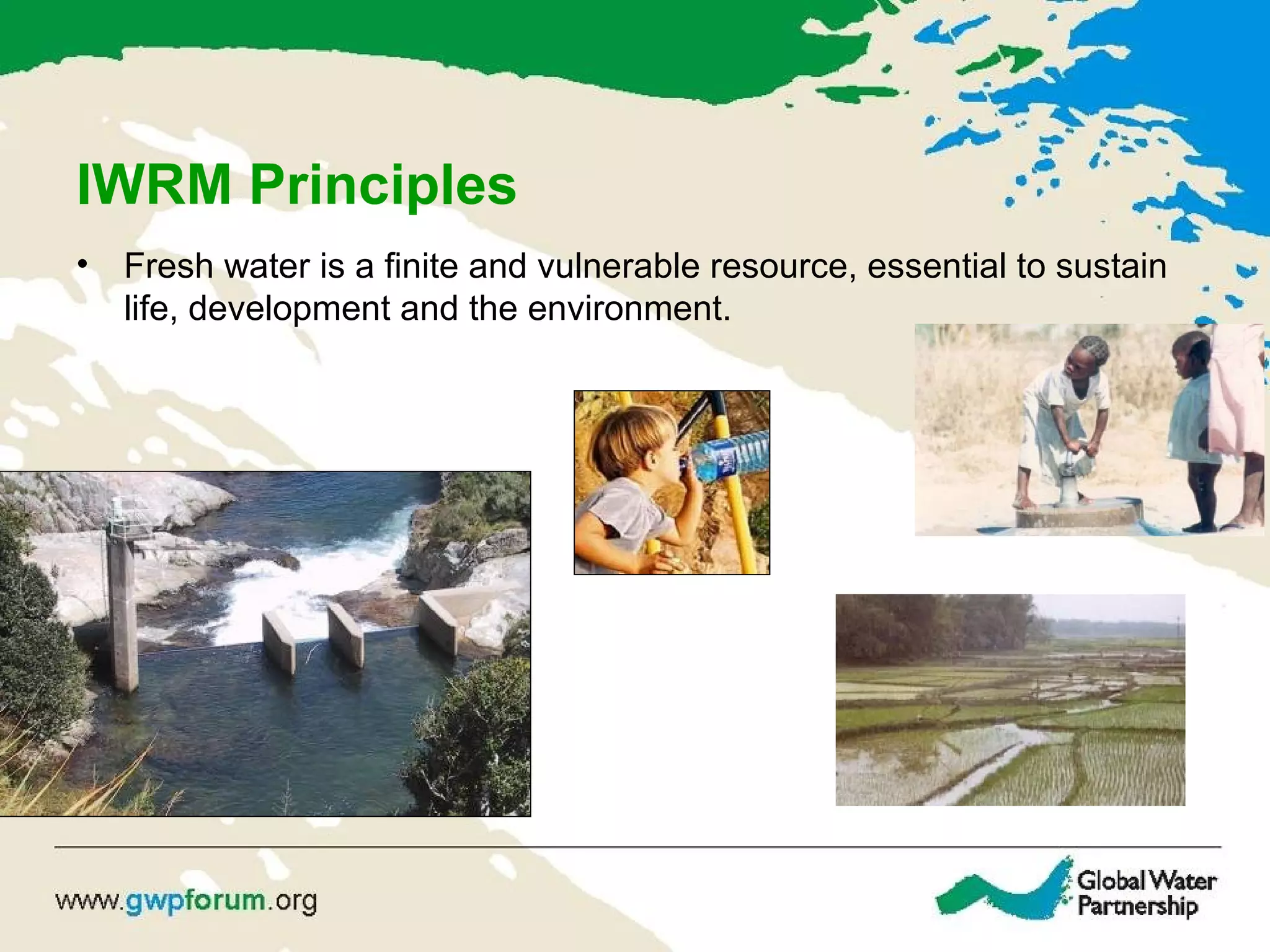
IWRM Principles
• Fresh water is a finite and vulnerable resource, essential to sustain
life, development and the environment.
Respecting the basin
IWRM Principles
• Water development and management should be based on a
participatory approach, involving users, planners and policymakers
at all levels.
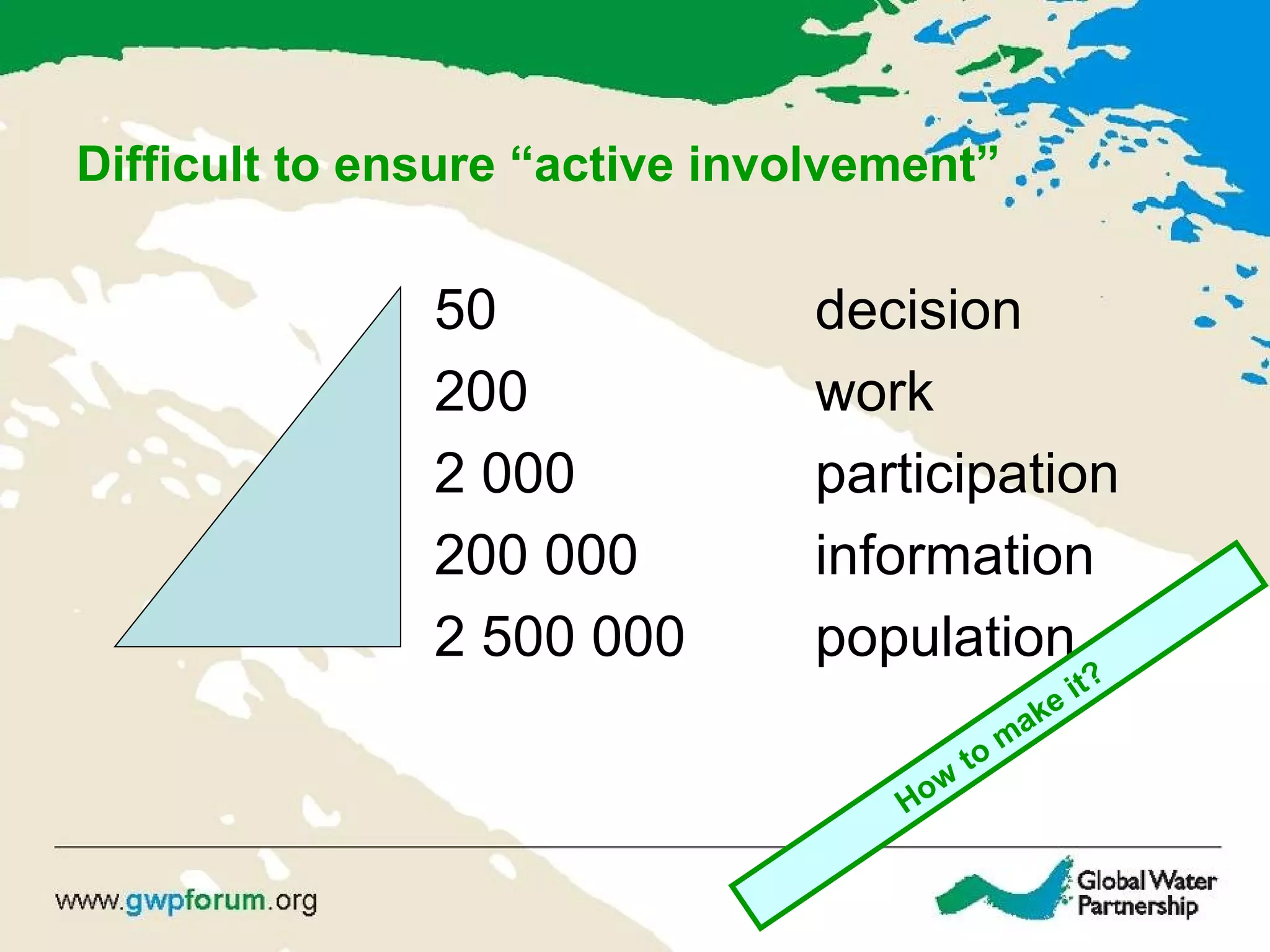
Difficult to ensure “active involvement”
50 decision
200 work
2 000 participation
200 000 information
2 500 000 population
How
to
make it?
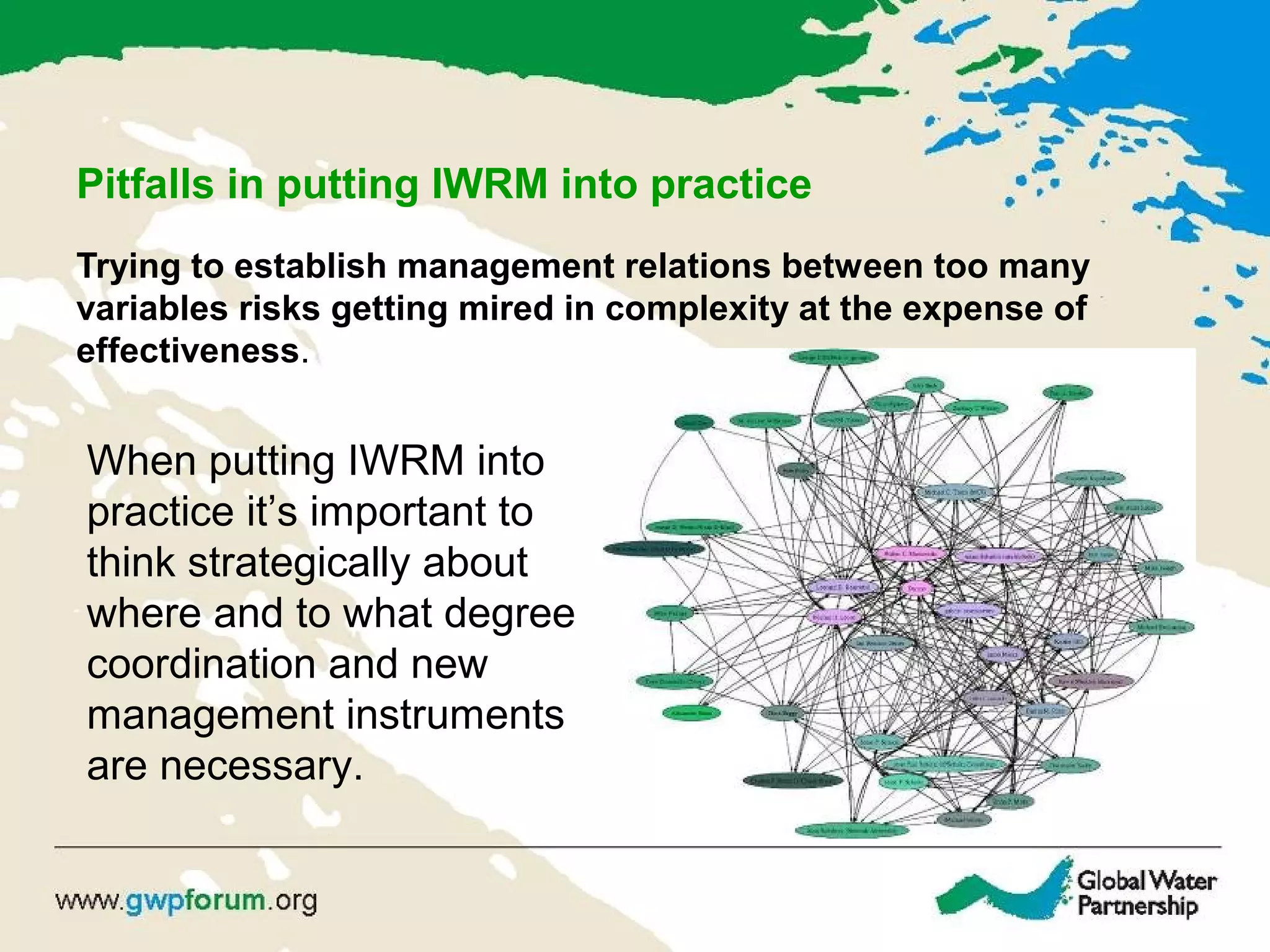
Pitfalls in putting IWRM into practice
Trying to establish management relations between too many
variables risks getting mired in complexity at the expense of
effectiveness.
When putting IWRM into
practice it’s important to
think strategically about
where and to what degree
coordination and new
management instruments
are necessary.
IWRM Principles
• Women play a central part
in the provision,
management and safe-
guarding of water
IWRM Principles
• Water has an economic value in all its competing uses and should be
recognized as an economic good as well as social good
– Water is becoming scarcer and its value rising
– Recognition that costs should be borne by those who benefit
Source: The Economist
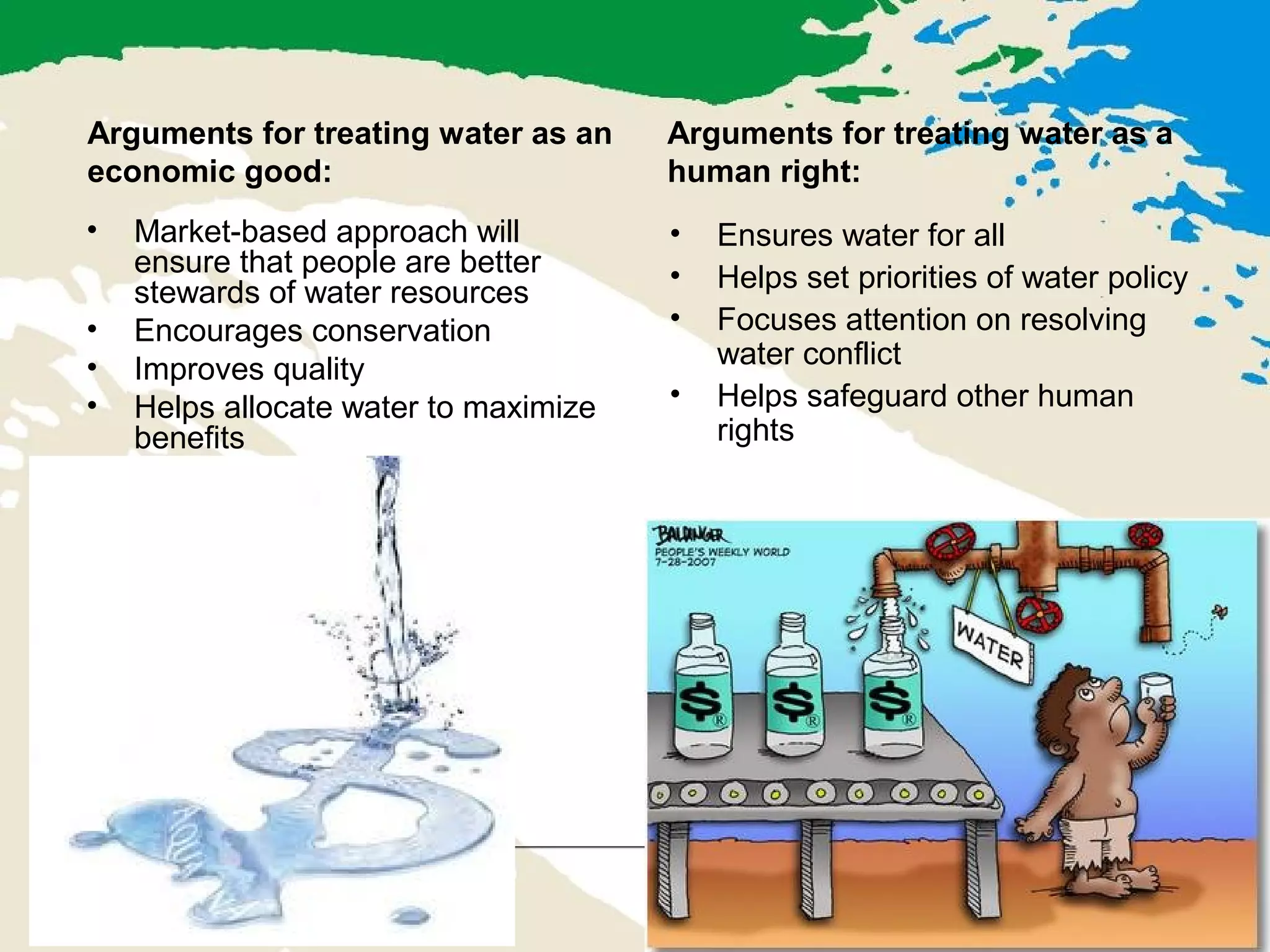
Arguments for treating water as an
economic good:
• Market-based approach will
ensure that people are better
stewards of water resources
• Encourages conservation
• Improves quality
• Helps allocate water to maximize
benefits
Arguments for treating water as a
human right:
• Ensures water for all
• Helps set priorities of water policy
• Focuses attention on resolving
water conflict
• Helps safeguard other human
rights
Why IWRM?
• Globally accepted and makes good sense.
• Key element in national water policy.
• Incorporates social and environmental considerations directly into policy and
decision making.
• Directly involves the stakeholders.
• Is a tool for optimizing investments under tight financing climate.
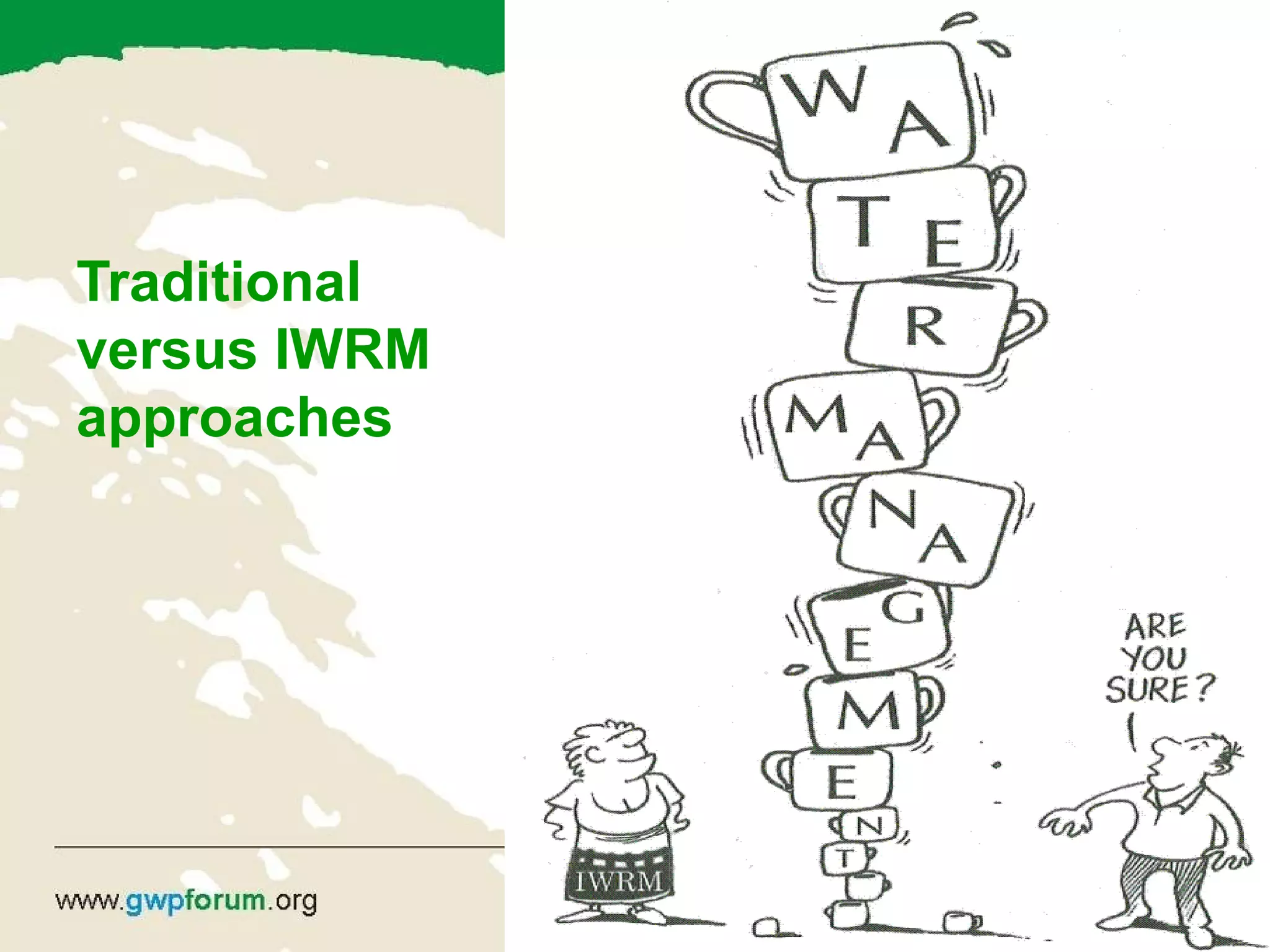
Traditional
versus IWRM
approaches
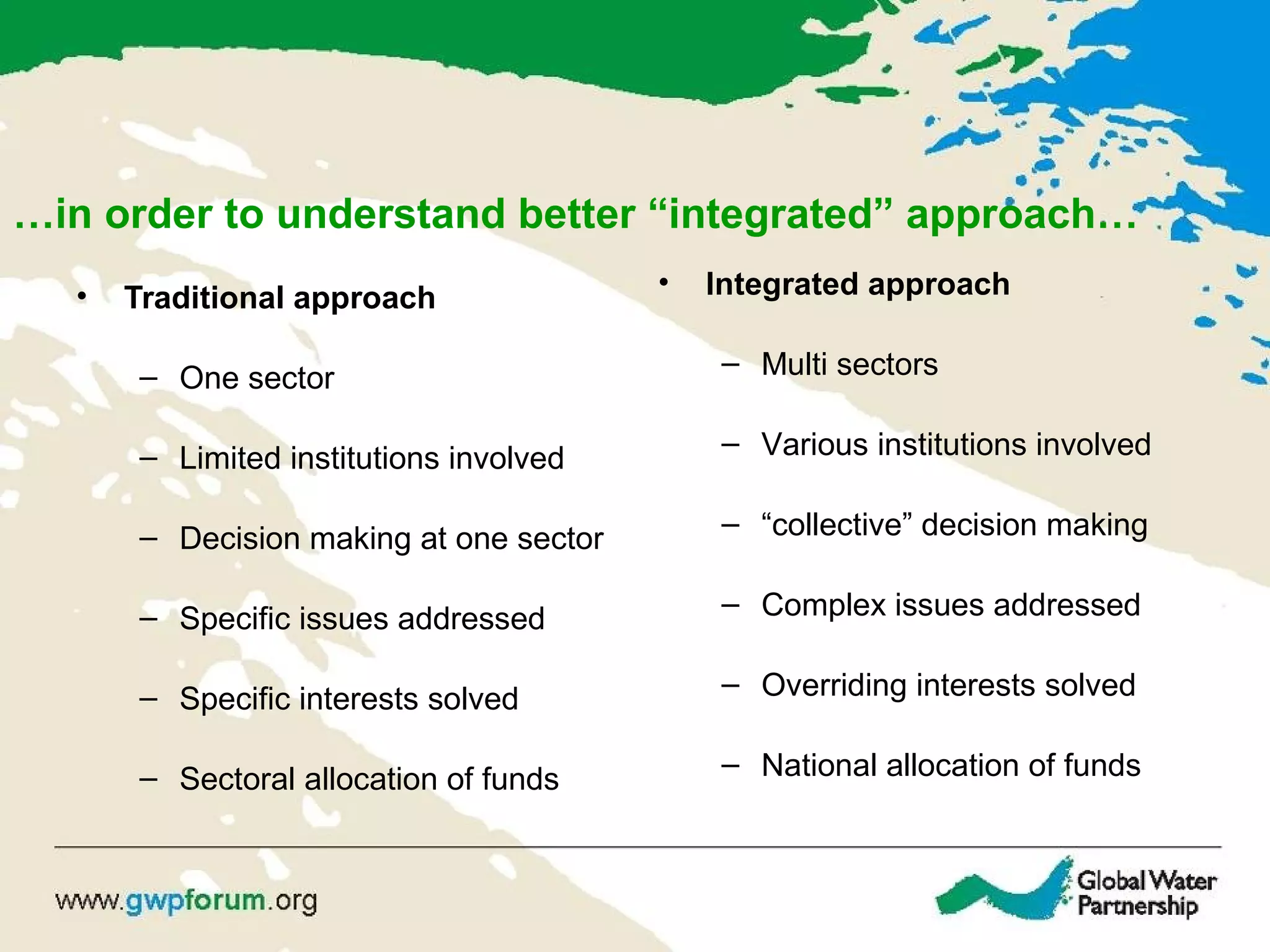
…in order to understand better “integrated” approach…
• Traditional approach
– One sector
– Limited institutions involved
– Decision making at one sector
– Specific issues addressed
– Specific interests solved
– Sectoral allocation of funds
• Integrated approach
– Multi sectors
– Various institutions involved
– “collective” decision making
– Complex issues addressed
– Overriding interests solved
– National allocation of funds
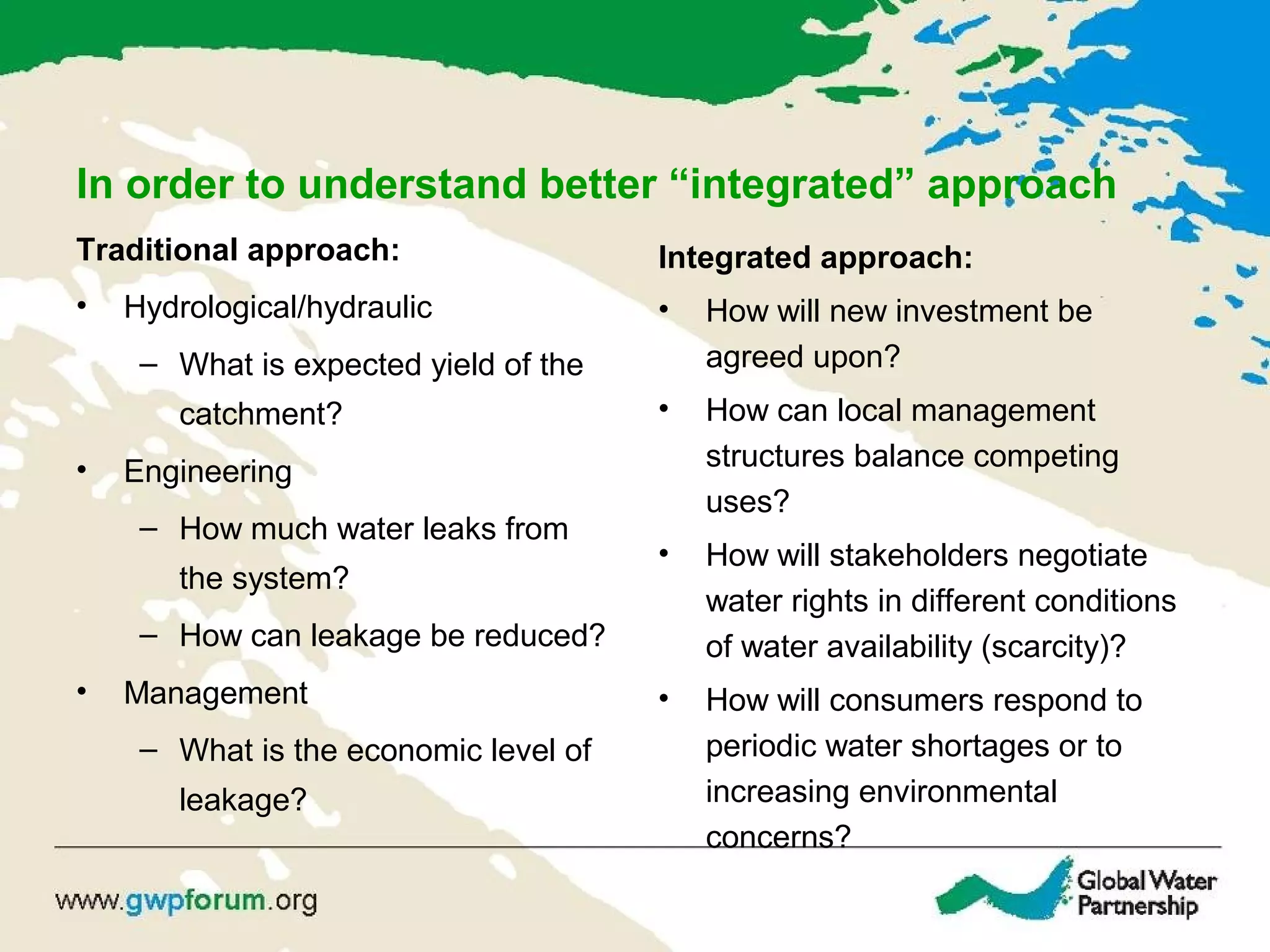
In order to understand better “integrated” approach
Traditional approach:
• Hydrological/hydraulic
– What is expected yield of the
catchment?
• Engineering
– How much water leaks from
the system?
– How can leakage be reduced?
• Management
– What is the economic level of
leakage?
Integrated approach:
• How will new investment be
agreed upon?
• How can local management
structures balance competing
uses?
• How will stakeholders negotiate
water rights in different conditions
of water availability (scarcity)?
• How will consumers respond to
periodic water shortages or to
increasing environmental
concerns?
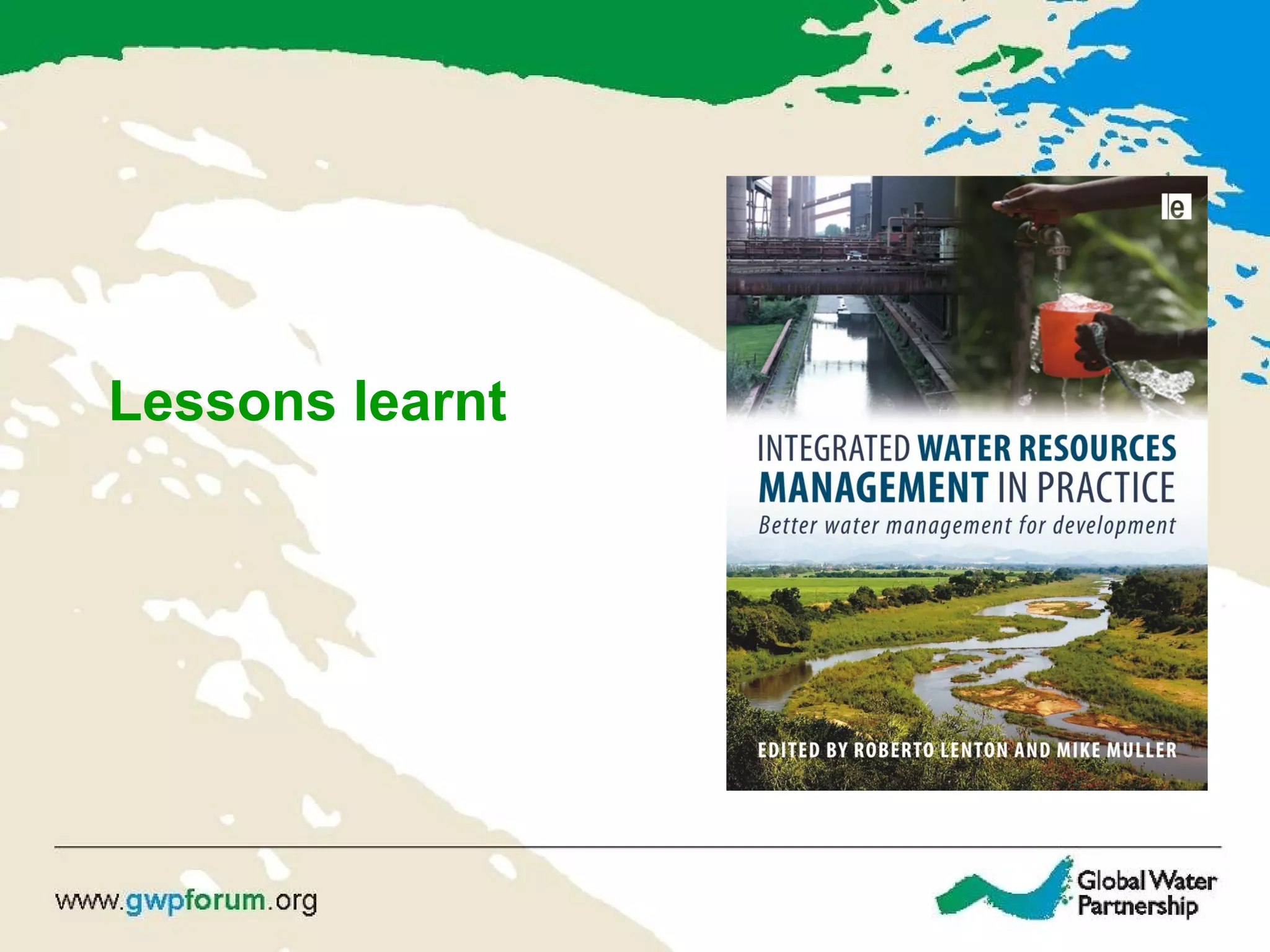
Lessons learnt
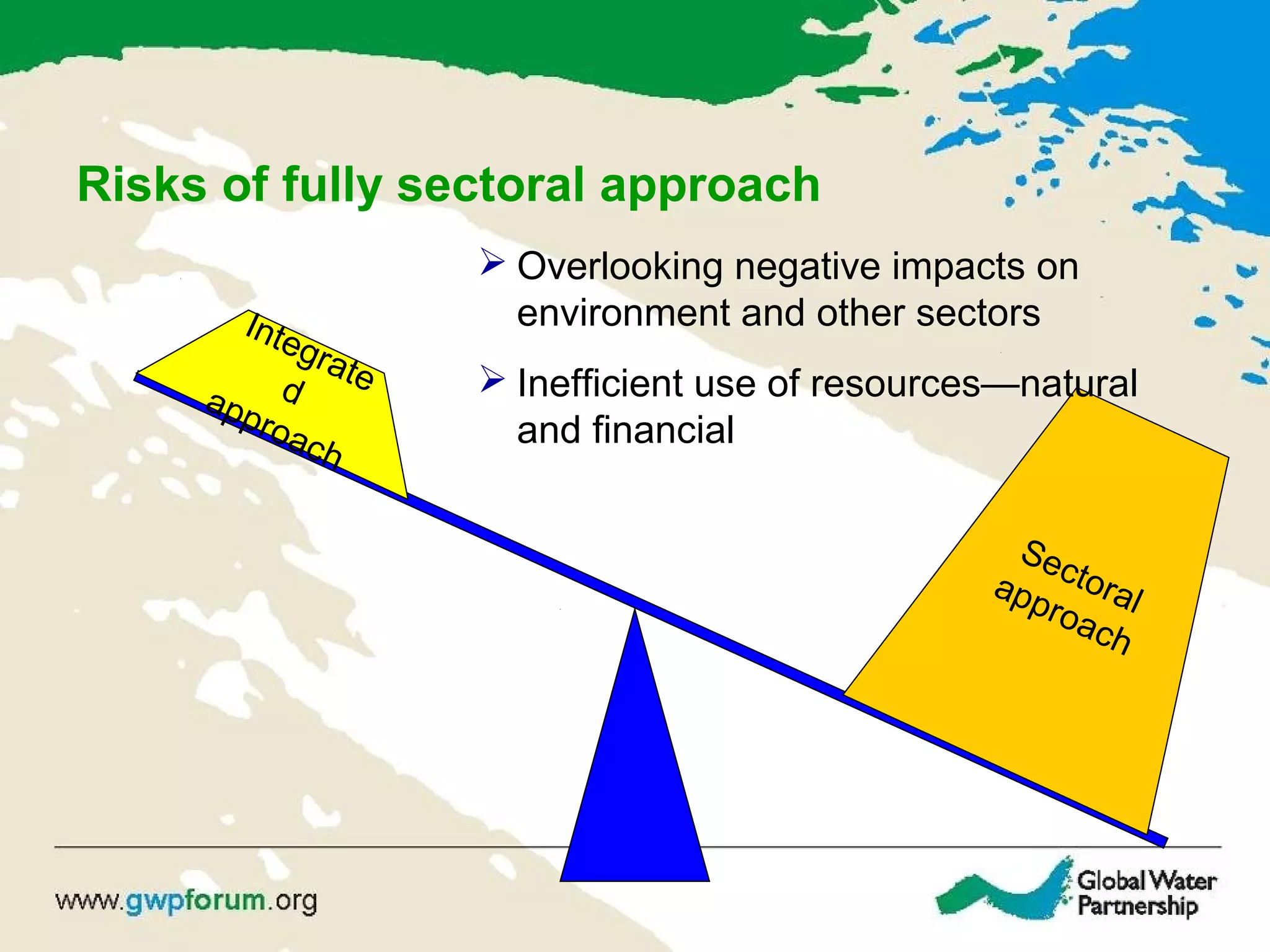
Risks of fully sectoral approach
Sectoralapproach
Integratedapproach
 Overlooking negative impacts on
environment and other sectors
 Inefficient use of resources—natural
and financial
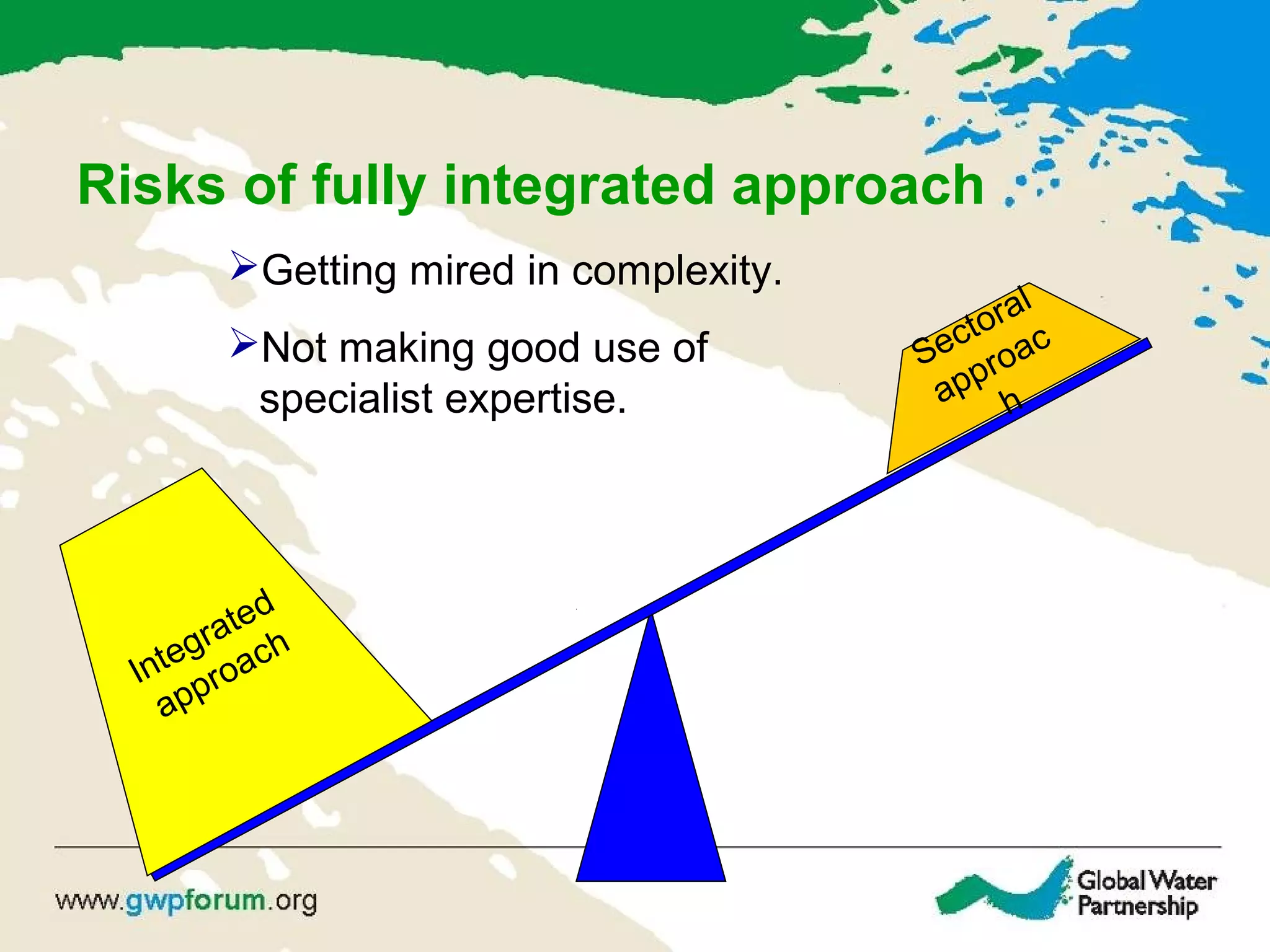
Risks of fully integrated approach
Sectoral
approac
h
Integrated
approach
Getting mired in complexity.
Not making good use of
specialist expertise.
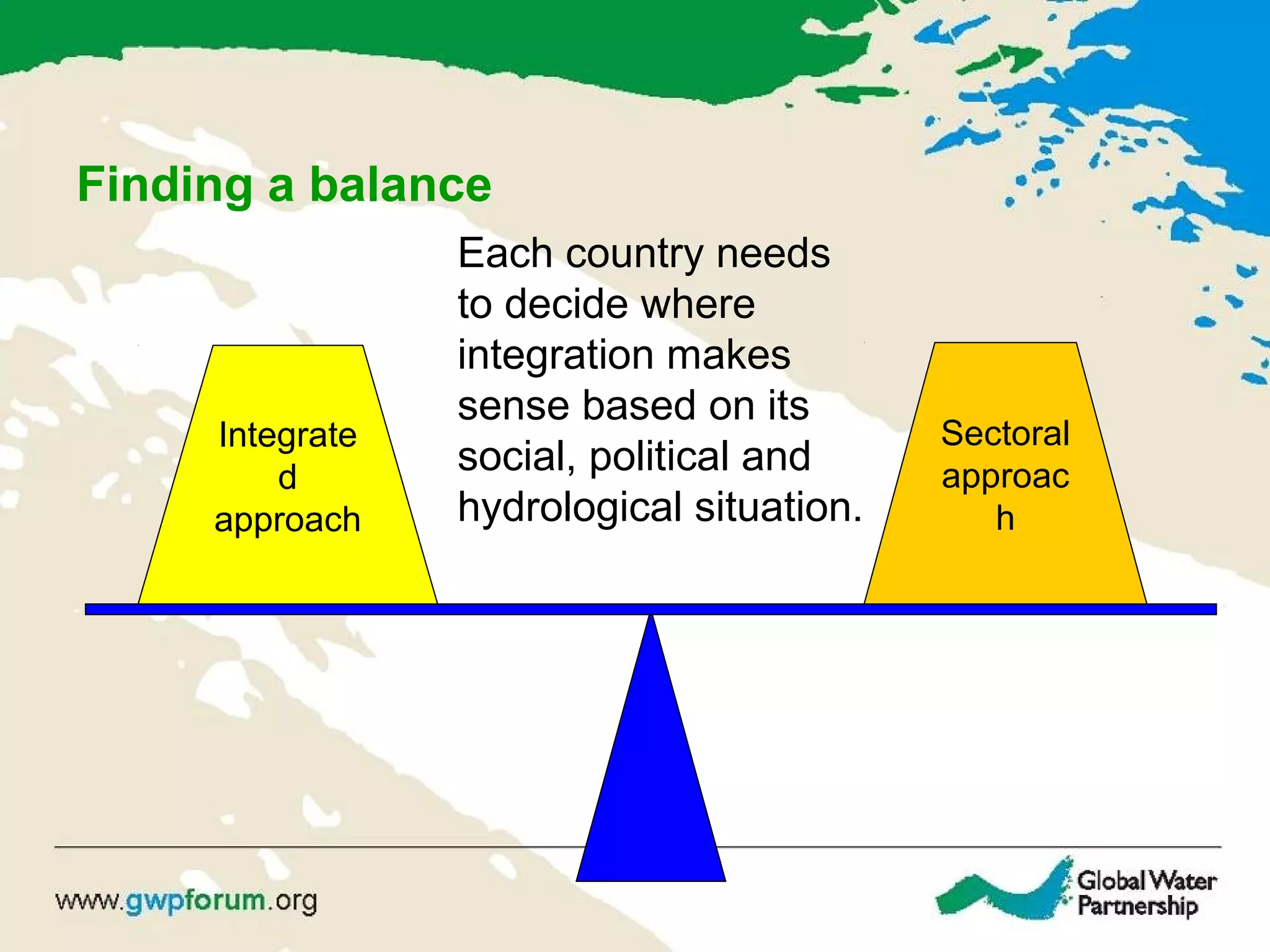
Finding a balance
Sectoral
approac
h
Integrate
d
approach
Each country needs
to decide where
integration makes
sense based on its
social, political and
hydrological situation.
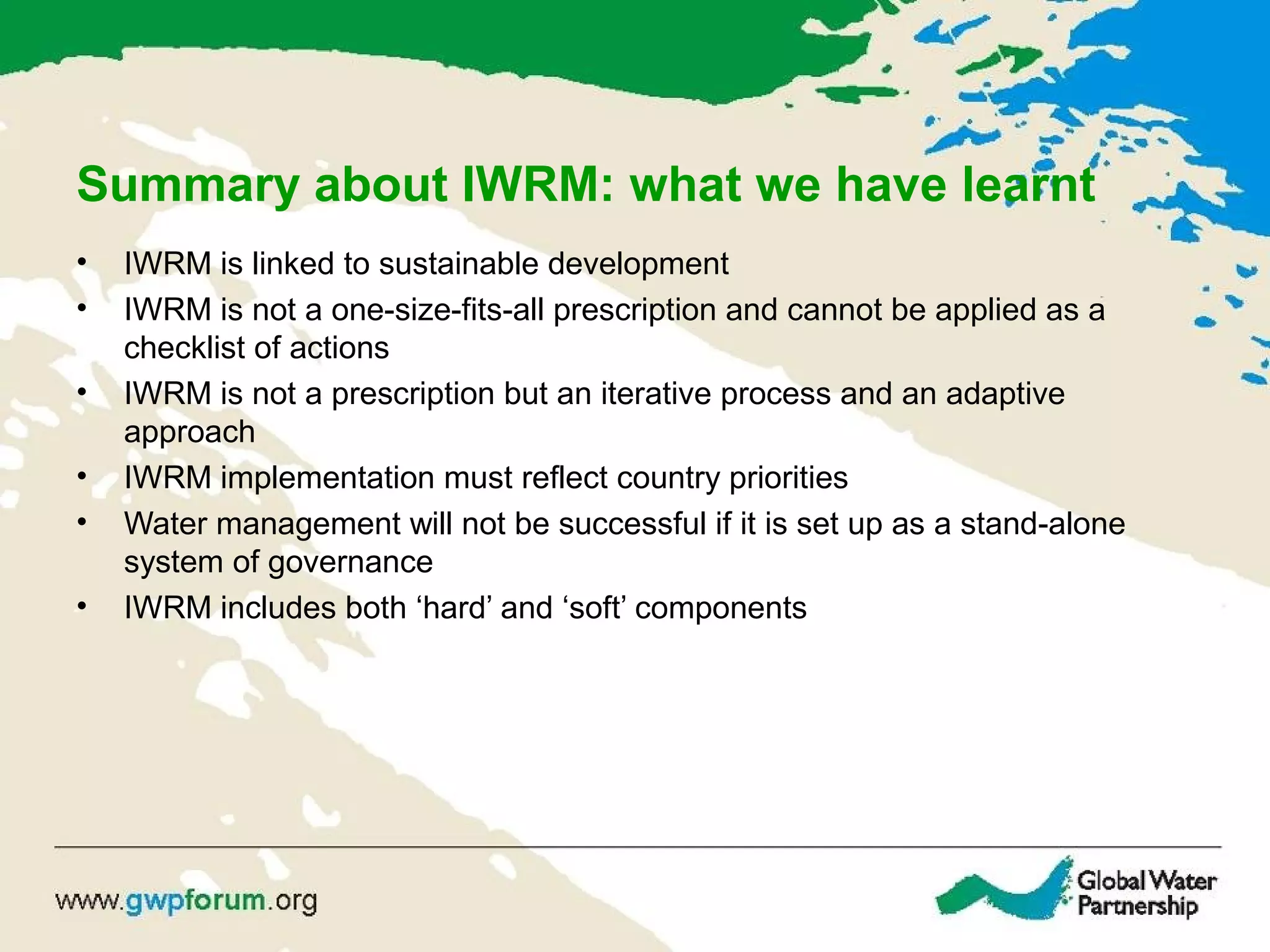
Summary about IWRM: what we have learnt
• IWRM is linked to sustainable development
• IWRM is not a one-size-fits-all prescription and cannot be applied as a
checklist of actions
• IWRM is not a prescription but an iterative process and an adaptive
approach
• IWRM implementation must reflect country priorities
• Water management will not be successful if it is set up as a stand-alone
system of governance
• IWRM includes both ‘hard’ and ‘soft’ components
•
THANK YOU

1 introduction iwrm_gwp_advocacy

  • 1.
    Introduction to IWRM SAURABHSINGH B.TEC CIVIL ENGINEERING A7615810020
  • 2.
    Before we start…. •The basis of IWRM is that different uses of water are interdependent • Integrated management means that all the different uses of water resources are considered together
  • 3.
  • 4.
    Driving forces onwater resources • Population growth: demands for more water and producing more waste water and pollution • Urbanization: migration from rural to urban areas which increases the current level of difficulty in water delivery and waste water treatment • Economic growth: mainly in developing countries with large populations contributes to increased demand for economic activities • Globalization of trade: production is relocated to “labor-cheap” areas that takes place without consideration for water resources • Climate variability: more intense floods and droughts increase vulnerability of people • Climate change: increase uncertainty about water cycle regimes WHICH OF THE FOLLOWING ISSUES ARE THE MAIN TOPICS IN YOUR JOB?
  • 5.
    IWRM concept is •an empirical concept which is built up from the on-the-ground experience of practitioners, • a flexible approach to water management that can adapt to diverse national and local contexts, • thus • it is not a scientific theory that needs to be proved or disproved by scholars. • and (but) • it requires policy-makers to make judgments about which reforms and measures, management tools and institutional arrangements are most appropriate in a particular cultural, social, political, economic and environmental context.
  • 6.
    IWRM definition IWRM isa process which promotes the coordinated development and management of water, land and related resources, in order to maximize the resultant economic and social welfare in an equitable manner without compromising the sustainability of vital ecosystems. GWP, TEC Background Paper No. 4: Integrated Water Resources Management
  • 7.
    IWRM: What does itreally mean? • More coordinated development and management of: – Land and water – Surface water and ground water – Upstream and downstream interests Discussion questions: Who should propose measures to protect against floods? Who should bear a cost to implement measures to mitigate floods?
  • 8.
    Key water resourcesmanagement functions • Water allocation • Pollution control • Monitoring • Financial management • Flood and drought management • Information management • Basin planning • Stakeholder participation IWRM
  • 9.
    Manage water resourceswithin a basin • What about international basins? • What about large distances within a basin (with disparate communities and institutions)? • How to manage a basin that has no monitoring network? • How to manage a basin where water supply and demand fluctuate both intra-seasonally and inter-annually? • How to manage a basin where authorities have a little access to financial, transport and technological capabilities?
  • 10.
    Three pillars ofIWRM • Implementing IWRM process is a question of getting the “three pillars” right: 1. Moving towards enabling environment of appropriate policies, strategies and legislation 2. Putting in place the institutional framework (through which policies can be implemented) 3. Setting up the management instruments required by these institutions to do their job
  • 11.
  • 12.
    Managing competing uses Waterfor people Water for food Water for nature Water for other uses Cross-sectoral integration • Enabling environment • Institutions • Management instruments
  • 13.
    Integrating across levelsand sectors National Basin Local Fisheries Envir onme nt Tourism Industry Finance Agriculture Energy Water
  • 14.
    IWRM PRINCIPLES • Freshwater is a finite and vulnerable resource, essential to sustain life, development and the environment. • Water development and management should be based on a participatory approach, involving users, planners and policymakers at all levels. • Women play a central part in the provision, management and safe- guarding of water. • Water has an economic value in all its competing uses and should be recognized as an economic good as well as social good. Dublin, 1992
  • 15.
    IWRM Principles • Freshwater is a finite and vulnerable resource, essential to sustain life, development and the environment.
  • 16.
  • 17.
    IWRM Principles • Waterdevelopment and management should be based on a participatory approach, involving users, planners and policymakers at all levels.
  • 18.
    Difficult to ensure“active involvement” 50 decision 200 work 2 000 participation 200 000 information 2 500 000 population How to make it?
  • 19.
    Pitfalls in puttingIWRM into practice Trying to establish management relations between too many variables risks getting mired in complexity at the expense of effectiveness. When putting IWRM into practice it’s important to think strategically about where and to what degree coordination and new management instruments are necessary.
  • 20.
    IWRM Principles • Womenplay a central part in the provision, management and safe- guarding of water
  • 21.
    IWRM Principles • Waterhas an economic value in all its competing uses and should be recognized as an economic good as well as social good – Water is becoming scarcer and its value rising – Recognition that costs should be borne by those who benefit Source: The Economist
  • 22.
    Arguments for treatingwater as an economic good: • Market-based approach will ensure that people are better stewards of water resources • Encourages conservation • Improves quality • Helps allocate water to maximize benefits Arguments for treating water as a human right: • Ensures water for all • Helps set priorities of water policy • Focuses attention on resolving water conflict • Helps safeguard other human rights
  • 23.
    Why IWRM? • Globallyaccepted and makes good sense. • Key element in national water policy. • Incorporates social and environmental considerations directly into policy and decision making. • Directly involves the stakeholders. • Is a tool for optimizing investments under tight financing climate.
  • 24.
  • 25.
    …in order tounderstand better “integrated” approach… • Traditional approach – One sector – Limited institutions involved – Decision making at one sector – Specific issues addressed – Specific interests solved – Sectoral allocation of funds • Integrated approach – Multi sectors – Various institutions involved – “collective” decision making – Complex issues addressed – Overriding interests solved – National allocation of funds
  • 26.
    In order tounderstand better “integrated” approach Traditional approach: • Hydrological/hydraulic – What is expected yield of the catchment? • Engineering – How much water leaks from the system? – How can leakage be reduced? • Management – What is the economic level of leakage? Integrated approach: • How will new investment be agreed upon? • How can local management structures balance competing uses? • How will stakeholders negotiate water rights in different conditions of water availability (scarcity)? • How will consumers respond to periodic water shortages or to increasing environmental concerns?
  • 27.
  • 28.
    Risks of fullysectoral approach Sectoralapproach Integratedapproach  Overlooking negative impacts on environment and other sectors  Inefficient use of resources—natural and financial
  • 29.
    Risks of fullyintegrated approach Sectoral approac h Integrated approach Getting mired in complexity. Not making good use of specialist expertise.
  • 30.
    Finding a balance Sectoral approac h Integrate d approach Eachcountry needs to decide where integration makes sense based on its social, political and hydrological situation.
  • 31.
    Summary about IWRM:what we have learnt • IWRM is linked to sustainable development • IWRM is not a one-size-fits-all prescription and cannot be applied as a checklist of actions • IWRM is not a prescription but an iterative process and an adaptive approach • IWRM implementation must reflect country priorities • Water management will not be successful if it is set up as a stand-alone system of governance • IWRM includes both ‘hard’ and ‘soft’ components
  • 32.

Editor's Notes

  • #14 [1 click - “and scales.” + pyramid on your click] Scales aspect of IWRM is often forgotten. But it is necessary in order to: Put into practice the 2nd Dublin Principle: Water development and management should be based on a participatory approach, involving users, planners and policy-makers at all levels. Achieve more efficient use of limited water resources Ensure decision-making is taking place at the lowest appropriate level. And that decisions made at local and river-basin levels are in-line with, or at least do not conflict with, the achievement of broader national objectives, and in turn, that national objectives reflect local needs. In some countries means more decentralized decision-making. E.g. In Thailand, where IWRM approach used to improve the responsiveness of water management to local conditions and to resolve conflicts that had arisen during phase of centralized water management. In others, means bumping some types of decisions up to the river basin or national level – for example decisions on water allocation frameworks.
  • #29 [2 clicks - 1 bullet point per click]
  • #30 [2 clicks - 1 bullet point per click]
  • #31 [No clicks]