Integrated Water Resources Management:
An Introduction
Presented by
Floyd Homer
fmhome@gmail.com
Objectives
■ To provide an introduction on key principles and themes
of Integrated Water Resources Management (IWRM).
■ To show IWRM’s key linkages to development and to
addressing poverty reduction, water and health, and
water and food (MDGs).
■ To enable application of IWRM principles for awareness
raising and capacity building in advising decision
makers.
About Water ….
■ A “Single” Resource – has no
substitute
■ A Limited Resource
■ A Scarce Resource (or is it?)
■ Has Social, Economic, and
Environmental Value (social and
environment are recent)
A Unique Resource
■ Every organism, individual, and
ecosystem on the planet depends on
water for survival.
■ Water impacts all aspects of life on the
planet
■ Poor water management and water
shortages can lead to disease,
malnutrition, reduced economic growth,
social instability, conflict, and
environmental disaster.
The Global Water Budget
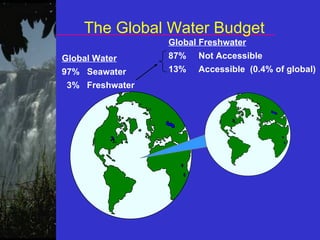
Global Water
97% Seawater
3% Freshwater
Global Freshwater
87% Not Accessible
13% Accessible (0.4% of global)
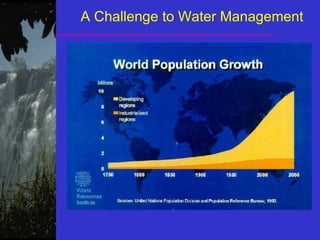
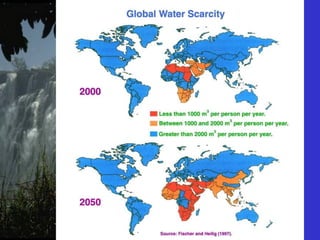
A Challenge to Water Management
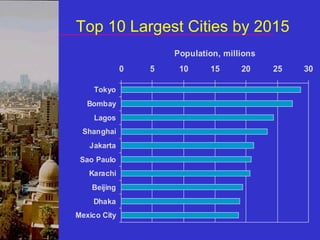
Top 10 Largest Cities by 2015
0 5 10 15 20 25 30
Tokyo
Bombay
Lagos
Shanghai
Jakarta
Sao Paulo
Karachi
Beijing
Dhaka
Mexico City
Population, millions
The Water Scene
■ Resources are scarce
■ Demands are outstripping supplies
■ Environmental/Ecological issues are
serious
■ Policy and institutional issues are
complicated
■ Current approach is sectoral and
fragmented
■ Financing is poor and options are
expensive
Where Are We Headed?
■ Decreasing per-capita availability
■ Degrading water quality
■ Increasing competition/conflict within sectors
and within society
 Urban versus agriculture
 Haves versus have nots
 Upstream versus downstream
 National versus international
■ Increasing competition/conflict with the
environment
Demand Sectors
■ Water for People – safe and reliable drinking
water supply, as well as sanitation.
■ Water for Food Production – irrigation,
wastewater reuse, and flood management
■ Water for Nature – rainwater infiltration,
groundwater recharge, river flow and aquatic
ecosystems maintenance
■ Water for Industry – manufacturing, cooling
systems and liquid waste disposal
■ Water for Emergencies – fire control and
drought relief
Water as a Global Issue
■ Water crisis has steadily moved
up the global agenda
■ The process is driven by
 water-related health impacts,
 rapid industrialization,
 water security, and
 awakening environmental
consciousness
The Paradigm Shift
The Dublin principles (1992)
■ Water is a single, finite resource
■ Water management and development
should include stakeholders
■ Water is an economic good
■ Women play a central role in
management and conservation of water
The Dublin Principles have served as
guide for the global water dialogue
Key Water Challenges and Needs
■ Integrated
management of
water
■ Water resources
economics
■ Political economy of
water
■ Water supply and
sanitation services
■ Irrigation/drainage
■ NRM and
environment
■ Water pricing and cost
recovery
■ Water entitlement and
rights
■ Water users
empowerment
■ Sharing of water and its
benefits
■ Cooperation and
conflict resolution
■ Energy
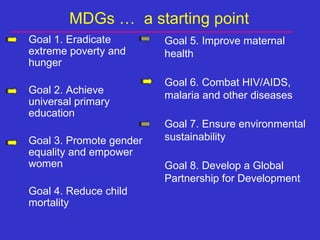
MDGs … a starting point
Goal 1. Eradicate
extreme poverty and
hunger
Goal 2. Achieve
universal primary
education
Goal 3. Promote gender
equality and empower
women
Goal 4. Reduce child
mortality
Goal 5. Improve maternal
health
Goal 6. Combat HIV/AIDS,
malaria and other diseases
Goal 7. Ensure environmental
sustainability
Goal 8. Develop a Global
Partnership for Development
■ Ad hoc
■ Economic Analysis -- Single Project
or Basin
■ Multi-Objective Planning
■ Comprehensive Multi-Purpose River
Basin Planning and Management
■ Strategic Planning and
Implementation through IWRM
Approaches to Water Management
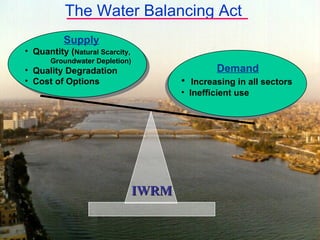
The Water Balancing Act
Demand
• Increasing in all sectors
• Inefficient use
Supply
• Quantity (Natural Scarcity,
Groundwater Depletion)
• Quality Degradation
• Cost of Options
IWRM
IWRM
Integrated Water Resources Management
A systematic process for managing water, land and
related resources in a way that meets society’s long-
term need for water while ensuring that economic
and social welfare are not compromised and that
there is no harm to the environment.
A coordinating framework for integrating and
implementing sectoral needs, water and water-
related policy, resource allocation, and management
of natural resources and environmental systems;
within the context of social, economic, and
environmental development objectives.
IWRM is about:
anaging water resources at the lowest possible
level.
anaging demand for water and optimising the
supply.
roviding equitable access to water resources by a
participatory approach.
stablishing policies to help manage water
resources.
Why IWRM?
■ Globally accepted and makes good
sense.
■ Key element in national water policy.
■ Incorporates social and environmental
considerations directly into policy and
decision making.
■ Directly involves the stakeholders.
■ Is a tool for optimizing investments
under tight financing climate.
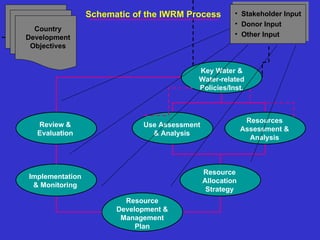
Key Water &
Water-related
Policies/Inst.
Resources
Assessment &
Analysis
Use Assessment
& Analysis
Resource
Development &
Management
Plan
Implementation
& Monitoring
Resource
Allocation
Strategy
Review &
Evaluation
Country
Development
Objectives
Schematic of the IWRM Process • Stakeholder Input
• Donor Input
• Other Input
IWRM can be characterized as:
■ A process, not a product
■ Scale independent - applies at all
levels of development
■ A tool for self assessment and
program evaluation
■ A tool for policy, planning, and
management
■ A mechanism for evaluating
competing demands, resource
allocation, and tradeoffs
IWRM in Practice
A. Enabling Environment
 Policies
 Legislative Framework
 Financing and Incentive Structures
B. Institutional Mechanism
 Institutional Framework
 Institutional Capacity Building
C. Management Instruments
 Water Resources Assessments
 Planning for IWRM
 Demand Management
 Social Change Instruments
 Economic Instruments
 Information and Communications
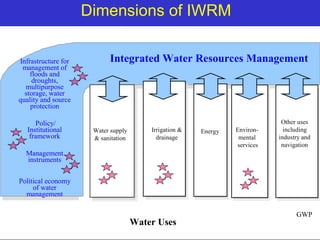
Dimensions of IWRM
Integrated Water Resources Management
Water supply
& sanitation
Irrigation &
drainage
Energy Environ-
mental
services
Infrastructure for
Infrastructure for
management of
management of
floods and
floods and
droughts,
droughts,
multipurpose
multipurpose
storage, water
storage, water
quality and source
quality and source
protection
protection
Policy/
Policy/
Institutional
Institutional
framework
framework
Management
Management
instruments
instruments
Political economy
Political economy
of water
of water
management
management
Other uses
including
industry and
navigation
Water Uses
GWP
Water Governance
• The GWP defines Water Governance as the
range of political, social, economic and
administrative systems that are in place to
develop and manage water resources and the
delivery of water services at different levels of
society.
• It is really the traditions and institutions by
which authority is exercised in a country.
Governance deals with who is really in charge
and how power is used to decide who gets
what and when.
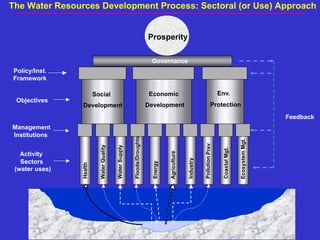
Governance
Health
Water
Quality
Water
Supply
Floods/Droughts
Energy
Agriculture
Industry
Pollution
Prev
Coastal
Mgt.
Ecosystem
Mgt.
Activity
Sectors
(water uses)
Social
Development
Economic
Development
Env.
Protection
Objectives
Policy/Inst.
Framework
Management
Institutions
Prosperity
The Water Resources Development Process: Sectoral (or Use) Approach
Feedback
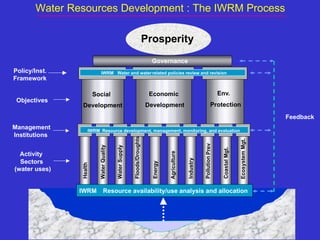
Governance
Health
Water
Quality
Water
Supply
Floods/Droughts
Energy
Agriculture
Industry
Pollution
Prev
Coastal
Mgt.
Ecosystem
Mgt.
Activity
Sectors
(water uses)
Social
Development
Economic
Development
Env.
Protection
Objectives
Policy/Inst.
Framework
Management
Institutions
Water Resources Development : The IWRM Process
Feedback
Prosperity
IWRM Water and waterrelated policies review and revision
IWRM Resource development, management, monitoring, and evaluation
IWRM Resource availability/use analysis and allocation
Barriers to IWRM
■ Willingness to change - Domestic water,
sanitation, agricultural water, etc. Are divided
over a several government departments, often
with little collaboration.
■ Lack of tools and systems for integration –
The challenge is finding effective tools and
processes to achieve greater coordination and
cooperation without incurring such high
transaction costs that the entire process
becomes wasteful.
Further Barriers
 A lack of both policy and the personnel to
implement it. Conflict between
decentralisation and the desire to maintain
central power and influence.
 The difficulty of getting the different sectors to
interact meaningfully for the common good.
 An unwillingness to deal with the
implications of the critical need for
reliability in domestic supplies, and the
implications this has on the availability of water
for other sectors, such as agriculture and
industry.
Influencing Change
■ Advocacy
■ Policy
■ Subsidiarity
■ Institutional development
■ Participatory management
THANK YOU…..
Questions or comments?

introduction to iwrm-111031100653-phpapp01.pdf

  • 1.
    Integrated Water ResourcesManagement: An Introduction Presented by Floyd Homer fmhome@gmail.com
  • 2.
    Objectives ■ To providean introduction on key principles and themes of Integrated Water Resources Management (IWRM). ■ To show IWRM’s key linkages to development and to addressing poverty reduction, water and health, and water and food (MDGs). ■ To enable application of IWRM principles for awareness raising and capacity building in advising decision makers.
  • 3.
    About Water …. ■A “Single” Resource – has no substitute ■ A Limited Resource ■ A Scarce Resource (or is it?) ■ Has Social, Economic, and Environmental Value (social and environment are recent)
  • 4.
    A Unique Resource ■Every organism, individual, and ecosystem on the planet depends on water for survival. ■ Water impacts all aspects of life on the planet ■ Poor water management and water shortages can lead to disease, malnutrition, reduced economic growth, social instability, conflict, and environmental disaster.
  • 5.
    The Global WaterBudget Global Water 97% Seawater 3% Freshwater Global Freshwater 87% Not Accessible 13% Accessible (0.4% of global)
  • 6.
    A Challenge toWater Management
  • 8.
    Top 10 LargestCities by 2015 0 5 10 15 20 25 30 Tokyo Bombay Lagos Shanghai Jakarta Sao Paulo Karachi Beijing Dhaka Mexico City Population, millions
  • 9.
    The Water Scene ■Resources are scarce ■ Demands are outstripping supplies ■ Environmental/Ecological issues are serious ■ Policy and institutional issues are complicated ■ Current approach is sectoral and fragmented ■ Financing is poor and options are expensive
  • 10.
    Where Are WeHeaded? ■ Decreasing per-capita availability ■ Degrading water quality ■ Increasing competition/conflict within sectors and within society  Urban versus agriculture  Haves versus have nots  Upstream versus downstream  National versus international ■ Increasing competition/conflict with the environment
  • 11.
    Demand Sectors ■ Waterfor People – safe and reliable drinking water supply, as well as sanitation. ■ Water for Food Production – irrigation, wastewater reuse, and flood management ■ Water for Nature – rainwater infiltration, groundwater recharge, river flow and aquatic ecosystems maintenance ■ Water for Industry – manufacturing, cooling systems and liquid waste disposal ■ Water for Emergencies – fire control and drought relief
  • 12.
    Water as aGlobal Issue ■ Water crisis has steadily moved up the global agenda ■ The process is driven by  water-related health impacts,  rapid industrialization,  water security, and  awakening environmental consciousness
  • 13.
    The Paradigm Shift TheDublin principles (1992) ■ Water is a single, finite resource ■ Water management and development should include stakeholders ■ Water is an economic good ■ Women play a central role in management and conservation of water The Dublin Principles have served as guide for the global water dialogue
  • 14.
    Key Water Challengesand Needs ■ Integrated management of water ■ Water resources economics ■ Political economy of water ■ Water supply and sanitation services ■ Irrigation/drainage ■ NRM and environment ■ Water pricing and cost recovery ■ Water entitlement and rights ■ Water users empowerment ■ Sharing of water and its benefits ■ Cooperation and conflict resolution ■ Energy
  • 15.
    MDGs … astarting point Goal 1. Eradicate extreme poverty and hunger Goal 2. Achieve universal primary education Goal 3. Promote gender equality and empower women Goal 4. Reduce child mortality Goal 5. Improve maternal health Goal 6. Combat HIV/AIDS, malaria and other diseases Goal 7. Ensure environmental sustainability Goal 8. Develop a Global Partnership for Development
  • 16.
    ■ Ad hoc ■Economic Analysis -- Single Project or Basin ■ Multi-Objective Planning ■ Comprehensive Multi-Purpose River Basin Planning and Management ■ Strategic Planning and Implementation through IWRM Approaches to Water Management
  • 17.
    The Water BalancingAct Demand • Increasing in all sectors • Inefficient use Supply • Quantity (Natural Scarcity, Groundwater Depletion) • Quality Degradation • Cost of Options IWRM IWRM
  • 18.
    Integrated Water ResourcesManagement A systematic process for managing water, land and related resources in a way that meets society’s long- term need for water while ensuring that economic and social welfare are not compromised and that there is no harm to the environment. A coordinating framework for integrating and implementing sectoral needs, water and water- related policy, resource allocation, and management of natural resources and environmental systems; within the context of social, economic, and environmental development objectives.
  • 19.
    IWRM is about: anagingwater resources at the lowest possible level. anaging demand for water and optimising the supply. roviding equitable access to water resources by a participatory approach. stablishing policies to help manage water resources.
  • 20.
    Why IWRM? ■ Globallyaccepted and makes good sense. ■ Key element in national water policy. ■ Incorporates social and environmental considerations directly into policy and decision making. ■ Directly involves the stakeholders. ■ Is a tool for optimizing investments under tight financing climate.
  • 21.
    Key Water & Water-related Policies/Inst. Resources Assessment& Analysis Use Assessment & Analysis Resource Development & Management Plan Implementation & Monitoring Resource Allocation Strategy Review & Evaluation Country Development Objectives Schematic of the IWRM Process • Stakeholder Input • Donor Input • Other Input
  • 22.
    IWRM can becharacterized as: ■ A process, not a product ■ Scale independent - applies at all levels of development ■ A tool for self assessment and program evaluation ■ A tool for policy, planning, and management ■ A mechanism for evaluating competing demands, resource allocation, and tradeoffs
  • 23.
    IWRM in Practice A.Enabling Environment  Policies  Legislative Framework  Financing and Incentive Structures B. Institutional Mechanism  Institutional Framework  Institutional Capacity Building C. Management Instruments  Water Resources Assessments  Planning for IWRM  Demand Management  Social Change Instruments  Economic Instruments  Information and Communications
  • 24.
    Dimensions of IWRM IntegratedWater Resources Management Water supply & sanitation Irrigation & drainage Energy Environ- mental services Infrastructure for Infrastructure for management of management of floods and floods and droughts, droughts, multipurpose multipurpose storage, water storage, water quality and source quality and source protection protection Policy/ Policy/ Institutional Institutional framework framework Management Management instruments instruments Political economy Political economy of water of water management management Other uses including industry and navigation Water Uses GWP
  • 25.
    Water Governance • TheGWP defines Water Governance as the range of political, social, economic and administrative systems that are in place to develop and manage water resources and the delivery of water services at different levels of society. • It is really the traditions and institutions by which authority is exercised in a country. Governance deals with who is really in charge and how power is used to decide who gets what and when.
  • 26.
  • 27.
    Governance Health Water Quality Water Supply Floods/Droughts Energy Agriculture Industry Pollution Prev Coastal Mgt. Ecosystem Mgt. Activity Sectors (water uses) Social Development Economic Development Env. Protection Objectives Policy/Inst. Framework Management Institutions Water ResourcesDevelopment : The IWRM Process Feedback Prosperity IWRM Water and waterrelated policies review and revision IWRM Resource development, management, monitoring, and evaluation IWRM Resource availability/use analysis and allocation
  • 28.
    Barriers to IWRM ■Willingness to change - Domestic water, sanitation, agricultural water, etc. Are divided over a several government departments, often with little collaboration. ■ Lack of tools and systems for integration – The challenge is finding effective tools and processes to achieve greater coordination and cooperation without incurring such high transaction costs that the entire process becomes wasteful.
  • 29.
    Further Barriers  Alack of both policy and the personnel to implement it. Conflict between decentralisation and the desire to maintain central power and influence.  The difficulty of getting the different sectors to interact meaningfully for the common good.  An unwillingness to deal with the implications of the critical need for reliability in domestic supplies, and the implications this has on the availability of water for other sectors, such as agriculture and industry.
  • 30.
    Influencing Change ■ Advocacy ■Policy ■ Subsidiarity ■ Institutional development ■ Participatory management
  • 31.