Presentation by
J.V. Raghavulu
Rtd. Superintending Engineer
Question
Question
1. What is potable water – Define
Question
Question
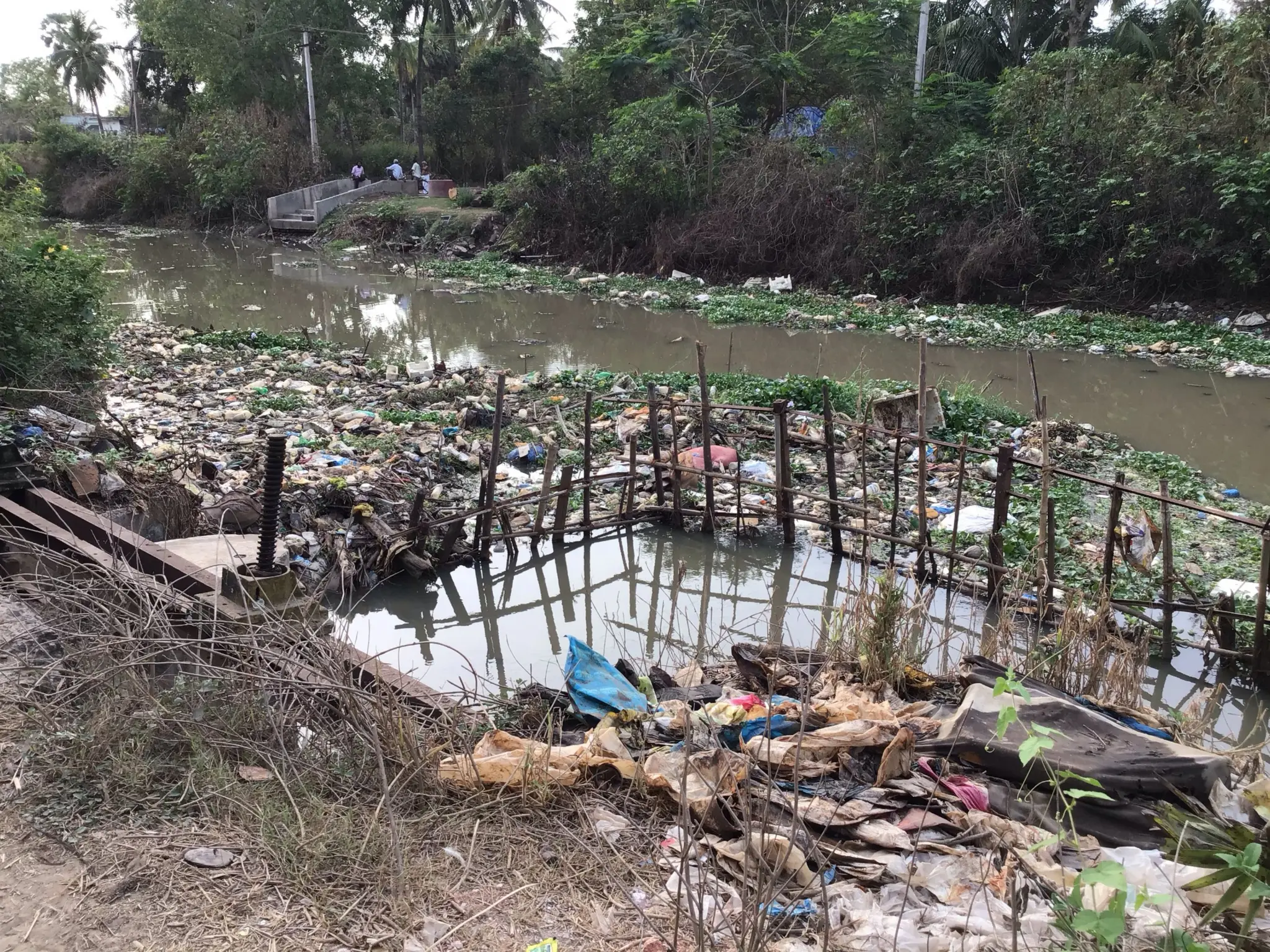
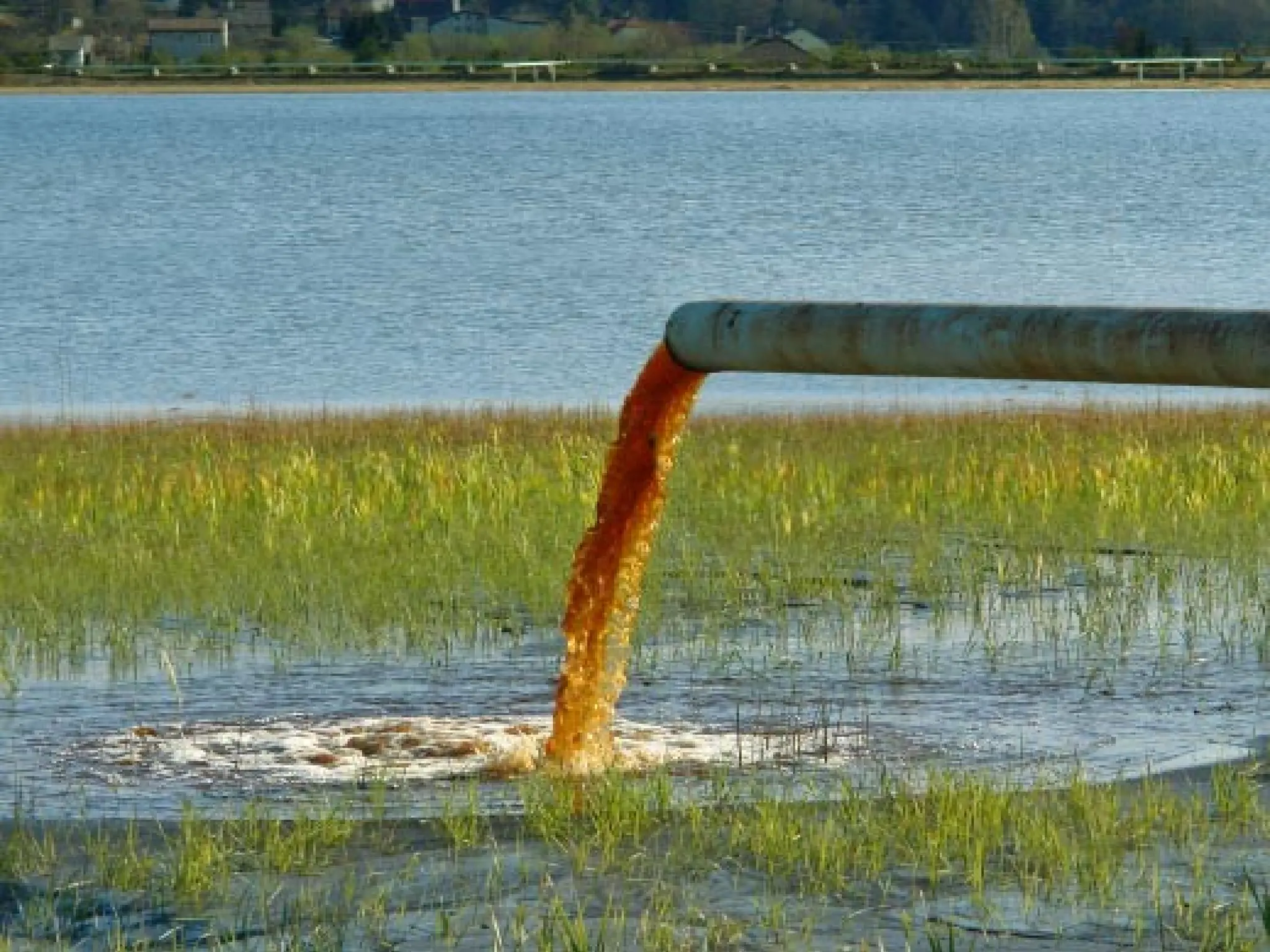
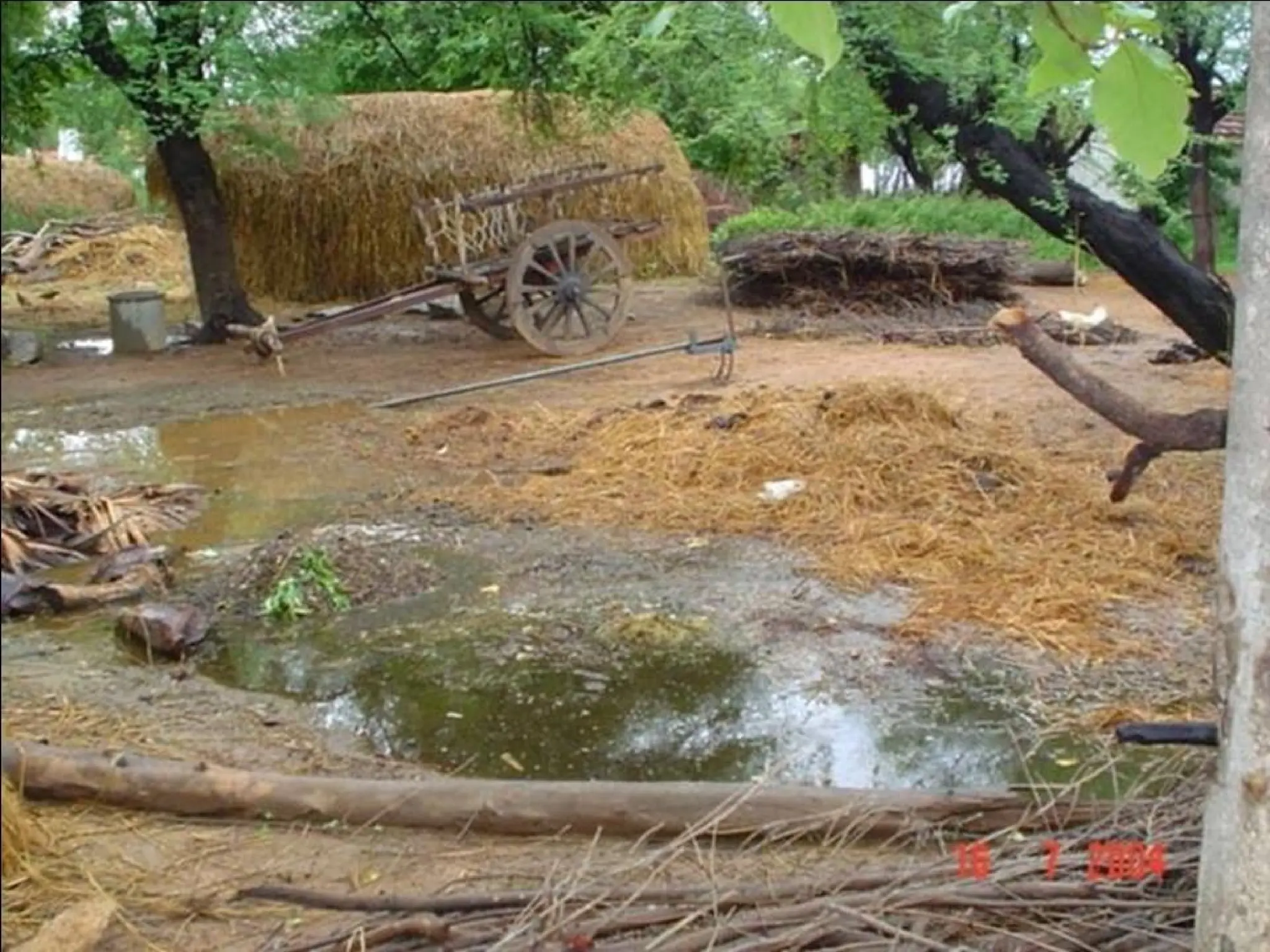
2. How water sources are getting polluted
in public supplies
Question
Question
3. Mention Various diseases occurring
through contaminated water
Question
Question
8. What are the bacteriological standards
of water as per code?
Question
Question
10. Mention chemical parameters and
desirable values of water
Earth’s Total Available Water
Oceans - 97.2 %
Glaciers - 2.15 %
Ground water - 0.625 %
Surface water - 0.071 %
Soil moisture - 0.005 %
Atmosphere - 0.0219 %
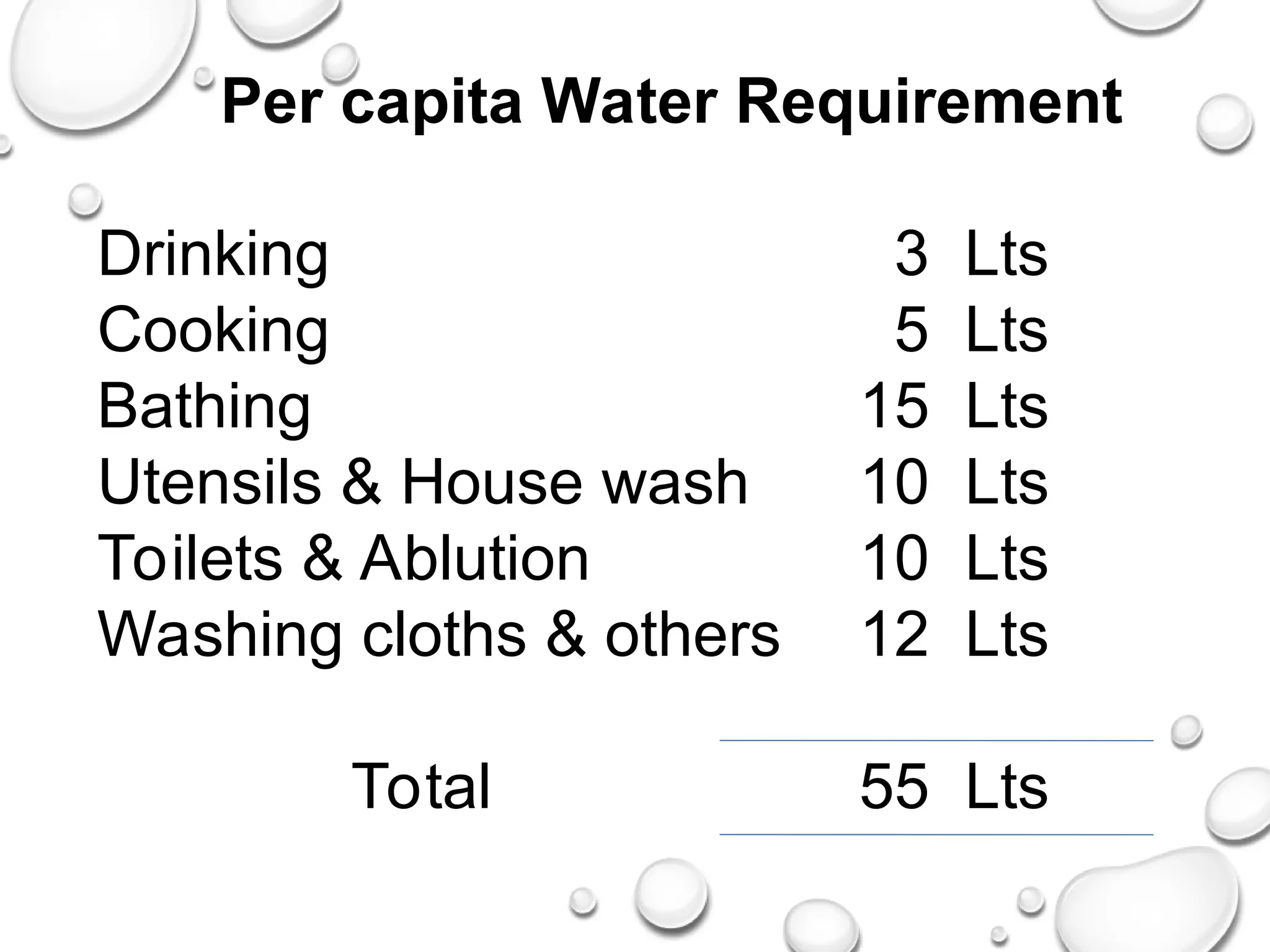
Per capita Water Requirement
Drinking 3 Lts
Cooking 5 Lts
Bathing 15 Lts
Utensils & House wash 10 Lts
Toilets & Ablution 10 Lts
Washing cloths & others 12 Lts
Total 55 Lts
Protected Water
Protected Water
Protected water or wholesome water or safe water
or potable water should be.
1.Free from Pathogenic organism.
2.Clear.
3.Not saline.
4.Free from offensive taste or smell.
5.Free from chemicals that adversely affect the
human health.
Functions of Water
Functions of Water
Water is one of the three most needed basic things for the
survival of human beings.
Functions :-
1. All the Chemical changes which occur into cells of the body
takes place in the presence of water.
2. Regulates body temperature.
3. It is the vehicle carrying nitrogenous material and salts to
the kidneys.
4. Water acts as a solvent for all to products of digestion,
holding them in solution – permitting to pass through intestinal
track walls.
5. 90% of water is present in the blood. It carries nutritious
elements to the cells.
6. It is required for life process, for functioning of all organs.
7. Water is an important lubricant, it prevents friction between
moving body parts.
WATER RELATED DISEASES
Water Born
1. Diarrhea
2. Cholera
3. Typhoid
4. Hepatitis A & E
Water Scarce
Water Scarce
1. Scabies (పొడి కురుపు / చర్మకురుపు)
2. Trachoma (కళ్ల వాపు రోగం)
3.Conjunctivitis (కన్నుఎర్రబారటం/కంటి
దద్దుర్లు)
4.Amoebiasis (జిగట విరేచనాలు)
5.Giardiasis
Water Based
Water Based
1.Guinea worm
2.Sistosomiasis (రక్తపురుగు వ్యాధి)
Water related
Water related
1.Malaria
2.Dengue
3.JE (జపనీస్
ఎన్‌
సెఫలైటిస్ /
జపనీస్ మెదడు వాపు రోగం)
HOW WATER IS GETTING
POLLUTED
POLLUTED
Bore wells
Bore wells
1.Chemical Contamination.
2.Platform damage / No platform.
3.Stagnation.
4.No drain.
Open wells
Open wells
1.Platform damage / No platform
2.Stagnation
3.Openings in steining upto 3.00m bgl
4.No parapet
5.Trees
6.Near to the fields
Schemes
Schemes
1.Pipeline Leaks and Valve leaks
2.Illegal connections
3.Pit tap connections
4.Cross drainages
5.OHSR Cleaning – opening of manhole covers
6.No lids for cisterns
Physical Parameters
Physical Parameters
1. COLOUR
2. ODOUR
3. TURBIDITY
4. TASTE
5. pH
6. Total dissolved salts
COLOUR
COLOUR
Colour produced are yellow, green, brown and navy due to:
• Decaying organic matter of vegetable or soil origin
• Colloidal and soluble iron and manganese
• Chromate waste which gives only yellow
BIS STANDARD
Acceptable limit - 5 Hazen units
Permissible limit - 15 Hazen units
Greater than 5 are objectionable in water used for
laundries, dairies, paper, textile and processing industries
TASTE
TASTE
• People have different sensitivities to taste
BIS standard Limit: Aggregable
Taste Possible sources
Salty High chloride & Na salts
Bitter Magnesium sulphate
Astringent Hard waters, iron & Mn
Sweet Organic matter
Metallic Fe, Mn, Cu & Zn
ODOUR
ODOUR
Source of Oduors can be due to:
•Presence of Hydrogen Sulphide in water due to septic
sewage, chemical and biological reduction of sulphates
•Contamination by organic matter from sewage, pit
toilets, soils and vegetation
•Contamination by chemicals from industrial sources or
treatment process
•Growth of algae, protozoa and fungi in water
•Contact with painted surfaces
BIS standard Limit: Aggregable
TURBIDITY
TURBIDITY
• Turbidity is measure of the transparency
or murkiness of water
• It is caused by Suspended solids such as
silt and clay, living or dead algae
Acceptable limit: 1 NTU
Permissible limit: 5 NTU
pH
pH
• It describes intensity of acidity or alkalinity
and defined as negative logarithm of
hydrogen ion concentration
• Water outside the range of pH 6 to 9 is
likely to be contaminated due to acidic or
alkaline wastes.
Acceptable limit: 6.5 to 8.5
Permissible limit: no relaxation
pH
pH
TOTAL DISSOLVED SOLIDS
• Dissolved minerals present in water
Acceptable limit is : 500 mg/L
Permissible limit is : 2000 mg/L
Chemical Parameters
Chemical Parameters
1. TOTAL ALKALINITY
2. TOTAL HARDNESS
3. CHLORIDE
4. CALCIUM
5. MAGNESIUM
6. SULPHATE
7. IRON
Total Alkalinity
Total Alkalinity
• The alkalinity in natural water due to the
salts of carbonate, bicarbonate, borates,
silicates and phosphates along with
hydroxyl ions in free state
BIS Standard:
Acceptable Limit : 200 mg/lit
Permissible Limit : 600 mg/lit
Total Hardness
Total Hardness
• Water hardness is the traditional measure of the
capacity of water to react with soap
• The principal hardness causing ions are Ca & Mg.
BIS Standard:
Acceptable limit: 200mg/lit
Permissible limit: 600mg/lit
Chloride
Chloride
• Chloride ion is generally present in natural waters
• Presence of chloride can be attributed in dissolution of
salts deposits, discharge of effluents from chemical
industries, irrigation drinage and sea water intrusion in
coastal areas
• High chloride value is deleterious effect on metallic
pipes and structures
BIS Standard:
Desirable limit: 250mg/lit
Permissible :1000 mg/lit
IRON
IRON
• Iron may be found as naturally occurring element in
surface and ground water
• It is considered an important part of every one’s diet
• Excess qty. of Iron gives bitter astringent taste to
water
• Excess iron in water will cause reddish brown
staining of laundry, dishes and utensils
• Food cooked in such water may also have slight
colour change
BIS Standard Limit :
Desirable : 0.3 mg/lit
Permissible : no relaxation
FLUORIDE
FLUORIDE
• Fluoride is naturally occurring ion in geological formation
• When water comes in contact with high fluoride containing rocks
the fluoride may get dissolved in water
• Excessive fluoride in water is extremely fatal, causing diseases like
Fluorosis, which effect teeth, skeletal & non skeletal parts of the
body
• Limitation of movement of joints and spine & inability to walk and
crippling
BIS Standard :
Acceptable limit: 0.5mg/lit
Permissible limit: 1.5 mg/lit
NITRATE
NITRATE
• Nitrate occurs elevated levels in ground water usually
result from human activities such as overuse of
chemical fertilizers and improper disposal of human
and animal wastes
• Nitrates are extremely soluble in water and can move
easily through soil into the drinking water
• Excess nitrates causes infantile methemoglobinemia
in infants
BIS Standard :
Acceptable limit : 45 mg/lit
Permissible limit : No relaxation
Bacteriological Parameters
Organism Requirements
All water intended for drinking
•E.coli or thermotolerant coliform
bacteria
•Shall not be detectable in any
100 ml sample
Treated water entering the
distribution system:
•E.coli or thermotolerant coliform
bacteria
•Total coliform bacteria
•Shall not be detectable in any
100 ml sample
•Shall not be detectable in any
100 ml sample
Treated water in the distribution
system
•E.coli or thermotolerant coliform
bacteria
•Total coliform bacteria
•Shall not be detectable in any
100 ml sample
•Shall not be detectable in any
100 ml sample
DRINKING WATER STANDARDS (IS 10500)
Sr. No Parameter
Bureau of Indian Standards
Desirable Limit Permissible Limit
1 Colour 5 Hazen units 15 Hazen units
2 Odour Agreeable Agreeable
3 Taste Agreeable Agreeable
4 Turbidity 1 NTU 5 NTU
5 pH Value 6.5 to 8.5 No relaxation
6 Total Hardness 200 mg/l 600 mg/l
7 Iron 0.3 No relaxation
8 Chloride 250 mg/l 1000 mg/l
9
Residual
Chlorine
0.2 mg/l 1 mg/l
10 Fluoride 1.0 mg/l 1.5 mg/l
11 Dissolved solids 500 mg/l 2000 mg/l
12 Calcium 75 mg/l 200 mg/l
13 Sulphate 200 mg/l 400 mg/l
14 Nitrate 45 mg/l No relaxation
15 Alkalinity 200 mg/l 600 mg/l
PARAMETERS BY FTK
PARAMETERS BY FTK
Chemical:
1. Turbidity
2. pH
3. Total Alkalinity
4. Chloride
5. Total hardness
6. Fluoride
7. Nitrate
8. Iron Test
9. Residual Chlorine
Bacteriological :
H2S Vial Test
COMPOSITIO COMPOSITION OF H S
₂ - STRIP
MEDIUM*
Peptone 20 g
Dipotassium Hydrogen PO₄ 1.5 g
Ferric Ammonium Citrate 0.75 g
Sodium thiosulphate 1 g
Teepol 1 ml
L-Cystiene HCl 0.25 g
Water 50 ml
* Concentrated 20x
DISINFECTION
DISINFECTION
Types of Disinfectants
Chemical
1. Chlorine and Chlorine Compounds.
2. Iodine.
3. Potassium Permanganate.
4. Ozone.
Non Chemical.
1. Boiling.
2. UV & Gamma Radiation.
Treatment with Ozone
1.Faintly blue gas.
2.Unstable allotropic form.
3. Produced by passing a high-tension electric
current through a stream of air in a closed
chamber.
4. Ozone and Chlorine are quite competitive
disinfectants.
5. Chlorine is however preferred and almost
universally adopted.
Treatment with Ozone
Advantages.
1. Being unstable, noting remains in water.
2. Ozonized water becomes tasty unlike chlorinated
water.
Disadvantages.
1. Much costlier than chlorination.
2. Power Supply required.
3. No residuals maintained – Best for bottling.
4. Cannot be supplied in Cylinders like chlorine –
requires Ozoniser plants to be installed.
UV Rays
UV Rays
1.invisible light rays.
2.They are basically found in sun light.
3.Produced by passing electric current through
Mercury enclosed in quartz bulb.
4. Highly effective in killing of all bacteria.
5.Water is passed several times around the quartz
bulbs emitting such rays.
6.Very costly – needs technical know.
7.Not suitable for large scale treatments.
Chlorine is best disinfectant
1. Chlorine in any form is most common disinfectants.
2. It destroys the enzymes, essential for the existence
of micro organism.
3. It destroys taste and colour producing constituents.
4. Controls Alge.
5. It also aids coagulation.
6. There is provision to check the residuals.
7. If residual remains in water it encounters further
contamination.
8. Invariably used throughout the world.
Forms of Chlorine Application
1.Chlorine Gas.
2.Chlorinated lime.
3.High test hypochlorite.
4.Sodium hypochlorite (Liquid chlorine)
5.Chlorine dioxide.
CHLORINE DEMAND
CHLORINE DEMAND
Types of Chlorination
1.Plain chlorination.
2.Pre chlorination.
3.Post chlorination.
4.Break point - chlorination.
5.Super chlorination.
6.De chlorination.
Testing of Chlorine Residuals
1. Orthotolidine
2. OTA
3. DPD Test Diethyle – Phenyle – Diamine
4. Starch Iodide Test
Thank You
Thank You

water quality on sustainable water source.ppt

  • 1.
    Presentation by J.V. Raghavulu Rtd.Superintending Engineer
  • 2.
    Question Question 1. What ispotable water – Define
  • 3.
    Question Question 2. How watersources are getting polluted in public supplies
  • 4.
    Question Question 3. Mention Variousdiseases occurring through contaminated water
  • 5.
    Question Question 8. What arethe bacteriological standards of water as per code?
  • 6.
    Question Question 10. Mention chemicalparameters and desirable values of water
  • 8.
    Earth’s Total AvailableWater Earth’s Total Available Water Oceans - 97.2 % Glaciers - 2.15 % Ground water - 0.625 % Surface water - 0.071 % Soil moisture - 0.005 % Atmosphere - 0.0219 %
  • 9.
    Per capita WaterRequirement Drinking 3 Lts Cooking 5 Lts Bathing 15 Lts Utensils & House wash 10 Lts Toilets & Ablution 10 Lts Washing cloths & others 12 Lts Total 55 Lts
  • 10.
    Protected Water Protected Water Protectedwater or wholesome water or safe water or potable water should be. 1.Free from Pathogenic organism. 2.Clear. 3.Not saline. 4.Free from offensive taste or smell. 5.Free from chemicals that adversely affect the human health.
  • 11.
    Functions of Water Functionsof Water Water is one of the three most needed basic things for the survival of human beings. Functions :- 1. All the Chemical changes which occur into cells of the body takes place in the presence of water. 2. Regulates body temperature. 3. It is the vehicle carrying nitrogenous material and salts to the kidneys. 4. Water acts as a solvent for all to products of digestion, holding them in solution – permitting to pass through intestinal track walls. 5. 90% of water is present in the blood. It carries nutritious elements to the cells. 6. It is required for life process, for functioning of all organs. 7. Water is an important lubricant, it prevents friction between moving body parts.
  • 12.
  • 13.
    Water Born 1. Diarrhea 2.Cholera 3. Typhoid 4. Hepatitis A & E
  • 14.
    Water Scarce Water Scarce 1.Scabies (పొడి కురుపు / చర్మకురుపు) 2. Trachoma (కళ్ల వాపు రోగం) 3.Conjunctivitis (కన్నుఎర్రబారటం/కంటి దద్దుర్లు) 4.Amoebiasis (జిగట విరేచనాలు) 5.Giardiasis
  • 15.
    Water Based Water Based 1.Guineaworm 2.Sistosomiasis (రక్తపురుగు వ్యాధి)
  • 16.
    Water related Water related 1.Malaria 2.Dengue 3.JE(జపనీస్ ఎన్‌ సెఫలైటిస్ / జపనీస్ మెదడు వాపు రోగం)
  • 17.
    HOW WATER ISGETTING HOW WATER IS GETTING POLLUTED POLLUTED
  • 23.
    Bore wells Bore wells 1.ChemicalContamination. 2.Platform damage / No platform. 3.Stagnation. 4.No drain.
  • 24.
    Open wells Open wells 1.Platformdamage / No platform 2.Stagnation 3.Openings in steining upto 3.00m bgl 4.No parapet 5.Trees 6.Near to the fields
  • 25.
    Schemes Schemes 1.Pipeline Leaks andValve leaks 2.Illegal connections 3.Pit tap connections 4.Cross drainages 5.OHSR Cleaning – opening of manhole covers 6.No lids for cisterns
  • 31.
    Physical Parameters Physical Parameters 1.COLOUR 2. ODOUR 3. TURBIDITY 4. TASTE 5. pH 6. Total dissolved salts
  • 32.
    COLOUR COLOUR Colour produced areyellow, green, brown and navy due to: • Decaying organic matter of vegetable or soil origin • Colloidal and soluble iron and manganese • Chromate waste which gives only yellow BIS STANDARD Acceptable limit - 5 Hazen units Permissible limit - 15 Hazen units Greater than 5 are objectionable in water used for laundries, dairies, paper, textile and processing industries
  • 33.
    TASTE TASTE • People havedifferent sensitivities to taste BIS standard Limit: Aggregable Taste Possible sources Salty High chloride & Na salts Bitter Magnesium sulphate Astringent Hard waters, iron & Mn Sweet Organic matter Metallic Fe, Mn, Cu & Zn
  • 34.
    ODOUR ODOUR Source of Oduorscan be due to: •Presence of Hydrogen Sulphide in water due to septic sewage, chemical and biological reduction of sulphates •Contamination by organic matter from sewage, pit toilets, soils and vegetation •Contamination by chemicals from industrial sources or treatment process •Growth of algae, protozoa and fungi in water •Contact with painted surfaces BIS standard Limit: Aggregable
  • 35.
    TURBIDITY TURBIDITY • Turbidity ismeasure of the transparency or murkiness of water • It is caused by Suspended solids such as silt and clay, living or dead algae Acceptable limit: 1 NTU Permissible limit: 5 NTU
  • 36.
    pH pH • It describesintensity of acidity or alkalinity and defined as negative logarithm of hydrogen ion concentration • Water outside the range of pH 6 to 9 is likely to be contaminated due to acidic or alkaline wastes. Acceptable limit: 6.5 to 8.5 Permissible limit: no relaxation
  • 37.
  • 38.
    TOTAL DISSOLVED SOLIDS TOTALDISSOLVED SOLIDS • Dissolved minerals present in water Acceptable limit is : 500 mg/L Permissible limit is : 2000 mg/L
  • 39.
    Chemical Parameters Chemical Parameters 1.TOTAL ALKALINITY 2. TOTAL HARDNESS 3. CHLORIDE 4. CALCIUM 5. MAGNESIUM 6. SULPHATE 7. IRON
  • 40.
    Total Alkalinity Total Alkalinity •The alkalinity in natural water due to the salts of carbonate, bicarbonate, borates, silicates and phosphates along with hydroxyl ions in free state BIS Standard: Acceptable Limit : 200 mg/lit Permissible Limit : 600 mg/lit
  • 41.
    Total Hardness Total Hardness •Water hardness is the traditional measure of the capacity of water to react with soap • The principal hardness causing ions are Ca & Mg. BIS Standard: Acceptable limit: 200mg/lit Permissible limit: 600mg/lit
  • 42.
    Chloride Chloride • Chloride ionis generally present in natural waters • Presence of chloride can be attributed in dissolution of salts deposits, discharge of effluents from chemical industries, irrigation drinage and sea water intrusion in coastal areas • High chloride value is deleterious effect on metallic pipes and structures BIS Standard: Desirable limit: 250mg/lit Permissible :1000 mg/lit
  • 43.
    IRON IRON • Iron maybe found as naturally occurring element in surface and ground water • It is considered an important part of every one’s diet • Excess qty. of Iron gives bitter astringent taste to water • Excess iron in water will cause reddish brown staining of laundry, dishes and utensils • Food cooked in such water may also have slight colour change BIS Standard Limit : Desirable : 0.3 mg/lit Permissible : no relaxation
  • 44.
    FLUORIDE FLUORIDE • Fluoride isnaturally occurring ion in geological formation • When water comes in contact with high fluoride containing rocks the fluoride may get dissolved in water • Excessive fluoride in water is extremely fatal, causing diseases like Fluorosis, which effect teeth, skeletal & non skeletal parts of the body • Limitation of movement of joints and spine & inability to walk and crippling BIS Standard : Acceptable limit: 0.5mg/lit Permissible limit: 1.5 mg/lit
  • 45.
    NITRATE NITRATE • Nitrate occurselevated levels in ground water usually result from human activities such as overuse of chemical fertilizers and improper disposal of human and animal wastes • Nitrates are extremely soluble in water and can move easily through soil into the drinking water • Excess nitrates causes infantile methemoglobinemia in infants BIS Standard : Acceptable limit : 45 mg/lit Permissible limit : No relaxation
  • 46.
    Bacteriological Parameters Organism Requirements Allwater intended for drinking •E.coli or thermotolerant coliform bacteria •Shall not be detectable in any 100 ml sample Treated water entering the distribution system: •E.coli or thermotolerant coliform bacteria •Total coliform bacteria •Shall not be detectable in any 100 ml sample •Shall not be detectable in any 100 ml sample Treated water in the distribution system •E.coli or thermotolerant coliform bacteria •Total coliform bacteria •Shall not be detectable in any 100 ml sample •Shall not be detectable in any 100 ml sample
  • 47.
    DRINKING WATER STANDARDS(IS 10500) DRINKING WATER STANDARDS (IS 10500) Sr. No Parameter Bureau of Indian Standards Desirable Limit Permissible Limit 1 Colour 5 Hazen units 15 Hazen units 2 Odour Agreeable Agreeable 3 Taste Agreeable Agreeable 4 Turbidity 1 NTU 5 NTU 5 pH Value 6.5 to 8.5 No relaxation 6 Total Hardness 200 mg/l 600 mg/l 7 Iron 0.3 No relaxation 8 Chloride 250 mg/l 1000 mg/l 9 Residual Chlorine 0.2 mg/l 1 mg/l 10 Fluoride 1.0 mg/l 1.5 mg/l 11 Dissolved solids 500 mg/l 2000 mg/l 12 Calcium 75 mg/l 200 mg/l 13 Sulphate 200 mg/l 400 mg/l 14 Nitrate 45 mg/l No relaxation 15 Alkalinity 200 mg/l 600 mg/l
  • 48.
    PARAMETERS BY FTK PARAMETERSBY FTK Chemical: 1. Turbidity 2. pH 3. Total Alkalinity 4. Chloride 5. Total hardness 6. Fluoride 7. Nitrate 8. Iron Test 9. Residual Chlorine Bacteriological : H2S Vial Test
  • 49.
    COMPOSITIO COMPOSITION OFH S ₂ - STRIP MEDIUM* Peptone 20 g Dipotassium Hydrogen PO₄ 1.5 g Ferric Ammonium Citrate 0.75 g Sodium thiosulphate 1 g Teepol 1 ml L-Cystiene HCl 0.25 g Water 50 ml * Concentrated 20x
  • 50.
  • 51.
    Types of Disinfectants Typesof Disinfectants Chemical 1. Chlorine and Chlorine Compounds. 2. Iodine. 3. Potassium Permanganate. 4. Ozone. Non Chemical. 1. Boiling. 2. UV & Gamma Radiation.
  • 52.
    Treatment with Ozone 1.Faintlyblue gas. 2.Unstable allotropic form. 3. Produced by passing a high-tension electric current through a stream of air in a closed chamber. 4. Ozone and Chlorine are quite competitive disinfectants. 5. Chlorine is however preferred and almost universally adopted.
  • 53.
    Treatment with Ozone Advantages. 1.Being unstable, noting remains in water. 2. Ozonized water becomes tasty unlike chlorinated water. Disadvantages. 1. Much costlier than chlorination. 2. Power Supply required. 3. No residuals maintained – Best for bottling. 4. Cannot be supplied in Cylinders like chlorine – requires Ozoniser plants to be installed.
  • 54.
    UV Rays UV Rays 1.invisiblelight rays. 2.They are basically found in sun light. 3.Produced by passing electric current through Mercury enclosed in quartz bulb. 4. Highly effective in killing of all bacteria. 5.Water is passed several times around the quartz bulbs emitting such rays. 6.Very costly – needs technical know. 7.Not suitable for large scale treatments.
  • 55.
    Chlorine is bestdisinfectant Chlorine is best disinfectant 1. Chlorine in any form is most common disinfectants. 2. It destroys the enzymes, essential for the existence of micro organism. 3. It destroys taste and colour producing constituents. 4. Controls Alge. 5. It also aids coagulation. 6. There is provision to check the residuals. 7. If residual remains in water it encounters further contamination. 8. Invariably used throughout the world.
  • 56.
    Forms of ChlorineApplication Forms of Chlorine Application 1.Chlorine Gas. 2.Chlorinated lime. 3.High test hypochlorite. 4.Sodium hypochlorite (Liquid chlorine) 5.Chlorine dioxide.
  • 57.
  • 58.
    Types of Chlorination 1.Plainchlorination. 2.Pre chlorination. 3.Post chlorination. 4.Break point - chlorination. 5.Super chlorination. 6.De chlorination.
  • 59.
    Testing of ChlorineResiduals Testing of Chlorine Residuals 1. Orthotolidine 2. OTA 3. DPD Test Diethyle – Phenyle – Diamine 4. Starch Iodide Test
  • 60.