PUBLIC HEALTH CHEMISTRY
WATER ANALYSIS –
THE NEED OF THE HOUR
Dr. R. VALLIAPPAN,
Professor
Department of Chemistry,
Annamalai University,
Annamalai nagar 608 002.
Email: rmvs1962@yahoo.com. Cell: 98420 87465
Objectives of the presentation
• Definition for public health Chemistry
• Introduction
• Need of the hour
• Area of research with “Water”
• - Physical Chemistry – kinetics of reaction
• - inorganic Chemistry – Quality & Quantity
• - organic Chemistry – pollution and contamination
Water … Water … Water …
Everywhere.. Which one is
suitable for drinking?
Potable water
Mineral water
Distilled water
Sterilized water
Deionised water
Wholesome water
Introduction
Water is a priceless, worthless commodity, a
blessing or curse depending on circumstances.
But without water there is no life. All life on earth
depends on water. Nothing can take the place of
water.
It is the duty of the Government to ensure the
continuous supply of clean and safe drinking water
for the public health protection at a free of cost.
• “Water is life’s mater and matrix, mother
and medium. There is no life without
water.” -Albert Szent-Gyorgyi
• Water is life, however not all water is safe
for human standards.
• Water samples can provide a lot of
information on a water source such as
nutrient content, pollution detection and
bacterial counts.
Water
• Home owners take samples of their drinking
water for health concerns.
• Ranchers and farmers may sample their
wells for livestock and pasture management
issues.
• State officials may test for water recreation
and fishing reasons.
• No matter what the water is being used for, if
it will impact humans in some way it needs to
be tested
Water is never pure in the true chemical
sense. It is aways found to contain unwanted
impurities in it.
The impurities may be dissolved and
suspended. Another more important and
serious impurity is brought into the water
source by human activity namely
urbanization and industrialization. Because of
these pollution and contamination of water
happens.
Introduction
• Water plays a significant role in maintaining the human health and
welfare. Clean drinking water is now recognised as a fundamental
right of human beings. Around 780 million people do not have
access to clean and safe water and around 2.5 billion people do
not have proper sanitation. As a result, around 6–8 million people
die each year due to water related diseases and disasters
• Therefore, water quality control is a top-priority policy agenda in
many parts of the world.
• In the today world, the water use in household supplies is
commonly defined as domestic water. This water is processed to
be safely consumed as drinking water and other purposes. Water
quality and suitability for use are determined by its taste, odor,
colour, and concentration of organic and inorganic matters.
• Contaminants in the water can affect the water quality and
consequently the human health. The potential sources of water
contamination are geological conditions, industrial and agricultural
activities, and water treatment plants. These contaminants are
further categorized as microorganisms, inorganics, organics,
radionuclides, and disinfectants.
• Till the 19th century pollution of water
assessed from the results of physical and
chemical analysis.
• The discovery of bacteria and the viruses as
the causative agents of many enteric
disorders, a delegate indication of pollution
has evolved.
• Assessments have to be made of
physicochemical and bacteriological
characteristics to establish pollution and
suitability of water for use either in industries
or potable purposes.
Hazards of pollution and contaminations
• Man’s health may be affected either directly
or indirectly by the polluted and contaminated
water.
• The hazards may be chemical or biological
• Chemical - indirect way of affecting both
human and environment – Nitrites/Nitrates
• Biological – direct – water borne diseases
Water may be free from
• Physical qualities – Turbidity, colour, odour
and Taste
• Chemical qualities – Chlorides, hardness,
Free from Saline ammonia, Albuminoid
ammonia, nitrites, nitrates, pH, oxygen
absorbed and free from hazardous chemicals,
• Biological qualities – Free from coliform
organisms, microscopic organisms - Plankton
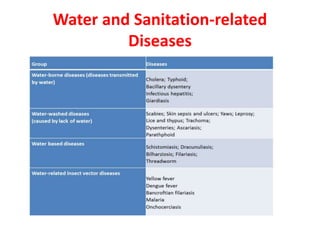
Water and Sanitation-related
Diseases
Pollution Act - 1974
• In India water Prevention and Control
pollution Act of 1974 was passed.
• This act provides for the prevention and
control of water pollution and maintaining
and restoring of wholesomeness of water,
• For the establishment with a view to carrying
out the purposes aforesaid of boards for the
prevention and control of water pollution.
Potable or wholesome water
• Water intended for human consumption
should not only safe but also wholesome.
Wholesome water is defined as that
• Free from pathogenic agents
• Free from harmful chemical substances
• Pleasant to taste
• Usable for domestic purpose
Why Water Analysis?
• Contaminants that may be in untreated water
include microorganisms such as viruses and
bacteria;
• inorganic contaminants such as salts and metals;
organic chemical contaminants from industrial
processes and petroleum use;
• pesticides and herbicides; and radioactive
contaminants. Water quality depends on the local
geology and ecosystem,
• as well as human uses such as sewage
dispersion, industrial pollution, use of water bodies
as a heat sink, and overuse
For routine test the following may be
done
• The measurement of the BOD
• Bacteriological test for human intestinal
bacteria known as “Coliform count”
• A biological check known as the algal plant
count which measures the microscopical
plants, animal life, as distinct from bacteria
and viruses present in water
Purification of water
• Filtration
• Chlorination
• Reverse Osmosis (RO) – cost effect
• UV radiation
• Ultrafiltration
• Demineralization
• Mineralization
CHLORINATION
• Chlorination is one of the important advances
in water purification.
• It is a “Supplement” and not a substitute to
sand filtration
• Capable of killing bacteria and taste and
odour producing constituents
• Horrock’s Test is used for this purpose
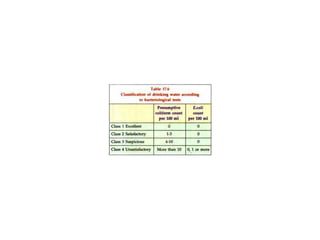
WHO standard of distribution system
• Throughout any year 95% of samples should
not contain any coliform organisms in 100 ml
of water.
• No sample should contain E. coli in 100 ml
• No sample should contain more than 3
coliform organisms in 100 ml and
• Coliform organisms should not be detectable
in 100 ml of any consecutive samples
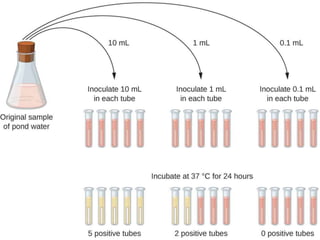
Most Probable Number (MPN) is a method used to estimate
the concentration of viable microorganisms in a sample by
means of replicate liquid broth growth in ten-fold dilutions. It is
commonly used in estimating microbial populations in soils,
waters, agricultural products and is particularly useful with
samples that contain particulate material that interferes
with plate count enumeration methods.
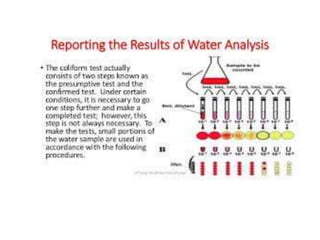
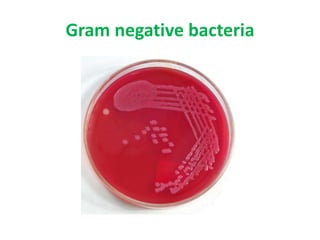
MPN is most commonly applied for quality testing of water
i.e to ensure whether the water is safe or not in terms of
bacteria present in it. A group of bacteria commonly referred as
fecal coliforms act as an indicator for fecal contamination of
water. The presence of very few fecal coliform bacteria would
indicate that a water probably contains no disease-causing
organisms, while the presence of large numbers of fecal
coliform bacteria would indicate a very high probability that the
water could contain disease-producing organisms making the
water unsafe for consumption.
Gram negative bacteria
Who is authorized?
• Usually the water testing must be done only in
the District Water Testing laboratory only for
the authorized results. But for research
purposes the results may be published.
• The Department of Sanitary Engineering and
Health authorities are responsible for any
outbreak of water borne diseases and their
quality.
Area of Water Research
• Usually anybody can do the water analysis
which may be superficial regarding the
physical and chemical qualities of water.
• Potable water research is relevant and its
purification are recommended by various
ways like Alum treatment, chlorination, plant
materials used as adsorbent
• Adsorption studies are high level in the
environmental studies
• Colour removal, Turbidity, odour, Taste are
preliminary method of research
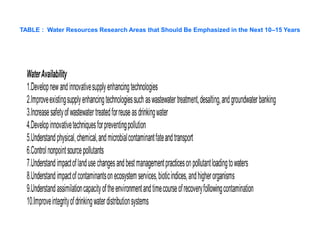
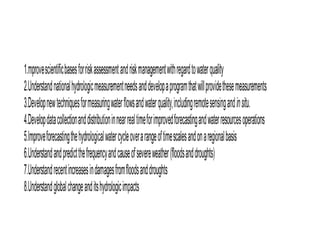
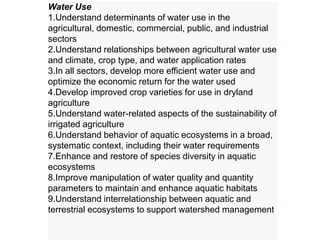
TABLE : Water Resources Research Areas that Should Be Emphasized in the Next 10–15 Years
Water Use
1.Understand determinants of water use in the
agricultural, domestic, commercial, public, and industrial
sectors
2.Understand relationships between agricultural water use
and climate, crop type, and water application rates
3.In all sectors, develop more efficient water use and
optimize the economic return for the water used
4.Develop improved crop varieties for use in dryland
agriculture
5.Understand water-related aspects of the sustainability of
irrigated agriculture
6.Understand behavior of aquatic ecosystems in a broad,
systematic context, including their water requirements
7.Enhance and restore of species diversity in aquatic
ecosystems
8.Improve manipulation of water quality and quantity
parameters to maintain and enhance aquatic habitats
9.Understand interrelationship between aquatic and
terrestrial ecosystems to support watershed management
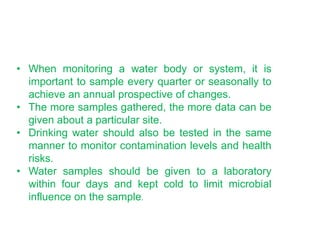
• When monitoring a water body or system, it is
important to sample every quarter or seasonally to
achieve an annual prospective of changes.
• The more samples gathered, the more data can be
given about a particular site.
• Drinking water should also be tested in the same
manner to monitor contamination levels and health
risks.
• Water samples should be given to a laboratory
within four days and kept cold to limit microbial
influence on the sample.
Thankful to the Authorities
Professor and Head, Department of
Chemistry,
Dean, Faculty of Science
Authorities of Annamalai University
To all those who watch this webinar,
Students, Researchers, Faculties

Water analysis webinar 23.06.2020

  • 3.
    PUBLIC HEALTH CHEMISTRY WATERANALYSIS – THE NEED OF THE HOUR Dr. R. VALLIAPPAN, Professor Department of Chemistry, Annamalai University, Annamalai nagar 608 002. Email: rmvs1962@yahoo.com. Cell: 98420 87465
  • 4.
    Objectives of thepresentation • Definition for public health Chemistry • Introduction • Need of the hour • Area of research with “Water” • - Physical Chemistry – kinetics of reaction • - inorganic Chemistry – Quality & Quantity • - organic Chemistry – pollution and contamination
  • 5.
    Water … Water… Water … Everywhere.. Which one is suitable for drinking? Potable water Mineral water Distilled water Sterilized water Deionised water Wholesome water
  • 6.
    Introduction Water is apriceless, worthless commodity, a blessing or curse depending on circumstances. But without water there is no life. All life on earth depends on water. Nothing can take the place of water. It is the duty of the Government to ensure the continuous supply of clean and safe drinking water for the public health protection at a free of cost.
  • 7.
    • “Water islife’s mater and matrix, mother and medium. There is no life without water.” -Albert Szent-Gyorgyi • Water is life, however not all water is safe for human standards. • Water samples can provide a lot of information on a water source such as nutrient content, pollution detection and bacterial counts.
  • 8.
    Water • Home ownerstake samples of their drinking water for health concerns. • Ranchers and farmers may sample their wells for livestock and pasture management issues. • State officials may test for water recreation and fishing reasons. • No matter what the water is being used for, if it will impact humans in some way it needs to be tested
  • 9.
    Water is neverpure in the true chemical sense. It is aways found to contain unwanted impurities in it. The impurities may be dissolved and suspended. Another more important and serious impurity is brought into the water source by human activity namely urbanization and industrialization. Because of these pollution and contamination of water happens.
  • 10.
    Introduction • Water playsa significant role in maintaining the human health and welfare. Clean drinking water is now recognised as a fundamental right of human beings. Around 780 million people do not have access to clean and safe water and around 2.5 billion people do not have proper sanitation. As a result, around 6–8 million people die each year due to water related diseases and disasters • Therefore, water quality control is a top-priority policy agenda in many parts of the world. • In the today world, the water use in household supplies is commonly defined as domestic water. This water is processed to be safely consumed as drinking water and other purposes. Water quality and suitability for use are determined by its taste, odor, colour, and concentration of organic and inorganic matters. • Contaminants in the water can affect the water quality and consequently the human health. The potential sources of water contamination are geological conditions, industrial and agricultural activities, and water treatment plants. These contaminants are further categorized as microorganisms, inorganics, organics, radionuclides, and disinfectants.
  • 11.
    • Till the19th century pollution of water assessed from the results of physical and chemical analysis. • The discovery of bacteria and the viruses as the causative agents of many enteric disorders, a delegate indication of pollution has evolved. • Assessments have to be made of physicochemical and bacteriological characteristics to establish pollution and suitability of water for use either in industries or potable purposes.
  • 12.
    Hazards of pollutionand contaminations • Man’s health may be affected either directly or indirectly by the polluted and contaminated water. • The hazards may be chemical or biological • Chemical - indirect way of affecting both human and environment – Nitrites/Nitrates • Biological – direct – water borne diseases
  • 13.
    Water may befree from • Physical qualities – Turbidity, colour, odour and Taste • Chemical qualities – Chlorides, hardness, Free from Saline ammonia, Albuminoid ammonia, nitrites, nitrates, pH, oxygen absorbed and free from hazardous chemicals, • Biological qualities – Free from coliform organisms, microscopic organisms - Plankton
  • 14.
  • 15.
    Pollution Act -1974 • In India water Prevention and Control pollution Act of 1974 was passed. • This act provides for the prevention and control of water pollution and maintaining and restoring of wholesomeness of water, • For the establishment with a view to carrying out the purposes aforesaid of boards for the prevention and control of water pollution.
  • 16.
    Potable or wholesomewater • Water intended for human consumption should not only safe but also wholesome. Wholesome water is defined as that • Free from pathogenic agents • Free from harmful chemical substances • Pleasant to taste • Usable for domestic purpose
  • 17.
    Why Water Analysis? •Contaminants that may be in untreated water include microorganisms such as viruses and bacteria; • inorganic contaminants such as salts and metals; organic chemical contaminants from industrial processes and petroleum use; • pesticides and herbicides; and radioactive contaminants. Water quality depends on the local geology and ecosystem, • as well as human uses such as sewage dispersion, industrial pollution, use of water bodies as a heat sink, and overuse
  • 18.
    For routine testthe following may be done • The measurement of the BOD • Bacteriological test for human intestinal bacteria known as “Coliform count” • A biological check known as the algal plant count which measures the microscopical plants, animal life, as distinct from bacteria and viruses present in water
  • 19.
    Purification of water •Filtration • Chlorination • Reverse Osmosis (RO) – cost effect • UV radiation • Ultrafiltration • Demineralization • Mineralization
  • 20.
    CHLORINATION • Chlorination isone of the important advances in water purification. • It is a “Supplement” and not a substitute to sand filtration • Capable of killing bacteria and taste and odour producing constituents • Horrock’s Test is used for this purpose
  • 21.
    WHO standard ofdistribution system • Throughout any year 95% of samples should not contain any coliform organisms in 100 ml of water. • No sample should contain E. coli in 100 ml • No sample should contain more than 3 coliform organisms in 100 ml and • Coliform organisms should not be detectable in 100 ml of any consecutive samples
  • 22.
    Most Probable Number(MPN) is a method used to estimate the concentration of viable microorganisms in a sample by means of replicate liquid broth growth in ten-fold dilutions. It is commonly used in estimating microbial populations in soils, waters, agricultural products and is particularly useful with samples that contain particulate material that interferes with plate count enumeration methods. MPN is most commonly applied for quality testing of water i.e to ensure whether the water is safe or not in terms of bacteria present in it. A group of bacteria commonly referred as fecal coliforms act as an indicator for fecal contamination of water. The presence of very few fecal coliform bacteria would indicate that a water probably contains no disease-causing organisms, while the presence of large numbers of fecal coliform bacteria would indicate a very high probability that the water could contain disease-producing organisms making the water unsafe for consumption.
  • 27.
  • 28.
    Who is authorized? •Usually the water testing must be done only in the District Water Testing laboratory only for the authorized results. But for research purposes the results may be published. • The Department of Sanitary Engineering and Health authorities are responsible for any outbreak of water borne diseases and their quality.
  • 29.
    Area of WaterResearch • Usually anybody can do the water analysis which may be superficial regarding the physical and chemical qualities of water. • Potable water research is relevant and its purification are recommended by various ways like Alum treatment, chlorination, plant materials used as adsorbent • Adsorption studies are high level in the environmental studies • Colour removal, Turbidity, odour, Taste are preliminary method of research
  • 30.
    TABLE : WaterResources Research Areas that Should Be Emphasized in the Next 10–15 Years
  • 32.
    Water Use 1.Understand determinantsof water use in the agricultural, domestic, commercial, public, and industrial sectors 2.Understand relationships between agricultural water use and climate, crop type, and water application rates 3.In all sectors, develop more efficient water use and optimize the economic return for the water used 4.Develop improved crop varieties for use in dryland agriculture 5.Understand water-related aspects of the sustainability of irrigated agriculture 6.Understand behavior of aquatic ecosystems in a broad, systematic context, including their water requirements 7.Enhance and restore of species diversity in aquatic ecosystems 8.Improve manipulation of water quality and quantity parameters to maintain and enhance aquatic habitats 9.Understand interrelationship between aquatic and terrestrial ecosystems to support watershed management
  • 33.
    • When monitoringa water body or system, it is important to sample every quarter or seasonally to achieve an annual prospective of changes. • The more samples gathered, the more data can be given about a particular site. • Drinking water should also be tested in the same manner to monitor contamination levels and health risks. • Water samples should be given to a laboratory within four days and kept cold to limit microbial influence on the sample.
  • 35.
    Thankful to theAuthorities Professor and Head, Department of Chemistry, Dean, Faculty of Science Authorities of Annamalai University To all those who watch this webinar, Students, Researchers, Faculties