Arba Minch Water Technology Institute
Faculty of Water Supply and Environmental Engineering
Course title; WaterTreatment
Course code; WSEE-3142
Target groups; 3rd year Water Supply and Environmental Engineering students
Academic year; 2019/20, Semester; II
Instructor; Samirawit D. and Kindeneh B.
February, 2020
Outline
1. Introduction
2. Preliminary treatment
3. Sedimentation
4. Coagulation and flocculation
5. Filtration
6. Disinfection
7. Miscellaneous water treatment
2
3
INTRODUCTION
So what is it about water that makes it so important to us?
Water is of major importance to all living things.
Up to 70 percent of the human body isWater.
Therefore the quality ofWater we drink is veryimportant.
The DrinkingWater should be clean, pure and free of any disease causing
Microbes, and that’s why it should be properlyTreated and Disinfectedbefore
using it for drinking purpose.
4
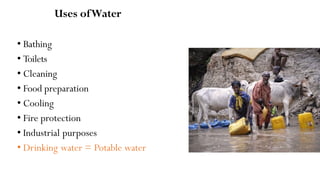
Uses ofWater
• Bathing
• Toilets
• Cleaning
• Food preparation
• Cooling
• Fire protection
• Industrial purposes
• Drinking water = Potable water
Sources of Water
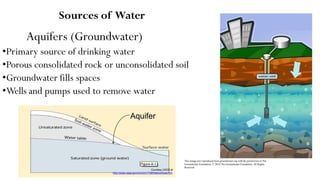
Aquifers (Groundwater)
•Primary source of drinking water
•Porous consolidated rock or unconsolidated soil
•Groundwater fills spaces
•Wells and pumps used to remove water
Aquifer
This image was reproduced from groundwater.org with the permission of The
Groundwater Foundation. © 2010 The Groundwater Foundation. All Rights
Reserved
Courtesy USGS at
http://pubs.usgs.gov/circ/circ1139/htdocs/boxa.htm
Sources ofWater
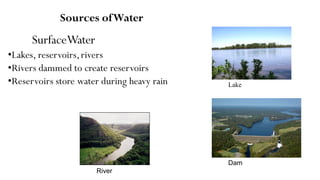
SurfaceWater
•Lakes, reservoirs,rivers
•Rivers dammed to create reservoirs
•Reservoirs store water during heavy rain
River
Lake
Dam
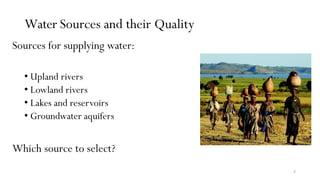
Water Sources and their Quality
Sources for supplying water:
• Upland rivers
• Lowland rivers
• Lakes and reservoirs
• Groundwater aquifers
Which source to select?
8
9
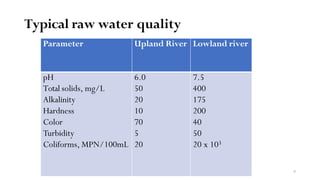
Typical raw water quality
Parameter Upland River Lowland river
pH
Total solids, mg/L
Alkalinity
Hardness
Color
Turbidity
Coliforms, MPN/100mL
6.0
50
20
10
70
5
20
7.5
400
175
200
40
50
20 x 103
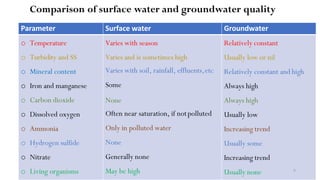
Comparison of surface water and groundwater quality
Parameter Surface water Groundwater
o Temperature
o Turbidity and SS
o Mineral content
o Iron and manganese
o Carbon dioxide
o Dissolved oxygen
o Ammonia
o Hydrogen sulfide
o Nitrate
o Living organisms
Varies with season
Varies and is sometimes high
Varies with soil, rainfall, effluents,etc
Some
None
Often near saturation, if notpolluted
Only in polluted water
None
Generally none
May be high
Relatively constant
Usually low or nil
Relatively constant and high
Always high
Always high
Usually low
Increasing trend
Usually some
Increasing trend
Usually none 9
11
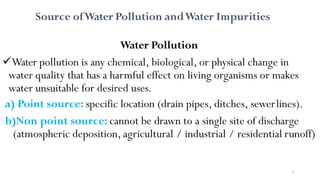
Source ofWater Pollution andWater Impurities
Water Pollution
Water pollution is any chemical, biological, or physical change in
water quality that has a harmful effect on living organisms or makes
water unsuitable for desired uses.
a) Point source: specific location (drain pipes, ditches, sewerlines).
b)Non point source: cannot be drawn to a single site of discharge
(atmospheric deposition, agricultural / industrial / residential runoff)
12
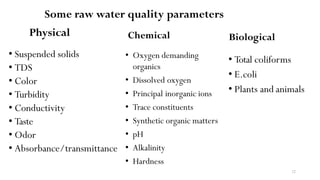
Some raw water quality parameters
Physical
• Suspended solids
• TDS
• Color
• Turbidity
• Conductivity
• Taste
• Odor
• Absorbance/transmittance
Biological
• Total coliforms
• E.coli
• Plants and animals
Chemical
• Oxygen demanding
organics
• Dissolved oxygen
• Principal inorganic ions
• Trace constituents
• Synthetic organic matters
• pH
• Alkalinity
• Hardness
13
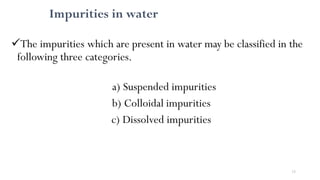
Impurities in water
The impurities which are present in water may be classified in the
following three categories.
a) Suspended impurities
b) Colloidal impurities
c) Dissolved impurities
14
a) Suspended impurities
 These impurities are dispersion of solid particles that are large
enough to be removed by filtration or sedimentation.
 These impurities are normally remain in suspension
 They are microscopic and make turbid.
 Suspended impurities are:-
• Bacteria –some cause diseases
•Algae, protozoa –colour, odor,turbidity
• Silt -muddiness or turbidity
15
b) Colloidal impurities
 The finely divided dispersion of solid particles
 Colloidal impurities are electrically charged. Due to this, the colloidal
particles usually very small in size, remain in constant motion and do not
settle.
 They are chief source of epidemic because they are associated with
bacteria. It is removed by coagulation.
c) Dissolved impurities
 Which are not visible to the naked eye cannot be removed by ordinary
filters
 It includes organic compound, inorganic salt and metals and gases etc.
Water analysis
•Various types of impurities present in water can be determined
by water analysis.
• The analysis of raw water is used to determine the processes of
water purification
•The analysis of purified water is done to know whether the
degree of purification has reached the required standards or not.
The examination of water may be divided in to three classes:
1. Physical Examination
2. Chemical Examination
3. Microbiological Examination
1. Physical Examination
i. Colour tests- Water must be free from objectionable colour.
 Colour is indicative of decayed vegetation and bacteria or chemical, petrol- chemical,textile,
paper and pulp etc.
ii. Taste and odour test- Odour in water indicates the presence of dissolved gases. Such situation
gives rise to taste.
 Odour is measured in terms of thresh hold number
iii. Temperature test- This could destroy the biological and biochemical configuration of a water
body.
 Aquatic organisms are sensitive to thermal changes.
 The temperature of water to be supplied should be between 100C to 200C
iv. Turbidity test- This refers to a state of unclear, muddy and thick water.It is an important measure
of effluent quality standard.
 Common methods of measurement is Nephelometers, turbidity rod, Jackson/ Baylis
turbidimeter.
 The permissible turbidity of domestic water may be between 5 to 10 p.p.m.
2. Chemical Examination
i. Total solids- the suspended, dissolved and colloidal solids are determined separately
and then added together to getTotalsolids.
o High TDS causes corrosion and dehydration of organic tissues within the
ecosystem.
o The amount of total solids should preferably be less than 500ppm.
ii. Chlorides- the test is carried out to determine the content of sodium chloride in water.
iii. Hardness- it is due to presence of certain salts of calcium and magnesium dissolved in
it.
o Calcium and magnesium salts are soap destroying and are prime constituents
concerned with hardness.
o Total hardness is composed of two components:Temporary hardness andpermanent
hardness
iv. PH value- This is a measure of acidity and alkalinity. pH for water body should
fall within range 6 – 9
v. Metals and other chemical substances
 Iron in water causes hardness, bad taste, discolouration of clothes and
flumbing fixtures and incrustation in water mains.
 Lead is a well known cumulative poison. Under normal condition, the
concentration of lead should be less than 0.05mg/l.
 Iodine upto 1ppm keep away goiter while fluoride upto 1.2ppm will prevent
dental caries of the children. Excess concentrations (>3ppm) can cause goiter
and dental fluorosis or mottled enamel in childrens.
 Sodium and potassium Excess quantities are excreted, primarily in the urine.
- some patients of Heart, Kidney or Lever diseases are unable to rid
themselves of sodium resulting substances.
3. Microbiological Examination
The water used should be free from fecal or sewage contamination.
The following are the purposes of bacteriological examination of water:
o Todetect and assess the degree of pollution in thesource.
o Toassess the amount of treatmentrequired.
o Todetermine the efficiency ofpurification
o Tolocate any sudden deterioration inquality
o Toestablish the final water purity frombacteria
 Test for E-coli (Escherichia coli)- are bacteria found in the environment, food
and intestines of humans and animals.
o E.coli are large and diverse group of bacteria
o E-coli in water supply indicates pollution by faecal contamination.
Diseases in Drinking water
 Diseases in drinking water can be classified in to:-
1. Water born disease: if pathogens that originates in Fecal material and are
transmitted by drinking water.Like diarrhea, fatigue, abdominal cramps etc…
2. WaterWashed disease: if organisms that originates in feces and are
transmitted through contact because of inadequate sanitation or hygiene.
3. Water based disease: if organisms that spend part of their life cycle in
aquatic animals and come in direct contact with humans in water,often
through skins.
4. Water related disease: if organisms with life cycles associated with insects
that live or breed in water and bite susceptible individuals.
Diseases in Drinking water
 Water born diseases are caused by pathogenic organisms carried
by water containing fecal or sewage contamination.
 The most common water born diseases are grouped in to four
heads:-
a. Bacterial diseases
b. Protozoal diseases
c. Virus diseases and
d. Helminthic( worm) diseases
a. Bacterial diseases
 Typhoid fever; water born disease where water supplies are drawn
from surface source contaminated by human faeces or urine.
 Paratyphoid fever; mostly due to ingestion of contaminated food,
especially milk, dried or frozen eggs and other products
 Cholera; by ingestion of water contaminated by infected human
fecal material
• It may be contracted by contaminated food or personal contact
 Bacillary dysentery; Mostly contracted due to ingestion of food
contaminated by flies or by unhygienic food handlers.
b. Protozoaldisease
Caused by the protozoon Entamoeba histolytica, they live in the
human large intestine forming cyst which are excreted in the bowel
discharge of infected persons
Infection takes place due to ingestion of these cyst which are carried
by water or flies or even human fingers.
c. Virus diseases
Any virus extracted and capable of causing infection when ingested
could be transmitted by water.
Those viruses that can multiply in the intestine wall and that are
discharged in large numbers in faeces are of more concern.
d. Helminthic( worm) diseases
Occurs only under grossly insanitary conditions or through
gross mis management of sewage disposal system.
Water quality standards
 Water quality standard is limits on the amount of impurities in water for
the intended use and which is legally enforced.
 It includes rules and regulations for sampling, testing and reporting
procedures.
 There are three water quality standards:
1. Stream standards: this can set limits on pollutants discharge in surface water
2. Effluent standards: this can set limits on pollutants from different sewage
treatment plants which discharged in to rivers.
3. Drinking water standard: this can set limits on contaminants in public water
supply.
Basic quality requirements of drinking water
• Free from diseases causing pathogenic organisms
• Contain no compounds that have adverse effect acute or in long term on
human health
• Fairly clear (i.e., of low turbidity, littlecolor)
• No saline
• Contain no compounds that cause offensive taste and odor
• Free of substances and organisms that cause corrosion or deposit of the
water supply system, staining of clothes washed in it or food items cooked
with it.
 Primary drinking water standards : Protect public health
and their maximum permissible levels was enforced by law.
 Secondary drinking water standards: this is about
aesthetic qualities, color, odor, andtaste
 Can be recommended but not enforced by law
 Water quality for any construction should be as much as
possible in the standards of drinking quality
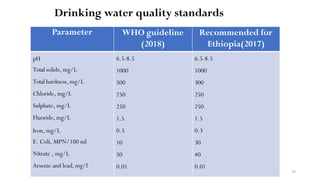
Drinking water quality standards
Parameter WHO guideline
(2018)
Recommended for
Ethiopia(2017)
pH
Total solids, mg/L
Total hardness, mg/L
Chloride, mg/L
Sulphate, mg/L
Fluoride, mg/L
Iron, mg/L
E. Coli, MPN/100 ml
Nitrate , mg/L
Arsenic and lead,mg/l
6.5-8.5
1000
500
250
250
1.5
0.3
10
50
0.01
6.5-8.5
1000
300
250
250
1.5
0.3
30
40
0.01
29
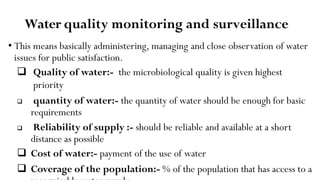
Water quality monitoring and surveillance
• This means basically administering, managing and close observation of water
issues for public satisfaction.
 Quality of water:- the microbiological quality is given highest
priority
 quantity of water:- the quantity of water should be enough for basic
requirements
 Reliability of supply :- should be reliable and available at a short
distance as possible
 Cost of water:- payment of the use of water
 Coverage of the population:- % of the population that has access to a
Introduction toWaterTreatment
processes
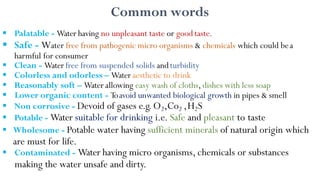
Common words
 Palatable - Water having no unpleasant taste or good taste.
 Safe - Water free from pathogenic micro organisms & chemicals which could bea
harmful for consumer
 Clean - Water free from suspended solids andturbidity
 Colorless and odorless – Water aesthetic to drink
 Reasonably soft – Water allowing easy wash of cloths, dishes with less soap
 Lower organic content - Toavoid unwanted biological growth in pipes & smell
 Non corrosive - Devoid of gases e.g.O2,Co2 ,H2S
 Potable - Water suitable for drinking i.e. Safe and pleasant to taste
 Wholesome - Potable water having sufficient minerals of natural origin which
are must for life.
 Contaminated - Water having micro organisms, chemicals or substances
making the water unsafe and dirty.
34
Some facts
• According toWHO,the water source has to be within 1,000 metres
of the home and collection time should not exceed 30 minutes.But
the average distance that women inAfrica andAsia walk to collect
water is 6 kilometres.
•27% of the urban population in the developing world does not have
piped water in their homes. Source:UNESCO
•Long-term exposure to high level of arsenic in drinking water can
cause thickening and pigment spots in the skin, and cancer of the skin,
lungs, bladder or kidney.
•An estimated 1000 children die every day in India due to polluted
water.
35
•Now a day globally, 844 million people lack access to clean water,
more than 1 of every 10 people on the planet. (world vision 2018)
•Woman and girls spend an estimated 200 million hours hauling water
every day.(world vision 2018)
•62 million people living without basic access to safe drinking water.
•31 percent of the Ethiopian population relies on unprotected water
for their daily needs.
•Every day,more than 800 children under age 5 die from diarrhea
attributed to poor water and sanitation. (world vision 2018)
•One in every 17 children does not live to see their fifth birthday, and
diarrheal disease is the leading cause of death in Ethiopia.
36
 Water available in various sources may contain various types
of impurities and cannot be directly used by the public for
various purposes, before removing the impurities
 Therefore, removing these impurities up to certain extent so
that it may not be harmful to the public health is necessary.
 The process of removing the impurities from water is called
water treatment and the treated water is called wholesome
water.
WaterTreatment
37
The degree and methods of treatment depend upon nature of the
source, quality of the source and purpose for which the water is
supplied.
The various treatment methods and the nature of source of
impurities removed by employing them are given in table:-
Process Impurity Removal
Aeration Taste and Odour removal, oxygen deficiency
Screening Floating matter
Plain sedimentation Large suspended solids
Coagulation Fine particle
Filtration Colloidal particles, microorganisms
Activated Carbon Elements causing tastes and odor
Softening Hardness
Disinfection Living organism including pathogen
38
Objective of treatment
The main objective of the treatment process is to remove the impurities of raw
water and bring the quality of water to the required standard
The objective may be summarized as follow:-
(i) Preventing DiseaseTransmission
 Organisms that cause disease must be removed or inactivated to make
the water safe
(ii) Making theWaterAcceptable
 If the consumers regard the water as unsatisfactory they may use an
alternative source which is hazardous
(iii) Protecting the distribution System
 Corrosion reduces the life of the pipes, reduces their carrying capacity,
and forms deposits which may color the water.
39
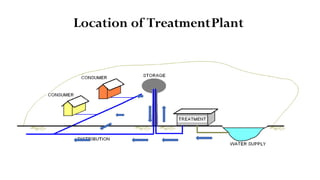
Location of treatment plant
•The treatment plant should be located
 Near to the town to which water is to be supplied and near to the
source of supply.This will prevent the water quality to depreciateafter
treatment.
 Away from any source of pollution.
 Away from the border of other countries and should be announced as a
protected area. During war time, a neighbor country may play foul
game by damaging the plant, poisoning the water.
 At higher elevation if the natural topography permit.
Location of TreatmentPlant
Treatment Schemes
a) Slow Sand Filters
b) ConventionalTreatment
c)Treatment of GroundWater
40
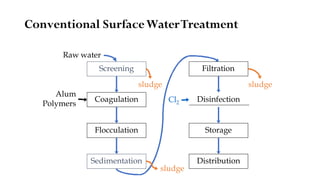
Conventional SurfaceWaterTreatment
Screening
Coagulation
Flocculation
Sedimentation
Filtration
Disinfection
Storage
Distribution
Raw water
Alum
Polymers Cl2
sludge
sludge
sludge
43
Factors Affecting the Choice of Treatment Schemes
a) Limitation of capital
b) Availability of skilled and unskilled labor
c) Availability of equipment, construction material, andwater
treatment chemicals
d) Local codes, drinking water standards and material
specifications
e) Local traditions, customs and cultural standards
f) National sanitation and pollution policies.
44
Consideration forTreatment units in developingcountry
 Use hydraulic devices instead of mechanical equipment’s
e.g.for mixing of chemicals
 Use indigenous materials & manufacturing to reduce the cost
 Lower peak and per capital consumption
 Lower design period
 Organizational capacity to recruits and retrain
 Head lose should be conserved possible
45
PreliminaryTreatment
Systems
46
•High turbidity water which may occur particularly during
the rainy season requires pre treatment in the form of
screening, sedimentation, storage or roughing filtration
to reduce much of the suspended solids.
•This is an advantage otherwise a very large amount of
chemicals may have to be employed for chemical
coagulation which can be expensive
47
Types of preliminary treatment
Intakes
Screens
Plain sedimentation
Storage
Roughing filter
Infiltration galleries
Silt trap
48
Intakes
•Proper design of the intake structure is one way of achieving
preliminary treatment
•The intakes should be located in such a way that rolling debris
at the bottom is prevented from entering via the intake
• Bar Screens are provided to screen out larger size floating
and suspended materials
•Sometimes two filters are provided successively for
coarse and fine screening
49
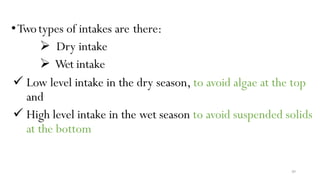
•Twotypes of intakes are there:
 Dry intake
 Wet intake
 Low level intake in the dry season, to avoid algae at the top
and
 High level intake in the wet season to avoid suspended solids
at the bottom
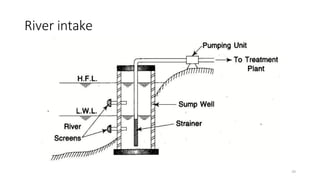
River intake
50
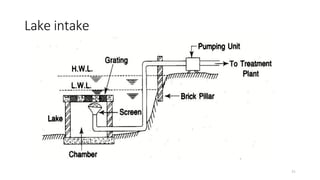
Lake intake
51
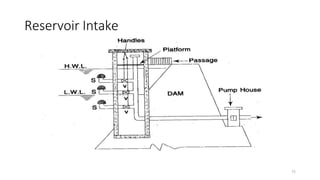
Reservoir Intake
52
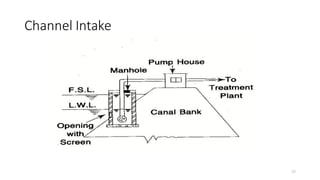
Channel Intake
53
54
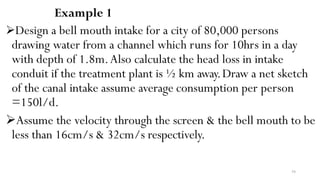
Example 1
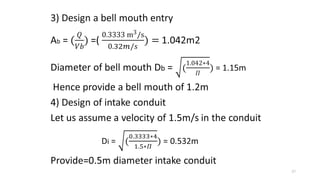
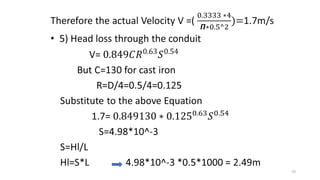
Design a bell mouth intake for a city of 80,000 persons
drawing water from a channel which runs for 10hrs in a day
with depth of 1.8m.Also calculate the head loss in intake
conduit if the treatment plant is ½ km away.Draw a net sketch
of the canal intake assume average consumption per person
=150l/d.
Assume the velocity through the screen & the bell mouth to be
less than 16cm/s & 32cm/s respectively.
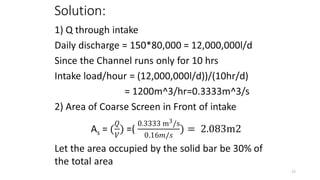
Solution:
55
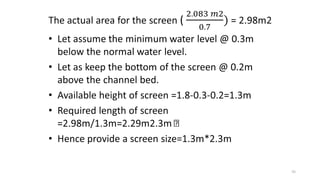
56
57
58
59
Screens
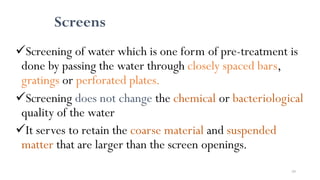
Screening of water which is one form of pre-treatment is
done by passing the water through closely spaced bars,
gratings or perforated plates.
Screening does not change the chemical or bacteriological
quality of the water
It serves to retain the coarse material and suspended
matter that are larger than the screen openings.
60
Purposes of screen
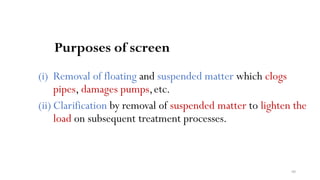
(i) Removal of floating and suspended matter which clogs
pipes, damages pumps,etc.
(ii) Clarification by removal of suspended matter to lighten the
load on subsequent treatment processes.
61
Types of screen
1. Coarse screen
2. Fine screen
3. Micro strainer
62
 Bar screen spacing is typically between 0.5 and 5cm
 Angle of inclination of bars is 600-750 if screening are
very small and 300-450 if larger amount is retained over
the screen bar.
 Between the openings the velocity should be restricted
to up to 0.7m/sec
 If regular cleaning is done an allowance for loss of heads
of up to 0.1 to 0.2m is made
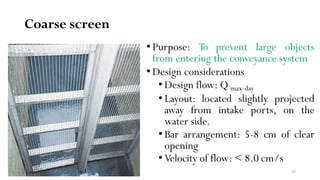
Coarse screen
• Purpose: To prevent large objects
from entering the conveyance system
• Design considerations
• Design flow: Q max-day
• Layout: located slightly projected
away from intake ports, on the
water side.
• Bar arrangement: 5-8 cm of clear
opening
• Velocity of flow: < 8.0 cm/s
63
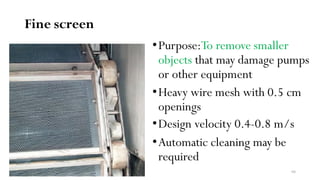
Fine screen
•Purpose:To remove smaller
objects that may damage pumps
or other equipment
•Heavy wire mesh with 0.5 cm
openings
•Design velocity 0.4-0.8 m/s
•Automatic cleaning may be
required
64
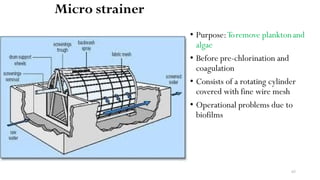
Micro strainer
• Purpose:Toremove planktonand
algae
• Before pre-chlorination and
coagulation
• Consists of a rotating cylinder
covered with fine wire mesh
• Operational problems due to
biofilms
65
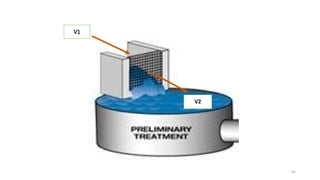
V2
66
67
68
69
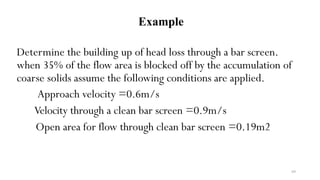
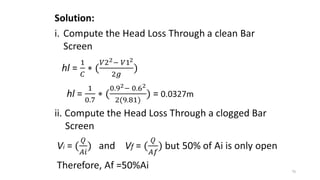
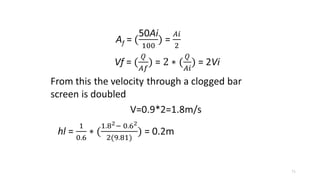
Determine the building up of head loss through a bar screen.
when 35% of the flow area is blocked off by the accumulation of
coarse solids assume the following conditions are applied.
Approach velocity =0.6m/s
Velocity through a clean bar screen =0.9m/s
Open area for flow through clean bar screen =0.19m2
Example
70
71
72
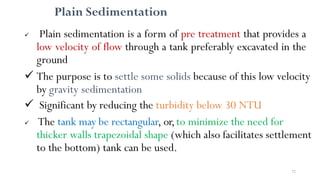
Plain Sedimentation
 Plain sedimentation is a form of pre treatment that provides a
low velocity of flow through a tank preferably excavated in the
ground
 The purpose is to settle some solids because of this low velocity
by gravity sedimentation
 Significant by reducing the turbidity below 30 NTU
 The tank may be rectangular, or,to minimize the need for
thicker walls trapezoidal shape (which also facilitates settlement
to the bottom) tank can be used.
73
Baffle walls are provided at the inlet to dissipate the kinetic
energy of the incoming water and provide quiescent
settlement.
Less importantly, they are also provided at the outlet to
prevent turbulence in the outlet zone.
74
Storage
 Storage is very effective for high turbidity water
The detention time is greater than for plain sedimentation
tanks
Advantages:
• Natural sedimentation
• Reduction of sudden water quality fluctuation.
• Reduction in the number of pathogenic bacteria
• Improved reliability of supply
• Excessively turbid water can be diverted away.
75
Roughing Filtration
 Roughing filtration allows a deep penetration of the filter layer and
holds a large silt storage capacity
 Used by removing suspended solids from water that could rapidly
clog a slow sand filter.
 Pathogen removal is between 60 and 90% without using any
disinfectant
 Considerably reduce the amount of iron and manganese.
 Capable of reducing turbidity to as low as 5NTU from a raw water
turbidity of 150NTU.
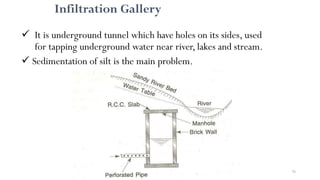
Infiltration Gallery
 It is underground tunnel which have holes on its sides, used
for tapping underground water near river, lakes and stream.
 Sedimentation of silt is the main problem.
76
77
Silt trap
• This is a box like structure to remove any kind of silt, soil,
sediment, metals or pesticides from entering your water storage
system by containing water in the trap for some times.
• It allows these unwanted materials to settle to the bottom of the
bucket and separate from the water
• It is essentially works like a filter
CONVENTIONAL METHODS OFWATER
TREATMENT
1
Coagulation & Flocculation
80
What is Coagulation?
 Coagulation is the process by which colloidal particles and very
fine solid suspensions initially present in a wastewater are combined
into larger agglomerates.
 Commonly achieved by adding different types of chemicals
(coagulants) to the waste water to promote destabilization of the
colloid dispersion and agglomeration of the resulting individual
colloidal particles.
 The chemicals are known as Coagulants, usually higher valence
cationic salts (Al3+, Fe3+ etc.)
 Coagulation is essentially a chemical process
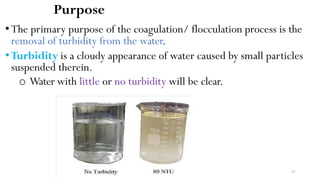
Purpose
•The primary purpose of the coagulation/ flocculation process is the
removal of turbidity from the water.
•Turbidity is a cloudy appearance of water caused by small particles
suspended therein.
o Water with little or no turbidity will be clear.
81
82
Location in the TreatmentPlant
• After the source water has been screened and has passed through the
optional steps of pre-chlorination and aeration, it is ready for
coagulation and flocculation
83
What is Flocculation?
Flocculation is the agglomeration of destabilized particles into a
large size particles known as flocs which can be effectively removed by
sedimentation or flotation.
84
Principle of coagulation
 When certain chemicals are added to water an insoluble gelatinous
flocculent is formed
 The gelatinous precipitate therefore has the property of removing
fine and colloidal particle quickly and completely than by plain
sedimentation
 These coagulants further the advantage of removing color, odor and
taste from the water
 First the coagulant are mixed in the water to produce the required
precipitate ,then the water is sent in the sedimentation basins
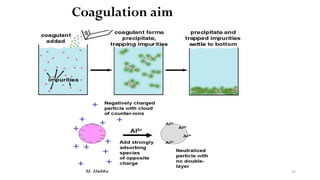
Coagulation aim
85
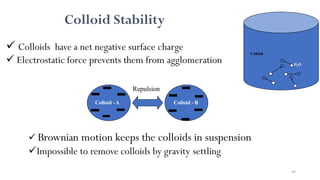
Colloid Stability
---
-- -
- -
-
-
-
- Repulsion
Colloid -A Colloid - B
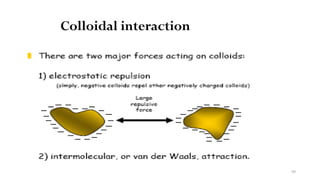
 Colloids have a net negative surface charge
 Electrostatic force prevents them from agglomeration
 Brownian motion keeps the colloids in suspension
Impossible to remove colloids by gravity settling
H2O
86
Colloid
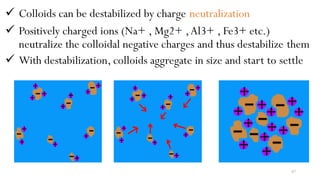
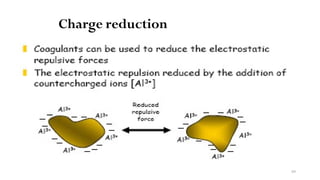
 Colloids can be destabilized by charge neutralization
 Positively charged ions (Na+ , Mg2+ ,Al3+ , Fe3+ etc.)
neutralize the colloidal negative charges and thus destabilize them
 With destabilization, colloids aggregate in size and start to settle
87
Colloidal interaction
88
Charge reduction
89
JarTests
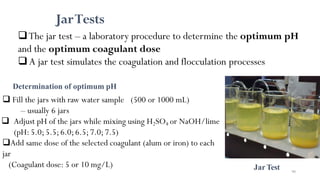
Determination of optimum pH
 Fill the jars with raw water sample (500 or 1000 mL)
– usually 6 jars
 Adjust pH of the jars while mixing using H2SO4 or NaOH/lime
(pH: 5.0;5.5;6.0;6.5;7.0;7.5)
Add same dose of the selected coagulant (alum or iron) to each
jar
(Coagulant dose: 5 or 10 mg/L)
The jar test – a laboratory procedure to determine the optimum pH
and the optimum coagulant dose
 A jar test simulates the coagulation and flocculation processes
JarTest 90
Jar Test set-up
91
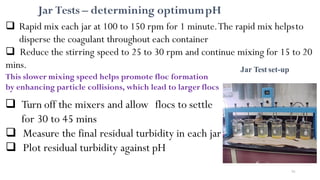
 Rapid mix each jar at 100 to 150 rpm for 1 minute.The rapid mix helpsto
disperse the coagulant throughout each container
 Reduce the stirring speed to 25 to 30 rpm and continue mixing for 15 to 20
mins.
This slower mixing speed helps promote floc formation
by enhancing particle collisions, which lead to larger flocs
 Turn off the mixers and allow flocs to settle
for 30 to 45 mins
 Measure the final residual turbidity in each jar
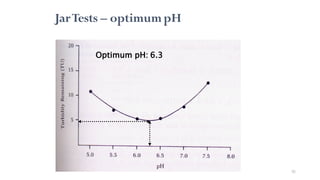
 Plot residual turbidity against pH
Jar Tests – determining optimumpH
Optimum pH: 6.3
92
JarTests – optimumpH
92
Optimum coagulant dose
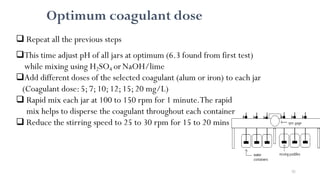
 Repeat all the previous steps
This time adjust pH of all jars at optimum (6.3 found from first test)
while mixing using H2SO4 orNaOH/lime
Add different doses of the selected coagulant (alum or iron) to each jar
(Coagulant dose:5;7;10;12;15;20 mg/L)
 Rapid mix each jar at 100 to 150 rpm for 1 minute.The rapid
mix helps to disperse the coagulant throughout each container
 Reduce the stirring speed to 25 to 30 rpm for 15 to 20 mins
93
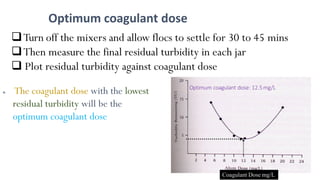
Turn off the mixers and allow flocs to settle for 30 to 45 mins
Then measure the final residual turbidity in each jar
 Plot residual turbidity against coagulant dose
Coagulant Dose mg/L
Optimum coagulant dose: 12.5mg/L
 The coagulant dose with the lowest
residual turbidity will be the
optimum coagulant dose
Optimum coagulant dose
95
Factors affecting coagulation
1. Type of coagulant
2. Dose of coagulant
3. Characteristic of water
• Type and quantity of suspended matter
• Temperature of water
• pH of water
4. Time and method of mixing
96
97
Common Coagulants
Coagulant chemicals come in two main types - primary coagulants
and coagulant aids
 Primary coagulants neutralize the electrical charges of
particles in the water which causes the particles to clump together
 Coagulant aids add density to slow-settling flocs and add
toughness to the flocs so that they will not break up during the
mixing and settling processes.
98
The following are the coagulants most commonly used:
i.Aluminum sulfate [Al2 (SO4)3.18H2O].
 It is also calledAlum
It is the most widely used chemical coagulant in water purification work
Alum reacts with water only in the presence of alkalinity.If natural
alkalinity is not present, lime may be added to develop alkalinity
The chemical is found to be most effective between pH range of 6.5 to
8.5.
Its dose may vary from 5 to 30mg/lit, for normal water usually dose
being 14mg/l.
99
Due to the following reason,Alum is the most widely used chemical
coagulant:-
1. It is very cheap
2. It removes taste and color in addition to turbidity
3. It is very efficient
4. Flocs formed are more stable and heavy
5. It is not harmful to health
6. It is simple in working, doesn't require skilled supervision for
dosing
100
ii. Sodium aluminates (Na2Al2O4)
In the process of coagulation, it can remove carbonate and non-
carbonate hardness
It reacts with calcium and magnesium salts to form flocculent
aluminates of these elements.
iii. Chlorinated Copperas (FeSO4.Cl)
Combination of Ferric Sulphate and Ferric chloride.
When solution of Ferrous Sulphate is mixed with chlorine,
both Ferric Sulphate and Ferric chloride are produced
101
Ferric Sulphate and Ferric chloride each is an effective floc
and so also their combination
Ferric chloride effective in pH range 3.5 – 6.5 or above 8.5
iv.Poly electrolytes
v.Hydrated lime
vi. Copperas (FeSO4.7H2O)
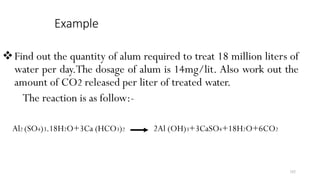
Example
Find out the quantity of alum required to treat 18 million liters of
water per day.The dosage of alum is 14mg/lit. Also work out the
amount of CO2 released per liter of treated water.
The reaction is as follow:-
Al2 (SO4)3.18H2O+3Ca (HCO3)2 2Al (OH)3+3CaSO4+18H2O+6CO2
102
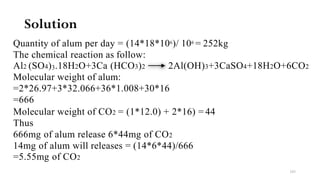
Solution
Quantity of alum per day = (14*18*106)/ 106 = 252kg
The chemical reaction as follow:
Al2 (SO4)3.18H2O+3Ca (HCO3)2 2Al(OH)3+3CaSO4+18H2O+6CO2
Molecular weight of alum:
=2*26.97+3*32.066+36*1.008+30*16
=666
Molecular weight of CO2 = (1*12.0) + 2*16) = 44
Thus
666mg of alum release 6*44mg of CO2
14mg of alum will releases = (14*6*44)/666
=5.55mg of CO2
103
104
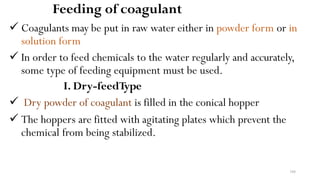
Feeding of coagulant
 Coagulants may be put in raw water either in powder form or in
solution form
 In order to feed chemicals to the water regularly and accurately,
some type of feeding equipment must be used.
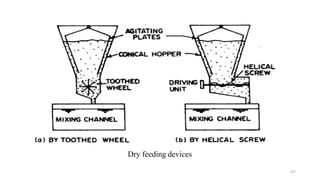
I. Dry-feedType
 Dry powder of coagulant is filled in the conical hopper
 The hoppers are fitted with agitating plates which prevent the
chemical from being stabilized.
Dry feeding devices
105
106
II.Wet feeding type
 First, solution of required strength of coagulant is prepared
The solution is filled in the tank and allowed to mix in the mixing
channel in required proportion to the quantity of water
It can be easily controlled with automatic devices.
107
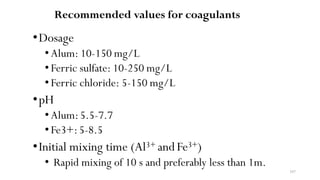
Recommended values for coagulants
•Dosage
• Alum: 10-150 mg/L
• Ferric sulfate: 10-250 mg/L
• Ferric chloride: 5-150 mg/L
•pH
• Alum:5.5-7.7
• Fe3+:5-8.5
•Initial mixing time (Al3+ and Fe3+)
• Rapid mixing of 10 s and preferably less than 1m.
108
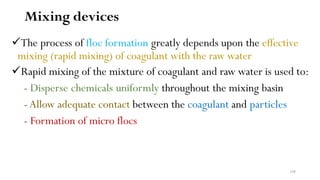
Mixing devices
The process of floc formation greatly depends upon the effective
mixing (rapid mixing) of coagulant with the raw water
Rapid mixing of the mixture of coagulant and raw water is used to:
- Disperse chemicals uniformly throughout the mixing basin
- Allow adequate contact between the coagulant and particles
- Formation of micro flocs
109
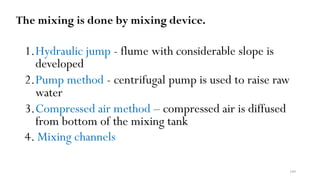
The mixing is done by mixing device.
1.Hydraulic jump - flume with considerable slope is
developed
2.Pump method - centrifugal pump is used to raise raw
water
3.Compressed air method – compressed air is diffused
from bottom of the mixing tank
4. Mixing channels
110
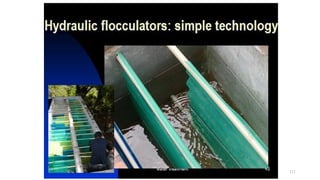
5. Mixing basin with baffle wall
6. Mechanical mixing basins
Mechanical means are used to agitate the mixture to achieve
the objective of thorough mixing.
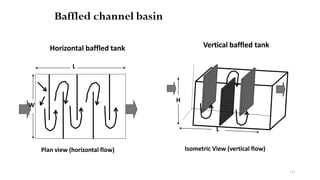
Baffled channel basin
Horizontal baffled tank
Plan view (horizontal flow)
L
W
Vertical baffled tank
L
Isometric View (vertical flow)
H
111
112
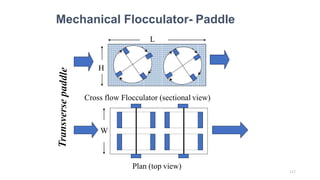
Plan (top view)
L
H
Cross flow Flocculator (sectional view)
W
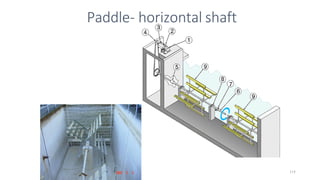
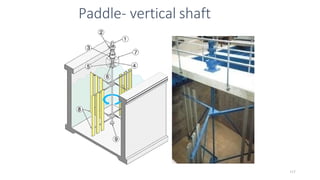
Mechanical Flocculator- Paddle
113
Paddle- horizontal shaft
114
Paddle- vertical shaft
115
116
Flocculation
 Next to rapid mixing, mixture is kept slowly agitated for about 30 to
60min.
Slow mixing process in which particles are brought into contact in
order to promote their agglomeration is called flocculation.
 The tank or basin in which flocculation process is carried out is called
flocculation chamber.
 The velocity of flow in the chamber is kept between 12 – 18cm/sec.
 Activated carbon in powder form can be used to speed up the
flocculation
117
The rate of agglomeration or flocculation is dependent upon
 Type and concentration of turbidity
 Type of coagulant and its dose
 Temporal mean velocity gradient – G in the basin
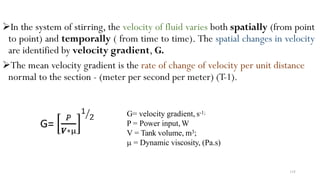
In the system of stirring, the velocity of fluid varies both spatially (from point
to point) and temporally ( from time to time). The spatial changes in velocity
are identified by velocity gradient, G.
The mean velocity gradient is the rate of change of velocity per unit distance
normal to the section - (meter per second per meter) (T-1).
G= velocity gradient, s-1;
P = Power input, W
V = Tank volume, m3;
µ = Dynamic viscosity, (Pa.s)
118
4/22/2020 water treatment 118
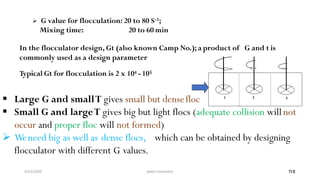
 G value for flocculation: 20 to 80 S-1;
Mixing time: 20 to 60 min
In the flocculator design, Gt (also known Camp No.); a product of G and t is
commonly used as a design parameter
Typical Gt for flocculation is 2 x 10⁴ -105
 Large G and smallT gives small but densefloc
 Small G and largeT gives big but light flocs (adequate collision will not
occur and proper floc will not formed)
 Weneed big as well as dense flocs, which can be obtained by designing
flocculator with different G values.
2
G11 G33
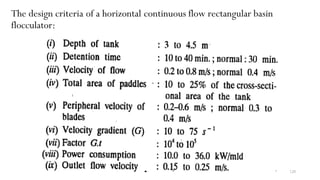
The design criteria of a horizontal continuous flow rectangular basin
flocculator:
120
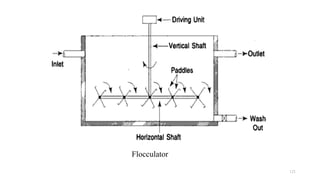
Flocculator
121
122
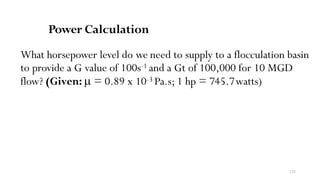
Power Calculation
What horsepower level do we need to supply to a flocculation basin
to provide a G value of 100s-1 and a Gt of 100,000 for 10 MGD
flow? (Given: µ = 0.89 x 10⁻³ Pa.s; 1 hp = 745.7watts)
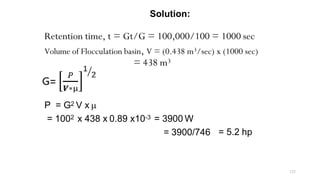
Solution:
Retention time, t = Gt/G = 100,000/100 = 1000 sec
Volume of Flocculation basin, V = (0.438 m3/sec) x (1000 sec)
= 438 m3
P = G2 V x µ
= 1002 x 438 x 0.89 x10-3 = 3900 W
= 3900/746 = 5.2 hp
123
124
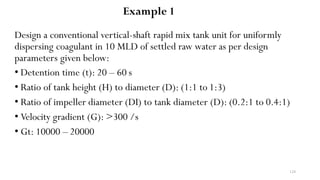
Design a conventional vertical-shaft rapid mix tank unit for uniformly
dispersing coagulant in 10 MLD of settled raw water as per design
parameters given below:
• Detention time (t): 20 – 60 s
• Ratio of tank height (H) to diameter (D): (1:1 to 1:3)
• Ratio of impeller diameter (DI) to tank diameter (D): (0.2:1 to 0.4:1)
• Velocity gradient (G): >300 /s
• Gt: 10000 – 20000
Example 1
125
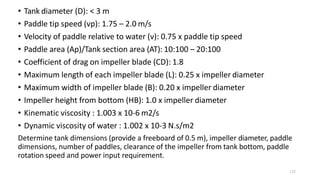
• Tank diameter (D): < 3 m
• Paddle tip speed (vp): 1.75 – 2.0 m/s
• Velocity of paddle relative to water (v): 0.75 x paddle tip speed
• Paddle area (Ap)/Tank section area (AT): 10:100 – 20:100
• Coefficient of drag on impeller blade (CD): 1.8
• Maximum length of each impeller blade (L): 0.25 x impeller diameter
• Maximum width of impeller blade (B): 0.20 x impeller diameter
• Impeller height from bottom (HB): 1.0 x impeller diameter
• Kinematic viscosity : 1.003 x 10⁻⁶ m2/s
• Dynamic viscosity of water : 1.002 x 10⁻³ N.s/m2
Determine tank dimensions (provide a freeboard of 0.5 m), impeller diameter, paddle
dimensions, number of paddles, clearance of the impeller from tank bottom, paddle
rotation speed and power input requirement.
126
Examples 2
A water treatment plant of design capacity 378500 m3/d
requires 100 mg/L of alum to remove 25 mg/L suspended
solids. Estimate the mass of alum required every day
(kg/day) and the maximum mass of dry solids (in kg/day)
that are removed from the plant.
127
Examples 3
Design a mechanical rapid mix tank used for treating
75700 m3/d of water that has a temperature of 10oC. The
items you need to determine are: 1) tank volume 2) tank
dimensions and 3) power consumption. Use a detention
time of 2 minutes, velocity gradient of 850 s-1 and cubic
tank geometry.
128
Examples 4
A water treatment plant is designed to process 100 x 10 6 L/d. The
flocculator is 30 m long, 15 m wide, and 5 m deep. Revolving
paddles are attached to four horizontal shafts that rotate at 1.5 rpm.
Each shaft supports four paddles that are 200 mm wide, 15 m long
and centered 2 m from the shaft. Assume the mean water velocity
to be 70% less than paddle velocity and CD = 1.8. All paddles remain
submerged all the time. Find:
a)the difference in velocity between paddles and water
b) the value of G and
c)the Camp number.
129
SEDIMENTATION
130
Definition and Use
Sedimentation is a treatment process in which the velocity of the
water is lowered below the suspension velocity and the
suspended particles settle out of the water due to gravity. The
process is also known as settling or clarification
It is a commonly used unit operation in water and wastewater
treatment plants.
This type of sedimentation requires chemical addition (in the
coagulation/flocculation step) and removes the resulting floc
from the water.
It is not be necessary in low turbidity water of less than 10
NTU
131
The purpose is to decrease the concentration of suspended
particles and reducing the load on the filters.
Sedimentation at this stage in the treatment process should
remove 90% of the suspended particles from the water,
including bacteria
•WaterTreatment:
• Plain Sedimentation (Pre-sedimentation)
• Sedimentation after Flocculation
• Sedimentation after Softening
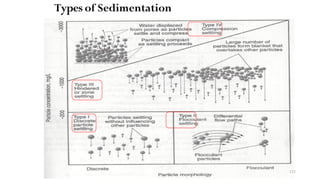
Types of Sedimentation
132
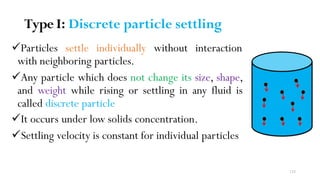
Type I: Discrete particle settling
Particles settle individually without interaction
with neighboring particles.
Any particle which does not change its size, shape,
and weight while rising or settling in any fluid is
called discrete particle
It occurs under low solids concentration.
Settling velocity is constant for individual particles
133
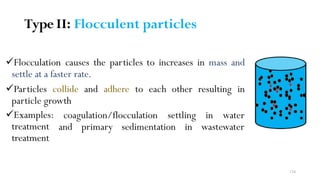
Type II: Flocculent particles
Flocculation causes the particles to increases in mass and
settle at a faster rate.
Particles collide and adhere to each other resulting in
particle growth
Examples:
treatment
treatment
coagulation/flocculation settling
and primary sedimentation in
in water
wastewater
134
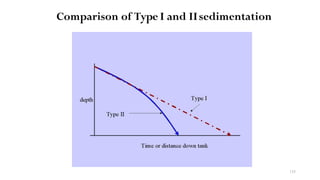
Comparison of Type I and IIsedimentation
135
136
Type III: Hindered or Zone settling
• The mass of particles tends to settle as a unity with
individual particles remaining in fixed positions with
respect to each other.
• Particles are so close together movement is restricted
• Solids move as a block rather than individual particles
• Fluidic interference causes a reduction in settling velocity
• Example: settling of secondary effluents
137
Type IV: Compression settling
The concentration of particles is so high that sedimentation
can only occur through compaction of structure.
Particles physically in contact
Volume of water may decrease
High concentration of solids (sludge)
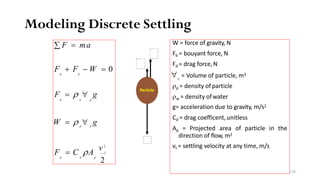
Modeling Discrete Settling
t
2
p p
v 2
F = C ρA
d d p
W = ρ ∀ g
F = ρ ∀ g
b w p
F + F − W = 0
d b
∑ F = ma W = force of gravity, N
Fb = bouyant force, N
Fd = drag force,N
p
ρp = density ofparticle
ρw = density ofwater
g= acceleration due to gravity, m/s2
Cd = drag coefficent,unitless
Ap = Projected area of particle in the
direction of flow, m2
vt = settling velocity at any time, m/s
∀ = Volume of particle, m3
Particle
138
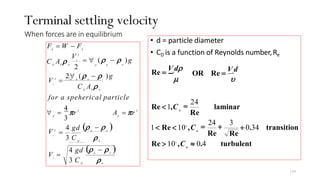
Terminal settling velocity
When forces are in equilibrium
• d = particle diameter
• CD is a function of Reynolds number,Re
p w
t
p w
D w
t
p
p
D P w
t
w
t
D P w
d b
for a speherical particle
ρ
ρ
C A ρ
C A ρ
V =
=
A = πr
∀ = πr
F = W − F
3 C
4 gd (ρ − ρ )
3 C
4 gd (ρ − ρ )
3
4
2∀ (ρ − ρ )g
= ∀ (ρ − ρ )g
p p
2
V 2
2
3
V 2
= p p w
V 2
turbulent
D w
139
transition
laminar
Re
+ 0.34
=
24
+
3
Re Re
=
24
D
D
D
Re > 104
,C ≈ 0.4
1< Re < 104
,C
Re <1,C
OR Re =
Vt
d
υ
µ
Re =
Vt
dρ
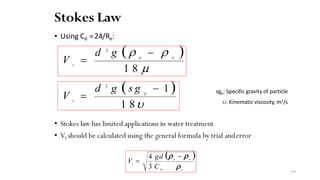
Stokes Law
• Using Cd =24/Re:
sgp: Specific gravity of particle
υ: Kinematic viscosity, m2/s
• Stokes law has limited applications in water treatment
• Vt should be calculated using the general formula by trial anderror
1 8 µ
p w
t
d 2
g (ρ − ρ )
V =
w
w
p
D
t
ρ
− ρ )
V =
3 C
4 gd (ρ
1 8υ
p
t
d 2
g (s g − 1)
V =
139
141
Example
Find the terminal settling velocity for spherical particle with
diameter 0.45 mm and density of 2650 kg/m3 settling
through water at 20 oC. Take dynamic viscosity as 1.002*10-3
at 20 oC
142
Classification of SedimentationTank
Sedimentation tank are classified as continuous flow or
intermittent flow
The continuous flow types are mostly used now a days
Tanks also classified as horizontal flow, when the liquid
passes through in the horizontal direction and as vertical
flow, when the liquid enters near the bottom of the tank and
is withdrawn at the surface.
The vertical flow type is generally used for sewage
treatment.
143
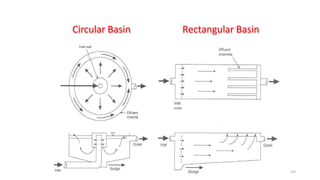
COMMON TYPES OF SEDIMENTATIONBASINS
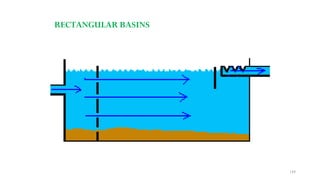
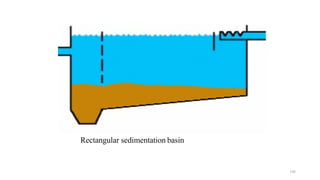
1. RECTANGULAR BASINS
Are the simplest design, allowing water to flow horizontally
through a long tank.
This type of basin is usually found in large-scale water treatment
plants.
Rectangular basins have a variety of advantages - predictability
,
cost-effectiveness, and low maintenance.
In addition, rectangular basins are the least likely to short-circuit,
especially if the length is at least twice the width.
A disadvantage of rectangular basins is the large amount of land
area required.
RECTANGULAR BASINS
144
145
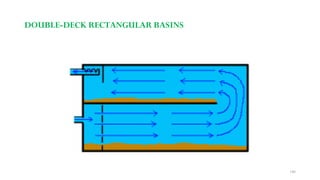
2. DOUBLE-DECK RECTANGULAR BASINS
Double-deck rectangular basins are essentially two
rectangular sedimentation basins stacked one atop the other.
This type of basin conserves land area, but has higher
operation and maintenance costs than a one-level rectangular
basin.
DOUBLE-DECK RECTANGULAR BASINS
146
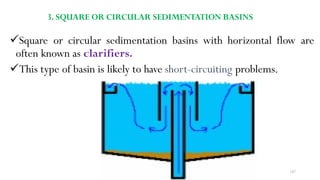
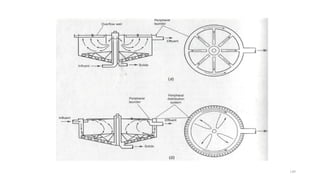
3. SQUARE OR CIRCULAR SEDIMENTATION BASINS
Square or circular sedimentation basins with horizontal flow are
often known as clarifiers.
This type of basin is likely to have short-circuiting problems.
147
Circular Basin Rectangular Basin
148
149
150
4. Solids-contact clarifiers
It is more complex than the others.
It is also known as up flow solids-contact clarifiers
Up flow sludge-blanket clarifiers combine coagulation,
flocculation and sedimentation within a single basin.
Solids-contact clarifiers are often found in packaged plants
and in cold climates where sedimentation must occur in odor.
This type of clarifier is also often used in softening operation.
151
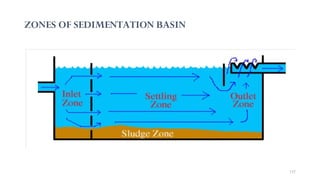
ZONES OF SEDIMENTATION BASIN
Sedimentation Basin has four Zones.
Each zone should provide a smooth transition between the
zone before and the zone after.
In addition, each zone has its own unique purpose
• The inlet zone,
• The settling zone,
• The sludge zone,and
• The outlet zone
ZONES OF SEDIMENTATION BASIN
152
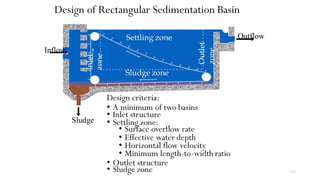
Design of Rectangular Sedimentation Basin
Design criteria:
• A minimum of two basins
• Inlet structure
• Settling zone:
• Surface overflow rate
• Effective water depth
• Horizontal flow velocity
• Minimum length-to-width ratio
• Outlet structure
• Sludge zone
Settling zone
Sludge zone
Inlet
zone
Outlet
zone
Inflow
Outflow
Sludge
152
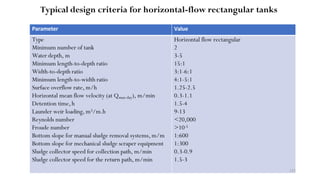
Typical design criteria for horizontal-flow rectangular tanks
Parameter Value
Type
Minimum number of tank
Water depth, m
Minimum length-to-depth ratio
Width-to-depth ratio
Minimum length-to-width ratio
Surface overflow rate, m/h
Horizontal mean flow velocity (at Qmax-day), m/min
Detention time,h
Launder weir loading, m3/m.h
Reynolds number
Froude number
Bottom slope for manual sludge removal systems, m/m
Bottom slope for mechanical sludge scraper equipment
Sludge collector speed for collection path, m/min
Sludge collector speed for the return path, m/min
Horizontal flow rectangular
2
3-5
15:1
3:1-6:1
4:1-5:1
1.25-2.5
0.3-1.1
1.5-4
9-13
<20,000
>10-5
1:600
1:300
0.3-0.9
1.5-3
153
155
Inlet Zone
 The two primary purposes of the inlet zone of a sedimentation
basin are to distribute the water and to control the water's velocity
as it enters the basin.
 In addition, inlet devices act to prevent turbulence of the water.
 The incoming flow in a sedimentation basin must be evenly
distributed across the width of the basin to prevent short-circuiting.
 Short-circuiting is a problematic circumstance in which water
bypasses the normal flow path through the basin and reaches the
outlet in less than the normal detention time.
156
Inlet Zone
In addition to preventing short-circuiting, inlets control
the velocity of the incoming flow.
If the water velocity is greater than 0.15 m/sec, then
floc in the water will break up due to agitation of the
water.
Breakup of floc in the sedimentation basin will make
settling much less efficient.
157
Inlet Zone
Twotypes of inlets are shown below.
1. The stilling wall, also known as a perforated baffle wall, spans the
entire basin from top to bottom and from side to side.
 Water leaves the inlet and enters the settling zone of the
sedimentation basin by flowing through the holes evenly spaced
across the stilling wall.
2. The Channel or flume, allows water to enter the basin by first
flowing through the holes evenly spaced across the bottom of the
channel and then by flowing under the baffle in front of the channel.
 The combination of channel and baffle serves to evenly distribute
the incoming water.
158
159
Settling zone
 After passing through the inlet zone, water enters the settling zone
where water velocity is greatly reduced.
 This is where the bulk of floc settling occurs and this zone will make
up the largest volume of the sedimentation basin.
 For optimal performance, the settling zone requires a slow and
smooth flow of water.
 The settling zone may be simply a large area of open water.
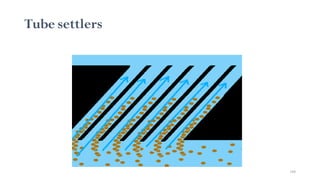
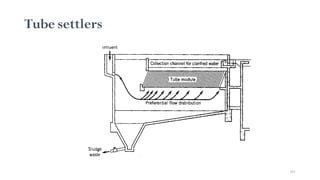
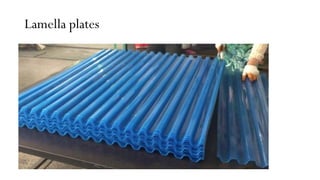
 But in some cases, tube settlers and lamella plates, such as those
shown below,are included in the settling zone
Tube settlers
160
Tube settlers
161
Lamella plates
Determining the capacity of the settling zone
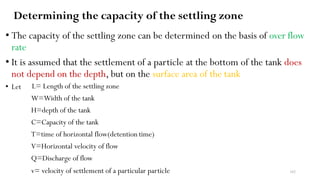
• The capacity of the settling zone can be determined on the basis of over flow
rate
• It is assumed that the settlement of a particle at the bottom of the tank does
not depend on the depth, but on the surface area of the tank
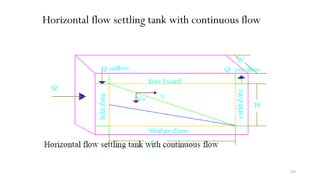
• Let L= Length of the settling zone
W=Width of the tank
H=depth of the tank
C=Capacity of the tank
T=time of horizontal flow(detention time)
V=Horizontal velocity of flow
Q=Discharge of flow
v= velocity of settlement of a particular particle 162
Horizontal flow settling tank with continuous flow
164
165
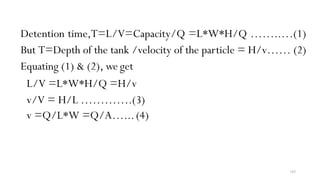
Detention time,T=L/V=Capacity/Q =L*W*H/Q ……..…(1)
But T=Depth of the tank /velocity of the particle = H/v…… (2)
Equating (1) & (2), we get
L/V =L*W*H/Q =H/v
v/V = H/L ………….(3)
v =Q/L*W =Q/A…...(4)
166
Outlet Zone
•The outlet zone controls the water flowing out of the
sedimentation basin
•Like the inlet zone, the outlet zone is designed to prevent
short-circuiting of water in the basin
•In addition, a good outlet will ensure that only well-settled
water leaves the basin and enters the filter
•The outlet can also be used to control the water level in the
basin
167
Outlet Zone
•Outlets are designed to ensure that the water flowing out of the
sedimentation basin has the minimum amount of floc suspended in it.
•The best quality water is usually found at the very top of the
sedimentation basin, so outlets are usually designed to skim this
water off the sedimentation basin.
•A typical outlet zone begins with a baffle in front of the effluent.
•This baffle prevents floating material from escaping the
sedimentation basin and clogging the filters.
•After the baffle comes the effluent structure, which usually consists
of a launder, weirs, and effluent piping.
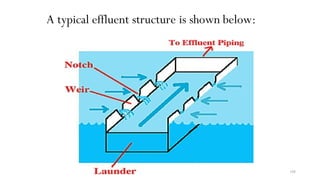
A typical effluent structure is shown below:
168
169
Outlet Zone
•The primary component of the effluent structure is the
effluent launder, a trench which collects the water flowing out
of the sedimentation basin and directs it to the effluent piping.
•The sides of a launder typically have weirs attached. Weirs are
walls preventing water from flowing uncontrolled in to the
launder.
•The weirs serve to skim the water evenly of the tank.
•A weir usually has notches, holes, or slits along its length.
•These holes allow water to flow in to the wire.
•The most common type of hole is the V-shaped notch Shown on the
picture above which allows only the top inch or so of water to flow
to out of the sedimentation basin
Outlet Zone
171
Outlet Zone
•Water flows over or through the holes in the weirs and in to
the launder.
•This pipe carries water away from the sedimentation basin
and to the next step in the treatment process.
•The effluent structure may be located at the end of a
rectangular sedimentation basin or around the edges of the
circular clarifier.
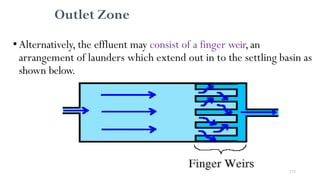
Outlet Zone
•Alternatively, the effluent may consist of a finger weir,an
arrangement of launders which extend out in to the settling basin as
shown below.
172
173
Sludge Zone
• The sludge zone is found across the bottom of the sedimentation basin
where the sludge collects temporarily.
•Velocity in this zone should be very slow to prevent re-suspension of
sludge.
•A drain at the bottom of the basin allows the sludge to be easily
removed from the tank.
• The tank bottom should slope toward the drains to further facilitate
sludge removal.
•In some plants, sludge removal is achieved continuously using
automated equipment.
174
Sludge Zone
• In other plants, sludge must be removed manually. If removed
manually, the basin should be cleaned at least twice per year or more
often if excessive sludge buildup occurs.
•It is best to clean the sedimentation basin when water demand is low,
usually in April andOctober.
•Many plants have at least two sedimentation basins so that water can
continue to be treated while one basin is being cleaned, maintained,
and inspected
175
Sludge Zone
•If sludge is not removed from the sedimentation basin often enough,
the effective (useable) volume of the tank will decrease, reducing the
efficiency of sedimentation.
•In addition, the sludge built up on the bottom of the tank may
become septic, meaning that it has begun to decay an aerobically.
•Septic sludge may result in taste and odor problems or may float to
the top of the water and become scum.
•Sludge may also become re-suspended in the water and be carried
over to the filters
176
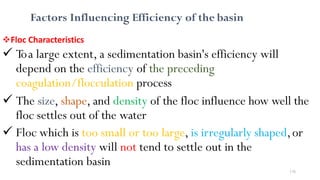
Factors Influencing Efficiency of the basin
Floc Characteristics
 Toa large extent, a sedimentation basin's efficiency will
depend on the efficiency of the preceding
coagulation/flocculation process
 The size, shape, and density of the floc influence how well the
floc settles out of the water
 Floc which is too small or too large, is irregularly shaped,or
has a low density will not tend to settle out in the
sedimentation basin
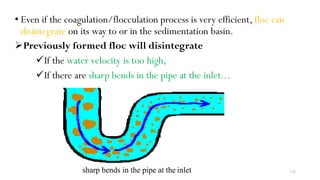
• Even if the coagulation/flocculation process is very efficient, floc can
disintegrate on its way to or in the sedimentation basin.
Previously formed floc will disintegrate
If the water velocity is too high,
If there are sharp bends in the pipe at the inlet...
176
sharp bends in the pipe at the inlet
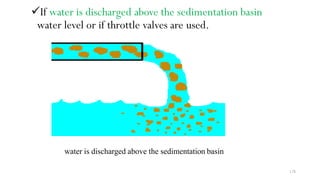
If water is discharged above the sedimentation basin
water level or if throttle valves are used.
water is discharged above the sedimentation basin
178
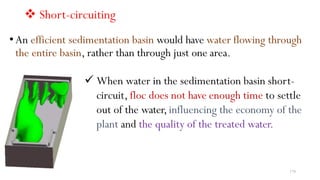
 Short-circuiting
• An efficient sedimentation basin would have water flowing through
the entire basin, rather than through just one area.
 When water in the sedimentation basin short-
circuit, floc does not have enough time to settle
out of the water,influencing the economy of the
plant and the quality of the treated water.
179
180
 A variety of factors causes short-circuiting in a sedimentation
basin
Basin shape and design of the inlet and out-let
Thin sedimentation basin is less likely to short-circuit than is
a short broad one
Uneven distribution of flow either at the inlet or out-let
Weir at the out-let is not level or if some of the notches
clog, flow will be uneven
Difference in temperature
181
Other Problems
•Gases in the water may cause floating scum,
•Algal growth.
•Intermittent operation of the basin can cause settling problems.
182
Designing a Rectangular SedimentationTank
• Designing a rectangular sedimentation tank is similar in many ways to design
a flocculation chamber.
• Water in a sedimentation basin is not agitated, so the velocity gradient is not
a factor in the calculation
• Twoadditional characteristics are important in designing a sedimentation
basin
 The overflow rate (also known as surface loading or the surface
overflow rate)
 Weir loading, also known as weir overflow rate
183
Design of Horizontal FlowTanks
•A depth of at least 3m is provided to allow for sludge storage
•For a given flow rate, the remaining variable to determine will be
either the plan area or the detention time
184
Specifications
The sedimentation basin we will design is a rectangular sedimentation
basin with the following specifications
• Rectangular basin
• Depth:7-16 ft (2m-5m)
• Width:10-50ft (3m-15m)
• Length:4mwidth
185
• Influent baffle to reduce the flow momentum
• Slope of bottom to ward sludge hopper >1%
• Continuous sludge removal with a scraper velocity
<15ft/min
• Detention time:4-8 hr
• Flow through velocity :0.5ft/min (0.15m/min)
• Overflow rate:500-1,000gal/day-ft2
(1gal=0.00379m3)
• Weir loading:15,000-20,000gal/day-ft
Rectangular sedimentation basin
186
187
Over view of calculations
Wewill determine the surface area, dimensions, and volume of
the sedimentation tank as well as the weir length
The calculations are as follows:
• Divide flow in to at least two tanks.
• Calculate the required surface area.
• Calculate the required volume.
• Calculate the tank depth.
188
• Calculate the tank width and length.
• Check flow through velocity.
• If velocity is too high, repeat calculations with
more tanks.
• Calculate the weir length
189
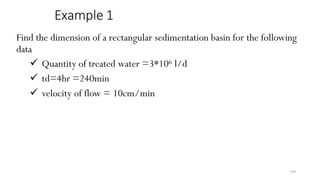
Example 1
Find the dimension of a rectangular sedimentation basin for the following
data
 Quantity of treated water =3*106 l/d
 td=4hr =240min
 velocity of flow = 10cm/min
190
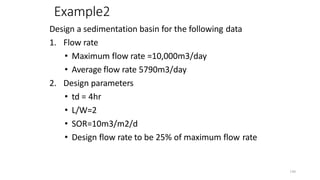
Example2
Design a sedimentation basin for the following data
1. Flow rate
• Maximum flow rate =10,000m3/day
• Average flow rate 5790m3/day
2. Design parameters
• td = 4hr
• L/W=2
• SOR=10m3/m2/d
• Design flow rate to be 25% of maximum flow rate
191
FILTRATION
Theory of Filtration
The effluent obtained after coagulation does not satisfy the
drinking water standard and is not safe, So it requires further
treatments
Filtration is one of the water purification process in which
water is allowed to pass through a porous medium to
remove remaining flocs or suspended solids from the
previous treatment processes
Filtration process assist significantly by reducing the load on
the disinfections process, increasing disinfection efficiency.
192
193
Filtration consists of passing water through a thick layer of
sand
During the passage of water through sand, the following
effects take place.
i) Suspended matter and colloidal matter are removed
ii) Chemical characteristic of water get changed
iii) Number of bacteria considerably reduced.
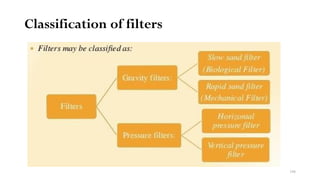
Classification of filters
194
Slow sand filters
•Simplest and biological filters without any mechanical equipment
•It can use for Less than 20 NTU water treatment.
•Best suited for the filtration of water for small towns
•Fine sand with an effective size of 0.2 mm
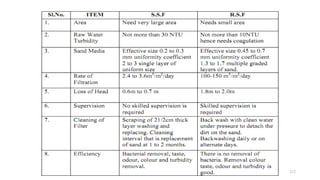
•Filtration rate is 50 to 100 times slower than that of rapid sand
filter (2.4 to 3.6m3/m2/day)
•A layer of dirt, debris, and microorganisms builds up on the top
of the sand.
•This layer is known as schmutzdecke, which is German for
"dirty skin.“or “dirty cover’’. 194
196
•The Schmutzdecke breaks down organic particles
in the water biologically, and is also very effective in
straining out even very small inorganic particles
•Filtered water has <0.3NTU turbidity (the goal is
<0.1NTU)
•Output water may requires chlorination (for quality
improvement)
197
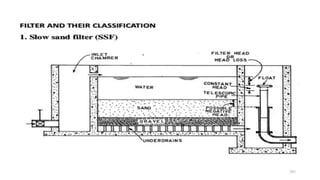
Essential features of slow sand filter
1.Enclosed tank
2.Filter media
3.Base material
4.Under drainage system
5.Appurtenances
198
1. Enclosed tank
SSF is open basin, rectangular shape and built below finished ground
level.
Surface area of the tank varies from 50 to 1000sqm.
Filtration rate – 100 to 200 lit/ sqm/hr
Depth – 2.5 to 4m
2. Filter media :Sand
Thickness of sand layer – 90 to 110cm.
Effective size – 0.20 to 0.35 ( common value – 2.5)
Coefficient of uniformity – 2.0 to 3.0 ( common value – 2.5)
3. Base material :Gravel
Thickness of gravel bed – 30 to 75cm.
4. Under drainage system
 Base material and filter media are supported by under drainage system
Under drainage system collects filtered water and delivers it to the
reservoir
199
200
5.Appurtenances
 Devices are required for
Gauge – to measure loss of head
Vertical air vent pipe – for proper functioning of
filtering layer
Telescope tube – to maintain constant discharge
A meter – to measure flow
201
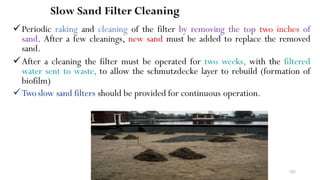
Slow Sand Filter Cleaning
Periodic raking and cleaning of the filter by removing the top two inches of
sand. After a few cleanings, new sand must be added to replace the removed
sand.
After a cleaning the filter must be operated for two weeks, with the filtered
water sent to waste, to allow the schmutzdecke layer to rebuild (formation of
biofilm)
Twoslow sand filters should be provided for continuous operation.
202
203
Advantages and Disadvantages of SSF
•Advantages:
oLong design life
oCan use local material and labor
oCost of construction cheaper than rapid sand filter
oDo not usually require coagulation/flocculation before filtration
oFilters enough water for a community ( up to 15,000gal/day)
oBacterial count reduction is 99.9% to 99.99% and E.coli reduction is
99% to 99.9%
•Disadvantages:
oInitial cost is low but maintenance cost is much more than rapid sand
filter
oThese filters requires extensive land area for a large municipal system.
204
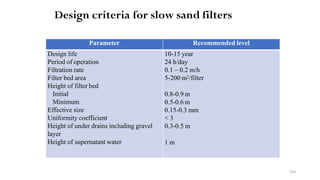
Design criteria for slow sand filters
Parameter Recommended level
Design life
Period of operation
Filtration rate
Filter bed area
Height of filter bed
Initial
Minimum
Effective size
Uniformity coefficient
Height of under drains including gravel
layer
Height of supernatant water
10-15 year
24 h/day
0.1 – 0.2 m/h
5-200 m2/filter
0.8-0.9 m
0.5-0.6 m
0.15-0.3 mm
< 3
0.3-0.5 m
1 m
205
Rapid Sand Filter
•It is somewhat complex and expensive to operate and
maintain and therefore less suitable for small communities.
•Much greater filtration rate ranging from 100 to
150m3/m2/day
•The ability to clean automatically using backwashing and
require small filter area.
•Do not use biological filtration and depend primarily on
adsorption and some straining
206
Rapid Filter
•The media is coarser compared to slow sand filters (0.4 to 0.6 mm
or higher)
•Most common in water treatment plants
•Removal is with depth
• Have to clean the entire filter media usually by backwashing for the
cleaning of rapid sand filter.
•Cleaning by back washing (head losses 1.2 – 2.5 m)
•W
ater must be pre-treated to destabilize negatively
charged particles
207
Rapid filter
•The most commonly used filter media is sand.
•Sometimes use coal, anthracite, coconut shell and
ballistic stone etc.
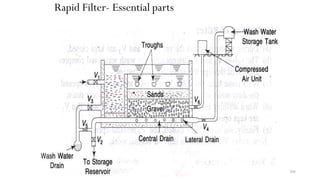
Rapid Filter- Essential parts
208
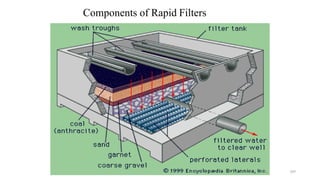
Components of Rapid Filters
209
210
Operation
The water from coagulation sedimentation tank is uniformly
distributed on the whole sand bed
Water after passing through the sand bed is collected through the
under drainage system in the filtered water well
The outlet chamber in this filter is also equipped with filter rate
controller
In the beginning the loss of head is very small
But as the bed gets clogged, the loss of head increases and the rate
of filtration become very low
Therefore the filter bed requires its washing.
211
Washing of Filter
Involves passing water upward through the filter media at a velocity
sufficient to expand (fluidize) the bed and wash out the accumulated
solids
Done when:
•The head loss through the filter exceeds the design value.
•Turbidity breakthrough causes the effluent quality to be less than
a minimum acceptable level
Bed expansions are achieved in backwashing.The sand bed expands
by about 50%.
Washing process is continued till the sand bed appears clearly.
Rapid sand filter bring down the turbidity of water to 1 N.T.U.
212
213
Parts of a rapid filter
• Filter tank: A water tight tank is constructed either masonry or
concrete
• Filter sand: specially manufactured or selected sand and other filter
media.The depth of sand 60 to 75cm
• Under drain system: carries filtered water & distributes the backwash
water uniformly
• Wash water trough: collects back wash water
• Filter bed agitator: agitates sand layer for cleansing (air-scour or
surface wash systems)
• Appurtenances :Air compressors useful for washing of filter and wash
water troughs for collection of dirty water after washing of filter.
214
Rapid Filter Media
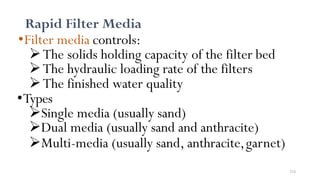
•Filter media controls:
The solids holding capacity of the filter bed
The hydraulic loading rate of the filters
The finished water quality
•Types
Single media (usually sand)
Dual media (usually sand and anthracite)
Multi-media (usually sand, anthracite,garnet)
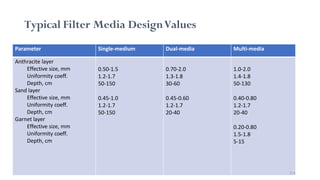
Typical Filter Media DesignValues
Parameter Single-medium Dual-media Multi-media
Anthracite layer
Effective size, mm
Uniformity coeff.
Depth, cm
Sand layer
Effective size, mm
Uniformity coeff.
Depth, cm
Garnet layer
Effective size, mm
Uniformity coeff.
Depth, cm
0.50-1.5
1.2-1.7
50-150
0.45-1.0
1.2-1.7
50-150
0.70-2.0
1.3-1.8
30-60
0.45-0.60
1.2-1.7
20-40
1.0-2.0
1.4-1.8
50-130
0.40-0.80
1.2-1.7
20-40
0.20-0.80
1.5-1.8
5-15
214
216
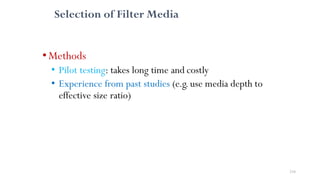
Selection of Filter Media
•Methods
• Pilot testing: takes long time and costly
• Experience from past studies (e.g.use media depth to
effective size ratio)
217
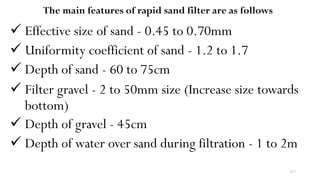
The main features of rapid sand filter are as follows
 Effective size of sand - 0.45 to 0.70mm
 Uniformity coefficient of sand - 1.2 to 1.7
 Depth of sand - 60 to 75cm
 Filter gravel - 2 to 50mm size (Increase size towards
bottom)
 Depth of gravel - 45cm
 Depth of water over sand during filtration - 1 to 2m
218
 Overall depth of filter including 0.5m free board - 2.5m
 Area of single filter unit - 100m2 in two parts of each 50m2
 Loss of head - Max 1.8 to 2.0m
 Turbidity of filtered water - 1 NTU
 Influent pipe to filters: 0.6-1.8 m/s
 Effluent pipe carrying filtered water: 0.9-1.8 m/s
 Drains carrying spent backwash water: 1.2-2.4 m/s
 Wash water line (influent): 2.4-3.7 m/s
 Filter to waste drain: 3.7-4.8 m/s
Pressure Filter
 Pressure filter is type of rapid sand filter in closed water tight
cylinder through which the water passes through the sand bed
under pressure
 All the operation of the filter is similar to rapid gravity filter;
except that the coagulated water is directly applied to the filter
without mixing and flocculation
 These filters are used for industrial plants but these are not
economical on large scale
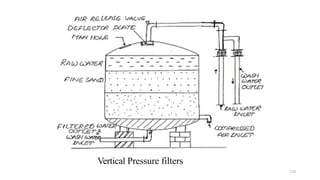
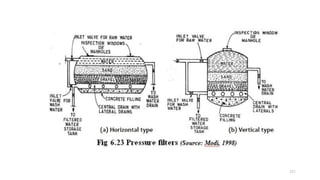
 Pressure filters may be vertical pressure filter and horizontal
pressure filter
 Backwash is carried by reversing the flow
 The rate of flow is 120 to 300 m3/m2/day 218
Vertical Pressure filters
220
221
222
Example 1
Calculate the head loss through a clean bed of uniform sand that has a
grain diameter of 0.5 mm, bed depth 0.3 m and porosity ratio of
0.4.The shape factor is 0.85 and the specific gravity of sand is 2.65.
The water temperature is 20°C and the filter has a loading rate of
4.0 m3/m2-h. Use the Carmen-Kozeny equation.
223
Example 2
•A dual-media filter bed is being designed.The media used are sand
and anthracite.The effective size and specific gravity of sand are 0.60
mm and 2.65.The specific gravity of anthracite is 1.5. Calculate
• The effective size of the anthracite that has the same settling velocity as
the sand
224
6. DISINFECTION
225
•The primary goal of water treatment is to ensure that the water is safe
to drink and does not contain any disease-causing microorganisms.
•Pathogens can be removed from water through physical or chemical
processes.
•Disinfection, which is the process of selectively destroying or
inactivating pathogenic organisms in water,usually by chemical means.
•Disinfection is different from sterilization, which is the complete
destruction of all organisms found in water and which is usually
expensive and unnecessary.
226
Location in the TreatmentProcess
•During pre-chlorination, chlorine is usually added to raw water after
screening and before flash mixing.
•Post-chlorination, is often the last stage in the treatment process.
•After flowing through the filter, water is chlorinated and then
pumped to the clear well to allow a sufficient contact time for the
chlorine to act.
•From the clear-well, the water may be pumped into a large,outdoor
storage tank.
•Finally, the water is released to the customer.
227
Requirements of Good Disinfectant
1. Destroy bacteria/pathogens within a practicable period of time,
over an expected range of water temperature.
2. Effective at variable compositions, concentration and conditions
of water treated.
3. Neither toxic to humans and domestic animals nor unpalatable
or otherwise offensive in required concentration.
4. Not change water properties
228
Requirements of Good Disinfectant
5. Have residual in a sufficient concentration to provide protection
against recontamination
6. Can be determined easily,quickly, and preferably automatically.
7. Unnecessary at reasonable cost.
8. Safe and easy to store, transport,handle and supply.
9. Not form toxic by-products due to their reactions with any
naturally occurring materials in water.
229
Methods of Disinfection
• The disinfection of water can be done by one of the following
methods:
a) Boiling of water
b) Ultra–Violate rays
c) Iodine and bromine
d) Ozone O3
e) Excess lime
f) Potassium permanganate [KMnO4]
g) Chlorine
230
The most common method of disinfection is the use of chlorine
i.e.chlorination.
The various chlorine compounds which are available in the
market and used as disinfectants are:
1. Calcium hypo chlorite [Ca (OCl) 2] – poweder form
2. Sodium hypo chlorite [NaOCl] –liquid form
3. Free chlorine Cl2- Gaseous form
231
Chlorination
Is the application of chlorine to water for the purpose of
disinfection.
Chlorination can also be used for taste and odor control,
iron and manganese removal, and to remove some gases
such as ammonia and hydrogen sulfide.
232
Chlorination Chemistry
When chlorine is added to water,a variety of chemical processes
take place.
The chlorine reacts with compounds in the water and with the
water itself.
Some of the results of these reactions (known as the chlorine
residual) are able to kill microorganisms in the water.
233
The total amount of chlorine which is used up in reactions
with compounds in the water is known as the chlorine
demand.
A sufficient quantity of chlorine must be added to the water
so that, after the chlorine demand is met, there is still some
chlorine left to kill microorganisms in the water.
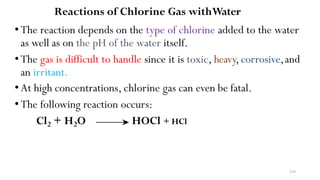
Reactions of Chlorine Gas withWater
•The reaction depends on the type of chlorine added to the water
as well as on the pH of the water itself.
•The gas is difficult to handle since it is toxic, heavy,corrosive,and
an irritant.
•At high concentrations, chlorine gas can even be fatal.
•The following reaction occurs:
Cl2 + H2O HOCl + HCl
234
235
• Hypochlorous acid is the most effective form of free chlorine
residual, meaning that it is chlorine available to kill
microorganisms in the water.
Hypo-chlorites
• Instead of using chlorine gas, some plants apply chlorine to water
as a hypochlorite, also known as a bleach.
• There are three types of hypochlorite's - sodium hypochlorite,
calcium hypochlorite, and commercial bleach.
• They react with water and form the disinfectant hypochlorous
acid.
•The reactions of sodium hypochlorite and calcium
hypochlorite with water are shown below:
Calcium hypochlorite +Water
Ca(OCl)2 +2H2O
Sodium hypochlorite +Water
NaOCl + H2O
HypochlorousAcid + Calcium Hydroxide
2HOCl + Ca(OH)2
Hypochlorous Acid + Sodium Hydroxide
HOCl + NaOH
236
Chloramines
• Some plants use chloramines rather than hypochlorous acid to
disinfect water.
• Toproduce chloramines, first chlorine gas or hypochlorite is
added to the water to produce hypochlorous acid
• Then ammonia is added to the water to react with the hypochlorous
acid and produce chloramine.
• Three types of chloramines can be formed in water
• Ammonia + HypochlorousAcid Monochloramine +Water
NH3 + HOCl NH2Cl + H2O
237
•Mono-chloramine + HypochlorousAcid
+Water
NH2Cl + HOCl NHCl2 + H2O
•Dichloramine + HypochlorousAcid
Water
NHCl2 + HOCl NCl3 +H2O
Dichloramine
Trichloramine +
Mono-chloramines and dichloramines can both be
used as a disinfecting agent, called combined chlorine
residual
238
239
Plain Chlorination
Plain chlorination is the process of addition of chlorine only
when the surface water with no other treatment is required.
The water of lakes and springs is pure and can be used after plain
chlorination.
A rate of 0.8mg/lit/hour at 15N/cm2 pressure is the normal
dosage so as to maintain in residual chlorine of 0.2 mg/lit.
240
Super Chlorination
Super chlorination is addition of excess amounts of chlorine
to a water supply, to insure disinfection within a short
contact time.
About 10 to 15 mg/lit is applied with a contact time of 10
to 30 minutes under the circumstances such as during
epidemic breakout water is to be dechlorinated before
supply to the distribution system.
241
Break Point Chlorination
• The breakpoint is the point at which the chlorine demand has been
totally satisfied - the chlorine has reacted with all reducing agents,
organics, and ammonia in the water.
•When more chlorine is added past the breakpoint, the chlorine
reacts with water and forms hypochlorous acid in direct proportion
to the amount of chlorine added.
•This process, known as breakpoint chlorination,is the most
common form of chlorination, in which enough chlorine is added
to the water to bring it past the breakpoint and to create some free
chlorine residual.
242
243
De-chlorination
Removal of excess chlorine resulting from super chlorination in
part or completely is called De-chlorination.
Excess chlorine in water gives pungent smell and corrodes the
pipe lines.
Hence excess chlorine is to be removed before supply.
Physical methods like aeration, heating and absorption on
charcoal may be adopted.
Chemical methods like Sulphur dioxide (SO2), Sodium Bi-
Sulphate (NaHSO3), SodiumThiosulphate (Na2S2O8) areused.
244
Points of Chlorination
 Chlorine applied at various stages of treatment and distribution accordingly
they are known as pre, post and re-chlorination.
a) Pre-Chlorination
 Chlorine applied prior to the sedimentation and filtration process is known
as Pre-chlorination.
 This is practiced when the water is heavily polluted and to remove taste,
odor,color and growth of algae on treatment units.
 Pre-chlorination improves coagulation.
 Always followed by post chlorination, so as to ensure the final safety of
water.
 The normal dose required are as high as 5 to 10 mg/l.
b) Post Chlorination
• Post chlorination is the application of chlorine after water has
been treated or after filtration but before the water reaches the
distribution system.
• At this stage, chlorination is meant to kill pathogens and to provide
a chlorine residual in the distribution system.
• The dosage should be such as to have a residual chlorine of about
0.1 to 0.2mg/l having a contact period of 30min.
• Post-chlorination is nearly always part of the treatment process,
either used in combination with pre-chlorination or used as the
sole disinfection process. 244
246
c) Re-Chlorination
•In long distribution systems, chlorine residual may fall
tendering the water unsafe.
•Application of excess chlorine to compensate for this may lead
to unpleasant smell to consumers at the points nearer to
treatment plant, in such cases chlorine is applied again that is
re-chlorinated at intermediate points generally at service
reservoirs and booster pumping stations.
247
Ozonation / ozone water treatment
Oxygen rich molecule is pumped in to water system to
eliminate biological contaminants.
It is also effective for oxidizing and removing iron, sulfur,
manganese and other inorganic substances.
Ozone is significantly more effective than chlorine at
inactivating and/or killing viruses and bacteria.
Since ozone quickly converts to oxygen and leaves no toxic
residual.
• Can increase the dissolved oxygen concentration of water.
248
The disadvantages of Ozonation is:
•The cost of treatment is relatively high, being both capital and
power intensive.
•There is no measurable residual to indicate the efficiency of ozone
disinfection.
•Very reactive, irritative, toxic and corrosive, thusrequires
corrosion resistance materials, such as stainless steel.
•Low dosages may not effectively inactivate some viruses, spores
and cysts.
249
UV disinfection
•Ultra violet(uv) light disinfection: is one water treatment
system that can be used to remove most forms of microbiological
contamination from water.
•Uv light is normally effective against all viruses, bacteria and
protozoa.
•Uv light enters a microorganism its energy will damage the
microorganism’s cellular function so that it will not be able to grow.
250
Advantages of UV
 Proven technology, environmentally friendly,safe.
Cost saving in both initial construction and long-term operation.
There is no residual effect that can be harmful to human and
aquatic life.
Effective disinfectant for chlorine- resistant protozoa's like giardia.
UV disinfection has a short contact time when compared to other
disinfectants.
Requires less space than other methods.
251
Disadvantages of UV
•Low dosage may not effective inactivating some viruses, cyst and
bacteria.
•Do not remove all impurities
•Water needs to be pre-filtered
•It has single application- producing microbiologically safe, it has no
effect on chemicals, heavy metals, sediments, and any other such
issues.
•Needs electricity to work
MISCELLANEOUSWATERTREATMENT
1. Removal of Taste and OdorProblem
The sense of odour is closely related to that of taste.
In fact it is normally correct to suggest that most 'tastes' in water are really a sensation of
smell
The brackishness associated with relatively high concentrations of
salts such as sodium chloride or magnesium sulphate
• Iron and manganese in water often produce an astringent taste.
• Surface waters deficient in dissolved oxygen are often 'flat' to the
taste.
• Consumers identify and accept water as being pure as a result of its
lack of colour, its clarity and its lack of taste and odour
Causes of Odor andTaste
 Concentrations of inorganic salts (brackishness)
 Hydrogen sulphide
 Contact with painted surfaces
 Industrial discharges _ pesticides, phenols etc
 Metabolites of actinomycete, algae etc
 Dead and decaying organic material including sewage and algae
 Chlorination
Prevention of odours and tastes from
microorganisms
Some bacteria reduce sulphate to sulphide (H2S)
o These are controlled by aeration and chlorination.
Mold-like bacteria grow frequently in mains as a slime on the inside
of the pipes
o They may be controlled by treating reservoirs with copper sulphate or by ensuring
there is residual chlorine throughout the mains
 Iron bacteria - grow in water containing high concentrations of iron
and in which the D.O.is limited
 They produce objectionable odours and tastes as well as leading to
the precipitation of iron
o The remedies are removal of iron, chlorination or dosing with copper sulphate
Recommended method to remove test and odour problem
1. Aeration
Slightly volatile odors resulting from the decomposition of vegetation.
Due to aeration, concentrations of odoriferous metabolites emanating from living
microorganisms can be decreased
Thus, reducing the amount of activated carbon required at a later stage.
2.Chlorine
 Marginal chlorination is not sufficient to remove odoriferous compounds and also may
add a noticeable smell of chlorine
 Super chlorination with more than a breakpoint dosage will destroy most malodorous
compounds
3.Ozone
Ozone reduces H2S odors and tastes and also the odors from decaying vegetable matter.
Algae must be removed prior to the addition of ozone
4. Hydrogen peroxide
This is occasionally used for odor control.
It is generally too costly.
5. Chlorine Dioxide
ClO2 is particularly effective at removing phenolic odors from water.
It is most effective when mixed with an excess of chlorine
6. Potassium Permanganate
 It is one of the most effective chemical reagents for odour and taste control.
 In the USA it is widely used and is most effective between PH 8.o and PH 8.3
 Although it is about three times as costly as activated Carbon it has been claimed to be
up to five times as effective
7.ActivatedCarbon
Powdered activated carbon is a fine black powder applied either to the raw
water, or the mixing basin, on the settling basin or directly before the filters
A normal dose might be 2.0 mg/1 to clarified water although it has been
applied at rates up to 125 mg/1 to raw water
Granular activated carbon consists of relatively large grains and is held in
filter towers through which the water is continually passed
At low levels of taste and odour powdered activated carbon is suggested as
being more economic than the granular
2. Removal of Hydrogen sulphide
 The permissible concentration of H2S in water, which are required for domestic
purpose, is 0.5 mg/1 of H2S
 It is offensive when its concentration greater than 1.0 mg/l
 The odours are less noticeable as the PH rises due to the formation of alkaline sulphides
 Hydrogen sulphide is removed by aeration and chlorination
 Aerators are normally of the natural-draft cascade-type but aeration has only a limited
effect
 Removal by chlorination is highly effective but as much as 10 kg of chlorine may be
required to remove 1.0 kg of hydrogen sulphide
 It is necessary to establish a cost balance between aeration and chlorination
3. Removal of Iron and Manganese
Iron and manganese can be dissolved from sandy soils, laterite, shale, sandstone and other
rocks by acid water which contains no dissolved oxygen (such water may have an organic
content )
Decomposition consumes the oxygen and produces carbon dioxide, which is acidic
The iron is usually in the form of ferrous bicarbonate and the manganese in the form of
manganese oxide or bicarbonate.These forms are soluble
If the water is now exposed to air so that oxygen can enter into solution and carbon
dioxide leaves, the ferrous form is oxidized to ferric, and the manganese to manganic
These latter forms are insoluble and so visible precipitates are formed
Therefore, iron bearing water may be clear when pumped up from a well, but may on
standing, turn brown and turbid
Manganese problem in a distribution system may take years to appear because the
reactions are slow until catalyzed by deposits
Iron and manganese problems most commonly occur with groundwater,but may also
appear in water drawn from the bottom of a stratified reservoir or in acidic waters
Manganese may occur in significant quantities in river water,sometimes coming from
acid mine drainage
Effects of Iron and Manganese
These metals in potable water can have:
a) Colour in the water
b) Staining of plumbing fixtures and clothing (Fe -brown. Mn - black)
c) Astringent, metallic or medicinal taste in the water
d) Growth of iron bacteria
e) Brown stains on cooked vegetables and discoloured etc.
Method of Treatment
• Groundwater containing iron and/or manganese needs only treatment to remove these
metals, and disinfection.
• Surface water containing iron or manganese will usually also require removal of the
turbidity of clay colloids.
• Small quantities of iron can be removed by normal conventional treatment.
• If a higher PH is needed to remove iron or manganese then alum may not be suitable and
ferric coagulants may be preferred if removal of turbidity and iron or manganese is
effected simultaneously.
1. Aeration
 It is commonly used, but some processes require exclusion of air at the early stages.
 Aeration raises the PH by removing carbon dioxide, and adds oxygen.
 Only 0.14 mg/1 of dissolved oxygen is needed to oxidize 1 mg/1 of iron.
2. Sedimentation
 It is useful where large particles are formed in a short time
3. Filtration
It is required in most processes as a means of capturing small suspended particles
Also often to promote oxidation by the catalytic effect of deposits on the sand grains.
Because the deposits are useful the filter will take time to mature and should not be back
washed too thoroughly
4. Chlorination
 It is simple and cheap, but slow for manganese below PH 8.5 and in some cases may
form very fine precipitates
5. Lime
 Raising the PH will cause oxidation, but this technique is not suitable for hard waters
because it will cause deposition of calcium carbonate on the filter sand
6. Ion exchange
 When used for softening water will also remove soluble iron and manganese, it should
therefore be done in the absence of air to prevent formation of the insoluble forms.
LET US PROVIDE QUALITY WATERFOROUR
COMMUNITY
272

Water Treatment.pdf

  • 1.
    Arba Minch WaterTechnology Institute Faculty of Water Supply and Environmental Engineering Course title; WaterTreatment Course code; WSEE-3142 Target groups; 3rd year Water Supply and Environmental Engineering students Academic year; 2019/20, Semester; II Instructor; Samirawit D. and Kindeneh B. February, 2020
  • 2.
    Outline 1. Introduction 2. Preliminarytreatment 3. Sedimentation 4. Coagulation and flocculation 5. Filtration 6. Disinfection 7. Miscellaneous water treatment 2
  • 3.
  • 4.
    So what isit about water that makes it so important to us? Water is of major importance to all living things. Up to 70 percent of the human body isWater. Therefore the quality ofWater we drink is veryimportant. The DrinkingWater should be clean, pure and free of any disease causing Microbes, and that’s why it should be properlyTreated and Disinfectedbefore using it for drinking purpose. 4
  • 5.
    Uses ofWater • Bathing •Toilets • Cleaning • Food preparation • Cooling • Fire protection • Industrial purposes • Drinking water = Potable water
  • 6.
    Sources of Water Aquifers(Groundwater) •Primary source of drinking water •Porous consolidated rock or unconsolidated soil •Groundwater fills spaces •Wells and pumps used to remove water Aquifer This image was reproduced from groundwater.org with the permission of The Groundwater Foundation. © 2010 The Groundwater Foundation. All Rights Reserved Courtesy USGS at http://pubs.usgs.gov/circ/circ1139/htdocs/boxa.htm
  • 7.
    Sources ofWater SurfaceWater •Lakes, reservoirs,rivers •Riversdammed to create reservoirs •Reservoirs store water during heavy rain River Lake Dam
  • 8.
    Water Sources andtheir Quality Sources for supplying water: • Upland rivers • Lowland rivers • Lakes and reservoirs • Groundwater aquifers Which source to select? 8
  • 9.
    9 Typical raw waterquality Parameter Upland River Lowland river pH Total solids, mg/L Alkalinity Hardness Color Turbidity Coliforms, MPN/100mL 6.0 50 20 10 70 5 20 7.5 400 175 200 40 50 20 x 103
  • 10.
    Comparison of surfacewater and groundwater quality Parameter Surface water Groundwater o Temperature o Turbidity and SS o Mineral content o Iron and manganese o Carbon dioxide o Dissolved oxygen o Ammonia o Hydrogen sulfide o Nitrate o Living organisms Varies with season Varies and is sometimes high Varies with soil, rainfall, effluents,etc Some None Often near saturation, if notpolluted Only in polluted water None Generally none May be high Relatively constant Usually low or nil Relatively constant and high Always high Always high Usually low Increasing trend Usually some Increasing trend Usually none 9
  • 11.
    11 Source ofWater PollutionandWater Impurities Water Pollution Water pollution is any chemical, biological, or physical change in water quality that has a harmful effect on living organisms or makes water unsuitable for desired uses. a) Point source: specific location (drain pipes, ditches, sewerlines). b)Non point source: cannot be drawn to a single site of discharge (atmospheric deposition, agricultural / industrial / residential runoff)
  • 12.
    12 Some raw waterquality parameters Physical • Suspended solids • TDS • Color • Turbidity • Conductivity • Taste • Odor • Absorbance/transmittance Biological • Total coliforms • E.coli • Plants and animals Chemical • Oxygen demanding organics • Dissolved oxygen • Principal inorganic ions • Trace constituents • Synthetic organic matters • pH • Alkalinity • Hardness
  • 13.
    13 Impurities in water Theimpurities which are present in water may be classified in the following three categories. a) Suspended impurities b) Colloidal impurities c) Dissolved impurities
  • 14.
    14 a) Suspended impurities These impurities are dispersion of solid particles that are large enough to be removed by filtration or sedimentation.  These impurities are normally remain in suspension  They are microscopic and make turbid.  Suspended impurities are:- • Bacteria –some cause diseases •Algae, protozoa –colour, odor,turbidity • Silt -muddiness or turbidity
  • 15.
    15 b) Colloidal impurities The finely divided dispersion of solid particles  Colloidal impurities are electrically charged. Due to this, the colloidal particles usually very small in size, remain in constant motion and do not settle.  They are chief source of epidemic because they are associated with bacteria. It is removed by coagulation. c) Dissolved impurities  Which are not visible to the naked eye cannot be removed by ordinary filters  It includes organic compound, inorganic salt and metals and gases etc.
  • 16.
    Water analysis •Various typesof impurities present in water can be determined by water analysis. • The analysis of raw water is used to determine the processes of water purification •The analysis of purified water is done to know whether the degree of purification has reached the required standards or not.
  • 17.
    The examination ofwater may be divided in to three classes: 1. Physical Examination 2. Chemical Examination 3. Microbiological Examination
  • 18.
    1. Physical Examination i.Colour tests- Water must be free from objectionable colour.  Colour is indicative of decayed vegetation and bacteria or chemical, petrol- chemical,textile, paper and pulp etc. ii. Taste and odour test- Odour in water indicates the presence of dissolved gases. Such situation gives rise to taste.  Odour is measured in terms of thresh hold number iii. Temperature test- This could destroy the biological and biochemical configuration of a water body.  Aquatic organisms are sensitive to thermal changes.  The temperature of water to be supplied should be between 100C to 200C iv. Turbidity test- This refers to a state of unclear, muddy and thick water.It is an important measure of effluent quality standard.  Common methods of measurement is Nephelometers, turbidity rod, Jackson/ Baylis turbidimeter.  The permissible turbidity of domestic water may be between 5 to 10 p.p.m.
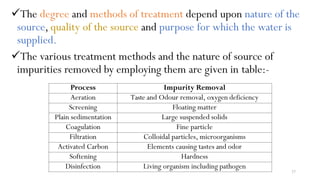
  • 19.
    2. Chemical Examination i.Total solids- the suspended, dissolved and colloidal solids are determined separately and then added together to getTotalsolids. o High TDS causes corrosion and dehydration of organic tissues within the ecosystem. o The amount of total solids should preferably be less than 500ppm. ii. Chlorides- the test is carried out to determine the content of sodium chloride in water. iii. Hardness- it is due to presence of certain salts of calcium and magnesium dissolved in it. o Calcium and magnesium salts are soap destroying and are prime constituents concerned with hardness. o Total hardness is composed of two components:Temporary hardness andpermanent hardness
  • 20.
    iv. PH value-This is a measure of acidity and alkalinity. pH for water body should fall within range 6 – 9 v. Metals and other chemical substances  Iron in water causes hardness, bad taste, discolouration of clothes and flumbing fixtures and incrustation in water mains.  Lead is a well known cumulative poison. Under normal condition, the concentration of lead should be less than 0.05mg/l.  Iodine upto 1ppm keep away goiter while fluoride upto 1.2ppm will prevent dental caries of the children. Excess concentrations (>3ppm) can cause goiter and dental fluorosis or mottled enamel in childrens.  Sodium and potassium Excess quantities are excreted, primarily in the urine. - some patients of Heart, Kidney or Lever diseases are unable to rid themselves of sodium resulting substances.
  • 21.
    3. Microbiological Examination Thewater used should be free from fecal or sewage contamination. The following are the purposes of bacteriological examination of water: o Todetect and assess the degree of pollution in thesource. o Toassess the amount of treatmentrequired. o Todetermine the efficiency ofpurification o Tolocate any sudden deterioration inquality o Toestablish the final water purity frombacteria  Test for E-coli (Escherichia coli)- are bacteria found in the environment, food and intestines of humans and animals. o E.coli are large and diverse group of bacteria o E-coli in water supply indicates pollution by faecal contamination.
  • 22.
    Diseases in Drinkingwater  Diseases in drinking water can be classified in to:- 1. Water born disease: if pathogens that originates in Fecal material and are transmitted by drinking water.Like diarrhea, fatigue, abdominal cramps etc… 2. WaterWashed disease: if organisms that originates in feces and are transmitted through contact because of inadequate sanitation or hygiene. 3. Water based disease: if organisms that spend part of their life cycle in aquatic animals and come in direct contact with humans in water,often through skins. 4. Water related disease: if organisms with life cycles associated with insects that live or breed in water and bite susceptible individuals.
  • 23.
    Diseases in Drinkingwater  Water born diseases are caused by pathogenic organisms carried by water containing fecal or sewage contamination.  The most common water born diseases are grouped in to four heads:- a. Bacterial diseases b. Protozoal diseases c. Virus diseases and d. Helminthic( worm) diseases
  • 24.
    a. Bacterial diseases Typhoid fever; water born disease where water supplies are drawn from surface source contaminated by human faeces or urine.  Paratyphoid fever; mostly due to ingestion of contaminated food, especially milk, dried or frozen eggs and other products  Cholera; by ingestion of water contaminated by infected human fecal material • It may be contracted by contaminated food or personal contact  Bacillary dysentery; Mostly contracted due to ingestion of food contaminated by flies or by unhygienic food handlers.
  • 25.
    b. Protozoaldisease Caused bythe protozoon Entamoeba histolytica, they live in the human large intestine forming cyst which are excreted in the bowel discharge of infected persons Infection takes place due to ingestion of these cyst which are carried by water or flies or even human fingers. c. Virus diseases Any virus extracted and capable of causing infection when ingested could be transmitted by water. Those viruses that can multiply in the intestine wall and that are discharged in large numbers in faeces are of more concern.
  • 26.
    d. Helminthic( worm)diseases Occurs only under grossly insanitary conditions or through gross mis management of sewage disposal system.
  • 27.
    Water quality standards Water quality standard is limits on the amount of impurities in water for the intended use and which is legally enforced.  It includes rules and regulations for sampling, testing and reporting procedures.  There are three water quality standards: 1. Stream standards: this can set limits on pollutants discharge in surface water 2. Effluent standards: this can set limits on pollutants from different sewage treatment plants which discharged in to rivers. 3. Drinking water standard: this can set limits on contaminants in public water supply.
  • 28.
    Basic quality requirementsof drinking water • Free from diseases causing pathogenic organisms • Contain no compounds that have adverse effect acute or in long term on human health • Fairly clear (i.e., of low turbidity, littlecolor) • No saline • Contain no compounds that cause offensive taste and odor • Free of substances and organisms that cause corrosion or deposit of the water supply system, staining of clothes washed in it or food items cooked with it.
  • 29.
     Primary drinkingwater standards : Protect public health and their maximum permissible levels was enforced by law.  Secondary drinking water standards: this is about aesthetic qualities, color, odor, andtaste  Can be recommended but not enforced by law  Water quality for any construction should be as much as possible in the standards of drinking quality
  • 30.
    Drinking water qualitystandards Parameter WHO guideline (2018) Recommended for Ethiopia(2017) pH Total solids, mg/L Total hardness, mg/L Chloride, mg/L Sulphate, mg/L Fluoride, mg/L Iron, mg/L E. Coli, MPN/100 ml Nitrate , mg/L Arsenic and lead,mg/l 6.5-8.5 1000 500 250 250 1.5 0.3 10 50 0.01 6.5-8.5 1000 300 250 250 1.5 0.3 30 40 0.01 29
  • 31.
    Water quality monitoringand surveillance • This means basically administering, managing and close observation of water issues for public satisfaction.  Quality of water:- the microbiological quality is given highest priority  quantity of water:- the quantity of water should be enough for basic requirements  Reliability of supply :- should be reliable and available at a short distance as possible  Cost of water:- payment of the use of water  Coverage of the population:- % of the population that has access to a
  • 32.
  • 33.
    Common words  Palatable- Water having no unpleasant taste or good taste.  Safe - Water free from pathogenic micro organisms & chemicals which could bea harmful for consumer  Clean - Water free from suspended solids andturbidity  Colorless and odorless – Water aesthetic to drink  Reasonably soft – Water allowing easy wash of cloths, dishes with less soap  Lower organic content - Toavoid unwanted biological growth in pipes & smell  Non corrosive - Devoid of gases e.g.O2,Co2 ,H2S  Potable - Water suitable for drinking i.e. Safe and pleasant to taste  Wholesome - Potable water having sufficient minerals of natural origin which are must for life.  Contaminated - Water having micro organisms, chemicals or substances making the water unsafe and dirty.
  • 34.
    34 Some facts • AccordingtoWHO,the water source has to be within 1,000 metres of the home and collection time should not exceed 30 minutes.But the average distance that women inAfrica andAsia walk to collect water is 6 kilometres. •27% of the urban population in the developing world does not have piped water in their homes. Source:UNESCO •Long-term exposure to high level of arsenic in drinking water can cause thickening and pigment spots in the skin, and cancer of the skin, lungs, bladder or kidney. •An estimated 1000 children die every day in India due to polluted water.
  • 35.
    35 •Now a dayglobally, 844 million people lack access to clean water, more than 1 of every 10 people on the planet. (world vision 2018) •Woman and girls spend an estimated 200 million hours hauling water every day.(world vision 2018) •62 million people living without basic access to safe drinking water. •31 percent of the Ethiopian population relies on unprotected water for their daily needs. •Every day,more than 800 children under age 5 die from diarrhea attributed to poor water and sanitation. (world vision 2018) •One in every 17 children does not live to see their fifth birthday, and diarrheal disease is the leading cause of death in Ethiopia.
  • 36.
    36  Water availablein various sources may contain various types of impurities and cannot be directly used by the public for various purposes, before removing the impurities  Therefore, removing these impurities up to certain extent so that it may not be harmful to the public health is necessary.  The process of removing the impurities from water is called water treatment and the treated water is called wholesome water. WaterTreatment
  • 37.
    37 The degree andmethods of treatment depend upon nature of the source, quality of the source and purpose for which the water is supplied. The various treatment methods and the nature of source of impurities removed by employing them are given in table:- Process Impurity Removal Aeration Taste and Odour removal, oxygen deficiency Screening Floating matter Plain sedimentation Large suspended solids Coagulation Fine particle Filtration Colloidal particles, microorganisms Activated Carbon Elements causing tastes and odor Softening Hardness Disinfection Living organism including pathogen
  • 38.
    38 Objective of treatment Themain objective of the treatment process is to remove the impurities of raw water and bring the quality of water to the required standard The objective may be summarized as follow:- (i) Preventing DiseaseTransmission  Organisms that cause disease must be removed or inactivated to make the water safe (ii) Making theWaterAcceptable  If the consumers regard the water as unsatisfactory they may use an alternative source which is hazardous (iii) Protecting the distribution System  Corrosion reduces the life of the pipes, reduces their carrying capacity, and forms deposits which may color the water.
  • 39.
    39 Location of treatmentplant •The treatment plant should be located  Near to the town to which water is to be supplied and near to the source of supply.This will prevent the water quality to depreciateafter treatment.  Away from any source of pollution.  Away from the border of other countries and should be announced as a protected area. During war time, a neighbor country may play foul game by damaging the plant, poisoning the water.  At higher elevation if the natural topography permit.
  • 40.
  • 41.
    Treatment Schemes a) SlowSand Filters b) ConventionalTreatment c)Treatment of GroundWater 40
  • 42.
  • 43.
    43 Factors Affecting theChoice of Treatment Schemes a) Limitation of capital b) Availability of skilled and unskilled labor c) Availability of equipment, construction material, andwater treatment chemicals d) Local codes, drinking water standards and material specifications e) Local traditions, customs and cultural standards f) National sanitation and pollution policies.
  • 44.
    44 Consideration forTreatment unitsin developingcountry  Use hydraulic devices instead of mechanical equipment’s e.g.for mixing of chemicals  Use indigenous materials & manufacturing to reduce the cost  Lower peak and per capital consumption  Lower design period  Organizational capacity to recruits and retrain  Head lose should be conserved possible
  • 45.
  • 46.
    46 •High turbidity waterwhich may occur particularly during the rainy season requires pre treatment in the form of screening, sedimentation, storage or roughing filtration to reduce much of the suspended solids. •This is an advantage otherwise a very large amount of chemicals may have to be employed for chemical coagulation which can be expensive
  • 47.
    47 Types of preliminarytreatment Intakes Screens Plain sedimentation Storage Roughing filter Infiltration galleries Silt trap
  • 48.
    48 Intakes •Proper design ofthe intake structure is one way of achieving preliminary treatment •The intakes should be located in such a way that rolling debris at the bottom is prevented from entering via the intake • Bar Screens are provided to screen out larger size floating and suspended materials •Sometimes two filters are provided successively for coarse and fine screening
  • 49.
    49 •Twotypes of intakesare there:  Dry intake  Wet intake  Low level intake in the dry season, to avoid algae at the top and  High level intake in the wet season to avoid suspended solids at the bottom
  • 50.
  • 51.
  • 52.
  • 53.
  • 54.
    54 Example 1 Design abell mouth intake for a city of 80,000 persons drawing water from a channel which runs for 10hrs in a day with depth of 1.8m.Also calculate the head loss in intake conduit if the treatment plant is ½ km away.Draw a net sketch of the canal intake assume average consumption per person =150l/d. Assume the velocity through the screen & the bell mouth to be less than 16cm/s & 32cm/s respectively.
  • 55.
  • 56.
  • 57.
  • 58.
  • 59.
    59 Screens Screening of waterwhich is one form of pre-treatment is done by passing the water through closely spaced bars, gratings or perforated plates. Screening does not change the chemical or bacteriological quality of the water It serves to retain the coarse material and suspended matter that are larger than the screen openings.
  • 60.
    60 Purposes of screen (i)Removal of floating and suspended matter which clogs pipes, damages pumps,etc. (ii) Clarification by removal of suspended matter to lighten the load on subsequent treatment processes.
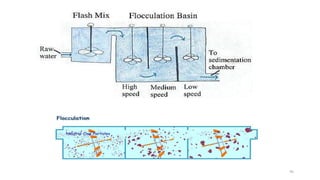
  • 61.
    61 Types of screen 1.Coarse screen 2. Fine screen 3. Micro strainer
  • 62.
    62  Bar screenspacing is typically between 0.5 and 5cm  Angle of inclination of bars is 600-750 if screening are very small and 300-450 if larger amount is retained over the screen bar.  Between the openings the velocity should be restricted to up to 0.7m/sec  If regular cleaning is done an allowance for loss of heads of up to 0.1 to 0.2m is made
  • 63.
    Coarse screen • Purpose:To prevent large objects from entering the conveyance system • Design considerations • Design flow: Q max-day • Layout: located slightly projected away from intake ports, on the water side. • Bar arrangement: 5-8 cm of clear opening • Velocity of flow: < 8.0 cm/s 63
  • 64.
    Fine screen •Purpose:To removesmaller objects that may damage pumps or other equipment •Heavy wire mesh with 0.5 cm openings •Design velocity 0.4-0.8 m/s •Automatic cleaning may be required 64
  • 65.
    Micro strainer • Purpose:Toremoveplanktonand algae • Before pre-chlorination and coagulation • Consists of a rotating cylinder covered with fine wire mesh • Operational problems due to biofilms 65
  • 66.
  • 67.
  • 68.
  • 69.
    69 Determine the buildingup of head loss through a bar screen. when 35% of the flow area is blocked off by the accumulation of coarse solids assume the following conditions are applied. Approach velocity =0.6m/s Velocity through a clean bar screen =0.9m/s Open area for flow through clean bar screen =0.19m2 Example
  • 70.
  • 71.
  • 72.
    72 Plain Sedimentation  Plainsedimentation is a form of pre treatment that provides a low velocity of flow through a tank preferably excavated in the ground  The purpose is to settle some solids because of this low velocity by gravity sedimentation  Significant by reducing the turbidity below 30 NTU  The tank may be rectangular, or,to minimize the need for thicker walls trapezoidal shape (which also facilitates settlement to the bottom) tank can be used.
  • 73.
    73 Baffle walls areprovided at the inlet to dissipate the kinetic energy of the incoming water and provide quiescent settlement. Less importantly, they are also provided at the outlet to prevent turbulence in the outlet zone.
  • 74.
    74 Storage  Storage isvery effective for high turbidity water The detention time is greater than for plain sedimentation tanks Advantages: • Natural sedimentation • Reduction of sudden water quality fluctuation. • Reduction in the number of pathogenic bacteria • Improved reliability of supply • Excessively turbid water can be diverted away.
  • 75.
    75 Roughing Filtration  Roughingfiltration allows a deep penetration of the filter layer and holds a large silt storage capacity  Used by removing suspended solids from water that could rapidly clog a slow sand filter.  Pathogen removal is between 60 and 90% without using any disinfectant  Considerably reduce the amount of iron and manganese.  Capable of reducing turbidity to as low as 5NTU from a raw water turbidity of 150NTU.
  • 76.
    Infiltration Gallery  Itis underground tunnel which have holes on its sides, used for tapping underground water near river, lakes and stream.  Sedimentation of silt is the main problem. 76
  • 77.
    77 Silt trap • Thisis a box like structure to remove any kind of silt, soil, sediment, metals or pesticides from entering your water storage system by containing water in the trap for some times. • It allows these unwanted materials to settle to the bottom of the bucket and separate from the water • It is essentially works like a filter
  • 78.
  • 79.
  • 80.
    80 What is Coagulation? Coagulation is the process by which colloidal particles and very fine solid suspensions initially present in a wastewater are combined into larger agglomerates.  Commonly achieved by adding different types of chemicals (coagulants) to the waste water to promote destabilization of the colloid dispersion and agglomeration of the resulting individual colloidal particles.  The chemicals are known as Coagulants, usually higher valence cationic salts (Al3+, Fe3+ etc.)  Coagulation is essentially a chemical process
  • 81.
    Purpose •The primary purposeof the coagulation/ flocculation process is the removal of turbidity from the water. •Turbidity is a cloudy appearance of water caused by small particles suspended therein. o Water with little or no turbidity will be clear. 81
  • 82.
    82 Location in theTreatmentPlant • After the source water has been screened and has passed through the optional steps of pre-chlorination and aeration, it is ready for coagulation and flocculation
  • 83.
    83 What is Flocculation? Flocculationis the agglomeration of destabilized particles into a large size particles known as flocs which can be effectively removed by sedimentation or flotation.
  • 84.
    84 Principle of coagulation When certain chemicals are added to water an insoluble gelatinous flocculent is formed  The gelatinous precipitate therefore has the property of removing fine and colloidal particle quickly and completely than by plain sedimentation  These coagulants further the advantage of removing color, odor and taste from the water  First the coagulant are mixed in the water to produce the required precipitate ,then the water is sent in the sedimentation basins
  • 85.
  • 86.
    Colloid Stability --- -- - -- - - - - Repulsion Colloid -A Colloid - B  Colloids have a net negative surface charge  Electrostatic force prevents them from agglomeration  Brownian motion keeps the colloids in suspension Impossible to remove colloids by gravity settling H2O 86 Colloid
  • 87.
     Colloids canbe destabilized by charge neutralization  Positively charged ions (Na+ , Mg2+ ,Al3+ , Fe3+ etc.) neutralize the colloidal negative charges and thus destabilize them  With destabilization, colloids aggregate in size and start to settle 87
  • 88.
  • 89.
  • 90.
    JarTests Determination of optimumpH  Fill the jars with raw water sample (500 or 1000 mL) – usually 6 jars  Adjust pH of the jars while mixing using H2SO4 or NaOH/lime (pH: 5.0;5.5;6.0;6.5;7.0;7.5) Add same dose of the selected coagulant (alum or iron) to each jar (Coagulant dose: 5 or 10 mg/L) The jar test – a laboratory procedure to determine the optimum pH and the optimum coagulant dose  A jar test simulates the coagulation and flocculation processes JarTest 90
  • 91.
    Jar Test set-up 91 Rapid mix each jar at 100 to 150 rpm for 1 minute.The rapid mix helpsto disperse the coagulant throughout each container  Reduce the stirring speed to 25 to 30 rpm and continue mixing for 15 to 20 mins. This slower mixing speed helps promote floc formation by enhancing particle collisions, which lead to larger flocs  Turn off the mixers and allow flocs to settle for 30 to 45 mins  Measure the final residual turbidity in each jar  Plot residual turbidity against pH Jar Tests – determining optimumpH
  • 92.
  • 93.
    92 Optimum coagulant dose Repeat all the previous steps This time adjust pH of all jars at optimum (6.3 found from first test) while mixing using H2SO4 orNaOH/lime Add different doses of the selected coagulant (alum or iron) to each jar (Coagulant dose:5;7;10;12;15;20 mg/L)  Rapid mix each jar at 100 to 150 rpm for 1 minute.The rapid mix helps to disperse the coagulant throughout each container  Reduce the stirring speed to 25 to 30 rpm for 15 to 20 mins
  • 94.
    93 Turn off themixers and allow flocs to settle for 30 to 45 mins Then measure the final residual turbidity in each jar  Plot residual turbidity against coagulant dose Coagulant Dose mg/L Optimum coagulant dose: 12.5mg/L  The coagulant dose with the lowest residual turbidity will be the optimum coagulant dose Optimum coagulant dose
  • 95.
    95 Factors affecting coagulation 1.Type of coagulant 2. Dose of coagulant 3. Characteristic of water • Type and quantity of suspended matter • Temperature of water • pH of water 4. Time and method of mixing
  • 96.
  • 97.
    97 Common Coagulants Coagulant chemicalscome in two main types - primary coagulants and coagulant aids  Primary coagulants neutralize the electrical charges of particles in the water which causes the particles to clump together  Coagulant aids add density to slow-settling flocs and add toughness to the flocs so that they will not break up during the mixing and settling processes.
  • 98.
    98 The following arethe coagulants most commonly used: i.Aluminum sulfate [Al2 (SO4)3.18H2O].  It is also calledAlum It is the most widely used chemical coagulant in water purification work Alum reacts with water only in the presence of alkalinity.If natural alkalinity is not present, lime may be added to develop alkalinity The chemical is found to be most effective between pH range of 6.5 to 8.5. Its dose may vary from 5 to 30mg/lit, for normal water usually dose being 14mg/l.
  • 99.
    99 Due to thefollowing reason,Alum is the most widely used chemical coagulant:- 1. It is very cheap 2. It removes taste and color in addition to turbidity 3. It is very efficient 4. Flocs formed are more stable and heavy 5. It is not harmful to health 6. It is simple in working, doesn't require skilled supervision for dosing
  • 100.
    100 ii. Sodium aluminates(Na2Al2O4) In the process of coagulation, it can remove carbonate and non- carbonate hardness It reacts with calcium and magnesium salts to form flocculent aluminates of these elements. iii. Chlorinated Copperas (FeSO4.Cl) Combination of Ferric Sulphate and Ferric chloride. When solution of Ferrous Sulphate is mixed with chlorine, both Ferric Sulphate and Ferric chloride are produced
  • 101.
    101 Ferric Sulphate andFerric chloride each is an effective floc and so also their combination Ferric chloride effective in pH range 3.5 – 6.5 or above 8.5 iv.Poly electrolytes v.Hydrated lime vi. Copperas (FeSO4.7H2O)
  • 102.
    Example Find out thequantity of alum required to treat 18 million liters of water per day.The dosage of alum is 14mg/lit. Also work out the amount of CO2 released per liter of treated water. The reaction is as follow:- Al2 (SO4)3.18H2O+3Ca (HCO3)2 2Al (OH)3+3CaSO4+18H2O+6CO2 102
  • 103.
    Solution Quantity of alumper day = (14*18*106)/ 106 = 252kg The chemical reaction as follow: Al2 (SO4)3.18H2O+3Ca (HCO3)2 2Al(OH)3+3CaSO4+18H2O+6CO2 Molecular weight of alum: =2*26.97+3*32.066+36*1.008+30*16 =666 Molecular weight of CO2 = (1*12.0) + 2*16) = 44 Thus 666mg of alum release 6*44mg of CO2 14mg of alum will releases = (14*6*44)/666 =5.55mg of CO2 103
  • 104.
    104 Feeding of coagulant Coagulants may be put in raw water either in powder form or in solution form  In order to feed chemicals to the water regularly and accurately, some type of feeding equipment must be used. I. Dry-feedType  Dry powder of coagulant is filled in the conical hopper  The hoppers are fitted with agitating plates which prevent the chemical from being stabilized.
  • 105.
  • 106.
    106 II.Wet feeding type First, solution of required strength of coagulant is prepared The solution is filled in the tank and allowed to mix in the mixing channel in required proportion to the quantity of water It can be easily controlled with automatic devices.
  • 107.
    107 Recommended values forcoagulants •Dosage • Alum: 10-150 mg/L • Ferric sulfate: 10-250 mg/L • Ferric chloride: 5-150 mg/L •pH • Alum:5.5-7.7 • Fe3+:5-8.5 •Initial mixing time (Al3+ and Fe3+) • Rapid mixing of 10 s and preferably less than 1m.
  • 108.
    108 Mixing devices The processof floc formation greatly depends upon the effective mixing (rapid mixing) of coagulant with the raw water Rapid mixing of the mixture of coagulant and raw water is used to: - Disperse chemicals uniformly throughout the mixing basin - Allow adequate contact between the coagulant and particles - Formation of micro flocs
  • 109.
    109 The mixing isdone by mixing device. 1.Hydraulic jump - flume with considerable slope is developed 2.Pump method - centrifugal pump is used to raise raw water 3.Compressed air method – compressed air is diffused from bottom of the mixing tank 4. Mixing channels
  • 110.
    110 5. Mixing basinwith baffle wall 6. Mechanical mixing basins Mechanical means are used to agitate the mixture to achieve the objective of thorough mixing.
  • 111.
    Baffled channel basin Horizontalbaffled tank Plan view (horizontal flow) L W Vertical baffled tank L Isometric View (vertical flow) H 111
  • 112.
  • 113.
    Plan (top view) L H Crossflow Flocculator (sectional view) W Mechanical Flocculator- Paddle 113
  • 114.
  • 115.
  • 116.
    116 Flocculation  Next torapid mixing, mixture is kept slowly agitated for about 30 to 60min. Slow mixing process in which particles are brought into contact in order to promote their agglomeration is called flocculation.  The tank or basin in which flocculation process is carried out is called flocculation chamber.  The velocity of flow in the chamber is kept between 12 – 18cm/sec.  Activated carbon in powder form can be used to speed up the flocculation
  • 117.
    117 The rate ofagglomeration or flocculation is dependent upon  Type and concentration of turbidity  Type of coagulant and its dose  Temporal mean velocity gradient – G in the basin
  • 118.
    In the systemof stirring, the velocity of fluid varies both spatially (from point to point) and temporally ( from time to time). The spatial changes in velocity are identified by velocity gradient, G. The mean velocity gradient is the rate of change of velocity per unit distance normal to the section - (meter per second per meter) (T-1). G= velocity gradient, s-1; P = Power input, W V = Tank volume, m3; µ = Dynamic viscosity, (Pa.s) 118
  • 119.
    4/22/2020 water treatment118  G value for flocculation: 20 to 80 S-1; Mixing time: 20 to 60 min In the flocculator design, Gt (also known Camp No.); a product of G and t is commonly used as a design parameter Typical Gt for flocculation is 2 x 10⁴ -105  Large G and smallT gives small but densefloc  Small G and largeT gives big but light flocs (adequate collision will not occur and proper floc will not formed)  Weneed big as well as dense flocs, which can be obtained by designing flocculator with different G values. 2 G11 G33
  • 120.
    The design criteriaof a horizontal continuous flow rectangular basin flocculator: 120
  • 121.
  • 122.
    122 Power Calculation What horsepowerlevel do we need to supply to a flocculation basin to provide a G value of 100s-1 and a Gt of 100,000 for 10 MGD flow? (Given: µ = 0.89 x 10⁻³ Pa.s; 1 hp = 745.7watts)
  • 123.
    Solution: Retention time, t= Gt/G = 100,000/100 = 1000 sec Volume of Flocculation basin, V = (0.438 m3/sec) x (1000 sec) = 438 m3 P = G2 V x µ = 1002 x 438 x 0.89 x10-3 = 3900 W = 3900/746 = 5.2 hp 123
  • 124.
    124 Design a conventionalvertical-shaft rapid mix tank unit for uniformly dispersing coagulant in 10 MLD of settled raw water as per design parameters given below: • Detention time (t): 20 – 60 s • Ratio of tank height (H) to diameter (D): (1:1 to 1:3) • Ratio of impeller diameter (DI) to tank diameter (D): (0.2:1 to 0.4:1) • Velocity gradient (G): >300 /s • Gt: 10000 – 20000 Example 1
  • 125.
    125 • Tank diameter(D): < 3 m • Paddle tip speed (vp): 1.75 – 2.0 m/s • Velocity of paddle relative to water (v): 0.75 x paddle tip speed • Paddle area (Ap)/Tank section area (AT): 10:100 – 20:100 • Coefficient of drag on impeller blade (CD): 1.8 • Maximum length of each impeller blade (L): 0.25 x impeller diameter • Maximum width of impeller blade (B): 0.20 x impeller diameter • Impeller height from bottom (HB): 1.0 x impeller diameter • Kinematic viscosity : 1.003 x 10⁻⁶ m2/s • Dynamic viscosity of water : 1.002 x 10⁻³ N.s/m2 Determine tank dimensions (provide a freeboard of 0.5 m), impeller diameter, paddle dimensions, number of paddles, clearance of the impeller from tank bottom, paddle rotation speed and power input requirement.
  • 126.
    126 Examples 2 A watertreatment plant of design capacity 378500 m3/d requires 100 mg/L of alum to remove 25 mg/L suspended solids. Estimate the mass of alum required every day (kg/day) and the maximum mass of dry solids (in kg/day) that are removed from the plant.
  • 127.
    127 Examples 3 Design amechanical rapid mix tank used for treating 75700 m3/d of water that has a temperature of 10oC. The items you need to determine are: 1) tank volume 2) tank dimensions and 3) power consumption. Use a detention time of 2 minutes, velocity gradient of 850 s-1 and cubic tank geometry.
  • 128.
    128 Examples 4 A watertreatment plant is designed to process 100 x 10 6 L/d. The flocculator is 30 m long, 15 m wide, and 5 m deep. Revolving paddles are attached to four horizontal shafts that rotate at 1.5 rpm. Each shaft supports four paddles that are 200 mm wide, 15 m long and centered 2 m from the shaft. Assume the mean water velocity to be 70% less than paddle velocity and CD = 1.8. All paddles remain submerged all the time. Find: a)the difference in velocity between paddles and water b) the value of G and c)the Camp number.
  • 129.
  • 130.
    130 Definition and Use Sedimentationis a treatment process in which the velocity of the water is lowered below the suspension velocity and the suspended particles settle out of the water due to gravity. The process is also known as settling or clarification It is a commonly used unit operation in water and wastewater treatment plants. This type of sedimentation requires chemical addition (in the coagulation/flocculation step) and removes the resulting floc from the water. It is not be necessary in low turbidity water of less than 10 NTU
  • 131.
    131 The purpose isto decrease the concentration of suspended particles and reducing the load on the filters. Sedimentation at this stage in the treatment process should remove 90% of the suspended particles from the water, including bacteria •WaterTreatment: • Plain Sedimentation (Pre-sedimentation) • Sedimentation after Flocculation • Sedimentation after Softening
  • 132.
  • 133.
    Type I: Discreteparticle settling Particles settle individually without interaction with neighboring particles. Any particle which does not change its size, shape, and weight while rising or settling in any fluid is called discrete particle It occurs under low solids concentration. Settling velocity is constant for individual particles 133
  • 134.
    Type II: Flocculentparticles Flocculation causes the particles to increases in mass and settle at a faster rate. Particles collide and adhere to each other resulting in particle growth Examples: treatment treatment coagulation/flocculation settling and primary sedimentation in in water wastewater 134
  • 135.
    Comparison of TypeI and IIsedimentation 135
  • 136.
    136 Type III: Hinderedor Zone settling • The mass of particles tends to settle as a unity with individual particles remaining in fixed positions with respect to each other. • Particles are so close together movement is restricted • Solids move as a block rather than individual particles • Fluidic interference causes a reduction in settling velocity • Example: settling of secondary effluents
  • 137.
    137 Type IV: Compressionsettling The concentration of particles is so high that sedimentation can only occur through compaction of structure. Particles physically in contact Volume of water may decrease High concentration of solids (sludge)
  • 138.
    Modeling Discrete Settling t 2 pp v 2 F = C ρA d d p W = ρ ∀ g F = ρ ∀ g b w p F + F − W = 0 d b ∑ F = ma W = force of gravity, N Fb = bouyant force, N Fd = drag force,N p ρp = density ofparticle ρw = density ofwater g= acceleration due to gravity, m/s2 Cd = drag coefficent,unitless Ap = Projected area of particle in the direction of flow, m2 vt = settling velocity at any time, m/s ∀ = Volume of particle, m3 Particle 138
  • 139.
    Terminal settling velocity Whenforces are in equilibrium • d = particle diameter • CD is a function of Reynolds number,Re p w t p w D w t p p D P w t w t D P w d b for a speherical particle ρ ρ C A ρ C A ρ V = = A = πr ∀ = πr F = W − F 3 C 4 gd (ρ − ρ ) 3 C 4 gd (ρ − ρ ) 3 4 2∀ (ρ − ρ )g = ∀ (ρ − ρ )g p p 2 V 2 2 3 V 2 = p p w V 2 turbulent D w 139 transition laminar Re + 0.34 = 24 + 3 Re Re = 24 D D D Re > 104 ,C ≈ 0.4 1< Re < 104 ,C Re <1,C OR Re = Vt d υ µ Re = Vt dρ
  • 140.
    Stokes Law • UsingCd =24/Re: sgp: Specific gravity of particle υ: Kinematic viscosity, m2/s • Stokes law has limited applications in water treatment • Vt should be calculated using the general formula by trial anderror 1 8 µ p w t d 2 g (ρ − ρ ) V = w w p D t ρ − ρ ) V = 3 C 4 gd (ρ 1 8υ p t d 2 g (s g − 1) V = 139
  • 141.
    141 Example Find the terminalsettling velocity for spherical particle with diameter 0.45 mm and density of 2650 kg/m3 settling through water at 20 oC. Take dynamic viscosity as 1.002*10-3 at 20 oC
  • 142.
    142 Classification of SedimentationTank Sedimentationtank are classified as continuous flow or intermittent flow The continuous flow types are mostly used now a days Tanks also classified as horizontal flow, when the liquid passes through in the horizontal direction and as vertical flow, when the liquid enters near the bottom of the tank and is withdrawn at the surface. The vertical flow type is generally used for sewage treatment.
  • 143.
    143 COMMON TYPES OFSEDIMENTATIONBASINS 1. RECTANGULAR BASINS Are the simplest design, allowing water to flow horizontally through a long tank. This type of basin is usually found in large-scale water treatment plants. Rectangular basins have a variety of advantages - predictability , cost-effectiveness, and low maintenance. In addition, rectangular basins are the least likely to short-circuit, especially if the length is at least twice the width. A disadvantage of rectangular basins is the large amount of land area required.
  • 144.
  • 145.
    145 2. DOUBLE-DECK RECTANGULARBASINS Double-deck rectangular basins are essentially two rectangular sedimentation basins stacked one atop the other. This type of basin conserves land area, but has higher operation and maintenance costs than a one-level rectangular basin.
  • 146.
  • 147.
    3. SQUARE ORCIRCULAR SEDIMENTATION BASINS Square or circular sedimentation basins with horizontal flow are often known as clarifiers. This type of basin is likely to have short-circuiting problems. 147
  • 148.
  • 149.
  • 150.
    150 4. Solids-contact clarifiers Itis more complex than the others. It is also known as up flow solids-contact clarifiers Up flow sludge-blanket clarifiers combine coagulation, flocculation and sedimentation within a single basin. Solids-contact clarifiers are often found in packaged plants and in cold climates where sedimentation must occur in odor. This type of clarifier is also often used in softening operation.
  • 151.
    151 ZONES OF SEDIMENTATIONBASIN Sedimentation Basin has four Zones. Each zone should provide a smooth transition between the zone before and the zone after. In addition, each zone has its own unique purpose • The inlet zone, • The settling zone, • The sludge zone,and • The outlet zone
  • 152.
  • 153.
    Design of RectangularSedimentation Basin Design criteria: • A minimum of two basins • Inlet structure • Settling zone: • Surface overflow rate • Effective water depth • Horizontal flow velocity • Minimum length-to-width ratio • Outlet structure • Sludge zone Settling zone Sludge zone Inlet zone Outlet zone Inflow Outflow Sludge 152
  • 154.
    Typical design criteriafor horizontal-flow rectangular tanks Parameter Value Type Minimum number of tank Water depth, m Minimum length-to-depth ratio Width-to-depth ratio Minimum length-to-width ratio Surface overflow rate, m/h Horizontal mean flow velocity (at Qmax-day), m/min Detention time,h Launder weir loading, m3/m.h Reynolds number Froude number Bottom slope for manual sludge removal systems, m/m Bottom slope for mechanical sludge scraper equipment Sludge collector speed for collection path, m/min Sludge collector speed for the return path, m/min Horizontal flow rectangular 2 3-5 15:1 3:1-6:1 4:1-5:1 1.25-2.5 0.3-1.1 1.5-4 9-13 <20,000 >10-5 1:600 1:300 0.3-0.9 1.5-3 153
  • 155.
    155 Inlet Zone  Thetwo primary purposes of the inlet zone of a sedimentation basin are to distribute the water and to control the water's velocity as it enters the basin.  In addition, inlet devices act to prevent turbulence of the water.  The incoming flow in a sedimentation basin must be evenly distributed across the width of the basin to prevent short-circuiting.  Short-circuiting is a problematic circumstance in which water bypasses the normal flow path through the basin and reaches the outlet in less than the normal detention time.
  • 156.
    156 Inlet Zone In additionto preventing short-circuiting, inlets control the velocity of the incoming flow. If the water velocity is greater than 0.15 m/sec, then floc in the water will break up due to agitation of the water. Breakup of floc in the sedimentation basin will make settling much less efficient.
  • 157.
    157 Inlet Zone Twotypes ofinlets are shown below. 1. The stilling wall, also known as a perforated baffle wall, spans the entire basin from top to bottom and from side to side.  Water leaves the inlet and enters the settling zone of the sedimentation basin by flowing through the holes evenly spaced across the stilling wall. 2. The Channel or flume, allows water to enter the basin by first flowing through the holes evenly spaced across the bottom of the channel and then by flowing under the baffle in front of the channel.  The combination of channel and baffle serves to evenly distribute the incoming water.
  • 158.
  • 159.
    159 Settling zone  Afterpassing through the inlet zone, water enters the settling zone where water velocity is greatly reduced.  This is where the bulk of floc settling occurs and this zone will make up the largest volume of the sedimentation basin.  For optimal performance, the settling zone requires a slow and smooth flow of water.  The settling zone may be simply a large area of open water.  But in some cases, tube settlers and lamella plates, such as those shown below,are included in the settling zone
  • 160.
  • 161.
  • 162.
  • 163.
    Determining the capacityof the settling zone • The capacity of the settling zone can be determined on the basis of over flow rate • It is assumed that the settlement of a particle at the bottom of the tank does not depend on the depth, but on the surface area of the tank • Let L= Length of the settling zone W=Width of the tank H=depth of the tank C=Capacity of the tank T=time of horizontal flow(detention time) V=Horizontal velocity of flow Q=Discharge of flow v= velocity of settlement of a particular particle 162
  • 164.
    Horizontal flow settlingtank with continuous flow 164
  • 165.
    165 Detention time,T=L/V=Capacity/Q =L*W*H/Q……..…(1) But T=Depth of the tank /velocity of the particle = H/v…… (2) Equating (1) & (2), we get L/V =L*W*H/Q =H/v v/V = H/L ………….(3) v =Q/L*W =Q/A…...(4)
  • 166.
    166 Outlet Zone •The outletzone controls the water flowing out of the sedimentation basin •Like the inlet zone, the outlet zone is designed to prevent short-circuiting of water in the basin •In addition, a good outlet will ensure that only well-settled water leaves the basin and enters the filter •The outlet can also be used to control the water level in the basin
  • 167.
    167 Outlet Zone •Outlets aredesigned to ensure that the water flowing out of the sedimentation basin has the minimum amount of floc suspended in it. •The best quality water is usually found at the very top of the sedimentation basin, so outlets are usually designed to skim this water off the sedimentation basin. •A typical outlet zone begins with a baffle in front of the effluent. •This baffle prevents floating material from escaping the sedimentation basin and clogging the filters. •After the baffle comes the effluent structure, which usually consists of a launder, weirs, and effluent piping.
  • 168.
    A typical effluentstructure is shown below: 168
  • 169.
    169 Outlet Zone •The primarycomponent of the effluent structure is the effluent launder, a trench which collects the water flowing out of the sedimentation basin and directs it to the effluent piping. •The sides of a launder typically have weirs attached. Weirs are walls preventing water from flowing uncontrolled in to the launder. •The weirs serve to skim the water evenly of the tank.
  • 170.
    •A weir usuallyhas notches, holes, or slits along its length. •These holes allow water to flow in to the wire. •The most common type of hole is the V-shaped notch Shown on the picture above which allows only the top inch or so of water to flow to out of the sedimentation basin Outlet Zone
  • 171.
    171 Outlet Zone •Water flowsover or through the holes in the weirs and in to the launder. •This pipe carries water away from the sedimentation basin and to the next step in the treatment process. •The effluent structure may be located at the end of a rectangular sedimentation basin or around the edges of the circular clarifier.
  • 172.
    Outlet Zone •Alternatively, theeffluent may consist of a finger weir,an arrangement of launders which extend out in to the settling basin as shown below. 172
  • 173.
    173 Sludge Zone • Thesludge zone is found across the bottom of the sedimentation basin where the sludge collects temporarily. •Velocity in this zone should be very slow to prevent re-suspension of sludge. •A drain at the bottom of the basin allows the sludge to be easily removed from the tank. • The tank bottom should slope toward the drains to further facilitate sludge removal. •In some plants, sludge removal is achieved continuously using automated equipment.
  • 174.
    174 Sludge Zone • Inother plants, sludge must be removed manually. If removed manually, the basin should be cleaned at least twice per year or more often if excessive sludge buildup occurs. •It is best to clean the sedimentation basin when water demand is low, usually in April andOctober. •Many plants have at least two sedimentation basins so that water can continue to be treated while one basin is being cleaned, maintained, and inspected
  • 175.
    175 Sludge Zone •If sludgeis not removed from the sedimentation basin often enough, the effective (useable) volume of the tank will decrease, reducing the efficiency of sedimentation. •In addition, the sludge built up on the bottom of the tank may become septic, meaning that it has begun to decay an aerobically. •Septic sludge may result in taste and odor problems or may float to the top of the water and become scum. •Sludge may also become re-suspended in the water and be carried over to the filters
  • 176.
    176 Factors Influencing Efficiencyof the basin Floc Characteristics  Toa large extent, a sedimentation basin's efficiency will depend on the efficiency of the preceding coagulation/flocculation process  The size, shape, and density of the floc influence how well the floc settles out of the water  Floc which is too small or too large, is irregularly shaped,or has a low density will not tend to settle out in the sedimentation basin
  • 177.
    • Even ifthe coagulation/flocculation process is very efficient, floc can disintegrate on its way to or in the sedimentation basin. Previously formed floc will disintegrate If the water velocity is too high, If there are sharp bends in the pipe at the inlet... 176 sharp bends in the pipe at the inlet
  • 178.
    If water isdischarged above the sedimentation basin water level or if throttle valves are used. water is discharged above the sedimentation basin 178
  • 179.
     Short-circuiting • Anefficient sedimentation basin would have water flowing through the entire basin, rather than through just one area.  When water in the sedimentation basin short- circuit, floc does not have enough time to settle out of the water,influencing the economy of the plant and the quality of the treated water. 179
  • 180.
    180  A varietyof factors causes short-circuiting in a sedimentation basin Basin shape and design of the inlet and out-let Thin sedimentation basin is less likely to short-circuit than is a short broad one Uneven distribution of flow either at the inlet or out-let Weir at the out-let is not level or if some of the notches clog, flow will be uneven Difference in temperature
  • 181.
    181 Other Problems •Gases inthe water may cause floating scum, •Algal growth. •Intermittent operation of the basin can cause settling problems.
  • 182.
    182 Designing a RectangularSedimentationTank • Designing a rectangular sedimentation tank is similar in many ways to design a flocculation chamber. • Water in a sedimentation basin is not agitated, so the velocity gradient is not a factor in the calculation • Twoadditional characteristics are important in designing a sedimentation basin  The overflow rate (also known as surface loading or the surface overflow rate)  Weir loading, also known as weir overflow rate
  • 183.
    183 Design of HorizontalFlowTanks •A depth of at least 3m is provided to allow for sludge storage •For a given flow rate, the remaining variable to determine will be either the plan area or the detention time
  • 184.
    184 Specifications The sedimentation basinwe will design is a rectangular sedimentation basin with the following specifications • Rectangular basin • Depth:7-16 ft (2m-5m) • Width:10-50ft (3m-15m) • Length:4mwidth
  • 185.
    185 • Influent baffleto reduce the flow momentum • Slope of bottom to ward sludge hopper >1% • Continuous sludge removal with a scraper velocity <15ft/min • Detention time:4-8 hr • Flow through velocity :0.5ft/min (0.15m/min) • Overflow rate:500-1,000gal/day-ft2 (1gal=0.00379m3) • Weir loading:15,000-20,000gal/day-ft
  • 186.
  • 187.
    187 Over view ofcalculations Wewill determine the surface area, dimensions, and volume of the sedimentation tank as well as the weir length The calculations are as follows: • Divide flow in to at least two tanks. • Calculate the required surface area. • Calculate the required volume. • Calculate the tank depth.
  • 188.
    188 • Calculate thetank width and length. • Check flow through velocity. • If velocity is too high, repeat calculations with more tanks. • Calculate the weir length
  • 189.
    189 Example 1 Find thedimension of a rectangular sedimentation basin for the following data  Quantity of treated water =3*106 l/d  td=4hr =240min  velocity of flow = 10cm/min
  • 190.
    190 Example2 Design a sedimentationbasin for the following data 1. Flow rate • Maximum flow rate =10,000m3/day • Average flow rate 5790m3/day 2. Design parameters • td = 4hr • L/W=2 • SOR=10m3/m2/d • Design flow rate to be 25% of maximum flow rate
  • 191.
  • 192.
    Theory of Filtration Theeffluent obtained after coagulation does not satisfy the drinking water standard and is not safe, So it requires further treatments Filtration is one of the water purification process in which water is allowed to pass through a porous medium to remove remaining flocs or suspended solids from the previous treatment processes Filtration process assist significantly by reducing the load on the disinfections process, increasing disinfection efficiency. 192
  • 193.
    193 Filtration consists ofpassing water through a thick layer of sand During the passage of water through sand, the following effects take place. i) Suspended matter and colloidal matter are removed ii) Chemical characteristic of water get changed iii) Number of bacteria considerably reduced.
  • 194.
  • 195.
    Slow sand filters •Simplestand biological filters without any mechanical equipment •It can use for Less than 20 NTU water treatment. •Best suited for the filtration of water for small towns •Fine sand with an effective size of 0.2 mm •Filtration rate is 50 to 100 times slower than that of rapid sand filter (2.4 to 3.6m3/m2/day) •A layer of dirt, debris, and microorganisms builds up on the top of the sand. •This layer is known as schmutzdecke, which is German for "dirty skin.“or “dirty cover’’. 194
  • 196.
    196 •The Schmutzdecke breaksdown organic particles in the water biologically, and is also very effective in straining out even very small inorganic particles •Filtered water has <0.3NTU turbidity (the goal is <0.1NTU) •Output water may requires chlorination (for quality improvement)
  • 197.
    197 Essential features ofslow sand filter 1.Enclosed tank 2.Filter media 3.Base material 4.Under drainage system 5.Appurtenances
  • 198.
    198 1. Enclosed tank SSFis open basin, rectangular shape and built below finished ground level. Surface area of the tank varies from 50 to 1000sqm. Filtration rate – 100 to 200 lit/ sqm/hr Depth – 2.5 to 4m 2. Filter media :Sand Thickness of sand layer – 90 to 110cm. Effective size – 0.20 to 0.35 ( common value – 2.5) Coefficient of uniformity – 2.0 to 3.0 ( common value – 2.5)
  • 199.
    3. Base material:Gravel Thickness of gravel bed – 30 to 75cm. 4. Under drainage system  Base material and filter media are supported by under drainage system Under drainage system collects filtered water and delivers it to the reservoir 199
  • 200.
    200 5.Appurtenances  Devices arerequired for Gauge – to measure loss of head Vertical air vent pipe – for proper functioning of filtering layer Telescope tube – to maintain constant discharge A meter – to measure flow
  • 201.
  • 202.
    Slow Sand FilterCleaning Periodic raking and cleaning of the filter by removing the top two inches of sand. After a few cleanings, new sand must be added to replace the removed sand. After a cleaning the filter must be operated for two weeks, with the filtered water sent to waste, to allow the schmutzdecke layer to rebuild (formation of biofilm) Twoslow sand filters should be provided for continuous operation. 202
  • 203.
    203 Advantages and Disadvantagesof SSF •Advantages: oLong design life oCan use local material and labor oCost of construction cheaper than rapid sand filter oDo not usually require coagulation/flocculation before filtration oFilters enough water for a community ( up to 15,000gal/day) oBacterial count reduction is 99.9% to 99.99% and E.coli reduction is 99% to 99.9% •Disadvantages: oInitial cost is low but maintenance cost is much more than rapid sand filter oThese filters requires extensive land area for a large municipal system.
  • 204.
    204 Design criteria forslow sand filters Parameter Recommended level Design life Period of operation Filtration rate Filter bed area Height of filter bed Initial Minimum Effective size Uniformity coefficient Height of under drains including gravel layer Height of supernatant water 10-15 year 24 h/day 0.1 – 0.2 m/h 5-200 m2/filter 0.8-0.9 m 0.5-0.6 m 0.15-0.3 mm < 3 0.3-0.5 m 1 m
  • 205.
    205 Rapid Sand Filter •Itis somewhat complex and expensive to operate and maintain and therefore less suitable for small communities. •Much greater filtration rate ranging from 100 to 150m3/m2/day •The ability to clean automatically using backwashing and require small filter area. •Do not use biological filtration and depend primarily on adsorption and some straining
  • 206.
    206 Rapid Filter •The mediais coarser compared to slow sand filters (0.4 to 0.6 mm or higher) •Most common in water treatment plants •Removal is with depth • Have to clean the entire filter media usually by backwashing for the cleaning of rapid sand filter. •Cleaning by back washing (head losses 1.2 – 2.5 m) •W ater must be pre-treated to destabilize negatively charged particles
  • 207.
    207 Rapid filter •The mostcommonly used filter media is sand. •Sometimes use coal, anthracite, coconut shell and ballistic stone etc.
  • 208.
  • 209.
  • 210.
    210 Operation The water fromcoagulation sedimentation tank is uniformly distributed on the whole sand bed Water after passing through the sand bed is collected through the under drainage system in the filtered water well The outlet chamber in this filter is also equipped with filter rate controller In the beginning the loss of head is very small But as the bed gets clogged, the loss of head increases and the rate of filtration become very low Therefore the filter bed requires its washing.
  • 211.
    211 Washing of Filter Involvespassing water upward through the filter media at a velocity sufficient to expand (fluidize) the bed and wash out the accumulated solids Done when: •The head loss through the filter exceeds the design value. •Turbidity breakthrough causes the effluent quality to be less than a minimum acceptable level Bed expansions are achieved in backwashing.The sand bed expands by about 50%. Washing process is continued till the sand bed appears clearly. Rapid sand filter bring down the turbidity of water to 1 N.T.U.
  • 212.
  • 213.
    213 Parts of arapid filter • Filter tank: A water tight tank is constructed either masonry or concrete • Filter sand: specially manufactured or selected sand and other filter media.The depth of sand 60 to 75cm • Under drain system: carries filtered water & distributes the backwash water uniformly • Wash water trough: collects back wash water • Filter bed agitator: agitates sand layer for cleansing (air-scour or surface wash systems) • Appurtenances :Air compressors useful for washing of filter and wash water troughs for collection of dirty water after washing of filter.
  • 214.
    214 Rapid Filter Media •Filtermedia controls: The solids holding capacity of the filter bed The hydraulic loading rate of the filters The finished water quality •Types Single media (usually sand) Dual media (usually sand and anthracite) Multi-media (usually sand, anthracite,garnet)
  • 215.
    Typical Filter MediaDesignValues Parameter Single-medium Dual-media Multi-media Anthracite layer Effective size, mm Uniformity coeff. Depth, cm Sand layer Effective size, mm Uniformity coeff. Depth, cm Garnet layer Effective size, mm Uniformity coeff. Depth, cm 0.50-1.5 1.2-1.7 50-150 0.45-1.0 1.2-1.7 50-150 0.70-2.0 1.3-1.8 30-60 0.45-0.60 1.2-1.7 20-40 1.0-2.0 1.4-1.8 50-130 0.40-0.80 1.2-1.7 20-40 0.20-0.80 1.5-1.8 5-15 214
  • 216.
    216 Selection of FilterMedia •Methods • Pilot testing: takes long time and costly • Experience from past studies (e.g.use media depth to effective size ratio)
  • 217.
    217 The main featuresof rapid sand filter are as follows  Effective size of sand - 0.45 to 0.70mm  Uniformity coefficient of sand - 1.2 to 1.7  Depth of sand - 60 to 75cm  Filter gravel - 2 to 50mm size (Increase size towards bottom)  Depth of gravel - 45cm  Depth of water over sand during filtration - 1 to 2m
  • 218.
    218  Overall depthof filter including 0.5m free board - 2.5m  Area of single filter unit - 100m2 in two parts of each 50m2  Loss of head - Max 1.8 to 2.0m  Turbidity of filtered water - 1 NTU  Influent pipe to filters: 0.6-1.8 m/s  Effluent pipe carrying filtered water: 0.9-1.8 m/s  Drains carrying spent backwash water: 1.2-2.4 m/s  Wash water line (influent): 2.4-3.7 m/s  Filter to waste drain: 3.7-4.8 m/s
  • 219.
    Pressure Filter  Pressurefilter is type of rapid sand filter in closed water tight cylinder through which the water passes through the sand bed under pressure  All the operation of the filter is similar to rapid gravity filter; except that the coagulated water is directly applied to the filter without mixing and flocculation  These filters are used for industrial plants but these are not economical on large scale  Pressure filters may be vertical pressure filter and horizontal pressure filter  Backwash is carried by reversing the flow  The rate of flow is 120 to 300 m3/m2/day 218
  • 220.
  • 221.
  • 222.
    222 Example 1 Calculate thehead loss through a clean bed of uniform sand that has a grain diameter of 0.5 mm, bed depth 0.3 m and porosity ratio of 0.4.The shape factor is 0.85 and the specific gravity of sand is 2.65. The water temperature is 20°C and the filter has a loading rate of 4.0 m3/m2-h. Use the Carmen-Kozeny equation.
  • 223.
    223 Example 2 •A dual-mediafilter bed is being designed.The media used are sand and anthracite.The effective size and specific gravity of sand are 0.60 mm and 2.65.The specific gravity of anthracite is 1.5. Calculate • The effective size of the anthracite that has the same settling velocity as the sand
  • 224.
  • 225.
    225 •The primary goalof water treatment is to ensure that the water is safe to drink and does not contain any disease-causing microorganisms. •Pathogens can be removed from water through physical or chemical processes. •Disinfection, which is the process of selectively destroying or inactivating pathogenic organisms in water,usually by chemical means. •Disinfection is different from sterilization, which is the complete destruction of all organisms found in water and which is usually expensive and unnecessary.
  • 226.
    226 Location in theTreatmentProcess •During pre-chlorination, chlorine is usually added to raw water after screening and before flash mixing. •Post-chlorination, is often the last stage in the treatment process. •After flowing through the filter, water is chlorinated and then pumped to the clear well to allow a sufficient contact time for the chlorine to act. •From the clear-well, the water may be pumped into a large,outdoor storage tank. •Finally, the water is released to the customer.
  • 227.
    227 Requirements of GoodDisinfectant 1. Destroy bacteria/pathogens within a practicable period of time, over an expected range of water temperature. 2. Effective at variable compositions, concentration and conditions of water treated. 3. Neither toxic to humans and domestic animals nor unpalatable or otherwise offensive in required concentration. 4. Not change water properties
  • 228.
    228 Requirements of GoodDisinfectant 5. Have residual in a sufficient concentration to provide protection against recontamination 6. Can be determined easily,quickly, and preferably automatically. 7. Unnecessary at reasonable cost. 8. Safe and easy to store, transport,handle and supply. 9. Not form toxic by-products due to their reactions with any naturally occurring materials in water.
  • 229.
    229 Methods of Disinfection •The disinfection of water can be done by one of the following methods: a) Boiling of water b) Ultra–Violate rays c) Iodine and bromine d) Ozone O3 e) Excess lime f) Potassium permanganate [KMnO4] g) Chlorine
  • 230.
    230 The most commonmethod of disinfection is the use of chlorine i.e.chlorination. The various chlorine compounds which are available in the market and used as disinfectants are: 1. Calcium hypo chlorite [Ca (OCl) 2] – poweder form 2. Sodium hypo chlorite [NaOCl] –liquid form 3. Free chlorine Cl2- Gaseous form
  • 231.
    231 Chlorination Is the applicationof chlorine to water for the purpose of disinfection. Chlorination can also be used for taste and odor control, iron and manganese removal, and to remove some gases such as ammonia and hydrogen sulfide.
  • 232.
    232 Chlorination Chemistry When chlorineis added to water,a variety of chemical processes take place. The chlorine reacts with compounds in the water and with the water itself. Some of the results of these reactions (known as the chlorine residual) are able to kill microorganisms in the water.
  • 233.
    233 The total amountof chlorine which is used up in reactions with compounds in the water is known as the chlorine demand. A sufficient quantity of chlorine must be added to the water so that, after the chlorine demand is met, there is still some chlorine left to kill microorganisms in the water.
  • 234.
    Reactions of ChlorineGas withWater •The reaction depends on the type of chlorine added to the water as well as on the pH of the water itself. •The gas is difficult to handle since it is toxic, heavy,corrosive,and an irritant. •At high concentrations, chlorine gas can even be fatal. •The following reaction occurs: Cl2 + H2O HOCl + HCl 234
  • 235.
    235 • Hypochlorous acidis the most effective form of free chlorine residual, meaning that it is chlorine available to kill microorganisms in the water. Hypo-chlorites • Instead of using chlorine gas, some plants apply chlorine to water as a hypochlorite, also known as a bleach. • There are three types of hypochlorite's - sodium hypochlorite, calcium hypochlorite, and commercial bleach. • They react with water and form the disinfectant hypochlorous acid.
  • 236.
    •The reactions ofsodium hypochlorite and calcium hypochlorite with water are shown below: Calcium hypochlorite +Water Ca(OCl)2 +2H2O Sodium hypochlorite +Water NaOCl + H2O HypochlorousAcid + Calcium Hydroxide 2HOCl + Ca(OH)2 Hypochlorous Acid + Sodium Hydroxide HOCl + NaOH 236
  • 237.
    Chloramines • Some plantsuse chloramines rather than hypochlorous acid to disinfect water. • Toproduce chloramines, first chlorine gas or hypochlorite is added to the water to produce hypochlorous acid • Then ammonia is added to the water to react with the hypochlorous acid and produce chloramine. • Three types of chloramines can be formed in water • Ammonia + HypochlorousAcid Monochloramine +Water NH3 + HOCl NH2Cl + H2O 237
  • 238.
    •Mono-chloramine + HypochlorousAcid +Water NH2Cl+ HOCl NHCl2 + H2O •Dichloramine + HypochlorousAcid Water NHCl2 + HOCl NCl3 +H2O Dichloramine Trichloramine + Mono-chloramines and dichloramines can both be used as a disinfecting agent, called combined chlorine residual 238
  • 239.
    239 Plain Chlorination Plain chlorinationis the process of addition of chlorine only when the surface water with no other treatment is required. The water of lakes and springs is pure and can be used after plain chlorination. A rate of 0.8mg/lit/hour at 15N/cm2 pressure is the normal dosage so as to maintain in residual chlorine of 0.2 mg/lit.
  • 240.
    240 Super Chlorination Super chlorinationis addition of excess amounts of chlorine to a water supply, to insure disinfection within a short contact time. About 10 to 15 mg/lit is applied with a contact time of 10 to 30 minutes under the circumstances such as during epidemic breakout water is to be dechlorinated before supply to the distribution system.
  • 241.
    241 Break Point Chlorination •The breakpoint is the point at which the chlorine demand has been totally satisfied - the chlorine has reacted with all reducing agents, organics, and ammonia in the water. •When more chlorine is added past the breakpoint, the chlorine reacts with water and forms hypochlorous acid in direct proportion to the amount of chlorine added. •This process, known as breakpoint chlorination,is the most common form of chlorination, in which enough chlorine is added to the water to bring it past the breakpoint and to create some free chlorine residual.
  • 242.
  • 243.
    243 De-chlorination Removal of excesschlorine resulting from super chlorination in part or completely is called De-chlorination. Excess chlorine in water gives pungent smell and corrodes the pipe lines. Hence excess chlorine is to be removed before supply. Physical methods like aeration, heating and absorption on charcoal may be adopted. Chemical methods like Sulphur dioxide (SO2), Sodium Bi- Sulphate (NaHSO3), SodiumThiosulphate (Na2S2O8) areused.
  • 244.
    244 Points of Chlorination Chlorine applied at various stages of treatment and distribution accordingly they are known as pre, post and re-chlorination. a) Pre-Chlorination  Chlorine applied prior to the sedimentation and filtration process is known as Pre-chlorination.  This is practiced when the water is heavily polluted and to remove taste, odor,color and growth of algae on treatment units.  Pre-chlorination improves coagulation.  Always followed by post chlorination, so as to ensure the final safety of water.  The normal dose required are as high as 5 to 10 mg/l.
  • 245.
    b) Post Chlorination •Post chlorination is the application of chlorine after water has been treated or after filtration but before the water reaches the distribution system. • At this stage, chlorination is meant to kill pathogens and to provide a chlorine residual in the distribution system. • The dosage should be such as to have a residual chlorine of about 0.1 to 0.2mg/l having a contact period of 30min. • Post-chlorination is nearly always part of the treatment process, either used in combination with pre-chlorination or used as the sole disinfection process. 244
  • 246.
    246 c) Re-Chlorination •In longdistribution systems, chlorine residual may fall tendering the water unsafe. •Application of excess chlorine to compensate for this may lead to unpleasant smell to consumers at the points nearer to treatment plant, in such cases chlorine is applied again that is re-chlorinated at intermediate points generally at service reservoirs and booster pumping stations.
  • 247.
    247 Ozonation / ozonewater treatment Oxygen rich molecule is pumped in to water system to eliminate biological contaminants. It is also effective for oxidizing and removing iron, sulfur, manganese and other inorganic substances. Ozone is significantly more effective than chlorine at inactivating and/or killing viruses and bacteria. Since ozone quickly converts to oxygen and leaves no toxic residual. • Can increase the dissolved oxygen concentration of water.
  • 248.
    248 The disadvantages ofOzonation is: •The cost of treatment is relatively high, being both capital and power intensive. •There is no measurable residual to indicate the efficiency of ozone disinfection. •Very reactive, irritative, toxic and corrosive, thusrequires corrosion resistance materials, such as stainless steel. •Low dosages may not effectively inactivate some viruses, spores and cysts.
  • 249.
    249 UV disinfection •Ultra violet(uv)light disinfection: is one water treatment system that can be used to remove most forms of microbiological contamination from water. •Uv light is normally effective against all viruses, bacteria and protozoa. •Uv light enters a microorganism its energy will damage the microorganism’s cellular function so that it will not be able to grow.
  • 250.
    250 Advantages of UV Proven technology, environmentally friendly,safe. Cost saving in both initial construction and long-term operation. There is no residual effect that can be harmful to human and aquatic life. Effective disinfectant for chlorine- resistant protozoa's like giardia. UV disinfection has a short contact time when compared to other disinfectants. Requires less space than other methods.
  • 251.
    251 Disadvantages of UV •Lowdosage may not effective inactivating some viruses, cyst and bacteria. •Do not remove all impurities •Water needs to be pre-filtered •It has single application- producing microbiologically safe, it has no effect on chemicals, heavy metals, sediments, and any other such issues. •Needs electricity to work
  • 252.
  • 253.
    1. Removal ofTaste and OdorProblem The sense of odour is closely related to that of taste. In fact it is normally correct to suggest that most 'tastes' in water are really a sensation of smell The brackishness associated with relatively high concentrations of salts such as sodium chloride or magnesium sulphate
  • 254.
    • Iron andmanganese in water often produce an astringent taste. • Surface waters deficient in dissolved oxygen are often 'flat' to the taste. • Consumers identify and accept water as being pure as a result of its lack of colour, its clarity and its lack of taste and odour
  • 255.
    Causes of OdorandTaste  Concentrations of inorganic salts (brackishness)  Hydrogen sulphide  Contact with painted surfaces  Industrial discharges _ pesticides, phenols etc  Metabolites of actinomycete, algae etc  Dead and decaying organic material including sewage and algae  Chlorination
  • 256.
    Prevention of odoursand tastes from microorganisms Some bacteria reduce sulphate to sulphide (H2S) o These are controlled by aeration and chlorination. Mold-like bacteria grow frequently in mains as a slime on the inside of the pipes o They may be controlled by treating reservoirs with copper sulphate or by ensuring there is residual chlorine throughout the mains
  • 257.
     Iron bacteria- grow in water containing high concentrations of iron and in which the D.O.is limited  They produce objectionable odours and tastes as well as leading to the precipitation of iron o The remedies are removal of iron, chlorination or dosing with copper sulphate
  • 258.
    Recommended method toremove test and odour problem 1. Aeration Slightly volatile odors resulting from the decomposition of vegetation. Due to aeration, concentrations of odoriferous metabolites emanating from living microorganisms can be decreased Thus, reducing the amount of activated carbon required at a later stage.
  • 259.
    2.Chlorine  Marginal chlorinationis not sufficient to remove odoriferous compounds and also may add a noticeable smell of chlorine  Super chlorination with more than a breakpoint dosage will destroy most malodorous compounds 3.Ozone Ozone reduces H2S odors and tastes and also the odors from decaying vegetable matter. Algae must be removed prior to the addition of ozone
  • 260.
    4. Hydrogen peroxide Thisis occasionally used for odor control. It is generally too costly. 5. Chlorine Dioxide ClO2 is particularly effective at removing phenolic odors from water. It is most effective when mixed with an excess of chlorine
  • 261.
    6. Potassium Permanganate It is one of the most effective chemical reagents for odour and taste control.  In the USA it is widely used and is most effective between PH 8.o and PH 8.3  Although it is about three times as costly as activated Carbon it has been claimed to be up to five times as effective
  • 262.
    7.ActivatedCarbon Powdered activated carbonis a fine black powder applied either to the raw water, or the mixing basin, on the settling basin or directly before the filters A normal dose might be 2.0 mg/1 to clarified water although it has been applied at rates up to 125 mg/1 to raw water Granular activated carbon consists of relatively large grains and is held in filter towers through which the water is continually passed At low levels of taste and odour powdered activated carbon is suggested as being more economic than the granular
  • 263.
    2. Removal ofHydrogen sulphide  The permissible concentration of H2S in water, which are required for domestic purpose, is 0.5 mg/1 of H2S  It is offensive when its concentration greater than 1.0 mg/l  The odours are less noticeable as the PH rises due to the formation of alkaline sulphides  Hydrogen sulphide is removed by aeration and chlorination
  • 264.
     Aerators arenormally of the natural-draft cascade-type but aeration has only a limited effect  Removal by chlorination is highly effective but as much as 10 kg of chlorine may be required to remove 1.0 kg of hydrogen sulphide  It is necessary to establish a cost balance between aeration and chlorination
  • 265.
    3. Removal ofIron and Manganese Iron and manganese can be dissolved from sandy soils, laterite, shale, sandstone and other rocks by acid water which contains no dissolved oxygen (such water may have an organic content ) Decomposition consumes the oxygen and produces carbon dioxide, which is acidic The iron is usually in the form of ferrous bicarbonate and the manganese in the form of manganese oxide or bicarbonate.These forms are soluble
  • 266.
    If the wateris now exposed to air so that oxygen can enter into solution and carbon dioxide leaves, the ferrous form is oxidized to ferric, and the manganese to manganic These latter forms are insoluble and so visible precipitates are formed Therefore, iron bearing water may be clear when pumped up from a well, but may on standing, turn brown and turbid
  • 267.
    Manganese problem ina distribution system may take years to appear because the reactions are slow until catalyzed by deposits Iron and manganese problems most commonly occur with groundwater,but may also appear in water drawn from the bottom of a stratified reservoir or in acidic waters Manganese may occur in significant quantities in river water,sometimes coming from acid mine drainage
  • 268.
    Effects of Ironand Manganese These metals in potable water can have: a) Colour in the water b) Staining of plumbing fixtures and clothing (Fe -brown. Mn - black) c) Astringent, metallic or medicinal taste in the water d) Growth of iron bacteria e) Brown stains on cooked vegetables and discoloured etc.
  • 269.
    Method of Treatment •Groundwater containing iron and/or manganese needs only treatment to remove these metals, and disinfection. • Surface water containing iron or manganese will usually also require removal of the turbidity of clay colloids. • Small quantities of iron can be removed by normal conventional treatment. • If a higher PH is needed to remove iron or manganese then alum may not be suitable and ferric coagulants may be preferred if removal of turbidity and iron or manganese is effected simultaneously.
  • 270.
    1. Aeration  Itis commonly used, but some processes require exclusion of air at the early stages.  Aeration raises the PH by removing carbon dioxide, and adds oxygen.  Only 0.14 mg/1 of dissolved oxygen is needed to oxidize 1 mg/1 of iron.
  • 271.
    2. Sedimentation  Itis useful where large particles are formed in a short time 3. Filtration It is required in most processes as a means of capturing small suspended particles Also often to promote oxidation by the catalytic effect of deposits on the sand grains. Because the deposits are useful the filter will take time to mature and should not be back washed too thoroughly
  • 272.
    4. Chlorination  Itis simple and cheap, but slow for manganese below PH 8.5 and in some cases may form very fine precipitates 5. Lime  Raising the PH will cause oxidation, but this technique is not suitable for hard waters because it will cause deposition of calcium carbonate on the filter sand 6. Ion exchange  When used for softening water will also remove soluble iron and manganese, it should therefore be done in the absence of air to prevent formation of the insoluble forms.
  • 273.
    LET US PROVIDEQUALITY WATERFOROUR COMMUNITY 272