Hydrogen bonds are collectively responsible for a large number of water's properties, including:  1. being a  liquid  rather than a gas a room temperature  Because water molecules display  cohesion  and thus have a  much reduced tendency to fly off into the overlying atmosphere  than these other listed molecules.  2. having a  high specific heat   Because of  cohesion , water molecules resist increasing their  motion. (this is another way of saying that is water molecules  resist the net breaking of  hydrogen bonds ). Consequently, water  resists heating; water has a very high specific heat.  This tendency to not want to change temperature both causes  resistance to radical temperature swings within beings and  causes bodies of water (e.g., a lake) to strongly resist rapid  changes in temperature. This temperature buffering capacity of  water is taken advantage of to a great extent by organisms.
3. having a  high heat of vaporization   Because it also involves the breaking of  hydrogen bonds , water resists vaporizing (evaporating). Consequently, it takes a lot of heat to evaporate water. This high heat of vaporization is also utilized by organisms as a cooling process, e.g., sweat or panting.
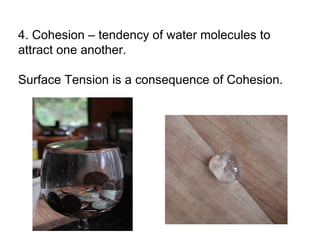
4. Cohesion – tendency of water molecules to attract one another. Surface Tension is a consequence of Cohesion.
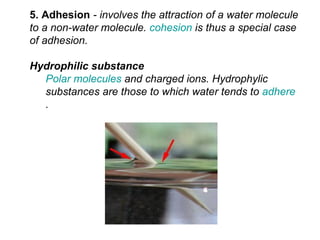
5. Adhesion  - involves the attraction of a water molecule to a non-water molecule.  cohesion  is thus a special case of adhesion.  Hydrophilic substance   Polar molecules  and charged ions. Hydrophylic substances are those to which water tends to  adhere .                                                                                                                                               
Water as a hydrophilic solvent   Solute: A substance that is  dissolved  into a  solution . Most biological molecules are found in liquids (usually water) in which they have  dissolved  and therefore may be considered to be solutes.  Solvent: A substance in which a  solute  has or can dissolve. The most important solvent to life is water.  Solution: A medium consisting of  solutes  and  solvent(s) .  Metabolic reactions  occur in solutions, usually solutions in which water is the  solvent .  Dissolve: The act of a  solute  going into  solution .  Water tends to very efficiently dissolve  hydrophilic substances  (both  polar molecules  and those which ionize upon  dissolving ).This occurs as a consequence of  adhesion .  6. Serving as a  powerful solvent of polar molecules
Hydration shell:  Water molecules form a  hydrogen bonded  layer, called a hydration shell, that surrounds  hydrophilic substances. This shell adheres so powerfully that it is actually more energetically favorable for many polar substances  to exist as individual molecules surrounded by hydration shells than to remain within a homogeneous solid material. Thus,  hydrophilic substances tend to dissolve  in water.  Any condition that increases the rate at which water can form a hydration shell (heating, stirring, shaking, adding an excess of water), the faster a hydrophilic crystalline substance will dissolve.
However, because those water molecules of its  hydration shell  do not readily  hydrogen bond  to the  hydrophobic molecule , the presence of a  hydration shell  is energetically unfavorable. (that is, the water molecules would much rather be free to  hydrogen bond  with one another).  7.  Effecting Hydrophobic exclusion  Energetically unfavorable hydration shells:  When  dissolved  in water, an individual  hydrophobic molecule  is, by definition, maximally surrounded by the water molecules of its  hydration shell .
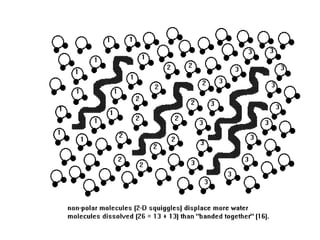
Hydrophobic exclusion:  This decline in total molecules required to surround  non-polar molecules  that have banded together leads to a phenomenon known as hydrophobic exclusion. This phenomenon is better known as "water and oil don't mix."  The hydrophobic exclusion of biomolecules plays a crucial role in the physiology of life, as crucial as the  dissolving  of  hydrophilic molecules .
 
8. ice floats   - as water freezes, it expands, which causes ice to be less dense than water.

Water properties

  • 1.
    Hydrogen bonds arecollectively responsible for a large number of water's properties, including: 1. being a liquid rather than a gas a room temperature Because water molecules display cohesion and thus have a much reduced tendency to fly off into the overlying atmosphere than these other listed molecules. 2. having a high specific heat Because of cohesion , water molecules resist increasing their motion. (this is another way of saying that is water molecules resist the net breaking of hydrogen bonds ). Consequently, water resists heating; water has a very high specific heat. This tendency to not want to change temperature both causes resistance to radical temperature swings within beings and causes bodies of water (e.g., a lake) to strongly resist rapid changes in temperature. This temperature buffering capacity of water is taken advantage of to a great extent by organisms.
  • 2.
    3. having a high heat of vaporization Because it also involves the breaking of hydrogen bonds , water resists vaporizing (evaporating). Consequently, it takes a lot of heat to evaporate water. This high heat of vaporization is also utilized by organisms as a cooling process, e.g., sweat or panting.
  • 3.
    4. Cohesion –tendency of water molecules to attract one another. Surface Tension is a consequence of Cohesion.
  • 4.
    5. Adhesion - involves the attraction of a water molecule to a non-water molecule. cohesion is thus a special case of adhesion. Hydrophilic substance Polar molecules and charged ions. Hydrophylic substances are those to which water tends to adhere .                                                                                                                                               
  • 5.
    Water as ahydrophilic solvent Solute: A substance that is dissolved into a solution . Most biological molecules are found in liquids (usually water) in which they have dissolved and therefore may be considered to be solutes. Solvent: A substance in which a solute has or can dissolve. The most important solvent to life is water. Solution: A medium consisting of solutes and solvent(s) . Metabolic reactions occur in solutions, usually solutions in which water is the solvent . Dissolve: The act of a solute going into solution . Water tends to very efficiently dissolve hydrophilic substances (both polar molecules and those which ionize upon dissolving ).This occurs as a consequence of adhesion . 6. Serving as a powerful solvent of polar molecules
  • 6.
    Hydration shell: Water molecules form a hydrogen bonded layer, called a hydration shell, that surrounds hydrophilic substances. This shell adheres so powerfully that it is actually more energetically favorable for many polar substances to exist as individual molecules surrounded by hydration shells than to remain within a homogeneous solid material. Thus, hydrophilic substances tend to dissolve in water. Any condition that increases the rate at which water can form a hydration shell (heating, stirring, shaking, adding an excess of water), the faster a hydrophilic crystalline substance will dissolve.
  • 7.
    However, because thosewater molecules of its hydration shell do not readily hydrogen bond to the hydrophobic molecule , the presence of a hydration shell is energetically unfavorable. (that is, the water molecules would much rather be free to hydrogen bond with one another). 7. Effecting Hydrophobic exclusion Energetically unfavorable hydration shells: When dissolved in water, an individual hydrophobic molecule is, by definition, maximally surrounded by the water molecules of its hydration shell .
  • 8.
    Hydrophobic exclusion: This decline in total molecules required to surround non-polar molecules that have banded together leads to a phenomenon known as hydrophobic exclusion. This phenomenon is better known as "water and oil don't mix." The hydrophobic exclusion of biomolecules plays a crucial role in the physiology of life, as crucial as the dissolving of hydrophilic molecules .
  • 9.
  • 10.
    8. ice floats - as water freezes, it expands, which causes ice to be less dense than water.