 SC.912.L.18.12 Discuss the special 
properties of water that contribute to Earth's 
suitability as an environment for life: 
cohesive behavior, ability to moderate 
temperature, expansion upon freezing, and 
versatility as a solvent.
It is a very stable. 
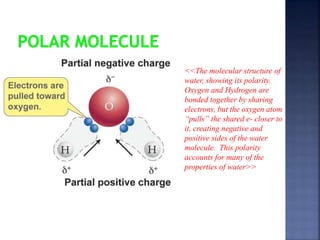
Polar molecule: It has a “+” and 
“–” end. This polarity has a large 
impact on the properties of water.
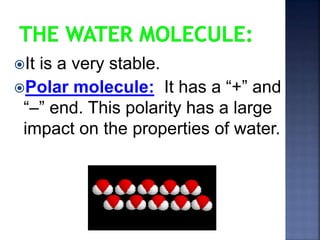
<<The molecular structure of 
water, showing its polarity. 
Oxygen and Hydrogen are 
bonded together by sharing 
electrons, but the oxygen atom 
“pulls” the shared e- closer to 
it, creating negative and 
positive sides of the water 
molecule. This polarity 
accounts for many of the 
properties of water>>
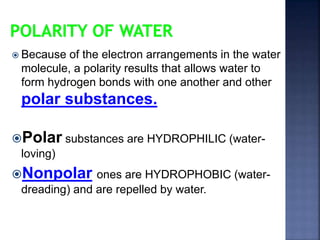
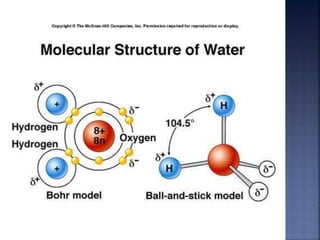
 Because of the electron arrangements in the water 
molecule, a polarity results that allows water to 
form hydrogen bonds with one another and other 
polar substances. 
Polar substances are HYDROPHILIC (water-loving) 
Nonpolar ones are HYDROPHOBIC (water-dreading) 
and are repelled by water.
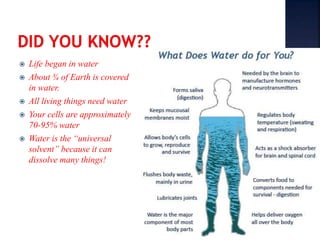
 Life began in water 
 About ¾ of Earth is covered 
in water. 
 All living things need water 
 Your cells are approximately 
70-95% water 
 Water is the “universal 
solvent” because it can 
dissolve many things!
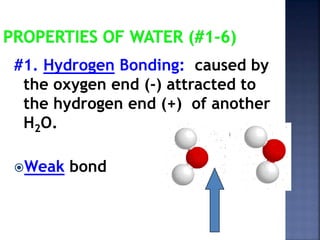
#1. Hydrogen Bonding: caused by 
the oxygen end (-) attracted to 
the hydrogen end (+) of another 
H2O. 
Weak bond
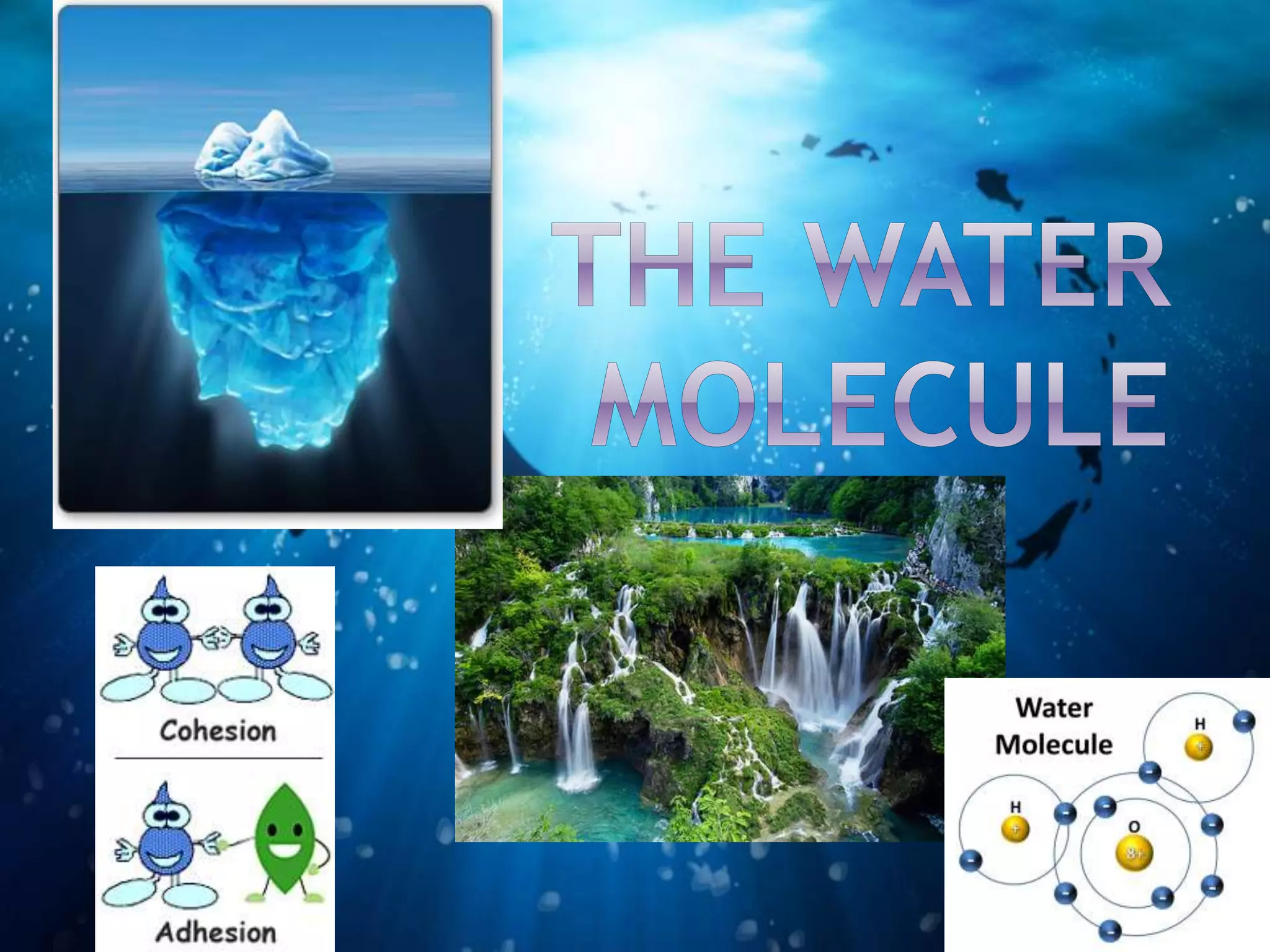
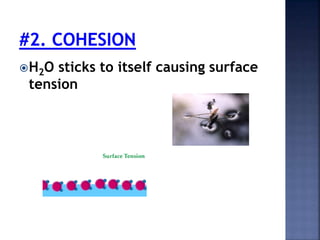
H2O sticks to itself causing surface 
tension
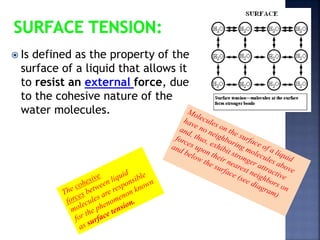
 Is defined as the property of the 
surface of a liquid that allows it 
to resist an external force, due 
to the cohesive nature of the 
water molecules.
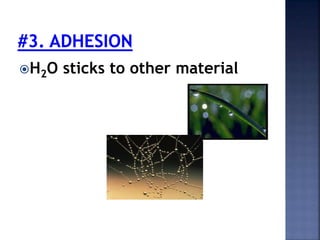
H2O sticks to other material
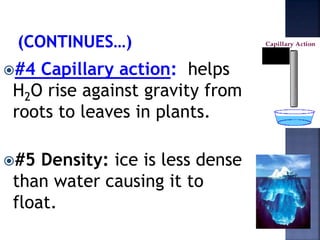
#4 Capillary action: helps 
H2O rise against gravity from 
roots to leaves in plants. 
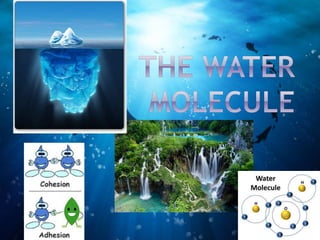
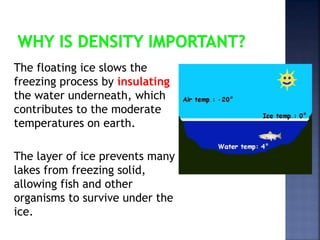
#5 Density: ice is less dense 
than water causing it to 
float.
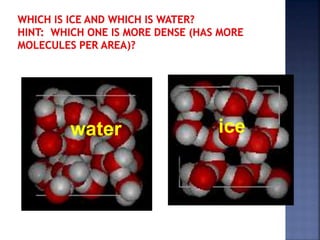
The floating ice slows the 
freezing process by insulating 
the water underneath, which 
contributes to the moderate 
temperatures on earth. 
The layer of ice prevents many 
lakes from freezing solid, 
allowing fish and other 
organisms to survive under the 
ice.
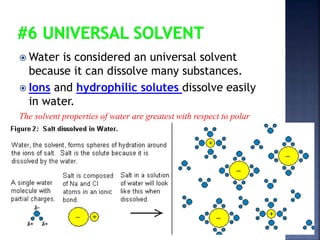
water ice
Water is considered an universal solvent 
because it can dissolve many substances. 
 Ions and hydrophilic solutes dissolve easily 
in water. 
The solvent properties of water are greatest with respect to polar 
molecules because "spheres of hydration" are formed around the 
solute molecules.
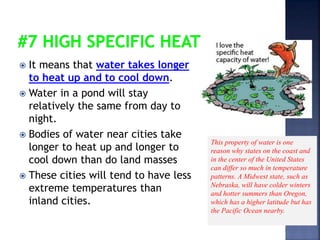
 It means that water takes longer 
to heat up and to cool down. 
 Water in a pond will stay 
relatively the same from day to 
night. 
 Bodies of water near cities take 
longer to heat up and longer to 
cool down than do land masses 
 These cities will tend to have less 
extreme temperatures than 
inland cities. 
This property of water is one 
reason why states on the coast and 
in the center of the United States 
can differ so much in temperature 
patterns. A Midwest state, such as 
Nebraska, will have colder winters 
and hotter summers than Oregon, 
which has a higher latitude but has 
the Pacific Ocean nearby.
 Coolant 
 Retains heat (Good insulator) 
 Resists sharp changes in temp. 
 Expands when it freezes & floats. 
 Dissolves many things (Universal solvent) 
 Key to biological processes 
 Maintains homeostasis. 
<<Homeostasis is the ability of living things to maintain a steady state of balance 
despite changing conditions. Ex.: Steady internal temperature in warm blooded 
animals no matter the temperature of their environment.
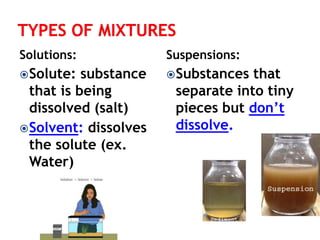
Solutions: 
Solute: substance 
that is being 
dissolved (salt) 
Solvent: dissolves 
the solute (ex. 
Water) 
Suspensions: 
Substances that 
separate into tiny 
pieces but don’t 
dissolve.
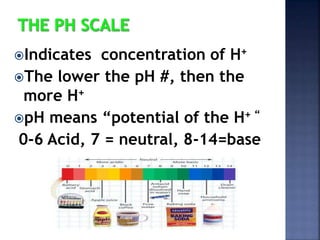
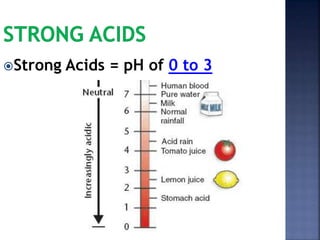
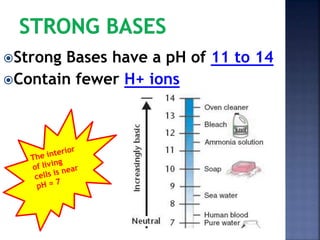
Indicates concentration of H+ 
The lower the pH #, then the 
more H+ 
pH means “potential of the H+ “ 
0-6 Acid, 7 = neutral, 8-14=base
Strong Acids = pH of 0 to 3
Strong Bases have a pH of 11 to 14 
Contain fewer H+ ions
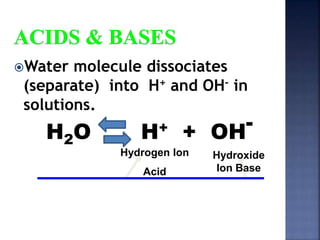
Water molecule dissociates 
(separate) into H+ and OH- in 
solutions. 
H 
O H+ + OH 
2 
- 
Hydrogen Ion 
Acid 
Hydroxide 
Ion Base
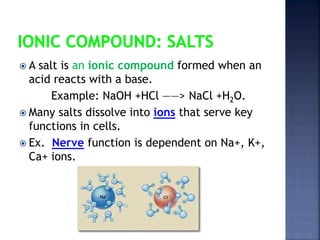
 A salt is an ionic compound formed when an 
acid reacts with a base. 
Example: NaOH +HCl ——> NaCl +H2O. 
 Many salts dissolve into ions that serve key 
functions in cells. 
 Ex. Nerve function is dependent on Na+, K+, 
Ca+ ions.
pH can affect chemical reactions 
necessary to support life. 
Buffers: 
Produced by body 
 used to prevent sharp, sudden 
changes in pH (neutralization). 
Maintain homeostasis.
Q1: What is water? How would you 
best describe what water is in 
chemical terms? 
Q2: Explain the physical phases of 
water. 
Q3: Water is a polar molecule. What 
does that mean?
ANY QUESTIONS?

Water properties ppt

  • 2.
     SC.912.L.18.12 Discussthe special properties of water that contribute to Earth's suitability as an environment for life: cohesive behavior, ability to moderate temperature, expansion upon freezing, and versatility as a solvent.
  • 3.
    It is avery stable. Polar molecule: It has a “+” and “–” end. This polarity has a large impact on the properties of water.
  • 4.
    <<The molecular structureof water, showing its polarity. Oxygen and Hydrogen are bonded together by sharing electrons, but the oxygen atom “pulls” the shared e- closer to it, creating negative and positive sides of the water molecule. This polarity accounts for many of the properties of water>>
  • 5.
     Because ofthe electron arrangements in the water molecule, a polarity results that allows water to form hydrogen bonds with one another and other polar substances. Polar substances are HYDROPHILIC (water-loving) Nonpolar ones are HYDROPHOBIC (water-dreading) and are repelled by water.
  • 6.
     Life beganin water  About ¾ of Earth is covered in water.  All living things need water  Your cells are approximately 70-95% water  Water is the “universal solvent” because it can dissolve many things!
  • 8.
    #1. Hydrogen Bonding:caused by the oxygen end (-) attracted to the hydrogen end (+) of another H2O. Weak bond
  • 9.
    H2O sticks toitself causing surface tension
  • 10.
     Is definedas the property of the surface of a liquid that allows it to resist an external force, due to the cohesive nature of the water molecules.
  • 11.
    H2O sticks toother material
  • 12.
    #4 Capillary action:helps H2O rise against gravity from roots to leaves in plants. #5 Density: ice is less dense than water causing it to float.
  • 13.
    The floating iceslows the freezing process by insulating the water underneath, which contributes to the moderate temperatures on earth. The layer of ice prevents many lakes from freezing solid, allowing fish and other organisms to survive under the ice.
  • 14.
  • 15.
    Water is consideredan universal solvent because it can dissolve many substances.  Ions and hydrophilic solutes dissolve easily in water. The solvent properties of water are greatest with respect to polar molecules because "spheres of hydration" are formed around the solute molecules.
  • 16.
     It meansthat water takes longer to heat up and to cool down.  Water in a pond will stay relatively the same from day to night.  Bodies of water near cities take longer to heat up and longer to cool down than do land masses  These cities will tend to have less extreme temperatures than inland cities. This property of water is one reason why states on the coast and in the center of the United States can differ so much in temperature patterns. A Midwest state, such as Nebraska, will have colder winters and hotter summers than Oregon, which has a higher latitude but has the Pacific Ocean nearby.
  • 17.
     Coolant Retains heat (Good insulator)  Resists sharp changes in temp.  Expands when it freezes & floats.  Dissolves many things (Universal solvent)  Key to biological processes  Maintains homeostasis. <<Homeostasis is the ability of living things to maintain a steady state of balance despite changing conditions. Ex.: Steady internal temperature in warm blooded animals no matter the temperature of their environment.
  • 18.
    Solutions: Solute: substance that is being dissolved (salt) Solvent: dissolves the solute (ex. Water) Suspensions: Substances that separate into tiny pieces but don’t dissolve.
  • 19.
    Indicates concentration ofH+ The lower the pH #, then the more H+ pH means “potential of the H+ “ 0-6 Acid, 7 = neutral, 8-14=base
  • 20.
    Strong Acids =pH of 0 to 3
  • 21.
    Strong Bases havea pH of 11 to 14 Contain fewer H+ ions
  • 22.
    Water molecule dissociates (separate) into H+ and OH- in solutions. H O H+ + OH 2 - Hydrogen Ion Acid Hydroxide Ion Base
  • 23.
     A saltis an ionic compound formed when an acid reacts with a base. Example: NaOH +HCl ——> NaCl +H2O.  Many salts dissolve into ions that serve key functions in cells.  Ex. Nerve function is dependent on Na+, K+, Ca+ ions.
  • 24.
    pH can affectchemical reactions necessary to support life. Buffers: Produced by body  used to prevent sharp, sudden changes in pH (neutralization). Maintain homeostasis.
  • 25.
    Q1: What iswater? How would you best describe what water is in chemical terms? Q2: Explain the physical phases of water. Q3: Water is a polar molecule. What does that mean?
  • 26.

Editor's Notes

  • #10 1
  • #11 Source: http://water.usgs.gov/edu/surface-tension.html
  • #14 Water is most dense at 39°F, and as it cools or warms from this temperature, the water expands slightly.  Source: http://water.me.vccs.edu/courses/env211/lesson10_2.htm
  • #15 1
  • #17 Source: http://water.usgs.gov/edu/heat-capacity.html
  • #18 EXPANSION OF WATER - This has important consequences for marine life as it gets protected in winter by the insulating sheet of ice that floats above water, while keeping underlying layers warm.
  • #21 A substance that releases hydrogen ions (H+) in solution is an acid; for example, HCl.
  • #22 Substances that release ions such as OH-(hydroxide ions) that can combine with hydrogen ions are called bases.
  • #25 Carbonic acid is one of the body’s major buffers
  • #26 ANSWER 1 - Water is a molecule composed of two atoms of hydrogen bonded to an oxygen atom. ANSWER 2 - . Water molecules exists as a solid, liquid or gas. As a solid (ice), water molecules are bonded to each other in a solid, crystalline structure. As a liquid, some of the molecules bond to each other with hydrogen bonds (bonds break and reform continuously). As a gas, water vapor, the water molecules are not bonded to each other (they float as single molecules). ANSWER 3 - It means that there is an uneven distribution of electron density. Water has a partial negative charge near the oxygen atom due to the unshared electrons, and partial positive charges near the hydrogen atoms.
  • #27 Possible Labs include: Penny Lab pH Lab IMPORTANT VOCAB: 6. monomer, 1. organic molecule, 2. inorganic molecule, 3. Hydrocarbon, 4. functional group,5. hydrophilic, 6. MONOMER, 7polymer, 8. carbohydrate, 9.Monosaccharide, 10. disaccharide