Temperature   Physics
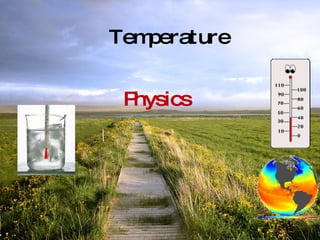
What is temperature? It is a variable to measure “hot” and “cold”. (We will see that it is a measure of an internal kinetic energy)
Conversion from °C to °F Use this formula:  [°F] = [°C] ×  9 ⁄ 5  + 32
Conversion from °F to °C Use this formula in order to convert °F to °C [°C] = ([°F] − 32) ×  5 ⁄ 9 Gabriel Farenheit
Thermal Energy The total of all the kinetic and potential  energy  of all the particles in a substance.  As temperature increases, so does  thermal   energy  (because the kinetic  energy  of the particles increased). Even if the temperature doesn’t change, the  thermal   energy  in a more massive substance is higher (because it is a total measure of  energy ).
What is heat? The flow of thermal energy from one object to another.  Heat  always  flows from warmer to cooler objects: Ice gets warmer while hand gets cooler  Cup gets cooler while hand gets warmer    
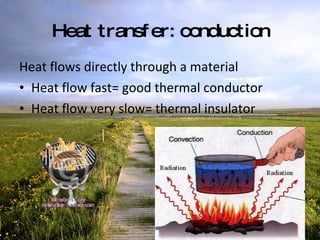
Heat transfer: conduction Heat flows directly through a material Heat flow fast= good thermal conductor Heat flow very slow= thermal insulator
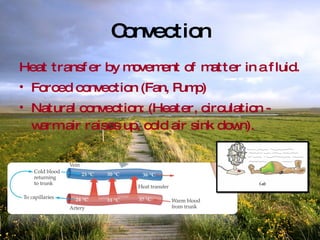
Convection Heat transfer by movement of matter in a fluid. Forced convection (Fan, Pump) Natural convection: (Heater,  circulation - warm air raises up, cold air sink down).
Radiation -Every object is emitting electromagnetic waves regardless of temperature .  Things we can  see  from their own radiation are very hot to have energy emitted in the visible region of the spectrum. -Things also absorb radiation: If they didn’t, they would run out of energy to emit .

Temperature

  • 1.
    Temperature Physics
  • 2.
    What is temperature?It is a variable to measure “hot” and “cold”. (We will see that it is a measure of an internal kinetic energy)
  • 3.
    Conversion from °Cto °F Use this formula: [°F] = [°C] ×  9 ⁄ 5  + 32
  • 4.
    Conversion from °Fto °C Use this formula in order to convert °F to °C [°C] = ([°F] − 32) ×  5 ⁄ 9 Gabriel Farenheit
  • 5.
    Thermal Energy Thetotal of all the kinetic and potential energy of all the particles in a substance.  As temperature increases, so does thermal energy (because the kinetic energy of the particles increased). Even if the temperature doesn’t change, the thermal energy in a more massive substance is higher (because it is a total measure of energy ).
  • 6.
    What is heat?The flow of thermal energy from one object to another.  Heat always flows from warmer to cooler objects: Ice gets warmer while hand gets cooler  Cup gets cooler while hand gets warmer    
  • 7.
    Heat transfer: conductionHeat flows directly through a material Heat flow fast= good thermal conductor Heat flow very slow= thermal insulator
  • 8.
    Convection Heat transferby movement of matter in a fluid. Forced convection (Fan, Pump) Natural convection: (Heater, circulation - warm air raises up, cold air sink down).
  • 9.
    Radiation -Every objectis emitting electromagnetic waves regardless of temperature . Things we can see from their own radiation are very hot to have energy emitted in the visible region of the spectrum. -Things also absorb radiation: If they didn’t, they would run out of energy to emit .