RIVER ENGINEERING
CHAPTER-I
Part-I
River Development and Training
1
RIVERS AND THEIR BEHAVIORS
 Rivers are the natural canals which carry a huge
quantity of water drained by the catchments as
runoff. They take off From Mountains, flow through
plains and finally join the sea or an ocean.
 Rivers are important arrangements of the
hydrological cycle.
 Rivers carry a large amount of silt or sediment which
is washed down from the catchments area and also
eroded form the bed and banks of river. 2
Types of rivers
 Rivers can be classified according to different criteria:
 Classification based on variation of discharge
1. Perennial River: Perennial rivers have adequate discharge
throughout the year.
2. Non-perennial rivers: their flow is quite high during and
after rainy seasons and reduces significantly during dry
seasons.
3. Flashy rivers: in these rivers, there is a sudden increases in
discharge. The river stage rises and falls in a very short
period.
4. Virgin rivers: these are those rivers which get completely
3
RIVERS AND THEIR BEHAVIORS
 Classification based on the location of reach:
1. Mountainous rivers: they flow in hilly and mountainous
regions. These rivers are further divided into rocky rivers
and Boulder Rivers.
2. Rivers in flood plains: after the boulder stages, a river
enters the flood plains having alluvial soil. The bed and
banks of river are made up of sand and silt.
3. Delta rivers: when a rivers enters a deltaic plain, it splits
into a number of small branches due to very flat slopes.
There is shoal formation and braiding of the channels in the
delta rivers.
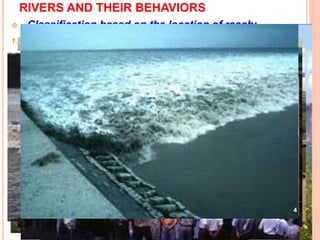
4. Tidal rivers: just before joining a sea or ocean, the river
becomes a tidal river. In a tidal river, there are periodic
changes in water level due to tides.
4
CONT…
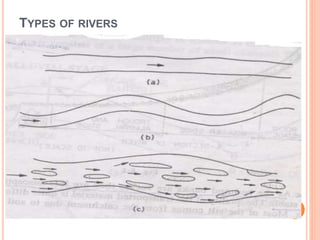
 Classification based on plan-from:
1. Straight rivers: these rivers are straight in plain and have
cross-sectional shape of a trough. The maximum velocity
of flow usually occurs in the middle of the section.
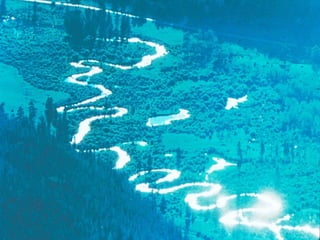
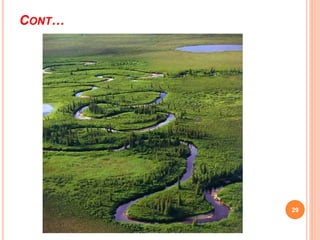
2. Meandering Rivers: follow a winding course. They
consist of a series of bends of alternate curvature in the
plain. The successive curves are connected by small
straight reach of the river called crossovers or crossings.
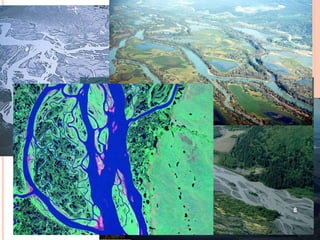
3. Braided rivers: flow in two or more channels around
alluvial islands developed due to deposition of silt.
5
CONT…
1. The cross section of the river is usually made up
of rock.
2. The river has a very steep slope and velocity of
water is quite high.
3. As the beds and banks are rocky, erosion hazard
is less.
4. It is ideal for the construction of dam.
6
TYPES OF RIVERS
7
8
STAGES OF RIVERS
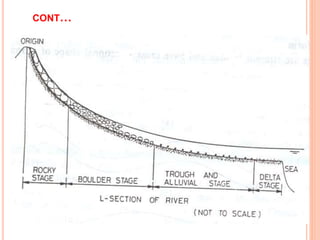
As the river flows from its origin in a mountain to
a sea, it passes through various stages. A river
generally has the following 4 stages:
Rocky stages
Boulder stage
Alluvial stage
Deltaic stage
9
CONT…
10
CONT…
1. Rocky stage: it is also called the hilly or mountainous
stage or the incised stage.
 The flow channel is formed on the rock by degradation
and cutting.
2. Boulder stage: the bed and banks are usually composed
of large boulders, gravels and shingles.
 The bed slope is quite steep
 The river first flows through wide shallow and
interlaced channels and then develop a straight course.
 Most of the diversion head works are constructed in this
11
CONT…
3. Alluvial stage: the river in this stage flows in a zig- zag
manner known as meandering.
 The cross section of the river is made up of alluvial
sand and silt.
 The materials get eroded form the concave side (the
outer side) of the bend and get deposited on the
convex side (inner side) of the bend.
 The bed slope is flat and consequently the velocity is
small. 12
CONT.…
 The behavior of the river in this stage depends up on
the silt charge and the flood discharge.
 River training works are required in the alluvial
stage.
13
CONT…
4. Deltaic stage: is the last stage of the river just before it
discharge into the sea.
 The river is unable to carry its sediment load.
 As a result, It drops its sediments and gets divided into
channels on either side of the deposited sediment and
form the delta.
14
TYPES OF ALLUVIAL RIVERS
Rivers in flood plains (alluvial stage) is future
sub divide into the following classification:-
1. Aggrading
2. Degrading
3. Stable deltaic
4. Deltaic
15
CONT…
1. Aggrading (accreting) type: For a river collecting sediment and
building up its bed called an aggrading/Accreting/ type.
 Is a silting river.
 It builds up its slope.
 The silting is mainly due to various reasons, such as: heavy sediment
load, construction of an obstruction across a river, sudden
intrusion of sediment from a tributary, etc.
2. Degrading type: If the bed is getting scoured year to year, it is
called degrading.
 If the river bed is constantly getting scoured, to reduce and dissipate
available excess land slope.
16
CONT…
3. Stable river: If there is no silting or scouring, it is called
a stable river.
 A river that does not change its alignment, slope and its
regime significant.
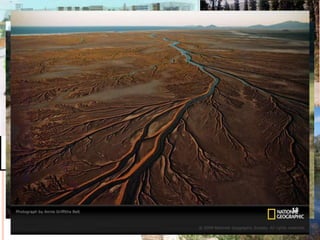
4. Deltaic river
 Is the last stage of the river just before it discharge into the
sea.
 The river is unable to carry its sediment load.
 As a result, It drops its sediments and gets divided into
channels on either side of the deposited sediment and
17
18
BEHAVIORS OF RIVERS IN ALLUVIAL STAGES
 The behaviors of alluvial rivers depend to a large extent on the
sediment carried by it.
 The sediment carried by the river poses numerous problems, such
as:
 Increasing of flood levels
 Silting of reservoirs
 Silting of irrigation and navigation channels
 Splitting of a river into a number of interacted channels
 Meandering of rivers
 Specially the meandering causes the river to leave its original course
and adopt a new course.
19
CONT…
 An alluvial river usually has the following three stages:
1. Flow in a straight reach
2. Flow at bends
3. Development of meanders
A. Flow in a straight reach:
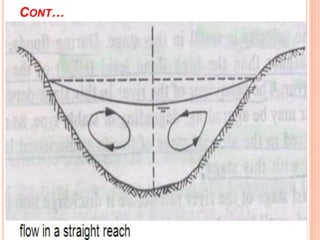
 The river cross section is in the shape of a ditch/channel, with high
velocity flow in the middle of the section.
 Since the velocity is higher in the middle, the water surface level
will be lower in the middle and higher at the edges.
 Due to the existence of this transverse gradient from sides towards
the center, transverse rotary currents get developed.
 However, straight reaches are very few in alluvial channels.
20
CONT…
21
CONT…
22
B. Bends:
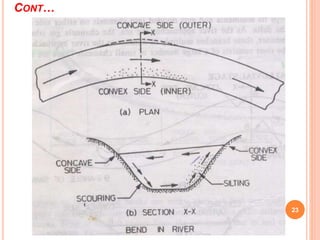
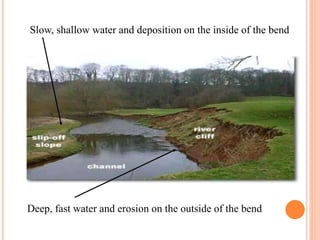
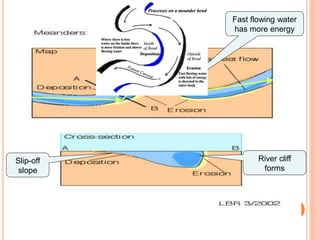
 Every alluvial river tends to develop bends, which are
characterized by scouring on the concave side and silting
on the convex side.
 The silting and scouring in bends may continue due to the
action of centrifugal force.
 These rotary currents cause the erosion of concave edge
and deposition on the convex edge forming shoal on this
edge.
 When once the bend forms, it tends to make the curvature
CONT…
23
Deep, fast water and erosion on the outside of the bend
Slow, shallow water and deposition on the inside of the bend
CONT…
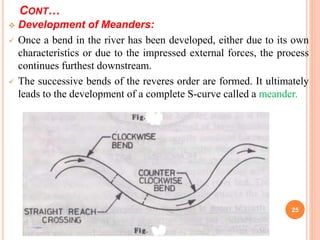
 Development of Meanders:
 Once a bend in the river has been developed, either due to its own
characteristics or due to the impressed external forces, the process
continues furthest downstream.
 The successive bends of the reveres order are formed. It ultimately
leads to the development of a complete S-curve called a meander.
25
Fast flowing water
has more energy
River cliff
forms
Slip-off
slope
CONT…
27
CONT…
29
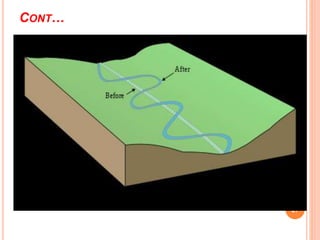
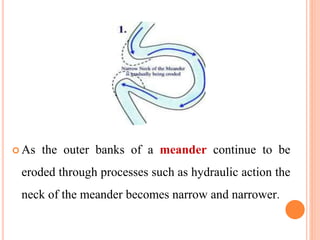
 As the outer banks of a meander continue to be
eroded through processes such as hydraulic action the
neck of the meander becomes narrow and narrower.

River Development.ppt

  • 1.
  • 2.
    RIVERS AND THEIRBEHAVIORS  Rivers are the natural canals which carry a huge quantity of water drained by the catchments as runoff. They take off From Mountains, flow through plains and finally join the sea or an ocean.  Rivers are important arrangements of the hydrological cycle.  Rivers carry a large amount of silt or sediment which is washed down from the catchments area and also eroded form the bed and banks of river. 2
  • 3.
    Types of rivers Rivers can be classified according to different criteria:  Classification based on variation of discharge 1. Perennial River: Perennial rivers have adequate discharge throughout the year. 2. Non-perennial rivers: their flow is quite high during and after rainy seasons and reduces significantly during dry seasons. 3. Flashy rivers: in these rivers, there is a sudden increases in discharge. The river stage rises and falls in a very short period. 4. Virgin rivers: these are those rivers which get completely 3
  • 4.
    RIVERS AND THEIRBEHAVIORS  Classification based on the location of reach: 1. Mountainous rivers: they flow in hilly and mountainous regions. These rivers are further divided into rocky rivers and Boulder Rivers. 2. Rivers in flood plains: after the boulder stages, a river enters the flood plains having alluvial soil. The bed and banks of river are made up of sand and silt. 3. Delta rivers: when a rivers enters a deltaic plain, it splits into a number of small branches due to very flat slopes. There is shoal formation and braiding of the channels in the delta rivers. 4. Tidal rivers: just before joining a sea or ocean, the river becomes a tidal river. In a tidal river, there are periodic changes in water level due to tides. 4
  • 5.
    CONT…  Classification basedon plan-from: 1. Straight rivers: these rivers are straight in plain and have cross-sectional shape of a trough. The maximum velocity of flow usually occurs in the middle of the section. 2. Meandering Rivers: follow a winding course. They consist of a series of bends of alternate curvature in the plain. The successive curves are connected by small straight reach of the river called crossovers or crossings. 3. Braided rivers: flow in two or more channels around alluvial islands developed due to deposition of silt. 5
  • 6.
    CONT… 1. The crosssection of the river is usually made up of rock. 2. The river has a very steep slope and velocity of water is quite high. 3. As the beds and banks are rocky, erosion hazard is less. 4. It is ideal for the construction of dam. 6
  • 7.
  • 8.
  • 9.
    STAGES OF RIVERS Asthe river flows from its origin in a mountain to a sea, it passes through various stages. A river generally has the following 4 stages: Rocky stages Boulder stage Alluvial stage Deltaic stage 9
  • 10.
  • 11.
    CONT… 1. Rocky stage:it is also called the hilly or mountainous stage or the incised stage.  The flow channel is formed on the rock by degradation and cutting. 2. Boulder stage: the bed and banks are usually composed of large boulders, gravels and shingles.  The bed slope is quite steep  The river first flows through wide shallow and interlaced channels and then develop a straight course.  Most of the diversion head works are constructed in this 11
  • 12.
    CONT… 3. Alluvial stage:the river in this stage flows in a zig- zag manner known as meandering.  The cross section of the river is made up of alluvial sand and silt.  The materials get eroded form the concave side (the outer side) of the bend and get deposited on the convex side (inner side) of the bend.  The bed slope is flat and consequently the velocity is small. 12
  • 13.
    CONT.…  The behaviorof the river in this stage depends up on the silt charge and the flood discharge.  River training works are required in the alluvial stage. 13
  • 14.
    CONT… 4. Deltaic stage:is the last stage of the river just before it discharge into the sea.  The river is unable to carry its sediment load.  As a result, It drops its sediments and gets divided into channels on either side of the deposited sediment and form the delta. 14
  • 15.
    TYPES OF ALLUVIALRIVERS Rivers in flood plains (alluvial stage) is future sub divide into the following classification:- 1. Aggrading 2. Degrading 3. Stable deltaic 4. Deltaic 15
  • 16.
    CONT… 1. Aggrading (accreting)type: For a river collecting sediment and building up its bed called an aggrading/Accreting/ type.  Is a silting river.  It builds up its slope.  The silting is mainly due to various reasons, such as: heavy sediment load, construction of an obstruction across a river, sudden intrusion of sediment from a tributary, etc. 2. Degrading type: If the bed is getting scoured year to year, it is called degrading.  If the river bed is constantly getting scoured, to reduce and dissipate available excess land slope. 16
  • 17.
    CONT… 3. Stable river:If there is no silting or scouring, it is called a stable river.  A river that does not change its alignment, slope and its regime significant. 4. Deltaic river  Is the last stage of the river just before it discharge into the sea.  The river is unable to carry its sediment load.  As a result, It drops its sediments and gets divided into channels on either side of the deposited sediment and 17
  • 18.
  • 19.
    BEHAVIORS OF RIVERSIN ALLUVIAL STAGES  The behaviors of alluvial rivers depend to a large extent on the sediment carried by it.  The sediment carried by the river poses numerous problems, such as:  Increasing of flood levels  Silting of reservoirs  Silting of irrigation and navigation channels  Splitting of a river into a number of interacted channels  Meandering of rivers  Specially the meandering causes the river to leave its original course and adopt a new course. 19
  • 20.
    CONT…  An alluvialriver usually has the following three stages: 1. Flow in a straight reach 2. Flow at bends 3. Development of meanders A. Flow in a straight reach:  The river cross section is in the shape of a ditch/channel, with high velocity flow in the middle of the section.  Since the velocity is higher in the middle, the water surface level will be lower in the middle and higher at the edges.  Due to the existence of this transverse gradient from sides towards the center, transverse rotary currents get developed.  However, straight reaches are very few in alluvial channels. 20
  • 21.
  • 22.
    CONT… 22 B. Bends:  Everyalluvial river tends to develop bends, which are characterized by scouring on the concave side and silting on the convex side.  The silting and scouring in bends may continue due to the action of centrifugal force.  These rotary currents cause the erosion of concave edge and deposition on the convex edge forming shoal on this edge.  When once the bend forms, it tends to make the curvature
  • 23.
  • 24.
    Deep, fast waterand erosion on the outside of the bend Slow, shallow water and deposition on the inside of the bend
  • 25.
    CONT…  Development ofMeanders:  Once a bend in the river has been developed, either due to its own characteristics or due to the impressed external forces, the process continues furthest downstream.  The successive bends of the reveres order are formed. It ultimately leads to the development of a complete S-curve called a meander. 25
  • 26.
    Fast flowing water hasmore energy River cliff forms Slip-off slope
  • 27.
  • 29.
  • 30.
     As theouter banks of a meander continue to be eroded through processes such as hydraulic action the neck of the meander becomes narrow and narrower.