BY:
NAME:AAYUSHI KEDIA
ROLL NO.:2
CLASS:X-’C’
BOARD REGITRATION
NO.:BII4084140122
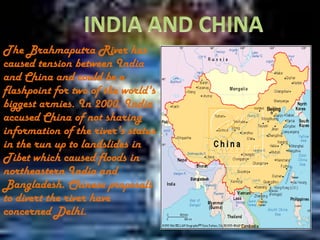
The Brahmaputra River has
caused tension between India
and China and could be a
flashpoint for two of the world's
biggest armies. In 2000, India
accused China of not sharing
information of the river's status
in the run up to landslides in
Tibet which caused floods in
northeastern India and
Bangladesh. Chinese proposals
to divert the river have
concerned Delhi.
The dispute between India and china is mainly regarding the
Brahmaputra river flowing through the two countries..
The search for water resources in China and India has persistently been
a source of tension between the two countries. Chinese efforts to divert
the water resources of the Brahmaputra River away from India will
worsen a situation that has remained tense since the 1962 Indo-China
war. The melting glaciers in the Himalayas as a result of accelerating
global climate change will have a dramatic effect on this river’s water
supply. This will increase water scarcity as well as the likelihood of
floods, impact agrarian livelihoods and strain the fragile equilibrium
between the two Asian giants.
Regional Summary:

Solutions:

The Brahmaputra River flows 2,900 km
from its source in the Kailas range of the
Himalayas to its massive delta and the Bay
of Bengal in Bangladesh. It flows through
China, India, and Bangladesh, but its
watershed includes Nepal, Bhutan, and
Burma as well. The river drops steeply from
the heights of the Tibetan Plateau through
the world’s deepest valley (5,075m) into
northeast India where the river eventually
merges with the Ganges and Meghan rivers
to form the largest river delta in the world
(60,000km2).The Brahmaputra basin
covers 651,334 km2 (WRI), 58% of which
lies in India and 20% in China.

China says it has no designs on the
Brahmaputra. In a story reported by the Times
of India this past fall China’s Minister for
Water Resources, Wang Shucheng, stated in
the China Daily that the proposal to divert
waters of the Tango-Brahmaputra had no
government backing and “there is no need for
such dramatic and unscientific projects”.
China’s own freshwater resources have become
more strained as the population grows and
pollution ruins available freshwater. China has
water issues…and the Tango-Brahmaputra
River is a tempting source and solution for their
issues.
In April 2010, China said the dam being built
by it on river Brahmaputra will have no impact
on the downstream flow of the river into India.

Water wars done ppt

  • 1.
  • 2.
    The Brahmaputra Riverhas caused tension between India and China and could be a flashpoint for two of the world's biggest armies. In 2000, India accused China of not sharing information of the river's status in the run up to landslides in Tibet which caused floods in northeastern India and Bangladesh. Chinese proposals to divert the river have concerned Delhi.
  • 3.
    The dispute betweenIndia and china is mainly regarding the Brahmaputra river flowing through the two countries.. The search for water resources in China and India has persistently been a source of tension between the two countries. Chinese efforts to divert the water resources of the Brahmaputra River away from India will worsen a situation that has remained tense since the 1962 Indo-China war. The melting glaciers in the Himalayas as a result of accelerating global climate change will have a dramatic effect on this river’s water supply. This will increase water scarcity as well as the likelihood of floods, impact agrarian livelihoods and strain the fragile equilibrium between the two Asian giants.
  • 4.
    Regional Summary: Solutions: The BrahmaputraRiver flows 2,900 km from its source in the Kailas range of the Himalayas to its massive delta and the Bay of Bengal in Bangladesh. It flows through China, India, and Bangladesh, but its watershed includes Nepal, Bhutan, and Burma as well. The river drops steeply from the heights of the Tibetan Plateau through the world’s deepest valley (5,075m) into northeast India where the river eventually merges with the Ganges and Meghan rivers to form the largest river delta in the world (60,000km2).The Brahmaputra basin covers 651,334 km2 (WRI), 58% of which lies in India and 20% in China. China says it has no designs on the Brahmaputra. In a story reported by the Times of India this past fall China’s Minister for Water Resources, Wang Shucheng, stated in the China Daily that the proposal to divert waters of the Tango-Brahmaputra had no government backing and “there is no need for such dramatic and unscientific projects”. China’s own freshwater resources have become more strained as the population grows and pollution ruins available freshwater. China has water issues…and the Tango-Brahmaputra River is a tempting source and solution for their issues. In April 2010, China said the dam being built by it on river Brahmaputra will have no impact on the downstream flow of the river into India.