Chapter 3 Water and the Fitness of  the Environment
Overview: The Molecule That Supports All of Life Water is the biological medium on Earth All living organisms require water more than any other substance Most cells are surrounded by water, and cells themselves are about 70–95% water The abundance of water is the main reason the Earth is habitable Copyright © 2008 Pearson Education, Inc., publishing as Pearson Benjamin Cummings
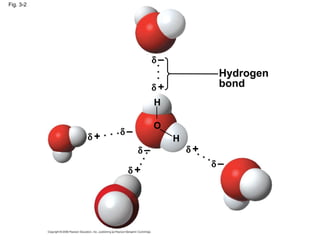
Concept 3.1: The polarity of water molecules results in hydrogen bonding The water molecule is a  polar molecule : The opposite ends have opposite charges Polarity allows water molecules to form hydrogen bonds with each other Animation: Water Structure Copyright © 2008 Pearson Education, Inc., publishing as Pearson Benjamin Cummings
Fig. 3-2 Hydrogen bond    – H    + H O — — — —    +    +    +    –    –    –
Concept 3.2: Four emergent properties of water contribute to Earth’s fitness for life Four of water’s properties that facilitate an environment for life are: Cohesive behavior Ability to moderate temperature Expansion upon freezing Versatility as a solvent Copyright © 2008 Pearson Education, Inc., publishing as Pearson Benjamin Cummings
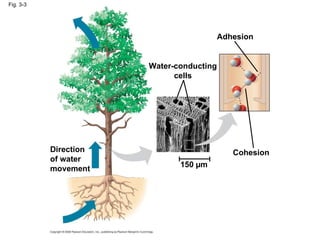
Cohesion Collectively, hydrogen bonds hold water molecules together, a phenomenon called  cohesion Cohesion helps the transport of water against gravity in plants Adhesion  is an attraction between different substances, for example, between water and plant cell walls Animation: Water Transport Copyright © 2008 Pearson Education, Inc., publishing as Pearson Benjamin Cummings
Fig. 3-3 Water-conducting cells Adhesion Cohesion 150 µm Direction of water movement
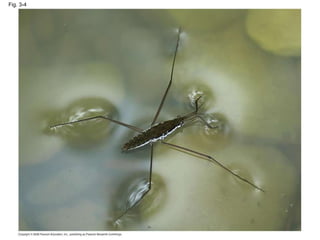
Surface tension  is a measure of how hard it is to break the surface of a liquid Surface tension is related to cohesion Copyright © 2008 Pearson Education, Inc., publishing as Pearson Benjamin Cummings
Fig. 3-4
Moderation of Temperature Water absorbs heat from warmer air and releases stored heat to cooler air Water can absorb or release a large amount of heat with only a slight change in its own temperature Copyright © 2008 Pearson Education, Inc., publishing as Pearson Benjamin Cummings
Heat and Temperature Kinetic energy  is the energy of motion Heat  is a measure of the  total  amount of kinetic energy due to molecular motion Temperature  measures the intensity of heat due to the  average  kinetic energy of molecules The  Celsius scale  is a measure of temperature using Celsius degrees (°C) Copyright © 2008 Pearson Education, Inc., publishing as Pearson Benjamin Cummings
Water’s High Specific Heat The  specific heat  of a substance is the amount of heat that must be absorbed or lost for 1 g of that substance to change its temperature by 1ºC The specific heat of water is 1 cal/g/ºC Water resists changing its temperature because of its high specific heat Copyright © 2008 Pearson Education, Inc., publishing as Pearson Benjamin Cummings
Water’s high specific heat can be traced to hydrogen bonding Heat is absorbed when hydrogen bonds break Heat is released when hydrogen bonds form The high specific heat of water minimizes temperature fluctuations to within limits that permit life Copyright © 2008 Pearson Education, Inc., publishing as Pearson Benjamin Cummings
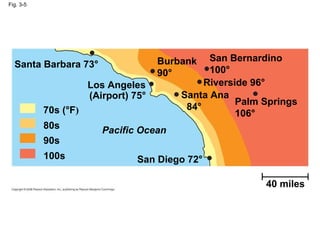
Fig. 3-5 San Diego 72° 40 miles Pacific Ocean 70s (°F ) 80s 90s 100s Santa Barbara 73° Los Angeles (Airport) 75° Burbank 90° San Bernardino 100° Riverside 96° Santa Ana 84° Palm Springs 106°
Evaporative Cooling Evaporation  is transformation of a substance from liquid to gas Heat of vaporization  is the heat a liquid must absorb for 1 g to be converted to gas As a liquid evaporates, its remaining surface cools, a process called  evaporative cooling  Evaporative cooling of water helps stabilize temperatures in organisms and bodies of water Copyright © 2008 Pearson Education, Inc., publishing as Pearson Benjamin Cummings
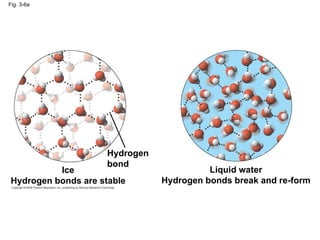
Insulation of Bodies of Water by Floating Ice Ice floats in liquid water because hydrogen bonds in ice are more “ordered,” making ice less dense Water reaches its greatest density at 4°C If ice sank, all bodies of water would eventually freeze solid, making life impossible on Earth Copyright © 2008 Pearson Education, Inc., publishing as Pearson Benjamin Cummings
Fig. 3-6a Hydrogen bond Liquid water Hydrogen bonds break and re-form Ice Hydrogen bonds are stable
The Solvent of Life A  solution  is a liquid that is a homogeneous mixture of substances A  solvent  is the dissolving agent of a solution The  solute  is the substance that is dissolved An  aqueous solution  is one in which water is the solvent  Copyright © 2008 Pearson Education, Inc., publishing as Pearson Benjamin Cummings
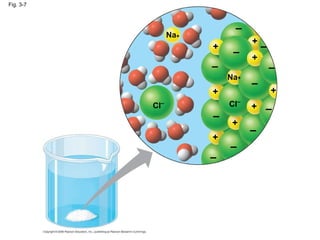
Water is a versatile solvent due to its polarity, which allows it to form hydrogen bonds easily When an ionic compound is dissolved in water, each ion is surrounded by a sphere of water molecules called a  hydration shell Copyright © 2008 Pearson Education, Inc., publishing as Pearson Benjamin Cummings
Fig. 3-7 Cl – Na Cl – + + + + + + + + – – – – – – – – Na + – – – +
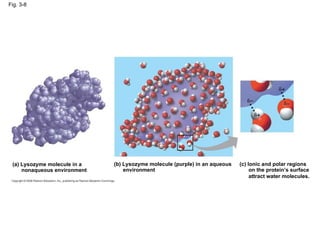
Water can also dissolve compounds made of nonionic polar molecules Even large polar molecules such as proteins can dissolve in water if they have ionic and polar regions Copyright © 2008 Pearson Education, Inc., publishing as Pearson Benjamin Cummings
Fig. 3-8 (a) Lysozyme molecule in a  nonaqueous environment (b) Lysozyme molecule (purple) in an aqueous environment  (c) Ionic and polar regions on the protein’s surface attract water molecules.
Hydrophilic and Hydrophobic Substances A  hydrophilic  substance is one that has an affinity for water A  hydrophobic  substance is one that does not have an affinity for water Oil molecules are hydrophobic because they have relatively nonpolar bonds A  colloid  is a stable suspension of fine particles in a liquid Copyright © 2008 Pearson Education, Inc., publishing as Pearson Benjamin Cummings
Solute Concentration in Aqueous Solutions Most biochemical reactions occur in water Chemical reactions depend on collisions of molecules and therefore on the concentration of solutes in an aqueous solution Copyright © 2008 Pearson Education, Inc., publishing as Pearson Benjamin Cummings
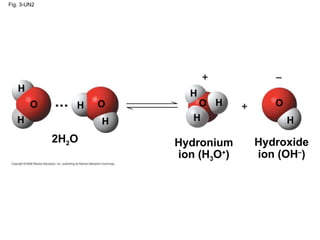
Concept 3.3: Acidic and basic conditions affect living organisms A hydrogen atom in a hydrogen bond between two water molecules can shift from one to the other: The hydrogen atom leaves its electron behind and is transferred as a proton, or  hydrogen ion  (H + ) The molecule with the extra proton is now a  hydronium ion  (H 3 O + ), though it is often represented as H + The molecule that lost the proton is now a  hydroxide ion  (OH – ) Copyright © 2008 Pearson Education, Inc., publishing as Pearson Benjamin Cummings
Water is in a state of dynamic equilibrium in which water molecules dissociate at the same rate at which they are being reformed Copyright © 2008 Pearson Education, Inc., publishing as Pearson Benjamin Cummings
Fig. 3-UN2 Hydronium ion (H 3 O + ) Hydroxide ion (OH – ) 2H 2 O H H H H H H H H O O O O
Though statistically rare, the dissociation of water molecules has a great effect on organisms Changes in concentrations of H +  and OH –  can drastically affect the chemistry of a cell Copyright © 2008 Pearson Education, Inc., publishing as Pearson Benjamin Cummings
Effects of Changes in pH Concentrations of H +  and OH –  are equal in pure water Adding certain solutes, called acids and bases, modifies the concentrations of H +  and OH –   Biologists use something called the pH scale to describe whether a solution is acidic or basic (the opposite of acidic) Copyright © 2008 Pearson Education, Inc., publishing as Pearson Benjamin Cummings
Acids and Bases An  acid  is any substance that increases the H +  concentration of a solution A  base  is any substance that reduces the H +  concentration of a solution Copyright © 2008 Pearson Education, Inc., publishing as Pearson Benjamin Cummings
The pH Scale In any aqueous solution at 25°C the product of H +  and OH –  is constant and can be written as  [H + ][OH – ] = 10 –14 The  pH  of a solution is defined by the negative logarithm of H +  concentration, written as  pH = –log [H + ] For a neutral aqueous solution  [H + ] is 10 –7  = –(–7) = 7  Copyright © 2008 Pearson Education, Inc., publishing as Pearson Benjamin Cummings
Acidic solutions have pH values less than 7 Basic solutions have pH values greater than 7 Most biological fluids have pH values in the range of 6 to 8 Copyright © 2008 Pearson Education, Inc., publishing as Pearson Benjamin Cummings
Fig. 3-UN5 Bases donate OH – or accept H +  in aqueous solutions Acids donate H +  in aqueous solutions Acidic [H + ] > [OH – ] Neutral [H + ] = [OH – ] Basic [H + ] < [OH – ] 14 7 0
Fig. 3-9 Neutral solution Acidic solution Basic solution OH – OH – OH – OH – OH – OH – OH – H + H + H + OH – H + H + H + H + OH – OH – OH – OH – H + OH – H + H + H + H + H + H + H + OH – Neutral [H + ]  =  [OH – ] Increasingly Acidic [H + ]  >  [OH – ]  Increasingly Basic [H + ]  <  [OH – ]  pH Scale 0 1 2 3 4 5 6 7 8 Battery acid Gastric juice, lemon juice Vinegar, beer, wine, cola Tomato juice Black coffee Rainwater Urine Saliva Pure water Human blood, tears Seawater 9 10 Milk of magnesia Household ammonia Household bleach Oven cleaner 11 12 13 14
Buffers The internal pH of most living cells must remain close to pH 7 Buffers  are substances that minimize changes in concentrations of H +  and OH –  in a solution Most buffers consist of an acid-base pair that reversibly combines with H + Copyright © 2008 Pearson Education, Inc., publishing as Pearson Benjamin Cummings
You should now be able to: List and explain the four properties of water that emerge as a result of its ability to form hydrogen bonds Distinguish between the following sets of terms: hydrophobic and hydrophilic substances; a solute, a solvent, and a solution Define acid, base, and pH Explain how buffers work Copyright © 2008 Pearson Education, Inc., publishing as Pearson Benjamin Cummings

Bio Ch 3 Pwpt

  • 1.
    Chapter 3 Waterand the Fitness of the Environment
  • 2.
    Overview: The MoleculeThat Supports All of Life Water is the biological medium on Earth All living organisms require water more than any other substance Most cells are surrounded by water, and cells themselves are about 70–95% water The abundance of water is the main reason the Earth is habitable Copyright © 2008 Pearson Education, Inc., publishing as Pearson Benjamin Cummings
  • 3.
    Concept 3.1: Thepolarity of water molecules results in hydrogen bonding The water molecule is a polar molecule : The opposite ends have opposite charges Polarity allows water molecules to form hydrogen bonds with each other Animation: Water Structure Copyright © 2008 Pearson Education, Inc., publishing as Pearson Benjamin Cummings
  • 4.
    Fig. 3-2 Hydrogenbond  – H  + H O — — — —  +  +  +  –  –  –
  • 5.
    Concept 3.2: Fouremergent properties of water contribute to Earth’s fitness for life Four of water’s properties that facilitate an environment for life are: Cohesive behavior Ability to moderate temperature Expansion upon freezing Versatility as a solvent Copyright © 2008 Pearson Education, Inc., publishing as Pearson Benjamin Cummings
  • 6.
    Cohesion Collectively, hydrogenbonds hold water molecules together, a phenomenon called cohesion Cohesion helps the transport of water against gravity in plants Adhesion is an attraction between different substances, for example, between water and plant cell walls Animation: Water Transport Copyright © 2008 Pearson Education, Inc., publishing as Pearson Benjamin Cummings
  • 7.
    Fig. 3-3 Water-conductingcells Adhesion Cohesion 150 µm Direction of water movement
  • 8.
    Surface tension is a measure of how hard it is to break the surface of a liquid Surface tension is related to cohesion Copyright © 2008 Pearson Education, Inc., publishing as Pearson Benjamin Cummings
  • 9.
  • 10.
    Moderation of TemperatureWater absorbs heat from warmer air and releases stored heat to cooler air Water can absorb or release a large amount of heat with only a slight change in its own temperature Copyright © 2008 Pearson Education, Inc., publishing as Pearson Benjamin Cummings
  • 11.
    Heat and TemperatureKinetic energy is the energy of motion Heat is a measure of the total amount of kinetic energy due to molecular motion Temperature measures the intensity of heat due to the average kinetic energy of molecules The Celsius scale is a measure of temperature using Celsius degrees (°C) Copyright © 2008 Pearson Education, Inc., publishing as Pearson Benjamin Cummings
  • 12.
    Water’s High SpecificHeat The specific heat of a substance is the amount of heat that must be absorbed or lost for 1 g of that substance to change its temperature by 1ºC The specific heat of water is 1 cal/g/ºC Water resists changing its temperature because of its high specific heat Copyright © 2008 Pearson Education, Inc., publishing as Pearson Benjamin Cummings
  • 13.
    Water’s high specificheat can be traced to hydrogen bonding Heat is absorbed when hydrogen bonds break Heat is released when hydrogen bonds form The high specific heat of water minimizes temperature fluctuations to within limits that permit life Copyright © 2008 Pearson Education, Inc., publishing as Pearson Benjamin Cummings
  • 14.
    Fig. 3-5 SanDiego 72° 40 miles Pacific Ocean 70s (°F ) 80s 90s 100s Santa Barbara 73° Los Angeles (Airport) 75° Burbank 90° San Bernardino 100° Riverside 96° Santa Ana 84° Palm Springs 106°
  • 15.
    Evaporative Cooling Evaporation is transformation of a substance from liquid to gas Heat of vaporization is the heat a liquid must absorb for 1 g to be converted to gas As a liquid evaporates, its remaining surface cools, a process called evaporative cooling Evaporative cooling of water helps stabilize temperatures in organisms and bodies of water Copyright © 2008 Pearson Education, Inc., publishing as Pearson Benjamin Cummings
  • 16.
    Insulation of Bodiesof Water by Floating Ice Ice floats in liquid water because hydrogen bonds in ice are more “ordered,” making ice less dense Water reaches its greatest density at 4°C If ice sank, all bodies of water would eventually freeze solid, making life impossible on Earth Copyright © 2008 Pearson Education, Inc., publishing as Pearson Benjamin Cummings
  • 17.
    Fig. 3-6a Hydrogenbond Liquid water Hydrogen bonds break and re-form Ice Hydrogen bonds are stable
  • 18.
    The Solvent ofLife A solution is a liquid that is a homogeneous mixture of substances A solvent is the dissolving agent of a solution The solute is the substance that is dissolved An aqueous solution is one in which water is the solvent Copyright © 2008 Pearson Education, Inc., publishing as Pearson Benjamin Cummings
  • 19.
    Water is aversatile solvent due to its polarity, which allows it to form hydrogen bonds easily When an ionic compound is dissolved in water, each ion is surrounded by a sphere of water molecules called a hydration shell Copyright © 2008 Pearson Education, Inc., publishing as Pearson Benjamin Cummings
  • 20.
    Fig. 3-7 Cl– Na Cl – + + + + + + + + – – – – – – – – Na + – – – +
  • 21.
    Water can alsodissolve compounds made of nonionic polar molecules Even large polar molecules such as proteins can dissolve in water if they have ionic and polar regions Copyright © 2008 Pearson Education, Inc., publishing as Pearson Benjamin Cummings
  • 22.
    Fig. 3-8 (a)Lysozyme molecule in a nonaqueous environment (b) Lysozyme molecule (purple) in an aqueous environment (c) Ionic and polar regions on the protein’s surface attract water molecules.
  • 23.
    Hydrophilic and HydrophobicSubstances A hydrophilic substance is one that has an affinity for water A hydrophobic substance is one that does not have an affinity for water Oil molecules are hydrophobic because they have relatively nonpolar bonds A colloid is a stable suspension of fine particles in a liquid Copyright © 2008 Pearson Education, Inc., publishing as Pearson Benjamin Cummings
  • 24.
    Solute Concentration inAqueous Solutions Most biochemical reactions occur in water Chemical reactions depend on collisions of molecules and therefore on the concentration of solutes in an aqueous solution Copyright © 2008 Pearson Education, Inc., publishing as Pearson Benjamin Cummings
  • 25.
    Concept 3.3: Acidicand basic conditions affect living organisms A hydrogen atom in a hydrogen bond between two water molecules can shift from one to the other: The hydrogen atom leaves its electron behind and is transferred as a proton, or hydrogen ion (H + ) The molecule with the extra proton is now a hydronium ion (H 3 O + ), though it is often represented as H + The molecule that lost the proton is now a hydroxide ion (OH – ) Copyright © 2008 Pearson Education, Inc., publishing as Pearson Benjamin Cummings
  • 26.
    Water is ina state of dynamic equilibrium in which water molecules dissociate at the same rate at which they are being reformed Copyright © 2008 Pearson Education, Inc., publishing as Pearson Benjamin Cummings
  • 27.
    Fig. 3-UN2 Hydroniumion (H 3 O + ) Hydroxide ion (OH – ) 2H 2 O H H H H H H H H O O O O
  • 28.
    Though statistically rare,the dissociation of water molecules has a great effect on organisms Changes in concentrations of H + and OH – can drastically affect the chemistry of a cell Copyright © 2008 Pearson Education, Inc., publishing as Pearson Benjamin Cummings
  • 29.
    Effects of Changesin pH Concentrations of H + and OH – are equal in pure water Adding certain solutes, called acids and bases, modifies the concentrations of H + and OH – Biologists use something called the pH scale to describe whether a solution is acidic or basic (the opposite of acidic) Copyright © 2008 Pearson Education, Inc., publishing as Pearson Benjamin Cummings
  • 30.
    Acids and BasesAn acid is any substance that increases the H + concentration of a solution A base is any substance that reduces the H + concentration of a solution Copyright © 2008 Pearson Education, Inc., publishing as Pearson Benjamin Cummings
  • 31.
    The pH ScaleIn any aqueous solution at 25°C the product of H + and OH – is constant and can be written as [H + ][OH – ] = 10 –14 The pH of a solution is defined by the negative logarithm of H + concentration, written as pH = –log [H + ] For a neutral aqueous solution [H + ] is 10 –7 = –(–7) = 7 Copyright © 2008 Pearson Education, Inc., publishing as Pearson Benjamin Cummings
  • 32.
    Acidic solutions havepH values less than 7 Basic solutions have pH values greater than 7 Most biological fluids have pH values in the range of 6 to 8 Copyright © 2008 Pearson Education, Inc., publishing as Pearson Benjamin Cummings
  • 33.
    Fig. 3-UN5 Basesdonate OH – or accept H + in aqueous solutions Acids donate H + in aqueous solutions Acidic [H + ] > [OH – ] Neutral [H + ] = [OH – ] Basic [H + ] < [OH – ] 14 7 0
  • 34.
    Fig. 3-9 Neutralsolution Acidic solution Basic solution OH – OH – OH – OH – OH – OH – OH – H + H + H + OH – H + H + H + H + OH – OH – OH – OH – H + OH – H + H + H + H + H + H + H + OH – Neutral [H + ] = [OH – ] Increasingly Acidic [H + ] > [OH – ] Increasingly Basic [H + ] < [OH – ] pH Scale 0 1 2 3 4 5 6 7 8 Battery acid Gastric juice, lemon juice Vinegar, beer, wine, cola Tomato juice Black coffee Rainwater Urine Saliva Pure water Human blood, tears Seawater 9 10 Milk of magnesia Household ammonia Household bleach Oven cleaner 11 12 13 14
  • 35.
    Buffers The internalpH of most living cells must remain close to pH 7 Buffers are substances that minimize changes in concentrations of H + and OH – in a solution Most buffers consist of an acid-base pair that reversibly combines with H + Copyright © 2008 Pearson Education, Inc., publishing as Pearson Benjamin Cummings
  • 36.
    You should nowbe able to: List and explain the four properties of water that emerge as a result of its ability to form hydrogen bonds Distinguish between the following sets of terms: hydrophobic and hydrophilic substances; a solute, a solvent, and a solution Define acid, base, and pH Explain how buffers work Copyright © 2008 Pearson Education, Inc., publishing as Pearson Benjamin Cummings

Editor's Notes

  • #5 Figure 3.2 Hydrogen bonds between water molecules
  • #8 Figure 3.3 Water transport in plants
  • #10 Figure 3.4 Walking on water
  • #15 Figure 3.5 The effect of a large body of water on climate
  • #18 Figure 3.6 Ice: crystalline structure and floating barrier
  • #21 Figure 3.7 Table salt dissolving in water
  • #23 Figure 3.8 A water-soluble protein
  • #35 Figure 3.9 The pH scale and pH values of some aqueous solutions