E.V.S Project Name:- Abhay M. jain S.T.D:- IX  (B) Roll no.:- 9 Teacher:-Rashmi miss School: S’T  Teresa’s  convent  english  medium high school.
CONTENTS 1.Intoduction 2.Types of waste a . Hazardous waste b . Non- hazardous waste 3. Disposal methods. a. Landfill b. Incineration c. Recycling methods d. Biological reprocessing e. Energy recovery.
Waste management  is the  collection ,   transport ,   processing ,   recycling   or   disposal, and monitoring of  waste   materials. [1]   The term usually relates to materials produced by human activity, and is generally undertaken to reduce their effect on  health , the  environment   or  aesthetics . Waste management is also carried out to recover  resources   from it. Waste management can involve  solid ,  liquid ,  gaseous   or  radioactive   substances, with different methods and fields of expertise for each. Waste management practices differ for   developed   and  developing nations , for  urban   and   rural areas , and for  residential   and  industrial   producers. Management for non- hazardous   residential and institutional waste in metropolitan areas is usually the responsibility of  local government   authorities, while management for non-hazardous commercial and industrial waste is usually the responsibility of the generator .
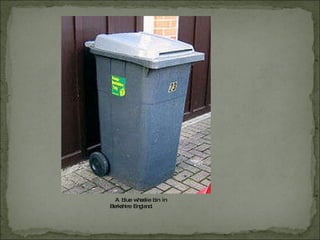
A  blue  wheelie  bin  in  Berkshire  England.
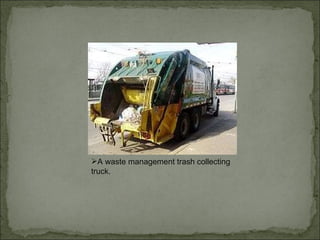
A waste management trash collecting truck.
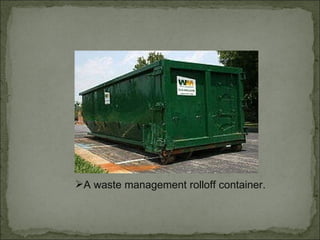
A waste management rolloff container.
Types  of waste Wastes  can  be  classified  as - Hazardous  waste Non – hazardous waste Hazardous waste  are  those  that  could  be  a  highly  toxic  to  humans , and plants . They are corrosive highly inflammable or explosive and react when exposed to certain things e.g. gases.Some of the waste may cause Genetic disorders. Certain types of industrial and hospital waste are considered hazardous as they may toxic substances .  Biomedical waste is infectious and requires careful handling .  Certain types of household waste are also hazardous .  This include old battries ,  shoe polish ,  tins of paint ,  old medicines ,  medicine bottles ,  bandages and discarded soiled clothes of sick persons , etc.
Non-hazardous  waste  are other municipal and household wastes,  street sweeping,  construction and demolition wastes  etc . Non-hazardous wastes may further be classified as- ‘ biodegradable’ and  ‘non-biodegradable wastes Biodegradable  or  organic wastes such as vegetable peels and remains of fruits ,  vegetables ,  bones,  meat,  left-over and rotten food,  garden waste such as leaves,  twigs etc. are decomposed by ants,  earthworms,  beetles,  millipedes,  fungi  and microbes. The degraded substances  again enter the biogeochemical cycles.  A lot of household  waste and agricultural waste and is bio-degredable.for convenience ,  this is also called ‘wet waste’  Non-biodegradable  waste  includes  synthetic  materials like plastics,  thermocol,  nylon,  rayon,  rayon and other synthetic  polymers.  It also includes  variety  of  electronic waste  e.g.  Communication  equipment  like  computers,  mobile  phones,  telephones,  etc.  Which  contain large volumes of  inert  materials  like  plastic  and  polymers.
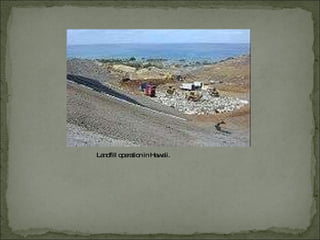
Disposal method. Landfill Disposing of waste in a landfill involves burying the waste, and this remains a common practice in most countries. Landfills were often established in abandoned or unused  quarries ,   mining   voids or  borrow pits . A properly-designed and well-managed landfill can be a hygienic and relatively inexpensive method of disposing of waste materials. Older, poorly-designed or poorly-managed landfills can create a number of adverse environmental impacts such as wind-blown  litter , attraction of   vermin ,   and generation of liquid  leachate .  Another common byproduct of landfills is gas (mostly composed of  methane   and  carbon dioxide ),   which is produced as organic waste breaks down  anaerobically .   This gas can create odor problems, kill surface vegetation, and is a  greenhouse gas . Design characteristics of a modern landfill include methods to contain leachate such as clay or plastic lining material. Deposited waste is normally compacted to increase its density and stability, and covered to prevent attracting   vermin   (such as  mice   or   rats ). Many landfills also have landfill gas extraction systems installed to extract the  landfill gas . Gas is pumped out of the landfill using perforated pipes and flared off or burnt in a  gas engine   to generate   electricity .
Landfill operation in Hawaii.
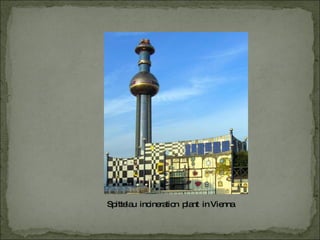
Incineration Incineration is a disposal method that involves   combustion   of waste material. Incineration and other high temperature waste treatment systems are sometimes described as " thermal treatment ". Incinerators convert waste materials into  heat ,  gas ,  steam , and  ash . Incineration is carried out both on a small scale by individuals and on a large scale by industry. It is used to dispose of solid, liquid and gaseous waste. It is recognized as a practical method of disposing of certain  hazardous waste   materials (such as biological  medical waste ). Incineration is a controversial method of waste disposal, due to issues such as emission of gaseous   pollutants . Incineration is common in countries such as  Japan   where land is more scarce, as these facilities generally do not require as much area as landfills.  Waste-to-energy   (WtE) or energy-from-waste (EfW) are broad terms for facilities that burn waste in a furnace or boiler to generate heat, steam and/or electricity. Combustion in an incinerator is not always perfect and there have been concerns about micro-pollutants in gaseous emissions from incinerator stacks. Particular concern has focused on some very persistent organics such as  dioxins   which may be created within the incinerator and which may have serious environmental consequences in the area immediately around the incinerator. On the other hand this method produces heat that can be used as energy.
Spittelau  incineration  plant  in Vienna
Recycling methods PVC ,   LDPE ,   PP , and  PS   (see  resin identification code ) are also recyclable, although these are not commonly collected. These items are usually composed of a single type of material, making them relatively easy to recycle into new products. The recycling of complex products (such as computers and electronic equipment) is more difficult, due to the additional dismantling and separation required.
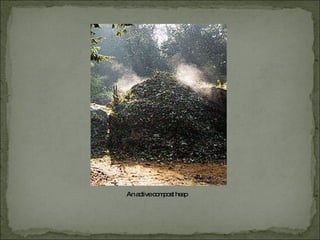
Biological reprocessing Waste materials that are organic in nature, such as plant material, food scraps, and paper products, can be recycled using biological composting and digestion processes to  decompose   the organic matter. The resulting organic material is then recycled as  mulch   or   compost   for agricultural or landscaping purposes. In addition, waste gas from the process (such as methane) can be captured and used for generating electricity. The intention of biological processing in waste management is to control and accelerate the natural process of decomposition of organic matter. There are a large variety of composting and digestion methods and technologies varying in complexity from simple home compost heaps, to industrial-scale enclosed-vessel digestion of mixed domestic waste (see   Mechanical biological treatment ). Methods of biological decomposition are differentiated as being  aerobic   or   anaerobic   methods, though hybrids of the two methods also exist. An example of waste management through composting is the Green Bin Program in  Toronto , Canada, where household organic waste (such as kitchen scraps and plant cuttings) are collected in a dedicated container and then composted.
An active compost heap
Energy recovery The energy content of waste products can be harnessed directly by using them as a direct combustion fuel, or indirectly by processing them into another type of fuel. Recycling through thermal treatment ranges from using waste as a fuel source for cooking or heating, to fuel for   boilers   to generate steam and electricity in a  turbine .  Pyrolysis   and   gasification   are two related forms of thermal treatment where waste materials are heated to high temperatures with limited   oxygen   availability. The process typically occurs in a sealed vessel under high   pressure . Pyrolysis of solid waste converts the material into solid, liquid and gas products. The liquid and gas can be burnt to produce energy or refined into other products. The solid residue (char) can be further refined into products such as   activated carbon . Gasification and advanced  Plasma arc gasification   are used to convert organic materials directly into a synthetic gas ( syngas )   composed of  carbon monoxide   and   hydrogen . The gas is then burnt to produce electricity and   steam .
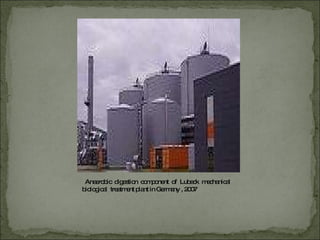
Anaerobic  digestion  component  of  Lubeck  mechanical  biological  treatment plant in Germany , 2007
Avoidance and reduction methods An important method of waste management is the prevention of waste material being created, also known as waste reduction. Methods of avoidance include reuse of second-hand products, repairing broken items instead of buying new, designing products to be refillable or reusable (such as cotton instead of plastic shopping bags), encouraging consumers to avoid using disposable products (such as disposable  cutlery ), removing any food/liquid remains from cans, packaging, ...  [2]  and designing products that use less material to achieve the same purpose (for example,  lightweighting of beverage cans
The Principles  of waste  Management 1.   Reduce . 2.   Reuse . 3.  Recycle .
Reduce The present age is dominated by ‘throwaway’ goods.  From ball pens to paper cups, the single-use products are filling the market. We should look for products which last long. We should avoid using ‘disposable’ like paper and plastic cups, paper napkins etc. and instead should use metal plates and glasses and cotton napkins.
Reuse Using the waste material in its present form again, is its reuse; and can be done in innumerable ways. When your grandmother stitches a new quilt or ‘godhadi’ by joining old sarees and pieces of clothes, it is a reuse.  When beautiful patterns are created on it, it gains the status of an art ! We Indians are expert in reusing things.
Recycle Recycling is the reprocessing of unwanted materials into new, useful products. If reduction or reuse of waste is not possible then it should be recycled .paper , plastic, glass and metals can be recycled. Recycling of wastes becomes difficult and costly ones they are mixed with organic, hazardous or other wastes. At home we always keep the old newspaper separately and give it to  ‘raddiwala’.
 

waste mgt by abhay jain

  • 1.
    E.V.S Project Name:-Abhay M. jain S.T.D:- IX (B) Roll no.:- 9 Teacher:-Rashmi miss School: S’T Teresa’s convent english medium high school.
  • 2.
    CONTENTS 1.Intoduction 2.Typesof waste a . Hazardous waste b . Non- hazardous waste 3. Disposal methods. a. Landfill b. Incineration c. Recycling methods d. Biological reprocessing e. Energy recovery.
  • 3.
    Waste management is the collection , transport , processing , recycling or disposal, and monitoring of waste materials. [1] The term usually relates to materials produced by human activity, and is generally undertaken to reduce their effect on health , the environment or aesthetics . Waste management is also carried out to recover resources from it. Waste management can involve solid , liquid , gaseous or radioactive substances, with different methods and fields of expertise for each. Waste management practices differ for developed and developing nations , for urban and rural areas , and for residential and industrial producers. Management for non- hazardous residential and institutional waste in metropolitan areas is usually the responsibility of local government authorities, while management for non-hazardous commercial and industrial waste is usually the responsibility of the generator .
  • 4.
    A blue wheelie bin in Berkshire England.
  • 5.
    A waste managementtrash collecting truck.
  • 6.
    A waste managementrolloff container.
  • 7.
    Types ofwaste Wastes can be classified as - Hazardous waste Non – hazardous waste Hazardous waste are those that could be a highly toxic to humans , and plants . They are corrosive highly inflammable or explosive and react when exposed to certain things e.g. gases.Some of the waste may cause Genetic disorders. Certain types of industrial and hospital waste are considered hazardous as they may toxic substances . Biomedical waste is infectious and requires careful handling . Certain types of household waste are also hazardous . This include old battries , shoe polish , tins of paint , old medicines , medicine bottles , bandages and discarded soiled clothes of sick persons , etc.
  • 8.
    Non-hazardous waste are other municipal and household wastes, street sweeping, construction and demolition wastes etc . Non-hazardous wastes may further be classified as- ‘ biodegradable’ and ‘non-biodegradable wastes Biodegradable or organic wastes such as vegetable peels and remains of fruits , vegetables , bones, meat, left-over and rotten food, garden waste such as leaves, twigs etc. are decomposed by ants, earthworms, beetles, millipedes, fungi and microbes. The degraded substances again enter the biogeochemical cycles. A lot of household waste and agricultural waste and is bio-degredable.for convenience , this is also called ‘wet waste’ Non-biodegradable waste includes synthetic materials like plastics, thermocol, nylon, rayon, rayon and other synthetic polymers. It also includes variety of electronic waste e.g. Communication equipment like computers, mobile phones, telephones, etc. Which contain large volumes of inert materials like plastic and polymers.
  • 9.
    Disposal method. LandfillDisposing of waste in a landfill involves burying the waste, and this remains a common practice in most countries. Landfills were often established in abandoned or unused quarries , mining voids or borrow pits . A properly-designed and well-managed landfill can be a hygienic and relatively inexpensive method of disposing of waste materials. Older, poorly-designed or poorly-managed landfills can create a number of adverse environmental impacts such as wind-blown litter , attraction of vermin , and generation of liquid leachate . Another common byproduct of landfills is gas (mostly composed of methane and carbon dioxide ), which is produced as organic waste breaks down anaerobically . This gas can create odor problems, kill surface vegetation, and is a greenhouse gas . Design characteristics of a modern landfill include methods to contain leachate such as clay or plastic lining material. Deposited waste is normally compacted to increase its density and stability, and covered to prevent attracting vermin (such as mice or rats ). Many landfills also have landfill gas extraction systems installed to extract the landfill gas . Gas is pumped out of the landfill using perforated pipes and flared off or burnt in a gas engine to generate electricity .
  • 10.
  • 11.
    Incineration Incineration isa disposal method that involves combustion of waste material. Incineration and other high temperature waste treatment systems are sometimes described as " thermal treatment ". Incinerators convert waste materials into heat , gas , steam , and ash . Incineration is carried out both on a small scale by individuals and on a large scale by industry. It is used to dispose of solid, liquid and gaseous waste. It is recognized as a practical method of disposing of certain hazardous waste materials (such as biological medical waste ). Incineration is a controversial method of waste disposal, due to issues such as emission of gaseous pollutants . Incineration is common in countries such as Japan where land is more scarce, as these facilities generally do not require as much area as landfills. Waste-to-energy (WtE) or energy-from-waste (EfW) are broad terms for facilities that burn waste in a furnace or boiler to generate heat, steam and/or electricity. Combustion in an incinerator is not always perfect and there have been concerns about micro-pollutants in gaseous emissions from incinerator stacks. Particular concern has focused on some very persistent organics such as dioxins which may be created within the incinerator and which may have serious environmental consequences in the area immediately around the incinerator. On the other hand this method produces heat that can be used as energy.
  • 12.
    Spittelau incineration plant in Vienna
  • 13.
    Recycling methods PVC, LDPE , PP , and PS (see resin identification code ) are also recyclable, although these are not commonly collected. These items are usually composed of a single type of material, making them relatively easy to recycle into new products. The recycling of complex products (such as computers and electronic equipment) is more difficult, due to the additional dismantling and separation required.
  • 14.
    Biological reprocessing Wastematerials that are organic in nature, such as plant material, food scraps, and paper products, can be recycled using biological composting and digestion processes to decompose the organic matter. The resulting organic material is then recycled as mulch or compost for agricultural or landscaping purposes. In addition, waste gas from the process (such as methane) can be captured and used for generating electricity. The intention of biological processing in waste management is to control and accelerate the natural process of decomposition of organic matter. There are a large variety of composting and digestion methods and technologies varying in complexity from simple home compost heaps, to industrial-scale enclosed-vessel digestion of mixed domestic waste (see Mechanical biological treatment ). Methods of biological decomposition are differentiated as being aerobic or anaerobic methods, though hybrids of the two methods also exist. An example of waste management through composting is the Green Bin Program in Toronto , Canada, where household organic waste (such as kitchen scraps and plant cuttings) are collected in a dedicated container and then composted.
  • 15.
  • 16.
    Energy recovery Theenergy content of waste products can be harnessed directly by using them as a direct combustion fuel, or indirectly by processing them into another type of fuel. Recycling through thermal treatment ranges from using waste as a fuel source for cooking or heating, to fuel for boilers to generate steam and electricity in a turbine . Pyrolysis and gasification are two related forms of thermal treatment where waste materials are heated to high temperatures with limited oxygen availability. The process typically occurs in a sealed vessel under high pressure . Pyrolysis of solid waste converts the material into solid, liquid and gas products. The liquid and gas can be burnt to produce energy or refined into other products. The solid residue (char) can be further refined into products such as activated carbon . Gasification and advanced Plasma arc gasification are used to convert organic materials directly into a synthetic gas ( syngas ) composed of carbon monoxide and hydrogen . The gas is then burnt to produce electricity and steam .
  • 17.
    Anaerobic digestion component of Lubeck mechanical biological treatment plant in Germany , 2007
  • 18.
    Avoidance and reductionmethods An important method of waste management is the prevention of waste material being created, also known as waste reduction. Methods of avoidance include reuse of second-hand products, repairing broken items instead of buying new, designing products to be refillable or reusable (such as cotton instead of plastic shopping bags), encouraging consumers to avoid using disposable products (such as disposable cutlery ), removing any food/liquid remains from cans, packaging, ... [2] and designing products that use less material to achieve the same purpose (for example, lightweighting of beverage cans
  • 19.
    The Principles of waste Management 1. Reduce . 2. Reuse . 3. Recycle .
  • 20.
    Reduce The presentage is dominated by ‘throwaway’ goods. From ball pens to paper cups, the single-use products are filling the market. We should look for products which last long. We should avoid using ‘disposable’ like paper and plastic cups, paper napkins etc. and instead should use metal plates and glasses and cotton napkins.
  • 21.
    Reuse Using thewaste material in its present form again, is its reuse; and can be done in innumerable ways. When your grandmother stitches a new quilt or ‘godhadi’ by joining old sarees and pieces of clothes, it is a reuse. When beautiful patterns are created on it, it gains the status of an art ! We Indians are expert in reusing things.
  • 22.
    Recycle Recycling isthe reprocessing of unwanted materials into new, useful products. If reduction or reuse of waste is not possible then it should be recycled .paper , plastic, glass and metals can be recycled. Recycling of wastes becomes difficult and costly ones they are mixed with organic, hazardous or other wastes. At home we always keep the old newspaper separately and give it to ‘raddiwala’.
  • 23.