Recycle
EVERYTHING?
Here’s how…
Can we really
Yes, we can.
Recycling Everything
2
• See what’s needed to
make it happen
• Jettison current assumptions
that prevent change
• Take a trip into the world
of industry and science
• Explore breakthrough ideas
Introduction
3
Janet Unruh
Institute for Material Sustainability
www.rebk.org
Portland, Oregon
Vita
• Instructional designer 25 years
• Manufacturing industry 10 years
• Masters of Engineering and
Technology Management,
Portland State University 2002
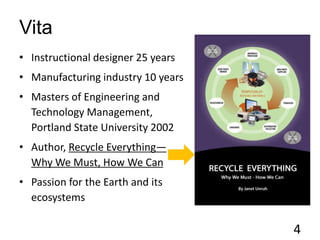
• Author, Recycle Everything—
Why We Must, How We Can
• Passion for the Earth and its
ecosystems
4
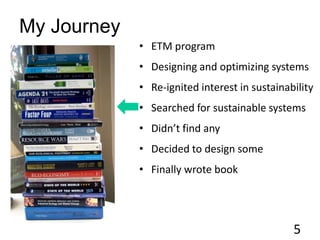
My Journey
• ETM program
• Designing and optimizing systems
• Re-ignited interest in sustainability
• Searched for sustainable systems
• Didn’t find any
• Decided to design some
• Finally wrote book
5
6
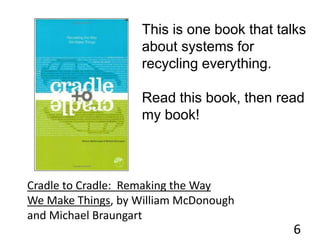
This is one book that talks
about systems for
recycling everything.
Read this book, then read
my book!
Cradle to Cradle: Remaking the Way
We Make Things, by William McDonough
and Michael Braungart
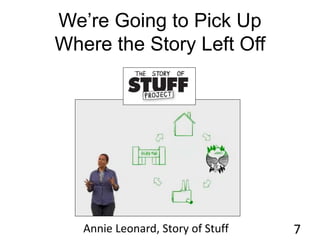
We’re Going to Pick Up
Where the Story Left Off
7Annie Leonard, Story of Stuff
8
But first, a quick
review of the
situation.
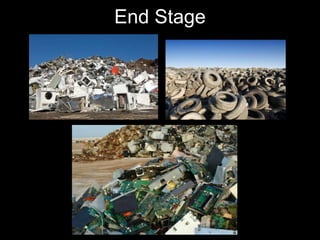
End Stage
9
10
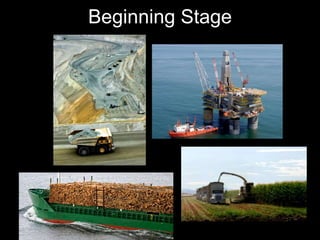
Beginning Stage
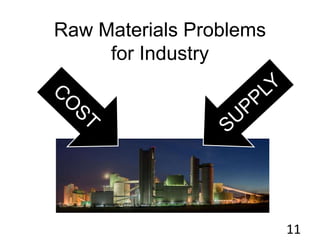
Raw Materials Problems
for Industry
11
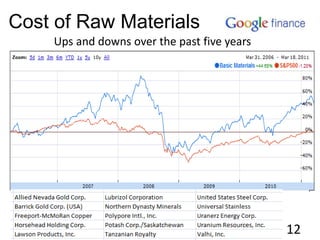
Cost of Raw Materials
12
Ups and downs over the past five years
Can Materials Keep On Flowing?
• Impacts on supply
• Price fluctuations and speculation
• Decreasing quality, lower grades
• More technology and fuel needed for extraction
• Resources in conflict areas or unfriendly countries
• Sudden increase in demand from multiple industries
• War—weapons, bombs, vehicles, materiel
• Dependency on oil and petrochemicals
13
14
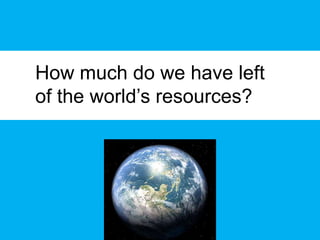
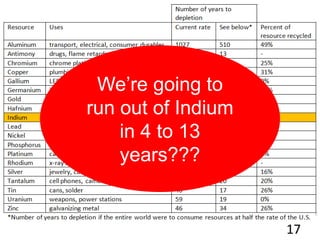
How much do we have left
of the world’s resources?
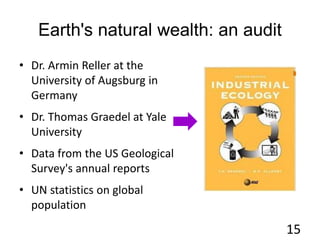
Earth's natural wealth: an audit
• Dr. Armin Reller at the
University of Augsburg in
Germany
• Dr. Thomas Graedel at Yale
University
• Data from the US Geological
Survey's annual reports
• UN statistics on global
population
15
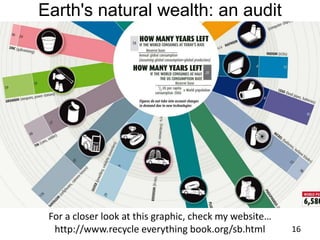
Earth's natural wealth: an audit
16
For a closer look at this graphic, check my website…
http://www.recycle everything book.org/sb.html
17
We’re going to
run out of Indium
in 4 to 13
years???
18
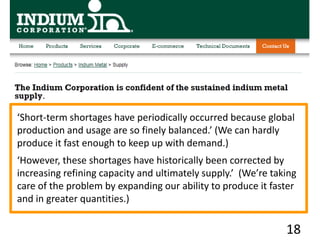
‘Short-term shortages have periodically occurred because global
production and usage are so finely balanced.’ (We can hardly
produce it fast enough to keep up with demand.)
‘However, these shortages have historically been corrected by
increasing refining capacity and ultimately supply.’ (We’re taking
care of the problem by expanding our ability to produce it faster
and in greater quantities.)
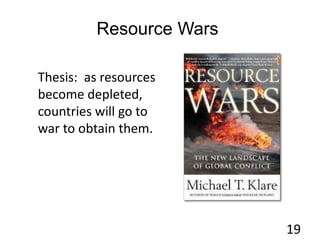
Resource Wars
19
Thesis: as resources
become depleted,
countries will go to
war to obtain them.
20
Recycling is an
urgent matter.
For industry, too.
21
The burden of
recycling falls on
consumers, local
governments and
concerned non-
profits, all of whom
are at the end of
the process.
What Do We Mean by
RECYCLING?
• Upcycling
• Downcycling
• Freecycling
• Blended recycling
• ‘Real’ recycling
22
23
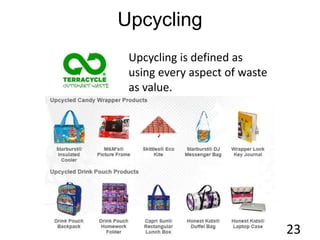
Upcycling is defined as
using every aspect of waste
as value.
Upcycling
Downcycling
24
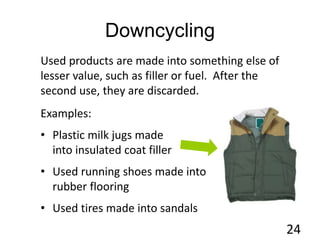
Used products are made into something else of
lesser value, such as filler or fuel. After the
second use, they are discarded.
Examples:
• Plastic milk jugs made
into insulated coat filler
• Used running shoes made into
rubber flooring
• Used tires made into sandals
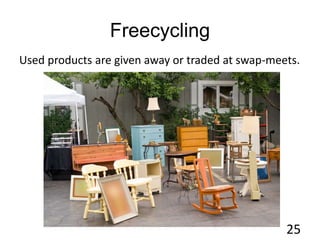
Freecycling
25
Used products are given away or traded at swap-meets.
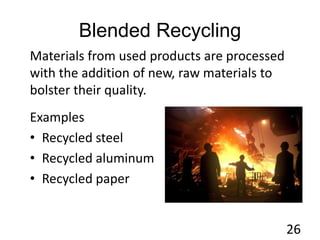
Blended Recycling
Examples
• Recycled steel
• Recycled aluminum
• Recycled paper
26
Materials from used products are processed
with the addition of new, raw materials to
bolster their quality.
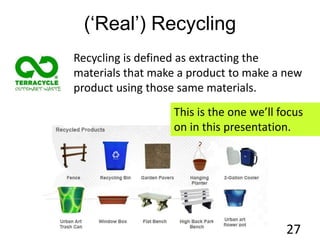
(‘Real’) Recycling
Recycling is defined as extracting the
materials that make a product to make a new
product using those same materials.
This is the one we’ll focus
on in this presentation.
27
28
Goal: recycle materials in cars,
trucks, airplanes, furniture, vinyl
siding, plastic dishware,
electronics, washers and dryers,
microwave ovens, lawnmowers,
toys, buildings—everything.
29
Can we reuse these materials
to make the same or similar products
countless times into the future?
I believe the answer is YES!
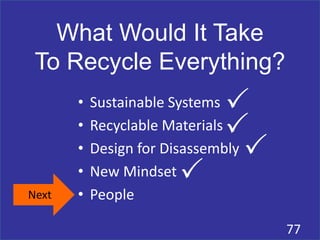
What Would It Take
To Recycle Everything?
• Sustainable Systems
• Recyclable Materials
• Design for Disassembly
• New Mindset
• People
30
Next
31
Let’s look at the current linear
production-consumption system…
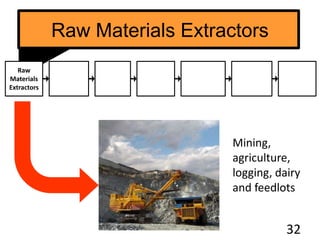
Raw Materials Extractors
32
Mining,
agriculture,
logging, dairy
and feedlots
Raw
Materials
Extractors
Primary Processors
33
Raw
Materials
Extractors
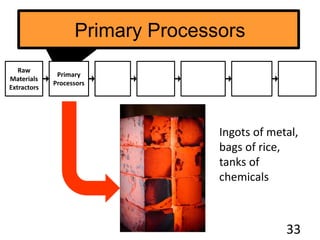
Ingots of metal,
bags of rice,
tanks of
chemicals
Primary
Processors
Parts Suppliers
34
Raw
Materials
Extractors
Primary
Processors
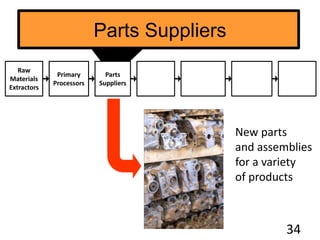
New parts
and assemblies
for a variety
of products
Parts
Suppliers
Producers
35
Raw
Materials
Extractors
Primary
Processors
Parts
Suppliers
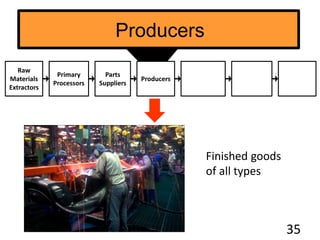
Finished goods
of all types
Producers
Distributors, Retail Outlets
36
Raw
Materials
Extractors
Primary
Processors
Parts
Suppliers
Producers
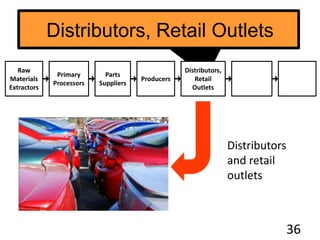
Distributors
and retail
outlets
Distributors,
Retail
Outlets
Consumers
37
Raw
Materials
Extractors
Primary
Processors
Parts
Suppliers
Producers
Distributors,
Retail
Outlets
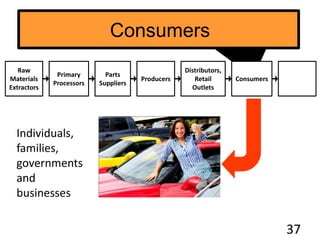
Individuals,
families,
governments
and
businesses
Consumers
Landfill Operators
38
Raw
Materials
Extractors
Primary
Processors
Parts
Suppliers
Producers
Distributors,
Retail
Outlets
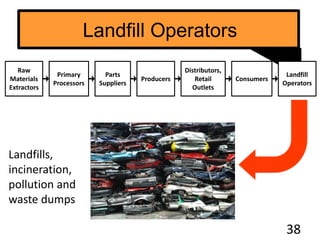
Landfills,
incineration,
pollution and
waste dumps
Consumers
Landfill
Operators
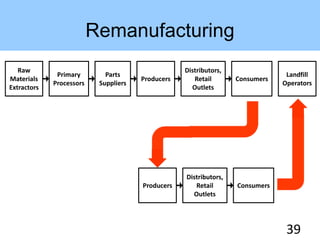
Remanufacturing
39
Raw
Materials
Extractors
Primary
Processors
Parts
Suppliers
Producers
Distributors,
Retail
Outlets
Consumers
Landfill
Operators
Producers
Distributors,
Retail
Outlets
Consumers
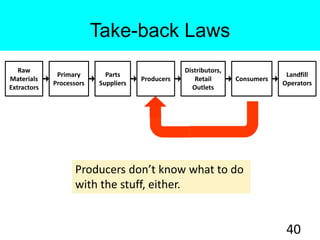
Take-back Laws
40
Raw
Materials
Extractors
Primary
Processors
Parts
Suppliers
Producers
Distributors,
Retail
Outlets
Consumers
Landfill
Operators
Producers don’t know what to do
with the stuff, either.
Once a thing can be imagined,
it can be engineered.
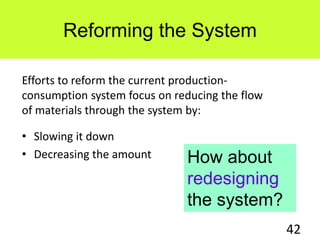
Reforming the System
• Slowing it down
• Decreasing the amount
42
Efforts to reform the current production-
consumption system focus on reducing the flow
of materials through the system by:
How about
redesigning
the system?
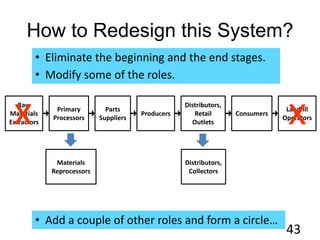
How to Redesign this System?
43
Raw
Materials
Extractors
Primary
Processors
Parts
Suppliers
Producers
Distributors,
Retail
Outlets
Consumers
Landfill
Operators
• Add a couple of other roles and form a circle…
• Eliminate the beginning and the end stages.
xx
• Modify some of the roles.
Materials
Reprocessors
Distributors,
Collectors
44
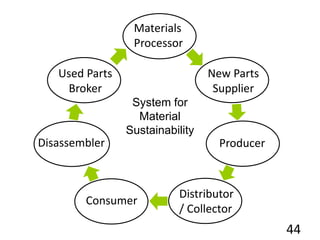
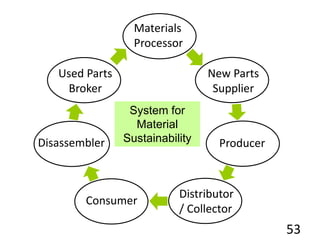
Materials
Processor
New Parts
Supplier
Producer
Distributor
/ Collector
Consumer
Disassembler
Used Parts
Broker
System for
Material
Sustainability
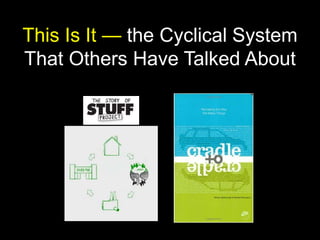
This Is It — the Cyclical System
That Others Have Talked About
45
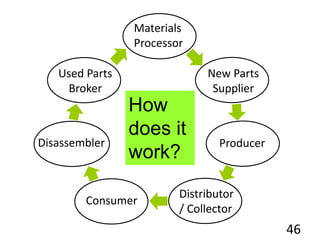
46
Materials
Processor
New Parts
Supplier
Producer
Distributor
/ Collector
Consumer
Disassembler
Used Parts
Broker
How
does it
work?
47
New Parts
Supplier
Producer
Distributor
/ Collector
Consumer
Disassembler
Used Parts
Broker
Materials
Processor
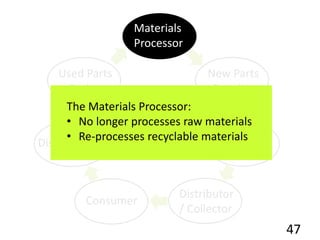
The Materials Processor:
• No longer processes raw materials
• Re-processes recyclable materials
Materials
Processor
48
Distributor
/ Collector
Consumer
Disassembler
Used Parts
Broker
New Parts
Supplier
Producer
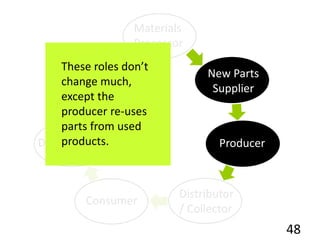
These roles don’t
change much,
except the
producer re-uses
parts from used
products.
New Parts
Supplier
Producer
Materials
Processor
49
Consumer
Disassembler
Used Parts
Broker
Distributor
/ Collector
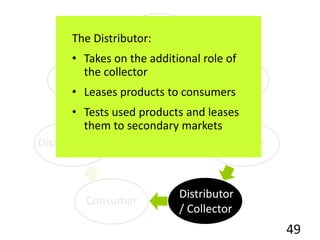
The Distributor:
• Takes on the additional role of
the collector
• Leases products to consumers
• Tests used products and leases
them to secondary markets
Distributor
/ Collector
New Parts
Supplier
Producer
Materials
Processor
50
Disassembler
Used Parts
Broker
Consumer
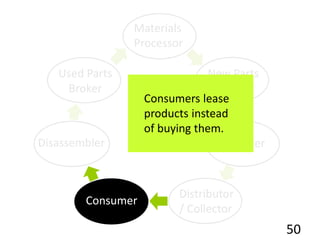
Consumers lease
products instead
of buying them.
Consumer
Distributor
/ Collector
New Parts
Supplier
Producer
Materials
Processor
51
Used Parts
Broker
Disassembler
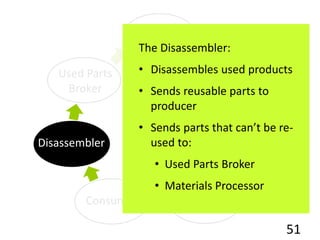
The Disassembler:
• Disassembles used products
• Sends reusable parts to
producer
• Sends parts that can’t be re-
used to:
• Used Parts Broker
• Materials Processor
Disassembler
Consumer
Distributor
/ Collector
New Parts
Supplier
Producer
Materials
Processor
52
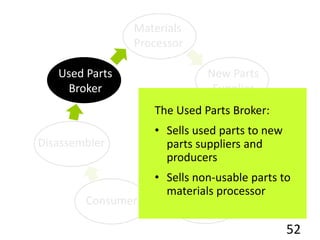
The Used Parts Broker:
• Sells used parts to new
parts suppliers and
producers
• Sells non-usable parts to
materials processor
Used Parts
Broker
53
Materials
Processor
New Parts
Supplier
Producer
Distributor
/ Collector
Consumer
Disassembler
Used Parts
Broker
System for
Material
Sustainability
Big
Changes
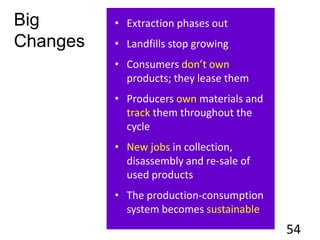
• Extraction phases out
• Landfills stop growing
• Consumers don’t own
products; they lease them
• Producers own materials and
track them throughout the
cycle
• New jobs in collection,
disassembly and re-sale of
used products
• The production-consumption
system becomes sustainable
54
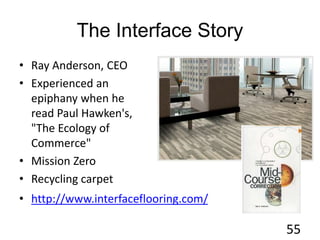
The Interface Story
• Ray Anderson, CEO
• Experienced an
epiphany when he
read Paul Hawken's,
"The Ecology of
Commerce"
• Mission Zero
• Recycling carpet
55
• http://www.interfaceflooring.com/
56
Inorganic versus
Organic Systems
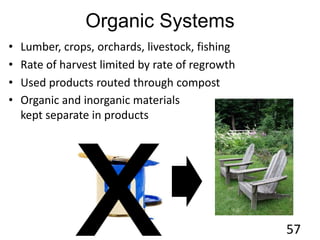
Organic Systems
• Lumber, crops, orchards, livestock, fishing
• Rate of harvest limited by rate of regrowth
• Used products routed through compost
57
• Organic and inorganic materials
kept separate in products
What Would It Take
To Recycle Everything?
58
• Sustainable Systems
• Recyclable Materials
• Design for Disassembly
• New Mindset
• People
Next
P
59
Recyclable materials are critical
to recycling everything.
We have to back up all the way
to the molecules.
Innovations in Material Science
• NOVA’s series, Making Materials on PBS
http://www.pbs.org/wgbh/nova/tech/making-
stuff.html
• MIT’s Technology Review
http://www.technologyreview.com/
• Discover magazine http://discovermagazine.com/
• New Scientist http://www.newscientist.com/
60
These links are on my website at…
http://www.recycle everything book.org/sb.html
A Few Examples
• Polymers that mend
themselves
• Two-dimensional graphene
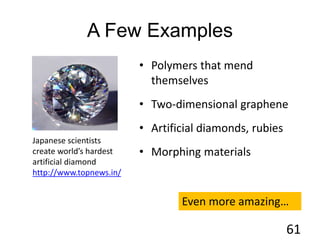
• Artificial diamonds, rubies
• Morphing materials
61
Japanese scientists
create world’s hardest
artificial diamond
http://www.topnews.in/
Even more amazing…
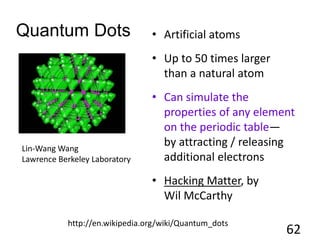
Quantum Dots • Artificial atoms
• Up to 50 times larger
than a natural atom
• Can simulate the
properties of any element
on the periodic table—
by attracting / releasing
additional electrons
• Hacking Matter, by
Wil McCarthy
62
Lin-Wang Wang
Lawrence Berkeley Laboratory
http://en.wikipedia.org/wiki/Quantum_dots
Programmable Matter
63
Wikipedia or other reference
64
If science can create
materials like these,
why can’t they create
recyclable materials?
They probably can.
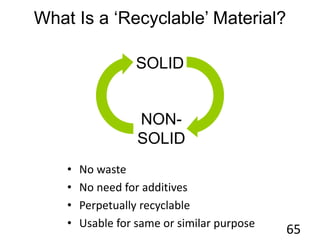
What Is a ‘Recyclable’ Material?
• No waste
• No need for additives
• Perpetually recyclable
• Usable for same or similar purpose
65
SOLID
NON-
SOLID
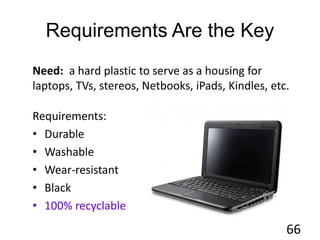
Requirements Are the Key
Requirements:
• Durable
• Washable
• Wear-resistant
• Black
• 100% recyclable
66
Need: a hard plastic to serve as a housing for
laptops, TVs, stereos, Netbooks, iPads, Kindles, etc.
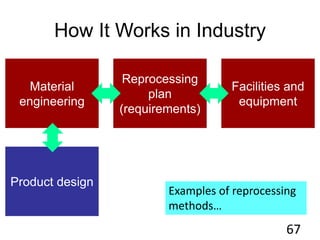
How It Works in Industry
67
Material
engineering
Reprocessing
plan
(requirements)
Facilities and
equipment
Product design
Examples of reprocessing
methods…
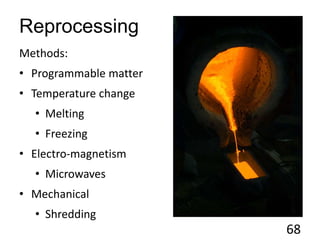
Reprocessing
Methods:
• Programmable matter
• Temperature change
• Melting
• Freezing
• Electro-magnetism
• Microwaves
• Mechanical
• Shredding
68
69
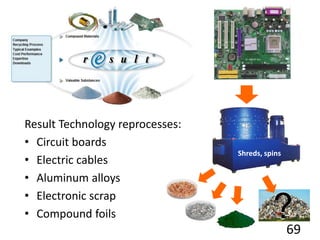
Result Technology reprocesses:
• Circuit boards
• Electric cables
• Aluminum alloys
• Electronic scrap
• Compound foils
Shreds, spins
??
What Would It Take
To Recycle Everything?
70
Next
• Sustainable Systems
• Recyclable Materials
• Design for Disassembly
• New Mindset
• People
P
P
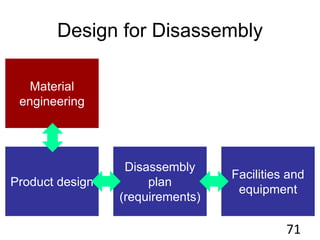
Design for Disassembly
71
Material
engineering
Disassembly
plan
(requirements)
Facilities and
equipment
Product design
Disassembly Requirements
• Disassembly process must be easy and fast
• All joins between parts must be reversible
• Parts must be designed to be recoverable and
reusable
• Parts must be designed to have separable materials
(for material reprocessing)
• Disassembly and reuse must be cost-effective
72
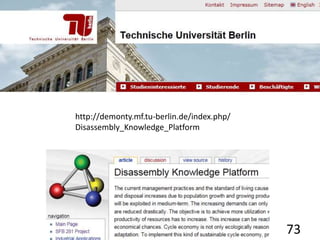
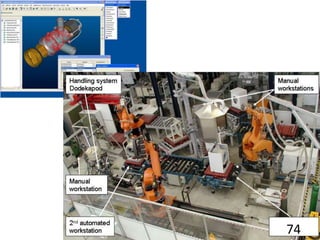
GTI
73
http://demonty.mf.tu-berlin.de/index.php/
Disassembly_Knowledge_Platform
74
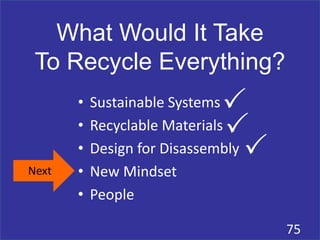
What Would It Take
To Recycle Everything?
75
Next
• Sustainable Systems
• Recyclable Materials
• Design for Disassembly
• New Mindset
• People
P
P
P
Mindset
• Resources are finite and
must be managed
• Everyone adapts to a
closed system for
handling materials
• Consumers do not own
products
• Producers own materials
and track them
76
What Would It Take
To Recycle Everything?
77
Next
• Sustainable Systems
• Recyclable Materials
• Design for Disassembly
• New Mindset
• People
P
P
P
P
78
People & Institute
for Material
Sustainability
Who or what is the Institute?
Institute for Material
Sustainability
• Non-profit organization
• Early stages
• Goal is to work with industry
• Get systems for material sustainability
up and running ASAP
79
Mission
80
The mission
of the Institute for
Material Sustainability
is to help industries
make the transition
to systems for material
sustainability.
of 34
Vision
Collaborative effort to:
• Develop 100% recyclable
materials for industry
• Design products using these new
materials and new processes for
material recovery
• Construct working models of
systems for material sustainability
• Establish a consulting agency to
work with industry to co-develop
and implement these systems
81
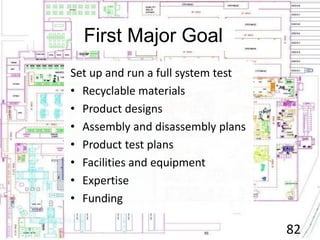
First Major Goal
Set up and run a full system test
• Recyclable materials
• Product designs
• Assembly and disassembly plans
• Product test plans
• Facilities and equipment
• Expertise
• Funding
82of 34
• Materials engineering
• Computer simulations
• Systems optimization
• Requirements engineering
• Lean manufacturing
• Product design
• Process design
83
An Appeal
We are looking for people who can help with…
• Assembly and disassembly
• Equipment and facilities design
• Finance
• Business consulting
• Website design
• Funding, fiscal sponsorship
84
A few final thoughts…
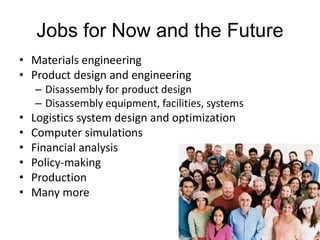
Jobs for Now and the Future
• Materials engineering
• Product design and engineering
– Disassembly for product design
– Disassembly equipment, facilities, systems
• Logistics system design and optimization
• Computer simulations
• Financial analysis
• Policy-making
• Production
• Many more
85
Reasons for Optimism
• Climate change and rapid evolution
• Accelerated innovation
• Crisis and opportunity
• Attitude
86
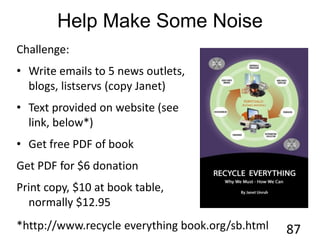
Help Make Some Noise
Challenge:
• Write emails to 5 news outlets,
blogs, listservs (copy Janet)
• Text provided on website (see
link, below*)
• Get free PDF of book
Get PDF for $6 donation
Print copy, $10 at book table,
normally $12.95
87*http://www.recycle everything book.org/sb.html
Feedback, Questions
88
http://www.recycle everything book.org/sb.html

Recycle Everything - Why We Must, How We Can

Editor's Notes

  • #3 DESIGN--need to add this one to the website We’re going to talk about what’s needed to make it happen
  • #8 How many of you are familiar with…? Explain how this presentation is going to pick up the story where Story of Stuff and Cradle to Cradle left off…
  • #18 Rhodium $2500 per ounce as of last September http://discovermagazine.com/2010/sep/11-elements
  • #19 Note that they didn’t say anything about reserves and how long they will last.
  • #31 DESIGN--need to add this one to the website
  • #42 Keywords: sustainability, green business, ecology, environment, manufacturing, story of stuff, cradle to cradle.
  • #45 No starting-point or end.
  • #46 How many of you are familiar with…? Explain how this presentation is going to pick up the story where Story of Stuff and Cradle to Cradle left off…
  • #47 No starting-point or end.
  • #54 Explain how materials travel between these roles. This graphic is a simplification.
  • #59 DESIGN--need to add this one to the website
  • #66 Reusing materials for the same or similar purpose—not lower-grade purpose such as filler or fuel
  • #67 How do we go about obtaining recyclable materials? Materials are engineered based on requirements.
  • #71 DESIGN--need to add this one to the website
  • #76 DESIGN--need to add this one to the website
  • #78 DESIGN--need to add this one to the website