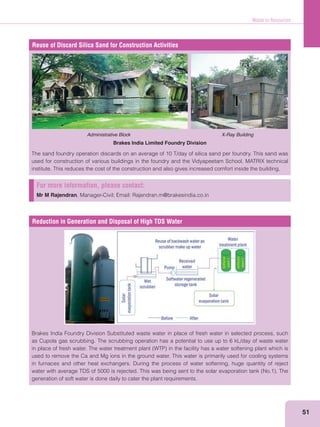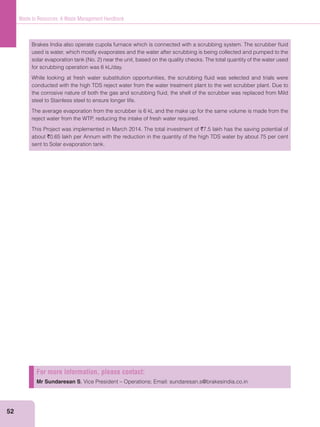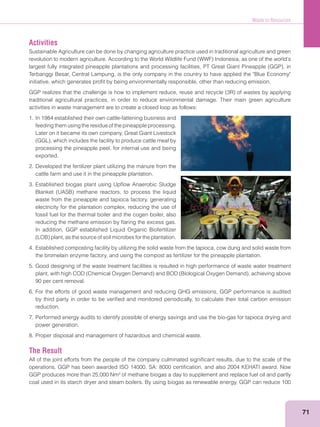




A Waste Management Handbook
Waste to Resources
Waste to Resources:
A Waste Management Handbook
ii
© The Energy and Resources Institute, 2014
All rights reserved. No part of this publication may be reproduced, stored in a retrieval system, or transmitted in any
form or by any means, electronic, mechanical, photocopying, recording or otherwise, without the prior permission of the
publisher.
Published by
TERI Press
The Energy and Resources Institute Tel. 2468 2100 or 4150 4900
Darbari Seth Block Fax 2468 2144 or 2468 2145
New Delhi – 110 003 E-mail teripress@teri.res.in
India Website www.teriin.org
Disclaimer
The views and opinions expressed in this compilation are those of the authors and do not necessarily reflect the official
examples of such applications by various industry participants. Assumptions made within the analysis are not reflective of
the position of TERI or TERI-BCSD or any government or any private entity.
This compendium is only a compilation of the aforementioned data in the form of case studies sent by officials from the
organizations that participated in this exercise.
TERI or TERI-BCSD does not claim the reliability of the content published as a part of the compendium. Circulation of
this publication or any data related to it is not permitted without the consent of the contributors.
Printed in India
iii
Contents
Foreword .............................................................................................................................................................v
Acknowledgements...........................................................................................................................................vii
Participating Companies....................................................................................................................................ix
Introduction....................................................................................................................................................... 1
Classification of Waste ....................................................................................................................................... 3
Evolution of Laws................................................................................................................................................ 9
Technology Factsheet ...................................................................................................................................... 15
Integrated Solid Waste Management............................................................................................................... 40
Case Studies................................................................................................................................................... 45
1. Reduction of Industrial Waste Generation by Proper Handling and Management of
Waste Materials ......................................................................................................................................... 47
............................................. 49
3. Municipal Solid Waste and Hazardous Waste Management by Polycrack Technology
.......................................................................................................................................... 53
...................................................................................... 57
......................................................................................................... 61
6. Integrated Municipal Solid Waste Management ...................................................................................... 63
7. Great Giant Pineapple: Soil Health Management .................................................................................... 67
8. Waste Management ................................................................................................................................. 70
9. Sintesa Group: Optimizing Waste of Natural Gas in Fulfilling Electricity Demand .................................. 73
References ...................................................................................................................................................... 75
v
Foreword
The growing urbanization and pursuit for faster economic development need,
particularly in growing economies, are leading to unprecedented growth in all kind
of wastes – municipal including e-waste, and industrial hazardous and non-hazardous
wastes. The cities in developing economies have also been witnessing a growing
amount of sewage, large portion of which is discharged untreated in water bodies and
thus, is largest source of their pollution. While the countries in Europe and countries
like Japan in Asia have been successful in maximizing resource recovery and waste
recycling and thus diverting waste from landfills, the cities in developing economies
have been still struggling with source segregation of waste and setting up material
recovery and waste recycling facilities, and most of the waste still is reaching the
landfill sites. As most of these landfill sites in developing economies unlined low-lying areas. Waste disposal
at such sites result in contamination of surface and groundwater sources making them unfit for human
consumption. Experiences in developed countries in past have shown that cleaning up contaminated sites
has been much more expensive than implementing pollution prevention strategies. It is expected that global
waste management cost which at present is whopping $205.4 billion annually will increase to $375.5 billion in
2025 thus, putting a lot of pressure on agencies managing these wastes.
Also as the cities are growing exponentially, they are facing problem in locating and developing waste disposal
sites. The availability of suitable land for waste disposal is becoming a challenge for urban local bodies.
`
recovery, but also to reduce the need for landfills. Enhanced material recovery also ensures resource security
in terms on lesser dependence on virgin resources.
This guidebook titled “Waste to Resource” provides a detailed overview of urban liquid and solid waste
facilities and e-waste management. The section in the guidebook also deals with the evolution of Acts and
Rules in India that deal with pollution control and waste management. It provides a snapshot of some of the
recent Rules dealing with waste management.
The last section of the guidebook provides technology fact sheet covering useful waste treatment and
processing technology options, which can not only control pollution, but also ensure maximizing resource
recovery from waste. I commend TERI-BCSD for their efforts to research and compile a guidebook on
this complex but topical issue. I am sure the information provided in the guidebook will be useful to waste
management practitioners and help them manage their waste in an environmentally sound manner.
Dr. Suneel Pandey
Associate Director, TERI
vii
Acknowledgements
The “Waste to Resources: A Waste Management Handbook” was developed with the active engagement
and other leading companies who contributed to the creation of this compendium by sending in the best
practices followed in their esteemed organizations. This guidebook strives to acknowledge and appreciate
some organizations that have championed Waste Management practices Implementation in India. We would
like to thank our working group companies to have come forward to develop this important guidebook that
encourages other businesses to learn from the industrial best practices in mainstreaming sustainability across
their business practices. This guidebook has benefited greatly from a highly engaged set of thought leaders
from the industry and beyond. We would like to acknowledge the contribution of the following individuals
Mr A K Sakalker, Bharat Petroleum Corporation Ltd
Mr Anuj Mishra/Ms Humsa Dhir, Akzo Nobel India Ltd
Ms Ashima Sushilchandra/Mr Thyagarajan, BASF India Ltd
Mr Avinash Patkar, TQMS
Ms Chaitanya Kommukuri, YES Bank Ltd
Mr Ganesh Chandra Tripathy, Jubilant Life Sciences Ltd
Mr J S Bhatia, Bharat Petroleum Corporation Ltd
Mr Jasraj Virdi, CLP India Pvt. Ltd
Mr K K Verma, NTPC Ltd
Mr Krunal Negandhi, Lavasa Corporation Ltd
Mr L Rajan, State Bank of India
Mr Manoj Kumar Singh, Indus Towers Pvt. Ltd
Ms Namita Vikas, YES Bank Ltd
Mr Naresh Patil, Mahindra and Mahindra Ltd
Ms Niyati Sareen, HCC Ltd
Mr P S Narayan, WIPRO Ltd
Mr Pramod Natuvetty, AkzoNobel India Ltd
Mr Rakesh Bhargava, Shree Cements Ltd
Mr Santanu Kumar Satapathy, CLP India Pvt. Ltd
Mr Shubhenjit Chaudhari, TATA Steel
Mr Srinath Komarina, YES Bank Ltd
Mr Ulhas Parlikar, ACC Pvt. Ltd
TERI
Mr Dipankar Sanyal
Dr Suneel Pandey
Ms Radhika Kapoor
Ms Smriti Bhatnagar
Mr Sumit Prasad
Mr Pawan Garg
Ms Mansi Gupta
Mr Santosh Gautam
Ms Shilpa Mohan
Mr Aman Sachdeva
ix
Participating Companies
1
Waste has always been a perennial problem and its
management remains a big predicament up to this
day, since the amount of solid waste increases as
populations rise and economies develop. Today, the
total amount of waste generated annually worldwide
tonnes, the municipal solid waste is between 1.6 to
2.0 billion tonnes. [1] Also, the global impacts of solid
waste are growing fast as solid waste management
to about $375.5 billion in 2025. [2]
Basel Convention by UNEP define wastes “as
substances or objects, which are disposed of or
are intended to be disposed of or are required to be
disposed of by the provisions of national law”. Our
daily activities give rise to a large variety of different
wastes arising from different sources. Cleaning up of
waste contamination is much more expensive in the
long term as compared to its prevention at source.
Countries are facing an uphill challenge to properly
manage their waste with most efforts to reduce the
final volumes and generate sufficient funds for waste
management.
Waste management is needed for these countries
which is the joint responsibility of the Citizens,
Industries, the local governments and the pollution
control boards. Waste management comprises a
collective activity involving segregation, collection,
transportation, re-processing, recycling and disposal
of various types of wastes. Different wastes and
waste-management activities have varying impacts
on energy consumption, methane emissions, carbon
storage, ecological and human health. For example,
recycling reduces greenhouse gas emissions by
preventing methane emissions from landfills or open
dumps and preventing the consumption of energy for
extracting and processing raw materials.
Improper Waste Management is one of the main
causes of environmental pollution. The World Health
Introduction
the diseases faced by mankind today occur due to
prolonged exposure to environmental pollution. Most
of these environment related diseases are not easily
detected, and may be acquired during childhood
and manifested later in adulthood. Also, there are
social implication of waste due to deficiencies in
waste management, disproportionately affect poorer
communities as waste is often dumped on land
adjacent to slums. This unsound waste management
has health implications. Millions of waste pickers
are exposed to hazardous substances as they try
mercury and infectious agents from healthcare
facilities—as well as dioxins and other harmful
emissions released during the recovery of valuable
materials from e-waste—not only affect the health
of waste pickers, but also contribute to air, land and
water contamination.
With growing public awareness about waste-
related problems and with increasing pressure on
the government and urban local bodies to manage
waste more efficiently, the concept of waste as
“a material which has no use” is changing to “a
resource at a wrong place”. Cleaning up of waste is
much more expensive in the long run as compared
to its prevention at source. Mixed waste is useless
as a resource until waste separation at source is
practiced. Society has to think of ways to minimize
and put waste to other uses.
Industry-based waste management is one of the most
elaborate Waste Management procedures. It has an
annual turnover above $433 billion and engages
operations for different waste streams and different
phases of the waste life-cycle. It is considered
that the industry will further grow, especially in
developing countries, and recycling business will
2
Waste to Resources: A Waste Management Handbook
be the cornerstone of it. Waste Recycling is one of
the most important sectors in terms of employment
creation and currently employs 12 million people in
just three countries—Brazil, China and the United
States In the waste sector, landfill methane is the
largest source of GHG emissions, caused by the
anaerobic degradation of organic material in landfills
and unmonitored dumpsites. If present waste-
management trends are maintained, landfilled food
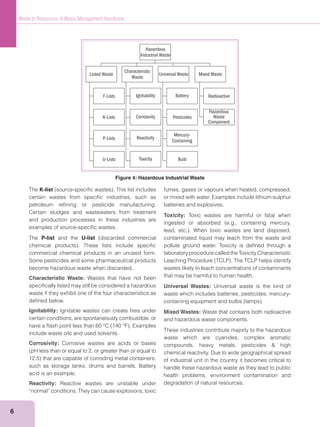
At present, India produces more than 62 million tonnes of solid waste annually, of which 80 per cent
is disposed of indiscriminately at dump yards in an unhygienic manner by the municipal authorities
leading to problems of health and environmental degradation.
—Report on Task Force on Waste to Resource: Planning Commission, May 2014
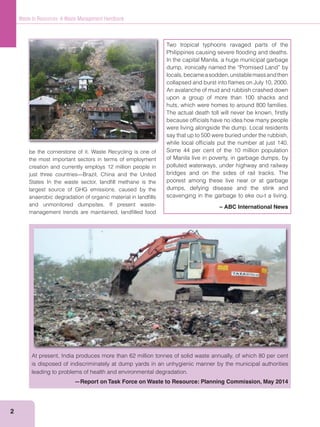
Two tropical typhoons ravaged parts of the
Philippines causing severe flooding and deaths.
In the capital Manila, a huge municipal garbage
dump, ironically named the “Promised Land” by
locals,becameasodden,unstablemassandthen
collapsed and burst into flames on July 10, 2000.
An avalanche of mud and rubbish crashed down
upon a group of more than 100 shacks and
huts, which were homes to around 800 families.
The actual death toll will never be known, firstly
because officials have no idea how many people
were living alongside the dump. Local residents
say that up to 500 were buried under the rubbish,
while local officials put the number at just 140.
Some 44 per cent of the 10 million population
of Manila live in poverty, in garbage dumps, by
polluted waterways, under highway and railway
bridges and on the sides of rail tracks. The
poorest among these live near or at garbage
dumps, defying disease and the stink and
scavenging in the garbage to eke ou-t a living.
– ABC International News
Waste to Resources
3
waste is predicted to increase the landfill share of
global anthropogenic Greenhouse Gas emissions
from 8 to 10 per cent.[1]
Classification of Waste
Managing waste in an environmentally sound, socially
satisfactory and a techno-economically viable manner
is Sustainable Waste Management. It is achieved
through strategic planning, institutional capacity
building, fiscal incentives, techno-economically
viable technologies, public-private partnerships
and community participation. Waste management
approaches differ for different types of wastes and
also for wastes in different geographical locations
such as urban, rural and hilly areas. While there are
many ways to classify waste, for the purpose of this
paper we will classify waste based on its source
stream. Wastes such as domestic and industrial ones
can be classified under the heads of urban, industrial,
biomedical and e-waste as shown in Figure 1. These
are generated during the extraction of raw materials,
manufacturing and processing of raw materials into
intermediate and final products, the consumption of
final products, and other human activities.
Urban waste
Urban Waste comprises of Municipal Solid Waste
Demolition waste.
Municipal Solid Waste
Municipal Solid waste comprises of recyclable,
biodegradable as well as inert waste as shown in
Figure 2.[5] The biodegradable waste streams from
urban hotspots dominate the bulk of MSW mainly due
to exorbitant food and yard wastage from households.
Recycling is the recovery of useful materials, such
as paper, glass, plastic, and metals, from the trash
to use to make new products, reducing the amount
of virgin raw materials needed. Waste is the kind
of waste that is neither chemically and biologically
Construction
& Demolition
Non- Hazardous
Municipal
Solid Waste
Sewage &
Sludge
Hazardous
Industrial
Waste Water
Solid Solid
Urban Industrial
Waste
Biomedical E -Waste
Liquid Liquid
Figure 1: Classification of Waste
Municipal
Solid Waste
Bio-
Degradable
Kitchen
Waste
Vegetable
Waste
Garden
Waste
Plastic &
Paper
Glass
Tin Can &
Metals
Sand
Pebbles
Gravels
Recyclable Inert
Figure 2: Municipal Solid Waste
4
Waste to Resources: A Waste Management Handbook
reactive, nor undergoes decomposition. In most of
the Indian cities, the MSW collection, segregation,
transportation, processing and disposal is carried
out by the respective municipal corporations and the
state governments enforce regulatory policies.
To minimize the quantum of waste for disposal by
optimal utilization of the potential of all components,
MSW is done by adopting the “concept of 5-R”—
Reduce,Reuse,Recover,RecycleandRemanufacture
Municipal Solid Waste Management generates
energy and other useful products and ensures safe
disposal of residual waste.[4]
A major fraction of urban MSW in India is
annual generation of MSW continues to be dumped
without treatment, it will need 3,40,000 cubic meter
Considering the projected waste generation of 165
million tonnes by 2031, the requirement of land for
hectares of precious land, which our country cannot
afford.[4]
Sewage & Sludge
Solid waste going into landfills has a serious impact
on the environment, but disposal is not our only
concern. Waste water also needs to be managed in
order to reduce threats to public health, safety and
the environment. Sewage is a water-carried waste, in
solution or suspension, it is more than 99 per cent
water and is characterized by volume or rate of flow,
physical condition, chemical constituents and the
bacteriological organisms that it contains.
Sludge is the semi-solid precipitate produced in
wastewater treatment plants originating from their
process of treatment. Due to the physical-chemical
processes involved in the treatment, the sludge
tends to concentrate heavy metals and poorly
biodegradable trace organic compounds as well as
in nutrients such as nitrogen and phosphorous and
contains valuable organic matter that is useful when
Indian Scenario for Municipal Solid Waste
Municipal areas in the country generate 1,33,760
only 91,152 TPD waste is collected and 25,884
TPD treated. Considering that the volume of
waste is expected to increase at the rate of 5
per cent per year on account of increase in the
population and change in lifestyle of the people,
it is assumed that urban India will generate
2,76,342 TPD by 2021, 4,50,132 TPD by 2031
and 1,195,000 TPD by 2050. The challenge is
in managing this waste which is projected to be
165 million by 2031 and 436 million by 2050. The
CPCB report also reveals that only 68 per cent of
the MSW generated in the country is collected
of which, 28 per cent is treated by the municipal
authorities. Thus, merely 19 per cent of the
total waste generated is currently treated. The
untapped waste has a potential of generating
439 MW of power from 32,890 tonnes per day of
combustible wastes including Refused Derived
per day or 72 MW of electricity from biogas and
5.4 million metric tonnes of compost annually to
support agriculture.
—Central Pollution Control Board
(CPCB Report 2012–13)
soils are depleted or subject to erosion. The organic
matter and nutrients are the two main elements that
make the spreading of this kind of waste on land as a
fertiliser or an organic soil improver suitable.[9]
Construction & Demolition Waste
as the solid waste generated by the construction,
remodeling, renovation, repair, alteration or demolition
of residential, commercial, government or institutional
buildings, industrial, commercial facilities and
infrastructures such as roads, bridges, dams, tunnels,
railways and airports. Source based generation of
construction and demolition is shown in Figure 3.
high volume, low risk. It is commonly understood that
Waste to Resources
5
Construction
& Demolition
Construction
Waste
Civil
Infrastructure
Waste
Demolition
Waste
Demolition
of Building
Maintenance
Road Waste
Construction &
Maintenance
Excavation
Soil & Rocks
Digging
Activities
Earth Works
Industrial Waste
Industrial Waste can be classified as Hazardous,
Non-Hazardous and Waste Water. It can be
discarded commercial products, like cleaning fluids
or pesticides, or the by-products of manufacturing
processes.
Hazardous Waste
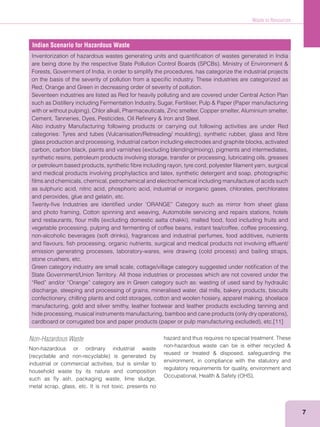
Hazardous waste is divided into listed wastes,
characteristic wastes, universal wastes and mixed
waste as shown in Figure 4. Waste Identification
Process details about the process for identifying,
characterizing, listing and delisting hazardous
wastes.
Listed Wastes: Wastes that Environmental Protection
termed as Listed Wastes. The lists include the F-list
K-list
P-list and U-list
The F-list
identifies wastes from common manufacturing and
industrial processes, such as solvents that have been
used in cleaning or degreasing operations. Because
the processes producing these wastes can occur in
different sectors of industry, the F-listed wastes are
known as wastes from non-specific sources.
this waste can be considered a resource, either for
reuse in its original form or for recycling or energy
recovery. If suitably selected, ground, cleaned and
sieved in appropriate industrial crushing plants,
these materials can be profitably used in concrete.
portion of total solid waste production in the world.
demolition activity takes place, such as building,
roads, bridges, flyover, subway, remodeling, etc.,
this waste is heavy, has high density, often bulky and
occupies considerable storage space either on the
road or communal waste bin. It is not uncommon
to see huge piles of such waste stacked on roads
especially in large projects, resulting in traffic
congestion and disruption.[10]
Indian construction industry is highly employment
intensive and accounts for approximately 50 per cent
of the capital out lay in successive five year plans of
our country. The projected investment in this industrial
sector continues to show a growing trend.
Central Pollution Control Board has estimated
current quantum of municipal solid waste generation
in India to the tune of 62 million tonnes/annum of
which waste from construction industry accounts
for 25 per cent. Thus the total quantum of waste
from construction industry is estimated to be 12 to
14.7 million tonnes per annum.
Figure 3: Construction & Demolition Waste
6
Waste to Resources: A Waste Management Handbook
The K-list
certain wastes from specific industries, such as
petroleum refining or pesticide manufacturing.
Certain sludges and wastewaters from treatment
and production processes in these industries are
examples of source-specific wastes.
The P-list and the U-list
commercial chemical products in an unused form.
Some pesticides and some pharmaceutical products
become hazardous waste when discarded.
Characteristic Waste: Wastes that have not been
specifically listed may still be considered a hazardous
waste if they exhibit one of the four characteristics as
defined below.
Ignitability: Ignitable wastes can create fires under
certain conditions, are spontaneously combustible, or
include waste oils and used solvents.
Corrosivity: Corrosive wastes are acids or bases
such as storage tanks, drums and barrels. Battery
acid is an example.
Reactivity: Reactive wastes are unstable under
“normal” conditions. They can cause explosions, toxic
fumes, gases or vapours when heated, compressed,
or mixed with water. Examples include lithium-sulphur
batteries and explosives.
Toxicity: Toxic wastes are harmful or fatal when
contaminated liquid may leach from the waste and
pollute ground water. Toxicity is defined through a
laboratory procedure called the Toxicity Characteristic
wastes likely to leach concentrations of contaminants
that may be harmful to human health.
Universal Wastes: Universal waste is the kind of
waste which includes batteries, pesticides, mercury-
Mixed Wastes: Waste that contains both radioactive
and hazardous waste components.
These industries contribute majorly to the hazardous
waste which are cyanides, complex aromatic
chemical reactivity. Due to wide geographical spread
of industrial unit in the country it becomes critical to
handle these hazardous waste as they lead to public
health problems, environment contamination and
degradation of natural resources.
Hazardous
Industrial Waste
Listed Waste
F-Lists
K-Lists
P-Lists
U-Lists
Ignitability
Corrosivity
Reactivity
Toxicity
Battery Radioactive
Pesticides
Hazardous
Waste
Component
Mercury-
Containing
Bulb
Characteristic
Waste
Universal Waste Mixed Waste
Figure 4: Hazardous Industrial Waste
Waste to Resources
7
Indian Scenario for Hazardous Waste
Inventorization of hazardous wastes generating units and quantification of wastes generated in India
Forests, Government of India, in order to simplify the procedures, has categorize the industrial projects
on the basis of the severity of pollution from a specific industry. These industries are categorized as
Red, Orange and Green in decreasing order of severity of pollution.
Seventeen industries are listed as Red for heavily polluting and are covered under Central Action Plan
Also industry Manufacturing following products or carrying out following activities are under Red
glass production and processing, Industrial carbon including electrodes and graphite blocks, activated
synthetic resins, petroleum products involving storage, transfer or processing, lubricating oils, greases
or petroleum based products, synthetic fibre including rayon, tyre cord, polyester filament yarn, surgical
and medical products involving prophylactics and latex, synthetic detergent and soap, photographic
films and chemicals, chemical, petrochemical and electrochemical including manufacture of acids such
as sulphuric acid, nitric acid, phosphoric acid, industrial or inorganic gases, chlorates, perchlorates
and peroxides, glue and gelatin, etc.
Twenty-five Industries are identified under ‘ORANGE” Category such as mirror from sheet glass
and photo framing, Cotton spinning and weaving, Automobile servicing and repairs stations, hotels
vegetable processing, pulping and fermenting of coffee beans, instant tea/coffee, coffee processing,
and flavours, fish processing, organic nutrients, surgical and medical products not involving effluent/
stone crushers, etc.
Green category industry are small scale, cottage/village category suggested under notification of the
State Government/Union Territory. All those industries or processes which are not covered under the
“Red” and/or “Orange” category are in Green category such as: wasting of used sand by hydraulic
discharge, steeping and processing of grains, mineralised water, dal mills, bakery products, biscuits
confectionery, chilling plants and cold storages, cotton and woolen hosiery, apparel making, shoelace
manufacturing, gold and silver smithy, leather footwear and leather products excluding tanning and
Non-Hazardous Waste
Non-hazardous or ordinary industrial waste
industrial or commercial activities, but is similar to
household waste by its nature and composition
such as fly ash, packaging waste, lime sludge,
metal scrap, glass, etc. It is not toxic, presents no
hazard and thus requires no special treatment. These
environment, in compliance with the statutory and
regulatory requirements for quality, environment and
8
Waste to Resources: A Waste Management Handbook
Industrial Waste Water
The liquid waste generated from Industrial Source
can be classified into four categories according to
nature of pollutant.
Organic pollution
Effluents generated from industries like dairies,
distilleries, tanneries, polymer processing units,
vegetable oil and food processing units, sugar
industries are rich in organic contents. Municipalities
and Domestic wastes are also rich in organic
constituents. They have High Biological oxygen
Dissolved Solids generated from Chemical
Industry, Fertilizer, Pharmaceutical and Pesticides
Toxic Chemicals from Electroplating, Coke –oven,
Cooling Water from Thermal Power Plants, Cable,
Rolling Mills, Plastic Mounting [12]
Biomedical Waste
from hospitals, healthcare facilities and health
research laboratories. BMW is estimated to be only
a small fraction of the MSW generation. About 80
per cent of this waste – called “general waste” – is
non-infectious and if segregated can be managed
as MSW. However, the remaining 20 per cent is
infectious and hazardous and hence is required to be
treated in dedicated facilities.
E-Waste
E-waste or electronic waste, broadly describes loosely
discarded, surplus, obsolete, broken, electrical or
electronic devices. The problem of e-waste has
becomeanimmediateandlong-termconcernasitcan
lead to major environmental problems endangering
human health. The Information Technology industry
in India has witnessed unprecedented growth in
recent years and has revolutionized the way we
live, work and communicate bringing countless
benefits and wealth to all its users. It has also led to
unrestrained resource consumption and an alarming
waste generation. [13]
Both developed countries and developing countries
like India face the problem of e-waste management.
The rapid growth of technology, upgradation of
technical innovations and a high rate of obsolescence
in the electronics industry have led to one of the fastest
growing waste streams in the world which consist
of end of life electrical and electronic equipment
products. It comprises a whole range of electrical
and electronic items such as refrigerators, washing
machines, computers and printers, televisions,
mobiles, i-pods, etc., many of which contain toxic
materials.
E-Waste Statistics in India
in India from old computers will jump by 500 per cent from 2007 and discarded mobile phones,
televisions will add to the numbers. According to the Assocham study, Bangalore generated over
MT of e-waste. The study of Assocham showed that as many as 8,500 mobile phones, 5,500 TVs and
3,000 personal computers are dismantled in Delhi every day for reuse of their component parts and
materials. In the capital alone, it is estimated that over 150,000 workers are employed in official and
Waste to Resources
9
Evolution of Laws
Indiaisthefirstcountryintheworldwhichhasprovided
for constitutional safeguards for the protection and
preservation of the environment. Environmental
law, post-independence, started growing its roots
conference, India represented by its head of state,
the only nation to do so, various laws were passed.
statute to be promulgated. [16]
The laws concerning Waste Management in India are:
Year Law
1974
1975
1977
1978
Cess Rules
1981
Act
1986
1989 The Manufacture, Storage and Import of
Hazardous Chemical Rules
1991 The Public Liability Insurance Act
1995 The National Environment Tribunal Act
1997 The National Environment Appellate
Authority Act
1998
2001
Rules
2008
2010 National Green Tribunal Act
2011
2011
Rules
The Water (Prevention and Control of Pollution) Act,
1974 was an effort to reduce and stop pollution in
rivers. The Air (Prevention and Control of Pollution) Act,
1981 is made on similar lines as the Water Act but it
goes a few steps forward in terms of details. It was
made to take appropriate steps for the preservation
of the natural resources of the earth which, among
other things, includes the preservation of the quality
of air and control of air pollution. It became the first
environmental act to not only put into words the
complete spectrum of environmental issues affecting
the air pollution in one act, but also gave guidelines
to not only protected the air but to also improved its
quality. [15]
The Environment (Protection) Act (EPA), 1986, is the first
Indian legislation to deal with environment protection
and its components in a holistic way. The Environment
effect to the decisions taken at the UN conference
on the human environment held in 1972; however,
many critics say that it was the Bhopal tragedy that
precipitated the enactment of the legislation. The EPA
provided a framework for management of hazardous
substances, prior assessment of the environmental
impact of major developmental projects, discharge of
industrial pollutants and effluents into the environment,
guidance for industrial sitting and management of
chemical accidents. [15]
The Public Liability Insurance Act, 1991 came on the
heels of the Bhopal Gas tragedy. Its main aim was to
provide relief to victims of industrial disaster victims.
It became obligatory for industrial set-ups to obtain
insurance which was equivalent to the capital needed
to establish the industry.[15]
Municipal Solid Wastes (Management and Handling) Rules
in 2000, making it mandatory for municipal authorities
to set up waste processing and disposal facilities,
identify sanitary landfill sites, and improve existing
dumpsites. The compliance however remains low,
mainly because of the inability of municipalities to
implement waste segregation, and lack of institutional
and financial means to implement waste processing
and disposal schemes. Efforts have been initiated for
bringing the informal waste recycling sector into the
10
Waste to Resources: A Waste Management Handbook
formal stream for waste collection and segregation to
form a cooperative/society and then get registered
with the CPCB.
To address industrial waste issues, the Ministry
notified the Hazardous Wastes (Management and
Handling) Rules
Rules were drafted to enable regulatory authorities
to control the handling, movement and disposal of
hazardous wastes generated within the country. The
amendment in 2000 and 2003 were largely aimed at
harmonizing the definition of hazardous waste with
provisions of the Basel Convention. The 2008 Rules
bring issues of e-waste management into the ambit of
hazardous waste management. [7]
The Biomedical Waste (Management and Handling) Rules
The Rules are based on the principle of segregation
lay out colour codes for containers, and treatment
and disposal options for 10 categories of waste.
The state governments have taken initiatives for
setting up of Common Biomedical Waste Treatment
waste. For treatment and disposal of Biomedical
common treatment and disposal facilities in operation
which were developed by the private entrepreneurs.
These are in addition to the 11,921 captive treatment
and disposal facilities developed within health
of bio-medical waste generated from HealthCare
It heralded a new dawn in environmental protection.
The court has been set in Bhopal and five benches
spread around the country with the sole mission to
quickly dispose of environmental protection cases. [7]
The E-waste (Management & Handling) Rules were
notified in May 2011, which became operational
from May 2012. Concept of Extended Producer
Responsibility was introduced in this rule, making
producers responsible for environmentally sound
management of their end of life products including
collection and their channelization to registered
dismantler or recycler. These rules will apply to every
producer, consumer or bulk consumer involved in the
manufacture, sale and purchase and processing of
electrical and electronic equipment or components as
specified in Schedule I, collection centre, dismantler
and recycler of E-waste. [17]
The Ministry of Environment and Forests notified
the draft “Plastics (Manufacture, Usage and Waste
Management) Rules, 2009” to replace the Recycled
Plastics Manufacture and Usage Rules, 1999
and usage of plastic carry bags. The draft rules
were widely published for public comments. An
expert committee was constituted by the Ministry to
examine these comments and to suggest economic
instruments. These Rules were finalized as Plastic
notified on February 4, 2011. [17]
Goa State Pollution Control Board has shut
down 101 industrial units and hotels for flouting
environmental rules and granted consent to
establish to nearly 230 new units. The closure
notices were issued to units for either working
without obtaining Consent to Operate, and
Establish, under Water and Air Acts, for creating
water and air pollution in the vicinity and for
sewage treatment facility.
—Oheraldo News Article, May 28, 2014
Waste to Resources
11
TheWater(PreventionandControlofPollution)
Act, 1974 (As Amended in 1978 and 1988)
Specifying standards for sewage and industrial
effluents discharge into water bodies
Inspection of sewage or industrial effluent
to obtain any information regarding the
construction, installation or operation of an
industrial establishment or treatment and
disposal system
prohibiting an industry from discharging any
poisonous, noxious or polluting matter in case
of emergencies, warranting immediate action.
industry, operation or process
water or any other service to industry in the
prescribed manner.
The Air (Prevention and Control of Pollution)
Act, 1981 (Amended in 1987)
The provisions of the Air Act state that no person
can establish or operate any industrial plant in
an air pollution control area without obtaining the
consent from the concerned State Board.
The Water (Prevention and Control of
Pollution) Cess Act, 1977 Amended in 1991)
The Water Cess Act provides for the levy
of a cess on water consumed by specified
industries given in Schedule-I of the Act and
also local authorities entrusted with the duty
of supplying water under the laws by or
under which they are constituted at the rates
specified in Schedule-II of the Act.
An industry which installs and operates its
effluent treatment plant is entitled to a rebate
of 25 per cent on the cess payable.
The Environment (Protection) Act, 1986
Restricts areas in which any industries, operations, processes may not be carried out or shall be
carried out subject to certain safeguards
Lays down safeguards for prevention of accidents and take remedial measures in case of such
accidents
Lays down procedures and safeguards for handling hazardous substances
Non-compliance would lead to stoppage of supply of electricity, water or any other service for the
Industry.
are required to submit the Environmental Statement in prescribed “Form-V”, for the Financial Year
ending 31st March to the concerned State Pollution Control Boards/Pollution Control Committees in
the Union Territories on or before 30th September every year.
Highlights
12
Waste to Resources: A Waste Management Handbook
The Manufacture, Storage and Import of
Hazardous Chemical (Amendment) Rules,
1989
Identifies the chemical which have acute
properties and are capable of producing
major accidents hazards
Records should be maintained for importing
hazardous chemicals as specified in Schedule
10 and the records so maintained shall be
open for inspection by the concerned authority
at the State or the Ministry of Environment and
Forests or any officer appointed by them in
this behalf
Threshold Quantity has been identified for
hazardous chemical for the storage at isolated
place.
Safety norms and documentation have
been identified for the storage and Import of
Chemicals.
The National Environment Tribunal Act, 1995
An Act which provides for strict liability for
damages arising out of any accident occurring
while handling any hazardous substance and
for the establishment of a National Environment
Tribunal for effective and expeditious disposal
of cases arising from such accident, with a view
to give relief and compensation for damages
to persons, property and the environment and
for matters connected therewith or incidental
thereto.
Whoever fails to comply with any order made
by the Tribunal, he shall be punishable with
imprisonment for a term which may extended
to three years, or with fine which may extend
to ten lakh rupees, or with both.
The Public Liability Insurance Act, 1991
A mandatory policy to be taken by owners,
users or transporters of hazardous substance
Act 1986 in excess of the minimum quantity
specified under the Public Liability Insurance
Act 1991.
The Act casts on the person, who has control
over handling any hazardous substance, the
liability to give the relief specified in the Act to
all the victims of any accident which occurs
while handling such substance.
Hazardous Waste (Management, Handling &
Transboundary Movement) Notified 2008
Gives procedure for handling hazardous
wastes defining the responsibilities, grants
as well as authority to cancel authorization
if failed to comply. Apart from this, various
standards for recycling the hazardous waste,
Transboundary movement of hazardous waste
mentioned which is to be approved by central
government.
using mineral, petroleum refining, healthcare
product, electronic industry, chemical, paper
for generating 107 hazardous waste. Waste
given.
Categories of hazardous waste are mentioned
along with their permissible generation
quantity. Industries generating any of these
waste beyond the regulatory limits are required
to seek authorization from the concerned
state pollution control board for its temporary
storage in the premises and its disposal.
Waste to Resources
13
National Environment Appellate Authority
1997
An Act to provide for the establishment of a
National Environment Appellate Authority to hear
appeals with respect to restriction of areas in
which any industries, operations or processes or
class of industries, operations or processes shall
not be carried out or shall be carried out subject
to certain safeguards under the Environment
therewith or incidental thereto.
National Green Tribunal (NGT)
The National Green Tribunal Act 2010
mandates effective and expeditious disposal
of cases relating to environmental protection
and conservation of forests and other natural
resources including enforcement of any legal
right relating to environment and giving relief
and compensation for damages to persons
and property.
It is a specialized body equipped with the
necessary expertise to handle environmental
disputes involving multi-disciplinary issues.
Plastic Waste (Management and Handling)
Rules, 2011
Use of plastic materials in sachets for storing,
packing or selling gutkha, tobacco and pan
masala have been banned.
In the new rule, food will not be allowed to be
packed in recycled plastics or compostable
plastics.
Recycled carry bags shall conform to specific
BIS standards
E-waste Management & Handling Rules, 2011
Rules shall apply to every producer, consumer
or bulk consumer, collection centre, dismantler
and recycler of e-waste involved in the
manufacture, sale, purchase and processing
of electrical and electronic equipment or
components as specified in Schedule I.
Responsibilities of the producer is to collect
e-waste generated during the manufacturing
and channelizing it to the recycler.
In case of non-compliance the SPCB/PCC
may cancel or suspend the authorization
issued under these rules for such period as
it considers necessary in the public interest.
The Bio-Medical Waste (Management and
Handling) Rules, 1998
The act mandates that the Bio-medical waste
shall be treated and disposed of in accordance
waste, Liquid waste are to be incineration,
Disinfection of chemical Treatment, deep
the standards prescribed in Schedule V
The prescribed authority may cancel or
suspend an authorisation, if for reasons, to be
recorded in writing, the occupier/operator has
failed to comply with any provision of the Act
or these rules.
Batteries ( Management & Handling)
Rules 2001
Responsibilities of manufacturer, importer,
as used batteries to be collected back and
sent only to registered recyclers.
Importers should get Register under the
Custom clearance of imports of new lead
acid batteries shall be contingent upon valid
registration with Reserve Bank of India, one
time registration with the environment and
Forests and undertaking in a Form.
14
Waste to Resources: A Waste Management Handbook
Future Environmental Legislations
Municipal Solid Waste (Management and Handling)
Rules, 2013 (Draft Stage)
up with draft rules for management and handling of
municipal solid waste. After its implementation, it will
become mandatory for the municipalities in the state
to develop landfills and submit annual reports to state
government and pollution control board. Municipal
also have detailed guidelines and specifications for
setting up landfills.
Landfill sites shall be set up as per guidelines of
Ministry of Urban Development. As per the draft
existing landfill sites which are in use for more than
five years shall be improved and the landfill site shall
be large enough to last for at least 20–25 years.
Municipal authority responsible for implementation
of rules and for the necessary infrastructure
development for collection, storage, segregation,
transportation, processing and disposal of municipal
solid waste. State Pollution Control Board and
Pollution Control Committee will monitor the progress
of implementation of Action Plan and the compliance
of the standards regarding ground water, ambient air,
leachate quality and the compost quality. The new
rules will also make it mandatory for the municipal
authority to prepare solid waste management plan as
per the policy of the state government. [18]
Source: http://greencleanguide.com/2013/09/01/
draft-municipal-solid-waste-management-
and-handling-rules-2013/
Bio Medical Wastes (Management and Handling)
Rules 2011 (Draft Stage)
Ministry of Environment and Forests has revised the
Rules promulgated under the Environment Protection
Act of 1986. The Rules now called the Bio Medical
has been notified for information of the masses and
feedback received from all fronts would be considered
by the Central Government. The new Rules are
elaborate, stringent and several new provisions have
been added in it. These are not applicable for the
radioactive waste, hazardous waste, municipal solid
waste and battery waste, which would be dealt under
the respective rules.
required to obtain authorization. Prior to these rules,
only occupiers with more than 1000 beds required
to obtain authorization. Proper training has to be
imparted by the occupier to the healthcare workers
that the BMW is collected from all the Health Care
stored, treated and disposed in an environmentally
sound manner. The operators also have to inform the
prescribed authority if any HCEs are not handing the
segregated BMW as per the guidelines prescribed in
the rules.
The previous rules merely instructed the occupiers
and operators to submit an annual report to the
Prescribed Authority but no information on data to
be furnished in the report was mentioned. A detailed
format for Annual Report has thus been included in
the new Rules. [19]
Source: http://www.cseindia.org/node/3702
Hazardous Substances
(Classification, Packaging and Labeling)
Rules, 2011 (Draft Stage)
Hazardous Substances Rule identifies the key
responsibilities and obligations of consigner,
consignee, occupiers and other stakeholders. Every
Hazardous substances are classified in one or more
hazardous class with divisions as given in the rule.
identified for the hazardous substance. Any activity
involving hazardous substances must use the proper
label match report for chemical hazard classification,
and to provide for the transportation of chemicals and
identification updates chemical safety data sheets
Waste to Resources
15
The projections made by Planning Commission as
well as Ministry of Power upto 2031–32 indicate that
two-third of power generation in the country would
continue to depend on coal. The annual generation
of fly ash is expected to be around 225 million tonnes
by end of XII Five Year Plan Period and around 500
million tonnes by 2031–32. The Fly Ash Utilization
Notification was issued by Ministry in September
1999 to regulate the disposal of fly ash and ensure
its proper utilization. Restriction was imposed to the
extent that all brick kilns within the radius of 50 Kms
from coal/lignite based thermal power plants should
use 25 per cent flyash while making the bricks. A
second Notification making amendments was issued
in August, 2003 increasing the radius from the thermal
power plants to 100 kms. [7]
Type Components of
Waste
Process
Biodegradable
Kitchen, Garden and
Food Waste
Biological Treatment Aerobic processes, Anaerobic processes
Thermal treatment Incinerations, Pyrolysis systems,
Gasification systems
Transformation Mechanical Transformation, Thermal
Transformation
Recyclable
Plastic
RDF
Paper Dissolution, Screening, De-inking, Sterilization and bleaching process
Glass Vitrification Technology
Inert
Sand
The MSW contains organic as well as inorganic
matter. The latent energy of its organic fraction
can be recovered for gainful utilization through the
adoption of suitable waste processing and treatment
technologies. Table 1 shows the process associated
with different components of Municipal Solid Waste.
A few options could be:
Sanitary landfill
Incineration
Gasification
Biodegradation processes
Composting
Anaerobic digestion
Sanitary Landfill
Landfill implying the final disposal of the MSW on
land has several merits and demerits.
Merits
Reduces emission of methane and toxics
Lowers land and water table contamination
Reduces menace of birds and rodents
Controls fire hazards
Curbs the problem of bad odour in the inhabited
area
Demerits
Involves high initial cost of design and
commitment
Public may object to the site selected
Emits obnoxious gases in the atmosphere
Results in a loss of real estate value of the nearby
areas
Pressure of rodents and birds remains
Site selection depends upon the availability of
land at economically transportable distances.
Technology Factsheet
Municipal Solid Waste
Table 1: Municipal Solid Waste
16
Waste to Resources: A Waste Management Handbook
If the landfill site is not properly maintained, it
becomes source of uncontrolled emission of
landfill gas.
Incineration
It is a process of direct burning of waste in presence
of excess air oxygen, at temperatures of about 800
°C and above, liberating heat energy, inert gases and
ash. The net energy yield depends upon the density
and composition of wastes, relative percentage
cent of the energy content of the organic matter can
be recovered as heat energy, which can be utilized
either for direct thermal application or for producing
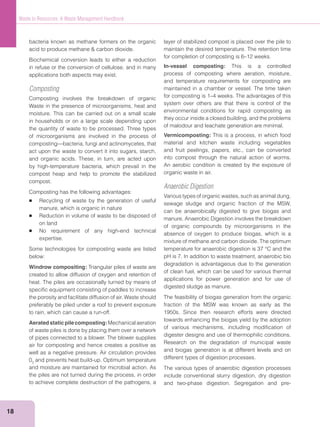
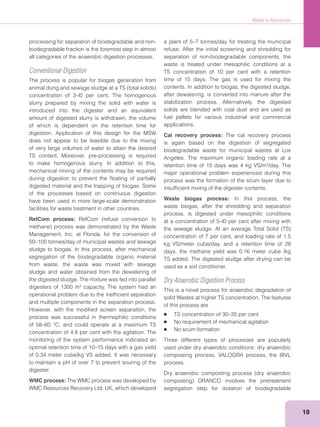
Figures 5 and 6 shows
the how energy can be recovered by incineration and
pyrolysis.
Merits
Reduction in the size of waste reduces the
problems of its dumping
Complete sterilization prevents the outbreak of
epidemics
Biologically hazardous waste is reduced to ash.
Demerits
Air pollution cannot be avoided even in highly
sophisticated plants.
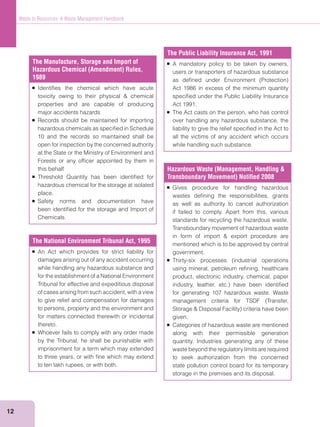
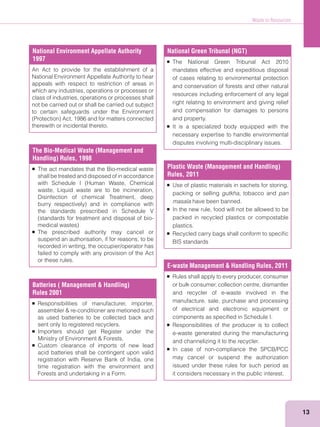
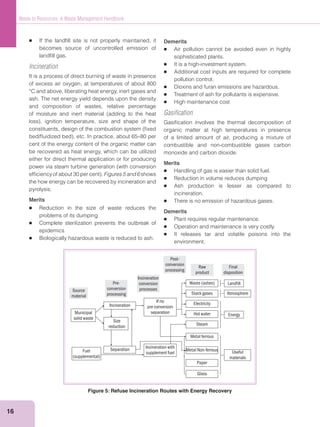
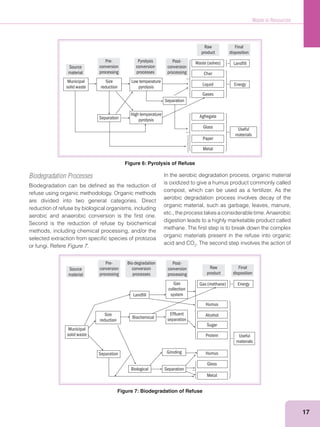
It is a high-investment system.
Additional cost inputs are required for complete
pollution control.
Dioxins and furan emissions are hazardous.
Treatment of ash for pollutants is expensive.
High maintenance cost
Gasification
Gasification involves the thermal decomposition of
organic matter at high temperatures in presence
of a limited amount of air, producing a mixture of
combustible and non-combustible gases carbon
monoxide and carbon dioxide.
Merits
Handling of gas is easier than solid fuel.
Reduction in volume reduces dumping
Ash production is lesser as compared to
incineration.
There is no emission of hazardous gases.
Demerits
Plant requires regular maintenance.
Operation and maintenance is very costly.
It releases tar and volatile poisons into the
environment.
Waste (ashes) Landfill
Energy
Stack gases Atmosphere
Useful
materials
If no
pre conversion
separation
Incineration with
supplement fuel
Size
reduction
Municipal
solid waste
Fuel
(supplemental)
Electricity
Hot water
Steam
Metal ferrous
Incineration
Separation Metal Non-ferrous
Paper
Glass
Source
material
Pre-
conversion
processing
Incineration
conversion
processes
Post-
conversion
processing
Raw
product
Final
disposition
Figure 5: Refuse Incineration Routes with Energy Recovery
Waste to Resources
17
Waste (ashes) Landfill
Energy
Char
Useful
materials
Low temperature
pyrolysis
Size
reduction
Municipal
solid waste
High temperature
pyrolysis
Liquid
Gases
Agfregate
Separation
Separation
Glass
Paper
Metal
Source
material
Pre-
conversion
processing
Pyrolysis
conversion
processes
Post-
conversion
processing
Raw
product
Final
disposition
Figure 6: Pyrolysis of Refuse
Biodegradation Processes
Biodegradation can be defined as the reduction of
refuse using organic methodology. Organic methods
are divided into two general categories. Direct
reduction of refuse by biological organisms, including
aerobic and anaerobic conversion is the first one.
Second is the reduction of refuse by biochemical
methods, including chemical processing, and/or the
selected extraction from specific species of protozoa
or fungi. Refere Figure 7.
In the aerobic degradation process, organic material
is oxidized to give a humus product commonly called
compost, which can be used as a fertilizer. As the
aerobic degradation process involves decay of the
organic material, such as garbage, leaves, manure,
etc., the process takes a considerable time. Anaerobic
digestion leads to a highly marketable product called
methane. The first step is to break down the complex
organic materials present in the refuse into organic
acid and CO2
. The second step involves the action of
Figure 7: Biodegradation of Refuse
Gas (methane) Energy
Landfill
Humus
Biochemical
SeparationBiological
Grinding
Useful
materials
Gas
collection
system
Effluent
separation
Size
reduction
Municipal
solid waste
Alcohol
Sugar
Protein
HumusSeparation
Glass
Metal
Source
material
Pre-
conversion
processing
Bio degradation
conversion
processes
Post-
conversion
processing
Raw
product
Final
disposition
18
Waste to Resources: A Waste Management Handbook
bacteria known as methane formers on the organic
Biochemical conversion leads to either a reduction
in refuse or the conversion of cellulose, and in many
applications both aspects may exist.
Composting
Composting involves the breakdown of organic
Waste in the presence of microorganisms, heat and
moisture. This can be carried out on a small scale
in households or on a large scale depending upon
the quantity of waste to be processed. Three types
of microorganisms are involved in the process of
composting—bacteria, fungi and actinomycetes, that
act upon the waste to convert it into sugars, starch,
and organic acids. These, in turn, are acted upon
by high-temperature bacteria, which prevail in the
compost heap and help to promote the stabilized
compost.
Composting has the following advantages:
Recycling of waste by the generation of useful
manure, which is organic in nature
Reduction in volume of waste to be disposed of
on land
No requirement of any high-end technical
expertise.
Some technologies for composting waste are listed
below:
Windrow compositing: Triangular piles of waste are
created to allow diffusion of oxygen and retention of
heat. The piles are occasionally turned by means of
specific equipment consisting of paddles to increase
the porosity and facilitate diffusion of air. Waste should
preferably be piled under a roof to prevent exposure
to rain, which can cause a run-off.
Aeratedstaticpilecomposting:Mechanicalaeration
of waste piles is done by placing them over a network
of pipes connected to a blower. The blower supplies
air for composting and hence creates a positive as
well as a negative pressure. Air circulation provides
02
and prevents heat build-up. Optimum temperature
and moisture are maintained for microbial action. As
the piles are not turned during the process, in order
to achieve complete destruction of the pathogens, a
layer of stabilized compost is placed over the pile to
maintain the desired temperature. The retention time
for completion of composting is 6–12 weeks.
In-vessel composting: This is a controlled
process of composting where aeration, moisture,
and temperature requirements for composting are
maintained in a chamber or vessel. The time taken
for composting is 1–4 weeks. The advantages of this
system over others are that there is control of the
environmental conditions for rapid composting as
they occur inside a closed building, and the problems
of malodour and leachate generation are minimal.
Vermicomposting: This is a process, in which food
material and kitchen waste including vegetables
and fruit peelings, papers, etc., can be converted
into compost through the natural action of worms.
An aerobic condition is created by the exposure of
organic waste in air.
Anaerobic Digestion
Various types of organic wastes, such as animal dung,
sewage sludge and organic fraction of the MSW,
can be anaerobically digested to give biogas and
manure. Anaerobic Digestion involves the breakdown
of organic compounds by microorganisms in the
absence of oxygen to produce biogas, which is a
mixture of methane and carbon dioxide. The optimum
temperature for anaerobic digestion is 37 °C and the
pH is 7. In addition to waste treatment, anaerobic bio
degradation is advantageous due to the generation
of clean fuel, which can be used for various thermal
applications for power generation and for use of
digested sludge as manure.
The feasibility of biogas generation from the organic
fraction of the MSW was known as early as the
1950s. Since then research efforts were directed
towards enhancing the biogas yield by the adoption
of various mechanisms, including modification of
digester designs and use of thermophilic conditions.
Research on the degradation of municipal waste
and biogas generation is at different levels and on
different types of digestion processes.
The various types of anaerobic digestion processes
include conventional slurry digestion, dry digestion
and two-phase digestion. Segregation and pre-
Waste to Resources
19
processing for separation of biodegradable and non-
biodegradable fraction is the foremost step in almost
all categories of the anaerobic digestion processes.
Conventional Digestion
The process is popular for biogas generation from
concentration of 3–l0 per cent. The homogenous
slurry prepared by mixing the solid with water is
introduced into the digester and an equivalent
amount of digested slurry is withdrawn, the volume
of which is dependent on the retention time for
digestion. Application of this design for the MSW
does not appear to be feasible due to the mixing
of very large volumes of water to attain the desired
TS content. Moreover, pre-processing is required
to make homogenous slurry. In addition to this,
mechanical mixing of the contents may be required
during digestion to prevent the floating of partially
digested material and the trapping of biogas. Some
of the processes based on continuous digestion
have been used in more large-scale demonstration
facilities for waste treatment in other countries.
RefCom process:
Management, Inc. at Florida, for the conversion of
50–100 tonnes/day of municipal wastes and sewage
sludge to biogas. In this process, after mechanical
segregation of the biodegradable organic material
from waste, the waste was mixed with sewage
sludge and water obtained from the dewatering of
the digested sludge. The mixture was fed into parallel
digesters of 1300 m3
capacity. The system had an
operational problem due to the inefficient separation
and multiple components in the separation process.
However, with the modified screen separation, the
process was successful in thermophilic conditions
of 58–60 °C, and could operate at a maximum TS
concentration of 4.8 per cent with the agitation. The
monitoring of the system performance indicated an
optimal retention time of 10–15 days with a gas yield
of 0.34 meter cube/kg VS added. It was necessary
to maintain a pH of over 7 to prevent souring of the
digester.
WMC process: The WMC process was developed by
WMC Resources Recovery Ltd, UK, which developed
a plant of 5–7 tonnes/day for treating the municipal
refuse. After the initial screening and shredding for
separation of non-biodegradable components, the
waste is treated under mesophilic conditions at a
TS concentration of 10 per cent with a retention
time of 15 days. The gas is used for mixing the
contents. In addition to biogas, the digested sludge,
after dewatering, is converted into manure after the
stabilization process. Alternatively, the digested
solids are blended with coal dust and are used as
fuel pellets for various industrial and commercial
applications.
Cal recovery process: The cal recovery process
is again based on the digestion of segregated
biodegradable waste for municipal wastes at Los
Angeles. The maximum organic loading rate at a
retention time of 15 days was 4 kg VS/m3
/day. The
major operational problem experienced during this
process was the formation of the scum layer due to
insufficient mixing of the digester contents.
Waste biogas process: In this process, the
waste biogas, after the shredding and separation
process, is digested under mesophilic conditions
at a concentration of 5–l0 per cent after mixing with
concentration of 7 per cent, and loading rate of 1.5
kg VS/meter cube/day, and a retention time of 28
days, the methane yield was 0.16 meter cube /kg
TS added. The digested sludge after drying can be
used as a soil conditioner.
Dry Anaerobic Digestion Process
This is a novel process for anaerobic degradation of
solid Wastes at higher TS concentration. The features
of this process are
TS concentration of 30–35 per cent
No requirement of mechanical agitation
No scum formation
Three different types of processes are popularly
used under dry anaerobic conditions: dry anaerobic
composting process, VALOGRA process, the IBVL
process.
segregation step for isolation of biodegradable
20
Waste to Resources: A Waste Management Handbook
components, which are anaerobically digested under
thermophilic conditions. After the process of digestion
at a TS concentration of 30–35 per cent, further
stabilization occurs in 2–3 days. The overall retention
time for the process is 21 days and the biogas yield is
125–180 m3
per tonnes of input. As in the continuous
process, sludge dewatering provides Water for
making up the initial TS concentration and the dried
digested sludge is used as a soil conditioner after
suitable processing to reduce the size. The compost
quality is high due to the absence of pathogens as a
result of processing at thermophilic conditions and a
high C:N ratio 15:1.
VALOGRA process This process can handle the TS
content of the slurry in the range of 35–40 per cent
with the agitation of the reactor contents by occasional
supply of biogas under a pressure of 6–7 bars.
Biogas production in this case is 4 m3
/m3
of reactor/
day, as compared to the conventional process of 1
m3
/m3
reactor per day at a retention time of 15 days
under the mesophilic conditions. The conversion
efficiency is 50 per cent and digested sludge is used
as the combustion material after further processing.
BIOCEL process: A relatively cheaper and low-
maintenance dry anaerobic system is the BIOCEL
process where the organic fraction of solid waste in
the presence of methanogenic bacteria, is allowed to
remain under a plastic cover for 6–8 weeks resulting
in methane, yield of 3750 m3
per tonnes of organic
waste. Preliminary experiments and pilot plant studies
have been carried out by adopting this process.
Two-phase Digestion
The two-phase digestion process involves the
separation of the hydrolysis, acidification and
methanation phases that occur during the anaerobic
digestion of wastes and provides the optimal
conditions for maximum efficiency in both phases.
There are three types of two-phase processes that
have been developed for solid wastes.
The Hitachi process: The Hitachi process was
developed by Hitachi Ltd.
It involves a thermochemical pretreatment process
under alkaline conditions at 60 °C and with a pH of
9.8 for 3 hours. The liquefaction step involves a high
temperature of 60 °C and an alkaline pH of 7.5 to 8.2.
The total retention time for the process is 6–8 days.
The IBVL process The IBVL process was developed
for treating organic solid Wastes, particularly agro-
based products by the Institute for Storage and
Processing of Agricultural Produce, the Netherlands.
The system involves liquefaction and acidification
reactor and a methanogenic reactor: the up-flow
reaction occurs under mesophilic condition. The
digested effluent from the methanogenic reactor
is recirculated into the liquefaction/acidification
reactor resulting in the conversion of the volatile
of methane-producing microbes in the effluent of
the UASB. During this period, the methanogenic
reactor handles the acids being produced from a
just-started liquefaction/acidification reactor. The
rate of degradation becomes constant after a period
of 10–14 days. The digested residue is subjected
to aerobic composting before being used as a soil
conditioner. [21]
Sewage and Sludge
The categorization of the sewage treatment
technologies has been done on basis of their
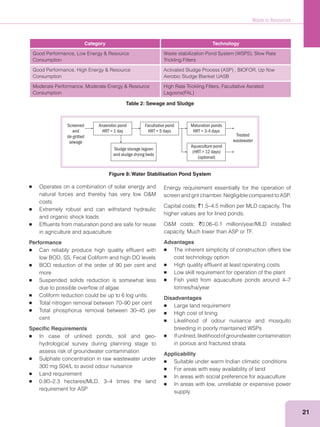
performance and cost as shown in Table 2. Waste
Trickling Filters is used where land availability is
not an issue and winter temperature is not very low.
of reliability and are used in areas with land constraint.
High Rate Trickling Filters, Facultative Aerated
wherever the category 2 technology cannot be used.
Also few technology are categorized on the basis of
marginal performance which are not widely used like
UASB system with FPU for downstream treatment.
Waste Stabilisation Pond Systems (WSPS)
Key Features of the Technology
Simple to construct, operate and maintain
Does not involve installation of expensive electro-
mechanical equipment
Waste to Resources
21
Operates on a combination of solar energy and
costs
Extremely robust and can withstand hydraulic
and organic shock loads
Effluents from maturation pond are safe for reuse
in agriculture and aquaculture
Performance
Can reliably produce high quality effluent with
low BOD, SS, Fecal Coliform and high DO levels
BOD reduction of the order of 90 per cent and
more
Suspended solids reduction is somewhat less
due to possible overflow of algae
Coliform reduction could be up to 6 log units.
Total nitrogen removal between 70–90 per cent
Total phosphorus removal between 30–45 per
cent
Specific Requirements
In case of unlined ponds, soil and geo-
hydrological survey during planning stage to
assess risk of groundwater contamination
Sulphate concentration in raw wastewater under
300 mg S04/L to avoid odour nuisance
Land requirement
0.80–2.3 hectares/MLD. 3–4 times the land
requirement for ASP
Energy requirement essentially for the operation of
screen and grit chamber. Negligible compared to ASP.
Capital costs: `1.5–4.5 million per MLD capacity. The
higher values are for lined ponds.
`0.06–0.1 million/year/MLD installed
capacity. Much lower than ASP or TF.
Advantages
The inherent simplicity of construction offers low
cost technology option
High quality effluent at least operating costs
Low skill requirement for operation of the plant
Fish yield from aquaculture ponds around 4–7
tonnes/ha/year
Disadvantages
Large land requirement
High cost of lining
Likelihood of odour nuisance and mosquito
breeding in poorly maintained WSPs
Ifunlined,likelihoodofgroundwatercontamination
in porous and fractured strata
Applicability
Suitable under warm Indian climatic conditions
For areas with easy availability of land
In areas with social preference for aquaculture
In areas with low, unreliable or expensive power
supply
Category Technology
Consumption Trickling Filters
Consumption Aerobic Sludge Blanket UASB
Consumption
High Rate Trickling Filters, Facultative Aerated
Sludge storage lagoon
and sludge drying beds
Aquaculture pond
(HRT > 12 days)
(optional)
Maturation ponds
HRT = 3-4 days
Facultative pond
HRT = 5 days
Anaerobic pond
HRT = 1 day
Screened
and
de-gritted
sewage
Treated
wastewater
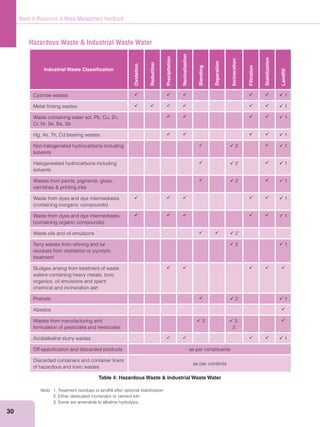
Table 2: Sewage and Sludge
Figure 8: Water Stabilisation Pond System
22
Waste to Resources: A Waste Management Handbook
Duckweed Pond System (DPS)
Key features of the technology
Natural and simple wastewater system involving
sheltered pond like culture plots
A large pond subdivided into smaller cells
through floating bamboo or other material to
break the wave and wind action
Extremely rapidly growing floating duckweed
vegetation serving as a dynamic sink for organic
carbon, dissolved nutrients and minerals
Thick mat of duckweed out-competing and
inhibiting growth of other aquatic plants
Pond functioning as a facultative lagoon with
deeper layers under anaerobic environment
Retention period in the system 7–21 days
Shallow water depths from 1.25 m up to 2 m
Continuous process requiring intensive
management for optimum production
Yield of large quantities of protein matter as fish
feed or as a supplement for animal feed
Performance: Can meet Indian discharge standards
for BOD and SS. Removal of N and P is also
substantial.
For settled wastewater, BOD and SS below 30
mg/L are attainable at 12 d detention
High nutrient and mineral removal due to uptake
by duckweeds
Specific Requirements
Primary treatment including screening, grease
trap, grit removal and sedimentation
Preferably the influent BOD, SS and ammonia
to be under 80 ppm, 100 pm and 50 ppm,
respectively
A series of smaller cells of around 10 m x 10 m to
10 m x 30 m to break the continuum in the pond
Cell borders made with floating bamboo mats or
PVC profiles to shelter from wind and wave action
Impermeable lining of clay or artificial liners in
case of pervious and fractured strata
Outlet structure with variable weir height
Nitrogen loading of around 9 kg/ha/day
Small size culture ponds for duckweed seedlings
and as fish nursery ponds
Duckweed drying and processing unit in case of
large harvest and for sale as animal feed
In case of downstream aquaculture ponds -
introduce suitable species of fishes, e.g., Grass
Carp, Common Carp, Silver Carp, Rohu, Mrigal,
Cattle and freshwater prawns
Land requirement: 2 to 6 ha/MLD for 7 to 20 days of
detention period. Comparable to WSPS.
Options
Pre-treatment comprising anaerobic pond or
primary sedimentation
In combination with aquaculture pond on
downstream to utilise duckweed as fish feed
Supplementary aeration in aquaculture ponds to
augment oxygen supply in summer season
Dos and Don’ts
Inclusion of downstream aquaculture ponds for
resource recovery and financial sustainability
Feeding only settled sewage into duckweed
ponds
Protection of the ponds against flooding
Avoid construction on porous soils, fractured
strata and on alkaline soils
Avoid duckweed ponds in cold climatic
conditions
Capital costs: Of the same order as WSP with
additional cost of floating cell material
Operation and Maintenance
Daily harvesting to ensure productivity and health
of duckweed colonies
Avoid breakage of the thick mat of duckweed to
Prevent piling up or accumulation or weed culture
on one side or the pond
Prevent toxins and extremes of pH and
temperature
Prevent crowding due to overgrowth
Prevent growth of other vegetation
Vector control measures
De-sludging of duck pond once in two years
` 0.18 million/MLD/year. More than WSPS
and UAS8. Less than ASP.
Includes: Manpower costs for maintaining the
primary treatment section, harvesting duckweed and
management of fish ponds.
Waste to Resources
23
Costs of post processing of duckweed for value
addition as a fish teed or as animal feed supplement
Advantages
Less sensitive to low temperatures, high nutrient
levels, pH fluctuations, pests and diseases
compared to other aquatic plants.
Reduced suspended solids in effluent due to
elimination of algae
Simultaneous significant nutrient removal
Easy to harvest compared to water hyacinth
Complete cover prevents breeding of mosquitoes
and odour nuisance
Yield of highly protein containing vegetative
Duckweed as an excellent feed for aquaculture
Realisation of tangible economic returns from
sale of raw or processed weed or fish to Least
Creation of a micro-enterprise with sustainable
income generation potential
Disadvantages
Low pathogen removal due to reduced light
penetration
Duckweed die off in cold weather conditions
Applicability
Low strength domestic wastewater or after
primary sedimentation with influent 800 < 80
mg/L
In combination with existing WSP
Rural and semi-urban settlements with easy land
availability
As a polishing pond for an existing activated
sludge plant or other technology based STPs
Facultative Aerated Lagoon
Key Features of the Technology
Simple flow scheme without primary or secondary
settling and sludge recirculation
Deep lagoon with anaerobic bottom layer and
aerobic top layer
Simultaneous degradation of sludge in the
bottom and dissolved organics in the top layer
Lower energy input corresponding to requirement
for maintaining only desired DO levels in the
top layer and not for creating completely mixed
conditions
Performance
As per the information in literature based on Indian
experience the following performance is expected
from a well-functioning facultative aerobic lagoon:
BOD removal 70–90 per cent
Suspended solids removal 70–80 per cent
Coliform removal 60–99 per cent
Specific Requirements
Typical hydraulic detention time of 3 days or
more
Depth between 2–5 m depending on local soil
and groundwater conditions
Effective outlet structure with baffles and stilling
basin to prevent solids overflow
Land requirement: Between 0.27 to 0.4 ha/MLD
Power requirement: 18 KWh/ML treated. Much
lower than ASP. Comparable to UASB
Options
Grit chamber as a preliminary treatment unit
Multiple cells of lagoons in series for higher
pathogen reduction
Screened
and
de-gritted
sewage
Sludge
storage
Anaerobic
pond
Fish pond
(optional)
Treated
Wastewater
For irrigation
Figure 9: Duckweed Pond Systems
24
Waste to Resources: A Waste Management Handbook
Long narrow layout of lagoon for low dispersion
coefficient
Arrangement for sludge withdrawal without the
need for emptying of lagoon
Provision of sludge storage lagoon
Dos and Don’ts
Avoid construction on porous soils and fractured
strata or provide impervious lining
Attain a balance between depth of lagoon and
number of small capacity aerators to create
two distinct zones of aerobic and anaerobic
conditions in the top and bottom layers
Capital costs: `
Operation and maintenance: Desludging of lagoon
once a year or according to the situation
Lower than ASP but higher than UASB.
Advantages
Simple operation of the plant requiring lower
skilled manpower
Minimum civil, electrical and mechanical
installation
Scheme devoid of primary and secondary
settling tanks as well as sludge digestors
Lower energy costs compared to other aerobic
processes
Disadvantages
Possibility of groundwater contamination in
porous and fractured strata
High cost of lining
Applicability
Standalone system for sewage treatment
As a pre-treatment unit for WSP
As an up-gradation option for overloaded WSPs
Activated Sludge Treatment
Key features
Proven and tested for more than 7–8 decades all
over world
Several modifications/advances possible to meet
specific requirements
Performance
Very good performance in terms of BOD and SS.
Treated effluent can most often satisfy the current
Indian effluent discharge standards. Performance is
critically dependent on sludge settling characteristics
and design of secondary clarifier. Sludge settling
characteristics are typically influenced by bio-
flocculation which in turn depends on growth rate of
microorganisms. Growth rate is generally controlled
by controlling biological solids retention time/food to
micro-organism ratio.
Specific Requirements
Un-interrupted power supply for aeration and
sludge recirculation
Maintenance of biomass concentration in the
aeration tank
Dos and Don’ts
Carefully monitor the reactor sludge levels and
sludge withdrawal
Regular painting/coating of corrosion susceptible
materials/exposed surfaces
Screened
and
de-gritted
sewage
Sludge storage
lagoon/drying bed
Facultative
aerated lagoon
Facultative pond
duckweed pond/
maturation pond
Treated
Wastewater
Maturation ponds
Optional units
Figure 10: Facultative Aerated Lagoon
Waste to Resources
25
Capital cost: The capital cost is in the range of `2–4
million per MLD capacity. Approximately 55 per cent
cost is of civil works and remaining 45 per cent is for
electrical and mechanical works
Operation and Maintenance
Careful monitoring and control of sludge quantity
in the aeration tank
Regular maintenance of aeration and recycle
system
collected from various Indian plants varies in the
range of ` 0.3–0.5 million/year/MLD installed capacity
Land Requirement: 0.15–0.25 ha/MLD installed
capacity
Energy Requirement: 180–225 Kwh/ML treated
Advantages
Performance is not significantly affected due to
normal variations in wastewater characteristics
and seasonal changes.
Less land requirements
Disadvantages
High recurring cost
High energy consumption
Performance is adversely affected due to
interruptioninpowersupplyevenforashortperiod
Foaming, particularly in winter season, may
adversely affect the oxygen transfer
Requires elaborate sludge digestion/drying/
disposal arrangement
Applicability
The most widely used option for treatment of domestic
wastewater for medium to large towns where land is
scarce.
BIOFOR (Biological, Filtration & Oxygenated
Reactor) Technology
Key Features of the Technology
Enhanced primary treatment with addition of
coagulants and flocculants
High rate primary tube settlers and integrated
thickening offering space economy
Two stage high rate filtration through a biologically
active media and with enhanced external aeration
Co-current up flow movement of wastewater and
air enable higher retention and contact
Treatment scheme excluding secondary
sedimentation but recycling of primary sludge
Deep reactors enabling lowland requirements
A compact and robust system
Performance
Suspended solids and BOD removal of 90 per
cent and 70 per cent respectively in the primary
clarifier
High quality effluent with BOD under 10 mg/L
and total system efficiency of 94–99.9 per cent
Low turbidity with suspended solids under 15
mg/L and total system efficiency of 98 per cent
Pathogen removal of 2 on the log scale
Specific requirements
Special and patented granular filter media
Backwash of BIOFOR bed and recycle of the
wastewater
Influent Aeration
tank
Returned sludge
Secondary
clarifier
Effluent
Excess sludge
Figure 11: Activated Sludge Treatment
26
Waste to Resources: A Waste Management Handbook
Energy Requirement: 220–335 kWh/ML treated.
Approximately double of ASP
Land requirement: 0.04 ha per MLD installed capacity
Much lower than ASP.
Sludge production: Thickened sludge @ 1000 kg/
3
Capital costs: `6.5–8.1 million per MLD capacity.
More than double that of ASP.
`0.86 million/year/
Advantages
Compact layout as a result of high rate processes
Higher aeration efficiency through co-current
diffused aeration system
Space saving as secondary sedimentation is
dispensed
Able to withstand fluctuations in flow rate and
organic loads
Compliance with stricter discharge standards
Effluent suitable for industrial applications, e.g.,
cooling water or ground water recharging
Effluent suitable for UV disinfection without
filtration
Absence of aerosol and odour nuisance in the
working area
Absence of corrosive gases in the area
Lower operation supervision enables lesser
manpower requirement
Disadvantages
Continuous and high chemical dosing in primary
clarification
Undigested sludge from primary clarification
requiring post treatment[22]
Sewage Screen & grit
chamber
Densadeg
reactor
Densadeg
clarifier
I II
Sludge digester
Allum Polyeleclrolyic
Sludge
Sludge drying beds
Blower
BIOFOR reactors
Treated
wastewater
Figure 12: BIOFOR Technology
Waste to Resources
27
Construction & Demolition
Construction & Demolition Waste
Types Sectors of origin Components Processes &
Technology
Construction
waste
Waste coming from maintenance
and/or construction activities of
buildings and civil infrastructure
works
mortars conglomerates,
bricks, tiles and blocks
excavation soil wood paper,
cellulose and polystyrene
Onsite or offsite
Demolition
waste
Waste coming from the
maintenance and/or from the partial
or total demolition of buildings and
civil infrastructure works
Magnetic Separation
Recycle: Onsite or off site
processing for to recover
high valuable saleable
products. Screen
Technology
Roads waste Waste coming from road
maintenance and construction works
Conglomerates and mixed
bituminous excavation soil
concrete wood metals
Landfilling: Jaw Crusher
Reuse Onsite
Excavation
soil and
rocks
Waste coming from earthworks for
the construction of civil works and/or
excavation
Excavation soil wood
Magnetic separation
Incineration
C & D waste
management modelC & D site
End use/
disposal
Waste
processing
Sorting/
storage
Recycling of Construction & Demolition Waste
Construction and Demolition Waste Management
may be defined as the discipline associated with
the proper storage, collection and transportation,
recovery and recycling, processing, reusing and
disposal in a manner that is in accord with the best
principles of human health, economic, engineering,
aesthetics and other environmental considerations.
The management approaches as shown in Table 3
are different from one country to another, as are the
levels of environmental protection. Figure 13 shows
of the Construction and Demolition management
systems are reviewed on the following basis:
Construction and Demolition waste management
includes following steps.
Storage and segregation.
Collection and transportation.
Recycling and reuse.
Disposal.
Storage and Segregation
Construction and Demolition wastes are best stored
at source, i.e., at the point of generation. If they are
scattered around or thrown on the road, they not only
cause obstruction to traffic but also add to the work
load of the local body. A proper screen should be
provided so that the waste does not get scattered
and does not become an eyesore. Segregation
can be carried out at source during Construction
and Demolition activities or can be achieved by
processing the mixed material to remove the foreign
materials. Segregation at source is most efficient
in terms of energy utilization, economics and time.
Gross segregation of Construction and Demolition
wastes into road work materials, structural building
materials, salvaged building parts and site clearance
Table 3: Construction & Demolition Waste Technology
Figure 13: C&D Waste Management Model
28
Waste to Resources: A Waste Management Handbook
waste is necessary. Additional segregation is
required to facilitate reuse/recycling of materials like
wood, glass, cabling, plastic, plaster board and so
on before demolition in order to produce recycled
aggregate that will meet the specification.
Collection and Transportation
The Construction and Demolition debris is stored
in skips. Then skip lifters fitted with hydraulic hoist
system are used for efficient and prompt removal.
In case, trailers are used, then tractors may remove
these. For handling very large volumes, front-end
loaders in combination with sturdy tipper trucks
may be used so that the time taken for loading and
unloading is kept to the minimum.
Recycling and Reuse
Construction and Demolition waste is bulky and
heavy and is mostly unsuitable for the disposal by
incineration/ composting. The growing population and
requirement of land for other uses has reduced the
availability of land for waste disposal. Reutilization or
recycling is an important strategy for management of
such waste. Apart from mounting problems of waste
management, other reasons which support adoption
of reuse/recycling strategy are reduced extraction of
raw materials, reduced transportation cost, improved
profits and reduced environmental impact. Above all,
the fast depleting reserves of conventional natural
aggregate have necessitated the use of recycling/
reuse technology, in order to be able to conserve the
conventional natural aggregate for other important
works. In the present context of increasing waste
production and growing public awareness of
environmental problems, recycled materials from
demolished concrete or masonry can be profitably
used in different ways within the building industry.
The study survey indicates the major components
of the Construction and Demolition waste stream are
excavation material, concrete, bricks and tiles, wood
and metal.
Concrete appears in two forms in the waste. Structural
elements of building have reinforced concrete, while
foundations have mass non-reinforced concrete.
Excavations produce top soil, clay, sand and gravel.
Excavation materials may be either reused as filler
at the same site after completion of work, in road
construction or in stone, gravel and sand mines, land
fill construction, structural fill in low lying areas to assist
in future development, in garden and landscaping.
Concrete and masonry constitute more than 50 per
cent of waste generated. It can be reused in block/
slab form. Recycling of this waste by converting it to
aggregate offer dual benefit of saving landfill space
and reduction in extraction of natural raw material for
new construction industry. Basic method of recycling
of concrete and masonry waste is to crush the debris
to produce a granular product of given particle
size. Plants for processing of demolition waste are
differentiated based on mobility, type of crusher and
process of separation.
The three types of available recycling plants are:
Mobile, Semi-Mobile and Stationary Plant
Mobile Plant: In the mobile plant, the material is
crushed and screened and ferrous impurities are
separated through magnetic separation. The material
is transported to the demolition site itself and is
suited to process only non-contaminated concrete or
masonry waste. Refer Figure 14.
Semi-Mobile Plant: In the semi-mobile plant, removal
of contaminants is carried out by hand and in the
end product is also screened. Magnetic separation
for removal of ferrous material is carried out. End
product quality is better than that of a mobile plant.
Above plants are not capable to process a source of
mixed demolishing waste containing foreign matter
like metal, wood, plastic, etc.
Stationary plants are equipped for carrying out
crushing, screening as well as purification to separate
the contaminants. Issues necessary to be considered
forerectionofstationaryplantsare:plantlocation,road
infrastructure, availability of land space, provision
of Weigh Bridge, provision for storage area, etc.
Different types of crushers are used in recycling plant
namely jaw-crusher, impact crusher, impeller-impact
crusher.
Applications of C&D Waste
Recycled aggregate can be used as general bulk
fill, sub-base material in road construction, canal
lining, playground, fills in drainage projects and
for making new concrete to less extent. While
Waste to Resources
29
using recycled aggregate for filler application,
care must be taken that it is free of contaminants
to avoid risk of ground water pollution use of
recycled aggregate are sub-base for road
construction is widely accepted in most of countries.
Bricks and masonry arise as waste during demolition.
These are generally mixed with cement, mortar or
lime. It is used in the construction of road base and
drayage layer, and mechanical soil stabilizers due to
its inertness after crushing and separation.
Tile materials recycling are almost identical to bricks.
Tile is often mixed with brick in final recycled product.
Metal waste is generated during demolition in the form
ofpipes,lightsheetmaterialusedinventilationsystem,
wires and sanitary fittings and as reinforcement in the
concrete. Metals are recovered and recycled by re-
melting. The metals involved onsite separation by
manual sorting or magnetic sorting. Aluminium can
be recovered without contamination, the material can
be directly sold to a recycler.
Wood recovered in good condition from beams,
window frames, doors, partitions and other fittings is
reused. However, wood used in construction is often
treated with chemicals to prevent termite infestation
and warrants special care during disposal other
problems associated to wood waste are inclusion
of jointing, nails, screws and fixings. In fact, wood
wastes have a high market value for special reuses
wood can be recycled/burned for energy recovery.
Scrap wood is shredded in-site/in a centralized plant.
Shredded wood is magnetically sorted for scrap
metal. Wood chips are stored so as to remain dry and
can be used as fuel. Also, it is used in the production
of various press boards and fiber boards and used
for animal bedding. Bituminous material arises from
road construction, breaking and digging of roads
for services and utilities. Recycling of Bituminous
material can be carried out by hot or cold mixing
techniques either at location or at a central asphalt
mixing plant it offers benefits like saving in use of
asphalt, saving of energy, reduction in aggregate
requirement, etc. Other miscellanies materials that
arise as waste include glass, plastic, paper, etc., can
be recovered and reused.
Disposal
not create chemical or bio-chemical pollution. Hence
maximum effort should make to reuse and recycle
them as explained above. The material can be used for
filling/leveling of low-lying areas. In the industrialized
countries, special landfills are sometimes created for
inert waste, which are normally located in abandoned
mines and quarries. [10]
Mobile plant
Demolition
Pre-sieve
Ferrous
RC building material
& mineral mix
RC building
material
Sieving
machine
Sieving
machine
Impact
crusher
Overhead magnet
Figure 14: Mobile Plant
30
Waste to Resources: A Waste Management Handbook
Note: 1. Treatment residues to landfill after optional stabilization
2. Either dedicated incinerator or cement kiln
3. Some are amenable to alkaline hydrolysis.
Hazardous Waste & Industrial Waste Water
Industrial Waste Classification
Oxidation
Reduction
Precipitation
Neutralization
Blending
Separation
Incineration
Filtration
Stabilization
Landfill
Cyanide wastes 1
Metal finsing wastes 1
Cr, Ni, Se, Ba, Sb
1
Hg, As, Th, Cd bearing wastes 1
Non-halogenated hydrocarbons including
solvents
2 1
Halogeneated hydrocarbons including
solvents
2 1
Wastes from paints, pigments, glues, 2 1
Waste from dyes and dye intermediates 1
Waste oils and oil emulsions 2
Tarry wastes from refining and tar
residues from distillation or pyrolytic
treatment
2 1
Sludges arising from treatment of waste
waters containing heavy metals, toxic
organics, oil emulsions and spent
chemical and incineration ash
Phenols 2 1
Absetos
Wastes from manufacturing and
formulation of pesticides and herbicides
3 3,
2
Acid/alkaline slurry wastes 1
Off-specification and discarded products as per constituents
Discarded containers and container liners
of hazardous and toxic wastes
as per contents
Table 4: Hazardous Waste & Industrial Waste Water
Waste to Resources
31
Source: http://water.me.vccs.edu/courses/env108/lesson1_2.htm
Picture 2: Sludge Treatment
Industrial
Waste
Water
Technology/ Processes
Primary Treatment for
Solid Removal
Screening, Grit
Chamber
Secondary Treatment
for BOD Removal
Biological
Digestion
Process
Tertiary Treatment
for Meeting
Specific Discharge
Requirement
Coagulation,
Oxidation,
Sedimentation
Primary Treatment helps in removing 90–95 per
cent settable solids and 50–65 per cent suspended
Solids. Removable of Soluble particles is done by
Secondary Treatment. Refer Picture 2 and Table 5.
These soluble particles are mostly organic loads like
Coagulation that neutralizes repulsive forces between
the particles is used as tertiary treatment for meeting
specific discharge limits as set by pollution control
board.
Oxidation Processes
May destroy certain compounds and constituents
through oxidation and reduction reactions.
Advanced oxidation is chemical oxidation with
hydroxyl radicals, which are very reactive, and short-
lived. The radicals need to be produced on site, in a
reactor where the radicals can contact the organics in
the wastewater. Hydroxyl radicals may be produced
in systems using: ultraviolet radiation/hydrogen
peroxide, ozone/hydrogen peroxide, ultraviolet
radiation and through other means.
Advantages
Takes care of contaminants with fast reaction
rates
Potential to reduce toxicity and possibly complete
mineralization of organics treated
Reactions do not produce excess materials like
“spent carbon” or chemical sludge
Non-selective process can take care of wide
range of organics
Used to floc and disinfect portable water
preferablybetterthanchlorinebecauseitdoesnot
The combination of ozone and UV is good for
colour, bacteria, odor, viruses, iron and microbial
growth
EPA is trying to replace chlorine with Ozone as
chlorine is linked to cancer
Table 5: Industrial Waste Water
32
Waste to Resources: A Waste Management Handbook
Limitations
Expensive
Chemistry of this process must target specific
types of contaminants
Can demand large amounts of peroxide
Tampering with this process can lead reduction
ThecombinationofozoneandUVdoesnotsolveall
waterproblems,theydontremoveleadorcalcium.
The process only removes organic material.
Reduction/Oxidation
Redox reactions chemically convert hazardous
contaminants to nonhazardous or less toxic
compounds that are more stable, less mobile and/
or inert. Redox reactions involve the transfer of
electrons from one compound to another. Specifically,
most commonly used for treatment of hazardous
contaminants are ozone, hydrogen peroxide,
hypochlorite, chlorine and chlorine dioxide. Chemical
reduction/oxidation is a short-to-medium-term
technology.
Chemical redox is a full-scale, well-established
technology used for disinfection of drinking water
and wastewater, and it is a common treatment for
systems are now being used more frequently to treat
hazardous wastes in soils.
The target contaminant group for chemical redox is
inorganics. The technology can be used but may be
less effective against non-halogenated VOCs and
SVOCs, fuel hydrocarbons and pesticides. Chemical
redox is commercial technology used for disinfection
of drinking water and wastewater. It is a common
Limitations
Factors that may limit the applicability and
effectiveness of the process include:
Incomplete oxidation or formation of intermediate
contaminants may occur depending upon the
contaminants and oxidizing agents used.
The process is not cost-effective for high
contaminant concentrations because of the large
amounts of oxidizing agent required.
Oil and grease in the media should be minimized
to optimize process efficiency.
Chemical Precipitation
Metals do not degrade in the environment. Chemical
precipitation is a widely used, proven technology
for the removal of metals and other inorganics,
suspended solids, fats, oils, greases and some other
from wastewater. The ionic metals are converted to
between the soluble metal compounds and the
precipitating reagent. The particles formed by this
reaction are removed from solution by settling and/
or filtration.
The effectiveness of a chemical precipitation process
is dependent on several factors, including the
type and concentration of ionic metals present in
solution, the precipitant used, the reaction conditions
of other constituents that may inhibit the precipitation
reaction.
The specific approach used for precipitation will
depend on the contaminants to be removed be it
metal removal, removal of fats, oils and greases,
suspended solids, phosphorus removal.
Before deciding whether chemical precipitation
meets the needs of a municipality, it is important to
understand the advantages and disadvantages of
this methodology.
Advantages
Chemical precipitation is a well-established
technology with ready availability of equipment
and many chemicals.
Some treatment chemicals, especially lime, are
very inexpensive.
Completely enclosed systems are often
conveniently self-operating and low maintenance,
requiring only replenishment of the chemicals
used. Often times, a sophisticated operator is not
needed.
Waste to Resources
33
Disadvantages
Competing reactions, varying levels of alkalinity
and other factors typically make calculation of
proper chemical dosages impossible. Therefore,
frequent jar tests are necessary for confirmation
of optimal treatment conditions. Overdosing can
diminish the effectiveness of the treatment.
Chemical precipitation may require working with
corrosive chemicals, increasing operator safety
concerns.
The addition of treatment chemicals, especially
lime, may increase the volume of waste sludge
up to 50 per cent.
Large amounts of chemicals may need to be
transported to the treatment location.
Polymers can be expensive.
The purpose of neutralization is to adjust the pH value
to meet the requirements of the different processing
units in the waste water treatment system.
Neutralization
May be used in order to treat acid wastewaters
containing metals, the method comprising increasing
the pH of the acid waste by addition of an alkaline
reagent, to form a precipitate and collecting the
precipitate. This way the incoming solution is pH
adjusted to the optimum range for precipitating
metals as hydroxides.
Blending
The waste-derived fuel is burned in related cement
kilns. This fuel blending and thermal destruction
process safely rids the environment of hazardous
waste. It conserves non-renewable natural resources
and fossil fuels by recovering the energy value from
the waste.
Bioremediation
Uses Advanced Bio-Technology for Industrial
Wastewater Treatment. The use of microbes or
bacteria to naturally consume oils and other
contaminants in wastewater breaking them down into
harmless CO2
and H2
O.
Advantages
All-natural, very environmentally friendly.
Disadvantages
The waste stream needs dwell time as well as a
constant organic food source, such as grass clippings
or emulsified oils, to feed the microbes. This imposes
limits to the volume of water that can be treated.
Filtration
Filtration techniques are used for very specific
applications in the field of industrial waste water
treatment. The three main types of membrane-
based filtration technologies include reverse
osmosis, nanofiltration and ultrafiltration. Although
categorized as different technologies, the three types
of membrane filtration have a great deal in common.
All three act as membranes created by coating a
thin layer of a very porous polymer, or plastic, onto a
backing material. The end result is the finest form of
filtration presently known, with reverse osmosis being
the smallest, nanofiltration being a slight step larger
and ultrafiltration being a bit larger again.
Advantages
Material reliability
Less chemicals required
Relatively simple follow-up, once the installation
is correctly set
Efficient use of energy
No change in state of aggregation necessary
Disadvantages
High purchase price of the membranes
collected or further treated
Mechanical Filtration
This is a process in which contaminants in a waste
stream are filtered or screened out. This method is
effective in preventing particles, even very tiny ones
like mud and sludge, from moving downstream. The
downside is that solids build up on the filtering media
and restrict the water flow requiring some type of
maintenance, such as purging or backwashing. Also,
mechanical filtration is not an effective method for
dealing with emulsified oils.
34
Waste to Resources: A Waste Management Handbook
media filters. A description of each along with the
pros and cons is as follows:
Indexing Paper Filters: A very fine paper filter
continuously unrolls while the waste stream flows
through the paper filter.
Advantages
the waste stream.
Disadvantages
Solids plug up the paper quickly requiring you to use
dispose of the contaminated paper safely.
Cartridge Filters is placed inside a canister or
enclosed tank.
Advantages
Provides excellent filtration even down to 5 microns
in size.
Disadvantages
As with indexing paper filters, they can plug quickly
and, depending on the dirt load, must be removed
often to clean or replace.
Media Filters: Other media, like sand or carbon, are
used to filter contaminants in the water.
Advantages
It provides reasonable removal of solids without
plugging up.
Disadvantages
It requires regular maintenance such as backwashing.
Oil-water separation: Oil-water separation is a
process that enhances the natural separation of oil
from water so the oil floats on the surface of the water.
Advantages
It effectively removes or skims “free” oils from the
water surface.
Disadvantages
It is not effective in removing emulsified oils that
are often trapped within the water molecules by
detergents or other cleaning agents.
Wastewater Evaporation
Like a pan of water on the stove, wastewater
subjected to heat is evaporated leaving the pollutants
to be skimmed off or disposed of as sludge. It
short, wastewater evaporators safely and naturally
eliminates the water portion of a waste stream leaving
behind only the gunk—usually about 5–10 per cent of
the total volume—to dispose of.
The technology use in wastewater evaporators is
systems with both technologies.
Advantages
a fraction left to dispose of.
Disadvantages
It still requires disposal of hazardous wastes plus
heating fuel costs can be expensive.
Electro-coagulation
This is a very effective process that removes
suspended solids, emulsified oils and heavy
metals from wastewater. Electro-coagulation uses
low-voltage DC current to effectively neutralize
the charges of the contaminants allowing them to
coagulate and separate from the waste stream.
Uses advanced electro-coagulation combined with
chemical flocculation to enhance and speed up the
process of removing constituents from waste water.
Advantages
When combined with other technologies, it produces
exceptional water quality with very little maintenance.
It successfully treats a very broad range of waste
streams and requires very little maintenance.
Disadvantages
Only a few manufacturers of environmental systems
truly understand this process and even fewer
know how to combine it with other water treatment
technologies.[23]
Waste to Resources
35
E-Waste – Technology Fact Sheet
Level 1 Output Level 2 Sub-level 2 Output Level 3 Output
E-waste
Decontamination,
Dismantling,
Segregation
Segregated
hazardous
wastes like
CFC, Hg,
Switches,
bateries and
capacitors
Hammering,
Shredding, CRT,
Electromagnetic
separation,
Eddy current
separation
Density
separation
Density Media
Sparation
Cyclone
Process
Sorted
Plastic
Chemical/
Thermal
Process
Recycling,
Incineration
Plastic
Product,
Energy
Recovery
Segregated
non-
hazardous
E-waste like
plastic, CRT,
circuit board
and cables
Splitting
technology
Thermal shcok,
NiChrome hot
wire cutting,
Laser cutting,
eddy current
separation
nonferrous
metal scrap,
Sorted
plastic,
Glass
fraction,
Lead
Breaking,
Recycling,
Separation
and
Distillation
Copper/
Aluminium,
Iron, Glass
Cullet
Dismantling
Pulverization/
Hammering,
Density
separation
using water
Nonferrous
metal scrap,
Lead,
Mercury, Oil
Separation
and
Distillation
Oil
recovery/
energy,
Copper/
Aluminium,
Iron
Refriger
ators/fire
Capictors
Batteries
Hg
switches
Other
CFCs, oil
CFC
Waste
ferrous
metal
non-
ferrous
precious
metal
sorted
plastic
plastic
mixture
plastic
with
glass
fraction
steel/iron
recycling
smelting
plants
separation recycling energy
recovery
incineration/
landfill
glass Pb
Other
white
Other
WEEE
Computer
PC
TV,
monitor
Disposal (landfill, incineration)
Dismantling
- components for reuse/recycling
- components with dangerous substances
Disposal/recycling
plastics Circuit
boards
CRT cabels
Special treatment processesShredder/DismantlingShredderDisposal
First level treatment
Second level
treatment
Third level
treatment'FR = flame retardant
CFC=chloroflucrecarbon
Source:
quantities, dangerous substances and treatment methods”, EEA Copenhagen, 2003
Table 6
Figure 15: E-waste treatment
36
Waste to Resources: A Waste Management Handbook
E-waste treatment technologies are used at the
following three levels:
1st level treatment
2nd level treatment
3rd level treatment
All the three levels of e-waste treatment are based
on material flow. The material flows from 1st level to
3rd level treatment. Each level treatment consists of
unit operations, where e-waste is treated and output
of 1st level treatment serves as input to 2nd level
treatment. After the third level treatment, the residues
are disposed of either in TSDF or incinerated. The
efficiency of operations at first and second level
determines the quantity of residues going to TSDF or
incineration.
1st Level Treatment
Unit operations operations at first level of e-waste
treatment are:
	 Decontamination: Removal of all liquids and
Gases
Dismantling: manual/mechanized breaking
Segregation
2nd Level Treatment
Unit operation at second level of e-waste treatment
Hammering
Shredding
Special treatment Processes comprising of
funnels and screen glass
Hammering and shredding objective is size reduction.
The third unit operation consists of special treatment
processes. Electromagnetic and eddy current
separation utilizes properties of different elements
like electrical conductivity, magnetic properties and
density to separate ferrous, nonferrous metal and
precious metal fractions.
CRT segregated after first level WEEE/ E-waste
treatment. Refer Figure 16(a) & (b). CRT is manually
removed from plastic/ wooden casing. De-
pressurization and Splitting: Picture tube is split and
the funnel section is then lifted off the screen section
and the internal metal mask can be lifted to facilitate
internal phosphor coating. Different types of splitting
technology used are given below:
NiChrome hot wire cutting: A NiChrome wire or
ribbon is wrapped round a CRT and electrically
heated for at least 30 seconds to causes a
thermal differential across the thickness of the
results in a crack. When this is lightly tapped, the
screen separates from the funnel section.
Thermal shock: The CRT tube is subjected to
localized heat followed by cold air. This creates
stress at the frit line where the leaded funnel
glass is joined to the unleaded panel glass and
the tube comes apart.
Laser cutting: A laser beam is focused inside and
this heats up the glass. It is immediately followed
by a cold water spray that cools the surface of
the glass and causes it to crack along the cut
line.
Diamond wire method: In this method, a wire with
a very small diameter, which is embedded with
Neck glass
cut
Panel Acid clean
(HF)
Acid clean
HNO of tube with
funnel and panel
3
Acid clean
(HF)
Funnel separation (thermal)
shock nichrome hot wire
cutting/laser/diamond wire/
diomand saw/waterijet
Effluent Effluent
Funnel
Funnel glass
CRT
Panel
glass
Figure 16(a): CRT treatment options used in India
Waste to Resources
37
Figure 16(b): Process flow diagram for recycling of
CRTs
Collection
Remove case
Depressurization
Cullet
Furnace
Saw/shredder Shredder
Cleaning
Metals, plastics
Figure 17: Mixed Plastic
Chemical
recycling
Refinery or
metal smelter
New raw
material
Mechanical
recycling
Shredding
Pelltized &
new products
Mixed plastic
Thermal
recycling
Power generator
cement kiln
Alternative
fuel
industrial diamond is used to cut the glass as the
CRT is passed through the cutting plane.
Diamond saw separation: Diamond saw
separation uses either wet or dry process. Wet
saw separation involves rotating the CRT in an
enclosure while one or more saw blades cut
through the CRT around its entire circumference.
Coolant is sprayed on to the surface of the saw
blades as they cut. This is to control temperature
and prevent warping.
Water-jet separation: This technology uses a
high-pressure spray of water containing abrasive,
directed at the surface to be cut. The water is
focused through a single or double nozzle-
spraying configuration set at a specific distance.
3rd Level Treatment
The 3rd level E-waste treatment is carried out mainly
to recover ferrous, nonferrous metals, plastics and
other items of economic value.
Plastic Recycling
There are three different types of plastic recycling
options, i.e., chemical recycling, mechanical
recycling and thermal recycling. Refer Figure 17.
In chemical recycling process, waste plastics are
used as raw materials for petrochemical processes
or as reluctant in a metal smelter. In mechanical
recycling process, shredding and identification
process is used to make new plastic product. In
thermal recycling process, plastics are used as
alternative fuel.
The two major types of plastic resins, which are used
in electronics, are “thermosets” and “thermoplastics”.
Thermosets are shredded and recycled because they
cannot be re-melted and formed into new products,
while thermoplastics can be re-melted and formed
into new products.
Mechanical Recycling Process
Contaminated plastic such laminated or painted
plastic are removed by are grinding, cryogenic
method, abrasion/abrasive technique, solvent
stripping method and high temperature aqueous
based paint removal method. Magnetic separators
are used for ferrous metals separation, while eddy
current separators are used for nonferrous metals
separation. Air separation system is used to separate
light fractions such as paper, labels and films. Resin
identification can be carried out by using a number
of techniques like turboelectric separator, high speed
accelerator and X-ray fluorescence spectroscopy. In
hydro cyclones separation technique, plastic fractions
are separated using density separation technique,
which is made more effective by enhancing material
wettability. In turboelectric separation technique,
plastic resins are separated on the basis of surface
charge transfer phenomena.
38
Waste to Resources: A Waste Management Handbook
Equipment used in second level WEEE/E-waste treatment
Shredder
For size reduction into a size enabling the majority of the ferrous material
to be separated from the non-ferous/insulation and plastic fraction
Eddy Current Separator 1
For separation of the heavy mixed metal fraction
Heavy Pre-Granulator
For size reduction of the material prior to separation in the Eddy Current
Separator 2
Eddy Current Separator 2
For separation of the light mixed metal fraction
Heavy Granulaor
For final size reduction of the material
Sepration Table
fraction and a mixed metal fraction
Waste to Resources
39
calorific value, which is equivalent to or greater than
coal, they can be combusted to produce heat energy
in cement kilns. APME has found thermal recycling of
plastic as the most environmentally sound option for
managing WEEE/ E-waste plastic fraction.
Metals Recycling
Metals recycling has been described below in terms of
lead recycling, copper recycling and precious metals
recycling. After sorting of metal fractions at second
level WEEE/E-waste treatment, they are sent to metal
recovery facilities. These metal recovery facilities use
the following processes to recover metals.
Lead Recovery
Reverberatory furnace and blast furnace are used
to recover lead from WEEE/ E-waste fraction. Refer
Figure 19. The process is shown in figure and involves
the following steps:
A reverberatory furnace is charged with lead
containing materials and reductants. In this
furnace, the reduction of lead compounds is
carried out to produce lead bullion and slag.
Lead bullion is 99.9 per cent while slag contains
lead product.
Slag in reverberatory furnace is continuously
tapped onto a slag caster. It consists of a thin,
Mixed
plastics
Depolymerization
< 400 °C
Hydrogenation 1
(liquid phase)
Hydrogenation
bitumen
Hydrogenation 2
(gas phase)
Petrochemical
processes
Metals HCL
Condensation
H
< 100 bar
2
<450 °C
Synerude Gas
Figure 18: De-polymerization of plastics and
conversion processes
Chemical Recycling Process
Chemical recycling process is shown in figure. This
process was developed by the Association of Plastic
Figure 18.
The different steps in this process are given below.
Mixed plastic waste is first de-polymerized at
In hydrogenation unit 1, the remaining polymer
chains from depolymerized unit are cracked
at temperatures between 350–400 °C and
hydrogenated at pressure greater than 100
bar. After hydrogenation, the liquid product is
subjected to distillation and left over inert material
is collected in the bottom of distillation column as
residue, hydrogenation bitumen.
In hydrogenation unit 2, high quality products
like off gas and sync rude are obtained by
hydro-treatment, which are sent to petrochemical
process.
Thermal Recycling Process
In thermal recycling process, plastics are used as
fuel for energy recovery. Since plastics have high
Figure 19: Processes flow for secondary lead
recovery
Preteatment
Reverberatory
furnace
Blast furnace
Hard Pb
Relining
Soft Pb
(99.98% Pb)
Reductant
SlagReductant
75–85% Pb
40
Waste to Resources: A Waste Management Handbook
fluid layer on top of the heavier lead layer in the
furnace.
Lead bullion is tapped from the furnace when the
metal level builds up to a height that only small
amounts of lead appear in the slag.
Lead is recovered from the slag by charging it
in blast furnace along with other lead containing
materials and fluxing agents like iron and
limestone.
Hard lead is recovered from the blast furnace.
Flue gas emissions from reverberatory furnace
are collected by bag house and feedback into
the furnace to recover lead. Slag from blast
furnace is disposed of in hazardous waste landfill
sites.
Precious Metals Recovery
It involves the steps shown in the flow chart. The
anode slime recovered from copper electrolytic
process shown in figure is used for precious metal
recovery. Refer Figure 20. The process involves the
following steps.
Anode slime is leached by pressure.
The leached residue is then dried and, after the
addition of fluxes, smelted in a precious metals
furnace. Selenium is recovered during smelting.
The remaining material from smelter is caste into
anode and undergoes electrolysis to form high-
purity silver cathode and anode gold slime.
The anode gold slime is further leached and high
purity gold, palladium and platinum sludge are
recovered.
Integrated Solid Waste Management
the strategic approach to sustainable management
of solid wastes covering all sources and all aspects
such as generation, segregation, transfer, sorting,
treatment, recovery and disposal in an integrated
manner, with an emphasis on maximizing resource use
efficiency. An effective ISWM system considers how
to prevent, recycle and manage solid waste in ways
that most effectively protect human health and the
environment. ISWM involves evaluating local needs
and conditions, and then selecting and combining
the most appropriate waste management activities
for those conditions. The major ISWM activities are
waste prevention, recycling and composting, and
combustion and disposal in properly designed,
constructed, and managed landfills.
The selection of the most appropriate waste
management systems and sustainable technologies
is also needed to deliver an optimum and sustainable
ISWM system. In combination with economic and
social considerations, this approach would help
waste managers to design more sustainable solid
waste management systems.
Thus, for the management of solid waste, the following
is the preferred hierarchy of approaches
Reduction at source: meaning incorporation of
the tenets of waste management at every stage
of consumption from design, manufacture,
purchase, or use of materials to reduce the
amount or toxicity of waste generated.
Environmentally suitable reuse and recycling:
to conserve natural resources and energy
through systematic segregation, collection and
reprocessing.
ISWM concept has to be adapted with a view that
effective management schemes need the flexibility
Silver electrolytic refining
Smelter
Leach
Copper anode slime
Silver Anode slime
Gold, platinum
palladium
Figure 20: Precious metals recovery process
Waste to Resources
41
Complexity, costs and
coordination of waste
management has
necessitated multi-
stakeholder involvement
in every stage of the waste
stream. This calls for an
integrated approach to
waste management.
There is a growing realization
of the negative impacts that
wastes have had on the local
environment (air, water, land,
human health, etc.)
Cities are facing an increasing
growth in population,and
shares in GDP growth,
resulting in among other
things increasing quantities
of waste being generated.
Due to changing lifestyles
and consumption pattern, the
quantity of waste generated
has increased with quality
andcompositionof waste
becoming more varied and
changing.
Industrialization and economic
growth has produced more
amounts of waste, including
hazardous and toxic wastes.
Local governments are
now looking at waste as a
business opportunity,
(a) to extract valuable
resources contained within
it that can still be used
(b) to safely process and
dispose wastes with a
minimum impact on the
environment.
Integrated
Solid Waste
Management
Need for Integrated Solid Waste Management
Concept of Integrated Solid Waste Management
Reuse
disposal &
treatment
Transportation
Decentralized
treatment
Collection
Recycle
and
reuse
MSW
E-waste
C&D
waste
Hazardous
waste
Bio-medical
waste
Generation
Segregation
SOCIAL
ENVIRONMENTAL
of design, adaptation and systems which can best
meet current social, economic and environmental
conditions. These are likely to change over time and
vary by location.
ISWM with respect to three perspectives are lifecycle,
waste generation and waste management.
42
Waste to Resources: A Waste Management Handbook
Natural resources
recycled resources
Consumption
(products & services)
Discarding
(products/waste)
Proper treatment
and recovery
Integrated
solid waste
management
Reduction
Reduction
Proper disposal
Treatment
Final disposal
Production
Material
recycling
Direct
consumption
Directly
recycled
resources
Sustainable
consumption
Reuse
Figure 21: Lifecycle-based Integrated Solid Waste Management
Life-cycle Based Integrated Solid Waste
Management
The first concept of ISWM is based on lifecycle
assessment of a product from its production
and consumption point of view. The reduction in
consumption, and utilization of discarded products
within the production system as a substitute for new
resources, can lead to reduced end-of-cycle waste
generation; thus, less efforts and resources would be
required for the final disposal of the waste.
Generation-based Integrated
Solid Waste Management
The second concept of ISWM is based on its
generation from different sources including domestic,
commercial, industrial and agriculture. This waste
could be further classified as hazardous and non-
hazardous waste. The former has to be segregated
at source and treated for disposal in accordance with
at the different levels of solid waste management
chain including collection, transportation, treatment
and disposal.
Management-based Integrated Solid Waste
Management
ThethirdconceptofISWMisbasedonitsmanagement
which includes regulations and laws, institutions,
financial mechanisms, technology and infrastructure,
and role of various stakeholders in the solid waste
management chain.
Benefits of Integrated Solid Waste Management
Cleaner and safe neighbourhoods
Savings in waste management costs due to
reduced levels of final waste for disposal.
Holistic approach to all waste streams thus
maximizing synergetic benefits in collection,
Maximize the opportunities for resource recovery
at all stages—from generation to final disposal
Accommodate aspirations of all stakeholders—
from waste generators to waste management
and service providers
Facilitate life-cycle view of products and
materials; thus, promoting greater resource use
efficiency
Integrate different response functions such as
technical, managerial, financial, policy, etc.
Waste to Resources
43
Figure 22: Generation-based Integrated Solid Waste Management
Figure 23: Management-based Integrated Solid Waste Management
3R 3R 3R
Residential
Energy
Resources
Treatment
recovery
final waste
Collection of waste
segregation of waste
recycling waste
(organic & inorganic)
waste exchange
discarded waste
Final disposal
Methane & heat
Sanitary landfill,
incineration
Plastics, wood, steel,
paper, glass, and
compost/biogas
Hazardous waste for
treatment & disposal
Industrial &
commercial
Services
(healthcare, laboratory, etc.)
Waste generators
(residents,
industries & services)
Waste generation
Technological
innovations &
development
Government
(local and national
government
departments)
Collection,
transportation &
segregation
Treatment &
final disposal
Recycling,
composting
and energy
Businesses
(to generate
compost, energy,
and recycling
materials/products
SWM service providers
(collection, segregation,
transportation of recycling
and non-recycling waste,
treatment (sanitary landfill
& incineratrion) and disposal
Waste disposal
regulations
Effective regulations &
financial mechanisms
for generators, service
providers & businesses
Technological innovations
efficiency and efficacy
3R
participation through a consultative approach
ISWM Plan
The objective of the ISWM plan is to develop waste
management approach covering MSW, Biomedical,
all the aspects of ISWM chain including collection,
segregation, transportation, recycling, treatment and
disposal.
An ISWM Plan per se is a package consisting of a
Management System including:
44
Waste to Resources: A Waste Management Handbook
Management System covers all aspects of waste
management from waste generation through
collection, transfer, transportation, sorting, treatment
and disposal. Data and information on waste
management system for operational stages provide
the basis for developing a concrete and locality-
specific management system.
Elements of ISWM Plan
Baseline data on waste characterization and
quantification with future trends and baseline
data on prevailing waste management systems
and gaps therein.
	 A list of targets to be achieved through the ISWM
System.
	 A Plan with details of the Management System
measures
	 Implementation Aspects such as time schedules,
costs, institutional requirements, etc.
	 Monitoring and feedback mechanism.
Steps for ISWM Plan
Targets are set for each operational level
sorting and material recovery, treatment and
coverage and efficiency of services, as well as
for efficiency of efforts and management system.
Identification of technical, socioeconomic and
policy constraints—which should be kept in
mind when designing the elements of an ISWM
System.
Identifying the issues of concerns of the
stakeholders: financial, social, technical and
environmental—which are consider as very
important to be addressed while designing the
ISWM system.
Designing the elements of the ISWM System—
economic viability and implementability.
Developing an implementation strategy
including financing strategy, human resources,
Developing a monitoring and feedback system
for periodic feedback to improve the ISWM
system and its implementation or to modify the
targets.
Developing detailed schemes based on strategic
action plan.
Source: UNEP
Waste characterization
& quantification
future trends
Integrated Solid Waste Management (ISWM) plan
(management system including technical, policy
& voluntary aspects
Prevailing solid waste
management system &
gaps therein
Constraints &
stakeholders concerns
Targets for
ISWM
1
2 4
3
Outline of ISWM Plan
Case Studies
Waste to Resources
47
Company Profile
Mahindra Reva Electric Vehicles Private Limited, formerly known as the Reva Electric Car Company, is an
Indian company based in Bangalore, involved in designing and manufacturing of compact electric vehicles.
Business Challenge as Opportunity
Mahindra Reva strives to manage and reduce waste material generated by the plant, which would in turn cut
amount of waste within the plant premises by segregating waste material into categories, handling scrap
through proper identification, recycling and reusing leading to cost benefits and also management hazardous
waste material with care to protect environment from pollution and degradation.
Strategy Employed
Devising the Intervention
Mahindra Reva strives to align all processes and resources with proper handling of waste, thereby effectively
reducing all forms of waste in everyday function through the medium of various waste management initiatives.
The major intervention were:
non-bio degradable, metallic and hazardous wastes.
Reduction of Industrial Waste
Generation by Proper Handling and
Management of Waste Materials
Site of the Intervention
Bommasandra Industrial Area, MREVA
Manufacturing Plant
Type of Intervention
Industry
Automobile
48
Waste to Resources: A Waste Management Handbook
Intervention Description & Business Case
Segregation of Waste Materials for Efficient Waste Management
With the help of segregation different types of wastes are categorised and managed differently. Also, proper
identification of scrap, made documentation became easier. Recycled materials used reduces the cost
during construction.
The cost incurred through the course of intervention is `15,42,000 and financial savings of `1,54,200 were
accrued over a period of two years. Disposal of waste through approved waste disposal agencies helped
in reducing the impact on the surrounding environment by preventing toxic wastes from the plant from
contaminating the surrounding water bodies and endangering aquatic life.
For more information, please contact:
Chandrahasa, Mahindra Reva
Jaganur Sangamesha, Mahindra Reva; Email: Jaganur.Sangamesha@mahindrareva.com
Waste to Resources
49
Company Profile
The Foundry Division of Brakes India, located at Sholinghur in Tamil Nadu, manufactures permanent mould
grey iron castings, high pressure sand moulded spheroidal graphite iron/grey iron castings/other graded
castings. The castings are widely used in automotive, farm machinery and refrigeration industries.
Business Challenge as Opportunity
Brakes India Limited is one of the forefront companies in sustainability and waste management. Foundry
Division has long established a robust Integrated Management System comprising of the ISO: 14001 and
OHSAS: 18001 where resource conservation and waste minimization form the forefront of its objectives.
Proactively addressing the reuse the process residues or materials to the most possible extent, there were a
list of opportunities identified where the waste/process residues could be reused both inside and outside the
factory.
Strategy Employed
improve material balance and waste handling facilities.
annum.
Devising the Intervention
The Foundry Division of Brakes India ensures the organizations growth in sustainability with respect to waste
management measures are taken from relooking at the material flow and material balance of the plant including
the process residues and waste. The major wastes were listed down with the present modes of handling and
disposal and suggested possibilities of reuse in the other processes. Most of the interventions were planned
and designed so as not to affect the existing system and operation to a major extent. By this way, the cost
implication was kept in control and in few cases new installations and the process were redesigned.
The list of interventions are as follows:
1. Use of dust collector fines in cement manufacturing as AFR/RDM.
Reduction of Industrial
(Non Hazardous & Hazardous)
Waste Generation
Site of the Intervention
Sholinghur, Tamil Nadu
Type of Intervention
Alternative Use of Foundry Process Residues,
Reuse Of Discard Silica Sand for Construction
of High TDS Water
Industry
50
Waste to Resources: A Waste Management Handbook
2. Use of refuse sand for construction purposes/road laying
3. Reuse of High TDS water for scrubbing operation
All the interventions save considerable amount of fresh resource/materials required for respective processes
besides improvising the waste management.
Intervention Description & Business Case
Alternative Use of Foundry Process Residues
When the sand is conveyed through the belt conveyors, a filter is used to collect the fugitive emissions at the
transfer points. The material collected from these filters are “Dust Fines” which are non-hazardous in nature.
These fines were disposed off to landfills with associated costs involved.
An alternative use was thought of and the use of fines in “Cement Manufacturing Process” was found to be
apt and mutually beneficial. The fines collected have been analysed with the requirements of the cement
manufacturing process in laboratory and was cleared to be used a raw material in the cement plants. The
fines collection, storage and disposal system from the plant on to the truck has been partly automated,
reducing human intervention in the process.
The dust fines are added up to an extent of 2–3 per cent in the cement mill, which saves equivalent amount
of raw material that cement plants use. This was implemented on April 2013 with the total investment of `20
lakh. More than 300 T of fines were dispatched to various cement plants, with few other major companies to
whom the trials and discussions are in various stages.
For more information, please contact:
Mr Sundaresan S, Vice President – Operations; Email: sundaresan.s@brakesindia.co.in
Waste to Resources
51
Reuse of Discard Silica Sand for Construction Activities
Administrative Block X-Ray Building
Brakes India Limited Foundry Division
The sand foundry operation discards on an average of 10 T/day of silica sand per foundry. This sand was
used for construction of various buildings in the foundry and the Vidyapeetam School, MATRIX technical
institute. This reduces the cost of the construction and also gives increased comfort inside the building.
Reduction in Generation and Disposal of High TDS Water
Brakes India Foundry Division Substituted waste water in place of fresh water in selected process, such
as Cupola gas scrubbing. The scrubbing operation has a potential to use up to 6 kL/day of waste water
used to remove the Ca and Mg ions in the ground water. This water is primarily used for cooling systems
in furnaces and other heat exchangers. During the process of water softening, huge quantity of reject
generation of soft water is done daily to cater the plant requirements.
For more information, please contact:
Mr M Rajendran, Manager-Civil; Email: Rajendran.m@brakesindia.co.in
52
Waste to Resources: A Waste Management Handbook
Brakes India also operate cupola furnace which is connected with a scrubbing system. The scrubber fluid
used is water, which mostly evaporates and the water after scrubbing is being collected and pumped to the
for scrubbing operation was 6 kL/day.
While looking at fresh water substitution opportunities, the scrubbing fluid was selected and trials were
conducted with the high TDS reject water from the water treatment plant to the wet scrubber plant. Due to
the corrosive nature of both the gas and scrubbing fluid, the shell of the scrubber was replaced from Mild
steel to Stainless steel to ensure longer life.
The average evaporation from the scrubber is 6 kL and the make up for the same volume is made from the
reject water from the WTP, reducing the intake of fresh water required.
This Project was implemented in March 2014. The total investment of `7.5 lakh has the saving potential of
about `0.65 lakh per Annum with the reduction in the quantity of the high TDS water by about 75 per cent
sent to Solar evaporation tank.
For more information, please contact:
Mr Sundaresan S, Vice President – Operations; Email: sundaresan.s@brakesindia.co.in
Waste to Resources
53
Company Profile
Infosys is a global leader in consulting, technology and outsourcing solutions. As a proven partner focused on
and stay ahead of the innovation curve. Infosys help enterprises transform and thrive in a changing world
through strategic consulting, operational leadership and the co-creation of breakthrough solutions, including
those in mobility, sustainability, big data and cloud computing.
Business Challenge as Opportunity
Certain categories of waste are challenging to manage due to lack of adequate treatment facilities and
inappropriate disposal methods. Treating unsegregated solid waste and ensuring hazardous waste like
CFLs and tube lights is being disposed in an environment friendly way, stand as a major challenge for most
corporates. Infosys focuses to minimize environment impacts and derive value out of waste, through innovative
technologies to find solutions for mixed waste, hazardous waste, recyclable plastic waste, etc.
CFLs contain around 3.5–6 mg of mercury per lamp. Mercury exposure has ill effects on human health,
adversely affecting the central nervous system, lungs, kidneys, skin and reproductive system. Hence, it was
a challenge for Infosys to dispose CFLs and tube lights in a safe and healthy manner and mitigate related
carbon emissions. To counter this, the CFL crusher system were installed in Bangalore campus, the first
potable crusher in this sector.
In order to extract maximum value from waste Infosys identified significant opportunity in treating municipal
solid waste using Polycrack Technology. This technology produces valuable by products that can be used as
alternative sources of fuels for industrial and other purposes.
Strategy Employed
Polycrack Technology
Advantage
Municipal Solid Waste and
Hazardous Waste Management by
Polycrack Technology & CFL Crusher
Site of the Intervention
Bangalore
Type of Intervention
Industry
IT and Consulting
54
Waste to Resources: A Waste Management Handbook
Disadvantages
CFL crusher
Advantage
Devising the Intervention
Polycrack technology converts municipal solid waste into products like gas, char and oil that can be reused
for varied purposes. This technology differs from other pyrolysis technologies in multiple unique ways. For
example, it has the ability to process both segregated and unsegregated municipal solid waste and process
composite non-recyclable materials such as biscuit, chips wrappers, etc. It also makes the separation of metal
from input feed convenient as the operating temperature does not exceed 400 °C. Waste is converted into
valuable products which can be further utilized for fuelling vehicles, heating, in boilers, etc., adding value to
waste.
CFL crushers separate hazardous mercury from CFLs and tube lights which have inherent adverse effects
if not disposed cautiously. They are often damaged during transportation and their breakage leads to the
release of mercury vapour into the atmosphere, which is highly toxic and may prove to cause severe health
and environment damages. The CFL crusher is a portable equipment which can be installed in decentralized
facilities, thus reducing the risk of release of mercury during transport. This technology has the ability to erode
emissions. This is one of the first portable crusher installed in this sector.
The main purpose of implementing these novel technologies is to eliminate the harmful environmental
damages caused due to disposing waste unscientifically, minimize our carbon emissions and ensure a healthy
environment for all.
Intervention Description & Business Case
Polycrack & CFL Crusher for Municipal Solid Waste
Polycrack technology
The Polycrack technology is used to convert waste such as plastics, rubber, composites, biomass and
other municipal solid wastes into usable forms such as oil, gas and char. This is a 100 kg per day capacity
processing unit and has two reactors of 50 kg capacity each.
Waste is fed into the reactors and is heated by induction using electricity. Temperature is slowly increased
from room temperature to about 400° over a period of 3–4 hours. The waste in the reactors vapourizes and
passes through a catalyst which performs the function of cracking the molecular chains, scrubbing elements
such as chlorine, sulphur, etc. and recombines them to form hydrocarbon chains. The vapour then passes
through a condenser where heavier fraction condenses to form oil, the lighter fraction comes out as gas.
Waste to Resources
55
CFL Crusher Polycrack
After the process is complete and the reactor cools down, char is obtained from the reactor. Since the
char in the reactor.
The char produced can be used as a soil conditioner or can be activated further to form activated carbon.
The by-product oil can be used as furnace oil or in boilers and can also be refined further to separate
fractions of petrol, kerosene and diesel. Gas also has a hydrocarbon composition and can be used as a fuel.
In larger units, this can be used back in the system for heating purposes.
CFL crusher
CFL crusher is used to separate hazardous materials that are present mainly in the form of mercury in CFLs
temperature. Mercury emissions in liquid and vapour can cause serious environmental and health hazards.
Mercury toxicity is known to cause several disorders related to nervous system, respiratory tract, skin and
eyes.
equipment is turned on, the motor rotates at high speeds and creates a vacuum. Inlets for feeding tube
lights and CFLs are separate.
The tube lights and CFLs are crushed by the rotating chains and hazardous mercury vapour that is released
is sucked under vacuum into a bag filter, then into a HEPA filter, and lastly by an activated carbon filter. In
the first stage, about 99 per cent of the dust and larger particles from air are removed. In the second stage,
the remaining small particles are filtered out and then the mercury vapours are adsorbed by the activated
carbon. The crushed materials such as glass, plastic and metal are collected in the drum which can be
treated and recycled separately. The mercury that is adsorbed on the filters can be recovered and recycled.
Thus, this system ensures complete recycling of the hazardous components in the CFLs and tube lights.
56
Waste to Resources: A Waste Management Handbook
Cost of Polycrack Technology machine is `15 lakh and CFL Crusher is `6.27 lakh. Saving occurred from the
` `
` `
` `
leading to reduced cost of transportation as well as carbon emission mitigation, also minimizing the
environmental impacts like land degradation, air pollution, groundwater contamination, etc., caused due to
the leachate that is generated from the garbage dump.
Treating waste by polycrack technology generates valuable by-products that can be reused for other
purposes adding value to waste. Adverse health and environment impacts due to mercury exposure from
CFLs and tube lights are being eliminated with the help of the CFL crusher technology. Hence, our initiatives
are ensuring better health, improved environment and an enhanced quality of life to the people.
Treating waste by polycrack technology generates valuable by-products that can be reused for other
purposes adding value to waste. Adverse health and environment impacts due to mercury exposure from
CFLs and tube lights are being eliminated with the help of the CFL crusher technology. Hence, our initiatives
are ensuring better health, improved environment and an enhanced quality of life to the people.
For more information, please contact:
Deepali Dhuliya; Email: deepali_dhuliya@infosys.com
Waste to Resources
57
Company Profile
solutions that help people and businesses realize their full potential. The Microsoft Devices Group includes
award-winning hardware used by over a billion people around the world, including Lumia smartphones and
tablets, Nokia mobile phones, Xbox hardware, Surface, Perceptive Pixel products and accessories.
Business Challenge as Opportunity
E-waste is one of the most significant and exponentially growing waste streams across the world. Recycling
as a concept is still not very well understood in India amongst the masses. The term often gets confused with
reuse.
The major challenge in India with regards to e-waste recycling is that consumers do not completely understand
the term recycling and even if they do, they do not associate recycling with mobile phones. Moreover, there is an
intrinsic attitude of clinging to old/unused items and storing them in closets because of emotional attachment.
Hence, the major issue today is to spread awareness on the benefits of recycling and the good it does to our
environment and bring about a behavioural change in the consumers.
in a unique position to effect positive environmental and social change around the world. Microsoft Mobile Oy
intends to go beyond managing the life-cycle environmental and social impacts of the products and leverage
their global reach, brand trust, local presence and mobile technology expertise to engage and enrol people to
adopt greener and sustainable lifestyles.
Strategy Employed
importance of recycling.
900 collection points are set up across India and have launched a number of take back and awareness
campaigns.
Pollution Control Board authorized recycler for dismantling and recycling.
E-Waste Management—
Take Back & Recycling
Site of the Intervention
Pan India
Type of Intervention
Industry
Telecommunication
58
Waste to Resources: A Waste Management Handbook
Devising the Intervention
Nokia staff members take the environment into account in all operations and in products they make, starting
from the selection of materials and ending with a globally leading take-back and recycling programme.
Nokia ensures the highest standard across operations, taking the legal requirement as the minimum starting
point. Also, they strive to minimize the environmental impact of their products, solutions, and operations, and
collaborate with suppliers to improve the environmental performance of our supply chain.
With a user base of more than one billion people, gives them a unique opportunity to have an impact that goes
beyond their activities. Nokia aim to offer people products and solutions that help them make sustainable
choices and reduce their own environmental footprint.
Intervention Description & Business Case
over 1000 recycling points at Care Centres and retail outlets. People can drop old phones and accessories of
any brand at Nokia recycling points. First Take Back awareness campaign started in 4 cities in January 2009
encouraging consumers to drop their unused mobile phones, chargers and accessories in to recycling bins
placed at any of the Nokia Care Centres or Priority Stores.
The response to the Take-back campaign has been extremely positive since the start in 2009. During the
first 45 days of the campaign in 2009, we collected 3 tonnes of old phones and batteries for recycling. Nokia
has collected over 170 tonnes of old mobile phones and accessories since the start of the programme. In
2013 alone, approx. collection of 10 tonnes of e-waste was achieved through take-back programmes. This
campaign evolved with time across multiple phases. In 2010, “Planet Ke Rakhwale” campaign which featured
Shahrukh Khan in TV, print and radio commercials aimed at inspiring young minds to spread the recycling
message. As part of the campaign, Nokia promised to plant a tree for every handset dropped in the recycle
bin. So far, Nokia had planted and taken care of 100,000+ tress in partnership with 5 NGOs as a part of this
campaign. Recycling initiatives include:
Take back and recycling Campaign from Nokia-owned Channels – With the aim to increase consumer awareness on
recycling, offer superior recycling in all markets and promote the recycling of used devices through specific
devices in 5000 Nokia care centres in more than 85 countries. In India, Nokia has over 1000 collection points.
Collection points are Nokia Priority
Stores and Care Centres where
secured recycle bins are placed for
people to drop their old phones and
accessories for recycling. To extend
mobile phone recycling programme
beyond Care and Retail Stores efforts
were made to engage with people who
have access to, handle and manage
most amount of e-waste from phones.
Responsible Recycling with Informal Sector (Kabadiwalas) – In India, 90 per cent of e-waste finds its way to the
cause severe environmental contamination. In Delhi NCR, a pilot project was started with a Delhi based
NGO – Chintan Environmental Action and Research Group, to leverage the reach/collection strength of the
kabadiwalas
Take back and recycling
Waste to Resources
59
kabadiwals
public-private partnership programme. The initiative aims at setting up an engagement with the informal sector
Recycling Engagement with Small Retail/Repair Shops
A very significant number of old mobile phones after going through multiple ownership end up in small
repair stores across the country who have very little knowledge on e-waste management. Nokia started
a programme in 2011 in partnership with Humana People to People India to reach out to such stores,
educate them on e-waste issues and provide them an access to responsible recycling. The enrolment
made were over 6000 stores in 25 cities/towns under this programme. Each of these enrolled stores takes
responsibility of engaging with their neighbourhood/network mobile phone stores and channel their e-waste
to a responsible recycler via us. In the first year of the programme over 50,000 old mobile phones and
accessories were recycled.
Viral Campaign: Nokia initiated a viral campaign to
raise awareness on mobile phone recycling and
encourage action via Social Media Engagement,
with the aim to engage people via 3 viral movies
on YouTube, Facebook and a twitter campaign.
Planet ke Rakhwaale School Programme: This
programme, started with 15 schools in
Delhi in July 2010, has now reached to over
3000 schools in 25 cities across 14 states.
Activity based learning and self-discovery
methods involving gamification, arts, etc.,
to engage with student and create awareness on different environmental issues with special
focus on e-waste management. Also, Nokia tied-up with locally trusted NGOs and build
their capacities to run this
programme. Students are
enrolled to discuss ways of
greening lifestyles with their
are encourages to recycle
their old mobile phones and
accessories. The programme
has reached out to over
10,000 teachers, 1,50,000
children directly and over 1
million students indirectly.
Create to Inspire School Programme: Launched in Delhi in July 2013 in partnership with the Department of
at building environmental leadership in teachers and students. The programme provides a framework for
teachers, along with students, to build and run creative environmental campaigns/programmes on the
themes of Energy, E-waste, Transportation, Water and Bio-diversity. Via campaigns, students enrol and
inspire their peers, parents, relatives and people in their colonies, communities and markets to question
existing consumption patterns and take steps towards practicing sustainable living.
Bano Planet Ke Rakhwaale
60
Waste to Resources: A Waste Management Handbook
Under this initiative, Nokia engaged with teachers and students from 150+ schools from Delhi for a period
of 6 months. Teachers were trained and provided with a toolkit to guide and assist teachers with materials
that can make them a harbinger of awareness and change. The toolkit comprises of a set of 15 activities on
a range of topic related to environment. The activities done by schools ranged from running environmental
competitions, creating short environmental films, conducting street plays, engaging with local shops,
conducting waste/water/energy audits, and driving e-waste collection. The programme was completed in
December 2013. Further it was decided to scale up the programme to 1500 schools in 2014. The Department
the Delhi - 2014 phase.
Theenvironmentalbenefitsofrecyclingareimmensefromreducingcarbonfootprintstoensuringconversation
of natural resources.
If every mobile phone user across the world recycled just one unwanted phone at the end of its life, it could
greenhouse gases by as much as taking 4 million cars off road for a year.
Environmental benefits from our various programmes are provided below:
Take Back and Recycling from Nokia Owned Channels:
Total quantity of e-waste collected and recycled
stores takes responsibility of engaging with their neighbourhood or network mobile phone stores and
channel their e-waste to a responsible recycler via us.
Planet ke Rakhwaale and Create to Inspire School Programme:
more than 25 cities across India
For more information, please contact:
Pranshu Singhal; Email: Pranshu.singhal@microsoft.com
Create to Inspire School Programme
Waste to Resources
61
Company Profile
Ricoh is a global technology company specializing in office imaging equipment, production print solutions,
document management systems and IT services. Headquartered in Tokyo, Ricoh Group operates in about 200
countries and regions.
Business Challenge as Opportunity
More than 300 k empty toner bottles used on Ricoh photocopier are going to landfill every year through
unauthorized recyclers. It is also estimated that 30 per cent of these empty bottles are refilled with spurious
toner by local vendors.
as hazardous.
Strategy Employed
Ensuring toner bottle pickups from the customer premises utilizing our resources. Based on the quality check
done, almost 60 per cent of the toner bottles get refilled using state of the art technology. The balance toner
bottles are safely disposed off through authorized recycling partners.
Devising the Intervention
Ricoh is commitment to reduce environmental impact and hence as a responsible corporate, ensures the toner
bottle pick up from the customer premises and its safe disposal by authorized recycler to avoid environmental
and health implications of failing to do so. Ricoh uses its own resources for the pickups to local offices and
further transport it to the authorized recyclers.
contribute towards environmental conservation.
Intervention Description & Business Case
beginning by designing environment friendly products-using environment efficient materials at production
empty toner bottles from customers through Meter readers, Service engineers and delivery boys directly as
well as through channel partners. These collected Toner bottles are transported to facility at Gandhinagar
where quality check is done.
E-Waste &
Hazardous Management
Site of the Intervention
Pan India
Type of Intervention
Industry
IT
62
Waste to Resources: A Waste Management Handbook
Total investment of `1 crore were made over 3 years which led to the savings of about `35 lakh. As 60 per cent
manufacture of same.
The project benefited the environment and people from the harmful effect of hazardous e-waste, contributed
to restrict the supply of empty toner bottles to spurious toner vendors and improve business of genuine
supplies and lastly it engaged customers and business partners in the programme that helped them become
environmental conscious.
For more information, please contact:
Ruchita Mandal; Email: ruchita.mandal@ricoh.co.in
Waste to Resources
63
Company Profile
development, construction and management of Lavasa, a private hill station development project in India.
objective is to develop the hill city into a sustainable city which offers world-class facilities and infrastructure
in a sustainable manner.
Business Challenge as Opportunity
garbage handling at source. Managing MSW from door to door/point to point at the point of generation and
at sanitary engineered landfill site is the challenge. Till the sanitary landfill site is sanctioned and constructed,
the recyclable waste is being disposed off through MPCB authorized agency.
In case of BMW Rules 1998, revised up to year 2003, the Generator/Occupier of the medical facility are directly
responsible for implementation of the BMW Rules 1998/revised up to 2003 and local authority or developing
agency has to monitor that BMW does not get mixed with MSW and help the BMW generators in discharging
their duty of disposal of the BMW. CMS, Lavasa is playing the same role for BMW management.
Managing International standard HDPE Bins, colour code for respective type of waste are in Lavasa which
are closed, aesthetically acceptable, user friendly and have easy access and waste is segregated at source
50 micron thicknesses of respective colour are placed in bins. Multi handling of waste is avoided and covered
vehicle is used for collection of waste so that waste is neither visible to public nor open to environment and
friendly.
Strategy Employed
bin system is introduced in Lavasa.
housekeeping in-charge of the garbage collection point.
Integrated Municipal
Solid Waste Management
Site of the Intervention
Lavasa, Pune
Type of Intervention
Integrated Municipal Solid Waste
Industry
Construction
64
Waste to Resources: A Waste Management Handbook
Contact Centre.
wastes according to mandatory eco-friendly ways.
Devising the Intervention
Lavasa that will save lot of money and time and will produce a good quality of organic manure.
Intervention Description & Business Case
Segregation of Garbage at Source
Segregation is achieved by the two-bin system in multi-storey apartments
and three compartment stainless steel bins in Villas.
The housekeeping attendant of the respective multi-storey apartment
collects garbage – wet in green garbage bag and dry in black garbage
bag from the Residents. The garbage bags are of the size 1000 mm x 1000
mm and thickness not < 50 µ. After collection the housekeeping attendant
bin and blue garbage bin respectively.
food / wet waste and dry garbage in the compartment designated as Dry waste.
Other wastes like batteries, outdated medicines, etc., are placed in the litterbin compartment designated as
other wastes.
Public awareness programmes for Garbage segregation at source
Public awareness programmes are conducted for the housekeeping teams of both residential entities and
commercial establishments, village shops, labour colonies once in a month. The Solid Waste Management
programme is decided. According to the schedule the residents and the shop owners are informed to attend.
The awareness programme is more of an interactive programme than a mere lecture. Live demonstrations of
segregations are shown to each participant.
Garbage Segregation checks
After successful public awareness programmes, validating the results of the programmes is an essential task.
This is achieved through intermittent checks for effective garbage segregation at source.
For instance, the garbage segregation check is carried out by the SWM officer at different garbage collection
points and feed back is given to the manager of the commercial establishment.
Two- Bin System
Waste to Resources
65
Collection of Garbage
Garbage collector picks up the garbage bags from the designated
collection point and puts the garbage bags containing waste into
the garbage collection vehicle. The security guard on duty ensures
that the garbage is being picked up by the garbage collection
vehicle and logs it in his/her register and confirms it by affixing
his/her signature in the register of pick-ups with the driver of the
garbage collection vehicle.
All the garbage collected by the garbage collector is put into the
garbage collection vehicle and sent to SWM facility for further
SWM facility. Litter is picked up on the road side and public area on daily basis and the waste is segregated
into wet and dry in separate designated bins.
Solid Waste Treatment
processing bio-degradable waste. The OWC set-up contains
mainly an OWC machine, double shredder machine and curing
rack system.
The end product is stabilized organic manure which can be used
for application to plants or any other mode of usage of manure
in agriculture. Thus, the entire process is extremely environment
friendly.
The organic manure is analyzed once in a quarter to ensure the nutrient availability and is free from contaminants
Transportation of Recyclables
Recyclables are further segregated into papers, plastics, glass, metals, etc., at designated points in the SWM
facility. The recyclables sent to Pune through a MPCB authorized agency.
Organic waste converter costs ` `15.77
lakh. Out of the total waste generated approx. 10 per cent of the waste is inert. Rest all waste generated are
used at the site. Further manure is generated at the OWC which is used for the city itself and the recycler are
not charged for collecting the recycled waste at the site. Waste generated in the last three Years:
Sl No Waste Type Method of disposal Units 2010–11 2011–12 2012–13
1 Steel scrap Recycling tonnes 240 252 0
2 Empty cement bags Recycling MT 19 0 10
3 Construction debris Landfilling MT 952 258 0
4 Bio degradable waste Composting MT 430 764 616
Continuous Composter (IVT)
Organic Waste Converter
66
Waste to Resources: A Waste Management Handbook
5 Recyclable waste Recycling MT 279 245 377
6 Inert Waste Landfilling MT 100 120 85
With this intervention 10 per cent of the waste is left, which decreases the use of land at site there by reducing
carbon sequestration. Practices followed help to segregate waste at source and improved collection efficiency.
Regular housekeeping measures kept the place clean and unwanted insects like mosquitos are controlled.
For more information, please contact:
Mr Ashok Bhataia; Email: ashok.bhataia@lavasa.com
Waste to Resources
67
The Business Case
GGP has emerged as the fastest growing producer in the
pineapple Industry, supplying 14 per cent for Canned
of global demand from the plantation in Lampung, with an
GGP have already implemented green practices for over 20
years.
The Issue
In their business, GGP aware that they have to cope with
several challenges such as the world demand or requirement
on sustainability, climate change and high dependency on
environmental carrying capacity, as well as the customer
requirement on green products, development of government
regulations or requirements on sustainability and
environmental aspect by customers, communities and NGOs,
development or changes of social aspects or communities
around the company, and efficiencies where in some cases,
sustainability can help to achieve efficiencies.
The Response
which are economic, environment and social.
As the response to the challenges, GGP develops a Commitment to Agriculture Sustainability Farming scoping
the production yield, GHG emission reduction, soil health and environmental issues which was driven by:
1. Waste to Worth Initiative
to treat the waste and meet government environmental standard. Converting into biogas as renewable
energy can help company reduce 100 per cent of HFO in tapioca drying and 7 per cent of Coal use in
power plant. This initiative is also reducing the GHG by approx. 40,000 tonne CO2
eq.
Great Giant Pineapple:
Soil Health Management
Site of the Intervention
Jakarta
Type of Intervention
PT Great Giant Pineapple
Industry
Integrated Pineapple Plantation and Pineapple
Cannery
68
Waste to Resources: A Waste Management Handbook
Through composting initiative cattle dung can become a nutritious fertilizer that help plant grows better
and reducing chemicals fertilizers use in plantation.
2. Soil Fertility – As the result of long-term application of chemical fertilizer soil fertility become degraded and
cannot sustain the agriculture farming. Soil biodiversity, chemicals and physical structure are affected.
and also produce phyto-hormones which is very useful to plant growth.
GGP applies modern agriculture rather than traditional and green agriculture, which is understood as the
practice of farming using principles of ecology to increase biological, physic and chemistry quality of soil
where the solid waste is used to feed the cattle and the manure from cattle is used as organic fertilizer.
The objectives from applying Good Practices Agriculture are:
1. Achieving High Yield, Reducing Waste
2. Comply with Environmental Regulations and Customer Requirements
3. Participate to Global Warming Prevention by Reducing Green House Gases Emission
GGP also set their goal to improve and sustain plantation production yield, reducing chemical fertilizer use,
and for better environmental management with objective in 2018 to reduce 30 per cent non-renewable energy,
reduce 40 per cent of chemical fertilizers, and in 2020 to increase plantation yield 50 per cent.
Activities
GGP works on waste to energy programme, renewable energy and clean development management;
underground water consumption is reduced and replaced with surface water and also social responsibility
programme.
To achieve their energy reduction objectives, in 2011 a biogas plant was constructed followed by composting
plant that was constructed in 2013 and the last but not least is the Liquid Organic Bio Fertilizer that was
constructed in 2012 and was expanded in 2013.
As part of Good Agriculture practices for Sustainable Agriculture, the farming uses principles of ecology. It
uses bio fertilizer and organic fertilizer application as well as the biological or organic pest controller, nutrient
conservation, soil conditioner, plant rotation and nutrient storage.
Papaya farmers and tapioca farmers are involved in alliance to produce more and improve their income.
The Results
As result of the initiative are:
1. Reduction of 100 per cent HFO in tapioca drying and 7 per cent coal in power plant.
2. Maintain or improve soil health and fertility.
Waste to Resources
69
It is expected that farmers in Lampung and GGP can get the benefit from this activities through better
production output. Improved environmental standard compare to business as usual is believe will make the
business more sustain.
For more information, please contact:
Ruslan Krisno; Email: Ruslan.Krisno@ggpc.co.id
70
Waste to Resources: A Waste Management Handbook
The Business Case
is located in Lampung, South Sumatra, Indonesia. GGP has
a total of approx. 31.000 ha of land and planting pineapple
and others rotation crop. It has 5 major plants for cannery,
can making and drum, labeling, juice concentrate, and can
process 2,000 tonnes of fresh pineapples each day. The
annual pineapple harvest is more than 500,000 tonnes of
pineapples annually, making it the third largest producer of
canned pineapple products and pineapple juice concentrate
in the world.
The company's primary products are canned pineapples,
pineapple juice concentrate and canned tropical fruit salad.
All of Great Giant Pineapple's products are exported to over
50 countries in Asia Pacific, North America, South America,
Middle East and Europe. GGP promotes its self with the motto
“The Green Company”.
The Issue
GGP is aware that the agriculture business of their scale generates massive amount of waste, but on the other
hand, they have to maintain and fulfill world demand on sustainable and green agricultural products. Another
challenge for GGP is that they should have a role of reducing the factors that promotes climate change and
impact toward the surrounding environment as required by the government regulations, NGOs, customers and
communities.
The Response
GGP has already practiced green agriculture for more than 20 years, and their pursuit of sustainability is to
balance and continuously improve the three elements of their performance which are social, economic and
environment, following the Triple Bottom Line Approach that focused on people, planet and profit. GGP has a
fully integrated operation, where they are involved from the development of improved seed varieties, through
cultivation, harvesting, processing and packaging, to final shipment of the finished product. This integration
gives GGP an edge in quality control and traceability of products, and environmental sustainability through
fuel usage by 30 per cent by replacing it with renewable energy, decreasing the use of inorganic fertilizer by
40 per cent, and increase the quality and yield by 50 per cent.
Waste Management Site of the Intervention
Jakarta
Type of Intervention
PT Great Giant Pineapple
Industry
Integrated Pineapple Plantation and Pineapple
Cannery
Waste to Resources
71
Activities
Sustainable Agriculture can be done by changing agriculture practice used in traditional agriculture and green
Terbanggi Besar, Central Lampung, is the only company in the country to have applied the "Blue Economy"
initiative, which generates profit by being environmentally responsible, other than reducing emission.
traditional agricultural practices, in order to reduce environmental damage. Their main green agriculture
activities in waste management are to create a closed loop as follows:
1. In 1984 established their own cattle-fattening business and
feeding them using the residue of the pineapple processing.
Later on it became its own company, Great Giant Livestock
processing the pineapple peel, for internal use and being
exported.
2. Developed the fertilizer plant utilizing the manure from the
cattle farm and use it in the pineapple plantation.
3. Established biogas plant using Upflow Anaerobic Sludge
waste from the pineapple and tapioca factory, generating
electricity for the plantation complex, reducing the use of
fossil fuel for the thermal boiler and the cogen boiler, also
reducing the methane emission by flaring the excess gas.
In addition, GGP established Liquid Organic Biofertilizer
4. Established composting facility by utilizing the solid waste from the tapioca, cow dung and solid waste from
the bromelain enzyme factory, and using the compost as fertilizer for the pineapple plantation.
5. Good designing of the waste treatment facilities is resulted in high performance of waste water treatment
90 per cent removal.
6. For the efforts of good waste management and reducing GHG emissions, GGP performance is audited
by third party in order to be verified and monitored periodically, to calculate their total carbon emission
reduction.
7. Performed energy audits to identify possible of energy savings and use the bio-gas for tapioca drying and
power generation.
8. Proper disposal and management of hazardous and chemical waste.
The Result
All of the joint efforts from the people of the company culminated significant results, due to the scale of the
operations. GGP has been awarded ISO 14000, SA: 8000 certification, and also 2004 KEHATI award. Now
GGP produces more than 25,000 Nm3
of methane biogas a day to supplement and replace fuel oil and partly
coal used in its starch dryer and steam boilers. By using biogas as renewable energy, GGP can reduce 100
72
Waste to Resources: A Waste Management Handbook
per cent of HFO and 5–6 per cent of coal as fossil fuel consumption for Tapioca Thermal Oil Boiler and Coal
Fired Power Plant. The integration of chain of production processes and closed loop waste system resulted in
significant efficiency in cost, raw materials, fossil fuel usage and reduction of waste disposal.
For more information, please contact:
Ruslan Krisno; Email: Ruslan.Krisno@ggpc.co.id
Waste to Resources
73
The Business Case
PT MEPPOGEN, the company was established in 2006 and
commenced its business activities in environmental friendly electric
power generation ever since.
PT MEPPOGEN started its business on electric power generation
Nowadays, in 2013, PT MEPPOGEN operates PLTGU Gunung Megang
Subdistrict of Gunung Megang, Regency of Muara Enim, Province of
Sumatera Selatan.
The Issue
Electricity demand in Indonesia continues to outpace supply growth.
Indonesia is in inability to meet the rising energy needs. A World Bank
report for 2011 ranks Indonesia 161st among 183 countries in the ease
of businesses getting reliable electricity supply, down three places
from the previous year. In this category, Indonesia has received worse
grades than Congo and Albania.
The National Electricity Policy has targeted that Indonesia is committed
to reduce its emission to 26 per cent without international support and
41 per cent with international support by 2020.
To address the challenge, PT MEPPOGEN started its business where
generating and optimizing a clean energy is embraced as a value of
the company as a form of responsible business.
The Response
PT MEPPOGEN creates an environmental friendly electric power
generation, a combine cycle technology, utilizing waste of natural gas
which is considered more sustain. This project is considered as a more
environmentally friendly due to the usage of natural gas instead of more polluted sources as the source of fuel.
Activities
PT. MEPPOGEN has contributed in providing and supporting economic development since it has made a
Power Purchase Agreement with PT. PLN on October 11, 2011 for capacity of 110 MW with add on combined
cycle system.
Sintesa Group: Optimizing Waste
of Natural Gas in Fulfilling
Electricity Demand
Site of the Intervention
Meppogen
Type of Intervention
Electric power generation
Industry
Sintesa Group
74
Waste to Resources: A Waste Management Handbook
However, since the beginning of operations of PT. MEPPOGEN has been
itself to carrying the spirit of renewable, green, and clean energy through a
Combined Cycle Power Plant power generation from the combined cycle
system.
The generator extracts the waste of natural gas to re-generate the energy
power. Though it is not benefiting much recently, the initiative is believed will
be more crisis proof, and will sustain the business in a long run.
Combined Cycle Technology
In electric power generation a combined cycle is an assembly of heat engines that work in tandem from the
same source of heat, converting it into mechanical energy, which in turn usually drives electrical generators.
The principle is that the exhaust of one heat engine is used as the heat source for another, thus extracting more
useful energy from the heat, increasing the system's overall efficiency. This works because heat engines are
Combining two or more thermodynamic cycles results in improved overall efficiency, reducing fuel costs. In
efficiency of around 60 per cent, in contrast to a single cycle steam power plant which is limited to efficiencies
of around 35–42 per cent. Many new gas power plants in North America and Europe are of this type. Such
Multiple stage turbine or steam cycles are also common.
Other historically successful combined cycles have used hot cycles with mercury vapour turbines, magneto
hydrodynamic generators or molten carbonate fuel cells, with steam plants for the low temperature "bottoming"
cycle. Bottoming cycles operating from a steam condenser's heat exhaust are theoretically possible, but
uneconomical because of the very large, expensive equipment needed to extract energy from the small
temperature differences between condensing steam and outside air or water. However, it is common in cold
cogeneration systems can yield theoretical efficiencies above 95 per cent.
In automotive and aeronautical engines, turbines have been driven from the exhausts of Otto and Diesel
commercially because their mechanical complexity and weight are less economical than multistage turbine
engines. Stirling engines are also a good theoretical fit for this application. A turbocharged car is also a
combined cycle.
The results
Although the initiative is quite young, the combine cycle generator is believed has generated electricity and
has been distributed to the Sumatra 150 kV system, and create employment in area of Sumatera Selatan.
For more information, please contact:
Yono Reksoprodjo
Sukarman Wiraatmadja
Rosar Mamara
Waste to Resources
75
References
1. Daniel Hoornweg and Perinaz Bhada-Tata , March 2012, No. 15, WHAT A WASTE A Global Review of Solid Waste
Management, Urban Development Series Knowledge Paper, World Bank
Solid Waste Association
3. UNEP Division of Technology, Industry and Economics International Environmental Technology Centre Osaka/Shiga,
2010, Waste and Climate Change - Global Trends and Strategy Framework, UNEP
6. Bressi Giorgio, Volpe Gianpaolo, Pavesi Elisabetta, September 2011, The Production of Recycled Aggregates
from Inert Waste - Environment, Soil and Coast Defence Department, ANPAR - Associazione Nazionale Produttori
Aggregati Riciclati
Forests, Government of India
Environment And Forests, Government of India
8. Dr Ashim Kumar Bhattacharya, March 2012, Water and Waste Water Management in Power Sector Industries, Water
and Waste Water Management WaterLife India Pvt limited, NPTI Seminar
10. Hemalatha B.R, Nagendra Prasad and B.V.Venkata Subramanya, April 2008, Vol. 2 No. 4, Construction and Demolition
waste recycling for sustainable growth and development, Journal of Environmental Research and Development
12. Assessment on industrial Pollution, Central Pollution Control Board
13. Dr. V. K. Agnihotri Et Al., June 2011 ,E-Waste In India, Research Unit, Rajya Sabha Secretariat
15. Sayan Das, Professor Nicholas Robinson, May 2012, Environmental Law in India, Pace Law School, Pace University
76
Waste to Resources: A Waste Management Handbook
17. Shri R H Khwaja et al, 2009-2010, Report to the People on Environment and Forests, Ministry Of Environment And
Forests, Government of India
18. Green Clean Guide. Draft Municipal Solid Waste Management and Handling Rules 2013. http://greencleanguide.
22. Vinod Tare and Purnendu Bose, August 2009, Compendium of Sewage Treatment Technologies, National River
Water and Waste Water Management WaterLife India Pvt limited, NPTI Seminar
24. UNEP Division of Technology, Industry and Economics International Environmental Technology Centre Osaka/Shiga,
2007, Volume II, E-waste, E-waste Management Manual- UNEP
A Waste Management Handbook
Waste to Resources

Waste management handbook

  • 1.
    A Waste ManagementHandbook Waste to Resources
  • 2.
    Waste to Resources: AWaste Management Handbook
  • 3.
    ii © The Energyand Resources Institute, 2014 All rights reserved. No part of this publication may be reproduced, stored in a retrieval system, or transmitted in any form or by any means, electronic, mechanical, photocopying, recording or otherwise, without the prior permission of the publisher. Published by TERI Press The Energy and Resources Institute Tel. 2468 2100 or 4150 4900 Darbari Seth Block Fax 2468 2144 or 2468 2145 New Delhi – 110 003 E-mail teripress@teri.res.in India Website www.teriin.org Disclaimer The views and opinions expressed in this compilation are those of the authors and do not necessarily reflect the official examples of such applications by various industry participants. Assumptions made within the analysis are not reflective of the position of TERI or TERI-BCSD or any government or any private entity. This compendium is only a compilation of the aforementioned data in the form of case studies sent by officials from the organizations that participated in this exercise. TERI or TERI-BCSD does not claim the reliability of the content published as a part of the compendium. Circulation of this publication or any data related to it is not permitted without the consent of the contributors. Printed in India
  • 4.
    iii Contents Foreword .............................................................................................................................................................v Acknowledgements...........................................................................................................................................vii Participating Companies....................................................................................................................................ix Introduction.......................................................................................................................................................1 Classification of Waste ....................................................................................................................................... 3 Evolution of Laws................................................................................................................................................ 9 Technology Factsheet ...................................................................................................................................... 15 Integrated Solid Waste Management............................................................................................................... 40 Case Studies................................................................................................................................................... 45 1. Reduction of Industrial Waste Generation by Proper Handling and Management of Waste Materials ......................................................................................................................................... 47 ............................................. 49 3. Municipal Solid Waste and Hazardous Waste Management by Polycrack Technology .......................................................................................................................................... 53 ...................................................................................... 57 ......................................................................................................... 61 6. Integrated Municipal Solid Waste Management ...................................................................................... 63 7. Great Giant Pineapple: Soil Health Management .................................................................................... 67 8. Waste Management ................................................................................................................................. 70 9. Sintesa Group: Optimizing Waste of Natural Gas in Fulfilling Electricity Demand .................................. 73 References ...................................................................................................................................................... 75
  • 6.
    v Foreword The growing urbanizationand pursuit for faster economic development need, particularly in growing economies, are leading to unprecedented growth in all kind of wastes – municipal including e-waste, and industrial hazardous and non-hazardous wastes. The cities in developing economies have also been witnessing a growing amount of sewage, large portion of which is discharged untreated in water bodies and thus, is largest source of their pollution. While the countries in Europe and countries like Japan in Asia have been successful in maximizing resource recovery and waste recycling and thus diverting waste from landfills, the cities in developing economies have been still struggling with source segregation of waste and setting up material recovery and waste recycling facilities, and most of the waste still is reaching the landfill sites. As most of these landfill sites in developing economies unlined low-lying areas. Waste disposal at such sites result in contamination of surface and groundwater sources making them unfit for human consumption. Experiences in developed countries in past have shown that cleaning up contaminated sites has been much more expensive than implementing pollution prevention strategies. It is expected that global waste management cost which at present is whopping $205.4 billion annually will increase to $375.5 billion in 2025 thus, putting a lot of pressure on agencies managing these wastes. Also as the cities are growing exponentially, they are facing problem in locating and developing waste disposal sites. The availability of suitable land for waste disposal is becoming a challenge for urban local bodies. ` recovery, but also to reduce the need for landfills. Enhanced material recovery also ensures resource security in terms on lesser dependence on virgin resources. This guidebook titled “Waste to Resource” provides a detailed overview of urban liquid and solid waste facilities and e-waste management. The section in the guidebook also deals with the evolution of Acts and Rules in India that deal with pollution control and waste management. It provides a snapshot of some of the recent Rules dealing with waste management. The last section of the guidebook provides technology fact sheet covering useful waste treatment and processing technology options, which can not only control pollution, but also ensure maximizing resource recovery from waste. I commend TERI-BCSD for their efforts to research and compile a guidebook on this complex but topical issue. I am sure the information provided in the guidebook will be useful to waste management practitioners and help them manage their waste in an environmentally sound manner. Dr. Suneel Pandey Associate Director, TERI
  • 8.
    vii Acknowledgements The “Waste toResources: A Waste Management Handbook” was developed with the active engagement and other leading companies who contributed to the creation of this compendium by sending in the best practices followed in their esteemed organizations. This guidebook strives to acknowledge and appreciate some organizations that have championed Waste Management practices Implementation in India. We would like to thank our working group companies to have come forward to develop this important guidebook that encourages other businesses to learn from the industrial best practices in mainstreaming sustainability across their business practices. This guidebook has benefited greatly from a highly engaged set of thought leaders from the industry and beyond. We would like to acknowledge the contribution of the following individuals Mr A K Sakalker, Bharat Petroleum Corporation Ltd Mr Anuj Mishra/Ms Humsa Dhir, Akzo Nobel India Ltd Ms Ashima Sushilchandra/Mr Thyagarajan, BASF India Ltd Mr Avinash Patkar, TQMS Ms Chaitanya Kommukuri, YES Bank Ltd Mr Ganesh Chandra Tripathy, Jubilant Life Sciences Ltd Mr J S Bhatia, Bharat Petroleum Corporation Ltd Mr Jasraj Virdi, CLP India Pvt. Ltd Mr K K Verma, NTPC Ltd Mr Krunal Negandhi, Lavasa Corporation Ltd Mr L Rajan, State Bank of India Mr Manoj Kumar Singh, Indus Towers Pvt. Ltd Ms Namita Vikas, YES Bank Ltd Mr Naresh Patil, Mahindra and Mahindra Ltd Ms Niyati Sareen, HCC Ltd Mr P S Narayan, WIPRO Ltd Mr Pramod Natuvetty, AkzoNobel India Ltd Mr Rakesh Bhargava, Shree Cements Ltd Mr Santanu Kumar Satapathy, CLP India Pvt. Ltd Mr Shubhenjit Chaudhari, TATA Steel Mr Srinath Komarina, YES Bank Ltd Mr Ulhas Parlikar, ACC Pvt. Ltd TERI Mr Dipankar Sanyal Dr Suneel Pandey Ms Radhika Kapoor Ms Smriti Bhatnagar Mr Sumit Prasad Mr Pawan Garg Ms Mansi Gupta Mr Santosh Gautam Ms Shilpa Mohan Mr Aman Sachdeva
  • 10.
  • 12.
    1 Waste has alwaysbeen a perennial problem and its management remains a big predicament up to this day, since the amount of solid waste increases as populations rise and economies develop. Today, the total amount of waste generated annually worldwide tonnes, the municipal solid waste is between 1.6 to 2.0 billion tonnes. [1] Also, the global impacts of solid waste are growing fast as solid waste management to about $375.5 billion in 2025. [2] Basel Convention by UNEP define wastes “as substances or objects, which are disposed of or are intended to be disposed of or are required to be disposed of by the provisions of national law”. Our daily activities give rise to a large variety of different wastes arising from different sources. Cleaning up of waste contamination is much more expensive in the long term as compared to its prevention at source. Countries are facing an uphill challenge to properly manage their waste with most efforts to reduce the final volumes and generate sufficient funds for waste management. Waste management is needed for these countries which is the joint responsibility of the Citizens, Industries, the local governments and the pollution control boards. Waste management comprises a collective activity involving segregation, collection, transportation, re-processing, recycling and disposal of various types of wastes. Different wastes and waste-management activities have varying impacts on energy consumption, methane emissions, carbon storage, ecological and human health. For example, recycling reduces greenhouse gas emissions by preventing methane emissions from landfills or open dumps and preventing the consumption of energy for extracting and processing raw materials. Improper Waste Management is one of the main causes of environmental pollution. The World Health Introduction the diseases faced by mankind today occur due to prolonged exposure to environmental pollution. Most of these environment related diseases are not easily detected, and may be acquired during childhood and manifested later in adulthood. Also, there are social implication of waste due to deficiencies in waste management, disproportionately affect poorer communities as waste is often dumped on land adjacent to slums. This unsound waste management has health implications. Millions of waste pickers are exposed to hazardous substances as they try mercury and infectious agents from healthcare facilities—as well as dioxins and other harmful emissions released during the recovery of valuable materials from e-waste—not only affect the health of waste pickers, but also contribute to air, land and water contamination. With growing public awareness about waste- related problems and with increasing pressure on the government and urban local bodies to manage waste more efficiently, the concept of waste as “a material which has no use” is changing to “a resource at a wrong place”. Cleaning up of waste is much more expensive in the long run as compared to its prevention at source. Mixed waste is useless as a resource until waste separation at source is practiced. Society has to think of ways to minimize and put waste to other uses. Industry-based waste management is one of the most elaborate Waste Management procedures. It has an annual turnover above $433 billion and engages operations for different waste streams and different phases of the waste life-cycle. It is considered that the industry will further grow, especially in developing countries, and recycling business will
  • 13.
    2 Waste to Resources:A Waste Management Handbook be the cornerstone of it. Waste Recycling is one of the most important sectors in terms of employment creation and currently employs 12 million people in just three countries—Brazil, China and the United States In the waste sector, landfill methane is the largest source of GHG emissions, caused by the anaerobic degradation of organic material in landfills and unmonitored dumpsites. If present waste- management trends are maintained, landfilled food At present, India produces more than 62 million tonnes of solid waste annually, of which 80 per cent is disposed of indiscriminately at dump yards in an unhygienic manner by the municipal authorities leading to problems of health and environmental degradation. —Report on Task Force on Waste to Resource: Planning Commission, May 2014 Two tropical typhoons ravaged parts of the Philippines causing severe flooding and deaths. In the capital Manila, a huge municipal garbage dump, ironically named the “Promised Land” by locals,becameasodden,unstablemassandthen collapsed and burst into flames on July 10, 2000. An avalanche of mud and rubbish crashed down upon a group of more than 100 shacks and huts, which were homes to around 800 families. The actual death toll will never be known, firstly because officials have no idea how many people were living alongside the dump. Local residents say that up to 500 were buried under the rubbish, while local officials put the number at just 140. Some 44 per cent of the 10 million population of Manila live in poverty, in garbage dumps, by polluted waterways, under highway and railway bridges and on the sides of rail tracks. The poorest among these live near or at garbage dumps, defying disease and the stink and scavenging in the garbage to eke ou-t a living. – ABC International News
  • 14.
    Waste to Resources 3 wasteis predicted to increase the landfill share of global anthropogenic Greenhouse Gas emissions from 8 to 10 per cent.[1] Classification of Waste Managing waste in an environmentally sound, socially satisfactory and a techno-economically viable manner is Sustainable Waste Management. It is achieved through strategic planning, institutional capacity building, fiscal incentives, techno-economically viable technologies, public-private partnerships and community participation. Waste management approaches differ for different types of wastes and also for wastes in different geographical locations such as urban, rural and hilly areas. While there are many ways to classify waste, for the purpose of this paper we will classify waste based on its source stream. Wastes such as domestic and industrial ones can be classified under the heads of urban, industrial, biomedical and e-waste as shown in Figure 1. These are generated during the extraction of raw materials, manufacturing and processing of raw materials into intermediate and final products, the consumption of final products, and other human activities. Urban waste Urban Waste comprises of Municipal Solid Waste Demolition waste. Municipal Solid Waste Municipal Solid waste comprises of recyclable, biodegradable as well as inert waste as shown in Figure 2.[5] The biodegradable waste streams from urban hotspots dominate the bulk of MSW mainly due to exorbitant food and yard wastage from households. Recycling is the recovery of useful materials, such as paper, glass, plastic, and metals, from the trash to use to make new products, reducing the amount of virgin raw materials needed. Waste is the kind of waste that is neither chemically and biologically Construction & Demolition Non- Hazardous Municipal Solid Waste Sewage & Sludge Hazardous Industrial Waste Water Solid Solid Urban Industrial Waste Biomedical E -Waste Liquid Liquid Figure 1: Classification of Waste Municipal Solid Waste Bio- Degradable Kitchen Waste Vegetable Waste Garden Waste Plastic & Paper Glass Tin Can & Metals Sand Pebbles Gravels Recyclable Inert Figure 2: Municipal Solid Waste
  • 15.
    4 Waste to Resources:A Waste Management Handbook reactive, nor undergoes decomposition. In most of the Indian cities, the MSW collection, segregation, transportation, processing and disposal is carried out by the respective municipal corporations and the state governments enforce regulatory policies. To minimize the quantum of waste for disposal by optimal utilization of the potential of all components, MSW is done by adopting the “concept of 5-R”— Reduce,Reuse,Recover,RecycleandRemanufacture Municipal Solid Waste Management generates energy and other useful products and ensures safe disposal of residual waste.[4] A major fraction of urban MSW in India is annual generation of MSW continues to be dumped without treatment, it will need 3,40,000 cubic meter Considering the projected waste generation of 165 million tonnes by 2031, the requirement of land for hectares of precious land, which our country cannot afford.[4] Sewage & Sludge Solid waste going into landfills has a serious impact on the environment, but disposal is not our only concern. Waste water also needs to be managed in order to reduce threats to public health, safety and the environment. Sewage is a water-carried waste, in solution or suspension, it is more than 99 per cent water and is characterized by volume or rate of flow, physical condition, chemical constituents and the bacteriological organisms that it contains. Sludge is the semi-solid precipitate produced in wastewater treatment plants originating from their process of treatment. Due to the physical-chemical processes involved in the treatment, the sludge tends to concentrate heavy metals and poorly biodegradable trace organic compounds as well as in nutrients such as nitrogen and phosphorous and contains valuable organic matter that is useful when Indian Scenario for Municipal Solid Waste Municipal areas in the country generate 1,33,760 only 91,152 TPD waste is collected and 25,884 TPD treated. Considering that the volume of waste is expected to increase at the rate of 5 per cent per year on account of increase in the population and change in lifestyle of the people, it is assumed that urban India will generate 2,76,342 TPD by 2021, 4,50,132 TPD by 2031 and 1,195,000 TPD by 2050. The challenge is in managing this waste which is projected to be 165 million by 2031 and 436 million by 2050. The CPCB report also reveals that only 68 per cent of the MSW generated in the country is collected of which, 28 per cent is treated by the municipal authorities. Thus, merely 19 per cent of the total waste generated is currently treated. The untapped waste has a potential of generating 439 MW of power from 32,890 tonnes per day of combustible wastes including Refused Derived per day or 72 MW of electricity from biogas and 5.4 million metric tonnes of compost annually to support agriculture. —Central Pollution Control Board (CPCB Report 2012–13) soils are depleted or subject to erosion. The organic matter and nutrients are the two main elements that make the spreading of this kind of waste on land as a fertiliser or an organic soil improver suitable.[9] Construction & Demolition Waste as the solid waste generated by the construction, remodeling, renovation, repair, alteration or demolition of residential, commercial, government or institutional buildings, industrial, commercial facilities and infrastructures such as roads, bridges, dams, tunnels, railways and airports. Source based generation of construction and demolition is shown in Figure 3. high volume, low risk. It is commonly understood that
  • 16.
    Waste to Resources 5 Construction &Demolition Construction Waste Civil Infrastructure Waste Demolition Waste Demolition of Building Maintenance Road Waste Construction & Maintenance Excavation Soil & Rocks Digging Activities Earth Works Industrial Waste Industrial Waste can be classified as Hazardous, Non-Hazardous and Waste Water. It can be discarded commercial products, like cleaning fluids or pesticides, or the by-products of manufacturing processes. Hazardous Waste Hazardous waste is divided into listed wastes, characteristic wastes, universal wastes and mixed waste as shown in Figure 4. Waste Identification Process details about the process for identifying, characterizing, listing and delisting hazardous wastes. Listed Wastes: Wastes that Environmental Protection termed as Listed Wastes. The lists include the F-list K-list P-list and U-list The F-list identifies wastes from common manufacturing and industrial processes, such as solvents that have been used in cleaning or degreasing operations. Because the processes producing these wastes can occur in different sectors of industry, the F-listed wastes are known as wastes from non-specific sources. this waste can be considered a resource, either for reuse in its original form or for recycling or energy recovery. If suitably selected, ground, cleaned and sieved in appropriate industrial crushing plants, these materials can be profitably used in concrete. portion of total solid waste production in the world. demolition activity takes place, such as building, roads, bridges, flyover, subway, remodeling, etc., this waste is heavy, has high density, often bulky and occupies considerable storage space either on the road or communal waste bin. It is not uncommon to see huge piles of such waste stacked on roads especially in large projects, resulting in traffic congestion and disruption.[10] Indian construction industry is highly employment intensive and accounts for approximately 50 per cent of the capital out lay in successive five year plans of our country. The projected investment in this industrial sector continues to show a growing trend. Central Pollution Control Board has estimated current quantum of municipal solid waste generation in India to the tune of 62 million tonnes/annum of which waste from construction industry accounts for 25 per cent. Thus the total quantum of waste from construction industry is estimated to be 12 to 14.7 million tonnes per annum. Figure 3: Construction & Demolition Waste
  • 17.
    6 Waste to Resources:A Waste Management Handbook The K-list certain wastes from specific industries, such as petroleum refining or pesticide manufacturing. Certain sludges and wastewaters from treatment and production processes in these industries are examples of source-specific wastes. The P-list and the U-list commercial chemical products in an unused form. Some pesticides and some pharmaceutical products become hazardous waste when discarded. Characteristic Waste: Wastes that have not been specifically listed may still be considered a hazardous waste if they exhibit one of the four characteristics as defined below. Ignitability: Ignitable wastes can create fires under certain conditions, are spontaneously combustible, or include waste oils and used solvents. Corrosivity: Corrosive wastes are acids or bases such as storage tanks, drums and barrels. Battery acid is an example. Reactivity: Reactive wastes are unstable under “normal” conditions. They can cause explosions, toxic fumes, gases or vapours when heated, compressed, or mixed with water. Examples include lithium-sulphur batteries and explosives. Toxicity: Toxic wastes are harmful or fatal when contaminated liquid may leach from the waste and pollute ground water. Toxicity is defined through a laboratory procedure called the Toxicity Characteristic wastes likely to leach concentrations of contaminants that may be harmful to human health. Universal Wastes: Universal waste is the kind of waste which includes batteries, pesticides, mercury- Mixed Wastes: Waste that contains both radioactive and hazardous waste components. These industries contribute majorly to the hazardous waste which are cyanides, complex aromatic chemical reactivity. Due to wide geographical spread of industrial unit in the country it becomes critical to handle these hazardous waste as they lead to public health problems, environment contamination and degradation of natural resources. Hazardous Industrial Waste Listed Waste F-Lists K-Lists P-Lists U-Lists Ignitability Corrosivity Reactivity Toxicity Battery Radioactive Pesticides Hazardous Waste Component Mercury- Containing Bulb Characteristic Waste Universal Waste Mixed Waste Figure 4: Hazardous Industrial Waste
  • 18.
    Waste to Resources 7 IndianScenario for Hazardous Waste Inventorization of hazardous wastes generating units and quantification of wastes generated in India Forests, Government of India, in order to simplify the procedures, has categorize the industrial projects on the basis of the severity of pollution from a specific industry. These industries are categorized as Red, Orange and Green in decreasing order of severity of pollution. Seventeen industries are listed as Red for heavily polluting and are covered under Central Action Plan Also industry Manufacturing following products or carrying out following activities are under Red glass production and processing, Industrial carbon including electrodes and graphite blocks, activated synthetic resins, petroleum products involving storage, transfer or processing, lubricating oils, greases or petroleum based products, synthetic fibre including rayon, tyre cord, polyester filament yarn, surgical and medical products involving prophylactics and latex, synthetic detergent and soap, photographic films and chemicals, chemical, petrochemical and electrochemical including manufacture of acids such as sulphuric acid, nitric acid, phosphoric acid, industrial or inorganic gases, chlorates, perchlorates and peroxides, glue and gelatin, etc. Twenty-five Industries are identified under ‘ORANGE” Category such as mirror from sheet glass and photo framing, Cotton spinning and weaving, Automobile servicing and repairs stations, hotels vegetable processing, pulping and fermenting of coffee beans, instant tea/coffee, coffee processing, and flavours, fish processing, organic nutrients, surgical and medical products not involving effluent/ stone crushers, etc. Green category industry are small scale, cottage/village category suggested under notification of the State Government/Union Territory. All those industries or processes which are not covered under the “Red” and/or “Orange” category are in Green category such as: wasting of used sand by hydraulic discharge, steeping and processing of grains, mineralised water, dal mills, bakery products, biscuits confectionery, chilling plants and cold storages, cotton and woolen hosiery, apparel making, shoelace manufacturing, gold and silver smithy, leather footwear and leather products excluding tanning and Non-Hazardous Waste Non-hazardous or ordinary industrial waste industrial or commercial activities, but is similar to household waste by its nature and composition such as fly ash, packaging waste, lime sludge, metal scrap, glass, etc. It is not toxic, presents no hazard and thus requires no special treatment. These environment, in compliance with the statutory and regulatory requirements for quality, environment and
  • 19.
    8 Waste to Resources:A Waste Management Handbook Industrial Waste Water The liquid waste generated from Industrial Source can be classified into four categories according to nature of pollutant. Organic pollution Effluents generated from industries like dairies, distilleries, tanneries, polymer processing units, vegetable oil and food processing units, sugar industries are rich in organic contents. Municipalities and Domestic wastes are also rich in organic constituents. They have High Biological oxygen Dissolved Solids generated from Chemical Industry, Fertilizer, Pharmaceutical and Pesticides Toxic Chemicals from Electroplating, Coke –oven, Cooling Water from Thermal Power Plants, Cable, Rolling Mills, Plastic Mounting [12] Biomedical Waste from hospitals, healthcare facilities and health research laboratories. BMW is estimated to be only a small fraction of the MSW generation. About 80 per cent of this waste – called “general waste” – is non-infectious and if segregated can be managed as MSW. However, the remaining 20 per cent is infectious and hazardous and hence is required to be treated in dedicated facilities. E-Waste E-waste or electronic waste, broadly describes loosely discarded, surplus, obsolete, broken, electrical or electronic devices. The problem of e-waste has becomeanimmediateandlong-termconcernasitcan lead to major environmental problems endangering human health. The Information Technology industry in India has witnessed unprecedented growth in recent years and has revolutionized the way we live, work and communicate bringing countless benefits and wealth to all its users. It has also led to unrestrained resource consumption and an alarming waste generation. [13] Both developed countries and developing countries like India face the problem of e-waste management. The rapid growth of technology, upgradation of technical innovations and a high rate of obsolescence in the electronics industry have led to one of the fastest growing waste streams in the world which consist of end of life electrical and electronic equipment products. It comprises a whole range of electrical and electronic items such as refrigerators, washing machines, computers and printers, televisions, mobiles, i-pods, etc., many of which contain toxic materials. E-Waste Statistics in India in India from old computers will jump by 500 per cent from 2007 and discarded mobile phones, televisions will add to the numbers. According to the Assocham study, Bangalore generated over MT of e-waste. The study of Assocham showed that as many as 8,500 mobile phones, 5,500 TVs and 3,000 personal computers are dismantled in Delhi every day for reuse of their component parts and materials. In the capital alone, it is estimated that over 150,000 workers are employed in official and
  • 20.
    Waste to Resources 9 Evolutionof Laws Indiaisthefirstcountryintheworldwhichhasprovided for constitutional safeguards for the protection and preservation of the environment. Environmental law, post-independence, started growing its roots conference, India represented by its head of state, the only nation to do so, various laws were passed. statute to be promulgated. [16] The laws concerning Waste Management in India are: Year Law 1974 1975 1977 1978 Cess Rules 1981 Act 1986 1989 The Manufacture, Storage and Import of Hazardous Chemical Rules 1991 The Public Liability Insurance Act 1995 The National Environment Tribunal Act 1997 The National Environment Appellate Authority Act 1998 2001 Rules 2008 2010 National Green Tribunal Act 2011 2011 Rules The Water (Prevention and Control of Pollution) Act, 1974 was an effort to reduce and stop pollution in rivers. The Air (Prevention and Control of Pollution) Act, 1981 is made on similar lines as the Water Act but it goes a few steps forward in terms of details. It was made to take appropriate steps for the preservation of the natural resources of the earth which, among other things, includes the preservation of the quality of air and control of air pollution. It became the first environmental act to not only put into words the complete spectrum of environmental issues affecting the air pollution in one act, but also gave guidelines to not only protected the air but to also improved its quality. [15] The Environment (Protection) Act (EPA), 1986, is the first Indian legislation to deal with environment protection and its components in a holistic way. The Environment effect to the decisions taken at the UN conference on the human environment held in 1972; however, many critics say that it was the Bhopal tragedy that precipitated the enactment of the legislation. The EPA provided a framework for management of hazardous substances, prior assessment of the environmental impact of major developmental projects, discharge of industrial pollutants and effluents into the environment, guidance for industrial sitting and management of chemical accidents. [15] The Public Liability Insurance Act, 1991 came on the heels of the Bhopal Gas tragedy. Its main aim was to provide relief to victims of industrial disaster victims. It became obligatory for industrial set-ups to obtain insurance which was equivalent to the capital needed to establish the industry.[15] Municipal Solid Wastes (Management and Handling) Rules in 2000, making it mandatory for municipal authorities to set up waste processing and disposal facilities, identify sanitary landfill sites, and improve existing dumpsites. The compliance however remains low, mainly because of the inability of municipalities to implement waste segregation, and lack of institutional and financial means to implement waste processing and disposal schemes. Efforts have been initiated for bringing the informal waste recycling sector into the
  • 21.
    10 Waste to Resources:A Waste Management Handbook formal stream for waste collection and segregation to form a cooperative/society and then get registered with the CPCB. To address industrial waste issues, the Ministry notified the Hazardous Wastes (Management and Handling) Rules Rules were drafted to enable regulatory authorities to control the handling, movement and disposal of hazardous wastes generated within the country. The amendment in 2000 and 2003 were largely aimed at harmonizing the definition of hazardous waste with provisions of the Basel Convention. The 2008 Rules bring issues of e-waste management into the ambit of hazardous waste management. [7] The Biomedical Waste (Management and Handling) Rules The Rules are based on the principle of segregation lay out colour codes for containers, and treatment and disposal options for 10 categories of waste. The state governments have taken initiatives for setting up of Common Biomedical Waste Treatment waste. For treatment and disposal of Biomedical common treatment and disposal facilities in operation which were developed by the private entrepreneurs. These are in addition to the 11,921 captive treatment and disposal facilities developed within health of bio-medical waste generated from HealthCare It heralded a new dawn in environmental protection. The court has been set in Bhopal and five benches spread around the country with the sole mission to quickly dispose of environmental protection cases. [7] The E-waste (Management & Handling) Rules were notified in May 2011, which became operational from May 2012. Concept of Extended Producer Responsibility was introduced in this rule, making producers responsible for environmentally sound management of their end of life products including collection and their channelization to registered dismantler or recycler. These rules will apply to every producer, consumer or bulk consumer involved in the manufacture, sale and purchase and processing of electrical and electronic equipment or components as specified in Schedule I, collection centre, dismantler and recycler of E-waste. [17] The Ministry of Environment and Forests notified the draft “Plastics (Manufacture, Usage and Waste Management) Rules, 2009” to replace the Recycled Plastics Manufacture and Usage Rules, 1999 and usage of plastic carry bags. The draft rules were widely published for public comments. An expert committee was constituted by the Ministry to examine these comments and to suggest economic instruments. These Rules were finalized as Plastic notified on February 4, 2011. [17] Goa State Pollution Control Board has shut down 101 industrial units and hotels for flouting environmental rules and granted consent to establish to nearly 230 new units. The closure notices were issued to units for either working without obtaining Consent to Operate, and Establish, under Water and Air Acts, for creating water and air pollution in the vicinity and for sewage treatment facility. —Oheraldo News Article, May 28, 2014
  • 22.
    Waste to Resources 11 TheWater(PreventionandControlofPollution) Act,1974 (As Amended in 1978 and 1988) Specifying standards for sewage and industrial effluents discharge into water bodies Inspection of sewage or industrial effluent to obtain any information regarding the construction, installation or operation of an industrial establishment or treatment and disposal system prohibiting an industry from discharging any poisonous, noxious or polluting matter in case of emergencies, warranting immediate action. industry, operation or process water or any other service to industry in the prescribed manner. The Air (Prevention and Control of Pollution) Act, 1981 (Amended in 1987) The provisions of the Air Act state that no person can establish or operate any industrial plant in an air pollution control area without obtaining the consent from the concerned State Board. The Water (Prevention and Control of Pollution) Cess Act, 1977 Amended in 1991) The Water Cess Act provides for the levy of a cess on water consumed by specified industries given in Schedule-I of the Act and also local authorities entrusted with the duty of supplying water under the laws by or under which they are constituted at the rates specified in Schedule-II of the Act. An industry which installs and operates its effluent treatment plant is entitled to a rebate of 25 per cent on the cess payable. The Environment (Protection) Act, 1986 Restricts areas in which any industries, operations, processes may not be carried out or shall be carried out subject to certain safeguards Lays down safeguards for prevention of accidents and take remedial measures in case of such accidents Lays down procedures and safeguards for handling hazardous substances Non-compliance would lead to stoppage of supply of electricity, water or any other service for the Industry. are required to submit the Environmental Statement in prescribed “Form-V”, for the Financial Year ending 31st March to the concerned State Pollution Control Boards/Pollution Control Committees in the Union Territories on or before 30th September every year. Highlights
  • 23.
    12 Waste to Resources:A Waste Management Handbook The Manufacture, Storage and Import of Hazardous Chemical (Amendment) Rules, 1989 Identifies the chemical which have acute properties and are capable of producing major accidents hazards Records should be maintained for importing hazardous chemicals as specified in Schedule 10 and the records so maintained shall be open for inspection by the concerned authority at the State or the Ministry of Environment and Forests or any officer appointed by them in this behalf Threshold Quantity has been identified for hazardous chemical for the storage at isolated place. Safety norms and documentation have been identified for the storage and Import of Chemicals. The National Environment Tribunal Act, 1995 An Act which provides for strict liability for damages arising out of any accident occurring while handling any hazardous substance and for the establishment of a National Environment Tribunal for effective and expeditious disposal of cases arising from such accident, with a view to give relief and compensation for damages to persons, property and the environment and for matters connected therewith or incidental thereto. Whoever fails to comply with any order made by the Tribunal, he shall be punishable with imprisonment for a term which may extended to three years, or with fine which may extend to ten lakh rupees, or with both. The Public Liability Insurance Act, 1991 A mandatory policy to be taken by owners, users or transporters of hazardous substance Act 1986 in excess of the minimum quantity specified under the Public Liability Insurance Act 1991. The Act casts on the person, who has control over handling any hazardous substance, the liability to give the relief specified in the Act to all the victims of any accident which occurs while handling such substance. Hazardous Waste (Management, Handling & Transboundary Movement) Notified 2008 Gives procedure for handling hazardous wastes defining the responsibilities, grants as well as authority to cancel authorization if failed to comply. Apart from this, various standards for recycling the hazardous waste, Transboundary movement of hazardous waste mentioned which is to be approved by central government. using mineral, petroleum refining, healthcare product, electronic industry, chemical, paper for generating 107 hazardous waste. Waste given. Categories of hazardous waste are mentioned along with their permissible generation quantity. Industries generating any of these waste beyond the regulatory limits are required to seek authorization from the concerned state pollution control board for its temporary storage in the premises and its disposal.
  • 24.
    Waste to Resources 13 NationalEnvironment Appellate Authority 1997 An Act to provide for the establishment of a National Environment Appellate Authority to hear appeals with respect to restriction of areas in which any industries, operations or processes or class of industries, operations or processes shall not be carried out or shall be carried out subject to certain safeguards under the Environment therewith or incidental thereto. National Green Tribunal (NGT) The National Green Tribunal Act 2010 mandates effective and expeditious disposal of cases relating to environmental protection and conservation of forests and other natural resources including enforcement of any legal right relating to environment and giving relief and compensation for damages to persons and property. It is a specialized body equipped with the necessary expertise to handle environmental disputes involving multi-disciplinary issues. Plastic Waste (Management and Handling) Rules, 2011 Use of plastic materials in sachets for storing, packing or selling gutkha, tobacco and pan masala have been banned. In the new rule, food will not be allowed to be packed in recycled plastics or compostable plastics. Recycled carry bags shall conform to specific BIS standards E-waste Management & Handling Rules, 2011 Rules shall apply to every producer, consumer or bulk consumer, collection centre, dismantler and recycler of e-waste involved in the manufacture, sale, purchase and processing of electrical and electronic equipment or components as specified in Schedule I. Responsibilities of the producer is to collect e-waste generated during the manufacturing and channelizing it to the recycler. In case of non-compliance the SPCB/PCC may cancel or suspend the authorization issued under these rules for such period as it considers necessary in the public interest. The Bio-Medical Waste (Management and Handling) Rules, 1998 The act mandates that the Bio-medical waste shall be treated and disposed of in accordance waste, Liquid waste are to be incineration, Disinfection of chemical Treatment, deep the standards prescribed in Schedule V The prescribed authority may cancel or suspend an authorisation, if for reasons, to be recorded in writing, the occupier/operator has failed to comply with any provision of the Act or these rules. Batteries ( Management & Handling) Rules 2001 Responsibilities of manufacturer, importer, as used batteries to be collected back and sent only to registered recyclers. Importers should get Register under the Custom clearance of imports of new lead acid batteries shall be contingent upon valid registration with Reserve Bank of India, one time registration with the environment and Forests and undertaking in a Form.
  • 25.
    14 Waste to Resources:A Waste Management Handbook Future Environmental Legislations Municipal Solid Waste (Management and Handling) Rules, 2013 (Draft Stage) up with draft rules for management and handling of municipal solid waste. After its implementation, it will become mandatory for the municipalities in the state to develop landfills and submit annual reports to state government and pollution control board. Municipal also have detailed guidelines and specifications for setting up landfills. Landfill sites shall be set up as per guidelines of Ministry of Urban Development. As per the draft existing landfill sites which are in use for more than five years shall be improved and the landfill site shall be large enough to last for at least 20–25 years. Municipal authority responsible for implementation of rules and for the necessary infrastructure development for collection, storage, segregation, transportation, processing and disposal of municipal solid waste. State Pollution Control Board and Pollution Control Committee will monitor the progress of implementation of Action Plan and the compliance of the standards regarding ground water, ambient air, leachate quality and the compost quality. The new rules will also make it mandatory for the municipal authority to prepare solid waste management plan as per the policy of the state government. [18] Source: http://greencleanguide.com/2013/09/01/ draft-municipal-solid-waste-management- and-handling-rules-2013/ Bio Medical Wastes (Management and Handling) Rules 2011 (Draft Stage) Ministry of Environment and Forests has revised the Rules promulgated under the Environment Protection Act of 1986. The Rules now called the Bio Medical has been notified for information of the masses and feedback received from all fronts would be considered by the Central Government. The new Rules are elaborate, stringent and several new provisions have been added in it. These are not applicable for the radioactive waste, hazardous waste, municipal solid waste and battery waste, which would be dealt under the respective rules. required to obtain authorization. Prior to these rules, only occupiers with more than 1000 beds required to obtain authorization. Proper training has to be imparted by the occupier to the healthcare workers that the BMW is collected from all the Health Care stored, treated and disposed in an environmentally sound manner. The operators also have to inform the prescribed authority if any HCEs are not handing the segregated BMW as per the guidelines prescribed in the rules. The previous rules merely instructed the occupiers and operators to submit an annual report to the Prescribed Authority but no information on data to be furnished in the report was mentioned. A detailed format for Annual Report has thus been included in the new Rules. [19] Source: http://www.cseindia.org/node/3702 Hazardous Substances (Classification, Packaging and Labeling) Rules, 2011 (Draft Stage) Hazardous Substances Rule identifies the key responsibilities and obligations of consigner, consignee, occupiers and other stakeholders. Every Hazardous substances are classified in one or more hazardous class with divisions as given in the rule. identified for the hazardous substance. Any activity involving hazardous substances must use the proper label match report for chemical hazard classification, and to provide for the transportation of chemicals and identification updates chemical safety data sheets
  • 26.
    Waste to Resources 15 Theprojections made by Planning Commission as well as Ministry of Power upto 2031–32 indicate that two-third of power generation in the country would continue to depend on coal. The annual generation of fly ash is expected to be around 225 million tonnes by end of XII Five Year Plan Period and around 500 million tonnes by 2031–32. The Fly Ash Utilization Notification was issued by Ministry in September 1999 to regulate the disposal of fly ash and ensure its proper utilization. Restriction was imposed to the extent that all brick kilns within the radius of 50 Kms from coal/lignite based thermal power plants should use 25 per cent flyash while making the bricks. A second Notification making amendments was issued in August, 2003 increasing the radius from the thermal power plants to 100 kms. [7] Type Components of Waste Process Biodegradable Kitchen, Garden and Food Waste Biological Treatment Aerobic processes, Anaerobic processes Thermal treatment Incinerations, Pyrolysis systems, Gasification systems Transformation Mechanical Transformation, Thermal Transformation Recyclable Plastic RDF Paper Dissolution, Screening, De-inking, Sterilization and bleaching process Glass Vitrification Technology Inert Sand The MSW contains organic as well as inorganic matter. The latent energy of its organic fraction can be recovered for gainful utilization through the adoption of suitable waste processing and treatment technologies. Table 1 shows the process associated with different components of Municipal Solid Waste. A few options could be: Sanitary landfill Incineration Gasification Biodegradation processes Composting Anaerobic digestion Sanitary Landfill Landfill implying the final disposal of the MSW on land has several merits and demerits. Merits Reduces emission of methane and toxics Lowers land and water table contamination Reduces menace of birds and rodents Controls fire hazards Curbs the problem of bad odour in the inhabited area Demerits Involves high initial cost of design and commitment Public may object to the site selected Emits obnoxious gases in the atmosphere Results in a loss of real estate value of the nearby areas Pressure of rodents and birds remains Site selection depends upon the availability of land at economically transportable distances. Technology Factsheet Municipal Solid Waste Table 1: Municipal Solid Waste
  • 27.
    16 Waste to Resources:A Waste Management Handbook If the landfill site is not properly maintained, it becomes source of uncontrolled emission of landfill gas. Incineration It is a process of direct burning of waste in presence of excess air oxygen, at temperatures of about 800 °C and above, liberating heat energy, inert gases and ash. The net energy yield depends upon the density and composition of wastes, relative percentage cent of the energy content of the organic matter can be recovered as heat energy, which can be utilized either for direct thermal application or for producing Figures 5 and 6 shows the how energy can be recovered by incineration and pyrolysis. Merits Reduction in the size of waste reduces the problems of its dumping Complete sterilization prevents the outbreak of epidemics Biologically hazardous waste is reduced to ash. Demerits Air pollution cannot be avoided even in highly sophisticated plants. It is a high-investment system. Additional cost inputs are required for complete pollution control. Dioxins and furan emissions are hazardous. Treatment of ash for pollutants is expensive. High maintenance cost Gasification Gasification involves the thermal decomposition of organic matter at high temperatures in presence of a limited amount of air, producing a mixture of combustible and non-combustible gases carbon monoxide and carbon dioxide. Merits Handling of gas is easier than solid fuel. Reduction in volume reduces dumping Ash production is lesser as compared to incineration. There is no emission of hazardous gases. Demerits Plant requires regular maintenance. Operation and maintenance is very costly. It releases tar and volatile poisons into the environment. Waste (ashes) Landfill Energy Stack gases Atmosphere Useful materials If no pre conversion separation Incineration with supplement fuel Size reduction Municipal solid waste Fuel (supplemental) Electricity Hot water Steam Metal ferrous Incineration Separation Metal Non-ferrous Paper Glass Source material Pre- conversion processing Incineration conversion processes Post- conversion processing Raw product Final disposition Figure 5: Refuse Incineration Routes with Energy Recovery
  • 28.
    Waste to Resources 17 Waste(ashes) Landfill Energy Char Useful materials Low temperature pyrolysis Size reduction Municipal solid waste High temperature pyrolysis Liquid Gases Agfregate Separation Separation Glass Paper Metal Source material Pre- conversion processing Pyrolysis conversion processes Post- conversion processing Raw product Final disposition Figure 6: Pyrolysis of Refuse Biodegradation Processes Biodegradation can be defined as the reduction of refuse using organic methodology. Organic methods are divided into two general categories. Direct reduction of refuse by biological organisms, including aerobic and anaerobic conversion is the first one. Second is the reduction of refuse by biochemical methods, including chemical processing, and/or the selected extraction from specific species of protozoa or fungi. Refere Figure 7. In the aerobic degradation process, organic material is oxidized to give a humus product commonly called compost, which can be used as a fertilizer. As the aerobic degradation process involves decay of the organic material, such as garbage, leaves, manure, etc., the process takes a considerable time. Anaerobic digestion leads to a highly marketable product called methane. The first step is to break down the complex organic materials present in the refuse into organic acid and CO2 . The second step involves the action of Figure 7: Biodegradation of Refuse Gas (methane) Energy Landfill Humus Biochemical SeparationBiological Grinding Useful materials Gas collection system Effluent separation Size reduction Municipal solid waste Alcohol Sugar Protein HumusSeparation Glass Metal Source material Pre- conversion processing Bio degradation conversion processes Post- conversion processing Raw product Final disposition
  • 29.
    18 Waste to Resources:A Waste Management Handbook bacteria known as methane formers on the organic Biochemical conversion leads to either a reduction in refuse or the conversion of cellulose, and in many applications both aspects may exist. Composting Composting involves the breakdown of organic Waste in the presence of microorganisms, heat and moisture. This can be carried out on a small scale in households or on a large scale depending upon the quantity of waste to be processed. Three types of microorganisms are involved in the process of composting—bacteria, fungi and actinomycetes, that act upon the waste to convert it into sugars, starch, and organic acids. These, in turn, are acted upon by high-temperature bacteria, which prevail in the compost heap and help to promote the stabilized compost. Composting has the following advantages: Recycling of waste by the generation of useful manure, which is organic in nature Reduction in volume of waste to be disposed of on land No requirement of any high-end technical expertise. Some technologies for composting waste are listed below: Windrow compositing: Triangular piles of waste are created to allow diffusion of oxygen and retention of heat. The piles are occasionally turned by means of specific equipment consisting of paddles to increase the porosity and facilitate diffusion of air. Waste should preferably be piled under a roof to prevent exposure to rain, which can cause a run-off. Aeratedstaticpilecomposting:Mechanicalaeration of waste piles is done by placing them over a network of pipes connected to a blower. The blower supplies air for composting and hence creates a positive as well as a negative pressure. Air circulation provides 02 and prevents heat build-up. Optimum temperature and moisture are maintained for microbial action. As the piles are not turned during the process, in order to achieve complete destruction of the pathogens, a layer of stabilized compost is placed over the pile to maintain the desired temperature. The retention time for completion of composting is 6–12 weeks. In-vessel composting: This is a controlled process of composting where aeration, moisture, and temperature requirements for composting are maintained in a chamber or vessel. The time taken for composting is 1–4 weeks. The advantages of this system over others are that there is control of the environmental conditions for rapid composting as they occur inside a closed building, and the problems of malodour and leachate generation are minimal. Vermicomposting: This is a process, in which food material and kitchen waste including vegetables and fruit peelings, papers, etc., can be converted into compost through the natural action of worms. An aerobic condition is created by the exposure of organic waste in air. Anaerobic Digestion Various types of organic wastes, such as animal dung, sewage sludge and organic fraction of the MSW, can be anaerobically digested to give biogas and manure. Anaerobic Digestion involves the breakdown of organic compounds by microorganisms in the absence of oxygen to produce biogas, which is a mixture of methane and carbon dioxide. The optimum temperature for anaerobic digestion is 37 °C and the pH is 7. In addition to waste treatment, anaerobic bio degradation is advantageous due to the generation of clean fuel, which can be used for various thermal applications for power generation and for use of digested sludge as manure. The feasibility of biogas generation from the organic fraction of the MSW was known as early as the 1950s. Since then research efforts were directed towards enhancing the biogas yield by the adoption of various mechanisms, including modification of digester designs and use of thermophilic conditions. Research on the degradation of municipal waste and biogas generation is at different levels and on different types of digestion processes. The various types of anaerobic digestion processes include conventional slurry digestion, dry digestion and two-phase digestion. Segregation and pre-
  • 30.
    Waste to Resources 19 processingfor separation of biodegradable and non- biodegradable fraction is the foremost step in almost all categories of the anaerobic digestion processes. Conventional Digestion The process is popular for biogas generation from concentration of 3–l0 per cent. The homogenous slurry prepared by mixing the solid with water is introduced into the digester and an equivalent amount of digested slurry is withdrawn, the volume of which is dependent on the retention time for digestion. Application of this design for the MSW does not appear to be feasible due to the mixing of very large volumes of water to attain the desired TS content. Moreover, pre-processing is required to make homogenous slurry. In addition to this, mechanical mixing of the contents may be required during digestion to prevent the floating of partially digested material and the trapping of biogas. Some of the processes based on continuous digestion have been used in more large-scale demonstration facilities for waste treatment in other countries. RefCom process: Management, Inc. at Florida, for the conversion of 50–100 tonnes/day of municipal wastes and sewage sludge to biogas. In this process, after mechanical segregation of the biodegradable organic material from waste, the waste was mixed with sewage sludge and water obtained from the dewatering of the digested sludge. The mixture was fed into parallel digesters of 1300 m3 capacity. The system had an operational problem due to the inefficient separation and multiple components in the separation process. However, with the modified screen separation, the process was successful in thermophilic conditions of 58–60 °C, and could operate at a maximum TS concentration of 4.8 per cent with the agitation. The monitoring of the system performance indicated an optimal retention time of 10–15 days with a gas yield of 0.34 meter cube/kg VS added. It was necessary to maintain a pH of over 7 to prevent souring of the digester. WMC process: The WMC process was developed by WMC Resources Recovery Ltd, UK, which developed a plant of 5–7 tonnes/day for treating the municipal refuse. After the initial screening and shredding for separation of non-biodegradable components, the waste is treated under mesophilic conditions at a TS concentration of 10 per cent with a retention time of 15 days. The gas is used for mixing the contents. In addition to biogas, the digested sludge, after dewatering, is converted into manure after the stabilization process. Alternatively, the digested solids are blended with coal dust and are used as fuel pellets for various industrial and commercial applications. Cal recovery process: The cal recovery process is again based on the digestion of segregated biodegradable waste for municipal wastes at Los Angeles. The maximum organic loading rate at a retention time of 15 days was 4 kg VS/m3 /day. The major operational problem experienced during this process was the formation of the scum layer due to insufficient mixing of the digester contents. Waste biogas process: In this process, the waste biogas, after the shredding and separation process, is digested under mesophilic conditions at a concentration of 5–l0 per cent after mixing with concentration of 7 per cent, and loading rate of 1.5 kg VS/meter cube/day, and a retention time of 28 days, the methane yield was 0.16 meter cube /kg TS added. The digested sludge after drying can be used as a soil conditioner. Dry Anaerobic Digestion Process This is a novel process for anaerobic degradation of solid Wastes at higher TS concentration. The features of this process are TS concentration of 30–35 per cent No requirement of mechanical agitation No scum formation Three different types of processes are popularly used under dry anaerobic conditions: dry anaerobic composting process, VALOGRA process, the IBVL process. segregation step for isolation of biodegradable
  • 31.
    20 Waste to Resources:A Waste Management Handbook components, which are anaerobically digested under thermophilic conditions. After the process of digestion at a TS concentration of 30–35 per cent, further stabilization occurs in 2–3 days. The overall retention time for the process is 21 days and the biogas yield is 125–180 m3 per tonnes of input. As in the continuous process, sludge dewatering provides Water for making up the initial TS concentration and the dried digested sludge is used as a soil conditioner after suitable processing to reduce the size. The compost quality is high due to the absence of pathogens as a result of processing at thermophilic conditions and a high C:N ratio 15:1. VALOGRA process This process can handle the TS content of the slurry in the range of 35–40 per cent with the agitation of the reactor contents by occasional supply of biogas under a pressure of 6–7 bars. Biogas production in this case is 4 m3 /m3 of reactor/ day, as compared to the conventional process of 1 m3 /m3 reactor per day at a retention time of 15 days under the mesophilic conditions. The conversion efficiency is 50 per cent and digested sludge is used as the combustion material after further processing. BIOCEL process: A relatively cheaper and low- maintenance dry anaerobic system is the BIOCEL process where the organic fraction of solid waste in the presence of methanogenic bacteria, is allowed to remain under a plastic cover for 6–8 weeks resulting in methane, yield of 3750 m3 per tonnes of organic waste. Preliminary experiments and pilot plant studies have been carried out by adopting this process. Two-phase Digestion The two-phase digestion process involves the separation of the hydrolysis, acidification and methanation phases that occur during the anaerobic digestion of wastes and provides the optimal conditions for maximum efficiency in both phases. There are three types of two-phase processes that have been developed for solid wastes. The Hitachi process: The Hitachi process was developed by Hitachi Ltd. It involves a thermochemical pretreatment process under alkaline conditions at 60 °C and with a pH of 9.8 for 3 hours. The liquefaction step involves a high temperature of 60 °C and an alkaline pH of 7.5 to 8.2. The total retention time for the process is 6–8 days. The IBVL process The IBVL process was developed for treating organic solid Wastes, particularly agro- based products by the Institute for Storage and Processing of Agricultural Produce, the Netherlands. The system involves liquefaction and acidification reactor and a methanogenic reactor: the up-flow reaction occurs under mesophilic condition. The digested effluent from the methanogenic reactor is recirculated into the liquefaction/acidification reactor resulting in the conversion of the volatile of methane-producing microbes in the effluent of the UASB. During this period, the methanogenic reactor handles the acids being produced from a just-started liquefaction/acidification reactor. The rate of degradation becomes constant after a period of 10–14 days. The digested residue is subjected to aerobic composting before being used as a soil conditioner. [21] Sewage and Sludge The categorization of the sewage treatment technologies has been done on basis of their performance and cost as shown in Table 2. Waste Trickling Filters is used where land availability is not an issue and winter temperature is not very low. of reliability and are used in areas with land constraint. High Rate Trickling Filters, Facultative Aerated wherever the category 2 technology cannot be used. Also few technology are categorized on the basis of marginal performance which are not widely used like UASB system with FPU for downstream treatment. Waste Stabilisation Pond Systems (WSPS) Key Features of the Technology Simple to construct, operate and maintain Does not involve installation of expensive electro- mechanical equipment
  • 32.
    Waste to Resources 21 Operateson a combination of solar energy and costs Extremely robust and can withstand hydraulic and organic shock loads Effluents from maturation pond are safe for reuse in agriculture and aquaculture Performance Can reliably produce high quality effluent with low BOD, SS, Fecal Coliform and high DO levels BOD reduction of the order of 90 per cent and more Suspended solids reduction is somewhat less due to possible overflow of algae Coliform reduction could be up to 6 log units. Total nitrogen removal between 70–90 per cent Total phosphorus removal between 30–45 per cent Specific Requirements In case of unlined ponds, soil and geo- hydrological survey during planning stage to assess risk of groundwater contamination Sulphate concentration in raw wastewater under 300 mg S04/L to avoid odour nuisance Land requirement 0.80–2.3 hectares/MLD. 3–4 times the land requirement for ASP Energy requirement essentially for the operation of screen and grit chamber. Negligible compared to ASP. Capital costs: `1.5–4.5 million per MLD capacity. The higher values are for lined ponds. `0.06–0.1 million/year/MLD installed capacity. Much lower than ASP or TF. Advantages The inherent simplicity of construction offers low cost technology option High quality effluent at least operating costs Low skill requirement for operation of the plant Fish yield from aquaculture ponds around 4–7 tonnes/ha/year Disadvantages Large land requirement High cost of lining Likelihood of odour nuisance and mosquito breeding in poorly maintained WSPs Ifunlined,likelihoodofgroundwatercontamination in porous and fractured strata Applicability Suitable under warm Indian climatic conditions For areas with easy availability of land In areas with social preference for aquaculture In areas with low, unreliable or expensive power supply Category Technology Consumption Trickling Filters Consumption Aerobic Sludge Blanket UASB Consumption High Rate Trickling Filters, Facultative Aerated Sludge storage lagoon and sludge drying beds Aquaculture pond (HRT > 12 days) (optional) Maturation ponds HRT = 3-4 days Facultative pond HRT = 5 days Anaerobic pond HRT = 1 day Screened and de-gritted sewage Treated wastewater Table 2: Sewage and Sludge Figure 8: Water Stabilisation Pond System
  • 33.
    22 Waste to Resources:A Waste Management Handbook Duckweed Pond System (DPS) Key features of the technology Natural and simple wastewater system involving sheltered pond like culture plots A large pond subdivided into smaller cells through floating bamboo or other material to break the wave and wind action Extremely rapidly growing floating duckweed vegetation serving as a dynamic sink for organic carbon, dissolved nutrients and minerals Thick mat of duckweed out-competing and inhibiting growth of other aquatic plants Pond functioning as a facultative lagoon with deeper layers under anaerobic environment Retention period in the system 7–21 days Shallow water depths from 1.25 m up to 2 m Continuous process requiring intensive management for optimum production Yield of large quantities of protein matter as fish feed or as a supplement for animal feed Performance: Can meet Indian discharge standards for BOD and SS. Removal of N and P is also substantial. For settled wastewater, BOD and SS below 30 mg/L are attainable at 12 d detention High nutrient and mineral removal due to uptake by duckweeds Specific Requirements Primary treatment including screening, grease trap, grit removal and sedimentation Preferably the influent BOD, SS and ammonia to be under 80 ppm, 100 pm and 50 ppm, respectively A series of smaller cells of around 10 m x 10 m to 10 m x 30 m to break the continuum in the pond Cell borders made with floating bamboo mats or PVC profiles to shelter from wind and wave action Impermeable lining of clay or artificial liners in case of pervious and fractured strata Outlet structure with variable weir height Nitrogen loading of around 9 kg/ha/day Small size culture ponds for duckweed seedlings and as fish nursery ponds Duckweed drying and processing unit in case of large harvest and for sale as animal feed In case of downstream aquaculture ponds - introduce suitable species of fishes, e.g., Grass Carp, Common Carp, Silver Carp, Rohu, Mrigal, Cattle and freshwater prawns Land requirement: 2 to 6 ha/MLD for 7 to 20 days of detention period. Comparable to WSPS. Options Pre-treatment comprising anaerobic pond or primary sedimentation In combination with aquaculture pond on downstream to utilise duckweed as fish feed Supplementary aeration in aquaculture ponds to augment oxygen supply in summer season Dos and Don’ts Inclusion of downstream aquaculture ponds for resource recovery and financial sustainability Feeding only settled sewage into duckweed ponds Protection of the ponds against flooding Avoid construction on porous soils, fractured strata and on alkaline soils Avoid duckweed ponds in cold climatic conditions Capital costs: Of the same order as WSP with additional cost of floating cell material Operation and Maintenance Daily harvesting to ensure productivity and health of duckweed colonies Avoid breakage of the thick mat of duckweed to Prevent piling up or accumulation or weed culture on one side or the pond Prevent toxins and extremes of pH and temperature Prevent crowding due to overgrowth Prevent growth of other vegetation Vector control measures De-sludging of duck pond once in two years ` 0.18 million/MLD/year. More than WSPS and UAS8. Less than ASP. Includes: Manpower costs for maintaining the primary treatment section, harvesting duckweed and management of fish ponds.
  • 34.
    Waste to Resources 23 Costsof post processing of duckweed for value addition as a fish teed or as animal feed supplement Advantages Less sensitive to low temperatures, high nutrient levels, pH fluctuations, pests and diseases compared to other aquatic plants. Reduced suspended solids in effluent due to elimination of algae Simultaneous significant nutrient removal Easy to harvest compared to water hyacinth Complete cover prevents breeding of mosquitoes and odour nuisance Yield of highly protein containing vegetative Duckweed as an excellent feed for aquaculture Realisation of tangible economic returns from sale of raw or processed weed or fish to Least Creation of a micro-enterprise with sustainable income generation potential Disadvantages Low pathogen removal due to reduced light penetration Duckweed die off in cold weather conditions Applicability Low strength domestic wastewater or after primary sedimentation with influent 800 < 80 mg/L In combination with existing WSP Rural and semi-urban settlements with easy land availability As a polishing pond for an existing activated sludge plant or other technology based STPs Facultative Aerated Lagoon Key Features of the Technology Simple flow scheme without primary or secondary settling and sludge recirculation Deep lagoon with anaerobic bottom layer and aerobic top layer Simultaneous degradation of sludge in the bottom and dissolved organics in the top layer Lower energy input corresponding to requirement for maintaining only desired DO levels in the top layer and not for creating completely mixed conditions Performance As per the information in literature based on Indian experience the following performance is expected from a well-functioning facultative aerobic lagoon: BOD removal 70–90 per cent Suspended solids removal 70–80 per cent Coliform removal 60–99 per cent Specific Requirements Typical hydraulic detention time of 3 days or more Depth between 2–5 m depending on local soil and groundwater conditions Effective outlet structure with baffles and stilling basin to prevent solids overflow Land requirement: Between 0.27 to 0.4 ha/MLD Power requirement: 18 KWh/ML treated. Much lower than ASP. Comparable to UASB Options Grit chamber as a preliminary treatment unit Multiple cells of lagoons in series for higher pathogen reduction Screened and de-gritted sewage Sludge storage Anaerobic pond Fish pond (optional) Treated Wastewater For irrigation Figure 9: Duckweed Pond Systems
  • 35.
    24 Waste to Resources:A Waste Management Handbook Long narrow layout of lagoon for low dispersion coefficient Arrangement for sludge withdrawal without the need for emptying of lagoon Provision of sludge storage lagoon Dos and Don’ts Avoid construction on porous soils and fractured strata or provide impervious lining Attain a balance between depth of lagoon and number of small capacity aerators to create two distinct zones of aerobic and anaerobic conditions in the top and bottom layers Capital costs: ` Operation and maintenance: Desludging of lagoon once a year or according to the situation Lower than ASP but higher than UASB. Advantages Simple operation of the plant requiring lower skilled manpower Minimum civil, electrical and mechanical installation Scheme devoid of primary and secondary settling tanks as well as sludge digestors Lower energy costs compared to other aerobic processes Disadvantages Possibility of groundwater contamination in porous and fractured strata High cost of lining Applicability Standalone system for sewage treatment As a pre-treatment unit for WSP As an up-gradation option for overloaded WSPs Activated Sludge Treatment Key features Proven and tested for more than 7–8 decades all over world Several modifications/advances possible to meet specific requirements Performance Very good performance in terms of BOD and SS. Treated effluent can most often satisfy the current Indian effluent discharge standards. Performance is critically dependent on sludge settling characteristics and design of secondary clarifier. Sludge settling characteristics are typically influenced by bio- flocculation which in turn depends on growth rate of microorganisms. Growth rate is generally controlled by controlling biological solids retention time/food to micro-organism ratio. Specific Requirements Un-interrupted power supply for aeration and sludge recirculation Maintenance of biomass concentration in the aeration tank Dos and Don’ts Carefully monitor the reactor sludge levels and sludge withdrawal Regular painting/coating of corrosion susceptible materials/exposed surfaces Screened and de-gritted sewage Sludge storage lagoon/drying bed Facultative aerated lagoon Facultative pond duckweed pond/ maturation pond Treated Wastewater Maturation ponds Optional units Figure 10: Facultative Aerated Lagoon
  • 36.
    Waste to Resources 25 Capitalcost: The capital cost is in the range of `2–4 million per MLD capacity. Approximately 55 per cent cost is of civil works and remaining 45 per cent is for electrical and mechanical works Operation and Maintenance Careful monitoring and control of sludge quantity in the aeration tank Regular maintenance of aeration and recycle system collected from various Indian plants varies in the range of ` 0.3–0.5 million/year/MLD installed capacity Land Requirement: 0.15–0.25 ha/MLD installed capacity Energy Requirement: 180–225 Kwh/ML treated Advantages Performance is not significantly affected due to normal variations in wastewater characteristics and seasonal changes. Less land requirements Disadvantages High recurring cost High energy consumption Performance is adversely affected due to interruptioninpowersupplyevenforashortperiod Foaming, particularly in winter season, may adversely affect the oxygen transfer Requires elaborate sludge digestion/drying/ disposal arrangement Applicability The most widely used option for treatment of domestic wastewater for medium to large towns where land is scarce. BIOFOR (Biological, Filtration & Oxygenated Reactor) Technology Key Features of the Technology Enhanced primary treatment with addition of coagulants and flocculants High rate primary tube settlers and integrated thickening offering space economy Two stage high rate filtration through a biologically active media and with enhanced external aeration Co-current up flow movement of wastewater and air enable higher retention and contact Treatment scheme excluding secondary sedimentation but recycling of primary sludge Deep reactors enabling lowland requirements A compact and robust system Performance Suspended solids and BOD removal of 90 per cent and 70 per cent respectively in the primary clarifier High quality effluent with BOD under 10 mg/L and total system efficiency of 94–99.9 per cent Low turbidity with suspended solids under 15 mg/L and total system efficiency of 98 per cent Pathogen removal of 2 on the log scale Specific requirements Special and patented granular filter media Backwash of BIOFOR bed and recycle of the wastewater Influent Aeration tank Returned sludge Secondary clarifier Effluent Excess sludge Figure 11: Activated Sludge Treatment
  • 37.
    26 Waste to Resources:A Waste Management Handbook Energy Requirement: 220–335 kWh/ML treated. Approximately double of ASP Land requirement: 0.04 ha per MLD installed capacity Much lower than ASP. Sludge production: Thickened sludge @ 1000 kg/ 3 Capital costs: `6.5–8.1 million per MLD capacity. More than double that of ASP. `0.86 million/year/ Advantages Compact layout as a result of high rate processes Higher aeration efficiency through co-current diffused aeration system Space saving as secondary sedimentation is dispensed Able to withstand fluctuations in flow rate and organic loads Compliance with stricter discharge standards Effluent suitable for industrial applications, e.g., cooling water or ground water recharging Effluent suitable for UV disinfection without filtration Absence of aerosol and odour nuisance in the working area Absence of corrosive gases in the area Lower operation supervision enables lesser manpower requirement Disadvantages Continuous and high chemical dosing in primary clarification Undigested sludge from primary clarification requiring post treatment[22] Sewage Screen & grit chamber Densadeg reactor Densadeg clarifier I II Sludge digester Allum Polyeleclrolyic Sludge Sludge drying beds Blower BIOFOR reactors Treated wastewater Figure 12: BIOFOR Technology
  • 38.
    Waste to Resources 27 Construction& Demolition Construction & Demolition Waste Types Sectors of origin Components Processes & Technology Construction waste Waste coming from maintenance and/or construction activities of buildings and civil infrastructure works mortars conglomerates, bricks, tiles and blocks excavation soil wood paper, cellulose and polystyrene Onsite or offsite Demolition waste Waste coming from the maintenance and/or from the partial or total demolition of buildings and civil infrastructure works Magnetic Separation Recycle: Onsite or off site processing for to recover high valuable saleable products. Screen Technology Roads waste Waste coming from road maintenance and construction works Conglomerates and mixed bituminous excavation soil concrete wood metals Landfilling: Jaw Crusher Reuse Onsite Excavation soil and rocks Waste coming from earthworks for the construction of civil works and/or excavation Excavation soil wood Magnetic separation Incineration C & D waste management modelC & D site End use/ disposal Waste processing Sorting/ storage Recycling of Construction & Demolition Waste Construction and Demolition Waste Management may be defined as the discipline associated with the proper storage, collection and transportation, recovery and recycling, processing, reusing and disposal in a manner that is in accord with the best principles of human health, economic, engineering, aesthetics and other environmental considerations. The management approaches as shown in Table 3 are different from one country to another, as are the levels of environmental protection. Figure 13 shows of the Construction and Demolition management systems are reviewed on the following basis: Construction and Demolition waste management includes following steps. Storage and segregation. Collection and transportation. Recycling and reuse. Disposal. Storage and Segregation Construction and Demolition wastes are best stored at source, i.e., at the point of generation. If they are scattered around or thrown on the road, they not only cause obstruction to traffic but also add to the work load of the local body. A proper screen should be provided so that the waste does not get scattered and does not become an eyesore. Segregation can be carried out at source during Construction and Demolition activities or can be achieved by processing the mixed material to remove the foreign materials. Segregation at source is most efficient in terms of energy utilization, economics and time. Gross segregation of Construction and Demolition wastes into road work materials, structural building materials, salvaged building parts and site clearance Table 3: Construction & Demolition Waste Technology Figure 13: C&D Waste Management Model
  • 39.
    28 Waste to Resources:A Waste Management Handbook waste is necessary. Additional segregation is required to facilitate reuse/recycling of materials like wood, glass, cabling, plastic, plaster board and so on before demolition in order to produce recycled aggregate that will meet the specification. Collection and Transportation The Construction and Demolition debris is stored in skips. Then skip lifters fitted with hydraulic hoist system are used for efficient and prompt removal. In case, trailers are used, then tractors may remove these. For handling very large volumes, front-end loaders in combination with sturdy tipper trucks may be used so that the time taken for loading and unloading is kept to the minimum. Recycling and Reuse Construction and Demolition waste is bulky and heavy and is mostly unsuitable for the disposal by incineration/ composting. The growing population and requirement of land for other uses has reduced the availability of land for waste disposal. Reutilization or recycling is an important strategy for management of such waste. Apart from mounting problems of waste management, other reasons which support adoption of reuse/recycling strategy are reduced extraction of raw materials, reduced transportation cost, improved profits and reduced environmental impact. Above all, the fast depleting reserves of conventional natural aggregate have necessitated the use of recycling/ reuse technology, in order to be able to conserve the conventional natural aggregate for other important works. In the present context of increasing waste production and growing public awareness of environmental problems, recycled materials from demolished concrete or masonry can be profitably used in different ways within the building industry. The study survey indicates the major components of the Construction and Demolition waste stream are excavation material, concrete, bricks and tiles, wood and metal. Concrete appears in two forms in the waste. Structural elements of building have reinforced concrete, while foundations have mass non-reinforced concrete. Excavations produce top soil, clay, sand and gravel. Excavation materials may be either reused as filler at the same site after completion of work, in road construction or in stone, gravel and sand mines, land fill construction, structural fill in low lying areas to assist in future development, in garden and landscaping. Concrete and masonry constitute more than 50 per cent of waste generated. It can be reused in block/ slab form. Recycling of this waste by converting it to aggregate offer dual benefit of saving landfill space and reduction in extraction of natural raw material for new construction industry. Basic method of recycling of concrete and masonry waste is to crush the debris to produce a granular product of given particle size. Plants for processing of demolition waste are differentiated based on mobility, type of crusher and process of separation. The three types of available recycling plants are: Mobile, Semi-Mobile and Stationary Plant Mobile Plant: In the mobile plant, the material is crushed and screened and ferrous impurities are separated through magnetic separation. The material is transported to the demolition site itself and is suited to process only non-contaminated concrete or masonry waste. Refer Figure 14. Semi-Mobile Plant: In the semi-mobile plant, removal of contaminants is carried out by hand and in the end product is also screened. Magnetic separation for removal of ferrous material is carried out. End product quality is better than that of a mobile plant. Above plants are not capable to process a source of mixed demolishing waste containing foreign matter like metal, wood, plastic, etc. Stationary plants are equipped for carrying out crushing, screening as well as purification to separate the contaminants. Issues necessary to be considered forerectionofstationaryplantsare:plantlocation,road infrastructure, availability of land space, provision of Weigh Bridge, provision for storage area, etc. Different types of crushers are used in recycling plant namely jaw-crusher, impact crusher, impeller-impact crusher. Applications of C&D Waste Recycled aggregate can be used as general bulk fill, sub-base material in road construction, canal lining, playground, fills in drainage projects and for making new concrete to less extent. While
  • 40.
    Waste to Resources 29 usingrecycled aggregate for filler application, care must be taken that it is free of contaminants to avoid risk of ground water pollution use of recycled aggregate are sub-base for road construction is widely accepted in most of countries. Bricks and masonry arise as waste during demolition. These are generally mixed with cement, mortar or lime. It is used in the construction of road base and drayage layer, and mechanical soil stabilizers due to its inertness after crushing and separation. Tile materials recycling are almost identical to bricks. Tile is often mixed with brick in final recycled product. Metal waste is generated during demolition in the form ofpipes,lightsheetmaterialusedinventilationsystem, wires and sanitary fittings and as reinforcement in the concrete. Metals are recovered and recycled by re- melting. The metals involved onsite separation by manual sorting or magnetic sorting. Aluminium can be recovered without contamination, the material can be directly sold to a recycler. Wood recovered in good condition from beams, window frames, doors, partitions and other fittings is reused. However, wood used in construction is often treated with chemicals to prevent termite infestation and warrants special care during disposal other problems associated to wood waste are inclusion of jointing, nails, screws and fixings. In fact, wood wastes have a high market value for special reuses wood can be recycled/burned for energy recovery. Scrap wood is shredded in-site/in a centralized plant. Shredded wood is magnetically sorted for scrap metal. Wood chips are stored so as to remain dry and can be used as fuel. Also, it is used in the production of various press boards and fiber boards and used for animal bedding. Bituminous material arises from road construction, breaking and digging of roads for services and utilities. Recycling of Bituminous material can be carried out by hot or cold mixing techniques either at location or at a central asphalt mixing plant it offers benefits like saving in use of asphalt, saving of energy, reduction in aggregate requirement, etc. Other miscellanies materials that arise as waste include glass, plastic, paper, etc., can be recovered and reused. Disposal not create chemical or bio-chemical pollution. Hence maximum effort should make to reuse and recycle them as explained above. The material can be used for filling/leveling of low-lying areas. In the industrialized countries, special landfills are sometimes created for inert waste, which are normally located in abandoned mines and quarries. [10] Mobile plant Demolition Pre-sieve Ferrous RC building material & mineral mix RC building material Sieving machine Sieving machine Impact crusher Overhead magnet Figure 14: Mobile Plant
  • 41.
    30 Waste to Resources:A Waste Management Handbook Note: 1. Treatment residues to landfill after optional stabilization 2. Either dedicated incinerator or cement kiln 3. Some are amenable to alkaline hydrolysis. Hazardous Waste & Industrial Waste Water Industrial Waste Classification Oxidation Reduction Precipitation Neutralization Blending Separation Incineration Filtration Stabilization Landfill Cyanide wastes 1 Metal finsing wastes 1 Cr, Ni, Se, Ba, Sb 1 Hg, As, Th, Cd bearing wastes 1 Non-halogenated hydrocarbons including solvents 2 1 Halogeneated hydrocarbons including solvents 2 1 Wastes from paints, pigments, glues, 2 1 Waste from dyes and dye intermediates 1 Waste from dyes and dye intermediates 1 Waste oils and oil emulsions 2 Tarry wastes from refining and tar residues from distillation or pyrolytic treatment 2 1 Sludges arising from treatment of waste waters containing heavy metals, toxic organics, oil emulsions and spent chemical and incineration ash Phenols 2 1 Absetos Wastes from manufacturing and formulation of pesticides and herbicides 3 3, 2 Acid/alkaline slurry wastes 1 Off-specification and discarded products as per constituents Discarded containers and container liners of hazardous and toxic wastes as per contents Table 4: Hazardous Waste & Industrial Waste Water
  • 42.
    Waste to Resources 31 Source:http://water.me.vccs.edu/courses/env108/lesson1_2.htm Picture 2: Sludge Treatment Industrial Waste Water Technology/ Processes Primary Treatment for Solid Removal Screening, Grit Chamber Secondary Treatment for BOD Removal Biological Digestion Process Tertiary Treatment for Meeting Specific Discharge Requirement Coagulation, Oxidation, Sedimentation Primary Treatment helps in removing 90–95 per cent settable solids and 50–65 per cent suspended Solids. Removable of Soluble particles is done by Secondary Treatment. Refer Picture 2 and Table 5. These soluble particles are mostly organic loads like Coagulation that neutralizes repulsive forces between the particles is used as tertiary treatment for meeting specific discharge limits as set by pollution control board. Oxidation Processes May destroy certain compounds and constituents through oxidation and reduction reactions. Advanced oxidation is chemical oxidation with hydroxyl radicals, which are very reactive, and short- lived. The radicals need to be produced on site, in a reactor where the radicals can contact the organics in the wastewater. Hydroxyl radicals may be produced in systems using: ultraviolet radiation/hydrogen peroxide, ozone/hydrogen peroxide, ultraviolet radiation and through other means. Advantages Takes care of contaminants with fast reaction rates Potential to reduce toxicity and possibly complete mineralization of organics treated Reactions do not produce excess materials like “spent carbon” or chemical sludge Non-selective process can take care of wide range of organics Used to floc and disinfect portable water preferablybetterthanchlorinebecauseitdoesnot The combination of ozone and UV is good for colour, bacteria, odor, viruses, iron and microbial growth EPA is trying to replace chlorine with Ozone as chlorine is linked to cancer Table 5: Industrial Waste Water
  • 43.
    32 Waste to Resources:A Waste Management Handbook Limitations Expensive Chemistry of this process must target specific types of contaminants Can demand large amounts of peroxide Tampering with this process can lead reduction ThecombinationofozoneandUVdoesnotsolveall waterproblems,theydontremoveleadorcalcium. The process only removes organic material. Reduction/Oxidation Redox reactions chemically convert hazardous contaminants to nonhazardous or less toxic compounds that are more stable, less mobile and/ or inert. Redox reactions involve the transfer of electrons from one compound to another. Specifically, most commonly used for treatment of hazardous contaminants are ozone, hydrogen peroxide, hypochlorite, chlorine and chlorine dioxide. Chemical reduction/oxidation is a short-to-medium-term technology. Chemical redox is a full-scale, well-established technology used for disinfection of drinking water and wastewater, and it is a common treatment for systems are now being used more frequently to treat hazardous wastes in soils. The target contaminant group for chemical redox is inorganics. The technology can be used but may be less effective against non-halogenated VOCs and SVOCs, fuel hydrocarbons and pesticides. Chemical redox is commercial technology used for disinfection of drinking water and wastewater. It is a common Limitations Factors that may limit the applicability and effectiveness of the process include: Incomplete oxidation or formation of intermediate contaminants may occur depending upon the contaminants and oxidizing agents used. The process is not cost-effective for high contaminant concentrations because of the large amounts of oxidizing agent required. Oil and grease in the media should be minimized to optimize process efficiency. Chemical Precipitation Metals do not degrade in the environment. Chemical precipitation is a widely used, proven technology for the removal of metals and other inorganics, suspended solids, fats, oils, greases and some other from wastewater. The ionic metals are converted to between the soluble metal compounds and the precipitating reagent. The particles formed by this reaction are removed from solution by settling and/ or filtration. The effectiveness of a chemical precipitation process is dependent on several factors, including the type and concentration of ionic metals present in solution, the precipitant used, the reaction conditions of other constituents that may inhibit the precipitation reaction. The specific approach used for precipitation will depend on the contaminants to be removed be it metal removal, removal of fats, oils and greases, suspended solids, phosphorus removal. Before deciding whether chemical precipitation meets the needs of a municipality, it is important to understand the advantages and disadvantages of this methodology. Advantages Chemical precipitation is a well-established technology with ready availability of equipment and many chemicals. Some treatment chemicals, especially lime, are very inexpensive. Completely enclosed systems are often conveniently self-operating and low maintenance, requiring only replenishment of the chemicals used. Often times, a sophisticated operator is not needed.
  • 44.
    Waste to Resources 33 Disadvantages Competingreactions, varying levels of alkalinity and other factors typically make calculation of proper chemical dosages impossible. Therefore, frequent jar tests are necessary for confirmation of optimal treatment conditions. Overdosing can diminish the effectiveness of the treatment. Chemical precipitation may require working with corrosive chemicals, increasing operator safety concerns. The addition of treatment chemicals, especially lime, may increase the volume of waste sludge up to 50 per cent. Large amounts of chemicals may need to be transported to the treatment location. Polymers can be expensive. The purpose of neutralization is to adjust the pH value to meet the requirements of the different processing units in the waste water treatment system. Neutralization May be used in order to treat acid wastewaters containing metals, the method comprising increasing the pH of the acid waste by addition of an alkaline reagent, to form a precipitate and collecting the precipitate. This way the incoming solution is pH adjusted to the optimum range for precipitating metals as hydroxides. Blending The waste-derived fuel is burned in related cement kilns. This fuel blending and thermal destruction process safely rids the environment of hazardous waste. It conserves non-renewable natural resources and fossil fuels by recovering the energy value from the waste. Bioremediation Uses Advanced Bio-Technology for Industrial Wastewater Treatment. The use of microbes or bacteria to naturally consume oils and other contaminants in wastewater breaking them down into harmless CO2 and H2 O. Advantages All-natural, very environmentally friendly. Disadvantages The waste stream needs dwell time as well as a constant organic food source, such as grass clippings or emulsified oils, to feed the microbes. This imposes limits to the volume of water that can be treated. Filtration Filtration techniques are used for very specific applications in the field of industrial waste water treatment. The three main types of membrane- based filtration technologies include reverse osmosis, nanofiltration and ultrafiltration. Although categorized as different technologies, the three types of membrane filtration have a great deal in common. All three act as membranes created by coating a thin layer of a very porous polymer, or plastic, onto a backing material. The end result is the finest form of filtration presently known, with reverse osmosis being the smallest, nanofiltration being a slight step larger and ultrafiltration being a bit larger again. Advantages Material reliability Less chemicals required Relatively simple follow-up, once the installation is correctly set Efficient use of energy No change in state of aggregation necessary Disadvantages High purchase price of the membranes collected or further treated Mechanical Filtration This is a process in which contaminants in a waste stream are filtered or screened out. This method is effective in preventing particles, even very tiny ones like mud and sludge, from moving downstream. The downside is that solids build up on the filtering media and restrict the water flow requiring some type of maintenance, such as purging or backwashing. Also, mechanical filtration is not an effective method for dealing with emulsified oils.
  • 45.
    34 Waste to Resources:A Waste Management Handbook media filters. A description of each along with the pros and cons is as follows: Indexing Paper Filters: A very fine paper filter continuously unrolls while the waste stream flows through the paper filter. Advantages the waste stream. Disadvantages Solids plug up the paper quickly requiring you to use dispose of the contaminated paper safely. Cartridge Filters is placed inside a canister or enclosed tank. Advantages Provides excellent filtration even down to 5 microns in size. Disadvantages As with indexing paper filters, they can plug quickly and, depending on the dirt load, must be removed often to clean or replace. Media Filters: Other media, like sand or carbon, are used to filter contaminants in the water. Advantages It provides reasonable removal of solids without plugging up. Disadvantages It requires regular maintenance such as backwashing. Oil-water separation: Oil-water separation is a process that enhances the natural separation of oil from water so the oil floats on the surface of the water. Advantages It effectively removes or skims “free” oils from the water surface. Disadvantages It is not effective in removing emulsified oils that are often trapped within the water molecules by detergents or other cleaning agents. Wastewater Evaporation Like a pan of water on the stove, wastewater subjected to heat is evaporated leaving the pollutants to be skimmed off or disposed of as sludge. It short, wastewater evaporators safely and naturally eliminates the water portion of a waste stream leaving behind only the gunk—usually about 5–10 per cent of the total volume—to dispose of. The technology use in wastewater evaporators is systems with both technologies. Advantages a fraction left to dispose of. Disadvantages It still requires disposal of hazardous wastes plus heating fuel costs can be expensive. Electro-coagulation This is a very effective process that removes suspended solids, emulsified oils and heavy metals from wastewater. Electro-coagulation uses low-voltage DC current to effectively neutralize the charges of the contaminants allowing them to coagulate and separate from the waste stream. Uses advanced electro-coagulation combined with chemical flocculation to enhance and speed up the process of removing constituents from waste water. Advantages When combined with other technologies, it produces exceptional water quality with very little maintenance. It successfully treats a very broad range of waste streams and requires very little maintenance. Disadvantages Only a few manufacturers of environmental systems truly understand this process and even fewer know how to combine it with other water treatment technologies.[23]
  • 46.
    Waste to Resources 35 E-Waste– Technology Fact Sheet Level 1 Output Level 2 Sub-level 2 Output Level 3 Output E-waste Decontamination, Dismantling, Segregation Segregated hazardous wastes like CFC, Hg, Switches, bateries and capacitors Hammering, Shredding, CRT, Electromagnetic separation, Eddy current separation Density separation Density Media Sparation Cyclone Process Sorted Plastic Chemical/ Thermal Process Recycling, Incineration Plastic Product, Energy Recovery Segregated non- hazardous E-waste like plastic, CRT, circuit board and cables Splitting technology Thermal shcok, NiChrome hot wire cutting, Laser cutting, eddy current separation nonferrous metal scrap, Sorted plastic, Glass fraction, Lead Breaking, Recycling, Separation and Distillation Copper/ Aluminium, Iron, Glass Cullet Dismantling Pulverization/ Hammering, Density separation using water Nonferrous metal scrap, Lead, Mercury, Oil Separation and Distillation Oil recovery/ energy, Copper/ Aluminium, Iron Refriger ators/fire Capictors Batteries Hg switches Other CFCs, oil CFC Waste ferrous metal non- ferrous precious metal sorted plastic plastic mixture plastic with glass fraction steel/iron recycling smelting plants separation recycling energy recovery incineration/ landfill glass Pb Other white Other WEEE Computer PC TV, monitor Disposal (landfill, incineration) Dismantling - components for reuse/recycling - components with dangerous substances Disposal/recycling plastics Circuit boards CRT cabels Special treatment processesShredder/DismantlingShredderDisposal First level treatment Second level treatment Third level treatment'FR = flame retardant CFC=chloroflucrecarbon Source: quantities, dangerous substances and treatment methods”, EEA Copenhagen, 2003 Table 6 Figure 15: E-waste treatment
  • 47.
    36 Waste to Resources:A Waste Management Handbook E-waste treatment technologies are used at the following three levels: 1st level treatment 2nd level treatment 3rd level treatment All the three levels of e-waste treatment are based on material flow. The material flows from 1st level to 3rd level treatment. Each level treatment consists of unit operations, where e-waste is treated and output of 1st level treatment serves as input to 2nd level treatment. After the third level treatment, the residues are disposed of either in TSDF or incinerated. The efficiency of operations at first and second level determines the quantity of residues going to TSDF or incineration. 1st Level Treatment Unit operations operations at first level of e-waste treatment are: Decontamination: Removal of all liquids and Gases Dismantling: manual/mechanized breaking Segregation 2nd Level Treatment Unit operation at second level of e-waste treatment Hammering Shredding Special treatment Processes comprising of funnels and screen glass Hammering and shredding objective is size reduction. The third unit operation consists of special treatment processes. Electromagnetic and eddy current separation utilizes properties of different elements like electrical conductivity, magnetic properties and density to separate ferrous, nonferrous metal and precious metal fractions. CRT segregated after first level WEEE/ E-waste treatment. Refer Figure 16(a) & (b). CRT is manually removed from plastic/ wooden casing. De- pressurization and Splitting: Picture tube is split and the funnel section is then lifted off the screen section and the internal metal mask can be lifted to facilitate internal phosphor coating. Different types of splitting technology used are given below: NiChrome hot wire cutting: A NiChrome wire or ribbon is wrapped round a CRT and electrically heated for at least 30 seconds to causes a thermal differential across the thickness of the results in a crack. When this is lightly tapped, the screen separates from the funnel section. Thermal shock: The CRT tube is subjected to localized heat followed by cold air. This creates stress at the frit line where the leaded funnel glass is joined to the unleaded panel glass and the tube comes apart. Laser cutting: A laser beam is focused inside and this heats up the glass. It is immediately followed by a cold water spray that cools the surface of the glass and causes it to crack along the cut line. Diamond wire method: In this method, a wire with a very small diameter, which is embedded with Neck glass cut Panel Acid clean (HF) Acid clean HNO of tube with funnel and panel 3 Acid clean (HF) Funnel separation (thermal) shock nichrome hot wire cutting/laser/diamond wire/ diomand saw/waterijet Effluent Effluent Funnel Funnel glass CRT Panel glass Figure 16(a): CRT treatment options used in India
  • 48.
    Waste to Resources 37 Figure16(b): Process flow diagram for recycling of CRTs Collection Remove case Depressurization Cullet Furnace Saw/shredder Shredder Cleaning Metals, plastics Figure 17: Mixed Plastic Chemical recycling Refinery or metal smelter New raw material Mechanical recycling Shredding Pelltized & new products Mixed plastic Thermal recycling Power generator cement kiln Alternative fuel industrial diamond is used to cut the glass as the CRT is passed through the cutting plane. Diamond saw separation: Diamond saw separation uses either wet or dry process. Wet saw separation involves rotating the CRT in an enclosure while one or more saw blades cut through the CRT around its entire circumference. Coolant is sprayed on to the surface of the saw blades as they cut. This is to control temperature and prevent warping. Water-jet separation: This technology uses a high-pressure spray of water containing abrasive, directed at the surface to be cut. The water is focused through a single or double nozzle- spraying configuration set at a specific distance. 3rd Level Treatment The 3rd level E-waste treatment is carried out mainly to recover ferrous, nonferrous metals, plastics and other items of economic value. Plastic Recycling There are three different types of plastic recycling options, i.e., chemical recycling, mechanical recycling and thermal recycling. Refer Figure 17. In chemical recycling process, waste plastics are used as raw materials for petrochemical processes or as reluctant in a metal smelter. In mechanical recycling process, shredding and identification process is used to make new plastic product. In thermal recycling process, plastics are used as alternative fuel. The two major types of plastic resins, which are used in electronics, are “thermosets” and “thermoplastics”. Thermosets are shredded and recycled because they cannot be re-melted and formed into new products, while thermoplastics can be re-melted and formed into new products. Mechanical Recycling Process Contaminated plastic such laminated or painted plastic are removed by are grinding, cryogenic method, abrasion/abrasive technique, solvent stripping method and high temperature aqueous based paint removal method. Magnetic separators are used for ferrous metals separation, while eddy current separators are used for nonferrous metals separation. Air separation system is used to separate light fractions such as paper, labels and films. Resin identification can be carried out by using a number of techniques like turboelectric separator, high speed accelerator and X-ray fluorescence spectroscopy. In hydro cyclones separation technique, plastic fractions are separated using density separation technique, which is made more effective by enhancing material wettability. In turboelectric separation technique, plastic resins are separated on the basis of surface charge transfer phenomena.
  • 49.
    38 Waste to Resources:A Waste Management Handbook Equipment used in second level WEEE/E-waste treatment Shredder For size reduction into a size enabling the majority of the ferrous material to be separated from the non-ferous/insulation and plastic fraction Eddy Current Separator 1 For separation of the heavy mixed metal fraction Heavy Pre-Granulator For size reduction of the material prior to separation in the Eddy Current Separator 2 Eddy Current Separator 2 For separation of the light mixed metal fraction Heavy Granulaor For final size reduction of the material Sepration Table fraction and a mixed metal fraction
  • 50.
    Waste to Resources 39 calorificvalue, which is equivalent to or greater than coal, they can be combusted to produce heat energy in cement kilns. APME has found thermal recycling of plastic as the most environmentally sound option for managing WEEE/ E-waste plastic fraction. Metals Recycling Metals recycling has been described below in terms of lead recycling, copper recycling and precious metals recycling. After sorting of metal fractions at second level WEEE/E-waste treatment, they are sent to metal recovery facilities. These metal recovery facilities use the following processes to recover metals. Lead Recovery Reverberatory furnace and blast furnace are used to recover lead from WEEE/ E-waste fraction. Refer Figure 19. The process is shown in figure and involves the following steps: A reverberatory furnace is charged with lead containing materials and reductants. In this furnace, the reduction of lead compounds is carried out to produce lead bullion and slag. Lead bullion is 99.9 per cent while slag contains lead product. Slag in reverberatory furnace is continuously tapped onto a slag caster. It consists of a thin, Mixed plastics Depolymerization < 400 °C Hydrogenation 1 (liquid phase) Hydrogenation bitumen Hydrogenation 2 (gas phase) Petrochemical processes Metals HCL Condensation H < 100 bar 2 <450 °C Synerude Gas Figure 18: De-polymerization of plastics and conversion processes Chemical Recycling Process Chemical recycling process is shown in figure. This process was developed by the Association of Plastic Figure 18. The different steps in this process are given below. Mixed plastic waste is first de-polymerized at In hydrogenation unit 1, the remaining polymer chains from depolymerized unit are cracked at temperatures between 350–400 °C and hydrogenated at pressure greater than 100 bar. After hydrogenation, the liquid product is subjected to distillation and left over inert material is collected in the bottom of distillation column as residue, hydrogenation bitumen. In hydrogenation unit 2, high quality products like off gas and sync rude are obtained by hydro-treatment, which are sent to petrochemical process. Thermal Recycling Process In thermal recycling process, plastics are used as fuel for energy recovery. Since plastics have high Figure 19: Processes flow for secondary lead recovery Preteatment Reverberatory furnace Blast furnace Hard Pb Relining Soft Pb (99.98% Pb) Reductant SlagReductant 75–85% Pb
  • 51.
    40 Waste to Resources:A Waste Management Handbook fluid layer on top of the heavier lead layer in the furnace. Lead bullion is tapped from the furnace when the metal level builds up to a height that only small amounts of lead appear in the slag. Lead is recovered from the slag by charging it in blast furnace along with other lead containing materials and fluxing agents like iron and limestone. Hard lead is recovered from the blast furnace. Flue gas emissions from reverberatory furnace are collected by bag house and feedback into the furnace to recover lead. Slag from blast furnace is disposed of in hazardous waste landfill sites. Precious Metals Recovery It involves the steps shown in the flow chart. The anode slime recovered from copper electrolytic process shown in figure is used for precious metal recovery. Refer Figure 20. The process involves the following steps. Anode slime is leached by pressure. The leached residue is then dried and, after the addition of fluxes, smelted in a precious metals furnace. Selenium is recovered during smelting. The remaining material from smelter is caste into anode and undergoes electrolysis to form high- purity silver cathode and anode gold slime. The anode gold slime is further leached and high purity gold, palladium and platinum sludge are recovered. Integrated Solid Waste Management the strategic approach to sustainable management of solid wastes covering all sources and all aspects such as generation, segregation, transfer, sorting, treatment, recovery and disposal in an integrated manner, with an emphasis on maximizing resource use efficiency. An effective ISWM system considers how to prevent, recycle and manage solid waste in ways that most effectively protect human health and the environment. ISWM involves evaluating local needs and conditions, and then selecting and combining the most appropriate waste management activities for those conditions. The major ISWM activities are waste prevention, recycling and composting, and combustion and disposal in properly designed, constructed, and managed landfills. The selection of the most appropriate waste management systems and sustainable technologies is also needed to deliver an optimum and sustainable ISWM system. In combination with economic and social considerations, this approach would help waste managers to design more sustainable solid waste management systems. Thus, for the management of solid waste, the following is the preferred hierarchy of approaches Reduction at source: meaning incorporation of the tenets of waste management at every stage of consumption from design, manufacture, purchase, or use of materials to reduce the amount or toxicity of waste generated. Environmentally suitable reuse and recycling: to conserve natural resources and energy through systematic segregation, collection and reprocessing. ISWM concept has to be adapted with a view that effective management schemes need the flexibility Silver electrolytic refining Smelter Leach Copper anode slime Silver Anode slime Gold, platinum palladium Figure 20: Precious metals recovery process
  • 52.
    Waste to Resources 41 Complexity,costs and coordination of waste management has necessitated multi- stakeholder involvement in every stage of the waste stream. This calls for an integrated approach to waste management. There is a growing realization of the negative impacts that wastes have had on the local environment (air, water, land, human health, etc.) Cities are facing an increasing growth in population,and shares in GDP growth, resulting in among other things increasing quantities of waste being generated. Due to changing lifestyles and consumption pattern, the quantity of waste generated has increased with quality andcompositionof waste becoming more varied and changing. Industrialization and economic growth has produced more amounts of waste, including hazardous and toxic wastes. Local governments are now looking at waste as a business opportunity, (a) to extract valuable resources contained within it that can still be used (b) to safely process and dispose wastes with a minimum impact on the environment. Integrated Solid Waste Management Need for Integrated Solid Waste Management Concept of Integrated Solid Waste Management Reuse disposal & treatment Transportation Decentralized treatment Collection Recycle and reuse MSW E-waste C&D waste Hazardous waste Bio-medical waste Generation Segregation SOCIAL ENVIRONMENTAL of design, adaptation and systems which can best meet current social, economic and environmental conditions. These are likely to change over time and vary by location. ISWM with respect to three perspectives are lifecycle, waste generation and waste management.
  • 53.
    42 Waste to Resources:A Waste Management Handbook Natural resources recycled resources Consumption (products & services) Discarding (products/waste) Proper treatment and recovery Integrated solid waste management Reduction Reduction Proper disposal Treatment Final disposal Production Material recycling Direct consumption Directly recycled resources Sustainable consumption Reuse Figure 21: Lifecycle-based Integrated Solid Waste Management Life-cycle Based Integrated Solid Waste Management The first concept of ISWM is based on lifecycle assessment of a product from its production and consumption point of view. The reduction in consumption, and utilization of discarded products within the production system as a substitute for new resources, can lead to reduced end-of-cycle waste generation; thus, less efforts and resources would be required for the final disposal of the waste. Generation-based Integrated Solid Waste Management The second concept of ISWM is based on its generation from different sources including domestic, commercial, industrial and agriculture. This waste could be further classified as hazardous and non- hazardous waste. The former has to be segregated at source and treated for disposal in accordance with at the different levels of solid waste management chain including collection, transportation, treatment and disposal. Management-based Integrated Solid Waste Management ThethirdconceptofISWMisbasedonitsmanagement which includes regulations and laws, institutions, financial mechanisms, technology and infrastructure, and role of various stakeholders in the solid waste management chain. Benefits of Integrated Solid Waste Management Cleaner and safe neighbourhoods Savings in waste management costs due to reduced levels of final waste for disposal. Holistic approach to all waste streams thus maximizing synergetic benefits in collection, Maximize the opportunities for resource recovery at all stages—from generation to final disposal Accommodate aspirations of all stakeholders— from waste generators to waste management and service providers Facilitate life-cycle view of products and materials; thus, promoting greater resource use efficiency Integrate different response functions such as technical, managerial, financial, policy, etc.
  • 54.
    Waste to Resources 43 Figure22: Generation-based Integrated Solid Waste Management Figure 23: Management-based Integrated Solid Waste Management 3R 3R 3R Residential Energy Resources Treatment recovery final waste Collection of waste segregation of waste recycling waste (organic & inorganic) waste exchange discarded waste Final disposal Methane & heat Sanitary landfill, incineration Plastics, wood, steel, paper, glass, and compost/biogas Hazardous waste for treatment & disposal Industrial & commercial Services (healthcare, laboratory, etc.) Waste generators (residents, industries & services) Waste generation Technological innovations & development Government (local and national government departments) Collection, transportation & segregation Treatment & final disposal Recycling, composting and energy Businesses (to generate compost, energy, and recycling materials/products SWM service providers (collection, segregation, transportation of recycling and non-recycling waste, treatment (sanitary landfill & incineratrion) and disposal Waste disposal regulations Effective regulations & financial mechanisms for generators, service providers & businesses Technological innovations efficiency and efficacy 3R participation through a consultative approach ISWM Plan The objective of the ISWM plan is to develop waste management approach covering MSW, Biomedical, all the aspects of ISWM chain including collection, segregation, transportation, recycling, treatment and disposal. An ISWM Plan per se is a package consisting of a Management System including:
  • 55.
    44 Waste to Resources:A Waste Management Handbook Management System covers all aspects of waste management from waste generation through collection, transfer, transportation, sorting, treatment and disposal. Data and information on waste management system for operational stages provide the basis for developing a concrete and locality- specific management system. Elements of ISWM Plan Baseline data on waste characterization and quantification with future trends and baseline data on prevailing waste management systems and gaps therein. A list of targets to be achieved through the ISWM System. A Plan with details of the Management System measures Implementation Aspects such as time schedules, costs, institutional requirements, etc. Monitoring and feedback mechanism. Steps for ISWM Plan Targets are set for each operational level sorting and material recovery, treatment and coverage and efficiency of services, as well as for efficiency of efforts and management system. Identification of technical, socioeconomic and policy constraints—which should be kept in mind when designing the elements of an ISWM System. Identifying the issues of concerns of the stakeholders: financial, social, technical and environmental—which are consider as very important to be addressed while designing the ISWM system. Designing the elements of the ISWM System— economic viability and implementability. Developing an implementation strategy including financing strategy, human resources, Developing a monitoring and feedback system for periodic feedback to improve the ISWM system and its implementation or to modify the targets. Developing detailed schemes based on strategic action plan. Source: UNEP Waste characterization & quantification future trends Integrated Solid Waste Management (ISWM) plan (management system including technical, policy & voluntary aspects Prevailing solid waste management system & gaps therein Constraints & stakeholders concerns Targets for ISWM 1 2 4 3 Outline of ISWM Plan
  • 56.
  • 58.
    Waste to Resources 47 CompanyProfile Mahindra Reva Electric Vehicles Private Limited, formerly known as the Reva Electric Car Company, is an Indian company based in Bangalore, involved in designing and manufacturing of compact electric vehicles. Business Challenge as Opportunity Mahindra Reva strives to manage and reduce waste material generated by the plant, which would in turn cut amount of waste within the plant premises by segregating waste material into categories, handling scrap through proper identification, recycling and reusing leading to cost benefits and also management hazardous waste material with care to protect environment from pollution and degradation. Strategy Employed Devising the Intervention Mahindra Reva strives to align all processes and resources with proper handling of waste, thereby effectively reducing all forms of waste in everyday function through the medium of various waste management initiatives. The major intervention were: non-bio degradable, metallic and hazardous wastes. Reduction of Industrial Waste Generation by Proper Handling and Management of Waste Materials Site of the Intervention Bommasandra Industrial Area, MREVA Manufacturing Plant Type of Intervention Industry Automobile
  • 59.
    48 Waste to Resources:A Waste Management Handbook Intervention Description & Business Case Segregation of Waste Materials for Efficient Waste Management With the help of segregation different types of wastes are categorised and managed differently. Also, proper identification of scrap, made documentation became easier. Recycled materials used reduces the cost during construction. The cost incurred through the course of intervention is `15,42,000 and financial savings of `1,54,200 were accrued over a period of two years. Disposal of waste through approved waste disposal agencies helped in reducing the impact on the surrounding environment by preventing toxic wastes from the plant from contaminating the surrounding water bodies and endangering aquatic life. For more information, please contact: Chandrahasa, Mahindra Reva Jaganur Sangamesha, Mahindra Reva; Email: Jaganur.Sangamesha@mahindrareva.com
  • 60.
    Waste to Resources 49 CompanyProfile The Foundry Division of Brakes India, located at Sholinghur in Tamil Nadu, manufactures permanent mould grey iron castings, high pressure sand moulded spheroidal graphite iron/grey iron castings/other graded castings. The castings are widely used in automotive, farm machinery and refrigeration industries. Business Challenge as Opportunity Brakes India Limited is one of the forefront companies in sustainability and waste management. Foundry Division has long established a robust Integrated Management System comprising of the ISO: 14001 and OHSAS: 18001 where resource conservation and waste minimization form the forefront of its objectives. Proactively addressing the reuse the process residues or materials to the most possible extent, there were a list of opportunities identified where the waste/process residues could be reused both inside and outside the factory. Strategy Employed improve material balance and waste handling facilities. annum. Devising the Intervention The Foundry Division of Brakes India ensures the organizations growth in sustainability with respect to waste management measures are taken from relooking at the material flow and material balance of the plant including the process residues and waste. The major wastes were listed down with the present modes of handling and disposal and suggested possibilities of reuse in the other processes. Most of the interventions were planned and designed so as not to affect the existing system and operation to a major extent. By this way, the cost implication was kept in control and in few cases new installations and the process were redesigned. The list of interventions are as follows: 1. Use of dust collector fines in cement manufacturing as AFR/RDM. Reduction of Industrial (Non Hazardous & Hazardous) Waste Generation Site of the Intervention Sholinghur, Tamil Nadu Type of Intervention Alternative Use of Foundry Process Residues, Reuse Of Discard Silica Sand for Construction of High TDS Water Industry
  • 61.
    50 Waste to Resources:A Waste Management Handbook 2. Use of refuse sand for construction purposes/road laying 3. Reuse of High TDS water for scrubbing operation All the interventions save considerable amount of fresh resource/materials required for respective processes besides improvising the waste management. Intervention Description & Business Case Alternative Use of Foundry Process Residues When the sand is conveyed through the belt conveyors, a filter is used to collect the fugitive emissions at the transfer points. The material collected from these filters are “Dust Fines” which are non-hazardous in nature. These fines were disposed off to landfills with associated costs involved. An alternative use was thought of and the use of fines in “Cement Manufacturing Process” was found to be apt and mutually beneficial. The fines collected have been analysed with the requirements of the cement manufacturing process in laboratory and was cleared to be used a raw material in the cement plants. The fines collection, storage and disposal system from the plant on to the truck has been partly automated, reducing human intervention in the process. The dust fines are added up to an extent of 2–3 per cent in the cement mill, which saves equivalent amount of raw material that cement plants use. This was implemented on April 2013 with the total investment of `20 lakh. More than 300 T of fines were dispatched to various cement plants, with few other major companies to whom the trials and discussions are in various stages. For more information, please contact: Mr Sundaresan S, Vice President – Operations; Email: sundaresan.s@brakesindia.co.in
  • 62.
    Waste to Resources 51 Reuseof Discard Silica Sand for Construction Activities Administrative Block X-Ray Building Brakes India Limited Foundry Division The sand foundry operation discards on an average of 10 T/day of silica sand per foundry. This sand was used for construction of various buildings in the foundry and the Vidyapeetam School, MATRIX technical institute. This reduces the cost of the construction and also gives increased comfort inside the building. Reduction in Generation and Disposal of High TDS Water Brakes India Foundry Division Substituted waste water in place of fresh water in selected process, such as Cupola gas scrubbing. The scrubbing operation has a potential to use up to 6 kL/day of waste water used to remove the Ca and Mg ions in the ground water. This water is primarily used for cooling systems in furnaces and other heat exchangers. During the process of water softening, huge quantity of reject generation of soft water is done daily to cater the plant requirements. For more information, please contact: Mr M Rajendran, Manager-Civil; Email: Rajendran.m@brakesindia.co.in
  • 63.
    52 Waste to Resources:A Waste Management Handbook Brakes India also operate cupola furnace which is connected with a scrubbing system. The scrubber fluid used is water, which mostly evaporates and the water after scrubbing is being collected and pumped to the for scrubbing operation was 6 kL/day. While looking at fresh water substitution opportunities, the scrubbing fluid was selected and trials were conducted with the high TDS reject water from the water treatment plant to the wet scrubber plant. Due to the corrosive nature of both the gas and scrubbing fluid, the shell of the scrubber was replaced from Mild steel to Stainless steel to ensure longer life. The average evaporation from the scrubber is 6 kL and the make up for the same volume is made from the reject water from the WTP, reducing the intake of fresh water required. This Project was implemented in March 2014. The total investment of `7.5 lakh has the saving potential of about `0.65 lakh per Annum with the reduction in the quantity of the high TDS water by about 75 per cent sent to Solar evaporation tank. For more information, please contact: Mr Sundaresan S, Vice President – Operations; Email: sundaresan.s@brakesindia.co.in
  • 64.
    Waste to Resources 53 CompanyProfile Infosys is a global leader in consulting, technology and outsourcing solutions. As a proven partner focused on and stay ahead of the innovation curve. Infosys help enterprises transform and thrive in a changing world through strategic consulting, operational leadership and the co-creation of breakthrough solutions, including those in mobility, sustainability, big data and cloud computing. Business Challenge as Opportunity Certain categories of waste are challenging to manage due to lack of adequate treatment facilities and inappropriate disposal methods. Treating unsegregated solid waste and ensuring hazardous waste like CFLs and tube lights is being disposed in an environment friendly way, stand as a major challenge for most corporates. Infosys focuses to minimize environment impacts and derive value out of waste, through innovative technologies to find solutions for mixed waste, hazardous waste, recyclable plastic waste, etc. CFLs contain around 3.5–6 mg of mercury per lamp. Mercury exposure has ill effects on human health, adversely affecting the central nervous system, lungs, kidneys, skin and reproductive system. Hence, it was a challenge for Infosys to dispose CFLs and tube lights in a safe and healthy manner and mitigate related carbon emissions. To counter this, the CFL crusher system were installed in Bangalore campus, the first potable crusher in this sector. In order to extract maximum value from waste Infosys identified significant opportunity in treating municipal solid waste using Polycrack Technology. This technology produces valuable by products that can be used as alternative sources of fuels for industrial and other purposes. Strategy Employed Polycrack Technology Advantage Municipal Solid Waste and Hazardous Waste Management by Polycrack Technology & CFL Crusher Site of the Intervention Bangalore Type of Intervention Industry IT and Consulting
  • 65.
    54 Waste to Resources:A Waste Management Handbook Disadvantages CFL crusher Advantage Devising the Intervention Polycrack technology converts municipal solid waste into products like gas, char and oil that can be reused for varied purposes. This technology differs from other pyrolysis technologies in multiple unique ways. For example, it has the ability to process both segregated and unsegregated municipal solid waste and process composite non-recyclable materials such as biscuit, chips wrappers, etc. It also makes the separation of metal from input feed convenient as the operating temperature does not exceed 400 °C. Waste is converted into valuable products which can be further utilized for fuelling vehicles, heating, in boilers, etc., adding value to waste. CFL crushers separate hazardous mercury from CFLs and tube lights which have inherent adverse effects if not disposed cautiously. They are often damaged during transportation and their breakage leads to the release of mercury vapour into the atmosphere, which is highly toxic and may prove to cause severe health and environment damages. The CFL crusher is a portable equipment which can be installed in decentralized facilities, thus reducing the risk of release of mercury during transport. This technology has the ability to erode emissions. This is one of the first portable crusher installed in this sector. The main purpose of implementing these novel technologies is to eliminate the harmful environmental damages caused due to disposing waste unscientifically, minimize our carbon emissions and ensure a healthy environment for all. Intervention Description & Business Case Polycrack & CFL Crusher for Municipal Solid Waste Polycrack technology The Polycrack technology is used to convert waste such as plastics, rubber, composites, biomass and other municipal solid wastes into usable forms such as oil, gas and char. This is a 100 kg per day capacity processing unit and has two reactors of 50 kg capacity each. Waste is fed into the reactors and is heated by induction using electricity. Temperature is slowly increased from room temperature to about 400° over a period of 3–4 hours. The waste in the reactors vapourizes and passes through a catalyst which performs the function of cracking the molecular chains, scrubbing elements such as chlorine, sulphur, etc. and recombines them to form hydrocarbon chains. The vapour then passes through a condenser where heavier fraction condenses to form oil, the lighter fraction comes out as gas.
  • 66.
    Waste to Resources 55 CFLCrusher Polycrack After the process is complete and the reactor cools down, char is obtained from the reactor. Since the char in the reactor. The char produced can be used as a soil conditioner or can be activated further to form activated carbon. The by-product oil can be used as furnace oil or in boilers and can also be refined further to separate fractions of petrol, kerosene and diesel. Gas also has a hydrocarbon composition and can be used as a fuel. In larger units, this can be used back in the system for heating purposes. CFL crusher CFL crusher is used to separate hazardous materials that are present mainly in the form of mercury in CFLs temperature. Mercury emissions in liquid and vapour can cause serious environmental and health hazards. Mercury toxicity is known to cause several disorders related to nervous system, respiratory tract, skin and eyes. equipment is turned on, the motor rotates at high speeds and creates a vacuum. Inlets for feeding tube lights and CFLs are separate. The tube lights and CFLs are crushed by the rotating chains and hazardous mercury vapour that is released is sucked under vacuum into a bag filter, then into a HEPA filter, and lastly by an activated carbon filter. In the first stage, about 99 per cent of the dust and larger particles from air are removed. In the second stage, the remaining small particles are filtered out and then the mercury vapours are adsorbed by the activated carbon. The crushed materials such as glass, plastic and metal are collected in the drum which can be treated and recycled separately. The mercury that is adsorbed on the filters can be recovered and recycled. Thus, this system ensures complete recycling of the hazardous components in the CFLs and tube lights.
  • 67.
    56 Waste to Resources:A Waste Management Handbook Cost of Polycrack Technology machine is `15 lakh and CFL Crusher is `6.27 lakh. Saving occurred from the ` ` ` ` ` ` leading to reduced cost of transportation as well as carbon emission mitigation, also minimizing the environmental impacts like land degradation, air pollution, groundwater contamination, etc., caused due to the leachate that is generated from the garbage dump. Treating waste by polycrack technology generates valuable by-products that can be reused for other purposes adding value to waste. Adverse health and environment impacts due to mercury exposure from CFLs and tube lights are being eliminated with the help of the CFL crusher technology. Hence, our initiatives are ensuring better health, improved environment and an enhanced quality of life to the people. Treating waste by polycrack technology generates valuable by-products that can be reused for other purposes adding value to waste. Adverse health and environment impacts due to mercury exposure from CFLs and tube lights are being eliminated with the help of the CFL crusher technology. Hence, our initiatives are ensuring better health, improved environment and an enhanced quality of life to the people. For more information, please contact: Deepali Dhuliya; Email: deepali_dhuliya@infosys.com
  • 68.
    Waste to Resources 57 CompanyProfile solutions that help people and businesses realize their full potential. The Microsoft Devices Group includes award-winning hardware used by over a billion people around the world, including Lumia smartphones and tablets, Nokia mobile phones, Xbox hardware, Surface, Perceptive Pixel products and accessories. Business Challenge as Opportunity E-waste is one of the most significant and exponentially growing waste streams across the world. Recycling as a concept is still not very well understood in India amongst the masses. The term often gets confused with reuse. The major challenge in India with regards to e-waste recycling is that consumers do not completely understand the term recycling and even if they do, they do not associate recycling with mobile phones. Moreover, there is an intrinsic attitude of clinging to old/unused items and storing them in closets because of emotional attachment. Hence, the major issue today is to spread awareness on the benefits of recycling and the good it does to our environment and bring about a behavioural change in the consumers. in a unique position to effect positive environmental and social change around the world. Microsoft Mobile Oy intends to go beyond managing the life-cycle environmental and social impacts of the products and leverage their global reach, brand trust, local presence and mobile technology expertise to engage and enrol people to adopt greener and sustainable lifestyles. Strategy Employed importance of recycling. 900 collection points are set up across India and have launched a number of take back and awareness campaigns. Pollution Control Board authorized recycler for dismantling and recycling. E-Waste Management— Take Back & Recycling Site of the Intervention Pan India Type of Intervention Industry Telecommunication
  • 69.
    58 Waste to Resources:A Waste Management Handbook Devising the Intervention Nokia staff members take the environment into account in all operations and in products they make, starting from the selection of materials and ending with a globally leading take-back and recycling programme. Nokia ensures the highest standard across operations, taking the legal requirement as the minimum starting point. Also, they strive to minimize the environmental impact of their products, solutions, and operations, and collaborate with suppliers to improve the environmental performance of our supply chain. With a user base of more than one billion people, gives them a unique opportunity to have an impact that goes beyond their activities. Nokia aim to offer people products and solutions that help them make sustainable choices and reduce their own environmental footprint. Intervention Description & Business Case over 1000 recycling points at Care Centres and retail outlets. People can drop old phones and accessories of any brand at Nokia recycling points. First Take Back awareness campaign started in 4 cities in January 2009 encouraging consumers to drop their unused mobile phones, chargers and accessories in to recycling bins placed at any of the Nokia Care Centres or Priority Stores. The response to the Take-back campaign has been extremely positive since the start in 2009. During the first 45 days of the campaign in 2009, we collected 3 tonnes of old phones and batteries for recycling. Nokia has collected over 170 tonnes of old mobile phones and accessories since the start of the programme. In 2013 alone, approx. collection of 10 tonnes of e-waste was achieved through take-back programmes. This campaign evolved with time across multiple phases. In 2010, “Planet Ke Rakhwale” campaign which featured Shahrukh Khan in TV, print and radio commercials aimed at inspiring young minds to spread the recycling message. As part of the campaign, Nokia promised to plant a tree for every handset dropped in the recycle bin. So far, Nokia had planted and taken care of 100,000+ tress in partnership with 5 NGOs as a part of this campaign. Recycling initiatives include: Take back and recycling Campaign from Nokia-owned Channels – With the aim to increase consumer awareness on recycling, offer superior recycling in all markets and promote the recycling of used devices through specific devices in 5000 Nokia care centres in more than 85 countries. In India, Nokia has over 1000 collection points. Collection points are Nokia Priority Stores and Care Centres where secured recycle bins are placed for people to drop their old phones and accessories for recycling. To extend mobile phone recycling programme beyond Care and Retail Stores efforts were made to engage with people who have access to, handle and manage most amount of e-waste from phones. Responsible Recycling with Informal Sector (Kabadiwalas) – In India, 90 per cent of e-waste finds its way to the cause severe environmental contamination. In Delhi NCR, a pilot project was started with a Delhi based NGO – Chintan Environmental Action and Research Group, to leverage the reach/collection strength of the kabadiwalas Take back and recycling
  • 70.
    Waste to Resources 59 kabadiwals public-privatepartnership programme. The initiative aims at setting up an engagement with the informal sector Recycling Engagement with Small Retail/Repair Shops A very significant number of old mobile phones after going through multiple ownership end up in small repair stores across the country who have very little knowledge on e-waste management. Nokia started a programme in 2011 in partnership with Humana People to People India to reach out to such stores, educate them on e-waste issues and provide them an access to responsible recycling. The enrolment made were over 6000 stores in 25 cities/towns under this programme. Each of these enrolled stores takes responsibility of engaging with their neighbourhood/network mobile phone stores and channel their e-waste to a responsible recycler via us. In the first year of the programme over 50,000 old mobile phones and accessories were recycled. Viral Campaign: Nokia initiated a viral campaign to raise awareness on mobile phone recycling and encourage action via Social Media Engagement, with the aim to engage people via 3 viral movies on YouTube, Facebook and a twitter campaign. Planet ke Rakhwaale School Programme: This programme, started with 15 schools in Delhi in July 2010, has now reached to over 3000 schools in 25 cities across 14 states. Activity based learning and self-discovery methods involving gamification, arts, etc., to engage with student and create awareness on different environmental issues with special focus on e-waste management. Also, Nokia tied-up with locally trusted NGOs and build their capacities to run this programme. Students are enrolled to discuss ways of greening lifestyles with their are encourages to recycle their old mobile phones and accessories. The programme has reached out to over 10,000 teachers, 1,50,000 children directly and over 1 million students indirectly. Create to Inspire School Programme: Launched in Delhi in July 2013 in partnership with the Department of at building environmental leadership in teachers and students. The programme provides a framework for teachers, along with students, to build and run creative environmental campaigns/programmes on the themes of Energy, E-waste, Transportation, Water and Bio-diversity. Via campaigns, students enrol and inspire their peers, parents, relatives and people in their colonies, communities and markets to question existing consumption patterns and take steps towards practicing sustainable living. Bano Planet Ke Rakhwaale
  • 71.
    60 Waste to Resources:A Waste Management Handbook Under this initiative, Nokia engaged with teachers and students from 150+ schools from Delhi for a period of 6 months. Teachers were trained and provided with a toolkit to guide and assist teachers with materials that can make them a harbinger of awareness and change. The toolkit comprises of a set of 15 activities on a range of topic related to environment. The activities done by schools ranged from running environmental competitions, creating short environmental films, conducting street plays, engaging with local shops, conducting waste/water/energy audits, and driving e-waste collection. The programme was completed in December 2013. Further it was decided to scale up the programme to 1500 schools in 2014. The Department the Delhi - 2014 phase. Theenvironmentalbenefitsofrecyclingareimmensefromreducingcarbonfootprintstoensuringconversation of natural resources. If every mobile phone user across the world recycled just one unwanted phone at the end of its life, it could greenhouse gases by as much as taking 4 million cars off road for a year. Environmental benefits from our various programmes are provided below: Take Back and Recycling from Nokia Owned Channels: Total quantity of e-waste collected and recycled stores takes responsibility of engaging with their neighbourhood or network mobile phone stores and channel their e-waste to a responsible recycler via us. Planet ke Rakhwaale and Create to Inspire School Programme: more than 25 cities across India For more information, please contact: Pranshu Singhal; Email: Pranshu.singhal@microsoft.com Create to Inspire School Programme
  • 72.
    Waste to Resources 61 CompanyProfile Ricoh is a global technology company specializing in office imaging equipment, production print solutions, document management systems and IT services. Headquartered in Tokyo, Ricoh Group operates in about 200 countries and regions. Business Challenge as Opportunity More than 300 k empty toner bottles used on Ricoh photocopier are going to landfill every year through unauthorized recyclers. It is also estimated that 30 per cent of these empty bottles are refilled with spurious toner by local vendors. as hazardous. Strategy Employed Ensuring toner bottle pickups from the customer premises utilizing our resources. Based on the quality check done, almost 60 per cent of the toner bottles get refilled using state of the art technology. The balance toner bottles are safely disposed off through authorized recycling partners. Devising the Intervention Ricoh is commitment to reduce environmental impact and hence as a responsible corporate, ensures the toner bottle pick up from the customer premises and its safe disposal by authorized recycler to avoid environmental and health implications of failing to do so. Ricoh uses its own resources for the pickups to local offices and further transport it to the authorized recyclers. contribute towards environmental conservation. Intervention Description & Business Case beginning by designing environment friendly products-using environment efficient materials at production empty toner bottles from customers through Meter readers, Service engineers and delivery boys directly as well as through channel partners. These collected Toner bottles are transported to facility at Gandhinagar where quality check is done. E-Waste & Hazardous Management Site of the Intervention Pan India Type of Intervention Industry IT
  • 73.
    62 Waste to Resources:A Waste Management Handbook Total investment of `1 crore were made over 3 years which led to the savings of about `35 lakh. As 60 per cent manufacture of same. The project benefited the environment and people from the harmful effect of hazardous e-waste, contributed to restrict the supply of empty toner bottles to spurious toner vendors and improve business of genuine supplies and lastly it engaged customers and business partners in the programme that helped them become environmental conscious. For more information, please contact: Ruchita Mandal; Email: ruchita.mandal@ricoh.co.in
  • 74.
    Waste to Resources 63 CompanyProfile development, construction and management of Lavasa, a private hill station development project in India. objective is to develop the hill city into a sustainable city which offers world-class facilities and infrastructure in a sustainable manner. Business Challenge as Opportunity garbage handling at source. Managing MSW from door to door/point to point at the point of generation and at sanitary engineered landfill site is the challenge. Till the sanitary landfill site is sanctioned and constructed, the recyclable waste is being disposed off through MPCB authorized agency. In case of BMW Rules 1998, revised up to year 2003, the Generator/Occupier of the medical facility are directly responsible for implementation of the BMW Rules 1998/revised up to 2003 and local authority or developing agency has to monitor that BMW does not get mixed with MSW and help the BMW generators in discharging their duty of disposal of the BMW. CMS, Lavasa is playing the same role for BMW management. Managing International standard HDPE Bins, colour code for respective type of waste are in Lavasa which are closed, aesthetically acceptable, user friendly and have easy access and waste is segregated at source 50 micron thicknesses of respective colour are placed in bins. Multi handling of waste is avoided and covered vehicle is used for collection of waste so that waste is neither visible to public nor open to environment and friendly. Strategy Employed bin system is introduced in Lavasa. housekeeping in-charge of the garbage collection point. Integrated Municipal Solid Waste Management Site of the Intervention Lavasa, Pune Type of Intervention Integrated Municipal Solid Waste Industry Construction
  • 75.
    64 Waste to Resources:A Waste Management Handbook Contact Centre. wastes according to mandatory eco-friendly ways. Devising the Intervention Lavasa that will save lot of money and time and will produce a good quality of organic manure. Intervention Description & Business Case Segregation of Garbage at Source Segregation is achieved by the two-bin system in multi-storey apartments and three compartment stainless steel bins in Villas. The housekeeping attendant of the respective multi-storey apartment collects garbage – wet in green garbage bag and dry in black garbage bag from the Residents. The garbage bags are of the size 1000 mm x 1000 mm and thickness not < 50 µ. After collection the housekeeping attendant bin and blue garbage bin respectively. food / wet waste and dry garbage in the compartment designated as Dry waste. Other wastes like batteries, outdated medicines, etc., are placed in the litterbin compartment designated as other wastes. Public awareness programmes for Garbage segregation at source Public awareness programmes are conducted for the housekeeping teams of both residential entities and commercial establishments, village shops, labour colonies once in a month. The Solid Waste Management programme is decided. According to the schedule the residents and the shop owners are informed to attend. The awareness programme is more of an interactive programme than a mere lecture. Live demonstrations of segregations are shown to each participant. Garbage Segregation checks After successful public awareness programmes, validating the results of the programmes is an essential task. This is achieved through intermittent checks for effective garbage segregation at source. For instance, the garbage segregation check is carried out by the SWM officer at different garbage collection points and feed back is given to the manager of the commercial establishment. Two- Bin System
  • 76.
    Waste to Resources 65 Collectionof Garbage Garbage collector picks up the garbage bags from the designated collection point and puts the garbage bags containing waste into the garbage collection vehicle. The security guard on duty ensures that the garbage is being picked up by the garbage collection vehicle and logs it in his/her register and confirms it by affixing his/her signature in the register of pick-ups with the driver of the garbage collection vehicle. All the garbage collected by the garbage collector is put into the garbage collection vehicle and sent to SWM facility for further SWM facility. Litter is picked up on the road side and public area on daily basis and the waste is segregated into wet and dry in separate designated bins. Solid Waste Treatment processing bio-degradable waste. The OWC set-up contains mainly an OWC machine, double shredder machine and curing rack system. The end product is stabilized organic manure which can be used for application to plants or any other mode of usage of manure in agriculture. Thus, the entire process is extremely environment friendly. The organic manure is analyzed once in a quarter to ensure the nutrient availability and is free from contaminants Transportation of Recyclables Recyclables are further segregated into papers, plastics, glass, metals, etc., at designated points in the SWM facility. The recyclables sent to Pune through a MPCB authorized agency. Organic waste converter costs ` `15.77 lakh. Out of the total waste generated approx. 10 per cent of the waste is inert. Rest all waste generated are used at the site. Further manure is generated at the OWC which is used for the city itself and the recycler are not charged for collecting the recycled waste at the site. Waste generated in the last three Years: Sl No Waste Type Method of disposal Units 2010–11 2011–12 2012–13 1 Steel scrap Recycling tonnes 240 252 0 2 Empty cement bags Recycling MT 19 0 10 3 Construction debris Landfilling MT 952 258 0 4 Bio degradable waste Composting MT 430 764 616 Continuous Composter (IVT) Organic Waste Converter
  • 77.
    66 Waste to Resources:A Waste Management Handbook 5 Recyclable waste Recycling MT 279 245 377 6 Inert Waste Landfilling MT 100 120 85 With this intervention 10 per cent of the waste is left, which decreases the use of land at site there by reducing carbon sequestration. Practices followed help to segregate waste at source and improved collection efficiency. Regular housekeeping measures kept the place clean and unwanted insects like mosquitos are controlled. For more information, please contact: Mr Ashok Bhataia; Email: ashok.bhataia@lavasa.com
  • 78.
    Waste to Resources 67 TheBusiness Case GGP has emerged as the fastest growing producer in the pineapple Industry, supplying 14 per cent for Canned of global demand from the plantation in Lampung, with an GGP have already implemented green practices for over 20 years. The Issue In their business, GGP aware that they have to cope with several challenges such as the world demand or requirement on sustainability, climate change and high dependency on environmental carrying capacity, as well as the customer requirement on green products, development of government regulations or requirements on sustainability and environmental aspect by customers, communities and NGOs, development or changes of social aspects or communities around the company, and efficiencies where in some cases, sustainability can help to achieve efficiencies. The Response which are economic, environment and social. As the response to the challenges, GGP develops a Commitment to Agriculture Sustainability Farming scoping the production yield, GHG emission reduction, soil health and environmental issues which was driven by: 1. Waste to Worth Initiative to treat the waste and meet government environmental standard. Converting into biogas as renewable energy can help company reduce 100 per cent of HFO in tapioca drying and 7 per cent of Coal use in power plant. This initiative is also reducing the GHG by approx. 40,000 tonne CO2 eq. Great Giant Pineapple: Soil Health Management Site of the Intervention Jakarta Type of Intervention PT Great Giant Pineapple Industry Integrated Pineapple Plantation and Pineapple Cannery
  • 79.
    68 Waste to Resources:A Waste Management Handbook Through composting initiative cattle dung can become a nutritious fertilizer that help plant grows better and reducing chemicals fertilizers use in plantation. 2. Soil Fertility – As the result of long-term application of chemical fertilizer soil fertility become degraded and cannot sustain the agriculture farming. Soil biodiversity, chemicals and physical structure are affected. and also produce phyto-hormones which is very useful to plant growth. GGP applies modern agriculture rather than traditional and green agriculture, which is understood as the practice of farming using principles of ecology to increase biological, physic and chemistry quality of soil where the solid waste is used to feed the cattle and the manure from cattle is used as organic fertilizer. The objectives from applying Good Practices Agriculture are: 1. Achieving High Yield, Reducing Waste 2. Comply with Environmental Regulations and Customer Requirements 3. Participate to Global Warming Prevention by Reducing Green House Gases Emission GGP also set their goal to improve and sustain plantation production yield, reducing chemical fertilizer use, and for better environmental management with objective in 2018 to reduce 30 per cent non-renewable energy, reduce 40 per cent of chemical fertilizers, and in 2020 to increase plantation yield 50 per cent. Activities GGP works on waste to energy programme, renewable energy and clean development management; underground water consumption is reduced and replaced with surface water and also social responsibility programme. To achieve their energy reduction objectives, in 2011 a biogas plant was constructed followed by composting plant that was constructed in 2013 and the last but not least is the Liquid Organic Bio Fertilizer that was constructed in 2012 and was expanded in 2013. As part of Good Agriculture practices for Sustainable Agriculture, the farming uses principles of ecology. It uses bio fertilizer and organic fertilizer application as well as the biological or organic pest controller, nutrient conservation, soil conditioner, plant rotation and nutrient storage. Papaya farmers and tapioca farmers are involved in alliance to produce more and improve their income. The Results As result of the initiative are: 1. Reduction of 100 per cent HFO in tapioca drying and 7 per cent coal in power plant. 2. Maintain or improve soil health and fertility.
  • 80.
    Waste to Resources 69 Itis expected that farmers in Lampung and GGP can get the benefit from this activities through better production output. Improved environmental standard compare to business as usual is believe will make the business more sustain. For more information, please contact: Ruslan Krisno; Email: Ruslan.Krisno@ggpc.co.id
  • 81.
    70 Waste to Resources:A Waste Management Handbook The Business Case is located in Lampung, South Sumatra, Indonesia. GGP has a total of approx. 31.000 ha of land and planting pineapple and others rotation crop. It has 5 major plants for cannery, can making and drum, labeling, juice concentrate, and can process 2,000 tonnes of fresh pineapples each day. The annual pineapple harvest is more than 500,000 tonnes of pineapples annually, making it the third largest producer of canned pineapple products and pineapple juice concentrate in the world. The company's primary products are canned pineapples, pineapple juice concentrate and canned tropical fruit salad. All of Great Giant Pineapple's products are exported to over 50 countries in Asia Pacific, North America, South America, Middle East and Europe. GGP promotes its self with the motto “The Green Company”. The Issue GGP is aware that the agriculture business of their scale generates massive amount of waste, but on the other hand, they have to maintain and fulfill world demand on sustainable and green agricultural products. Another challenge for GGP is that they should have a role of reducing the factors that promotes climate change and impact toward the surrounding environment as required by the government regulations, NGOs, customers and communities. The Response GGP has already practiced green agriculture for more than 20 years, and their pursuit of sustainability is to balance and continuously improve the three elements of their performance which are social, economic and environment, following the Triple Bottom Line Approach that focused on people, planet and profit. GGP has a fully integrated operation, where they are involved from the development of improved seed varieties, through cultivation, harvesting, processing and packaging, to final shipment of the finished product. This integration gives GGP an edge in quality control and traceability of products, and environmental sustainability through fuel usage by 30 per cent by replacing it with renewable energy, decreasing the use of inorganic fertilizer by 40 per cent, and increase the quality and yield by 50 per cent. Waste Management Site of the Intervention Jakarta Type of Intervention PT Great Giant Pineapple Industry Integrated Pineapple Plantation and Pineapple Cannery
  • 82.
    Waste to Resources 71 Activities SustainableAgriculture can be done by changing agriculture practice used in traditional agriculture and green Terbanggi Besar, Central Lampung, is the only company in the country to have applied the "Blue Economy" initiative, which generates profit by being environmentally responsible, other than reducing emission. traditional agricultural practices, in order to reduce environmental damage. Their main green agriculture activities in waste management are to create a closed loop as follows: 1. In 1984 established their own cattle-fattening business and feeding them using the residue of the pineapple processing. Later on it became its own company, Great Giant Livestock processing the pineapple peel, for internal use and being exported. 2. Developed the fertilizer plant utilizing the manure from the cattle farm and use it in the pineapple plantation. 3. Established biogas plant using Upflow Anaerobic Sludge waste from the pineapple and tapioca factory, generating electricity for the plantation complex, reducing the use of fossil fuel for the thermal boiler and the cogen boiler, also reducing the methane emission by flaring the excess gas. In addition, GGP established Liquid Organic Biofertilizer 4. Established composting facility by utilizing the solid waste from the tapioca, cow dung and solid waste from the bromelain enzyme factory, and using the compost as fertilizer for the pineapple plantation. 5. Good designing of the waste treatment facilities is resulted in high performance of waste water treatment 90 per cent removal. 6. For the efforts of good waste management and reducing GHG emissions, GGP performance is audited by third party in order to be verified and monitored periodically, to calculate their total carbon emission reduction. 7. Performed energy audits to identify possible of energy savings and use the bio-gas for tapioca drying and power generation. 8. Proper disposal and management of hazardous and chemical waste. The Result All of the joint efforts from the people of the company culminated significant results, due to the scale of the operations. GGP has been awarded ISO 14000, SA: 8000 certification, and also 2004 KEHATI award. Now GGP produces more than 25,000 Nm3 of methane biogas a day to supplement and replace fuel oil and partly coal used in its starch dryer and steam boilers. By using biogas as renewable energy, GGP can reduce 100
  • 83.
    72 Waste to Resources:A Waste Management Handbook per cent of HFO and 5–6 per cent of coal as fossil fuel consumption for Tapioca Thermal Oil Boiler and Coal Fired Power Plant. The integration of chain of production processes and closed loop waste system resulted in significant efficiency in cost, raw materials, fossil fuel usage and reduction of waste disposal. For more information, please contact: Ruslan Krisno; Email: Ruslan.Krisno@ggpc.co.id
  • 84.
    Waste to Resources 73 TheBusiness Case PT MEPPOGEN, the company was established in 2006 and commenced its business activities in environmental friendly electric power generation ever since. PT MEPPOGEN started its business on electric power generation Nowadays, in 2013, PT MEPPOGEN operates PLTGU Gunung Megang Subdistrict of Gunung Megang, Regency of Muara Enim, Province of Sumatera Selatan. The Issue Electricity demand in Indonesia continues to outpace supply growth. Indonesia is in inability to meet the rising energy needs. A World Bank report for 2011 ranks Indonesia 161st among 183 countries in the ease of businesses getting reliable electricity supply, down three places from the previous year. In this category, Indonesia has received worse grades than Congo and Albania. The National Electricity Policy has targeted that Indonesia is committed to reduce its emission to 26 per cent without international support and 41 per cent with international support by 2020. To address the challenge, PT MEPPOGEN started its business where generating and optimizing a clean energy is embraced as a value of the company as a form of responsible business. The Response PT MEPPOGEN creates an environmental friendly electric power generation, a combine cycle technology, utilizing waste of natural gas which is considered more sustain. This project is considered as a more environmentally friendly due to the usage of natural gas instead of more polluted sources as the source of fuel. Activities PT. MEPPOGEN has contributed in providing and supporting economic development since it has made a Power Purchase Agreement with PT. PLN on October 11, 2011 for capacity of 110 MW with add on combined cycle system. Sintesa Group: Optimizing Waste of Natural Gas in Fulfilling Electricity Demand Site of the Intervention Meppogen Type of Intervention Electric power generation Industry Sintesa Group
  • 85.
    74 Waste to Resources:A Waste Management Handbook However, since the beginning of operations of PT. MEPPOGEN has been itself to carrying the spirit of renewable, green, and clean energy through a Combined Cycle Power Plant power generation from the combined cycle system. The generator extracts the waste of natural gas to re-generate the energy power. Though it is not benefiting much recently, the initiative is believed will be more crisis proof, and will sustain the business in a long run. Combined Cycle Technology In electric power generation a combined cycle is an assembly of heat engines that work in tandem from the same source of heat, converting it into mechanical energy, which in turn usually drives electrical generators. The principle is that the exhaust of one heat engine is used as the heat source for another, thus extracting more useful energy from the heat, increasing the system's overall efficiency. This works because heat engines are Combining two or more thermodynamic cycles results in improved overall efficiency, reducing fuel costs. In efficiency of around 60 per cent, in contrast to a single cycle steam power plant which is limited to efficiencies of around 35–42 per cent. Many new gas power plants in North America and Europe are of this type. Such Multiple stage turbine or steam cycles are also common. Other historically successful combined cycles have used hot cycles with mercury vapour turbines, magneto hydrodynamic generators or molten carbonate fuel cells, with steam plants for the low temperature "bottoming" cycle. Bottoming cycles operating from a steam condenser's heat exhaust are theoretically possible, but uneconomical because of the very large, expensive equipment needed to extract energy from the small temperature differences between condensing steam and outside air or water. However, it is common in cold cogeneration systems can yield theoretical efficiencies above 95 per cent. In automotive and aeronautical engines, turbines have been driven from the exhausts of Otto and Diesel commercially because their mechanical complexity and weight are less economical than multistage turbine engines. Stirling engines are also a good theoretical fit for this application. A turbocharged car is also a combined cycle. The results Although the initiative is quite young, the combine cycle generator is believed has generated electricity and has been distributed to the Sumatra 150 kV system, and create employment in area of Sumatera Selatan. For more information, please contact: Yono Reksoprodjo Sukarman Wiraatmadja Rosar Mamara
  • 86.
    Waste to Resources 75 References 1.Daniel Hoornweg and Perinaz Bhada-Tata , March 2012, No. 15, WHAT A WASTE A Global Review of Solid Waste Management, Urban Development Series Knowledge Paper, World Bank Solid Waste Association 3. UNEP Division of Technology, Industry and Economics International Environmental Technology Centre Osaka/Shiga, 2010, Waste and Climate Change - Global Trends and Strategy Framework, UNEP 6. Bressi Giorgio, Volpe Gianpaolo, Pavesi Elisabetta, September 2011, The Production of Recycled Aggregates from Inert Waste - Environment, Soil and Coast Defence Department, ANPAR - Associazione Nazionale Produttori Aggregati Riciclati Forests, Government of India Environment And Forests, Government of India 8. Dr Ashim Kumar Bhattacharya, March 2012, Water and Waste Water Management in Power Sector Industries, Water and Waste Water Management WaterLife India Pvt limited, NPTI Seminar 10. Hemalatha B.R, Nagendra Prasad and B.V.Venkata Subramanya, April 2008, Vol. 2 No. 4, Construction and Demolition waste recycling for sustainable growth and development, Journal of Environmental Research and Development 12. Assessment on industrial Pollution, Central Pollution Control Board 13. Dr. V. K. Agnihotri Et Al., June 2011 ,E-Waste In India, Research Unit, Rajya Sabha Secretariat 15. Sayan Das, Professor Nicholas Robinson, May 2012, Environmental Law in India, Pace Law School, Pace University
  • 87.
    76 Waste to Resources:A Waste Management Handbook 17. Shri R H Khwaja et al, 2009-2010, Report to the People on Environment and Forests, Ministry Of Environment And Forests, Government of India 18. Green Clean Guide. Draft Municipal Solid Waste Management and Handling Rules 2013. http://greencleanguide. 22. Vinod Tare and Purnendu Bose, August 2009, Compendium of Sewage Treatment Technologies, National River Water and Waste Water Management WaterLife India Pvt limited, NPTI Seminar 24. UNEP Division of Technology, Industry and Economics International Environmental Technology Centre Osaka/Shiga, 2007, Volume II, E-waste, E-waste Management Manual- UNEP
  • 90.
    A Waste ManagementHandbook Waste to Resources