COMMUNITY HEALTH
NURSING
T O P I C : - M I N O R A I L M E N T S
B Y: - M I S S H A R L E E N
K A RWA L
I N T R O D U C T I O N
Aches & illness which people suffer from time to time , which are not
necessarily serious or long lasting or require a doctor’s attention; they
are described as minor ailments. Community health nurse may come
across patients who may have minor ailments & injuries, which needs
medical attention.
D E F I N E : - M I N O R A I L M E N T S
A minor ailment is defined as a health complaint which ,
by simple actions patients could handle themselves.
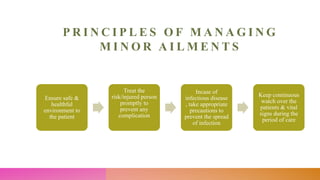
P R I N C I P L E S O F M A N A G I N G
M I N O R A I L M E N T S
Ensure safe &
healthful
environment to
the patient
Treat the
risk/injured person
promptly to
prevent any
complication
Incase of
infectious disease
, take appropriate
precautions to
prevent the spread
of infection
Keep continuous
watch over the
patients & vital
signs during the
period of care
P R I N C I P L E S O F M A N A G I N G
M I N O R A I L M E N T S
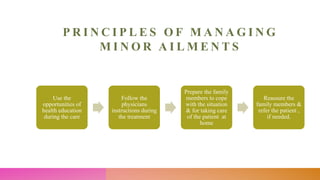
Use the
opportunities of
health education
during the care
Follow the
physicians
instructions during
the treatment
Prepare the family
members to cope
with the situation
& for taking care
of the patient at
home
Reassure the
family members &
refer the patient ,
if needed.
M A N A G E M E N T O F M I N O R
A I L M E N T S
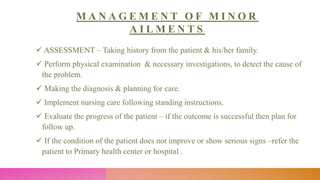
 ASSESSMENT – Taking history from the patient & his/her family.
 Perform physical examination & necessary investigations, to detect the cause of
the problem.
 Making the diagnosis & planning for care.
 Implement nursing care following standing instructions.
 Evaluate the progress of the patient – if the outcome is successful then plan for
follow up.
 If the condition of the patient does not improve or show serious signs –refer the
patient to Primary health center or hospital .
D E F I N E : - S TA N D I N G O R D E R S
Standing order are specific instructions regarding treatment for
conditions that nurses & other health workers meet in homes ,
schools & industries where a doctor is not readily available.
OBJECTIVES
 To maintain the continuity of treatment of the patient.
 To protect the life of the patient.
 To create the feeling of responsibility in the members of health team.
USES
 Enhancing the quality & activity of the health services.
 Decentralization of health responsibilities.
 Developing the feeling of confidence & responsibility in nursing &
other health worker.
 Strengthening of primary health services in the community.
 Protecting the general public from quacks.
VA R I O U S M I N O R A I L M E N T S
1) FEVER :- Fever may arise due to many reasons. It may be due to
malaria typhoid or any other infections etc.
 Check the vital signs.
 Find out the signs & symptoms such as body aches, headache, fatigue,
GI disturbance, hyperthermia, cold etc.
 Take blood smear for malaria.
TREATMENT :- 1) Take bed rest & plenty of fluids & fruit juices.
2) Soft diet should be taken.
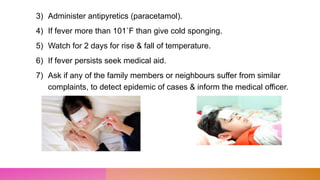
3) Administer antipyretics (paracetamol).
4) If fever more than 101˚F than give cold sponging.
5) Watch for 2 days for rise & fall of temperature.
6) If fever persists seek medical aid.
7) Ask if any of the family members or neighbours suffer from similar
complaints, to detect epidemic of cases & inform the medical officer.
C O U G H
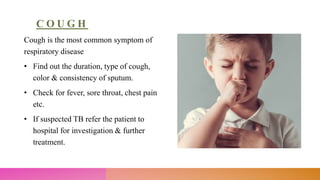
Cough is the most common symptom of
respiratory disease
• Find out the duration, type of cough,
color & consistency of sputum.
• Check for fever, sore throat, chest pain
etc.
• If suspected TB refer the patient to
hospital for investigation & further
treatment.
TREATMENT OF COUGH :-
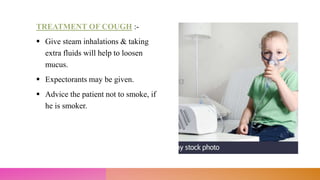
 Give steam inhalations & taking
extra fluids will help to loosen
mucus.
 Expectorants may be given.
 Advice the patient not to smoke, if
he is smoker.
S O R E T H R O AT
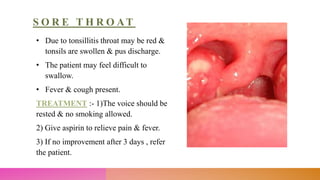
• Due to tonsillitis throat may be red &
tonsils are swollen & pus discharge.
• The patient may feel difficult to
swallow.
• Fever & cough present.
TREATMENT :- 1)The voice should be
rested & no smoking allowed.
2) Give aspirin to relieve pain & fever.
3) If no improvement after 3 days , refer
the patient.
E Y E I N F E C T I O N S
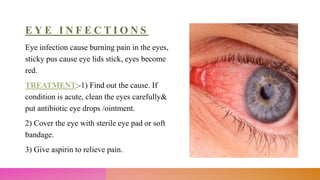
Eye infection cause burning pain in the eyes,
sticky pus cause eye lids stick, eyes become
red.
TREATMENT:-1) Find out the cause. If
condition is acute, clean the eyes carefully&
put antibiotic eye drops /ointment.
2) Cover the eye with sterile eye pad or soft
bandage.
3) Give aspirin to relieve pain.
4) Refer the patient to hospital:-
• When any wound that cuts or ruptures the eye bowl.
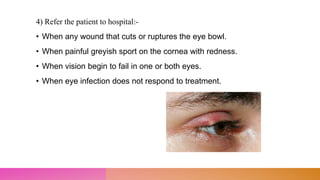
• When painful greyish sport on the cornea with redness.
• When vision begin to fail in one or both eyes.
• When eye infection does not respond to treatment.
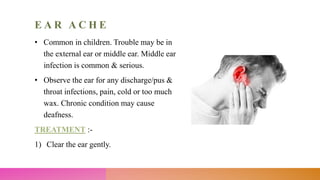
E A R A C H E
• Common in children. Trouble may be in
the external ear or middle ear. Middle ear
infection is common & serious.
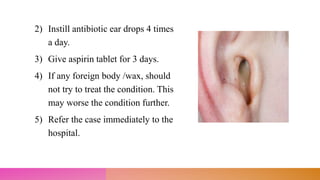
• Observe the ear for any discharge/pus &
throat infections, pain, cold or too much
wax. Chronic condition may cause
deafness.
TREATMENT :-
1) Clear the ear gently.
2) Instill antibiotic ear drops 4 times
a day.
3) Give aspirin tablet for 3 days.
4) If any foreign body /wax, should
not try to treat the condition. This
may worse the condition further.
5) Refer the case immediately to the
hospital.
SINUSITIS
• Common complaint of cold with severe pain &
tenderness in the bones just above or below the eyes.
• Severe headache & pain increases when patient bends
forward. Thick mucus or pus in the nose .
TREATMENT:-1)Take steam inhalation.
2)Decongestant tablets or nose drops for relief. Aspirin
/paracetamol to relief pain.
3) If no improvement, refer the patient.
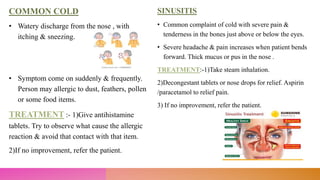
COMMON COLD
• Watery discharge from the nose , with
itching & sneezing.
• Symptom come on suddenly & frequently.
Person may allergic to dust, feathers, pollen
or some food items.
TREATMENT :- 1)Give antihistamine
tablets. Try to observe what cause the allergic
reaction & avoid that contact with that item.
2)If no improvement, refer the patient.
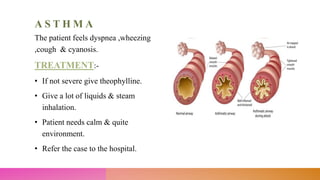
A S T H M A
The patient feels dyspnea ,wheezing
,cough & cyanosis.
TREATMENT:-
• If not severe give theophylline.
• Give a lot of liquids & steam
inhalation.
• Patient needs calm & quite
environment.
• Refer the case to the hospital.
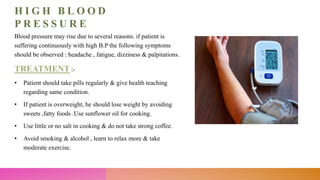
H I G H B L O O D
P R E S S U R E
Blood pressure may rise due to several reasons. if patient is
suffering continuously with high B.P the following symptoms
should be observed : headache , fatigue, dizziness & palpitations.
TREATMENT :-
• Patient should take pills regularly & give health teaching
regarding same condition.
• If patient is overweight, he should lose weight by avoiding
sweets ,fatty foods .Use sunflower oil for cooking.
• Use little or no salt in cooking & do not take strong coffee.
• Avoid smoking & alcohol , learn to relax more & take
moderate exercise.
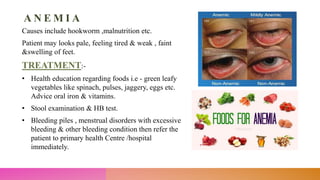
A N E M I A
Causes include hookworm ,malnutrition etc.
Patient may looks pale, feeling tired & weak , faint
&swelling of feet.
TREATMENT:-
• Health education regarding foods i.e - green leafy
vegetables like spinach, pulses, jaggery, eggs etc.
Advice oral iron & vitamins.
• Stool examination & HB test.
• Bleeding piles , menstrual disorders with excessive
bleeding & other bleeding condition then refer the
patient to primary health Centre /hospital
immediately.
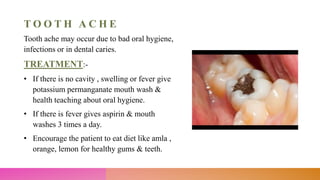
T O O T H A C H E
Tooth ache may occur due to bad oral hygiene,
infections or in dental caries.
TREATMENT:-
• If there is no cavity , swelling or fever give
potassium permanganate mouth wash &
health teaching about oral hygiene.
• If there is fever gives aspirin & mouth
washes 3 times a day.
• Encourage the patient to eat diet like amla ,
orange, lemon for healthy gums & teeth.
DIARRHEA
• Malnutrition & intestinal infections are the causes.
• Observe sign of dehydration like dry mouth, rapid pulse, loss of elasticity of skin.
TREATMENT:-
• Give plenty of fluids for rehydration. Give ORS solution & rice water ,coconut
water etc.
• Give health education to the patient & family regarding protect the food from flies,
drink boiled water , encourage freshly cooked food & wash hands with soap 7 water
before & after eating & after toilet.
• Alert the village health committee regarding diarrheal situation.
• If there is severe dehydration refer the patient to the hospital.
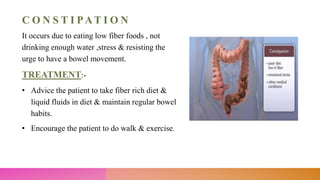
C O N S T I PAT I O N
It occurs due to eating low fiber foods , not
drinking enough water ,stress & resisting the
urge to have a bowel movement.
TREATMENT:-
• Advice the patient to take fiber rich diet &
liquid fluids in diet & maintain regular bowel
habits.
• Encourage the patient to do walk & exercise.
INDIGESTION
Patient may feel stomach pain, heart-burn,
flatulence , regurgitation of fluid &
constipation.
TREATMENT:-
• Health teaching regarding avoidance of
taking too spicy or fatty foods or too
much alcohol.
• Avoid eating quickly or swallowing
without properly chewing the foods.
• Take balance diet according to proper
timings.
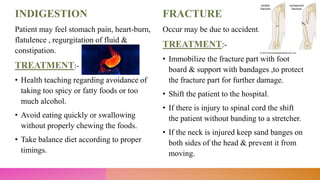
FRACTURE
Occur may be due to accident.
TREATMENT:-
• Immobilize the fracture part with foot
board & support with bandages ,to protect
the fracture part for further damage.
• Shift the patient to the hospital.
• If there is injury to spinal cord the shift
the patient without banding to a stretcher.
• If the neck is injured keep sand banges on
both sides of the head & prevent it from
moving.
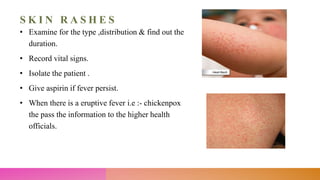
S K I N R A S H E S
• Examine for the type ,distribution & find out the
duration.
• Record vital signs.
• Isolate the patient .
• Give aspirin if fever persist.
• When there is a eruptive fever i.e :- chickenpox
the pass the information to the higher health
officials.
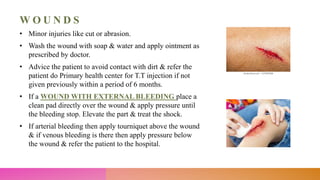
W O U N D S
• Minor injuries like cut or abrasion.
• Wash the wound with soap & water and apply ointment as
prescribed by doctor.
• Advice the patient to avoid contact with dirt & refer the
patient do Primary health center for T.T injection if not
given previously within a period of 6 months.
• If a WOUND WITH EXTERNAL BLEEDING place a
clean pad directly over the wound & apply pressure until
the bleeding stop. Elevate the part & treat the shock.
• If arterial bleeding then apply tourniquet above the wound
& if venous bleeding is there then apply pressure below
the wound & refer the patient to the hospital.
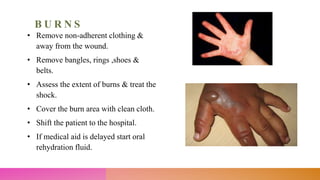
B U R N S
• Remove non-adherent clothing &
away from the wound.
• Remove bangles, rings ,shoes &
belts.
• Assess the extent of burns & treat the
shock.
• Cover the burn area with clean cloth.
• Shift the patient to the hospital.
• If medical aid is delayed start oral
rehydration fluid.
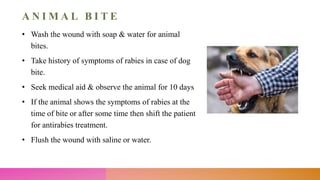
A N I M A L B I T E
• Wash the wound with soap & water for animal
bites.
• Take history of symptoms of rabies in case of dog
bite.
• Seek medical aid & observe the animal for 10 days
• If the animal shows the symptoms of rabies at the
time of bite or after some time then shift the patient
for antirabies treatment.
• Flush the wound with saline or water.
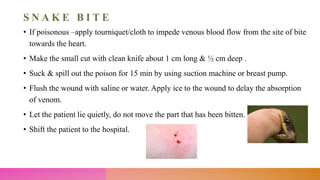
S N A K E B I T E
• If poisonous –apply tourniquet/cloth to impede venous blood flow from the site of bite
towards the heart.
• Make the small cut with clean knife about 1 cm long & ½ cm deep .
• Suck & spill out the poison for 15 min by using suction machine or breast pump.
• Flush the wound with saline or water. Apply ice to the wound to delay the absorption
of venom.
• Let the patient lie quietly, do not move the part that has been bitten.
• Shift the patient to the hospital.
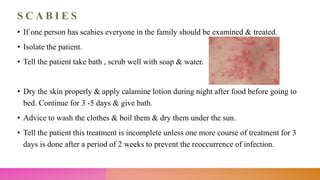
S C A B I E S
• If one person has scabies everyone in the family should be examined & treated.
• Isolate the patient.
• Tell the patient take bath , scrub well with soap & water.
• Dry the skin properly & apply calamine lotion during night after food before going to
bed. Continue for 3 -5 days & give bath.
• Advice to wash the clothes & boil them & dry them under the sun.
• Tell the patient this treatment is incomplete unless one more course of treatment for 3
days is done after a period of 2 weeks to prevent the reoccurrence of infection.
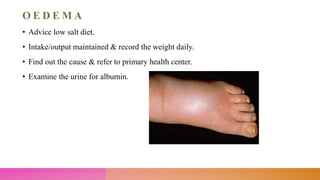
O E D E M A
• Advice low salt diet.
• Intake/output maintained & record the weight daily.
• Find out the cause & refer to primary health center.
• Examine the urine for albumin.
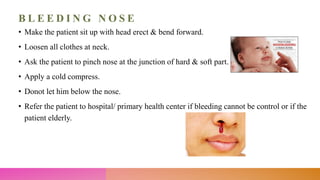
B L E E D I N G N O S E
• Make the patient sit up with head erect & bend forward.
• Loosen all clothes at neck.
• Ask the patient to pinch nose at the junction of hard & soft part.
• Apply a cold compress.
• Donot let him below the nose.
• Refer the patient to hospital/ primary health center if bleeding cannot be control or if the
patient elderly.
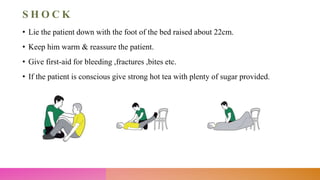
S H O C K
• Lie the patient down with the foot of the bed raised about 22cm.
• Keep him warm & reassure the patient.
• Give first-aid for bleeding ,fractures ,bites etc.
• If the patient is conscious give strong hot tea with plenty of sugar provided.

Minor ailments

  • 1.
    COMMUNITY HEALTH NURSING T OP I C : - M I N O R A I L M E N T S B Y: - M I S S H A R L E E N K A RWA L
  • 2.
    I N TR O D U C T I O N Aches & illness which people suffer from time to time , which are not necessarily serious or long lasting or require a doctor’s attention; they are described as minor ailments. Community health nurse may come across patients who may have minor ailments & injuries, which needs medical attention.
  • 3.
    D E FI N E : - M I N O R A I L M E N T S A minor ailment is defined as a health complaint which , by simple actions patients could handle themselves.
  • 4.
    P R IN C I P L E S O F M A N A G I N G M I N O R A I L M E N T S Ensure safe & healthful environment to the patient Treat the risk/injured person promptly to prevent any complication Incase of infectious disease , take appropriate precautions to prevent the spread of infection Keep continuous watch over the patients & vital signs during the period of care
  • 5.
    P R IN C I P L E S O F M A N A G I N G M I N O R A I L M E N T S Use the opportunities of health education during the care Follow the physicians instructions during the treatment Prepare the family members to cope with the situation & for taking care of the patient at home Reassure the family members & refer the patient , if needed.
  • 6.
    M A NA G E M E N T O F M I N O R A I L M E N T S  ASSESSMENT – Taking history from the patient & his/her family.  Perform physical examination & necessary investigations, to detect the cause of the problem.  Making the diagnosis & planning for care.  Implement nursing care following standing instructions.  Evaluate the progress of the patient – if the outcome is successful then plan for follow up.  If the condition of the patient does not improve or show serious signs –refer the patient to Primary health center or hospital .
  • 7.
    D E FI N E : - S TA N D I N G O R D E R S Standing order are specific instructions regarding treatment for conditions that nurses & other health workers meet in homes , schools & industries where a doctor is not readily available.
  • 8.
    OBJECTIVES  To maintainthe continuity of treatment of the patient.  To protect the life of the patient.  To create the feeling of responsibility in the members of health team.
  • 9.
    USES  Enhancing thequality & activity of the health services.  Decentralization of health responsibilities.  Developing the feeling of confidence & responsibility in nursing & other health worker.  Strengthening of primary health services in the community.  Protecting the general public from quacks.
  • 10.
    VA R IO U S M I N O R A I L M E N T S 1) FEVER :- Fever may arise due to many reasons. It may be due to malaria typhoid or any other infections etc.  Check the vital signs.  Find out the signs & symptoms such as body aches, headache, fatigue, GI disturbance, hyperthermia, cold etc.  Take blood smear for malaria. TREATMENT :- 1) Take bed rest & plenty of fluids & fruit juices. 2) Soft diet should be taken.
  • 11.
    3) Administer antipyretics(paracetamol). 4) If fever more than 101˚F than give cold sponging. 5) Watch for 2 days for rise & fall of temperature. 6) If fever persists seek medical aid. 7) Ask if any of the family members or neighbours suffer from similar complaints, to detect epidemic of cases & inform the medical officer.
  • 12.
    C O UG H Cough is the most common symptom of respiratory disease • Find out the duration, type of cough, color & consistency of sputum. • Check for fever, sore throat, chest pain etc. • If suspected TB refer the patient to hospital for investigation & further treatment.
  • 13.
    TREATMENT OF COUGH:-  Give steam inhalations & taking extra fluids will help to loosen mucus.  Expectorants may be given.  Advice the patient not to smoke, if he is smoker.
  • 14.
    S O RE T H R O AT • Due to tonsillitis throat may be red & tonsils are swollen & pus discharge. • The patient may feel difficult to swallow. • Fever & cough present. TREATMENT :- 1)The voice should be rested & no smoking allowed. 2) Give aspirin to relieve pain & fever. 3) If no improvement after 3 days , refer the patient.
  • 15.
    E Y EI N F E C T I O N S Eye infection cause burning pain in the eyes, sticky pus cause eye lids stick, eyes become red. TREATMENT:-1) Find out the cause. If condition is acute, clean the eyes carefully& put antibiotic eye drops /ointment. 2) Cover the eye with sterile eye pad or soft bandage. 3) Give aspirin to relieve pain.
  • 16.
    4) Refer thepatient to hospital:- • When any wound that cuts or ruptures the eye bowl. • When painful greyish sport on the cornea with redness. • When vision begin to fail in one or both eyes. • When eye infection does not respond to treatment.
  • 17.
    E A RA C H E • Common in children. Trouble may be in the external ear or middle ear. Middle ear infection is common & serious. • Observe the ear for any discharge/pus & throat infections, pain, cold or too much wax. Chronic condition may cause deafness. TREATMENT :- 1) Clear the ear gently.
  • 18.
    2) Instill antibioticear drops 4 times a day. 3) Give aspirin tablet for 3 days. 4) If any foreign body /wax, should not try to treat the condition. This may worse the condition further. 5) Refer the case immediately to the hospital.
  • 19.
    SINUSITIS • Common complaintof cold with severe pain & tenderness in the bones just above or below the eyes. • Severe headache & pain increases when patient bends forward. Thick mucus or pus in the nose . TREATMENT:-1)Take steam inhalation. 2)Decongestant tablets or nose drops for relief. Aspirin /paracetamol to relief pain. 3) If no improvement, refer the patient. COMMON COLD • Watery discharge from the nose , with itching & sneezing. • Symptom come on suddenly & frequently. Person may allergic to dust, feathers, pollen or some food items. TREATMENT :- 1)Give antihistamine tablets. Try to observe what cause the allergic reaction & avoid that contact with that item. 2)If no improvement, refer the patient.
  • 20.
    A S TH M A The patient feels dyspnea ,wheezing ,cough & cyanosis. TREATMENT:- • If not severe give theophylline. • Give a lot of liquids & steam inhalation. • Patient needs calm & quite environment. • Refer the case to the hospital.
  • 21.
    H I GH B L O O D P R E S S U R E Blood pressure may rise due to several reasons. if patient is suffering continuously with high B.P the following symptoms should be observed : headache , fatigue, dizziness & palpitations. TREATMENT :- • Patient should take pills regularly & give health teaching regarding same condition. • If patient is overweight, he should lose weight by avoiding sweets ,fatty foods .Use sunflower oil for cooking. • Use little or no salt in cooking & do not take strong coffee. • Avoid smoking & alcohol , learn to relax more & take moderate exercise.
  • 22.
    A N EM I A Causes include hookworm ,malnutrition etc. Patient may looks pale, feeling tired & weak , faint &swelling of feet. TREATMENT:- • Health education regarding foods i.e - green leafy vegetables like spinach, pulses, jaggery, eggs etc. Advice oral iron & vitamins. • Stool examination & HB test. • Bleeding piles , menstrual disorders with excessive bleeding & other bleeding condition then refer the patient to primary health Centre /hospital immediately.
  • 23.
    T O OT H A C H E Tooth ache may occur due to bad oral hygiene, infections or in dental caries. TREATMENT:- • If there is no cavity , swelling or fever give potassium permanganate mouth wash & health teaching about oral hygiene. • If there is fever gives aspirin & mouth washes 3 times a day. • Encourage the patient to eat diet like amla , orange, lemon for healthy gums & teeth.
  • 24.
    DIARRHEA • Malnutrition &intestinal infections are the causes. • Observe sign of dehydration like dry mouth, rapid pulse, loss of elasticity of skin. TREATMENT:- • Give plenty of fluids for rehydration. Give ORS solution & rice water ,coconut water etc. • Give health education to the patient & family regarding protect the food from flies, drink boiled water , encourage freshly cooked food & wash hands with soap 7 water before & after eating & after toilet. • Alert the village health committee regarding diarrheal situation. • If there is severe dehydration refer the patient to the hospital.
  • 25.
    C O NS T I PAT I O N It occurs due to eating low fiber foods , not drinking enough water ,stress & resisting the urge to have a bowel movement. TREATMENT:- • Advice the patient to take fiber rich diet & liquid fluids in diet & maintain regular bowel habits. • Encourage the patient to do walk & exercise.
  • 26.
    INDIGESTION Patient may feelstomach pain, heart-burn, flatulence , regurgitation of fluid & constipation. TREATMENT:- • Health teaching regarding avoidance of taking too spicy or fatty foods or too much alcohol. • Avoid eating quickly or swallowing without properly chewing the foods. • Take balance diet according to proper timings. FRACTURE Occur may be due to accident. TREATMENT:- • Immobilize the fracture part with foot board & support with bandages ,to protect the fracture part for further damage. • Shift the patient to the hospital. • If there is injury to spinal cord the shift the patient without banding to a stretcher. • If the neck is injured keep sand banges on both sides of the head & prevent it from moving.
  • 27.
    S K IN R A S H E S • Examine for the type ,distribution & find out the duration. • Record vital signs. • Isolate the patient . • Give aspirin if fever persist. • When there is a eruptive fever i.e :- chickenpox the pass the information to the higher health officials.
  • 28.
    W O UN D S • Minor injuries like cut or abrasion. • Wash the wound with soap & water and apply ointment as prescribed by doctor. • Advice the patient to avoid contact with dirt & refer the patient do Primary health center for T.T injection if not given previously within a period of 6 months. • If a WOUND WITH EXTERNAL BLEEDING place a clean pad directly over the wound & apply pressure until the bleeding stop. Elevate the part & treat the shock. • If arterial bleeding then apply tourniquet above the wound & if venous bleeding is there then apply pressure below the wound & refer the patient to the hospital.
  • 29.
    B U RN S • Remove non-adherent clothing & away from the wound. • Remove bangles, rings ,shoes & belts. • Assess the extent of burns & treat the shock. • Cover the burn area with clean cloth. • Shift the patient to the hospital. • If medical aid is delayed start oral rehydration fluid.
  • 30.
    A N IM A L B I T E • Wash the wound with soap & water for animal bites. • Take history of symptoms of rabies in case of dog bite. • Seek medical aid & observe the animal for 10 days • If the animal shows the symptoms of rabies at the time of bite or after some time then shift the patient for antirabies treatment. • Flush the wound with saline or water.
  • 31.
    S N AK E B I T E • If poisonous –apply tourniquet/cloth to impede venous blood flow from the site of bite towards the heart. • Make the small cut with clean knife about 1 cm long & ½ cm deep . • Suck & spill out the poison for 15 min by using suction machine or breast pump. • Flush the wound with saline or water. Apply ice to the wound to delay the absorption of venom. • Let the patient lie quietly, do not move the part that has been bitten. • Shift the patient to the hospital.
  • 32.
    S C AB I E S • If one person has scabies everyone in the family should be examined & treated. • Isolate the patient. • Tell the patient take bath , scrub well with soap & water. • Dry the skin properly & apply calamine lotion during night after food before going to bed. Continue for 3 -5 days & give bath. • Advice to wash the clothes & boil them & dry them under the sun. • Tell the patient this treatment is incomplete unless one more course of treatment for 3 days is done after a period of 2 weeks to prevent the reoccurrence of infection.
  • 33.
    O E DE M A • Advice low salt diet. • Intake/output maintained & record the weight daily. • Find out the cause & refer to primary health center. • Examine the urine for albumin.
  • 34.
    B L EE D I N G N O S E • Make the patient sit up with head erect & bend forward. • Loosen all clothes at neck. • Ask the patient to pinch nose at the junction of hard & soft part. • Apply a cold compress. • Donot let him below the nose. • Refer the patient to hospital/ primary health center if bleeding cannot be control or if the patient elderly.
  • 35.
    S H OC K • Lie the patient down with the foot of the bed raised about 22cm. • Keep him warm & reassure the patient. • Give first-aid for bleeding ,fractures ,bites etc. • If the patient is conscious give strong hot tea with plenty of sugar provided.