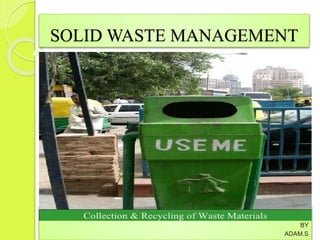
SOLID WASTE MANAGEMENT
BY
ADAM.S
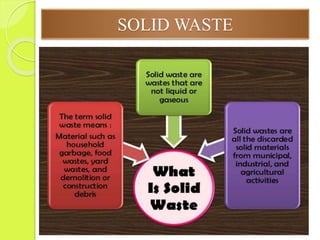
SOLID WASTE
Why manage waste?
 Waste degrades water, soil, and air quality;
does environmental and ecological harm.
 Waste does harm to human health.
 Waste is unpleasant aesthetically.
 Create Unhygienic Conditions
CAUSES
Types and Sources of Solid wastes
 Depending upon the nature, Solid wastes
can be broadly classified into 3 types
1.Urban Or Municipal wastes.
2.Industrial wastes.
3.Hazardous wastes.
Sources of Urban Wastes
Domestic Wastes (Eg Food waste, cloth) Commercial wastes(Eg Waste paper, Cans)
Sources of Urban Wastes
Construction wastes(Eg Wood, Concrete) Biomedical wastes(Eg Anatomical wastes)
Type and Characteristics of Urban
Wastes
Bio-degradable wastes:
The urban solid waste materials that can be degraded by micro organisms are called
biodegradable wastes
Eg Food, Vegetables, Tea leaves, Egg Shells
Non-Biodegradable wastes
The urban solid waste materials that cannot be degraded by micro organisms are called
non-biodegradable wastes.
Eg Polythene bags, Scrap metals, Glass bottles etc.,
Source and Characteristics of
Industrial Wastes
The main sources of industrial wastes are
chemical industries, metal and mineral
processing industries.
Eg 1.Nuclear power plants,
2.Thermal power plants,
3.Chemical industries
Hazardous Wastes
 Hazardous Wastes are the wastes, that pose a
substantial danger immediately or over a
period of time to human,plant or animal life.
Sources of Hazardous wastes
Chemical manufacturing companies,
Petroleum refinieries,Paper mills, Radio active
Substances,Biological wastes,Heavy metals
and other industries.
Process of Solid Waste
Management
Solid waste
Generation
Collection of
Waste
Transportation
Storage
Segregation
of wastes
Home
Separation for
Recycling
Disposal
Methods
DISPOSAL METHODS
DISPOSAL
METHODS
LAND FILL INCINERATION COMPOSTING
Steps Involved in SWM
 Two important steps of Solid waste
management is
 Reduce, Reuse and Recycle before
destruction and safe storage of wastes.
 Discarding wastes
WASTE REDUCTION HIERARCHY
SANITARY LANDFILL
 Solid Wastes are placed in sanitary landfill system in alternate
layers of 80cm thick refuse, covered with selected earth fill of
20 cm thickness.
 After 2 or 3 years solid waste volume shrinks by 25-30% and
the land is used for parks, roads and small buildings.
 The most common and cheapest method of waste disposal in
sanitary land fills which is invariably employed in Indian
cities.
SANITARY LANDFILL
 Land-fill structure is built either into the
ground or on the ground into which the waste
is dumped.
 The method involves spreading the solid
waste on the ground, compacting it and then
covering it with soil at suitable intervals.
Sanitary Landfill
Energy from landfills
 Landfills can harness energy, too.
 Bacterial decomposition inside landfills
produces methane, the main component of
natural gas.
 By collecting “landfill gas”:
• Landfills can make extra money
• Fuel is made available
• Greenhouse gas methane is prevented from
reaching atmosphere
ADVANTAGES OF SANITORY
LANDFILL
 It is simple and economical
 Segregation not required.
 Landfilled areas can be reclaimed and used for
other purposes.
 Converts low-lying,marshy waste-land into useful
areas
 Natural resources are returned to soil and recycled
DISADVANTAGES OF
SANITORY LANDFILL
 A large area is required.
 Since land is available away from town,transportation cost is heavy.
 Bad odours, if landfills are not properly managed.
 The land filled areas will be the sources of mosquitoes and files and
hence insecticides and pesticides are to be applied at regular
intervals.
 Cause fire hazard due to the formation of methane in wet weather.
Incineration
 It is a hygienic way of disposing solid waste.
 It is more suitable if the waste contains more
hazardous material and organic content.
 It is a thermal process and is very effective for
detoxification of all combustible pathogens.
 It is an expensive technology compared to landfill
and composting because incinerators are costly.
WTE incineration
Incineration
 In this method the municipal solid wastes are burnt in a furnace
called incinerator.
 The combustible substances such as rubbish, garbage,dead
organisms and the noncombustible matter such as glass,porcelain,
metals are separated before feeding to incinerators.
 The noncombustible materials can be left out for recycling and
reuse.
 The left out ashes and clinkers from the incinerators may be
accounted for only about 10 to 20% which need further disposal
either by sanitory land fill or by some other means.
Incineration
 The heat produced in the incinerator during the burning of
refuse is used in the form of steam power for generation of
electricity throughout turbines
 The municipal solid waste is generally wet but has a very
calorific value so it has to be dried up first before burning.
 The waste is dried in preheater from where it is taken into
large incinerating furnace called destructors which can
incinerate about 100 to 150 tonnes per hour.
Incineration
 The temperature normally maintained in a
combustion chamber is about 700 degree
celsius and may be increased to about
1000 degree celsius when electricity is to
be generated.
INCINERATION
Advantages Disadvantages
 Reduce trash volume
 It requires very little space
 Transportation cost is low
 Safest from hygienic point of
view
 An incinerator plant of 300
tonnes per day capacity can
generate 3MW of power.
 High Cost
 Needs Skilled personnel
 Air Pollution (Especially
toxic dioxins )
 Produces a highly toxic ash.
COMPOSTING
In this method, bulk organic waste is converted
into a fertilizing manure by biological action.
 The separated compostable waste is dumped
in underground earthen trenches in layers of
1.5m and is finally covered with earth of
about 20 cm and left over for decomposition.
COMPOSTING
 Sometimes certain microorganisms such as actinomycetes are
introduced for active decomposition.
 Within 2-3 days biological action starts, the organic matters
are being destroyed by actinomycetes and lot of heat is
liberated increasing the temperature of the compost by about
75degree celsius.
 Finally the refuse is converted to powdery brown coloured
odourless mass known as humus and has a fertilizing value
which can be used for agricultural field.
COMPOSTING
 The Compost contains lot of nitrogen essential for plant
growth apart from phospates and other minerals.
 WHO has set up a compost plant in New Delhi in 1981 with a
capacity to handle 90 to 100 tonnes of waste everyday.
 The prepared compost was supplied to nurseries, kitchen
gardens and horticulture department.
 The composting technology is widely employed in
developing countries.
TYPES OF COMPOSTING
 Aerobic Composting
 Anaerobic Composting
 Vermi Composting
Advantages
 When the manure is added to the soil, it increases the
water retention and ion exchange capacity of soil.
 A number of industrial solid wastes can also be
treated by this method.
 It can manure be sold thereby reducing the cost of
disposing of wastes
 Recycling – Occurs.
Disadvantages
 The non-consumables have to be disposed
separately.
 Use of compost has not yet caught up with
farmers and hence no assured market.
Hazardous waste
Waste that poses a potential danger to human
health
Four criteria:
• Ignitability: substances catch fire
• Corrosivity: substances corrode metals
• Reactivity: substances are chemically unstable and
react with other chemicals in dangerous ways
• Toxicity: substances are known to be harmful to
human health
Hazardous waste
 There are many types of hazardous waste.
 Two are worst because they persist for a long
time without breaking down:
• Heavy metals
• (mercury, lead, chromium, arsenic,
cadmium, tin, copper — from industry,
mining, consumer products)
• Organic compounds
• (synthetic pesticides, petroleum products,
rubber, solvents, preservatives…)
Hazardous waste: Surface
impoundments
 Really only for
temporary
storage; not
ideal
 Waste may
overflow, blow
out, vaporize,
or leak
Hazardous waste: Deep-well injection
Seems a good
idea, but is not
without risk:
Waste can
leak out into
groundwater.
Process of Disposal and Treatment
of Health Care System
BEST FROM WASTE
BEST FROM WASTE
BEST FROM WASTE(PLASTIC ROAD )
Solid waste management

Solid waste management

  • 1.
  • 2.
  • 3.
    Why manage waste? Waste degrades water, soil, and air quality; does environmental and ecological harm.  Waste does harm to human health.  Waste is unpleasant aesthetically.  Create Unhygienic Conditions
  • 5.
  • 6.
    Types and Sourcesof Solid wastes  Depending upon the nature, Solid wastes can be broadly classified into 3 types 1.Urban Or Municipal wastes. 2.Industrial wastes. 3.Hazardous wastes.
  • 7.
    Sources of UrbanWastes Domestic Wastes (Eg Food waste, cloth) Commercial wastes(Eg Waste paper, Cans)
  • 8.
    Sources of UrbanWastes Construction wastes(Eg Wood, Concrete) Biomedical wastes(Eg Anatomical wastes)
  • 10.
    Type and Characteristicsof Urban Wastes Bio-degradable wastes: The urban solid waste materials that can be degraded by micro organisms are called biodegradable wastes Eg Food, Vegetables, Tea leaves, Egg Shells Non-Biodegradable wastes The urban solid waste materials that cannot be degraded by micro organisms are called non-biodegradable wastes. Eg Polythene bags, Scrap metals, Glass bottles etc.,
  • 11.
    Source and Characteristicsof Industrial Wastes The main sources of industrial wastes are chemical industries, metal and mineral processing industries. Eg 1.Nuclear power plants, 2.Thermal power plants, 3.Chemical industries
  • 12.
    Hazardous Wastes  HazardousWastes are the wastes, that pose a substantial danger immediately or over a period of time to human,plant or animal life. Sources of Hazardous wastes Chemical manufacturing companies, Petroleum refinieries,Paper mills, Radio active Substances,Biological wastes,Heavy metals and other industries.
  • 14.
    Process of SolidWaste Management Solid waste Generation Collection of Waste Transportation Storage Segregation of wastes Home Separation for Recycling Disposal Methods
  • 15.
  • 16.
    Steps Involved inSWM  Two important steps of Solid waste management is  Reduce, Reuse and Recycle before destruction and safe storage of wastes.  Discarding wastes
  • 19.
  • 20.
    SANITARY LANDFILL  SolidWastes are placed in sanitary landfill system in alternate layers of 80cm thick refuse, covered with selected earth fill of 20 cm thickness.  After 2 or 3 years solid waste volume shrinks by 25-30% and the land is used for parks, roads and small buildings.  The most common and cheapest method of waste disposal in sanitary land fills which is invariably employed in Indian cities.
  • 21.
    SANITARY LANDFILL  Land-fillstructure is built either into the ground or on the ground into which the waste is dumped.  The method involves spreading the solid waste on the ground, compacting it and then covering it with soil at suitable intervals.
  • 22.
  • 23.
    Energy from landfills Landfills can harness energy, too.  Bacterial decomposition inside landfills produces methane, the main component of natural gas.  By collecting “landfill gas”: • Landfills can make extra money • Fuel is made available • Greenhouse gas methane is prevented from reaching atmosphere
  • 24.
    ADVANTAGES OF SANITORY LANDFILL It is simple and economical  Segregation not required.  Landfilled areas can be reclaimed and used for other purposes.  Converts low-lying,marshy waste-land into useful areas  Natural resources are returned to soil and recycled
  • 25.
    DISADVANTAGES OF SANITORY LANDFILL A large area is required.  Since land is available away from town,transportation cost is heavy.  Bad odours, if landfills are not properly managed.  The land filled areas will be the sources of mosquitoes and files and hence insecticides and pesticides are to be applied at regular intervals.  Cause fire hazard due to the formation of methane in wet weather.
  • 26.
    Incineration  It isa hygienic way of disposing solid waste.  It is more suitable if the waste contains more hazardous material and organic content.  It is a thermal process and is very effective for detoxification of all combustible pathogens.  It is an expensive technology compared to landfill and composting because incinerators are costly.
  • 27.
  • 28.
    Incineration  In thismethod the municipal solid wastes are burnt in a furnace called incinerator.  The combustible substances such as rubbish, garbage,dead organisms and the noncombustible matter such as glass,porcelain, metals are separated before feeding to incinerators.  The noncombustible materials can be left out for recycling and reuse.  The left out ashes and clinkers from the incinerators may be accounted for only about 10 to 20% which need further disposal either by sanitory land fill or by some other means.
  • 29.
    Incineration  The heatproduced in the incinerator during the burning of refuse is used in the form of steam power for generation of electricity throughout turbines  The municipal solid waste is generally wet but has a very calorific value so it has to be dried up first before burning.  The waste is dried in preheater from where it is taken into large incinerating furnace called destructors which can incinerate about 100 to 150 tonnes per hour.
  • 30.
    Incineration  The temperaturenormally maintained in a combustion chamber is about 700 degree celsius and may be increased to about 1000 degree celsius when electricity is to be generated.
  • 31.
    INCINERATION Advantages Disadvantages  Reducetrash volume  It requires very little space  Transportation cost is low  Safest from hygienic point of view  An incinerator plant of 300 tonnes per day capacity can generate 3MW of power.  High Cost  Needs Skilled personnel  Air Pollution (Especially toxic dioxins )  Produces a highly toxic ash.
  • 32.
    COMPOSTING In this method,bulk organic waste is converted into a fertilizing manure by biological action.  The separated compostable waste is dumped in underground earthen trenches in layers of 1.5m and is finally covered with earth of about 20 cm and left over for decomposition.
  • 34.
    COMPOSTING  Sometimes certainmicroorganisms such as actinomycetes are introduced for active decomposition.  Within 2-3 days biological action starts, the organic matters are being destroyed by actinomycetes and lot of heat is liberated increasing the temperature of the compost by about 75degree celsius.  Finally the refuse is converted to powdery brown coloured odourless mass known as humus and has a fertilizing value which can be used for agricultural field.
  • 35.
    COMPOSTING  The Compostcontains lot of nitrogen essential for plant growth apart from phospates and other minerals.  WHO has set up a compost plant in New Delhi in 1981 with a capacity to handle 90 to 100 tonnes of waste everyday.  The prepared compost was supplied to nurseries, kitchen gardens and horticulture department.  The composting technology is widely employed in developing countries.
  • 37.
    TYPES OF COMPOSTING Aerobic Composting  Anaerobic Composting  Vermi Composting
  • 38.
    Advantages  When themanure is added to the soil, it increases the water retention and ion exchange capacity of soil.  A number of industrial solid wastes can also be treated by this method.  It can manure be sold thereby reducing the cost of disposing of wastes  Recycling – Occurs.
  • 39.
    Disadvantages  The non-consumableshave to be disposed separately.  Use of compost has not yet caught up with farmers and hence no assured market.
  • 40.
    Hazardous waste Waste thatposes a potential danger to human health Four criteria: • Ignitability: substances catch fire • Corrosivity: substances corrode metals • Reactivity: substances are chemically unstable and react with other chemicals in dangerous ways • Toxicity: substances are known to be harmful to human health
  • 41.
    Hazardous waste  Thereare many types of hazardous waste.  Two are worst because they persist for a long time without breaking down: • Heavy metals • (mercury, lead, chromium, arsenic, cadmium, tin, copper — from industry, mining, consumer products) • Organic compounds • (synthetic pesticides, petroleum products, rubber, solvents, preservatives…)
  • 42.
    Hazardous waste: Surface impoundments Really only for temporary storage; not ideal  Waste may overflow, blow out, vaporize, or leak
  • 43.
    Hazardous waste: Deep-wellinjection Seems a good idea, but is not without risk: Waste can leak out into groundwater.
  • 44.
    Process of Disposaland Treatment of Health Care System
  • 50.
  • 51.
  • 52.