Solid and Hazardous Wastes
Prof. Dr. Ali El-Naqa
2023/2024
Hashemite University, Department of Water
Management & Environment
Chapter 13 - Topics
• Waste
• Waste-Disposal Methods
• Shrinking the Waste Stream
• Hazardous and Toxic Wastes
Learning Objectives
• identify the major components of the
waste stream, and describe how wastes
have been-and are being-disposed of in
North America and around the world.
• explain the differences between dumps,
sanitary landfills, and modern, secure
landfills.
• summarize the benefits, problems, and
potential of recycling and reusing
wastes.
• analyze some alternatives for reducing
the waste we generate.
Learning Objectives
• understand what hazardous and toxic wastes
are and how we dispose of them.
• evaluate the options for hazardous-waste
management.
• outline some ways we can destroy or
permanently store hazardous wastes.
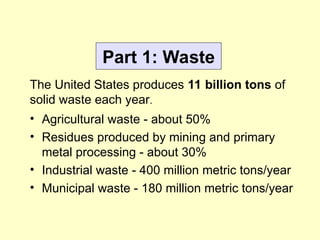
Part 1: Waste
• Agricultural waste - about 50%
• Residues produced by mining and primary
metal processing - about 30%
• Industrial waste - 400 million metric tons/year
• Municipal waste - 180 million metric tons/year
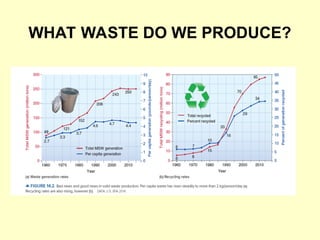
The United States produces 11 billion tons of
solid waste each year.
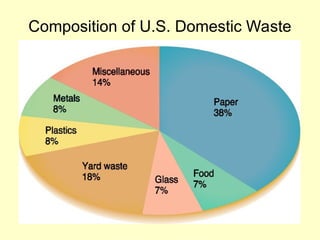
Composition of U.S. Domestic Waste
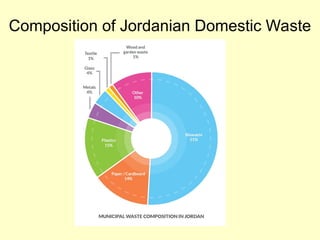
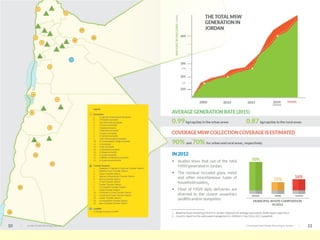
Composition of Jordanian Domestic Waste
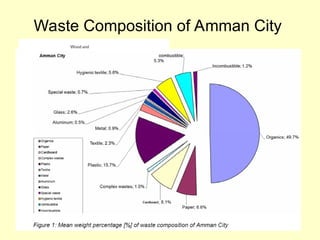
Waste Composition of Amman City
Composition of Jordanian Domestic Waste
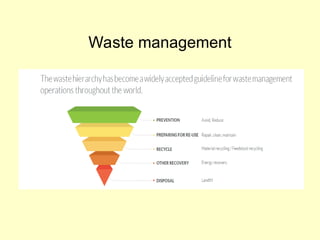
Waste management
The Waste Stream
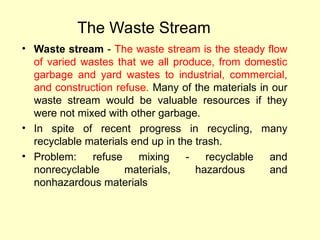
• Waste stream - The waste stream is the steady flow
of varied wastes that we all produce, from domestic
garbage and yard wastes to industrial, commercial,
and construction refuse. Many of the materials in our
waste stream would be valuable resources if they
were not mixed with other garbage.
• In spite of recent progress in recycling, many
recyclable materials end up in the trash.
• Problem: refuse mixing - recyclable and
nonrecyclable materials, hazardous and
nonhazardous materials
The Waste Stream
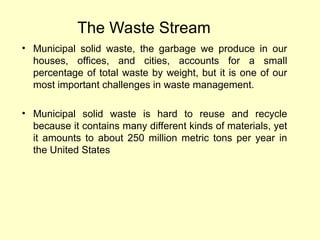
• Municipal solid waste, the garbage we produce in our
houses, offices, and cities, accounts for a small
percentage of total waste by weight, but it is one of our
most important challenges in waste management.
• Municipal solid waste is hard to reuse and recycle
because it contains many different kinds of materials, yet
it amounts to about 250 million metric tons per year in
the United States
WHAT WASTE DO WE PRODUCE?
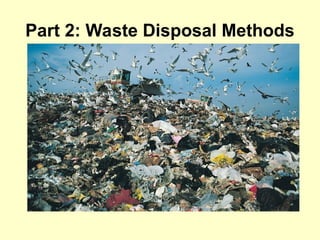
Part 2: Waste Disposal Methods
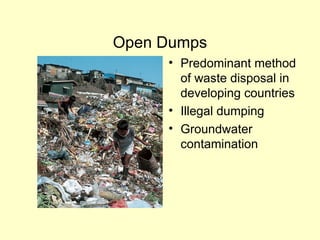
• Predominant method
of waste disposal in
developing countries
• Illegal dumping
• Groundwater
contamination
Open Dumps
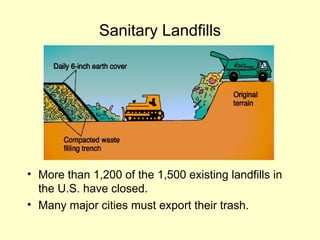
Sanitary Landfills
• More than 1,200 of the 1,500 existing landfills in
the U.S. have closed.
• Many major cities must export their trash.
“Garbage Imperialism”
• Although most industrialized nations in the world have
agreed to stop shipping hazardous and toxic waste to
less developed countries, the practice still continues.
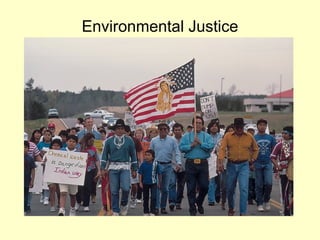
• Within rich nations, poor neighborhoods and minority
populations are more likely to be the recipients of
LULUs.(Locally Unwanted Land Uses. )
• These are facilities or land uses that, while necessary
or beneficial to society as a whole, are considered
undesirable by the communities in which they are
located due to their potential negative impacts.
Examples of LULUs include: Landfills, Power plants,
Industrial facilities, Waste treatment plants
Incineration and Resource Recovery
• Incineration - burning refuse
• Energy recovery - heat derived from
incineration is a useful resource
• Refuse-derived fuel: RDF is produced by processing
municipal solid waste to remove non-combustible materials. The
remaining combustible materials are then used as a fuel source, often in
industrial furnaces or power plants.
• Mass burn - greater problems with air pollution
• Residual ash - toxic components - dioxins
Incineration
• Can burn unseparated trash or separate trash that is
free of non combustibles such as glass or metal
• Heat used to produce steam for energy use, usually
electricity
• Became popular in the 1970’s during the oil crises
• Generation of toxic air pollutants was a problem
• Separating trash before burning helps
• In 1996, about 156 incinerators were operating in the
US (about 15.5% of solid waste output)
• Much higher in Europe, Japan, Scandanavia
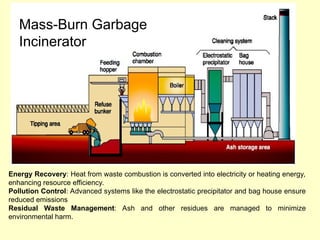
Mass-Burn Garbage
Incinerator
Energy Recovery: Heat from waste combustion is converted into electricity or heating energy,
enhancing resource efficiency.
Pollution Control: Advanced systems like the electrostatic precipitator and bag house ensure
reduced emissions
Residual Waste Management: Ash and other residues are managed to minimize
environmental harm.
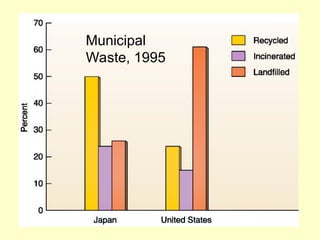
Municipal
Waste, 1995
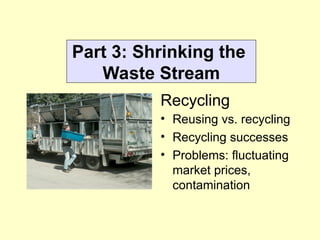
Part 3: Shrinking the
Waste Stream
• Reusing vs. recycling
• Recycling successes
• Problems: fluctuating
market prices,
contamination
Recycling
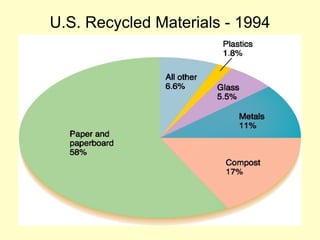
Recycling Benefits, Incentives
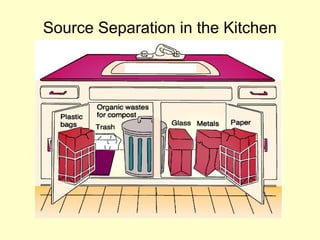
• Recycling saves money, energy, raw
materials, and land space, while also
reducing pollution.
• Recycling encourages individual awareness
and responsibility.
• Japan - probably the most successful
recycling program in the world
• Creating incentives for recycling - public
policies, consumer demand
Source Separation in the Kitchen
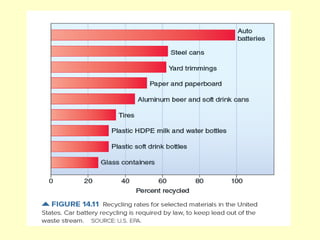
U.S. Recycled Materials - 1994
Composting
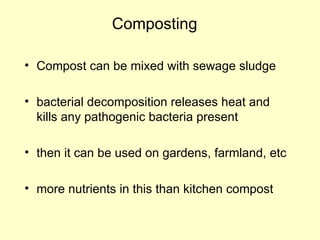
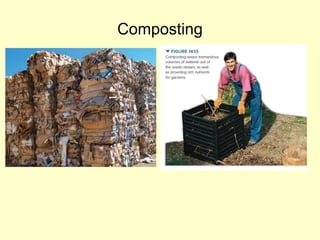
• Compost can be mixed with sewage sludge
• bacterial decomposition releases heat and
kills any pathogenic bacteria present
• then it can be used on gardens, farmland, etc
• more nutrients in this than kitchen compost
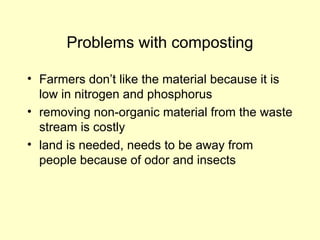
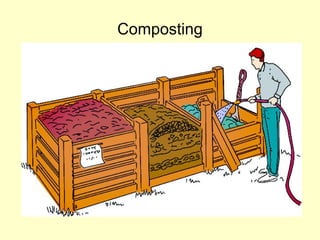
Problems with composting
• Farmers don’t like the material because it is
low in nitrogen and phosphorus
• removing non-organic material from the waste
stream is costly
• land is needed, needs to be away from
people because of odor and insects
Composting
Composting
Demanufacturing
• De-manufacturing - the disassembly and recycling
of obsolete consumer products
• Refrigerators and air conditioners - CFCs
• Computers and other electronics - both toxic and
valuable metals
• Problem: electronics that are turned in for recycling in
the U.S. are sometimes dumped in developing
countries
• Discarded electronics, or e-waste, is one of the
greatest sources of toxic material currently going to
developing countries. There are at least 2 billion
television sets and personal computers in use
globally.
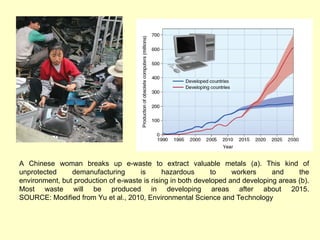
A Chinese woman breaks up e-waste to extract valuable metals (a). This kind of
unprotected demanufacturing is hazardous to workers and the
environment, but production of e-waste is rising in both developed and developing areas (b).
Most waste will be produced in developing areas after about 2015.
SOURCE: Modified from Yu et al., 2010, Environmental Science and Technology
Reuse
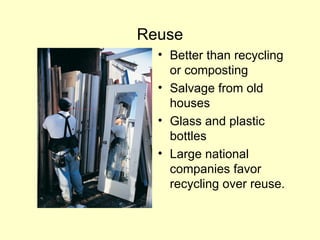
• Better than recycling
or composting
• Salvage from old
houses
• Glass and plastic
bottles
• Large national
companies favor
recycling over reuse.
Producing Less Waste
• The best way to reduce our waste stream
• Excess packaging of food and consumer
products is one of our greatest sources of
unnecessary waste.
• Photodegradable plastics - break down when
exposed to UV rays
• Biodegradable plastics - can be decomposed
by microorganisms
• Problems with photodegradable and
biodegradable plastics
The “Three R’s”
Reduce
Reuse
Recycle
Part 4: Hazardous and Toxic
Wastes
• What is hazardous waste?
• U.S. industries generate about about 265 million
metric tons of officially classified toxic wastes each
year.
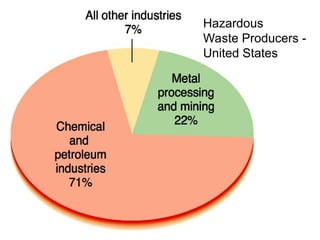
• Chemical and petroleum industries - biggest sources
of toxins
• Hazardous waste is any discarded material, liquid or
solid that contains substances known to be 1)fatal to
humans or laboratory animals 2) toxic carcinogenic,
mutagenic or teratogenic to human or other life
forms, 3)ignitable with a flash point less than 60C°,
4)corrosive, 5) explosive or highly reactive
Hazardous
Waste Producers -
United States
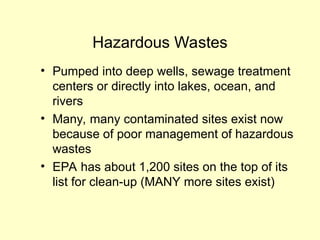
Hazardous Wastes
• Pumped into deep wells, sewage treatment
centers or directly into lakes, ocean, and
rivers
• Many, many contaminated sites exist now
because of poor management of hazardous
wastes
• EPA has about 1,200 sites on the top of its
list for clean-up (MANY more sites exist)
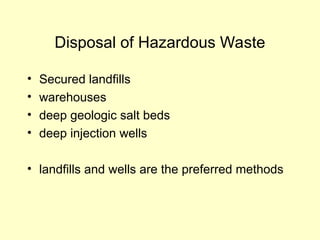
Disposal of Hazardous Waste
• Secured landfills
• warehouses
• deep geologic salt beds
• deep injection wells
• landfills and wells are the preferred methods
Disposal
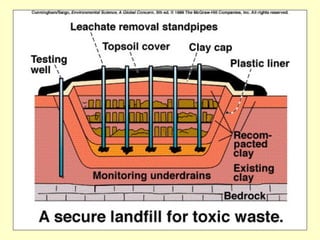
• Secured Landfills:
– most popular option
– impermeable clay liners, synthetic liners,
monitoring wells
– drain systems gathering liquids, detoxify
– careful siting of the landfills
– grading and compaction of soil over the
site minimizes infiltration, reducing
leaching
– what about cracks and earthquakes
Disposal
• Deep Injection Wells:
– 85% of HW is highly diluted with water
– Great amounts of toxic water
– Inject water into the earth’s crust between
layers of impermeable rock
– in theory, remains there forever
– but can migrate through unexpected fissures
in the rock and contaminate aquifers
– cracks in well casing, earthquakes
Hazardous Waste Disposal
• Resource Conservation and Recovery Act
(RCRA)
• Comprehensive Environmental Response,
Compensation, and Liability Act (CERCLA or
Superfund Act)
• Superfund Amendments and Reauthorization
Act (SARA) - Toxic Release Inventory
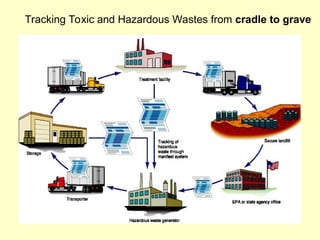
Tracking Toxic and Hazardous Wastes from cradle to grave
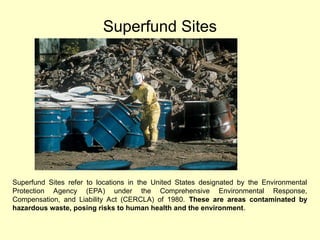
Superfund Sites
Superfund Sites refer to locations in the United States designated by the Environmental
Protection Agency (EPA) under the Comprehensive Environmental Response,
Compensation, and Liability Act (CERCLA) of 1980. These are areas contaminated by
hazardous waste, posing risks to human health and the environment.
National Priority List (NPL)
• EPA estimate: 36,000 seriously contaminated
sites in the U.S.
• General Accounting Office (GAO) estimate:
400,000 seriously contaminated sites
• National Priority List (NPL) sites - waste sites
that are especially hazardous to human health or
environmental quality for cleanup with financing
from Superfund.
• How clean is clean?
• Brownfields - liability risks discourage
redevelopment
Environmental Justice
Options for Hazardous Waste
Management
• Produce less waste
• Physical treatments
• Incineration
• Chemical processing
• Permanent retrievable storage
• Secure landfills
• Bioremediation
Options for Hazardous Waste
Management
• Produce Less Waste As with other wastes, the safest
and least expensive way to avoid hazardous waste
problems is to avoid creating the wastes in the first place.
• Convert to Less Hazardous Substances Several
processes are available to make hazardous materials
less toxic. Physical treatments tie up or isolate
substances
• Permanent retrievable storage involves placing waste
storage containers in a secure place such as a salt mine
or bedrock cavern, where they can be inspected
periodically and retrieved if necessary.
Options for Hazardous Waste
Management
• Store Permanently Inevitably, there are some materials
we can’t destroy, make into something else, or otherwise
eliminate. We will have to store them out of harm’s way
(fig. 14.21).
• Permanent retrievable storage involves placing waste
storage containers in a secure place such as a salt mine
or bedrock cavern,
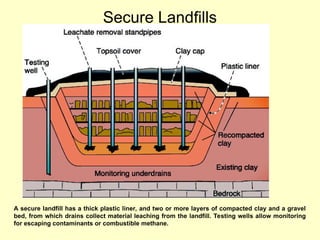
• Secure landfills are the most popular solutions for
hazardous waste disposal, however. Although many
landfills have been environmental disasters, newer
techniques make it possible to create safe, secure,
modern landfills that can contain many hazardous
wastes.
Secure Landfills
A secure landfill has a thick plastic liner, and two or more layers of compacted clay and a gravel
bed, from which drains collect material leaching from the landfill. Testing wells allow monitoring
for escaping contaminants or combustible methane.
Options for Hazardous Waste
Management
• Bioremediation, or biological waste treatment, offer
promising prospects for business development as well as
for environmental health and saving taxpayer money.
• A promising alternative to these methods involves
bioremediation. Microscopic bacteria and fungi can
absorb, accumulate, and detoxify a remarkable variety of
toxic compounds. They can also accumulate heavy
metals, and some have been developed that can
metabolize (break down) PCBs. Aquatic plants such as
water hyacinths and cattails can also be used to purify
contaminated effluent.

chapter 11 Solid and Hazardous Wastes.ppt

  • 1.
    Solid and HazardousWastes Prof. Dr. Ali El-Naqa 2023/2024 Hashemite University, Department of Water Management & Environment
  • 2.
    Chapter 13 -Topics • Waste • Waste-Disposal Methods • Shrinking the Waste Stream • Hazardous and Toxic Wastes
  • 3.
    Learning Objectives • identifythe major components of the waste stream, and describe how wastes have been-and are being-disposed of in North America and around the world. • explain the differences between dumps, sanitary landfills, and modern, secure landfills. • summarize the benefits, problems, and potential of recycling and reusing wastes. • analyze some alternatives for reducing the waste we generate.
  • 4.
    Learning Objectives • understandwhat hazardous and toxic wastes are and how we dispose of them. • evaluate the options for hazardous-waste management. • outline some ways we can destroy or permanently store hazardous wastes.
  • 5.
    Part 1: Waste •Agricultural waste - about 50% • Residues produced by mining and primary metal processing - about 30% • Industrial waste - 400 million metric tons/year • Municipal waste - 180 million metric tons/year The United States produces 11 billion tons of solid waste each year.
  • 6.
    Composition of U.S.Domestic Waste
  • 7.
  • 8.
  • 9.
  • 10.
  • 11.
    The Waste Stream •Waste stream - The waste stream is the steady flow of varied wastes that we all produce, from domestic garbage and yard wastes to industrial, commercial, and construction refuse. Many of the materials in our waste stream would be valuable resources if they were not mixed with other garbage. • In spite of recent progress in recycling, many recyclable materials end up in the trash. • Problem: refuse mixing - recyclable and nonrecyclable materials, hazardous and nonhazardous materials
  • 12.
    The Waste Stream •Municipal solid waste, the garbage we produce in our houses, offices, and cities, accounts for a small percentage of total waste by weight, but it is one of our most important challenges in waste management. • Municipal solid waste is hard to reuse and recycle because it contains many different kinds of materials, yet it amounts to about 250 million metric tons per year in the United States
  • 13.
    WHAT WASTE DOWE PRODUCE?
  • 14.
    Part 2: WasteDisposal Methods
  • 15.
    • Predominant method ofwaste disposal in developing countries • Illegal dumping • Groundwater contamination Open Dumps
  • 16.
    Sanitary Landfills • Morethan 1,200 of the 1,500 existing landfills in the U.S. have closed. • Many major cities must export their trash.
  • 17.
    “Garbage Imperialism” • Althoughmost industrialized nations in the world have agreed to stop shipping hazardous and toxic waste to less developed countries, the practice still continues. • Within rich nations, poor neighborhoods and minority populations are more likely to be the recipients of LULUs.(Locally Unwanted Land Uses. ) • These are facilities or land uses that, while necessary or beneficial to society as a whole, are considered undesirable by the communities in which they are located due to their potential negative impacts. Examples of LULUs include: Landfills, Power plants, Industrial facilities, Waste treatment plants
  • 18.
    Incineration and ResourceRecovery • Incineration - burning refuse • Energy recovery - heat derived from incineration is a useful resource • Refuse-derived fuel: RDF is produced by processing municipal solid waste to remove non-combustible materials. The remaining combustible materials are then used as a fuel source, often in industrial furnaces or power plants. • Mass burn - greater problems with air pollution • Residual ash - toxic components - dioxins
  • 19.
    Incineration • Can burnunseparated trash or separate trash that is free of non combustibles such as glass or metal • Heat used to produce steam for energy use, usually electricity • Became popular in the 1970’s during the oil crises • Generation of toxic air pollutants was a problem • Separating trash before burning helps • In 1996, about 156 incinerators were operating in the US (about 15.5% of solid waste output) • Much higher in Europe, Japan, Scandanavia
  • 20.
    Mass-Burn Garbage Incinerator Energy Recovery:Heat from waste combustion is converted into electricity or heating energy, enhancing resource efficiency. Pollution Control: Advanced systems like the electrostatic precipitator and bag house ensure reduced emissions Residual Waste Management: Ash and other residues are managed to minimize environmental harm.
  • 21.
  • 22.
    Part 3: Shrinkingthe Waste Stream • Reusing vs. recycling • Recycling successes • Problems: fluctuating market prices, contamination Recycling
  • 23.
    Recycling Benefits, Incentives •Recycling saves money, energy, raw materials, and land space, while also reducing pollution. • Recycling encourages individual awareness and responsibility. • Japan - probably the most successful recycling program in the world • Creating incentives for recycling - public policies, consumer demand
  • 25.
  • 26.
  • 27.
    Composting • Compost canbe mixed with sewage sludge • bacterial decomposition releases heat and kills any pathogenic bacteria present • then it can be used on gardens, farmland, etc • more nutrients in this than kitchen compost
  • 28.
    Problems with composting •Farmers don’t like the material because it is low in nitrogen and phosphorus • removing non-organic material from the waste stream is costly • land is needed, needs to be away from people because of odor and insects
  • 29.
  • 30.
  • 31.
    Demanufacturing • De-manufacturing -the disassembly and recycling of obsolete consumer products • Refrigerators and air conditioners - CFCs • Computers and other electronics - both toxic and valuable metals • Problem: electronics that are turned in for recycling in the U.S. are sometimes dumped in developing countries • Discarded electronics, or e-waste, is one of the greatest sources of toxic material currently going to developing countries. There are at least 2 billion television sets and personal computers in use globally.
  • 32.
    A Chinese womanbreaks up e-waste to extract valuable metals (a). This kind of unprotected demanufacturing is hazardous to workers and the environment, but production of e-waste is rising in both developed and developing areas (b). Most waste will be produced in developing areas after about 2015. SOURCE: Modified from Yu et al., 2010, Environmental Science and Technology
  • 33.
    Reuse • Better thanrecycling or composting • Salvage from old houses • Glass and plastic bottles • Large national companies favor recycling over reuse.
  • 34.
    Producing Less Waste •The best way to reduce our waste stream • Excess packaging of food and consumer products is one of our greatest sources of unnecessary waste. • Photodegradable plastics - break down when exposed to UV rays • Biodegradable plastics - can be decomposed by microorganisms • Problems with photodegradable and biodegradable plastics
  • 35.
  • 36.
    Part 4: Hazardousand Toxic Wastes • What is hazardous waste? • U.S. industries generate about about 265 million metric tons of officially classified toxic wastes each year. • Chemical and petroleum industries - biggest sources of toxins • Hazardous waste is any discarded material, liquid or solid that contains substances known to be 1)fatal to humans or laboratory animals 2) toxic carcinogenic, mutagenic or teratogenic to human or other life forms, 3)ignitable with a flash point less than 60C°, 4)corrosive, 5) explosive or highly reactive
  • 37.
  • 38.
    Hazardous Wastes • Pumpedinto deep wells, sewage treatment centers or directly into lakes, ocean, and rivers • Many, many contaminated sites exist now because of poor management of hazardous wastes • EPA has about 1,200 sites on the top of its list for clean-up (MANY more sites exist)
  • 39.
    Disposal of HazardousWaste • Secured landfills • warehouses • deep geologic salt beds • deep injection wells • landfills and wells are the preferred methods
  • 40.
    Disposal • Secured Landfills: –most popular option – impermeable clay liners, synthetic liners, monitoring wells – drain systems gathering liquids, detoxify – careful siting of the landfills – grading and compaction of soil over the site minimizes infiltration, reducing leaching – what about cracks and earthquakes
  • 42.
    Disposal • Deep InjectionWells: – 85% of HW is highly diluted with water – Great amounts of toxic water – Inject water into the earth’s crust between layers of impermeable rock – in theory, remains there forever – but can migrate through unexpected fissures in the rock and contaminate aquifers – cracks in well casing, earthquakes
  • 43.
    Hazardous Waste Disposal •Resource Conservation and Recovery Act (RCRA) • Comprehensive Environmental Response, Compensation, and Liability Act (CERCLA or Superfund Act) • Superfund Amendments and Reauthorization Act (SARA) - Toxic Release Inventory
  • 44.
    Tracking Toxic andHazardous Wastes from cradle to grave
  • 45.
    Superfund Sites Superfund Sitesrefer to locations in the United States designated by the Environmental Protection Agency (EPA) under the Comprehensive Environmental Response, Compensation, and Liability Act (CERCLA) of 1980. These are areas contaminated by hazardous waste, posing risks to human health and the environment.
  • 46.
    National Priority List(NPL) • EPA estimate: 36,000 seriously contaminated sites in the U.S. • General Accounting Office (GAO) estimate: 400,000 seriously contaminated sites • National Priority List (NPL) sites - waste sites that are especially hazardous to human health or environmental quality for cleanup with financing from Superfund. • How clean is clean? • Brownfields - liability risks discourage redevelopment
  • 47.
  • 48.
    Options for HazardousWaste Management • Produce less waste • Physical treatments • Incineration • Chemical processing • Permanent retrievable storage • Secure landfills • Bioremediation
  • 49.
    Options for HazardousWaste Management • Produce Less Waste As with other wastes, the safest and least expensive way to avoid hazardous waste problems is to avoid creating the wastes in the first place. • Convert to Less Hazardous Substances Several processes are available to make hazardous materials less toxic. Physical treatments tie up or isolate substances • Permanent retrievable storage involves placing waste storage containers in a secure place such as a salt mine or bedrock cavern, where they can be inspected periodically and retrieved if necessary.
  • 50.
    Options for HazardousWaste Management • Store Permanently Inevitably, there are some materials we can’t destroy, make into something else, or otherwise eliminate. We will have to store them out of harm’s way (fig. 14.21). • Permanent retrievable storage involves placing waste storage containers in a secure place such as a salt mine or bedrock cavern, • Secure landfills are the most popular solutions for hazardous waste disposal, however. Although many landfills have been environmental disasters, newer techniques make it possible to create safe, secure, modern landfills that can contain many hazardous wastes.
  • 51.
    Secure Landfills A securelandfill has a thick plastic liner, and two or more layers of compacted clay and a gravel bed, from which drains collect material leaching from the landfill. Testing wells allow monitoring for escaping contaminants or combustible methane.
  • 52.
    Options for HazardousWaste Management • Bioremediation, or biological waste treatment, offer promising prospects for business development as well as for environmental health and saving taxpayer money. • A promising alternative to these methods involves bioremediation. Microscopic bacteria and fungi can absorb, accumulate, and detoxify a remarkable variety of toxic compounds. They can also accumulate heavy metals, and some have been developed that can metabolize (break down) PCBs. Aquatic plants such as water hyacinths and cattails can also be used to purify contaminated effluent.