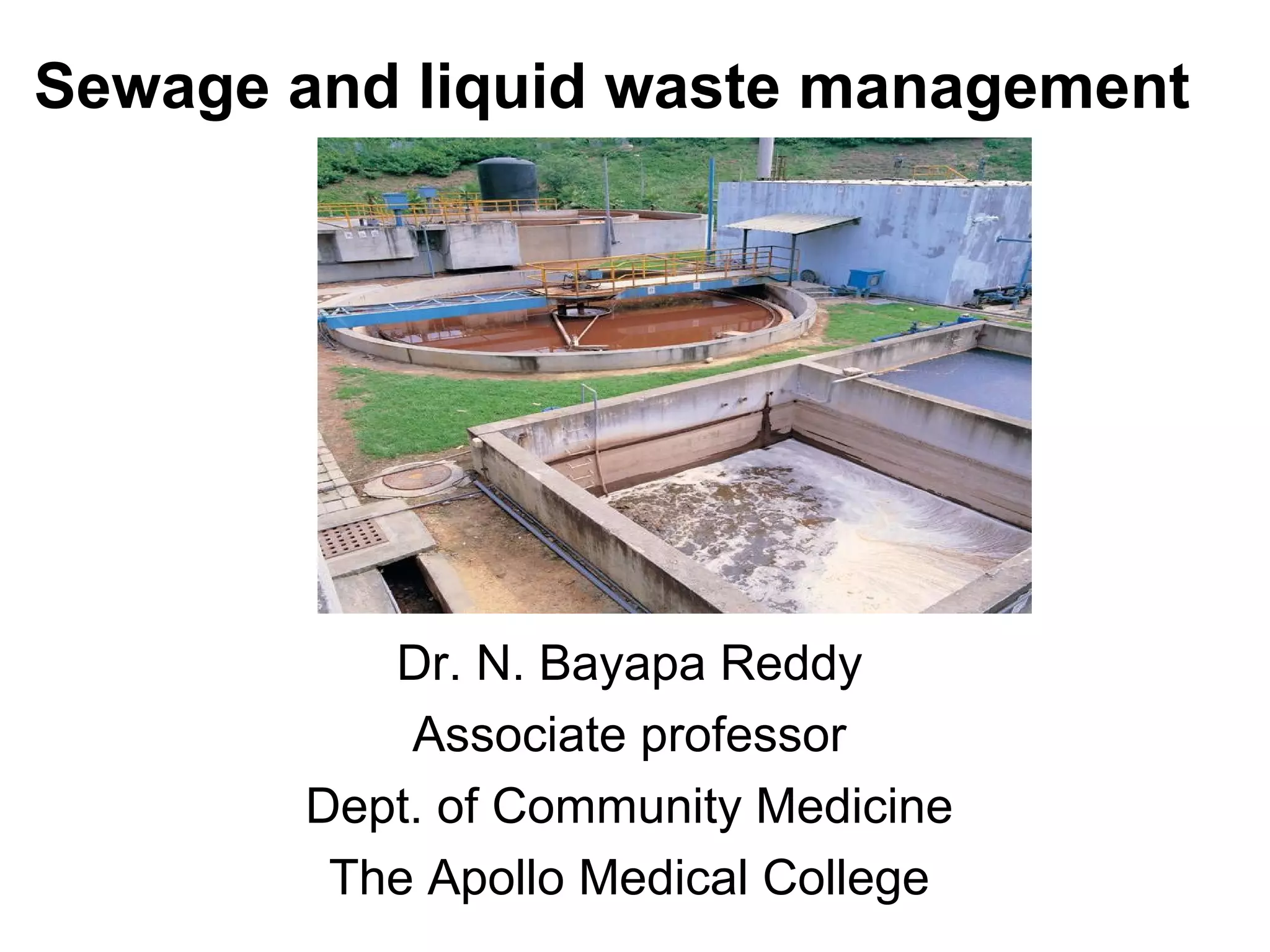
Sewage and liquid waste management
Dr. N. Bayapa Reddy
Associate professor
Dept. of Community Medicine
The Apollo Medical College
Definitions
Sewage: Waste water consisting of liquid & solid human
excreta together with Liquid from houses, cow-shed,
stables, & factories.
Sullage: waste water without human excreta
Dry weather flow: the average amount of sewage which
flows through the sewerage system in 24 hours
Sewage Treatment
• Wastewater treatment consists of applying known
technology to improve or upgrade the quality of a
wastewater
Urban Waste Water
• Sources:
Wastewater produced by residential and commercial
establishments and discharged into sewers
• What is in it?
– Domestic waste
– Industry
– Rainwater run-off
STP
• Sewage can be treated close to where it is created in
septic tanks, Biofilters or aerobic treatment systems, or
collected and transported to a municipal treatment plant
• The principal objective of wastewater treatment is
generally to allow human and industrial effluents to be
disposed off without danger to human health or
unacceptable damage to the natural environment
Health aspects
• Creation of nuisance, unsightliness and unpleasant
odours
• Breeding of flies and mosquitoes
• Pollution of soil and water supplies
• Contamination of food
• Increase in the incidence of disease especially enteric
and helmenthic diseases
Aim of sewage purification
• Raw sewage or inadequately treated sewage should
not be discharged into rivers, sea or other source of
water supply
• The Oxygen in the water is consumed by aerobic
bacteria
• Stabilize the organic matter so that it can be disposed
off safely
• Convert the sewage water into an effluent of an
acceptable standards
The strength of sewage is expressed
• Biological oxygen demand (BOD):- the amount of
oxygen absorbed by a sample of sewage during
specific period (5days) at specific temperature (200
C)
– Normal 300 mg/l
– if its more than that it is strong
– If it is 100 mg/L it is weak
• Chemical Oxygen Demand (COD)
• Suspended solids 100-500 ppm
– SPM 100 ppm it is waek
– SPM 500 ppm it is strong
Treatment
• Pre-treatment
• Primary treatment
• Secondary treatment
• Tertiary treatment
• Sludge treatment
• Sludge disposal
Conventional wastewater treatment
processes
Conventional wastewater treatment consists of a
combination of physical, chemical and biological
processes and operations to remove solids, organic
matter and sometimes, nutrients from wastewater.
General terms used to describe different degrees of
treatment, in order of increasing treatment level, are
preliminary, primary, secondary, and tertiary and/or
advanced wastewater treatment.
In some countries, disinfection to remove pathogens
sometimes follows the last treatment step
Pre-treatment
• Screens
– Remove large debris (large organic matter)
– Remove suspended solids
• Grit traps
– Slow down flow rate to allow coarse grit to settle
out
• Mechanical
• Landfill or recycled
A. screening
screening Metal screen which intercepts
large floating objects to prevent clogging
of treatment plant.
B. Removal of grit
• This chamber is approximately
– 10 to 20 mts in length;
– it is so designed as to maintain a constant velocity of
about 1 foot per second,
– with a detention period of 30 seconds to 1 minute
• Grit chamber is to allow the settlement of heavier solids
such as sand and gravel, while permitting the organic
matter to pass through.
• The grit which collects at the bottom of the chamber
is removed periodically or continuously.
Grit chamber
Aerated grit chamber :
diffused air keeps organic
solids in suspension as grit
settles
Vortex - Type Grit Chambers
Vortex is created
-Grit move to the outside
of the unit and gets collected
Primary Sedimentation or primary clarifiers
• The tanks are large enough to hold from 1/4 to 1/3 the
dry weather flow
• Sewage is made to flow very slowly across the tank at
a velocity of 1-2 feet per minute.
• spends about 6-8 hours in the tank
• Nearly 50-70 per cent of the solids settle down under
the influence of gravity
• that sludge can settle and floating material such as
grease and oils can rise to the surface and be
skimmed off.
Primary treatment
The objective of primary treatment is the removal of settle-
able organic and inorganic solids by sedimentation, and
the removal of materials that will float (scum) by skimming
Approximately 25 to 50% of the incoming biochemical
oxygen demand (BOD5), 50 to 70% of the total suspended
solids (SS), and 65% of the oil and grease are removed
during primary treatment
Some organic nitrogen, organic phosphorus, and heavy
metals associated with solids are also removed during
primary sedimentation
Primary Sedimentation Tank
Secondary Treatment
The treatment processes used to reduce
the BOD of sewage waste are secondary
treatment processes.
Secondary Treatment
• Removes dissolved organic material
– Activated sludge
– Trickling filter beds
• Using aerobic biological processes to consume soluble organic
contaminants
– Oxygen
– Bacteria
A. Trickling Filters / Percolating filter
The trickling filter or percolating filter is a bed of
crushed stones or cinker, 1 to 2 m (4-8 ft.) deep
and 2 to 30 m (6-100 ft.) in diameter
The effluent from the primary sedimentation tank
is sprinkled uniformly on the surface of the bed
by a revolving device.
The device consists of hollow pipes each of which
have a row of holes.
zoogleallayer
• Over the surface and down through the
filter
– a very complex biological growth consisting of
algae, fungi, protozoa and bacteria of many
kinds occurs. This is known as the
"zoogleallayer".
– zoogleal layer lives, grows and dies. The
dead matter sloughs off, It is a light green,
flocculent material and is called "humus".
Trickling Filter Beds
• Sewage sprinkled over porous
material
• Contains micro-organisms
– Breaks down organic matter
– Reduces BOD
• Rotating ars
• Beds of:
– Coke
– Limestone
– Plastic
• Large surface area
• Drains collect water and provide
oxygen
• May need recirculation
B. Activated sludge process
• Activated Sludge is a widely used aerobic method of
sewage treatment.
• After primary settling, the waste stream is brought to
an aeration tank.
• The effluent from the primary sedimentation tank is
mixed with sludge drawn from the final settling tank
(also known as activated sludge or return sludge; this
sludge is a rich culture of aerobic bacteria).
• The "heart" of the activated sludge process is the
aeration tank.
• The mixture is subjected to aeration in the aeration
chamber for about 6 to 8 hours
Activated Sludge and Aeration
• Addition of solids
rich in micro-
organisms and
dissolved oxygen
• Promotes the
growth of
biological flocs
• Helps decompose
organic matter
• The typhoid and cholera organisms are definitely
destroyed, and the coliforms greatly reduced.
• Activated sludge plants occupy less space, require
skilled operations.
• One acre of activated sludge plant does the work of
10 acres of percolating filter.
Secondary sedimentation
• The oxidized sewage from the trickling filter or aeration
chamber is led into the secondary sedimentation tank
where it is detained for 2-3 hours.
• The sludge that collects in the secondary sedimentation
tank is called 'aerated sludge' or activated sludge,
because it is fully aerated.
• Part of the activated sludge is pumped back into the
"aeration tanks" in the activated sludge process and the
rest pumped into the sludge digestion tanks for
treatment and disposal
Sludge digestion
• One of greatest problems associated with sewage
treatment is the treatment and disposal of the
resulting sludge.
• One million gallons of sewage produces 15-20 tons of
sludge.
• The sludge is a thick, black mass containing 95 per
cent of water, and it has a revolting odour.
Sludge disposal
• Digestion: If sludge is incubated under favourable
conditions of temperature and pH, it undergoes
anaerobic auto-digestion in which complex solids are
broken down into water, carbon dioxide, methane and
ammonia.
• The volume of sludge is also considerably reduced. It
takes 3-4 weeks or longer for complete sludge
digestion.
• Sea Disposal: Sea coast towns and cities can dispose of
sludge by pumping it into the sea
• Land: Sludge can be disposed of by composting with
town refuse.
Disposal of Effluent
• Disposal by dilution: Disposal into water courses
such as rivers and streams is called 'disposal by
dilution‘
– Recommended that an effluent from a sewage
treatment plant should not have more than SPM 30
mg/litre
– B.O.D. should not exceed 20 mg/ l of 5 days .
• Disposal on Land : effluent can be used for irrigation
purposes
• Disinfection is the final step in the sewage treatment
process
• Designed to kill entero pathogenic bacteria and
viruses that were not eliminated during the previous
stages of treatment.
• Disinfect ion is commonly done by chlorination with
chlorine gas or hypo chlorite Dose 5-25 mg / L 99.9
% reduction of coliform
Chlorination
32
Stabilization Ponds for
Wastewater Treatment
oxidation pond
• The organic matter contained in the sewage is oxidized
by bacteria (hence oxidation pond) to simple chemical
compounds such as carbon dioxide, ammonia and water.
• A cheap method of sewage treatment is the oxidation
pond
• there must be the presence of
– (1) algae
– (2) certain types of bacteria which feed on decaying
organic matter, and
– (3) sun-light.
34
Stabilization Ponds
• The algae, with the help of sunlight, utilize the carbon
dioxide, water and inorganic minerals for their
growth
• Oxygen that is needed for oxidation is derived
– small extent from the atmosphere
– mostly from the algae which liberates oxygen
under the influence of sunlight.
– The oxidation ponds are predominantly aerobic
during sunshine hours as well as some hours of the
night.
– In the remaining hours of the night, the bottom
layers are generally anaerobic
oxidation pond
• The effluent may be used for growing vegetable crops
(land irrigation) or may be discharged into a river or
other water courses after appropriate treatment.
• Oxidation ponds have become an established method
of purifying sewage for small communities.
36
Pretreatment Classifications
• None – receives raw untreated WW
• Screening – receives screened raw
untreated WW
• Primary – pond acts as a form of
secondary treatment
• Secondary-pond acts as a tertiary
(polishing) treatment
Example---Milo, Maine
http://www.mwwca.org/milo.htm
Summery of Oxidation pond
Sewage and liquid waste management

Sewage and liquid waste management

  • 1.
    Sewage and liquidwaste management Dr. N. Bayapa Reddy Associate professor Dept. of Community Medicine The Apollo Medical College
  • 2.
    Definitions Sewage: Waste waterconsisting of liquid & solid human excreta together with Liquid from houses, cow-shed, stables, & factories. Sullage: waste water without human excreta Dry weather flow: the average amount of sewage which flows through the sewerage system in 24 hours Sewage Treatment • Wastewater treatment consists of applying known technology to improve or upgrade the quality of a wastewater
  • 3.
    Urban Waste Water •Sources: Wastewater produced by residential and commercial establishments and discharged into sewers • What is in it? – Domestic waste – Industry – Rainwater run-off
  • 4.
    STP • Sewage canbe treated close to where it is created in septic tanks, Biofilters or aerobic treatment systems, or collected and transported to a municipal treatment plant • The principal objective of wastewater treatment is generally to allow human and industrial effluents to be disposed off without danger to human health or unacceptable damage to the natural environment
  • 5.
    Health aspects • Creationof nuisance, unsightliness and unpleasant odours • Breeding of flies and mosquitoes • Pollution of soil and water supplies • Contamination of food • Increase in the incidence of disease especially enteric and helmenthic diseases
  • 6.
    Aim of sewagepurification • Raw sewage or inadequately treated sewage should not be discharged into rivers, sea or other source of water supply • The Oxygen in the water is consumed by aerobic bacteria • Stabilize the organic matter so that it can be disposed off safely • Convert the sewage water into an effluent of an acceptable standards
  • 7.
    The strength ofsewage is expressed • Biological oxygen demand (BOD):- the amount of oxygen absorbed by a sample of sewage during specific period (5days) at specific temperature (200 C) – Normal 300 mg/l – if its more than that it is strong – If it is 100 mg/L it is weak • Chemical Oxygen Demand (COD) • Suspended solids 100-500 ppm – SPM 100 ppm it is waek – SPM 500 ppm it is strong
  • 8.
    Treatment • Pre-treatment • Primarytreatment • Secondary treatment • Tertiary treatment • Sludge treatment • Sludge disposal
  • 9.
  • 10.
    Conventional wastewater treatmentconsists of a combination of physical, chemical and biological processes and operations to remove solids, organic matter and sometimes, nutrients from wastewater. General terms used to describe different degrees of treatment, in order of increasing treatment level, are preliminary, primary, secondary, and tertiary and/or advanced wastewater treatment. In some countries, disinfection to remove pathogens sometimes follows the last treatment step
  • 11.
    Pre-treatment • Screens – Removelarge debris (large organic matter) – Remove suspended solids • Grit traps – Slow down flow rate to allow coarse grit to settle out • Mechanical • Landfill or recycled
  • 12.
    A. screening screening Metalscreen which intercepts large floating objects to prevent clogging of treatment plant.
  • 13.
    B. Removal ofgrit • This chamber is approximately – 10 to 20 mts in length; – it is so designed as to maintain a constant velocity of about 1 foot per second, – with a detention period of 30 seconds to 1 minute • Grit chamber is to allow the settlement of heavier solids such as sand and gravel, while permitting the organic matter to pass through. • The grit which collects at the bottom of the chamber is removed periodically or continuously.
  • 14.
    Grit chamber Aerated gritchamber : diffused air keeps organic solids in suspension as grit settles Vortex - Type Grit Chambers Vortex is created -Grit move to the outside of the unit and gets collected
  • 15.
    Primary Sedimentation orprimary clarifiers • The tanks are large enough to hold from 1/4 to 1/3 the dry weather flow • Sewage is made to flow very slowly across the tank at a velocity of 1-2 feet per minute. • spends about 6-8 hours in the tank • Nearly 50-70 per cent of the solids settle down under the influence of gravity • that sludge can settle and floating material such as grease and oils can rise to the surface and be skimmed off.
  • 16.
    Primary treatment The objectiveof primary treatment is the removal of settle- able organic and inorganic solids by sedimentation, and the removal of materials that will float (scum) by skimming Approximately 25 to 50% of the incoming biochemical oxygen demand (BOD5), 50 to 70% of the total suspended solids (SS), and 65% of the oil and grease are removed during primary treatment Some organic nitrogen, organic phosphorus, and heavy metals associated with solids are also removed during primary sedimentation
  • 17.
  • 18.
    Secondary Treatment The treatmentprocesses used to reduce the BOD of sewage waste are secondary treatment processes.
  • 19.
    Secondary Treatment • Removesdissolved organic material – Activated sludge – Trickling filter beds • Using aerobic biological processes to consume soluble organic contaminants – Oxygen – Bacteria
  • 20.
    A. Trickling Filters/ Percolating filter The trickling filter or percolating filter is a bed of crushed stones or cinker, 1 to 2 m (4-8 ft.) deep and 2 to 30 m (6-100 ft.) in diameter The effluent from the primary sedimentation tank is sprinkled uniformly on the surface of the bed by a revolving device. The device consists of hollow pipes each of which have a row of holes.
  • 21.
    zoogleallayer • Over thesurface and down through the filter – a very complex biological growth consisting of algae, fungi, protozoa and bacteria of many kinds occurs. This is known as the "zoogleallayer". – zoogleal layer lives, grows and dies. The dead matter sloughs off, It is a light green, flocculent material and is called "humus".
  • 22.
    Trickling Filter Beds •Sewage sprinkled over porous material • Contains micro-organisms – Breaks down organic matter – Reduces BOD • Rotating ars • Beds of: – Coke – Limestone – Plastic • Large surface area • Drains collect water and provide oxygen • May need recirculation
  • 23.
    B. Activated sludgeprocess • Activated Sludge is a widely used aerobic method of sewage treatment. • After primary settling, the waste stream is brought to an aeration tank. • The effluent from the primary sedimentation tank is mixed with sludge drawn from the final settling tank (also known as activated sludge or return sludge; this sludge is a rich culture of aerobic bacteria). • The "heart" of the activated sludge process is the aeration tank. • The mixture is subjected to aeration in the aeration chamber for about 6 to 8 hours
  • 24.
    Activated Sludge andAeration • Addition of solids rich in micro- organisms and dissolved oxygen • Promotes the growth of biological flocs • Helps decompose organic matter
  • 25.
    • The typhoidand cholera organisms are definitely destroyed, and the coliforms greatly reduced. • Activated sludge plants occupy less space, require skilled operations. • One acre of activated sludge plant does the work of 10 acres of percolating filter.
  • 26.
    Secondary sedimentation • Theoxidized sewage from the trickling filter or aeration chamber is led into the secondary sedimentation tank where it is detained for 2-3 hours. • The sludge that collects in the secondary sedimentation tank is called 'aerated sludge' or activated sludge, because it is fully aerated. • Part of the activated sludge is pumped back into the "aeration tanks" in the activated sludge process and the rest pumped into the sludge digestion tanks for treatment and disposal
  • 27.
    Sludge digestion • Oneof greatest problems associated with sewage treatment is the treatment and disposal of the resulting sludge. • One million gallons of sewage produces 15-20 tons of sludge. • The sludge is a thick, black mass containing 95 per cent of water, and it has a revolting odour.
  • 28.
    Sludge disposal • Digestion:If sludge is incubated under favourable conditions of temperature and pH, it undergoes anaerobic auto-digestion in which complex solids are broken down into water, carbon dioxide, methane and ammonia. • The volume of sludge is also considerably reduced. It takes 3-4 weeks or longer for complete sludge digestion. • Sea Disposal: Sea coast towns and cities can dispose of sludge by pumping it into the sea • Land: Sludge can be disposed of by composting with town refuse.
  • 30.
    Disposal of Effluent •Disposal by dilution: Disposal into water courses such as rivers and streams is called 'disposal by dilution‘ – Recommended that an effluent from a sewage treatment plant should not have more than SPM 30 mg/litre – B.O.D. should not exceed 20 mg/ l of 5 days . • Disposal on Land : effluent can be used for irrigation purposes
  • 31.
    • Disinfection isthe final step in the sewage treatment process • Designed to kill entero pathogenic bacteria and viruses that were not eliminated during the previous stages of treatment. • Disinfect ion is commonly done by chlorination with chlorine gas or hypo chlorite Dose 5-25 mg / L 99.9 % reduction of coliform Chlorination
  • 32.
  • 33.
    oxidation pond • Theorganic matter contained in the sewage is oxidized by bacteria (hence oxidation pond) to simple chemical compounds such as carbon dioxide, ammonia and water. • A cheap method of sewage treatment is the oxidation pond • there must be the presence of – (1) algae – (2) certain types of bacteria which feed on decaying organic matter, and – (3) sun-light.
  • 34.
    34 Stabilization Ponds • Thealgae, with the help of sunlight, utilize the carbon dioxide, water and inorganic minerals for their growth • Oxygen that is needed for oxidation is derived – small extent from the atmosphere – mostly from the algae which liberates oxygen under the influence of sunlight. – The oxidation ponds are predominantly aerobic during sunshine hours as well as some hours of the night. – In the remaining hours of the night, the bottom layers are generally anaerobic
  • 35.
    oxidation pond • Theeffluent may be used for growing vegetable crops (land irrigation) or may be discharged into a river or other water courses after appropriate treatment. • Oxidation ponds have become an established method of purifying sewage for small communities.
  • 36.
    36 Pretreatment Classifications • None– receives raw untreated WW • Screening – receives screened raw untreated WW • Primary – pond acts as a form of secondary treatment • Secondary-pond acts as a tertiary (polishing) treatment
  • 37.
  • 39.