Surya Narayan Pradhan et al Int. Journal of Engineering Research and Applications www.ijera.com
ISSN : 2248-9622, Vol. 4, Issue 5( Version 1), May 2014, pp.149-153
www.ijera.com 149 | P a g e
Design & Implementation of a Low Cost Based Wireless HCI
System for Disabled Persons Using ARM7
Surya Narayan Pradhan*, Debidatta Acharya**, Soumyashree Mongaraj***
*M.Tech Student (Department of Electronics & Communication, KIIT University, Bhubaneswar, INDIA)
**M.Tech Student (Department of Electronics & Communication, KIIT University, Bhubaneswar, INDIA)
*** Assistant Professor (Department of Electronics & Communication, KIIT University, Bhubaneswar, INDIA)
Abstract
This paper focuses on design & development of a portable wireless Human Computer Interface (HCI) system to
create a robust hands free interface for disabled peoples or peoples having upper limb motor paralysis. Early
techniques mainly considered image processing, gaze tracking and cameras to synthesis the device. We propose
a new mouse as an input device for a computer whose operation is based on measurement of rotations of the
user‘s head and detection of eye blinks. A tilt sensor(3-axis accelerometer) is used to detect both lateral and
vertical head movements to navigate the mouse cursor position placed on a helmet .The IR based eye blink
sensor is placed on a spec used to detect eye blink and in turns do clicking operation. The signals are sent to the
micro-controller (ARM7 LPC2148) for processing & do required operations. The wireless technology includes
Zigbee module used to sends signals to the computer in use. A C# based program is developed for the mouse
control operations & provides a flexible method for the disabled people to improve both personal & professional
life quality.
Keywords—Accelerometer, ARM7 Lpc2148, Eye blink sensor, HCI, Zigbee
I. INTRODUCTION
In the era of science & technology
computers are an integral part of life that makes
human life more comfortable. Human Computer
Interface (HCI) is a technology used to incorporate
the correlation between human and Computer. HCI
device which use information taken from the head
area offer interaction methods that are more
Convenience, spontaneous & intuitive compared to
the traditional input devices like keyboard, or mouse.
One of the most benefitted target groups is
physically disabled people having spinal cord
problem, motor paralysis & who cannot use their
hands in the interaction. Additionally as the number
of people with disabilities is increasing drastically
several researches has been going on for effective
Human computer interaction.
According to the users‘ ability, systems like
speech recognition, brain-computer interfaces (BCI)
and infrared head-operated joysticks etc. may be
involved for this purpose. However patients with
several disabilities may not able to speak and eye
muscles are the only muscle they can control. Some
prominent Eye-movement detection interfaces may
be based on videooculography (VOG), image
analysis [1], infraredoculography (IORG)[2]
,electrooculography (EOG)[3] [4] and
electromyography(EMG)[5]. Furthermore, this type
of interface is not be limited to critically disabled
Peoples and could be applicable to any one with
enough eye-movement control.
EOG is a widely and successfully
implemented technique that has proven reliable
human–computer interfaces (HCI) where electrode-
based device is designed to enable people with
special needs to control a computer with their eyes
but it leads to an uncomfortable way of act as several
electrodes are placed on face near eye area.
Gaze tracking recommended as an
alternative to traditional computer pointing
mechanisms. However, the precision or accuracy
limitations of gaze estimation algorithms and the
fatigue imposed on users when overloading the
visual perceptual channel with a motor control task
have prevented the widespread adoption of gaze as a
pointing modality. The prototype system combines
head-mounted, video-based gaze tracking with
capacitive facial movement detection that enable
multimodal interaction by gaze pointing and making
selections with facial gestures [6]
Brain Computer Interfaces (BCIs)[7]
measure brain signals of brain activity intentionally
and unintentionally induced by the user, and thus
provide a promising communication channel that
does not depend on the brain‘s normal output
pathway consisting of peripheral nerves and muscles.
Present-day Brain Computer Interfaces determine the
intent of the user from a variety of different
electrophysiological signals. They translate these
RESEARCH ARTICLE OPEN ACCESS
Surya Narayan Pradhan et al Int. Journal of Engineering Research and Applications www.ijera.com
ISSN : 2248-9622, Vol. 4, Issue 5( Version 1), May 2014, pp.149-153
www.ijera.com 150 | P a g e
signals in real-time commands that operate a
computer display or other device
All of the above existing methods mainly
includes cameras or expensive sensors and electrodes
as input devices for sophisticated image processing
,video processing & signal processing purpose .It
makes the system enormous complex & expensive to
operate. It motivates to make one simpler,
comfortable and cost effective device which can be
used by a common disabled person with most
intuitive way
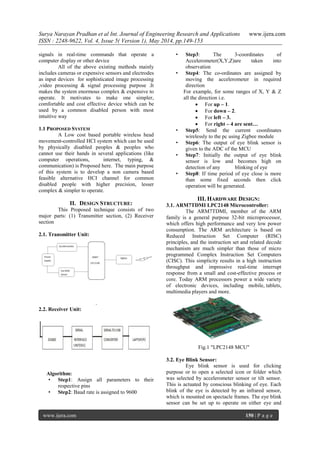
1.1 PROPOSED SYSTEM
A Low cost based portable wireless head
movement-controlled HCI system which can be used
by physically disabled peoples & peoples who
cannot use their hands in several applications (like
computer operations, internet, typing, &
communication) is Proposed here. The main purpose
of this system is to develop a non camera based
feasible alternative HCI channel for common
disabled people with higher precision, lesser
complex & simpler to operate.
II. DESIGN STRUCTURE:
This Proposed technique consists of two
major parts: (1) Transmitter section, (2) Receiver
section
2.1. Transmitter Unit:
.
2.2. Receiver Unit:
Algorithm:
• Step1: Assign all parameters to their
respective pins
• Step2: Baud rate is assigned to 9600
• Step3: The 3-coordinates of
Accelerometer(X,Y,Z)are taken into
observation
• Step4: The co-ordinates are assigned by
moving the accelerometer in required
direction
For example, for some ranges of X, Y & Z
all the direction i.e.
 For up – 1.
 For down – 2.
 For left – 3.
 For right – 4 are sent…
• Step5: Send the current coordinates
wirelessly to the pc using Zigbee module
• Step6: The output of eye blink sensor is
given to the ADC of the MCU
• Step7: Initially the output of eye blink
sensor is low and becomes high on
detection of any blinking of eye
• Step8: If time period of eye close is more
than some fixed seconds then click
operation will be generated.
III. HARDWARE DESIGN:
3.1. ARM7TDMI LPC2148 Microcontroller:
The ARM7TDMI, member of the ARM
family is a general purpose 32-bit microprocessor,
which offers high performance and very low power
consumption. The ARM architecture is based on
Reduced Instruction Set Computer (RISC)
principles, and the instruction set and related decode
mechanism are much simpler than those of micro
programmed Complex Instruction Set Computers
(CISC). This simplicity results in a high instruction
throughput and impressive real-time interrupt
response from a small and cost-effective process or
core. Today ARM processors power a wide variety
of electronic devices, including mobile, tablets,
multimedia players and more.
Fig.1 "LPC2148 MCU"
3.2. Eye Blink Sensor:
Eye blink sensor is used for clicking
purpose or to open a selected icon or folder which
was selected by accelerometer sensor or tilt sensor.
This is actuated by conscious blinking of eye. Each
blink of the eye is detected by an infrared sensor,
which is mounted on spectacle frames. The eye blink
sensor can be set up to operate on either eye and
Surya Narayan Pradhan et al Int. Journal of Engineering Research and Applications www.ijera.com
ISSN : 2248-9622, Vol. 4, Issue 5( Version 1), May 2014, pp.149-153
www.ijera.com 151 | P a g e
maybe mounted on wearable glasses. Eye blink is
detected by measuring reflection of infrared rays
from eye. When eye is closed the strength of detector
output is high and low on normal eye open condition.
Conscious & Unconscious blinking of eye is detected
by the time of reflection. The sensitivity of the
sensor can be adjusted to the user‘s needs and
involuntary blinks are ignored. The sensor is
connected to the microcontroller
Fig.2"Eye Blink Sensor"
• Maxim operated voltage 0 to 5V
• Position of IRIS detected by IR
• Sensitivity adjustment : potentiometer
• Blinking of eye is actuated through
comparator
3.3. Accelerometer:
The MMA8451Q, I2C based 3-axis digital
accelerometer is used here in the project. It is used to
detect the head motion which in turns moves the
mouse pointer in the screen. It is a small, thin, low
power, complete 3-axis accelerometer with signal
conditioned voltage outputs. The product measures
acceleration with a minimum full-scale range of ±2
g.It can measure the static acceleration of gravity in
tilt-sensing applications, as well as dynamic
acceleration resulting from motion, shock, or
vibration. Output data rates with a range of 1.5 Hz to
800 Hz. The MMA8451Q is available in a small, low
profile, 3 mm ×3 mm × 1 mm, 16-lead, plastic lead
frame chip scale package. This accelerometer was
interfaced with the LPC2148 microcontroller to send
the movement and direction signals from the
transmitter unit. The signals will then be received at
the receiver and then decoded which will then be
used to move the mouse pointer on the screen.
3.4. Zigbee Module:
Zigbee modem can be used for applications
that need two way wireless data transmission. It
features high data rate (adjustable baud rate) and
longer transmission distance. The communication
protocol is self-controlled and completely transparent
to user interface. The module is embedded to our
current design so that wireless communication can be
set up easily.
Fig.3"Zigbee Interfacing with MCU"
 Low power consuming
 The modules operate within the ISM 2.4 GHz
frequency band and are pin-for-pin compatible
with each other
 Maximum range up to 1500 meters outside &
100mtrs inside room or building
 Low data rate
IV. WORKING DETAILS OF THE SYSTEM:
Mouse Cursor can be moved with the help
of head movements. The 3-Axis Accelerometer
sends the information about movement direction to
Microcontroller. Microcontroller processes the signal
information and passes it to Zigbee transmitter
module. Zigbee receiver will decode the received
information & sends to PC through RS232 cable. It
will perform the required operations like selecting
any documents or icons or typing letters with the
help of voluntary eye blink. A GUI (Graphical User
Interface) is designed to control smart home
appliances by clicking on required icon.
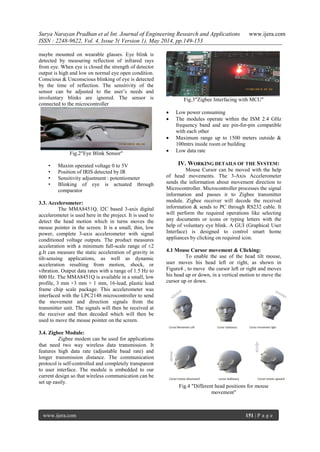
4.1 Mouse Cursor movement & Clicking:
To enable the use of the head tilt mouse,
user moves his head left or right, as shown in
Figure4 , to move the cursor left or right and moves
his head up or down, in a vertical motion to move the
cursor up or down.
Fig.4 "Different head positions for mouse
movement"
Surya Narayan Pradhan et al Int. Journal of Engineering Research and Applications www.ijera.com
ISSN : 2248-9622, Vol. 4, Issue 5( Version 1), May 2014, pp.149-153
www.ijera.com 152 | P a g e
The tilt is sensed by a digital accelerometer
MMA8451Q. The MMA8451Q is a I2C based low
cost accelerometer that is connected with the ADC of
the LPC2148 microcontroller. it senses tilt and tilt
angle. Each axis (i.e. X Y Z) can sense 90 degrees of
tilt. This is more than adequate for the head tilt
mouse since it is unlikely someone would want or be
able to move their head that much. Also, the chip is
sensitive enough for real-time use and has been used
in applications like real-time Robot balancing [9].
Depending upon the user‘s comfortably
sensitivity of accelerometer is set which decides the
cursor movement.
Table 1.Sensitivity values of accelerometer for
cursor movement
Axis values Symbol to
PC
Operation
Y>5 Sends 1 Cursor moves
upward
Y<2 Sends 2 Cursor moves
downward
X<-5 Sends 3 Cursor moves
Left
X>5 Sends 4 moves Right
Mouse clicking is actuated by eye-blink,
which is one of the most natural phenomenon human
behaviour. It based on Infrared radiation from eye.
Fig.5".IR mechanism"
The object here is treated as the eye, upon
which IR ray falls reflection signal is collected by the
photodetector.The received signal is sent to the
signal processing circuit that comprises of an Op-
amp or comparator(LM358 most probably).The
comparator is used to amplify the low strength
received signal makes it strengthen enough to send to
the ADC Microcontroller(LPC2148) which operates
on 3.3v.When the user close his/her eyes the output
of the eye blink sensor is high and keeping this
condition up to some define time interval clicking
operation is generated.
V. SOFTWARE DESIGN:
ALGORITHM FOR MOUSE INTERFACING
IN VISUAL C#:
Step1: Create an object of serial port class
Step2: Connect to the provided com port with this
object by passing parameter values.
Step3: Received data through serial port
Step4: Get the current (x, y) co-ordinates of mouse
cursors
Step5: The mouse cursor moves to the direction by
received data from serial port by increases or
decreases the value of X or Y
Step6: For example
 when it receives 1,then it will move upwards,
having co-ordinatesX,Y+1,
 When it receives 2 then it will move down-
word having the coordinate x, y-1.
 When it receives 3 then it will move left
having the coordinate x-1, y.
 When it receives 4 then it will move right
having the coordinate x+1, y.
Step7: Now For Clicking purpose import
SYSTEM32.DLL into the program.
Step8: when it gets proper value of timer, it will do
required click operation
Step9: Now one can move cursor, click and open a
folder
Keil uvision: Keil simulator is used for the purpose
of coding ARM7 LPC2148 microcontroller unit.
Flash magic: This software is used to dump the hex
code generated from keil into LPC2148 MCU.
Flow chart:
5.1.Experiment Setup & Results:
Fig.6 "accelerometer values at different head
positions"
Surya Narayan Pradhan et al Int. Journal of Engineering Research and Applications www.ijera.com
ISSN : 2248-9622, Vol. 4, Issue 5( Version 1), May 2014, pp.149-153
www.ijera.com 153 | P a g e
‗
Fig 7".Hardware setup of wearable HCI system "
VI. Conclusion
The HCI is an evolving area of research
interest nowadays. This project aims to be a
convenient process for helping out the disabled to
operate computers. These systems can also be used
in other application like robotics efforts, in process to
make the device cost effective and more complex
thereby reducing the size. Thus We have developed a
real hand free mouse. This paper will be very
effective and accurate using of both MEMS and eye
blink sensors as a wireless mouse for future
generation machines.
6.1 Future Scope:
Human Computer Interaction is gaining
mass popularity in the present days. This project
provides a greater scope for improvement in the near
future. Effective control of mouse cursor with speech
recognition & increasing of writing speed are still
some sectors to be improved in future. Better
methods of transmission and reception channel can
also be developed on further experiment.
REFERENCES
[1] O. K. Oyekoya and F. W. M. Stentiford,
―Eye tracking—A new interface for visual
exploration,‖ BT Technol. J., vol. 24, no. 3,
pp. 57–66, 2006.
[2] M. W. Johns, A. Tucker, J. R. Chapman, E.
K. Crowley, and N. Michael,―Monitoring
eye and eyelid movements by infrared
reflectance oculography to measure
drowsiness in drivers,‖. Somnologie
SchlafforschungSchlafmedizin, vol. 11, pp.
234–242, 2007
[3] Shang-Lin Wu†, Lun-De Liao, Shao-Wei
Lu, Wei-Ling Jiang, Shi-An Chen
―Controlling a Human–Computer Interface
System With a Novel Classification Method
that Uses Electrooculography
Signals‖.IEEE,2013
[4] L. Y. Deng, C. L. Hsu, T. C. Lin, J. S. Tuan,
and S. M. Chang, ―EOG-based human–
computer interface system development,‖
Expert Syst. Appl.,vol. 37, pp. 3337–3343,
Apr. 2010
[5] A. B. Barreto, S. D. Scargle, and M.
Adjouadi, ―A practical emg-basedhuman-
computer interface for users with motor
disabilities,‖ J. Rehabil. Res. Dev., vol. 37,
no. 1, pp. 53–64, Jan./Feb. 2000
[6] Ville Rantanen, Toni Vanhala, Outi Tuisku,
Pekka-Henrik Niemenlehto, Jarmo Verho,
Veikko Surakka,Martti Juhola, and Jukka
Lekala ―A Wearable, Wireless Gaze
Tracker with Integrated Selection
Command Source for Human-Computer
Interaction”.IEEE transactions on
INFORMATION TECHNOLOGY IN
BIOMEDICINE, VOL. 15, NOk. 5,
SEPTEMBER 2011
[7] E. Ianez, J. M. Azorın, A. U beda, J. M.
Ferrandez, and E. Fernandez,―Mental tasks-
based brain–robot interface,‖ Robot. Auton.
Syst., vol. 58, no. 12, pp. 1238–1245, 2010
[8] Natural Eye Movement & its application for
paralyzed patients, Yash Shaileshkumar
Desai.IJETT April 2013
[9] Memsic 2125 Accelerometer Demo Kit
(#28017), Parallax Inc., 2004.
[10] www.microbuilder.eu
[11] www.ocfreaks.com
[12] www.zembedded.com

Z4501149153

  • 1.
    Surya Narayan Pradhanet al Int. Journal of Engineering Research and Applications www.ijera.com ISSN : 2248-9622, Vol. 4, Issue 5( Version 1), May 2014, pp.149-153 www.ijera.com 149 | P a g e Design & Implementation of a Low Cost Based Wireless HCI System for Disabled Persons Using ARM7 Surya Narayan Pradhan*, Debidatta Acharya**, Soumyashree Mongaraj*** *M.Tech Student (Department of Electronics & Communication, KIIT University, Bhubaneswar, INDIA) **M.Tech Student (Department of Electronics & Communication, KIIT University, Bhubaneswar, INDIA) *** Assistant Professor (Department of Electronics & Communication, KIIT University, Bhubaneswar, INDIA) Abstract This paper focuses on design & development of a portable wireless Human Computer Interface (HCI) system to create a robust hands free interface for disabled peoples or peoples having upper limb motor paralysis. Early techniques mainly considered image processing, gaze tracking and cameras to synthesis the device. We propose a new mouse as an input device for a computer whose operation is based on measurement of rotations of the user‘s head and detection of eye blinks. A tilt sensor(3-axis accelerometer) is used to detect both lateral and vertical head movements to navigate the mouse cursor position placed on a helmet .The IR based eye blink sensor is placed on a spec used to detect eye blink and in turns do clicking operation. The signals are sent to the micro-controller (ARM7 LPC2148) for processing & do required operations. The wireless technology includes Zigbee module used to sends signals to the computer in use. A C# based program is developed for the mouse control operations & provides a flexible method for the disabled people to improve both personal & professional life quality. Keywords—Accelerometer, ARM7 Lpc2148, Eye blink sensor, HCI, Zigbee I. INTRODUCTION In the era of science & technology computers are an integral part of life that makes human life more comfortable. Human Computer Interface (HCI) is a technology used to incorporate the correlation between human and Computer. HCI device which use information taken from the head area offer interaction methods that are more Convenience, spontaneous & intuitive compared to the traditional input devices like keyboard, or mouse. One of the most benefitted target groups is physically disabled people having spinal cord problem, motor paralysis & who cannot use their hands in the interaction. Additionally as the number of people with disabilities is increasing drastically several researches has been going on for effective Human computer interaction. According to the users‘ ability, systems like speech recognition, brain-computer interfaces (BCI) and infrared head-operated joysticks etc. may be involved for this purpose. However patients with several disabilities may not able to speak and eye muscles are the only muscle they can control. Some prominent Eye-movement detection interfaces may be based on videooculography (VOG), image analysis [1], infraredoculography (IORG)[2] ,electrooculography (EOG)[3] [4] and electromyography(EMG)[5]. Furthermore, this type of interface is not be limited to critically disabled Peoples and could be applicable to any one with enough eye-movement control. EOG is a widely and successfully implemented technique that has proven reliable human–computer interfaces (HCI) where electrode- based device is designed to enable people with special needs to control a computer with their eyes but it leads to an uncomfortable way of act as several electrodes are placed on face near eye area. Gaze tracking recommended as an alternative to traditional computer pointing mechanisms. However, the precision or accuracy limitations of gaze estimation algorithms and the fatigue imposed on users when overloading the visual perceptual channel with a motor control task have prevented the widespread adoption of gaze as a pointing modality. The prototype system combines head-mounted, video-based gaze tracking with capacitive facial movement detection that enable multimodal interaction by gaze pointing and making selections with facial gestures [6] Brain Computer Interfaces (BCIs)[7] measure brain signals of brain activity intentionally and unintentionally induced by the user, and thus provide a promising communication channel that does not depend on the brain‘s normal output pathway consisting of peripheral nerves and muscles. Present-day Brain Computer Interfaces determine the intent of the user from a variety of different electrophysiological signals. They translate these RESEARCH ARTICLE OPEN ACCESS
  • 2.
    Surya Narayan Pradhanet al Int. Journal of Engineering Research and Applications www.ijera.com ISSN : 2248-9622, Vol. 4, Issue 5( Version 1), May 2014, pp.149-153 www.ijera.com 150 | P a g e signals in real-time commands that operate a computer display or other device All of the above existing methods mainly includes cameras or expensive sensors and electrodes as input devices for sophisticated image processing ,video processing & signal processing purpose .It makes the system enormous complex & expensive to operate. It motivates to make one simpler, comfortable and cost effective device which can be used by a common disabled person with most intuitive way 1.1 PROPOSED SYSTEM A Low cost based portable wireless head movement-controlled HCI system which can be used by physically disabled peoples & peoples who cannot use their hands in several applications (like computer operations, internet, typing, & communication) is Proposed here. The main purpose of this system is to develop a non camera based feasible alternative HCI channel for common disabled people with higher precision, lesser complex & simpler to operate. II. DESIGN STRUCTURE: This Proposed technique consists of two major parts: (1) Transmitter section, (2) Receiver section 2.1. Transmitter Unit: . 2.2. Receiver Unit: Algorithm: • Step1: Assign all parameters to their respective pins • Step2: Baud rate is assigned to 9600 • Step3: The 3-coordinates of Accelerometer(X,Y,Z)are taken into observation • Step4: The co-ordinates are assigned by moving the accelerometer in required direction For example, for some ranges of X, Y & Z all the direction i.e.  For up – 1.  For down – 2.  For left – 3.  For right – 4 are sent… • Step5: Send the current coordinates wirelessly to the pc using Zigbee module • Step6: The output of eye blink sensor is given to the ADC of the MCU • Step7: Initially the output of eye blink sensor is low and becomes high on detection of any blinking of eye • Step8: If time period of eye close is more than some fixed seconds then click operation will be generated. III. HARDWARE DESIGN: 3.1. ARM7TDMI LPC2148 Microcontroller: The ARM7TDMI, member of the ARM family is a general purpose 32-bit microprocessor, which offers high performance and very low power consumption. The ARM architecture is based on Reduced Instruction Set Computer (RISC) principles, and the instruction set and related decode mechanism are much simpler than those of micro programmed Complex Instruction Set Computers (CISC). This simplicity results in a high instruction throughput and impressive real-time interrupt response from a small and cost-effective process or core. Today ARM processors power a wide variety of electronic devices, including mobile, tablets, multimedia players and more. Fig.1 "LPC2148 MCU" 3.2. Eye Blink Sensor: Eye blink sensor is used for clicking purpose or to open a selected icon or folder which was selected by accelerometer sensor or tilt sensor. This is actuated by conscious blinking of eye. Each blink of the eye is detected by an infrared sensor, which is mounted on spectacle frames. The eye blink sensor can be set up to operate on either eye and
  • 3.
    Surya Narayan Pradhanet al Int. Journal of Engineering Research and Applications www.ijera.com ISSN : 2248-9622, Vol. 4, Issue 5( Version 1), May 2014, pp.149-153 www.ijera.com 151 | P a g e maybe mounted on wearable glasses. Eye blink is detected by measuring reflection of infrared rays from eye. When eye is closed the strength of detector output is high and low on normal eye open condition. Conscious & Unconscious blinking of eye is detected by the time of reflection. The sensitivity of the sensor can be adjusted to the user‘s needs and involuntary blinks are ignored. The sensor is connected to the microcontroller Fig.2"Eye Blink Sensor" • Maxim operated voltage 0 to 5V • Position of IRIS detected by IR • Sensitivity adjustment : potentiometer • Blinking of eye is actuated through comparator 3.3. Accelerometer: The MMA8451Q, I2C based 3-axis digital accelerometer is used here in the project. It is used to detect the head motion which in turns moves the mouse pointer in the screen. It is a small, thin, low power, complete 3-axis accelerometer with signal conditioned voltage outputs. The product measures acceleration with a minimum full-scale range of ±2 g.It can measure the static acceleration of gravity in tilt-sensing applications, as well as dynamic acceleration resulting from motion, shock, or vibration. Output data rates with a range of 1.5 Hz to 800 Hz. The MMA8451Q is available in a small, low profile, 3 mm ×3 mm × 1 mm, 16-lead, plastic lead frame chip scale package. This accelerometer was interfaced with the LPC2148 microcontroller to send the movement and direction signals from the transmitter unit. The signals will then be received at the receiver and then decoded which will then be used to move the mouse pointer on the screen. 3.4. Zigbee Module: Zigbee modem can be used for applications that need two way wireless data transmission. It features high data rate (adjustable baud rate) and longer transmission distance. The communication protocol is self-controlled and completely transparent to user interface. The module is embedded to our current design so that wireless communication can be set up easily. Fig.3"Zigbee Interfacing with MCU"  Low power consuming  The modules operate within the ISM 2.4 GHz frequency band and are pin-for-pin compatible with each other  Maximum range up to 1500 meters outside & 100mtrs inside room or building  Low data rate IV. WORKING DETAILS OF THE SYSTEM: Mouse Cursor can be moved with the help of head movements. The 3-Axis Accelerometer sends the information about movement direction to Microcontroller. Microcontroller processes the signal information and passes it to Zigbee transmitter module. Zigbee receiver will decode the received information & sends to PC through RS232 cable. It will perform the required operations like selecting any documents or icons or typing letters with the help of voluntary eye blink. A GUI (Graphical User Interface) is designed to control smart home appliances by clicking on required icon. 4.1 Mouse Cursor movement & Clicking: To enable the use of the head tilt mouse, user moves his head left or right, as shown in Figure4 , to move the cursor left or right and moves his head up or down, in a vertical motion to move the cursor up or down. Fig.4 "Different head positions for mouse movement"
  • 4.
    Surya Narayan Pradhanet al Int. Journal of Engineering Research and Applications www.ijera.com ISSN : 2248-9622, Vol. 4, Issue 5( Version 1), May 2014, pp.149-153 www.ijera.com 152 | P a g e The tilt is sensed by a digital accelerometer MMA8451Q. The MMA8451Q is a I2C based low cost accelerometer that is connected with the ADC of the LPC2148 microcontroller. it senses tilt and tilt angle. Each axis (i.e. X Y Z) can sense 90 degrees of tilt. This is more than adequate for the head tilt mouse since it is unlikely someone would want or be able to move their head that much. Also, the chip is sensitive enough for real-time use and has been used in applications like real-time Robot balancing [9]. Depending upon the user‘s comfortably sensitivity of accelerometer is set which decides the cursor movement. Table 1.Sensitivity values of accelerometer for cursor movement Axis values Symbol to PC Operation Y>5 Sends 1 Cursor moves upward Y<2 Sends 2 Cursor moves downward X<-5 Sends 3 Cursor moves Left X>5 Sends 4 moves Right Mouse clicking is actuated by eye-blink, which is one of the most natural phenomenon human behaviour. It based on Infrared radiation from eye. Fig.5".IR mechanism" The object here is treated as the eye, upon which IR ray falls reflection signal is collected by the photodetector.The received signal is sent to the signal processing circuit that comprises of an Op- amp or comparator(LM358 most probably).The comparator is used to amplify the low strength received signal makes it strengthen enough to send to the ADC Microcontroller(LPC2148) which operates on 3.3v.When the user close his/her eyes the output of the eye blink sensor is high and keeping this condition up to some define time interval clicking operation is generated. V. SOFTWARE DESIGN: ALGORITHM FOR MOUSE INTERFACING IN VISUAL C#: Step1: Create an object of serial port class Step2: Connect to the provided com port with this object by passing parameter values. Step3: Received data through serial port Step4: Get the current (x, y) co-ordinates of mouse cursors Step5: The mouse cursor moves to the direction by received data from serial port by increases or decreases the value of X or Y Step6: For example  when it receives 1,then it will move upwards, having co-ordinatesX,Y+1,  When it receives 2 then it will move down- word having the coordinate x, y-1.  When it receives 3 then it will move left having the coordinate x-1, y.  When it receives 4 then it will move right having the coordinate x+1, y. Step7: Now For Clicking purpose import SYSTEM32.DLL into the program. Step8: when it gets proper value of timer, it will do required click operation Step9: Now one can move cursor, click and open a folder Keil uvision: Keil simulator is used for the purpose of coding ARM7 LPC2148 microcontroller unit. Flash magic: This software is used to dump the hex code generated from keil into LPC2148 MCU. Flow chart: 5.1.Experiment Setup & Results: Fig.6 "accelerometer values at different head positions"
  • 5.
    Surya Narayan Pradhanet al Int. Journal of Engineering Research and Applications www.ijera.com ISSN : 2248-9622, Vol. 4, Issue 5( Version 1), May 2014, pp.149-153 www.ijera.com 153 | P a g e ‗ Fig 7".Hardware setup of wearable HCI system " VI. Conclusion The HCI is an evolving area of research interest nowadays. This project aims to be a convenient process for helping out the disabled to operate computers. These systems can also be used in other application like robotics efforts, in process to make the device cost effective and more complex thereby reducing the size. Thus We have developed a real hand free mouse. This paper will be very effective and accurate using of both MEMS and eye blink sensors as a wireless mouse for future generation machines. 6.1 Future Scope: Human Computer Interaction is gaining mass popularity in the present days. This project provides a greater scope for improvement in the near future. Effective control of mouse cursor with speech recognition & increasing of writing speed are still some sectors to be improved in future. Better methods of transmission and reception channel can also be developed on further experiment. REFERENCES [1] O. K. Oyekoya and F. W. M. Stentiford, ―Eye tracking—A new interface for visual exploration,‖ BT Technol. J., vol. 24, no. 3, pp. 57–66, 2006. [2] M. W. Johns, A. Tucker, J. R. Chapman, E. K. Crowley, and N. Michael,―Monitoring eye and eyelid movements by infrared reflectance oculography to measure drowsiness in drivers,‖. Somnologie SchlafforschungSchlafmedizin, vol. 11, pp. 234–242, 2007 [3] Shang-Lin Wu†, Lun-De Liao, Shao-Wei Lu, Wei-Ling Jiang, Shi-An Chen ―Controlling a Human–Computer Interface System With a Novel Classification Method that Uses Electrooculography Signals‖.IEEE,2013 [4] L. Y. Deng, C. L. Hsu, T. C. Lin, J. S. Tuan, and S. M. Chang, ―EOG-based human– computer interface system development,‖ Expert Syst. Appl.,vol. 37, pp. 3337–3343, Apr. 2010 [5] A. B. Barreto, S. D. Scargle, and M. Adjouadi, ―A practical emg-basedhuman- computer interface for users with motor disabilities,‖ J. Rehabil. Res. Dev., vol. 37, no. 1, pp. 53–64, Jan./Feb. 2000 [6] Ville Rantanen, Toni Vanhala, Outi Tuisku, Pekka-Henrik Niemenlehto, Jarmo Verho, Veikko Surakka,Martti Juhola, and Jukka Lekala ―A Wearable, Wireless Gaze Tracker with Integrated Selection Command Source for Human-Computer Interaction”.IEEE transactions on INFORMATION TECHNOLOGY IN BIOMEDICINE, VOL. 15, NOk. 5, SEPTEMBER 2011 [7] E. Ianez, J. M. Azorın, A. U beda, J. M. Ferrandez, and E. Fernandez,―Mental tasks- based brain–robot interface,‖ Robot. Auton. Syst., vol. 58, no. 12, pp. 1238–1245, 2010 [8] Natural Eye Movement & its application for paralyzed patients, Yash Shaileshkumar Desai.IJETT April 2013 [9] Memsic 2125 Accelerometer Demo Kit (#28017), Parallax Inc., 2004. [10] www.microbuilder.eu [11] www.ocfreaks.com [12] www.zembedded.com