By:
SHAGUFTA YASMIN
     2SD12SCS11
Topics for discussion
 Introduction
    Sensor network
    Architecture of sensor network.
    Applications of sensor network.
    Challenges of sensor network.
 Cuts in sensor networks.
 Detection of cuts.
 Distributed cut detection algorithm.
 Conclusion.
 Future aspects.
 References.
 Sensor Network:

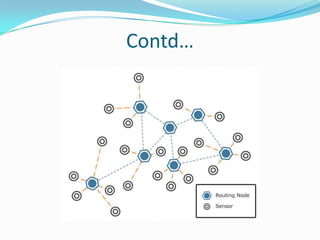
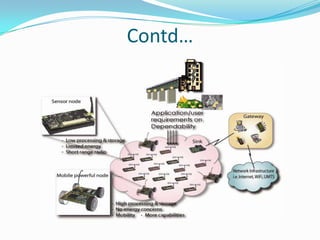
     It is a group of specialized transducers with a
 communication infrastructure intended to monitor
 and record conditions at diverse location, it may be
 temperature, pressure humidity wind direction and
 speed etc…
     It consists of multiple detection station called
 nodes, which is small, lightweight and portable.
Contd…
Contd…
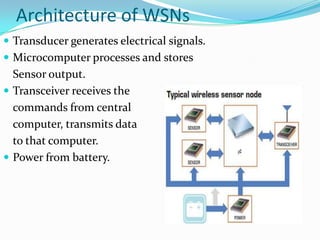
Architecture of WSNs
 Transducer generates electrical signals.
 Microcomputer processes and stores
  Sensor output.
 Transceiver receives the
  commands from central
  computer, transmits data
  to that computer.
 Power from battery.
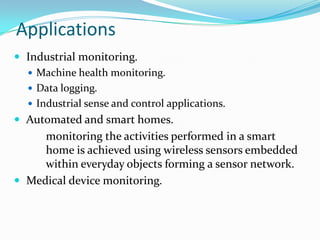
Applications
 Industrial monitoring.
   Machine health monitoring.
   Data logging.
   Industrial sense and control applications.
 Automated and smart homes.
     monitoring the activities performed in a smart
     home is achieved using wireless sensors embedded
     within everyday objects forming a sensor network.
 Medical device monitoring.
Contd…
 Monitoring of weather conditions.
 Air traffic control.
 Robot control.
 Air pollution monitoring.
 Forest fire detection.
 Natural disaster prevention.
Challenges
 One of the challenge in the successful use of WSNs
  come from limited energy of the individual sensor
  nodes.
 WSNs consist of large number of small, low cost
  sensor nodes distributed over large area.
 WSNs have emerged as a promising new technology
  to monitor large regions.
 Node failure is expected to be quite common. this is
  true for sensor networks deployed in harsh and
  dangerous fields such as forest fire monitoring and in
  defense applications.
Cuts in sensor networks
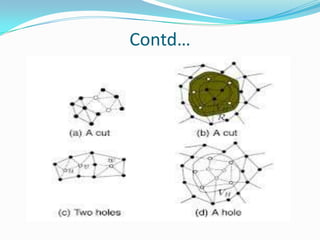
 WSNs can get separated into multiple connected
  components due to failure of some of its nodes, which
  is called “cut”.
 So here we consider the problem of detecting cuts.
 Two nodes are said to be disconnected if there is no
  path between them.
Contd…
Contd…
 In the figure, filled circles represents active nodes and
  unfilled circles represent failed node.
 Solid lines represents the edges, and dashed lines
  represent the edges that existed before the failure of
  node.
 the hole in (d) is indistinguishable from the cut in (b)
  to nodes that lie outside the region R
Detection of cuts
 Nodes that detect the occurrence and approximate the
  locations of the cuts can then alert the source node or base
  station.
 If the node were able to detect the occurrence of cut it could
  simply wait for the network to be repaired and eventually
  reconnected, which saves on-board energy of multiple nodes
  and prolongs their lives.
 The ability to detect cuts by both the disconnected node and
  source node will lead to increase in the operational lifetime
  of the network as a whole.
Distributed cut detection algorithm
 This algorithm allows each node to detect
  DOS(Disconnection frOm Source) events and subset of node
  to detect CCOS(connected but cut occurred somewhere)
  events.
 The algorithm is distributed and asynchronous.
 It involves only local communication between neighboring
  nodes and is robust to temporary communication failure
  between node pairs.
 A key component of the DCD algorithm is a distributed
  iterative computational step through which the nodes
  compute their electrical potentials.
Distributed cut Detection
  Definition and problem statement
 Time is measured with a discrete counter k=∞,…., -
  1,0,1,2,…..
 We model the sensor network as a time varying graph
    ( ) = ( (k )ℰ(k)), whose node set V(k) represents the
  sensor nodes active at time k and the edge set ℰ( )
  consist of pairs of nodes (u,v) such that nodes u and v can
  directly exchange the message between each other at
  time k.
 By an active nodes we mean a nodes that has not failed
  permanently .
Contid…
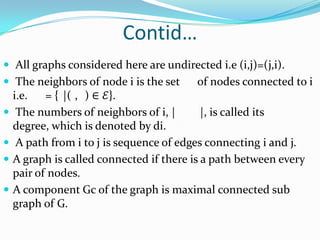
 All graphs considered here are undirected i.e (i,j)=(j,i).
 The neighbors of node i is the set     of nodes connected to i
    i.e.   = { |( , ) ∈ ℰ}.
    The numbers of neighbors of i, |       |, is called its
    degree, which is denoted by di.
    A path from i to j is sequence of edges connecting i and j.
   A graph is called connected if there is a path between every
    pair of nodes.
   A component Gc of the graph is maximal connected sub
    graph of G.
Contid…
 A cut is formally defined as the increase of the
  number of components of a graph due to the failure of
  subset of nodes.
 The number of the cuts associated with a cut event is
  the increase in the number of components after the
  event.
Contid…
 The problem we seek to address is two fold
   First we want to enable every node to detect if it is
    disconnected from source.
   Second we want to enable nodes that lie close to the cuts
    but are still connected to the source.
Contid…
 The DCD algorithm is based on the following electrical
    analogy.
    Imagine the wireless sensor network as an electrical circuit
    where the current is injected at the source node and
    extracted out of a common fictitious node that is connected
    to every node of sensor network.
    Each edge is replaced by the 1 Ω resistor.
    When a cut separates certain nodes from source node, the
    potential of each of those nodes becomes 0, since there is no
    current injection into their components.
    The potential is computed by an iterative scheme which only
    requires periodic communication among the neighboring
    nodes.
Contid…
DOS detection
• When node u is disconnected from the source, we say that a
  disconnected from source event has occurred for u.
• The algorithm allows each node to detect DOS events.
• The nodes use the computed potentials to detect if DOS
  event have occurred .
• The approach here is if the state is close to 0 then the node is
  disconnected from the source , otherwise not.
Contid…
 DOS detection part consist of steady state
 detection, normalized state computation and
 connection/separation detection.
Contid…
CCOS detection
 When a cut occurs in the network that does not separate a
  node u from the source node, connected but a cut occurred
  somewhere (CCOS) event has occurred for u.
 Detection of CCOS events by the nodes close to a cut, and
  approximate location of cut means location of one or more
  active nodes that lie at the boundary of cut and that are
  connected to source.
Contid…
 To detect the CCOS event the algorithm uses the fact
  that the potential of nodes that are connected to
  source node changes after the cut and also using probe
  messages.
 Probe messages that are initiated by the certain nodes
  that encounter failed neighbors, and are forwarded
  from one node to another node in a way that if short
  path exist around a hole created by node failures, the
  message will reach initiating nodes.
Contid…
 Each probe message contains the following
    information:
    A unique source ID
    Source node ID S
    Destination node,
    path traversed, and
    angle traversed by probe message.
Conclusion
 The DCD algorithm we propose here enables every
  node of a wireless sensor network to detect
  disconnected from source event if they occur.
 Second it enables the subset of nodes that experiences
  CCOS event to detect them and estimate the
  approximate location of the cut in the form of a list of
  active nodes that lie at the boundary of the cut/hole.
Future Aspect
 Application of DCD algorithm to detect the node
 separation and reconnection to the source in mobile
 networks.
references
 http:// www.liveieeeprojects.com
 http://www.ijsrp.org/research-paper-1212/ijsrp-p1203.pd
 http://www.faculty.cs.tamu.edu/stoleru/papers/prabir12c
  ut.pdf - United States
 www.cs.ucsb.edu/~suri/psdir/sentinel.pdf
 www.slideshare.net/.../cut-detection-in-wireless-sensor-
  networks
 http://en.wikipedia.org/wiki/Wireless_sensor_network
THANK YOU

Cut detection

  • 1.
  • 2.
    Topics for discussion Introduction  Sensor network  Architecture of sensor network.  Applications of sensor network.  Challenges of sensor network.  Cuts in sensor networks.  Detection of cuts.  Distributed cut detection algorithm.  Conclusion.  Future aspects.  References.
  • 3.
     Sensor Network: It is a group of specialized transducers with a communication infrastructure intended to monitor and record conditions at diverse location, it may be temperature, pressure humidity wind direction and speed etc… It consists of multiple detection station called nodes, which is small, lightweight and portable.
  • 4.
  • 5.
  • 6.
    Architecture of WSNs Transducer generates electrical signals.  Microcomputer processes and stores Sensor output.  Transceiver receives the commands from central computer, transmits data to that computer.  Power from battery.
  • 7.
    Applications  Industrial monitoring.  Machine health monitoring.  Data logging.  Industrial sense and control applications.  Automated and smart homes. monitoring the activities performed in a smart home is achieved using wireless sensors embedded within everyday objects forming a sensor network.  Medical device monitoring.
  • 8.
    Contd…  Monitoring ofweather conditions.  Air traffic control.  Robot control.  Air pollution monitoring.  Forest fire detection.  Natural disaster prevention.
  • 9.
    Challenges  One ofthe challenge in the successful use of WSNs come from limited energy of the individual sensor nodes.  WSNs consist of large number of small, low cost sensor nodes distributed over large area.  WSNs have emerged as a promising new technology to monitor large regions.  Node failure is expected to be quite common. this is true for sensor networks deployed in harsh and dangerous fields such as forest fire monitoring and in defense applications.
  • 10.
    Cuts in sensornetworks  WSNs can get separated into multiple connected components due to failure of some of its nodes, which is called “cut”.  So here we consider the problem of detecting cuts.  Two nodes are said to be disconnected if there is no path between them.
  • 11.
  • 12.
    Contd…  In thefigure, filled circles represents active nodes and unfilled circles represent failed node.  Solid lines represents the edges, and dashed lines represent the edges that existed before the failure of node.  the hole in (d) is indistinguishable from the cut in (b) to nodes that lie outside the region R
  • 13.
    Detection of cuts Nodes that detect the occurrence and approximate the locations of the cuts can then alert the source node or base station.  If the node were able to detect the occurrence of cut it could simply wait for the network to be repaired and eventually reconnected, which saves on-board energy of multiple nodes and prolongs their lives.  The ability to detect cuts by both the disconnected node and source node will lead to increase in the operational lifetime of the network as a whole.
  • 14.
    Distributed cut detectionalgorithm  This algorithm allows each node to detect DOS(Disconnection frOm Source) events and subset of node to detect CCOS(connected but cut occurred somewhere) events.  The algorithm is distributed and asynchronous.  It involves only local communication between neighboring nodes and is robust to temporary communication failure between node pairs.  A key component of the DCD algorithm is a distributed iterative computational step through which the nodes compute their electrical potentials.
  • 15.
    Distributed cut Detection Definition and problem statement  Time is measured with a discrete counter k=∞,…., - 1,0,1,2,…..  We model the sensor network as a time varying graph ( ) = ( (k )ℰ(k)), whose node set V(k) represents the sensor nodes active at time k and the edge set ℰ( ) consist of pairs of nodes (u,v) such that nodes u and v can directly exchange the message between each other at time k.  By an active nodes we mean a nodes that has not failed permanently .
  • 16.
    Contid…  All graphsconsidered here are undirected i.e (i,j)=(j,i).  The neighbors of node i is the set of nodes connected to i i.e. = { |( , ) ∈ ℰ}.  The numbers of neighbors of i, | |, is called its degree, which is denoted by di.  A path from i to j is sequence of edges connecting i and j.  A graph is called connected if there is a path between every pair of nodes.  A component Gc of the graph is maximal connected sub graph of G.
  • 17.
    Contid…  A cutis formally defined as the increase of the number of components of a graph due to the failure of subset of nodes.  The number of the cuts associated with a cut event is the increase in the number of components after the event.
  • 18.
    Contid…  The problemwe seek to address is two fold  First we want to enable every node to detect if it is disconnected from source.  Second we want to enable nodes that lie close to the cuts but are still connected to the source.
  • 19.
    Contid…  The DCDalgorithm is based on the following electrical analogy.  Imagine the wireless sensor network as an electrical circuit where the current is injected at the source node and extracted out of a common fictitious node that is connected to every node of sensor network.  Each edge is replaced by the 1 Ω resistor.  When a cut separates certain nodes from source node, the potential of each of those nodes becomes 0, since there is no current injection into their components.  The potential is computed by an iterative scheme which only requires periodic communication among the neighboring nodes.
  • 20.
    Contid… DOS detection • Whennode u is disconnected from the source, we say that a disconnected from source event has occurred for u. • The algorithm allows each node to detect DOS events. • The nodes use the computed potentials to detect if DOS event have occurred . • The approach here is if the state is close to 0 then the node is disconnected from the source , otherwise not.
  • 21.
    Contid…  DOS detectionpart consist of steady state detection, normalized state computation and connection/separation detection.
  • 22.
    Contid… CCOS detection  Whena cut occurs in the network that does not separate a node u from the source node, connected but a cut occurred somewhere (CCOS) event has occurred for u.  Detection of CCOS events by the nodes close to a cut, and approximate location of cut means location of one or more active nodes that lie at the boundary of cut and that are connected to source.
  • 23.
    Contid…  To detectthe CCOS event the algorithm uses the fact that the potential of nodes that are connected to source node changes after the cut and also using probe messages.  Probe messages that are initiated by the certain nodes that encounter failed neighbors, and are forwarded from one node to another node in a way that if short path exist around a hole created by node failures, the message will reach initiating nodes.
  • 24.
    Contid…  Each probemessage contains the following information:  A unique source ID  Source node ID S  Destination node,  path traversed, and  angle traversed by probe message.
  • 25.
    Conclusion  The DCDalgorithm we propose here enables every node of a wireless sensor network to detect disconnected from source event if they occur.  Second it enables the subset of nodes that experiences CCOS event to detect them and estimate the approximate location of the cut in the form of a list of active nodes that lie at the boundary of the cut/hole.
  • 26.
    Future Aspect  Applicationof DCD algorithm to detect the node separation and reconnection to the source in mobile networks.
  • 27.
    references  http:// www.liveieeeprojects.com http://www.ijsrp.org/research-paper-1212/ijsrp-p1203.pd  http://www.faculty.cs.tamu.edu/stoleru/papers/prabir12c ut.pdf - United States  www.cs.ucsb.edu/~suri/psdir/sentinel.pdf  www.slideshare.net/.../cut-detection-in-wireless-sensor- networks  http://en.wikipedia.org/wiki/Wireless_sensor_network
  • 28.