
By: Mintoo Jakhmola
    Roll No.: A19
The Wireless Application Protocol (WAP) is an
 application environment and also a set of
 communication protocols for wireless devices
 designed to give manufacturer, vendor, and
 technology-independent access to the Internet
 and advanced telephony services.
WAP is an open technology based on Internet
 technologies
  Allows competition - lower cost
WAP is backed by major vendors
  Nokia, Ericsson, Motorola, Microsoft, IBM
  Future proof
WAP Forum is open for all
  WAP is not “take it or leave it”
  Over one hundred companies have joined the WAP
    Forum
WAP supports several wireless systems
  GSM, IS-136, CDMA, PDC etc.
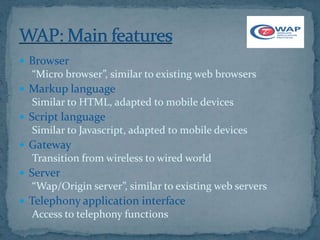
 Browser
  “Micro browser”, similar to existing web browsers
 Markup language
  Similar to HTML, adapted to mobile devices
 Script language
  Similar to Javascript, adapted to mobile devices
 Gateway
  Transition from wireless to wired world
 Server
  “Wap/Origin server”, similar to existing web servers
 Telephony application interface
  Access to telephony functions
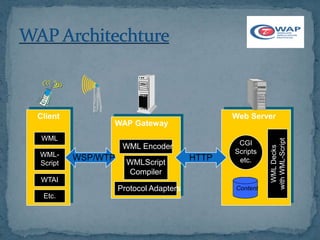
Client                                        Web Server
               WAP Gateway
 WML


                                                        with WML-Script
                                               CGI
                    WML Encoder


                                                          WML Decks
WML-                                          Scripts
         WSP/WTP     WMLScript
                                       HTTP    etc.
Script
                     Compiler
WTAI
                   Protocol Adapters          Content
 Etc.
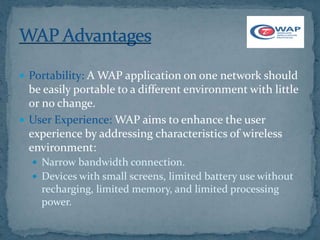
 Portability: A WAP application on one network should
  be easily portable to a different environment with little
  or no change.
 User Experience: WAP aims to enhance the user
  experience by addressing characteristics of wireless
  environment:
   Narrow bandwidth connection.
   Devices with small screens, limited battery use without
    recharging, limited memory, and limited processing
    power.
 Cost and Application Development Time
 Reduction: New services can be added quickly and
 at a lower cost using WAP.
Wireless Application Protocol (by Mintoo Jakhmola)

Wireless Application Protocol (by Mintoo Jakhmola)

  • 1.
    By: Mintoo Jakhmola Roll No.: A19
  • 2.
    The Wireless ApplicationProtocol (WAP) is an application environment and also a set of communication protocols for wireless devices designed to give manufacturer, vendor, and technology-independent access to the Internet and advanced telephony services.
  • 3.
    WAP is anopen technology based on Internet technologies Allows competition - lower cost WAP is backed by major vendors Nokia, Ericsson, Motorola, Microsoft, IBM Future proof WAP Forum is open for all WAP is not “take it or leave it” Over one hundred companies have joined the WAP Forum WAP supports several wireless systems GSM, IS-136, CDMA, PDC etc.
  • 4.
     Browser “Micro browser”, similar to existing web browsers  Markup language Similar to HTML, adapted to mobile devices  Script language Similar to Javascript, adapted to mobile devices  Gateway Transition from wireless to wired world  Server “Wap/Origin server”, similar to existing web servers  Telephony application interface Access to telephony functions
  • 5.
    Client Web Server WAP Gateway WML with WML-Script CGI WML Encoder WML Decks WML- Scripts WSP/WTP WMLScript HTTP etc. Script Compiler WTAI Protocol Adapters Content Etc.
  • 6.
     Portability: AWAP application on one network should be easily portable to a different environment with little or no change.  User Experience: WAP aims to enhance the user experience by addressing characteristics of wireless environment:  Narrow bandwidth connection.  Devices with small screens, limited battery use without recharging, limited memory, and limited processing power.
  • 7.
     Cost andApplication Development Time Reduction: New services can be added quickly and at a lower cost using WAP.