The Art and Science of
Designing Competencies

       August 23, 2012
        3 pm eastern
2


Overview
• Welcome to CompetencyWorks

• What is Competency Education

• Introducing our Panelists

• The Art and Science of Designing Competencies

 • Q.E.D Foundation

 • Virtual Learning Academy Charter School

• Getting Involved in CompetencyWorks
3


Partners
4


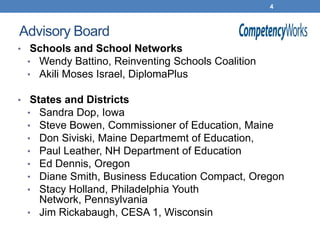
Advisory Board
• Schools and School Networks
  • Wendy Battino, Reinventing Schools Coalition
  • Akili Moses Israel, DiplomaPlus

• States and Districts
  • Sandra Dop, Iowa
  • Steve Bowen, Commissioner of Education, Maine
  • Don Siviski, Maine Departmemt of Education,
  • Paul Leather, NH Department of Education
  • Ed Dennis, Oregon
  • Diane Smith, Business Education Compact, Oregon
  • Stacy Holland, Philadelphia Youth
   Network, Pennsylvania
 • Jim Rickabaugh, CESA 1, Wisconsin
5


Advisory Board
•    National Education and Policy Organizations
    • Betsy Brand, AYPF
    • Christina Brown, Center for Collaborative Education
    • Linda Pittenger, CCSSO
    • Tabitha Grossman, NGA
    • Rebecca Wolfe, JFF

•    Leading Consultants
    • Rose Colby, New Hampshire
    • JoEllen Lynch, Consultant

•    Foundations
    • Beth Miller and Charles Toulmin, NMEF
    • Tony Lewis, Donnel-Kay Foundation
6


 Competency Education: Working Definition
• Students advance upon mastery.

• Competencies include explicit, measurable, transferable
  learning objectives that empower students.

• Assessment is meaningful and a positive learning
  experience for students.

• Students receive timely, differentiated support based on
  their individual learning needs.

• Learning outcomes emphasize competencies that include
  application and creation of knowledge, along with the
  development of important skills and dispositions
7


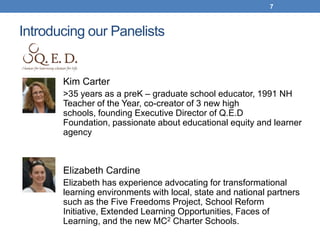
Introducing our Panelists


       Kim Carter
       >35 years as a preK – graduate school educator, 1991 NH
       Teacher of the Year, co-creator of 3 new high
       schools, founding Executive Director of Q.E.D
       Foundation, passionate about educational equity and learner
       agency


       Elizabeth Cardine
       Elizabeth has experience advocating for transformational
       learning environments with local, state and national partners
       such as the Five Freedoms Project, School Reform
       Initiative, Extended Learning Opportunities, Faces of
       Learning, and the new MC2 Charter Schools.
8


Introducing our Panelists


       Steve Kosssakoski
       >Dr. Kossakoski currently serves as the Chief Executive
       Officer of the Virtual Learning Academy Charter School. Under
       his leadership the Academy has grown from 700 enrollments
       to over 15,500 enrollments since opening in January 2008
9


Our Mission is to build, inspire, cultivate and sustain
cultures of transformational learning where
• We are all learners with aspirations and passions which
  deserve to be supported in every way possible.
• Learning changes lives by helping us develop the
  will, knowledge, skill, and capacity to achieve our
  aspirations.
• Learning needs to happen in different ways, so we use
  various strengths and resources to engage with the
  world around us.
• Learning empowers us to co-create our public world and
  to shape the decisions that impact our lives.
10


What is a Competency
Competencies are the knowledge, skills and/or behaviors
students must master in a specific content or performance
area.

Students demonstrate Proficiency through a
preponderance of evidence of attainment of the required
competencies in and/or across a content area.

Mastery is the consistently successful application of a set
of knowledge (facts), skills (processes), and behaviors
(actions) to complex problems and novel situations.
11


What Makes a Good Competency
• Describes knowledge and skills that can be applied to
  novel, complex situations.
• Skills will be valuable ten years from now even if the
  content knowledge has changed.
• Learning objectives have clear performance criteria so
  students can identify their performance level(s) and what
  they need to do to improve.
• Learning objectives are accompanied by effective rubrics
  that help students understand themselves as learners.
• The competency and the learning objectives allow for
  personalization and opportunities for deeper learning.
12


Competency Development
List characteristics of graduates (what do they need to
know and be able to do?)
   - e.g. effective communicator

Identify how each discipline contributes to those
characteristics.
   - e.g. English: speaking skills, organizational
methods, grammar and mechanics, etc.

Map the progression of knowledge and skills that get
students there.
   - e.g. Learning progression through skill levels
13


Examples
Students will make informative presentations.


Students will understand that different audiences
require different communication styles and strategies.


Students [I can] use a wide range of strategies to
communicate effectively with a variety of audiences to
convey a variety of purposes.
14


Quality Competency
CCSS: Adapt speech to a     MC2: Students [I can] use a
variety of contexts and     wide range of strategies to
communication               communicate effectively with a
tasks, demonstrating        variety of audiences to convey
command of formal           a variety of purposes.
English when indicated or
appropriate.
15


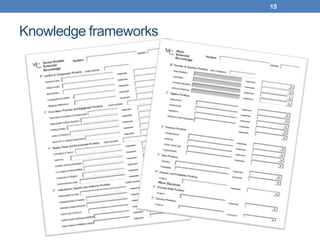
Knowledge frameworks
16


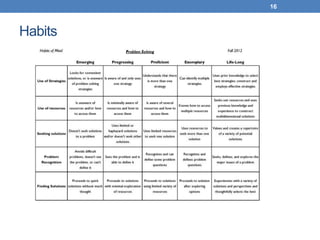
Habits
17


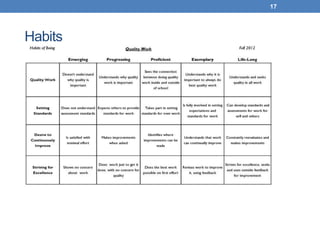
Habit
 Habits
30 Linden St., POB 1050, Exeter, NH

603.778.2500

info@vlacs.org

facebook.com/vlacs

virtuallrnacad
About Us
• Enrollment
    • 15,500
         • 98.5% part-time students
         • 1.5% full-time students
• Serving grades 6-12
• Over 100 courses: traditional subjects, AP, and dual
  credit
• Instructors
    • 120 adjunct
    • 12 full-time
Competency


Time
Competency


Time
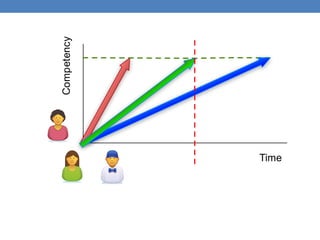
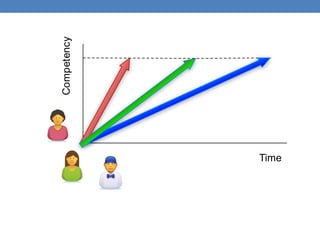
Competency based school -
            Phase I
• No calendar
• Rolling admissions for
  part-time and full-time
  students
• Students work at their
  own pace. Time is not a
  factor when awarding
  credit.
• Funding based on
  completion percentage
• Instructor compensation
  based on completion
  percentage
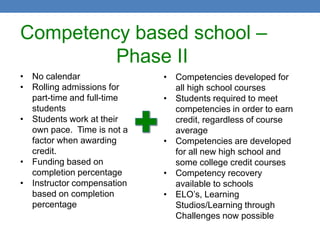
Competency based school –
         Phase II
• No calendar               • Competencies developed for
• Rolling admissions for      all high school courses
  part-time and full-time   • Students required to meet
  students                    competencies in order to earn
• Students work at their      credit, regardless of course
  own pace. Time is not a     average
  factor when awarding      • Competencies are developed
  credit.                     for all new high school and
• Funding based on            some college credit courses
  completion percentage     • Competency recovery
• Instructor compensation     available to schools
  based on completion       • ELO’s, Learning
  percentage                  Studios/Learning through
                              Challenges now possible
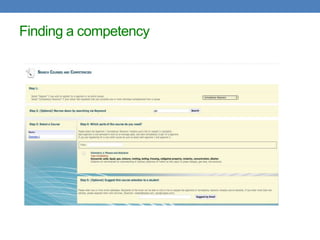
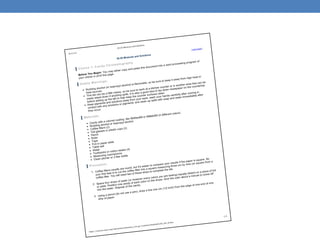
Finding a competency
Sample Competency
Chemistry 1: Phases and Solutions

Competency: Students will demonstrate an understanding of physical
properties of matter as they apply to phase changes, gas laws, and
solutions.

Keywords:
solid, liquid, gas, mixture, melting, boiling, freezing, colligative
property, molarity, concentration, dilution

Assessments:
1. 5.03 Gas Laws
2. 5.05 Mixtures and Solutions
3. 5.09 Discussion-Based Assessment
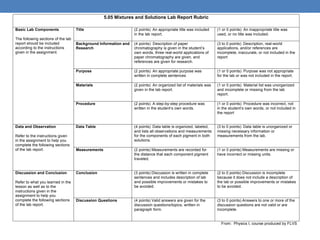
5.05 Mixtures and Solutions Lab Report Rubric

Basic Lab Components                Title                        (2 points) An appropriate title was included    (1 or 0 points) An inappropriate title was
                                                                 in the lab report.                              used, or no title was included.
The following sections of the lab
report should be included           Background Information and   (4 points) Description of paper                 (3 to 0 points) Description, real-world
according to the instructions       Research                     chromatography is given in the student’s        applications, and/or references are
given in the assignment.                                         own words, three real-world applications of     incomplete, inaccurate, or not included in the
                                                                 paper chromatography are given, and             report
                                                                 references are given for research.

                                    Purpose                      (2 points) An appropriate purpose was           (1 or 0 points) Purpose was not appropriate
                                                                 written in complete sentences                   for the lab or was not included in the report.

                                    Materials                    (2 points) An organized list of materials was   (1 or 0 points) Material list was unorganized
                                                                 given in the lab report.                        and incomplete or missing from the lab
                                                                                                                 report.

                                    Procedure                    (2 points) A step-by-step procedure was         (1 or 0 points) Procedure was incorrect, not
                                                                 written in the student’s own words.             in the student’s own words, or not included in
                                                                                                                 the report


Data and Observation                Data Table                   (4 points) Data table is organized, labeled,    (3 to 0 points) Data table is unorganized or
                                                                 and lists all observations and measurements     missing necessary information or
Refer to the instructions given                                  for the components of each pigment in both      measurements from the lab.
in the assignment to help you                                    solutions.
complete the following sections
of the lab report.                  Measurements                 (2 points) Measurements are recorded for        (1 or 0 points) Measurements are missing or
                                                                 the distance that each component pigment        have incorrect or missing units.
                                                                 traveled.


Discussion and Conclusion           Conclusion                   (3 points) Discussion is written in complete    (2 to 0 points) Discussion is incomplete
                                                                 sentences and includes description of lab       because it does not include a description of
Refer to what you learned in the                                 and possible improvements or mistakes to        the lab or possible improvements or mistakes
lesson as well as to the                                         be avoided.                                     to be avoided.
instructions given in the
assignment to help you
complete the following sections     Discussion Questions         (4 points) Valid answers are given for the      (3 to 0 points) Answers to one or more of the
of the lab report.                                               discussion questions/topics, written in         discussion questions are not valid or are
                                                                 paragraph form.                                 incomplete.


                                                                                                                   From: Physics I, course produced by FLVS
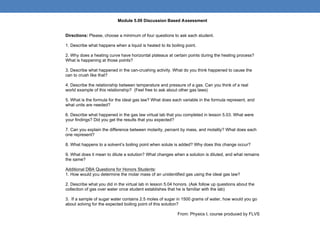
Module 5.09 Discussion Based Assessment


Directions: Please, choose a minimum of four questions to ask each student.

1. Describe what happens when a liquid is heated to its boiling point.

2. Why does a heating curve have horizontal plateaus at certain points during the heating process?
What is happening at those points?

3. Describe what happened in the can-crushing activity. What do you think happened to cause the
can to crush like that?

4. Describe the relationship between temperature and pressure of a gas. Can you think of a real
world example of this relationship? (Feel free to ask about other gas laws)

5. What is the formula for the ideal gas law? What does each variable in the formula represent, and
what units are needed?

6. Describe what happened in the gas law virtual lab that you completed in lesson 5.03. What were
your findings? Did you get the results that you expected?

7. Can you explain the difference between molarity, percent by mass, and molality? What does each
one represent?

8. What happens to a solvent’s boiling point when solute is added? Why does this change occur?

9. What does it mean to dilute a solution? What changes when a solution is diluted, and what remains
the same?

Additional DBA Questions for Honors Students:
1. How would you determine the molar mass of an unidentified gas using the ideal gas law?

2. Describe what you did in the virtual lab in lesson 5.04 honors. (Ask follow up questions about the
collection of gas over water once student establishes that he is familiar with the lab)

3. If a sample of sugar water contains 2.5 moles of sugar in 1500 grams of water, how would you go
about solving for the expected boiling point of this solution?

                                                            From: Physics I, course produced by FLVS
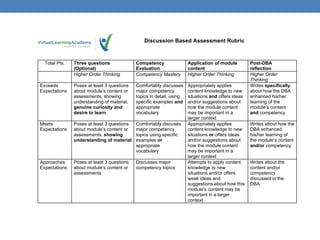
Discussion Based Assessment Rubric


  Total Pts.   Three questions              Competency                Application of module         Post-DBA
               (Optional)                   Evaluation                content                       reflection
               Higher Order Thinking        Competency Mastery        Higher Order Thinking         Higher Order
                                                                                                    Thinking
Exceeds        Poses at least 3 questions   Comfortably discusses     Appropriately applies         Writes specifically
Expectations   about module’s content or    major competency          content knowledge to new      about how the DBA
               assessments, showing         topics in detail, using   situations and offers ideas   enhanced his/her
               understanding of material,   specific examples and     and/or suggestions about      learning of the
               genuine curiosity and        appropriate               how the module content        module’s content
               desire to learn              vocabulary                may be important in a         and competency
                                                                      larger context
Meets          Poses at least 3 questions   Comfortably discuses      Appropriately applies         Writes about how the
Expectations   about module’s content or    major competency          content knowledge to new      DBA enhanced
               assessments, showing         topics using specific     situations or offers ideas    his/her learning of
               understanding of material    examples or               and/or suggestions about      the module’s content
                                            appropriate               how the module content        and/or competency
                                            vocabulary                may be important in a
                                                                      larger context
Approaches     Poses at least 3 questions   Discusses major           Attempts to apply content     Writes about the
Expectations   about module’s content or    competency topics         knowledge to new              content and/or
               assessments                                            situations and/or offers      competency
                                                                      weak ideas and                discussed in the
                                                                      suggestions about how this    DBA
                                                                      module’s content may be
                                                                      important in a larger
                                                                      context
Competency Maintenance
• Competency team
   • Instructors who are trained and experienced in writing
     competencies
   • Annual competency “scrubbing”
   • Establish competencies for new courses
   • Train new instructors, as needed
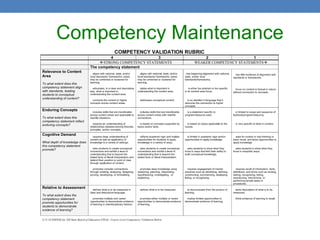
Competency Maintenance
33


New Resources
•    Competency-based Pathways Wiki
    • https://sites.google.com/site/competencybasedpathways/ho
      me

    •    Coming Soon
        • Issue Brief on Supports and Opportunities
        • Case Study on Boston Day and Evening Academy by
          Jobs for the Future
        • The Proficiency Based Pathways Project: A Close-Up
          View of Competency Education by Nellie Mae Education
          Foundation
        • Issue Brief on Information Management Systems
        • Virtual Schools Symposium Strand on Competency
          Education
34


FOR MORE INFORMATION
  AND SHARE IDEAS

CHRIS@METISNET.NET
35


Get Involved
 Knowledge Sharing Thru Blogging

 • Become a contributing author

 • Ask your staff and board to be contributing authors
   • Leadership development and networking
   • Raises attention to your organization
   • Keep an eye out novice mastery among staff
 Comment! Use the comments sections to share your
  thoughts
 Pass on ideas! People/places to highlight, and give us
  feedback
36


Get Involved! ….continued…..
 Share tools, materials, and know-how

 • Products: Create a wiki page to share resources
 • Video’s: Create video for youtube on your best
     practices

 Participate in a workgroup

 Connect – Stand up for Competency
 •   Ask everyone in your network (board
     members, staff, even students) to sign up at the
     website.
37


More Info


• Competency-based Pathways Wiki
 • https://sites.google.com/site/competencybasedpathwa
    ys/home
• iNACOL Competency Based Reports -
  http://www.inacol.org/research/competency/index.php

CompetencyWorks Aug 23 Webinar Slides

  • 1.
    The Art andScience of Designing Competencies August 23, 2012 3 pm eastern
  • 2.
    2 Overview • Welcome toCompetencyWorks • What is Competency Education • Introducing our Panelists • The Art and Science of Designing Competencies • Q.E.D Foundation • Virtual Learning Academy Charter School • Getting Involved in CompetencyWorks
  • 3.
  • 4.
    4 Advisory Board • Schoolsand School Networks • Wendy Battino, Reinventing Schools Coalition • Akili Moses Israel, DiplomaPlus • States and Districts • Sandra Dop, Iowa • Steve Bowen, Commissioner of Education, Maine • Don Siviski, Maine Departmemt of Education, • Paul Leather, NH Department of Education • Ed Dennis, Oregon • Diane Smith, Business Education Compact, Oregon • Stacy Holland, Philadelphia Youth Network, Pennsylvania • Jim Rickabaugh, CESA 1, Wisconsin
  • 5.
    5 Advisory Board • National Education and Policy Organizations • Betsy Brand, AYPF • Christina Brown, Center for Collaborative Education • Linda Pittenger, CCSSO • Tabitha Grossman, NGA • Rebecca Wolfe, JFF • Leading Consultants • Rose Colby, New Hampshire • JoEllen Lynch, Consultant • Foundations • Beth Miller and Charles Toulmin, NMEF • Tony Lewis, Donnel-Kay Foundation
  • 6.
    6 Competency Education:Working Definition • Students advance upon mastery. • Competencies include explicit, measurable, transferable learning objectives that empower students. • Assessment is meaningful and a positive learning experience for students. • Students receive timely, differentiated support based on their individual learning needs. • Learning outcomes emphasize competencies that include application and creation of knowledge, along with the development of important skills and dispositions
  • 7.
    7 Introducing our Panelists Kim Carter >35 years as a preK – graduate school educator, 1991 NH Teacher of the Year, co-creator of 3 new high schools, founding Executive Director of Q.E.D Foundation, passionate about educational equity and learner agency Elizabeth Cardine Elizabeth has experience advocating for transformational learning environments with local, state and national partners such as the Five Freedoms Project, School Reform Initiative, Extended Learning Opportunities, Faces of Learning, and the new MC2 Charter Schools.
  • 8.
    8 Introducing our Panelists Steve Kosssakoski >Dr. Kossakoski currently serves as the Chief Executive Officer of the Virtual Learning Academy Charter School. Under his leadership the Academy has grown from 700 enrollments to over 15,500 enrollments since opening in January 2008
  • 9.
    9 Our Mission isto build, inspire, cultivate and sustain cultures of transformational learning where • We are all learners with aspirations and passions which deserve to be supported in every way possible. • Learning changes lives by helping us develop the will, knowledge, skill, and capacity to achieve our aspirations. • Learning needs to happen in different ways, so we use various strengths and resources to engage with the world around us. • Learning empowers us to co-create our public world and to shape the decisions that impact our lives.
  • 10.
    10 What is aCompetency Competencies are the knowledge, skills and/or behaviors students must master in a specific content or performance area. Students demonstrate Proficiency through a preponderance of evidence of attainment of the required competencies in and/or across a content area. Mastery is the consistently successful application of a set of knowledge (facts), skills (processes), and behaviors (actions) to complex problems and novel situations.
  • 11.
    11 What Makes aGood Competency • Describes knowledge and skills that can be applied to novel, complex situations. • Skills will be valuable ten years from now even if the content knowledge has changed. • Learning objectives have clear performance criteria so students can identify their performance level(s) and what they need to do to improve. • Learning objectives are accompanied by effective rubrics that help students understand themselves as learners. • The competency and the learning objectives allow for personalization and opportunities for deeper learning.
  • 12.
    12 Competency Development List characteristicsof graduates (what do they need to know and be able to do?) - e.g. effective communicator Identify how each discipline contributes to those characteristics. - e.g. English: speaking skills, organizational methods, grammar and mechanics, etc. Map the progression of knowledge and skills that get students there. - e.g. Learning progression through skill levels
  • 13.
    13 Examples Students will makeinformative presentations. Students will understand that different audiences require different communication styles and strategies. Students [I can] use a wide range of strategies to communicate effectively with a variety of audiences to convey a variety of purposes.
  • 14.
    14 Quality Competency CCSS: Adaptspeech to a MC2: Students [I can] use a variety of contexts and wide range of strategies to communication communicate effectively with a tasks, demonstrating variety of audiences to convey command of formal a variety of purposes. English when indicated or appropriate.
  • 15.
  • 16.
  • 17.
  • 18.
    30 Linden St.,POB 1050, Exeter, NH 603.778.2500 info@vlacs.org facebook.com/vlacs virtuallrnacad
  • 19.
    About Us • Enrollment • 15,500 • 98.5% part-time students • 1.5% full-time students • Serving grades 6-12 • Over 100 courses: traditional subjects, AP, and dual credit • Instructors • 120 adjunct • 12 full-time
  • 20.
  • 21.
  • 22.
    Competency based school- Phase I • No calendar • Rolling admissions for part-time and full-time students • Students work at their own pace. Time is not a factor when awarding credit. • Funding based on completion percentage • Instructor compensation based on completion percentage
  • 23.
    Competency based school– Phase II • No calendar • Competencies developed for • Rolling admissions for all high school courses part-time and full-time • Students required to meet students competencies in order to earn • Students work at their credit, regardless of course own pace. Time is not a average factor when awarding • Competencies are developed credit. for all new high school and • Funding based on some college credit courses completion percentage • Competency recovery • Instructor compensation available to schools based on completion • ELO’s, Learning percentage Studios/Learning through Challenges now possible
  • 24.
  • 25.
    Sample Competency Chemistry 1:Phases and Solutions Competency: Students will demonstrate an understanding of physical properties of matter as they apply to phase changes, gas laws, and solutions. Keywords: solid, liquid, gas, mixture, melting, boiling, freezing, colligative property, molarity, concentration, dilution Assessments: 1. 5.03 Gas Laws 2. 5.05 Mixtures and Solutions 3. 5.09 Discussion-Based Assessment
  • 28.
    5.05 Mixtures andSolutions Lab Report Rubric Basic Lab Components Title (2 points) An appropriate title was included (1 or 0 points) An inappropriate title was in the lab report. used, or no title was included. The following sections of the lab report should be included Background Information and (4 points) Description of paper (3 to 0 points) Description, real-world according to the instructions Research chromatography is given in the student’s applications, and/or references are given in the assignment. own words, three real-world applications of incomplete, inaccurate, or not included in the paper chromatography are given, and report references are given for research. Purpose (2 points) An appropriate purpose was (1 or 0 points) Purpose was not appropriate written in complete sentences for the lab or was not included in the report. Materials (2 points) An organized list of materials was (1 or 0 points) Material list was unorganized given in the lab report. and incomplete or missing from the lab report. Procedure (2 points) A step-by-step procedure was (1 or 0 points) Procedure was incorrect, not written in the student’s own words. in the student’s own words, or not included in the report Data and Observation Data Table (4 points) Data table is organized, labeled, (3 to 0 points) Data table is unorganized or and lists all observations and measurements missing necessary information or Refer to the instructions given for the components of each pigment in both measurements from the lab. in the assignment to help you solutions. complete the following sections of the lab report. Measurements (2 points) Measurements are recorded for (1 or 0 points) Measurements are missing or the distance that each component pigment have incorrect or missing units. traveled. Discussion and Conclusion Conclusion (3 points) Discussion is written in complete (2 to 0 points) Discussion is incomplete sentences and includes description of lab because it does not include a description of Refer to what you learned in the and possible improvements or mistakes to the lab or possible improvements or mistakes lesson as well as to the be avoided. to be avoided. instructions given in the assignment to help you complete the following sections Discussion Questions (4 points) Valid answers are given for the (3 to 0 points) Answers to one or more of the of the lab report. discussion questions/topics, written in discussion questions are not valid or are paragraph form. incomplete. From: Physics I, course produced by FLVS
  • 29.
    Module 5.09 DiscussionBased Assessment Directions: Please, choose a minimum of four questions to ask each student. 1. Describe what happens when a liquid is heated to its boiling point. 2. Why does a heating curve have horizontal plateaus at certain points during the heating process? What is happening at those points? 3. Describe what happened in the can-crushing activity. What do you think happened to cause the can to crush like that? 4. Describe the relationship between temperature and pressure of a gas. Can you think of a real world example of this relationship? (Feel free to ask about other gas laws) 5. What is the formula for the ideal gas law? What does each variable in the formula represent, and what units are needed? 6. Describe what happened in the gas law virtual lab that you completed in lesson 5.03. What were your findings? Did you get the results that you expected? 7. Can you explain the difference between molarity, percent by mass, and molality? What does each one represent? 8. What happens to a solvent’s boiling point when solute is added? Why does this change occur? 9. What does it mean to dilute a solution? What changes when a solution is diluted, and what remains the same? Additional DBA Questions for Honors Students: 1. How would you determine the molar mass of an unidentified gas using the ideal gas law? 2. Describe what you did in the virtual lab in lesson 5.04 honors. (Ask follow up questions about the collection of gas over water once student establishes that he is familiar with the lab) 3. If a sample of sugar water contains 2.5 moles of sugar in 1500 grams of water, how would you go about solving for the expected boiling point of this solution? From: Physics I, course produced by FLVS
  • 30.
    Discussion Based AssessmentRubric Total Pts. Three questions Competency Application of module Post-DBA (Optional) Evaluation content reflection Higher Order Thinking Competency Mastery Higher Order Thinking Higher Order Thinking Exceeds Poses at least 3 questions Comfortably discusses Appropriately applies Writes specifically Expectations about module’s content or major competency content knowledge to new about how the DBA assessments, showing topics in detail, using situations and offers ideas enhanced his/her understanding of material, specific examples and and/or suggestions about learning of the genuine curiosity and appropriate how the module content module’s content desire to learn vocabulary may be important in a and competency larger context Meets Poses at least 3 questions Comfortably discuses Appropriately applies Writes about how the Expectations about module’s content or major competency content knowledge to new DBA enhanced assessments, showing topics using specific situations or offers ideas his/her learning of understanding of material examples or and/or suggestions about the module’s content appropriate how the module content and/or competency vocabulary may be important in a larger context Approaches Poses at least 3 questions Discusses major Attempts to apply content Writes about the Expectations about module’s content or competency topics knowledge to new content and/or assessments situations and/or offers competency weak ideas and discussed in the suggestions about how this DBA module’s content may be important in a larger context
  • 31.
    Competency Maintenance • Competencyteam • Instructors who are trained and experienced in writing competencies • Annual competency “scrubbing” • Establish competencies for new courses • Train new instructors, as needed
  • 32.
  • 33.
    33 New Resources • Competency-based Pathways Wiki • https://sites.google.com/site/competencybasedpathways/ho me • Coming Soon • Issue Brief on Supports and Opportunities • Case Study on Boston Day and Evening Academy by Jobs for the Future • The Proficiency Based Pathways Project: A Close-Up View of Competency Education by Nellie Mae Education Foundation • Issue Brief on Information Management Systems • Virtual Schools Symposium Strand on Competency Education
  • 34.
    34 FOR MORE INFORMATION AND SHARE IDEAS CHRIS@METISNET.NET
  • 35.
    35 Get Involved  KnowledgeSharing Thru Blogging • Become a contributing author • Ask your staff and board to be contributing authors • Leadership development and networking • Raises attention to your organization • Keep an eye out novice mastery among staff  Comment! Use the comments sections to share your thoughts  Pass on ideas! People/places to highlight, and give us feedback
  • 36.
    36 Get Involved! ….continued….. Share tools, materials, and know-how • Products: Create a wiki page to share resources • Video’s: Create video for youtube on your best practices  Participate in a workgroup  Connect – Stand up for Competency • Ask everyone in your network (board members, staff, even students) to sign up at the website.
  • 37.
    37 More Info • Competency-basedPathways Wiki • https://sites.google.com/site/competencybasedpathwa ys/home • iNACOL Competency Based Reports - http://www.inacol.org/research/competency/index.php

Editor's Notes

  • #2 Introduction by Susan Patrick (these will be re-written by Susan)First of our issue papersPlease use the chat room, we have found that this is a vital part of the conversation. Please introduce yourself now and say where you are from and your interest in competency education. The materials will be archived and resources can be found at the Competency-based Pathways wiki. You can find a link to the wiki on the home page of competencyworks.orgA quick note about language – we use comptency, but panelists and participants may use other language such as proficiency. Different states use different language and so we accommodate that. We have many resources related to this topic on the wiki. You may want to create a tab so that you can take a look during the webinar. You can find the wiki by going to the home page of competencyworks.org
  • #4 Susan: Before I turn you over to Chris, let me introduce you to the partner organizations. First of all, I’d like to highlight the leadership of the Nellie Mae Education Foundation has been an outstanding partner – their early funding allowed us to do the research in Success is the Only Option, organize the Competency Education Summit in March 2011, and kick off CompetencyWorks. Donnell-Kay Foundation also was an early supporter of the Competency Education Summit. We couldn’t do this work without our partners American Youth Policy Forum, National Governors Association and Jobs for the Future.
  • #5 We have an incredible advisory board. We are going to rely on them to help us make sure thatCompetencyWorks is valuable to folks doing the work across the country. We also are counting on them to help us prioritize the topics and make sure we are engaging the most knowledgeable folks in the work. We have people from school networks, states and districts, national education and policy organizations, and leading consultants.
  • #6 I will now introduce you to Chris Sturgis of MetisNet. We’ve been working together for two years to raise awareness and support knowledge sharing in competency education. Chris was instrumental in helping the US Department of Education introduce competency education into policy. She has been advocating for competency education for overage, undercredited students on the Youth Transition Funders Group blog Connected by 25. She comes to this work because of her commitment that the education system must be re-designed to ensure that all young people get a high school diploma that is meaningful to their future. C
  • #7 We are driving towards quality – competency education is not a silver bullet. If not done well, could continue the achievement gap. So we need to constantly ask ourselves, Am I doing this effectively? Have I asked how others who more experience are doing it to make sure I’ve considered the ways that students might fall off-pace?”If you have any questions about this definition, please use the chat room to ask or comment. Others will help answer questions.
  • #8 We are so lucky today to have people with years of expertise in competency education to share their expertise with us. They will each give an overview of how they design copetencies and learning objectives, the things they’ve learned to pay attention to, and advise on how to move forward.Please note, there are some differences between designing for an online school providing online courses as compared to a school that is primarily face-to-face or even blended learning. We also have other practitioners participating and we hope that you will share your expertise as well through the chat. If you feel that there is an important variation in how you do your work please raise your hand and we will have you talk directly about your experience. Ad panelists mention resources, please be assured we will collect everything and put it on the wiki for you to see.
  • #9 We are so lucky today to have people with years of expertise in competency education to share their expertise with us. They will each give an overview of how they design copetencies and learning objectives, the things they’ve learned to pay attention to, and advise on how to move forward.Please note, there are some differences between designing for an online school providing online courses as compared to a school that is primarily face-to-face or even blended learning. We also have other practitioners participating and we hope that you will share your expertise as well through the chat. If you feel that there is an important variation in how you do your work please raise your hand and we will have you talk directly about your experience. Ad panelists mention resources, please be assured we will collect everything and put it on the wiki for you to see.
  • #36 In summary, there are lots of ways to be involved. The website is only as good as the content. Paul Leather reminds us – we have to get to the nuts and bolts. I can write about what I learn from you but it will never be as valuable as someone who is writing for their peers. The power of the moment of novice mastery – someone who has just learned or designed something that is working has all the freshness of their learning. We need you to capture that and share it. We need eyes and ears on the ground to tell us about advancements, best practices, examples of real results, and emerging leaders and innovators.
  • #37 Sharing Tools is So Important: If you see something that is really good, let us know. Your input on what is “best” is so important.Video’s: There isn’t going to be a lot of money for the systemic reform. We all need to develop capacity to make video’s really easily. Connect: We need to be able to have networking capacity to build a field to support advocacy, creating a workforce that understands competency-based learning, and increase the diversity among innovators and leadership.