John StatherTwitter.com/jstather
Aim of the studyEvaluating the Impact of an ELearning resource upon the attainment of Year 8 pupils during their Design and technology home learning project.
John StatherTeacher of Design TechnologyTeaching 8 Years spread between two 11 – 16 Comprehensive SchoolsResponsibilities include Co-ordinating Key stage 3 Technology
Aims of this presentationIntroduce the enquiry, how it fits with the school agenda and define terms used within the presentationReview major findings of the enquiryOutline implications for policy implementationOutline future orientation of the Elearning App
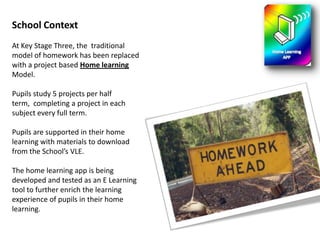
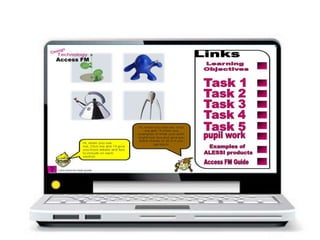
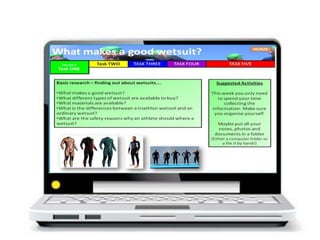
School ContextAt Key Stage Three, the  traditional model of homework has been replaced with a project based Home learning Model. Pupils study 5 projects per half term,  completing a project in each subject every full term.Pupils are supported in their home learning with materials to download from the School’s VLE. The home learning app is being developed and tested as an E Learning tool to further enrich the learning experience of pupils in their home learning.
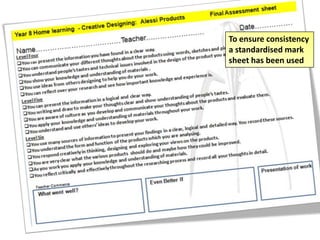
To ensure consistency a standardised mark sheet has been used
Basiel – VLE it self does led to transferable learning skillsOftsed 09 – VLE population is largely down to few keen members of staff who have an interest in the fieldBrenham – 50% more courses within the next 5 years will have 50% of content delivered online. Bates – Argues that a major role of the vle and e learning is to prepare learners for work Hargreaves – had argued that it is this tinkering and discussion between staff that can and staff that what to that leds to knowledge being transferred
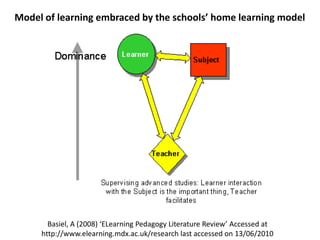
Model of learning embraced by the schools’ home learning modelBasiel, A (2008) ‘ELearning Pedagogy Literature Review’ Accessed at http://www.elearning.mdx.ac.uk/research last accessed on 13/06/2010
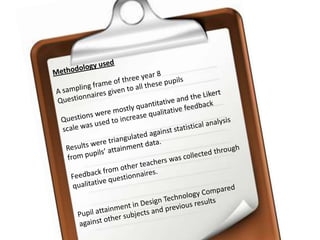
Methodology used A sampling frame of three year 8 Questionnaires given to all these pupilsQuestions were mostly quantitative and the Likert scale was used to increase qualitative feedbackResults were triangulated against statistical analysis from pupils’ attainment data.Feedback from other teachers was collected through qualitative questionnaires.Pupil attainment in Design Technology Compared against other subjects and previous results
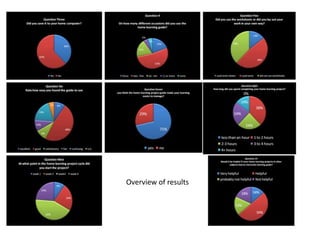
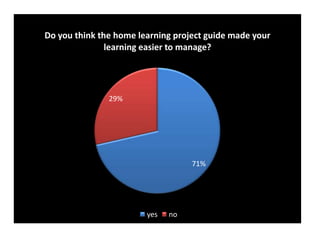
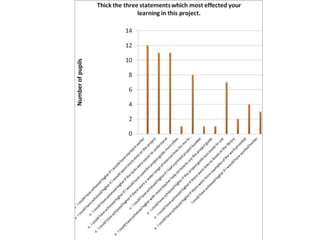
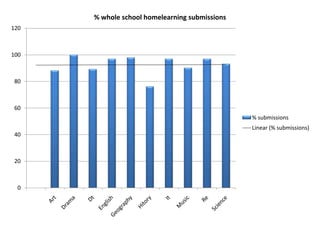
Overview of results
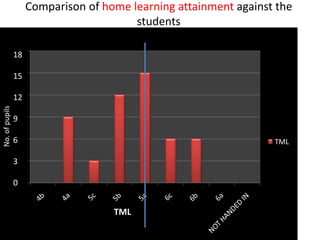
Comparison of home learning attainment against the students1815129630No. of pupils
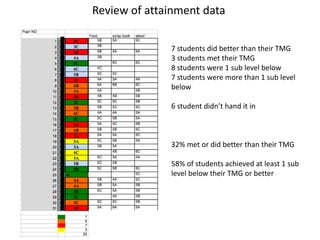
Review of attainment data7 students did better than their TMG3 students met their TMG8 students were 1 sub level below7 students were more than 1 sub level below6 student didn’t hand it in32% met or did better than their TMG58% of students achieved at least 1 sub level below their TMG or better
Teacher Questionnaires All returned responses appear to be in favor of the app as a learning resource. A number of responses from across the questionnaire suggest that there is a lot of potential for the app but only if changes are made which focus on the specific learning outcomes, which the app is looking to take the learners to. The data gained here will be invaluable in the  future development of the App.
Teacher Questionnaires The questionnaire returns did show a gap in the understanding of how Rapid ELearning products in the Secondary Education sector could be deployedas learning tools.
Final conclusionsThe final conclusions of all the data analysis, especially the questionnaire data suggests that the app could support the pupils’ independent learning and with more work on the instructional design within it, will create greater support.
Final conclusionsHowever, at present the statistical analysis of attainment data suggests that the impact of the app is on average minimal and suits some learners better than others. The actual impact of the app cannot be totally measured using the methodology deployed in this assignment. The full scope of evaluating the app goes beyond the research methodology which I have used.
Implications to introducing this Innovation PolicyKai Zen Approach  - let people tinkerBe aware that a school is a complex system – everybody will have a different understanding/knowledge level of elearning + Computer literacy but also of the role of homeworkBe aware of peoples values. Elearning is part my working practice and is valued as part of my grounded theory  but not everyone else.Except that once introduced the innovation policy will be shaped by comprise for all the reasons above. Be sensitive and intrapersonal to other peoples training needs
Trowlerargues that the outcome may not be what is intended as in deed a compromise between the policy and the stakeholders.
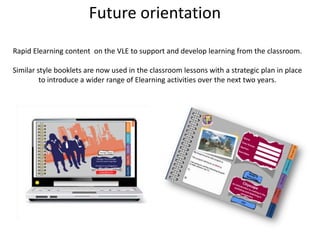
Future orientationRapid Elearning content  on the VLE to support and develop learning from the classroom.Similar style booklets are now used in the classroom lessons with a strategic plan in place to introduce a wider range of Elearning activities over the next two years.
References Basiel, A (2008) ‘ELearning Pedagogy Literature Review’ Accessed at http://www.elearning.mdx.ac.uk/research last accessed on 13/06/2010Bates, T. (2009) Can you move classroom courses online quickly and cheaply? Accessed at: http://www.tonybates.ca/ Access on 15/3/10Brenman, J. (2006) Shift Happens. Accessed at: http://www.slideshare.net/jbrenman/shift-happens-33834:  Accessed on 01/07/10Bush, T. (1998) ‘Organisational Culture and Strategic Management’ in Strategic Management in Schools and Colleges, London: Paul ChampmanFullan, M. (2001) ‘The Meaning of Educational Change, London: RoutledgeGarret, V. (2005) ‘Leading and managing Change’, in Davies et al. (2005) School Leadership in the 21st Century, London: RoutledgeFalmerGladwell, Malcolm. The Tipping Point: How Little Things Can Make a Big Difference.New York: Little, Brown and Company, 2000.Martin T. (1994) Institutional Blockages to learning and Changing a Psychodynamic Perspective  (Paper presented at an annual conference, British Educational Management and Administrative Society September (1994) Ofsted (2009) ‘Virtual learning environments: an evaluation of their development in a sample of educational settings’ Crown Copyright.Trowler, P., Saunders, M. and Knight, P. (2003) Change Thinking, Change Practices ITSN Generic CentreWest-Burnham., Farrar, M. and Otero, G. (2007) ‘Change and Complex Communities’, in Schools and Communities, London: Continuum

Presentation module 6

  • 1.
  • 2.
    Aim of thestudyEvaluating the Impact of an ELearning resource upon the attainment of Year 8 pupils during their Design and technology home learning project.
  • 3.
    John StatherTeacher ofDesign TechnologyTeaching 8 Years spread between two 11 – 16 Comprehensive SchoolsResponsibilities include Co-ordinating Key stage 3 Technology
  • 4.
    Aims of thispresentationIntroduce the enquiry, how it fits with the school agenda and define terms used within the presentationReview major findings of the enquiryOutline implications for policy implementationOutline future orientation of the Elearning App
  • 5.
    School ContextAt KeyStage Three, the traditional model of homework has been replaced with a project based Home learning Model. Pupils study 5 projects per half term, completing a project in each subject every full term.Pupils are supported in their home learning with materials to download from the School’s VLE. The home learning app is being developed and tested as an E Learning tool to further enrich the learning experience of pupils in their home learning.
  • 9.
    To ensure consistencya standardised mark sheet has been used
  • 10.
    Basiel – VLEit self does led to transferable learning skillsOftsed 09 – VLE population is largely down to few keen members of staff who have an interest in the fieldBrenham – 50% more courses within the next 5 years will have 50% of content delivered online. Bates – Argues that a major role of the vle and e learning is to prepare learners for work Hargreaves – had argued that it is this tinkering and discussion between staff that can and staff that what to that leds to knowledge being transferred
  • 11.
    Model of learningembraced by the schools’ home learning modelBasiel, A (2008) ‘ELearning Pedagogy Literature Review’ Accessed at http://www.elearning.mdx.ac.uk/research last accessed on 13/06/2010
  • 12.
    Methodology used Asampling frame of three year 8 Questionnaires given to all these pupilsQuestions were mostly quantitative and the Likert scale was used to increase qualitative feedbackResults were triangulated against statistical analysis from pupils’ attainment data.Feedback from other teachers was collected through qualitative questionnaires.Pupil attainment in Design Technology Compared against other subjects and previous results
  • 13.
  • 20.
    Comparison of homelearning attainment against the students1815129630No. of pupils
  • 22.
    Review of attainmentdata7 students did better than their TMG3 students met their TMG8 students were 1 sub level below7 students were more than 1 sub level below6 student didn’t hand it in32% met or did better than their TMG58% of students achieved at least 1 sub level below their TMG or better
  • 23.
    Teacher Questionnaires Allreturned responses appear to be in favor of the app as a learning resource. A number of responses from across the questionnaire suggest that there is a lot of potential for the app but only if changes are made which focus on the specific learning outcomes, which the app is looking to take the learners to. The data gained here will be invaluable in the future development of the App.
  • 24.
    Teacher Questionnaires Thequestionnaire returns did show a gap in the understanding of how Rapid ELearning products in the Secondary Education sector could be deployedas learning tools.
  • 25.
    Final conclusionsThe finalconclusions of all the data analysis, especially the questionnaire data suggests that the app could support the pupils’ independent learning and with more work on the instructional design within it, will create greater support.
  • 26.
    Final conclusionsHowever, atpresent the statistical analysis of attainment data suggests that the impact of the app is on average minimal and suits some learners better than others. The actual impact of the app cannot be totally measured using the methodology deployed in this assignment. The full scope of evaluating the app goes beyond the research methodology which I have used.
  • 27.
    Implications to introducingthis Innovation PolicyKai Zen Approach - let people tinkerBe aware that a school is a complex system – everybody will have a different understanding/knowledge level of elearning + Computer literacy but also of the role of homeworkBe aware of peoples values. Elearning is part my working practice and is valued as part of my grounded theory but not everyone else.Except that once introduced the innovation policy will be shaped by comprise for all the reasons above. Be sensitive and intrapersonal to other peoples training needs
  • 28.
    Trowlerargues that theoutcome may not be what is intended as in deed a compromise between the policy and the stakeholders.
  • 29.
    Future orientationRapid Elearningcontent on the VLE to support and develop learning from the classroom.Similar style booklets are now used in the classroom lessons with a strategic plan in place to introduce a wider range of Elearning activities over the next two years.
  • 30.
    References Basiel, A(2008) ‘ELearning Pedagogy Literature Review’ Accessed at http://www.elearning.mdx.ac.uk/research last accessed on 13/06/2010Bates, T. (2009) Can you move classroom courses online quickly and cheaply? Accessed at: http://www.tonybates.ca/ Access on 15/3/10Brenman, J. (2006) Shift Happens. Accessed at: http://www.slideshare.net/jbrenman/shift-happens-33834: Accessed on 01/07/10Bush, T. (1998) ‘Organisational Culture and Strategic Management’ in Strategic Management in Schools and Colleges, London: Paul ChampmanFullan, M. (2001) ‘The Meaning of Educational Change, London: RoutledgeGarret, V. (2005) ‘Leading and managing Change’, in Davies et al. (2005) School Leadership in the 21st Century, London: RoutledgeFalmerGladwell, Malcolm. The Tipping Point: How Little Things Can Make a Big Difference.New York: Little, Brown and Company, 2000.Martin T. (1994) Institutional Blockages to learning and Changing a Psychodynamic Perspective (Paper presented at an annual conference, British Educational Management and Administrative Society September (1994) Ofsted (2009) ‘Virtual learning environments: an evaluation of their development in a sample of educational settings’ Crown Copyright.Trowler, P., Saunders, M. and Knight, P. (2003) Change Thinking, Change Practices ITSN Generic CentreWest-Burnham., Farrar, M. and Otero, G. (2007) ‘Change and Complex Communities’, in Schools and Communities, London: Continuum

Editor's Notes

  • #7 Basiel – VLE it self does led to transferable learning skillsOftsed 09 – VLE population is largely down to few keen members of staff who have an interest in the fieldBrenham – 50% more courses within the next 5 years will have 50% of content delivered online. Bates – Argues that a major role of the vle and e learning is to prepare learners for work Hargreaves – had argued that it is this tinkering and discussion between staff that can and staff that what to that leds to knowledge being transferred
  • #8 Basiel – VLE it self does led to transferable learning skillsOftsed 09 – VLE population is largely down to few keen members of staff who have an interest in the fieldBrenham – 50% more courses within the next 5 years will have 50% of content delivered online. Bates – Argues that a major role of the vle and e learning is to prepare learners for work Hargreaves – had argued that it is this tinkering and discussion between staff that can and staff that what to that leds to knowledge being transferred
  • #9 Basiel – VLE it self does led to transferable learning skillsOftsed 09 – VLE population is largely down to few keen members of staff who have an interest in the fieldBrenham – 50% more courses within the next 5 years will have 50% of content delivered online. Bates – Argues that a major role of the vle and e learning is to prepare learners for work Hargreaves – had argued that it is this tinkering and discussion between staff that can and staff that what to that leds to knowledge being transferred