Geotechnical Characterization for Seismic
Design: Standard Penetration Testing and
Shear Wave Velocity ProfilesShear Wave Velocity Profiles
Brady R. Cox, Ph.D., P.E.Brady R. Cox, Ph.D., P.E.
The University of Arkansas
Department of Civil Engineering
Geotechnical Earthquake Engineering for Seismic Design Workshop,
Department of Civil Engineering
Port-au-Prince, Haiti, November 18-19, 2010
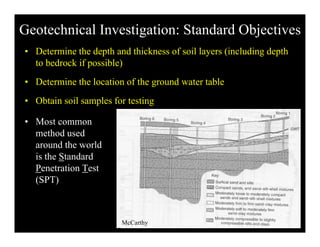
Geotechnical Investigation: Standard Objectives
• Determine the depth and thickness of soil layers (including depth
to bedrock if possible)
• Determine the location of the ground water table
• Obtain soil samples for testing
• Most common
method used
around the world
is the Standard
Penetration TestPenetration Test
(SPT)
McCarthy
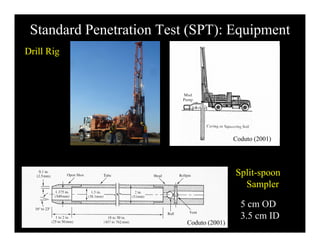
Standard Penetration Test (SPT): Equipment
Drill Rig
Coduto (2001)
S lit
Coduto (2001)
Split-spoon
Sampler
5 OD
Coduto (2001)
5 cm OD
3.5 cm ID
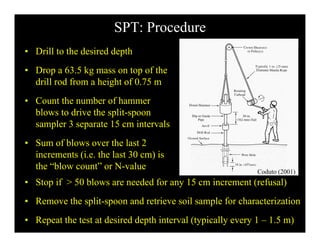
SPT: Procedure
• Drill to the desired depth
• Drop a 63.5 kg mass on top of the
drill rod from a height of 0.75 m
• Count the number of hammer
blows to drive the split-spoon
sampler 3 separate 15 cm intervals
• Sum of blows over the last 2
increments (i.e. the last 30 cm) is
the “blow count” or N-value C d t (2001)Coduto (2001)
• Stop if > 50 blows are needed for any 15 cm increment (refusal)
• Remove the split spoon and retrieve soil sample for characterization• Remove the split-spoon and retrieve soil sample for characterization
• Repeat the test at desired depth interval (typically every 1 – 1.5 m)
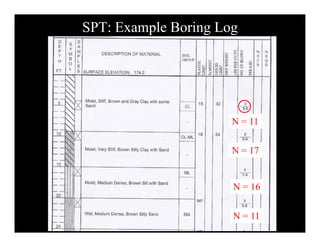
SPT: Example Boring Log
N = 11
N = 17
N = 16
N = 11
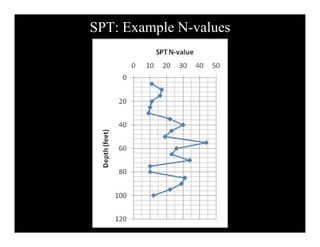
SPT: Example N-values
In-Situ Shear Wave Velocity (Vs) Measurements
• Earthquake damage is considered to be caused
primarily by vertically propagating shear waves
• The velocity at which these shear waves travel
through a given material (i e rock vs soil)through a given material (i.e. rock vs. soil)
strongly influences the response of the material
because V is directly related to shear modulusbecause Vs is directly related to shear modulus
• Therefore, a very important part of
Geotechnical Earthquake Engineering is
dynamic site characterization to obtain in-situ
measurements of Vs
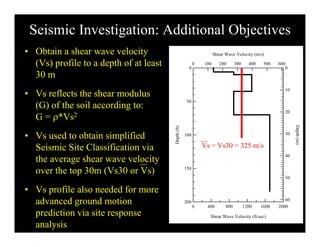
Seismic Investigation: Additional Objectives
• Obtain a shear wave velocity
(Vs) profile to a depth of at least
30 m
0 0
6005004003002001000
Shear Wave Velocity (m/s)
30 m
• Vs reflects the shear modulus
(G) of the soil according to:
50
10
(G) of the soil according to:
G = *Vs2
• Vs used to obtain simplified 100
epth(ft)
30
20
Depth(
p
Seismic Site Classification via
the average shear wave velocity
over the top 30m (Vs30 or Vs) 150
De
40
(m)
Vs = Vs30 = 325 m/s
over the top 30m (Vs30 or Vs)
• Vs profile also needed for more
advanced ground motion 200 60
50
advanced ground motion
prediction via site response
analysis
200
2000160012008004000
Shear Wave Velocity (ft/sec)
In-Situ Shear Wave Velocity (Vs) Measurements
• Intrusive (Borehole Methods)
C h l– Crosshole
– Downhole
S i L i– Suspension Logging
• Non intr si e (S rface Wa e Methods)• Non-intrusive (Surface Wave Methods)
– Spectral Analysis of Surface Waves (SASW)
Multi channel Analysis of Surface Waves (MASW)– Multi-channel Analysis of Surface Waves (MASW)
– Refraction Microtremor (ReMi)
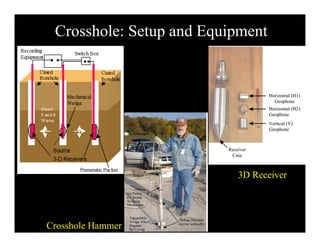
Crosshole: Setup and Equipment
Horizontal (H1)
Geophone
H i t l (H2)
Horizontal (H1)
Geophone
H i t l (H2)Horizontal (H2)
Geophone
Vertical (V)
Geophone
Horizontal (H2)
Geophone
Vertical (V)
Geophone
Receiver
Case
Receiver
Case
3D Receiver
Crosshole Hammer
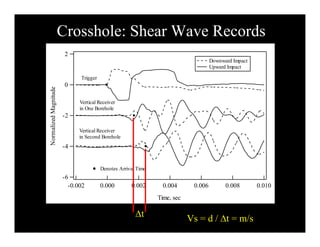
Crosshole: Shear Wave Records
2
Downward Impact
Upward Impact
T i
0
agnitude
Trigger
Vertical Receiver
in One Borehole
-2
ormalizedMa
in One Borehole
Vertical Receiver
in Second Borehole
-4
No
Denotes Arrival Time
-6
0.0100.0080.0060.0040.0020.000-0.002
Time, sec
Denotes Arrival Time
t Vs = d / t = m/s
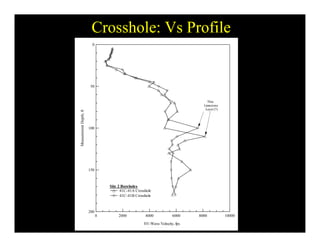
Crosshole: Vs Profile
00
50
Thin
Limestone
100
surementDepth,ft
Layer (?)
150
Meas
150
Site 2 Boreholes
41C-41A Crosshole
41C-41B Crosshole
200
1000080006000400020000
SV-Wave Velocity, fps
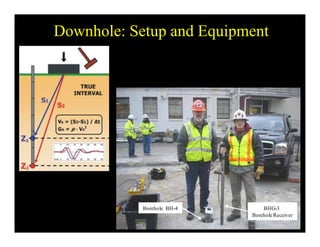
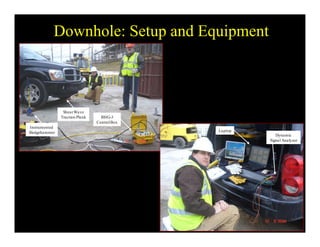
Downhole: Setup and Equipment
BHG-3
Borehole Receiver
Borehole BH-4
Downhole: Setup and Equipment
Instrumented
Sledgehammer
ShearWave
Traction Plank BHG-3
ControlBox
Laptop
Dynamic
Si l A lSignal Analyzer
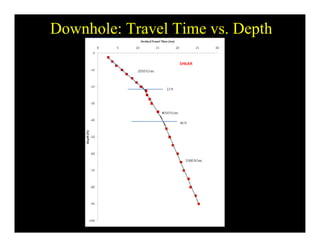
Downhole: Travel Time vs. Depth
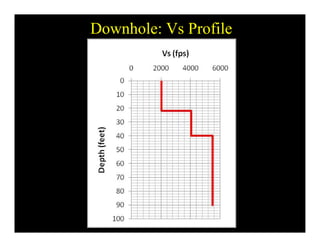
Downhole: Vs Profile
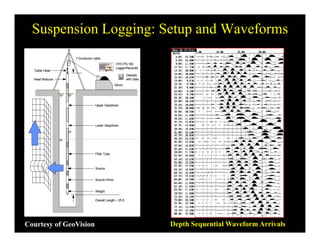
Suspension Logging: Setup and Waveforms
Cable Head
7-Conductor cable
Diskette
OYO PS-160
Logger/Recorder
Head Reducer
Upper Geophone
Winch
with Data
Lower Geophone
Filter Tube
Source
Source Driver
Weight
Overall Length ~ 25 ftOverall Length 25 ft
Depth Sequential Waveform ArrivalsCourtesy of GeoVision
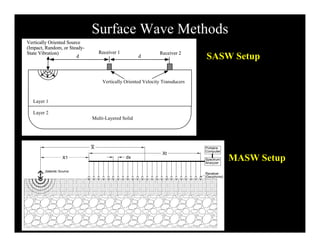
Surface Wave Methods
Vertically Oriented SourceVertically Oriented Source
SASW Setup
Receiver 1 Receiver 2
d d
(Impact, Random, or Steady-
State Vibration) Receiver 1 Receiver 2
d d
(Impact, Random, or Steady-
State Vibration)
Vertically Oriented Velocity Transducers
Layer 1
Vertically Oriented Velocity Transducers
Layer 1
Multi-Layered Solid
Layer 2
Multi-Layered Solid
Layer 2
MASW Setup
SASW Equipment
Dynamic Signal Analyzer Geophones and Sledgehammer
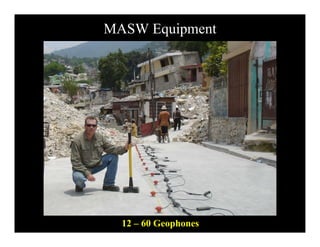
MASW Equipment
12 – 60 Geophones
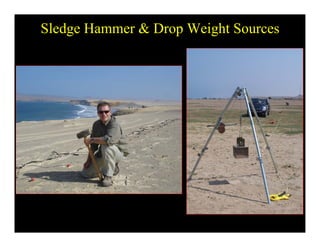
Sledge Hammer & Drop Weight Sources
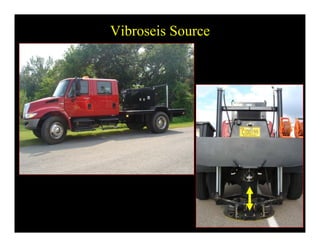
Vibroseis Source
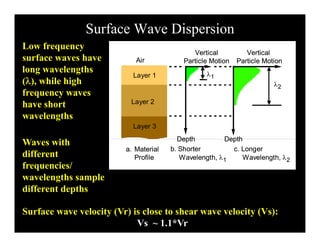
Surface Wave Dispersion
Low frequency
Layer 1Layer 1
Vertical
Particle Motion
Vertical
Particle Motion
1
Air
Layer 1Layer 1
Vertical
Particle Motion
Vertical
Particle Motion
1
Air
Layer 1Layer 1
Vertical
Particle Motion
Vertical
Particle Motion
1
Air
Low frequency
surface waves have
long wavelengths
Layer 2
Layer 1
Layer 2
Layer 1
2
1
Layer 2
Layer 1
Layer 2
Layer 1
2
1
Layer 2
Layer 1
Layer 2
Layer 1
2
1
(), while high
frequency waves
have short
Depth Depth
Layer 3Layer 3
Depth Depth
Layer 3Layer 3
Depth Depth
Layer 3Layer 3
wavelengths
W i h Depth Depth
a. Material
Profile
c. Longer
Wavelength, 2
b. Shorter
Wavelength, 1
Depth Depth
a. Material
Profile
c. Longer
Wavelength, 2
b. Shorter
Wavelength, 1
Depth Depth
a. Material
Profile
c. Longer
Wavelength, 2
b. Shorter
Wavelength, 1
Waves with
different
frequencies/q
wavelengths sample
different depths
Surface wave velocity (Vr) is close to shear wave velocity (Vs):
Vs ~ 1.1*Vr
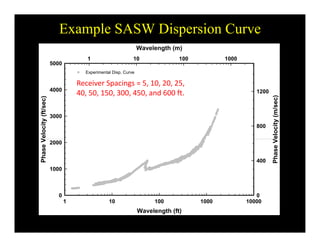
Example SASW Dispersion Curve
5000
Wavelength (m)
1 10 100 1000
Experimental Disp. Curve
sec)
4000
/sec)
1200
Receiver Spacings = 5, 10, 20, 25, 
40, 50, 150, 300, 450, and 600 ft.
Velocity(ft/s
3000
Velocity(m/
800
PhaseV
1000
2000
PhaseV
400
1 10 100 1000 10000
0
1000
0
Wavelength (ft)
1 10 100 1000 10000
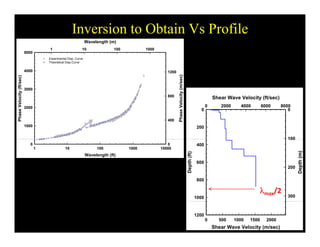
Inversion to Obtain Vs Profile
Wavelength (m)
c)
4000
5000
1 10 100 1000
c)
1200
Experimental Disp. Curve
Theoretical Disp.Curve
Velocity(ft/sec
2000
3000
Velocity(m/sec
800
Shear Wave Velocity (ft/sec)
0 2000 4000 6000 8000
Phase
1000
2000
PhaseV
400
0
100
0
200
Wavelength (ft)
1 10 100 1000 10000
0 0
epth(m)
100
200
Depth(ft)
400
600
D
300
D
800
1000
max/2
Shear Wave Velocity (m/sec)
0 500 1000 1500 2000
1200
Seismic Site Classification
Required by Seismic Provisions in Building CodesRequired by Seismic Provisions in Building Codes
IBC (2009) ASCE 7-05
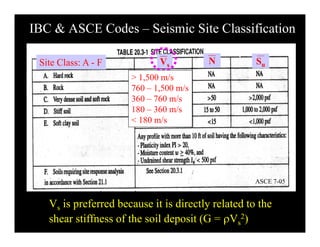
IBC & ASCE Codes – Seismic Site Classification
Vs N SuSite Class: A - F
> 1 500 m/s> 1,500 m/s
760 – 1,500 m/s
360 – 760 m/s
180 360 /180 – 360 m/s
< 180 m/s
V i f d b it i di tl l t d t th
ASCE 7-05
Vs is preferred because it is directly related to the
shear stiffness of the soil deposit (G = Vs
2)
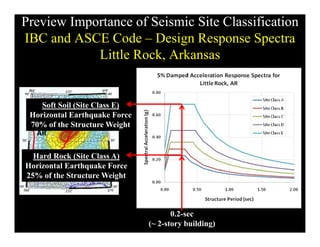
Preview Importance of Seismic Site Classification
IBC and ASCE Code – Design Response Spectra
Little Rock, Arkansas
Soft Soil (Site Class E)
AR
( )
Horizontal Earthquake Force
70% of the Structure Weight
Hard Rock (Site Class A)
Horizontal Earthquake Force
25% of the Structure Weight
0.2-sec
(~ 2-story building)
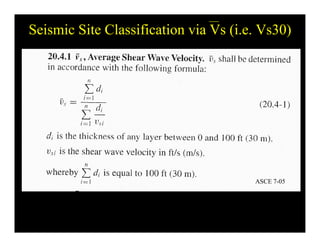
Seismic Site Classification via Vs (i.e. Vs30)
ASCE 7-05
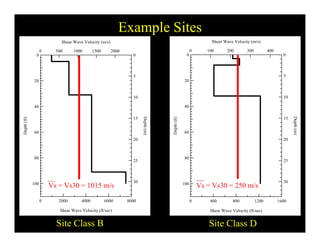
Example Sites
Shear Wave Velocity (m/s) Shear Wave Velocity (m/s)
0
5
0
2000150010005000
0
5
0
4003002001000
40
20
10
5
40
20
10
5
60
40
Depth(ft)
20
15
Depth(m)
60
0
Depth(ft)
20
15
Depth(m)
80
25
20
80
25
20
100
80006000400020000
30 100
160012008004000
30
Vs = Vs30 = 1015 m/s Vs = Vs30 = 250 m/s
80006000400020000
Shear Wave Velocity (ft/sec)
160012008004000
Shear Wave Velocity (ft/sec)
Site Class B Site Class D
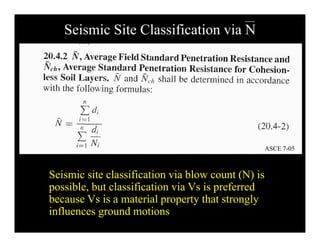
Seismic Site Classification via N
ASCE 7-05
Seismic site classification via blow count (N) is
possible, but classification via Vs is preferred
because Vs is a material property that stronglybecause Vs is a material property that strongly
influences ground motions
Questions?Questions?

Vs30 measurements for Seismic Site Classification

  • 1.
    Geotechnical Characterization forSeismic Design: Standard Penetration Testing and Shear Wave Velocity ProfilesShear Wave Velocity Profiles Brady R. Cox, Ph.D., P.E.Brady R. Cox, Ph.D., P.E. The University of Arkansas Department of Civil Engineering Geotechnical Earthquake Engineering for Seismic Design Workshop, Department of Civil Engineering Port-au-Prince, Haiti, November 18-19, 2010
  • 2.
    Geotechnical Investigation: StandardObjectives • Determine the depth and thickness of soil layers (including depth to bedrock if possible) • Determine the location of the ground water table • Obtain soil samples for testing • Most common method used around the world is the Standard Penetration TestPenetration Test (SPT) McCarthy
  • 3.
    Standard Penetration Test(SPT): Equipment Drill Rig Coduto (2001) S lit Coduto (2001) Split-spoon Sampler 5 OD Coduto (2001) 5 cm OD 3.5 cm ID
  • 4.
    SPT: Procedure • Drillto the desired depth • Drop a 63.5 kg mass on top of the drill rod from a height of 0.75 m • Count the number of hammer blows to drive the split-spoon sampler 3 separate 15 cm intervals • Sum of blows over the last 2 increments (i.e. the last 30 cm) is the “blow count” or N-value C d t (2001)Coduto (2001) • Stop if > 50 blows are needed for any 15 cm increment (refusal) • Remove the split spoon and retrieve soil sample for characterization• Remove the split-spoon and retrieve soil sample for characterization • Repeat the test at desired depth interval (typically every 1 – 1.5 m)
  • 5.
    SPT: Example BoringLog N = 11 N = 17 N = 16 N = 11
  • 6.
  • 7.
    In-Situ Shear WaveVelocity (Vs) Measurements • Earthquake damage is considered to be caused primarily by vertically propagating shear waves • The velocity at which these shear waves travel through a given material (i e rock vs soil)through a given material (i.e. rock vs. soil) strongly influences the response of the material because V is directly related to shear modulusbecause Vs is directly related to shear modulus • Therefore, a very important part of Geotechnical Earthquake Engineering is dynamic site characterization to obtain in-situ measurements of Vs
  • 8.
    Seismic Investigation: AdditionalObjectives • Obtain a shear wave velocity (Vs) profile to a depth of at least 30 m 0 0 6005004003002001000 Shear Wave Velocity (m/s) 30 m • Vs reflects the shear modulus (G) of the soil according to: 50 10 (G) of the soil according to: G = *Vs2 • Vs used to obtain simplified 100 epth(ft) 30 20 Depth( p Seismic Site Classification via the average shear wave velocity over the top 30m (Vs30 or Vs) 150 De 40 (m) Vs = Vs30 = 325 m/s over the top 30m (Vs30 or Vs) • Vs profile also needed for more advanced ground motion 200 60 50 advanced ground motion prediction via site response analysis 200 2000160012008004000 Shear Wave Velocity (ft/sec)
  • 9.
    In-Situ Shear WaveVelocity (Vs) Measurements • Intrusive (Borehole Methods) C h l– Crosshole – Downhole S i L i– Suspension Logging • Non intr si e (S rface Wa e Methods)• Non-intrusive (Surface Wave Methods) – Spectral Analysis of Surface Waves (SASW) Multi channel Analysis of Surface Waves (MASW)– Multi-channel Analysis of Surface Waves (MASW) – Refraction Microtremor (ReMi)
  • 10.
    Crosshole: Setup andEquipment Horizontal (H1) Geophone H i t l (H2) Horizontal (H1) Geophone H i t l (H2)Horizontal (H2) Geophone Vertical (V) Geophone Horizontal (H2) Geophone Vertical (V) Geophone Receiver Case Receiver Case 3D Receiver Crosshole Hammer
  • 11.
    Crosshole: Shear WaveRecords 2 Downward Impact Upward Impact T i 0 agnitude Trigger Vertical Receiver in One Borehole -2 ormalizedMa in One Borehole Vertical Receiver in Second Borehole -4 No Denotes Arrival Time -6 0.0100.0080.0060.0040.0020.000-0.002 Time, sec Denotes Arrival Time t Vs = d / t = m/s
  • 12.
    Crosshole: Vs Profile 00 50 Thin Limestone 100 surementDepth,ft Layer(?) 150 Meas 150 Site 2 Boreholes 41C-41A Crosshole 41C-41B Crosshole 200 1000080006000400020000 SV-Wave Velocity, fps
  • 13.
    Downhole: Setup andEquipment BHG-3 Borehole Receiver Borehole BH-4
  • 14.
    Downhole: Setup andEquipment Instrumented Sledgehammer ShearWave Traction Plank BHG-3 ControlBox Laptop Dynamic Si l A lSignal Analyzer
  • 15.
  • 16.
  • 17.
    Suspension Logging: Setupand Waveforms Cable Head 7-Conductor cable Diskette OYO PS-160 Logger/Recorder Head Reducer Upper Geophone Winch with Data Lower Geophone Filter Tube Source Source Driver Weight Overall Length ~ 25 ftOverall Length 25 ft Depth Sequential Waveform ArrivalsCourtesy of GeoVision
  • 18.
    Surface Wave Methods VerticallyOriented SourceVertically Oriented Source SASW Setup Receiver 1 Receiver 2 d d (Impact, Random, or Steady- State Vibration) Receiver 1 Receiver 2 d d (Impact, Random, or Steady- State Vibration) Vertically Oriented Velocity Transducers Layer 1 Vertically Oriented Velocity Transducers Layer 1 Multi-Layered Solid Layer 2 Multi-Layered Solid Layer 2 MASW Setup
  • 19.
    SASW Equipment Dynamic SignalAnalyzer Geophones and Sledgehammer
  • 20.
  • 21.
    Sledge Hammer &Drop Weight Sources
  • 22.
  • 23.
    Surface Wave Dispersion Lowfrequency Layer 1Layer 1 Vertical Particle Motion Vertical Particle Motion 1 Air Layer 1Layer 1 Vertical Particle Motion Vertical Particle Motion 1 Air Layer 1Layer 1 Vertical Particle Motion Vertical Particle Motion 1 Air Low frequency surface waves have long wavelengths Layer 2 Layer 1 Layer 2 Layer 1 2 1 Layer 2 Layer 1 Layer 2 Layer 1 2 1 Layer 2 Layer 1 Layer 2 Layer 1 2 1 (), while high frequency waves have short Depth Depth Layer 3Layer 3 Depth Depth Layer 3Layer 3 Depth Depth Layer 3Layer 3 wavelengths W i h Depth Depth a. Material Profile c. Longer Wavelength, 2 b. Shorter Wavelength, 1 Depth Depth a. Material Profile c. Longer Wavelength, 2 b. Shorter Wavelength, 1 Depth Depth a. Material Profile c. Longer Wavelength, 2 b. Shorter Wavelength, 1 Waves with different frequencies/q wavelengths sample different depths Surface wave velocity (Vr) is close to shear wave velocity (Vs): Vs ~ 1.1*Vr
  • 24.
    Example SASW DispersionCurve 5000 Wavelength (m) 1 10 100 1000 Experimental Disp. Curve sec) 4000 /sec) 1200 Receiver Spacings = 5, 10, 20, 25,  40, 50, 150, 300, 450, and 600 ft. Velocity(ft/s 3000 Velocity(m/ 800 PhaseV 1000 2000 PhaseV 400 1 10 100 1000 10000 0 1000 0 Wavelength (ft) 1 10 100 1000 10000
  • 25.
    Inversion to ObtainVs Profile Wavelength (m) c) 4000 5000 1 10 100 1000 c) 1200 Experimental Disp. Curve Theoretical Disp.Curve Velocity(ft/sec 2000 3000 Velocity(m/sec 800 Shear Wave Velocity (ft/sec) 0 2000 4000 6000 8000 Phase 1000 2000 PhaseV 400 0 100 0 200 Wavelength (ft) 1 10 100 1000 10000 0 0 epth(m) 100 200 Depth(ft) 400 600 D 300 D 800 1000 max/2 Shear Wave Velocity (m/sec) 0 500 1000 1500 2000 1200
  • 26.
    Seismic Site Classification Requiredby Seismic Provisions in Building CodesRequired by Seismic Provisions in Building Codes IBC (2009) ASCE 7-05
  • 27.
    IBC & ASCECodes – Seismic Site Classification Vs N SuSite Class: A - F > 1 500 m/s> 1,500 m/s 760 – 1,500 m/s 360 – 760 m/s 180 360 /180 – 360 m/s < 180 m/s V i f d b it i di tl l t d t th ASCE 7-05 Vs is preferred because it is directly related to the shear stiffness of the soil deposit (G = Vs 2)
  • 28.
    Preview Importance ofSeismic Site Classification IBC and ASCE Code – Design Response Spectra Little Rock, Arkansas Soft Soil (Site Class E) AR ( ) Horizontal Earthquake Force 70% of the Structure Weight Hard Rock (Site Class A) Horizontal Earthquake Force 25% of the Structure Weight 0.2-sec (~ 2-story building)
  • 29.
    Seismic Site Classificationvia Vs (i.e. Vs30) ASCE 7-05
  • 30.
    Example Sites Shear WaveVelocity (m/s) Shear Wave Velocity (m/s) 0 5 0 2000150010005000 0 5 0 4003002001000 40 20 10 5 40 20 10 5 60 40 Depth(ft) 20 15 Depth(m) 60 0 Depth(ft) 20 15 Depth(m) 80 25 20 80 25 20 100 80006000400020000 30 100 160012008004000 30 Vs = Vs30 = 1015 m/s Vs = Vs30 = 250 m/s 80006000400020000 Shear Wave Velocity (ft/sec) 160012008004000 Shear Wave Velocity (ft/sec) Site Class B Site Class D
  • 31.
    Seismic Site Classificationvia N ASCE 7-05 Seismic site classification via blow count (N) is possible, but classification via Vs is preferred because Vs is a material property that stronglybecause Vs is a material property that strongly influences ground motions
  • 32.