GANDHINAGAR INSTITUTE OF
TECHNOLOGY
DYNAMICS OF MACHINES
ACTIVE LEARNING ASSIGNMENT
MAGNIFICATION FACTOR, PHASE DIFFERENCE & TRANSMISSIBILTY
PREPARED BY
VADI RAKSHIT D (150123119055)
MECHANICAL 6
D3
Contents
3/21/2017DOM/ALA/6D32
 Magnification factor.
 Vibration transmissibility.
 Phase difference.
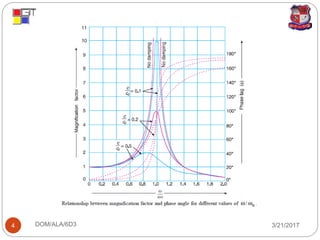
Magnification factor
3/21/2017DOM/ALA/6D33
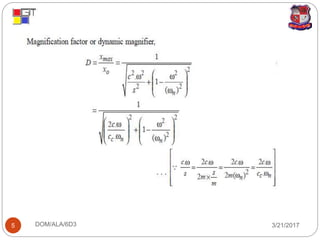
 It is the ratio of maximum displacement of the
forced vibration (Xmax ) to the deflection due to
the static force F(Xo).
3/21/2017DOM/ALA/6D34
3/21/2017DOM/ALA/6D35
Vibration transmissibility
3/21/2017DOM/ALA/6D36
 The transmission of the vibration can be specified by
one of the following terms:
1. Force transmissibility.
2. Motion transmissibility.
Force transmissibility
3/21/2017DOM/ALA/6D37
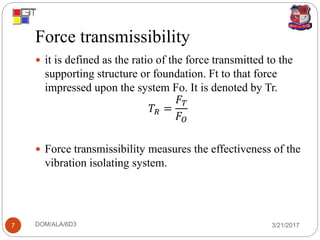
 it is defined as the ratio of the force transmitted to the
supporting structure or foundation. Ft to that force
impressed upon the system Fo. It is denoted by Tr.
𝑇𝑅 =
𝐹 𝑇
𝐹𝑂
 Force transmissibility measures the effectiveness of the
vibration isolating system.
Motion transmissibility
3/21/2017DOM/ALA/6D38
 Motion transmissibility, in case of forced vibration
due to excitation of the support, is defined as ratio
of absolute amplitude of the mass to the
amplitude of the base excitation.
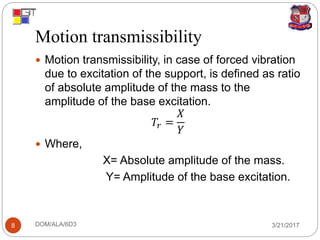
𝑇𝑟 =
𝑋
𝑌
 Where,
X= Absolute amplitude of the mass.
Y= Amplitude of the base excitation.
Phase difference
3/21/2017DOM/ALA/6D39
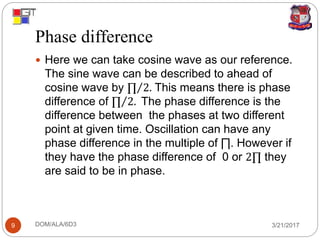
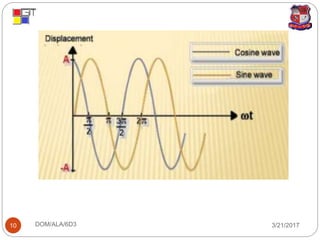
 Here we can take cosine wave as our reference.
The sine wave can be described to ahead of
cosine wave by ∏ 2. This means there is phase
difference of ∏ 2. The phase difference is the
difference between the phases at two different
point at given time. Oscillation can have any
phase difference in the multiple of ∏. However if
they have the phase difference of 0 or 2∏ they
are said to be in phase.
3/21/2017DOM/ALA/6D310
presentation on magnification factor, phase difference and transmissibility in mechanical vibration

presentation on magnification factor, phase difference and transmissibility in mechanical vibration