FLOW
MEASUREMENT
CHAPTER 2
OBJECTIVES
After you study this chapter, you should be able to
1. Define flow measurement.
2. Describe the importance of flow measurement.
3. Explain the basic operation, list the
advantages and disadvantages of each flow
measurement device.
TOPIC COVERED
 Introduction to Flow Measurement
 Flow Measuring Device:
1. Differential Pressure Meter
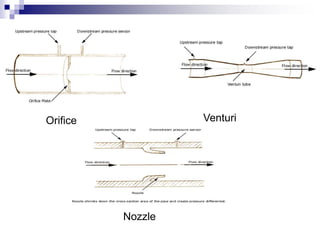
- Orifice, Venturi. Nozzle
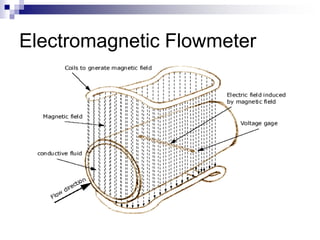
2. Electromagnetic Flowmeter
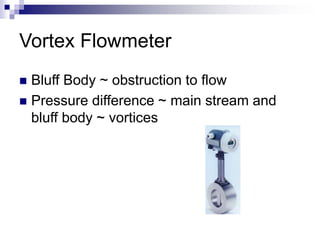
3. Vortex Flowmeter
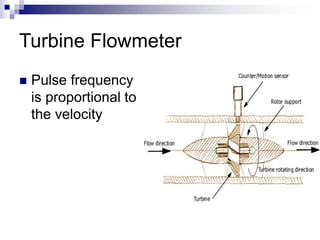
4. Turbine Flowmeter
5. Ultrasonic Flowmeter
INTRODUCTION
 What is flowrate??
Amount of material passing one point for
certain time
 Give one simple method to measure
1. Water flowrate from tap water.
2. Gas flowrate – filling in a bottle
INTRODUCTION
 Why flow is prime important parameter?
Most process involves moving material from one
part of the plant to another
Flow of
1. Material - Gas, liquid, solid particle
2. Energy – Power
3. Thermal energy
TASK 1
 Discuss in group, write the basic operation
of each instrument given. Each group
members must be able to explain the
basic operation of the instrument. List
the advantages and disadvantages of
the instrument.
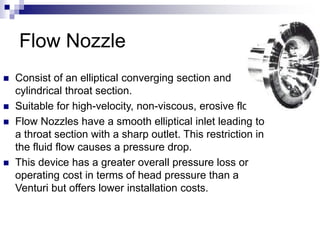
Flow Nozzle
 Consist of an elliptical converging section and
cylindrical throat section.
 Suitable for high-velocity, non-viscous, erosive flows.
 Flow Nozzles have a smooth elliptical inlet leading to
a throat section with a sharp outlet. This restriction in
the fluid flow causes a pressure drop.
 This device has a greater overall pressure loss or
operating cost in terms of head pressure than a
Venturi but offers lower installation costs.
Orifice Venturi
Nozzle
Electromagnetic Flowmeter
Vortex Flowmeter
 Bluff Body ~ obstruction to flow
 Pressure difference ~ main stream and
bluff body ~ vortices
Turbine Flowmeter
 Pulse frequency
is proportional to
the velocity
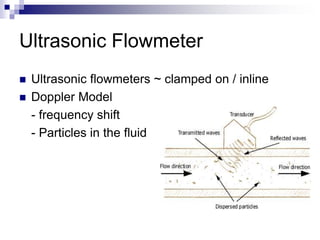
Ultrasonic Flowmeter
 Ultrasonic flowmeters ~ clamped on / inline
 Doppler Model
- frequency shift
- Particles in the fluid
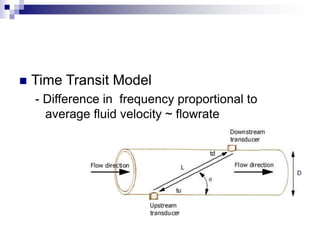
 Time Transit Model
- Difference in frequency proportional to
average fluid velocity ~ flowrate
Minute Paper
To be continued

Chapter 2 - FLOW MEASUREMENT MEASUREMENT

  • 1.
  • 2.
    OBJECTIVES After you studythis chapter, you should be able to 1. Define flow measurement. 2. Describe the importance of flow measurement. 3. Explain the basic operation, list the advantages and disadvantages of each flow measurement device.
  • 3.
    TOPIC COVERED  Introductionto Flow Measurement  Flow Measuring Device: 1. Differential Pressure Meter - Orifice, Venturi. Nozzle 2. Electromagnetic Flowmeter 3. Vortex Flowmeter 4. Turbine Flowmeter 5. Ultrasonic Flowmeter
  • 4.
    INTRODUCTION  What isflowrate?? Amount of material passing one point for certain time  Give one simple method to measure 1. Water flowrate from tap water. 2. Gas flowrate – filling in a bottle
  • 5.
    INTRODUCTION  Why flowis prime important parameter? Most process involves moving material from one part of the plant to another Flow of 1. Material - Gas, liquid, solid particle 2. Energy – Power 3. Thermal energy
  • 6.
    TASK 1  Discussin group, write the basic operation of each instrument given. Each group members must be able to explain the basic operation of the instrument. List the advantages and disadvantages of the instrument.
  • 7.
    Flow Nozzle  Consistof an elliptical converging section and cylindrical throat section.  Suitable for high-velocity, non-viscous, erosive flows.  Flow Nozzles have a smooth elliptical inlet leading to a throat section with a sharp outlet. This restriction in the fluid flow causes a pressure drop.  This device has a greater overall pressure loss or operating cost in terms of head pressure than a Venturi but offers lower installation costs.
  • 8.
  • 9.
  • 10.
    Vortex Flowmeter  BluffBody ~ obstruction to flow  Pressure difference ~ main stream and bluff body ~ vortices
  • 11.
    Turbine Flowmeter  Pulsefrequency is proportional to the velocity
  • 12.
    Ultrasonic Flowmeter  Ultrasonicflowmeters ~ clamped on / inline  Doppler Model - frequency shift - Particles in the fluid
  • 13.
     Time TransitModel - Difference in frequency proportional to average fluid velocity ~ flowrate
  • 14.
  • 15.