2014 Blade Reliability Presentation 
Field Trials of Vortex Generators Sandia Blade Workshop Albuquerque, NM 
Ron Grife 
Manager, Turbine Performance and Reliability 
Aug 26-28, 2014
2014 Blade Reliabiltiy Presentation 
2 
Vortex Generators (VGs) 
The typical turbine blade is designed as a compromise between the ideal/theoretical airfoil shape and the structural efficiency of a practical rotor set. As a result, turbine blades can suffer from stall losses (especially around the root section) due to the detachment of air flow.
2014 Blade Reliabiltiy Presentation 
3 
Vortex Generators (VGs) 
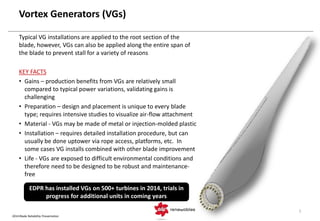
Typical VG installations are applied to the root section of the blade, however, VGs can also be applied along the entire span of the blade to prevent stall for a variety of reasons 
KEY FACTS 
•Gains – production benefits from VGs are relatively small compared to typical power variations, validating gains is challenging 
•Preparation – design and placement is unique to every blade type; requires intensive studies to visualize air-flow attachment 
•Material - VGs may be made of metal or injection-molded plastic 
•Installation – requires detailed installation procedure, but can usually be done uptower via rope access, platforms, etc. In some cases VG installs combined with other blade improvement 
•Life - VGs are exposed to difficult environmental conditions and therefore need to be designed to be robust and maintenance- free 
EDPR has installed VGs on 500+ turbines in 2014, trials in progress for additional units in coming years
2014 Blade Reliabiltiy Presentation 
4 
Met Mast Reference (IEC style) 
•Two turbines near met in IEC conditions 
•One of the turbines gets VG’s installed 
•One turbine unmodified as a control 
•Data requirements similar/same as IEC 
•Relative production difference is VG gain 
No Met Mast (Long Term Production) 
•Various turbines selected at wind farm 
•Turbine production monitored for 12 months 
•Unmodified neighbor turbines provide reference 
•Very little filtering (attempting to get “actual” production effects) 
•Relative gain compared to unmodified neighbors is the VG effect 
Types of Gain Analysis
2014 Blade Reliabiltiy Presentation 
5 
Summary of VG Trials 
Turbine 
Trial Description 
Status 
Turbine Type 1 
Trialed 2 Different VGs 
Initial Measurements Complete 
Turbine Type 2 
Trialed 2 Different VGs + additional blade impr. 
Initial Measurements Complete 
Turbine Type 3 
Trialed 3 Different VGs + additional blade impr. 
Measurements in Review 
Turbine Type 3 
VGs in different positions in park: 
•Edge of array 
•waked positions 
•with control improvement 
Measurement period almost complete
2014 Blade Reliabiltiy Presentation 
6 
VG Gain Comparisons 
0 
1 
2 
Relative Production Gain 
Turbine Type 
Turbine Type 1 - VG Type 1 
Turbine Type 1 - VG Type 2 
Turbine Type 2 - VG Type 1 
Turbine Type 2 - VG Type 2 
Turbine Type 2 - VG Type 3 
•Gains on Type 2 are generally higher 
•Spread in results between turbine types is similar 
•Analysis for type 3 not completed
2014 Blade Reliabiltiy Presentation 
7 
Environmental variation (Siting, TI, Shear, etc.) 
VGs change the blades sensitivity to changes in local angle of attack which are driven by TI, shear 
Configuration differences (pitch settings, blade condition) 
Small changes in blade settings and actual conditions could have a relatively large influence on the overall effect from VGs 
Anemometer impact (only issue if referencing WTG anemometer) 
The change in aerodynamics at the blade root affects the flow in the area near the nacelle where the anemometer is located 
Confounding Factors (Sources of variation)
2014 Blade Reliabiltiy Presentation 
8 
Anemometer Impacts 
Analysis: Wind sensor readings on trial turbines compared to control neighbor in IEC conditions before and after VGs were installed. Results: Conclusions: VGs may have an impact on wind sensors. Results not unexpected, although magnitudes don’t have clear correlation yet. 
Turbine 
Measured Impact 
Comments 
Turbine Type 1 
No Clear Change 
Large “seasonal” variations in correlation without VGs. 
Turbine Type 2 
Increase in Indicated WS 
Clear change in wind speeds across various VG types 
Turbine Type 3 
[Apparent Increase in Indicated WS, still verifying] 
Initial indicators: Seasonal variations in baseline turbine, needs further study
2014 Blade Reliabiltiy Presentation 
9 
•VGs consistently produced positive gains in trials 
•Gains appear to have a consistent variation according to trial results 
•Gains appear to be larger on some turbine types 
•Anemometers were impacted on some of the turbines that were tested 
•Longer term trials showing that VGs have longevity to justify investment 
Conclusions

Sandia 2014 Wind Turbine Blade Workshop- Grife

  • 1.
    2014 Blade ReliabilityPresentation Field Trials of Vortex Generators Sandia Blade Workshop Albuquerque, NM Ron Grife Manager, Turbine Performance and Reliability Aug 26-28, 2014
  • 2.
    2014 Blade ReliabiltiyPresentation 2 Vortex Generators (VGs) The typical turbine blade is designed as a compromise between the ideal/theoretical airfoil shape and the structural efficiency of a practical rotor set. As a result, turbine blades can suffer from stall losses (especially around the root section) due to the detachment of air flow.
  • 3.
    2014 Blade ReliabiltiyPresentation 3 Vortex Generators (VGs) Typical VG installations are applied to the root section of the blade, however, VGs can also be applied along the entire span of the blade to prevent stall for a variety of reasons KEY FACTS •Gains – production benefits from VGs are relatively small compared to typical power variations, validating gains is challenging •Preparation – design and placement is unique to every blade type; requires intensive studies to visualize air-flow attachment •Material - VGs may be made of metal or injection-molded plastic •Installation – requires detailed installation procedure, but can usually be done uptower via rope access, platforms, etc. In some cases VG installs combined with other blade improvement •Life - VGs are exposed to difficult environmental conditions and therefore need to be designed to be robust and maintenance- free EDPR has installed VGs on 500+ turbines in 2014, trials in progress for additional units in coming years
  • 4.
    2014 Blade ReliabiltiyPresentation 4 Met Mast Reference (IEC style) •Two turbines near met in IEC conditions •One of the turbines gets VG’s installed •One turbine unmodified as a control •Data requirements similar/same as IEC •Relative production difference is VG gain No Met Mast (Long Term Production) •Various turbines selected at wind farm •Turbine production monitored for 12 months •Unmodified neighbor turbines provide reference •Very little filtering (attempting to get “actual” production effects) •Relative gain compared to unmodified neighbors is the VG effect Types of Gain Analysis
  • 5.
    2014 Blade ReliabiltiyPresentation 5 Summary of VG Trials Turbine Trial Description Status Turbine Type 1 Trialed 2 Different VGs Initial Measurements Complete Turbine Type 2 Trialed 2 Different VGs + additional blade impr. Initial Measurements Complete Turbine Type 3 Trialed 3 Different VGs + additional blade impr. Measurements in Review Turbine Type 3 VGs in different positions in park: •Edge of array •waked positions •with control improvement Measurement period almost complete
  • 6.
    2014 Blade ReliabiltiyPresentation 6 VG Gain Comparisons 0 1 2 Relative Production Gain Turbine Type Turbine Type 1 - VG Type 1 Turbine Type 1 - VG Type 2 Turbine Type 2 - VG Type 1 Turbine Type 2 - VG Type 2 Turbine Type 2 - VG Type 3 •Gains on Type 2 are generally higher •Spread in results between turbine types is similar •Analysis for type 3 not completed
  • 7.
    2014 Blade ReliabiltiyPresentation 7 Environmental variation (Siting, TI, Shear, etc.) VGs change the blades sensitivity to changes in local angle of attack which are driven by TI, shear Configuration differences (pitch settings, blade condition) Small changes in blade settings and actual conditions could have a relatively large influence on the overall effect from VGs Anemometer impact (only issue if referencing WTG anemometer) The change in aerodynamics at the blade root affects the flow in the area near the nacelle where the anemometer is located Confounding Factors (Sources of variation)
  • 8.
    2014 Blade ReliabiltiyPresentation 8 Anemometer Impacts Analysis: Wind sensor readings on trial turbines compared to control neighbor in IEC conditions before and after VGs were installed. Results: Conclusions: VGs may have an impact on wind sensors. Results not unexpected, although magnitudes don’t have clear correlation yet. Turbine Measured Impact Comments Turbine Type 1 No Clear Change Large “seasonal” variations in correlation without VGs. Turbine Type 2 Increase in Indicated WS Clear change in wind speeds across various VG types Turbine Type 3 [Apparent Increase in Indicated WS, still verifying] Initial indicators: Seasonal variations in baseline turbine, needs further study
  • 9.
    2014 Blade ReliabiltiyPresentation 9 •VGs consistently produced positive gains in trials •Gains appear to have a consistent variation according to trial results •Gains appear to be larger on some turbine types •Anemometers were impacted on some of the turbines that were tested •Longer term trials showing that VGs have longevity to justify investment Conclusions