1
International Journal of
Science, Engineering and Innovative Research Vol. 8, February 2016
Voltage Stability Indices
Taxonomy, Formulation and Calculation algorithm
Ebrahim Saadati1
, Ahmad Mirzaei2
1
Yazd University, Faculty of ECE
2
Yazd University, Faculty of ECE
(1
ebrahim.saadati@gmail.com)
Abstract- Modern power systems are operating closer to their
limits, due to load growth and maximum efficiency of usage of
transmission line capacity. Operation of power system under such
condition may endangers the voltage stability of network and
leads to voltage collapse. Voltage stability indices are used as an
efficient, accurate and uncomplicated method in static voltage
stability analysis. In this paper a review of most common line
voltage stability indices which previously studied in literature, is
provided. A model of IEEE-14 Bus System has been presented as
case study. The simulation tool used was DIgSILENT
PowerFactory and the indices were computed using the DPL.
Simulation results approved the theoretical background of
indices.
Keywords- Voltage stability, Voltage collapse, Line stability
index, Calculation algorithm, DIgSILENT Programming
language
I. INTRODUCTION
Electricity consumption growth, complexity and cost of
construction new transmission lines, causing power systems to
be more vulnerable than ever. The more efficient use of
transmission network has already led to a situation in which
many power systems are operated more often longer and closer
to voltage stability limits resulting in a higher probability of
voltage instability or collapse [1]. IEEE defines voltage
collapse as: the process by which voltage instability leads to
loss of voltage in significant part of the power system [2]. In
order to prevent a voltage collapse, there is a desperate need to
identify the methods which is used for predict occurrence of
this phenomenon.
Even though voltage instability is known for long time,
active work involving voltage stability started in 80’s [3] and
attracted the attention of many researchers up to now. Although
stability studies, in general require a dynamic model of the
power system, the static approaches is used widely for
assessment of voltage stability [4]. Static analysis is accurate
and less complex as it requires low computation time to carry
out system stability analysis [5].
Several analytical methods are available for measuring
voltage stability margin and prediction of voltage collapse
points. Static and dynamic bifurcation analysis [6,7], P-V and
Q-V curves (also called nose curves) [2,8], continuation power
flow (CPF) [9] and modal analysis [10,11], are popularly used
in voltage stability research. Another set of papers have studied
the voltage stability by define an index. Voltage stability
indices (also called voltage collapse proximity/prediction
indices), can used as a tool for identifying weakest area, critical
lines and the power stability margin.
VSIs can be used for online and offline purposes. Operators
would be able to observe the monitored value of indices which
change with system parameters and take the appropriate action.
So the online value of VSIs is used to prevent voltage
instability. Furthermore, before operation of power system,
planner and designer would be able to used offline value of
indices for network stability studies.
As expressed in [12,13], VSIs classified in two main
categories: jacobian matrix based and system variable based
VSIs. Table I illustrates a comparison of these two groups.
TABLE I. COMPARISON OF VOLTAGE STABILITY INDEX
Jacobian based VSI System variable based
Offline application Online application
Planner/Designer use Operator use
More computing time Less computing time
Proximity to voltage collapse Determining weak area
Jacobian matrix based VSIs can calculate the voltage
collapse point or maximum loadability limit and determine the
voltage stability margin, so the computation time is high and
they are not suitable for online assessment. On the other hand,
system variables based VSIs, which use the elements of the
admittance matrix and some system variables such as bus
voltages or power flow through lines, require less computation
and therefore these VSIs are adequate for online monitoring.
International Journal of Science, Engineering and Innovative Research, Volume 8, February 2016 2
WWW.IJSEIR.ORG Paper ID:ISSN: 4212-513X
This paper provides a general overview of the indices and
their formulation that have been recently reported in literature.
Some of them were tested in IEEE-14 Bus test system. The
simulation tool used is DIgSILENT PowerFactory and the
stability indices are computed by DIgSILENT Programming
Language (DPL).
The paper is organized as follows: in Section II, taxonomy
of the reviewed VSIs is done. Also mathematical description
and formulation of them is presented. In section III the
programming procedure for calculating indices is given. In
order to validate the theoretical background of indices and see
how they work, some of them is tested on IEEE-14 Bus test
system in section IV. Finally, conclusions are presented in
Section V.
II. VOLTAGE STABILITY INDICES
After a literature research on voltage stability indices, a
lack of an organized, detailed and complete classification of
these indices was noticed. The main object of this section is to
give a classification and wide perspective of VSIs which is
proposed in most recent literature or the base paper.
Table II presents a taxonomy of VSIs. As shown in this
table, system variable based VSIs is classified in two group:
bus index (which use the bus parameters) and Line index
(which use line parameters). Definition of used parameters in
each index can be found in given reference.
Furthermore, the stable and unstable condition of each
index is presented. As you can see, value of line stability
indices change from “0” (in no load condition) to “1” (in
critical/ collapse condition).
In general, line VSIs are formulated base on a single line
in an interconnected network that is illustrated in Fig. 1.
Figure 1. single line in an interconnected network
Formulation process starts with the power equations and
forming a quadratic/quartic equation in terms of the receiving
end voltage. Then the condition for achieving real roots, in
order to satisfy the stability criteria, was investigated and the
index reproduced. In this section detailed formulation of some
VSIs is formulated and discussed.
A. Voltage Collapse Index (VCI)
This index derives from the load apparent power. As we
know, the following equation can be expressed for apparent
power:
𝑆𝑖 = 𝑉𝑖 𝐼𝑖 (1)
By use of Taylor’s theorem and neglecting higher order
terms, incremental change can be written as:
∆𝑆𝑖 =
𝜕𝑆𝑖
𝜕𝑉𝑖
∆𝑉𝑖 +
𝜕𝑆𝑖
𝜕𝐼𝑖
∆𝐼𝑖 (2)
When the load of a bus approaches the critical value ∆𝑆𝑖
approaches zero. So to assure stability:
𝐼𝑖∆𝑉𝑖 + 𝑉𝑖∆𝐼𝑖 ≥ 0 (3)
Or
1 +
𝐼𝑖∆𝑉𝑖
𝑉𝑖∆𝐼𝑖
≥ 0 (4)
Therefore the VCI at bus i, defined by:
𝑉𝐶𝐼𝑖 = (1 +
𝐼𝑖∆𝑉𝑖
𝑉𝑖∆𝐼𝑖
)
𝛼
(5)
It is raised to a power of (𝛼 >1) in order to give a more or
less linear characteristic to the index. The value of a may
depend on the system. Also this index has the value of “1” at
no load and reach to “0” at the voltage collapse point or
instability.
B. Stability Index (SI)
Following quadratic equation can be expressed for the
sending end voltage:
𝑉𝑗
4
+ 2𝑉𝑗
2
(𝑃𝑗 𝑅 + 𝑄𝑗 𝑋) − (𝑉𝑖 𝑉𝑗)
2
+ |𝑍|2
(𝑃𝑗
2
+ 𝑄𝑗
2
) = 0
(6)
From the above equation, line receiving end active and reactive
power can be written as:
𝑃𝑗 =
−𝑉𝑗
2
𝑐𝑜𝑠𝜃 ± √ 𝑉𝑗
4
𝑐𝑜𝑠2 𝜃 − 𝑉𝑗
4
− |𝑍|2 𝑄𝑗
2
− 2𝑉𝑗
2
𝑄𝑗 𝑋 + (𝑉𝑖 𝑉𝑗)
2
|𝑍|
(7)
𝑄𝑗 =
−𝑉𝑗
2
𝑠𝑖𝑛𝜃 ± √ 𝑉𝑗
4
𝑠𝑖𝑛2 𝜃 − 𝑉𝑗
4
− |𝑍|2 𝑃𝑗
2
− 2𝑉𝑗
2
𝑃𝑗 𝑅 + (𝑉𝑖 𝑉𝑗)
2
|𝑍|
(8)
The condition for the solution existence is therefore:
𝑉𝑗
4
𝑐𝑜𝑠2
𝜃 − 𝑉𝑗
4
− |𝑍|2
𝑄𝑗
2
− 2𝑉𝑗
2
𝑄𝑗 𝑋 + (𝑉𝑖 𝑉𝑗)
2
≥ 0 (9)
𝑉𝑗
4
𝑠𝑖𝑛2 𝜃 − 𝑉𝑗
4
− |𝑍|2 𝑃𝑗
2
− 2𝑉𝑗
2
𝑃𝑗 𝑅 + (𝑉𝑖 𝑉𝑗)
2
≥ 0
(10)
By adding to last equation, the SI defined by:
𝑆𝐼𝑗 = 2(𝑉𝑖 𝑉𝑗)2
− 𝑉𝑗
4
− 2𝑉𝑗
2
(𝑃𝑗 𝑅 + 𝑄𝑗 𝑋) − |𝑍|2
(𝑃𝑗
2
+ 𝑄𝑗
2
) (11)
International Journal of Science, Engineering and Innovative Research, Volume 8, February 2016 3
WWW.IJSEIR.ORG Paper ID:ISSN: 4212-513X
C. Line Collapse Proximity Index (LCPI)
The relationship among the network parameters can be
expressed as:
Where A, B, C and D known as transmission parameters.
The current at the receiving end of the line is expressed as:
𝐼𝑗 =
𝑃𝑗 − 𝑗𝑄𝑗
𝑉𝑗
∗ = (𝑃𝑗 − 𝑗𝑄𝑗)/𝑉𝑗∠ − 𝛿𝑗 (13)
Also the sending end voltage can be written as:
𝑉𝑖∠𝛿𝑖 = (𝐴∠𝛼)(𝑉𝑗∠𝛿𝑗) + (𝐵∠𝛽)(𝐼𝑗∠0) (14)
By substituting the value of Eq. 13 into Eq. 14, we have:
𝑉𝑖∠𝛿𝑖 = (𝐴∠𝛼)(𝑉𝑗∠𝛿𝑗) + (𝐵∠𝛽)((𝑃𝑗 − 𝑗𝑄𝑗)/𝑉𝑗∠ − 𝛿𝑗) (15)
TABLE II. TAXONOMY OF VOLTAGE STABILITY INDICES
VSI Type Index Formula Stable Condition Unstable Condition Ref.
JacobianMatrixbased
𝑡 𝑐𝑐 = |𝑒 𝑐
𝑇
𝐽 𝐽𝑐𝑐
−1
𝑒 𝑐|
Quadratic Shape Linear Shape [14]
𝑖 =
1
𝑖0
𝜎 𝑚𝑎𝑥
𝑑𝜎 𝑚𝑎𝑥
𝑑𝜆 𝑡𝑜𝑡𝑎𝑙
⁄ 0 ≤ 𝑖 ≤ 1 𝑖 = 0 [15]
𝑇𝑉𝐼𝑖 = |
𝑑𝑉𝑖
𝑑𝜆
|
−1
𝑇𝑉𝐼𝑖 ≠ 0 𝑇𝑉𝐼𝑖 → 0 [16]
𝑉
𝑉0
⁄ 𝑉
𝑉0
⁄ = 1 𝑉
𝑉0
⁄ = 0 [17]
SystemVariablebased
Bus
Index
𝐿𝑗 = |
𝑆𝑗+
𝑌𝑗𝑗+
∗
𝑉𝑗
2| 𝐿𝑗 < 1 𝐿𝑗 = 1 [18]
𝑉𝐶𝐼𝑖 = (1 +
𝐼𝑖∆𝑉𝑖
𝑉𝑖∆𝐼𝑖
)
𝛼
𝑉𝐶𝐼𝑖 ≤ 1 𝑉𝐶𝐼𝑖 = 0 [19]
𝑆𝐼𝑗 = 2(𝑉𝑖 𝑉𝑗)2
− 𝑉𝑗
4
− 2𝑉𝑗
2
(𝑃𝑗 𝑅 + 𝑄𝑗 𝑋) − |𝑍|2
(𝑃𝑗
2
+ 𝑄𝑗
2
) 𝑆𝐼𝑗 ≥ 0 𝑆𝐼𝑗 < 0 [20]
𝑉𝐶𝑃𝐼 𝑘𝑡ℎ 𝑏𝑢𝑠 = |1 −
∑ 𝑉𝑚
𝑁
𝑚=1,𝑚≠𝑘
𝑉𝑘
| 𝑉𝐶𝑃𝐼𝑘𝑡ℎ < 1 𝑉𝐶𝑃𝐼𝑘𝑡ℎ = 1 [21]
Line
index
𝐿 𝑚𝑛 =
4𝑄𝑗 𝑋
(𝑉𝑖 sin(𝜃 − 𝛿))2
0 ≤ 𝐿 𝑚𝑛 < 1 𝐿 𝑚𝑛 = 1 [22]
𝐿𝑉𝑆𝐼 =
4𝑃𝑗 𝑅
(𝑉𝑖 cos(𝜃 − 𝛿))2
0 ≤ 𝐿𝑉𝑆𝐼 < 1 𝐿𝑉𝑆𝐼 = 1 [23]
𝐿𝑄𝑃 = 4 (
𝑋
𝑉𝑖
2) (
𝑋𝑃𝑖
2
𝑉𝑖
2 + 𝑄𝑗) 0 ≤ 𝐿𝑄𝑃 < 1 𝐿𝑄𝑃 = 1 [24]
𝐹𝑉𝑆𝐼 =
4𝑍2
𝑄𝑗
𝑉𝑖
2
𝑋
0 ≤ 𝐹𝑉𝑆𝐼 < 1 𝐹𝑉𝑆𝐼 = 1 [25]
𝑉𝐶𝑃𝐼(𝑃𝑜𝑤𝑒𝑟) =
𝑃𝑅
𝑃𝑅(𝑚𝑎𝑥)
0 ≤ 𝑉𝐶𝑃𝐼 < 1 𝑉𝐶𝑃𝐼 = 1 [26]
𝐿𝑆𝑍 = 2
|𝑍|. |𝑆𝑗|
|𝑉𝑖|2 − 2|𝑍|(𝑃𝑗 cos 𝜃 + 𝑄𝑗 sin 𝜃)
0 ≤ 𝐿𝑆𝑍 < 1 𝐿𝑆𝑍 = 1 [27]
𝑉𝑄𝐼𝑙𝑖𝑛𝑒 = 4
𝑄𝑗
𝐵𝑖𝑗. |𝑉𝑖|2 0 ≤ 𝑉𝑄𝐼 < 1 𝑉𝑄𝐼 = 1 [5]
𝑁𝑉𝑆𝐼 =
2𝑋√ 𝑃𝑗
2
+ 𝑄𝑗
2
2𝑄𝑗 𝑋 − 𝑉𝑖
2
0 ≤ 𝑁𝑉𝑆𝐼 < 1 𝑁𝑉𝑆𝐼 = 1 [28]
[
𝑉𝑖
𝐼𝑖
] = [
𝐴 𝐵
𝐶 𝐷
] [
𝑉𝑗
𝐼𝑗
] (12)
International Journal of Science, Engineering and Innovative Research, Volume 8, February 2016 4
WWW.IJSEIR.ORG Paper ID:ISSN: 4212-513X
𝐿𝐶𝑃𝐼 =
4𝐴 cos 𝛼 (𝑃𝑗 𝐵 cos 𝛽 + 𝑄𝑗 𝐵 sin 𝛽)
(𝑉𝑖 cos 𝛿)2 0 ≤ 𝐿𝐶𝑃𝐼 < 1 𝐿𝐶𝑃𝐼 = 1 [29]
Separating Eq. 15 into real and imaginary parts and
considering 𝛿𝑖 − 𝛿𝑗 = 𝛿 we obtain following quadratic
equation from real part:
𝑉𝑗
2
(𝐴. cos 𝛼) − 𝑉𝑗(𝑉𝑖 cos 𝛿) + (𝑃𝑗 𝐵 cos 𝛽 + 𝑄𝑗 𝐵 sin 𝛽) = 0 (16)
The roots of quadratic equation will be:
𝑉𝑗
=
−𝑉𝑖 cos 𝛿 ± √(𝑉𝑖 cos 𝛿)2 − 4𝐴 cos 𝛼 (𝑃𝑗 𝐵 cos 𝛽 + 𝑄𝑗 𝐵 sin 𝛽)
2𝐴 cos 𝛼
(17)
In order to satisfy the stability criteria, the discriminant of
Eq. 17 must be greater than zero and the LCPI defined by:
𝐿𝐶𝑃𝐼 =
4𝐴 cos 𝛼 (𝑃𝑗 𝐵 cos 𝛽 + 𝑄𝑗 𝐵 sin 𝛽)
(𝑉𝑖 cos 𝛿)2
(18)
The value of LCPI change from “0” at no load to “1” at
unstable condition.
D. Novel Voltage Stability Index (NVSI)
In lossless condition, the current of line can be expressed
as:
𝐼𝑖𝑗 =
𝑉𝑖∠𝛿𝑖 − 𝑉𝑗∠𝛿𝑗
𝑗𝑋
(19)
Also the apparent power can be written as:
𝑆𝑗 = 𝑉𝑗
̅ 𝐼𝑖𝑗
∗̅̅̅̅ (20)
By substituting Eq. 19 in Eq. 20 we have a quartic equation
in term of receiving end voltage that the discriminant must be
greater than zero. So:
(2𝑄𝑗 𝑋 − 𝑉𝑖
2
)
2
− 4𝑋2
(𝑃𝑗
2
+ 𝑄𝑗
2
) ≥ 0 (21)
And the NVSI defined as:
𝑁𝑉𝑆𝐼 =
2𝑋√𝑃𝑗
2
+ 𝑄𝑗
2
2𝑄𝑗 𝑋 − 𝑉𝑖
2 ≤ 1
(22)
III. CALCULATION PROCEDURE
In order to find out effectiveness of line VSIs in a power
system, we should increase the load of network. In each step
we need to run a load flow and then by having the voltage,
current and power, calculate the index by use of their formula.
The flowchart of this algorithm is shown in Fig. 2.
DIgSILENT programming language (DPL) is used for
programming calculation procedure. The program is capable
to run on any optional power test system and it will give a
suitable conception from voltage stability of network based on
VSIs.
It’s necessary to mention that increase of load can be done in
all loads of power system or in specific load bus. If use the
second state, we can identify the weak bus in addition to the
critical lines.
Figure 2. VSIs calculation procedure algorithm
IV. TEST SYSTEM AND SIMULATION RESULT
A. Power system model
IEEE-14 Bus test system, is considered as the case study in
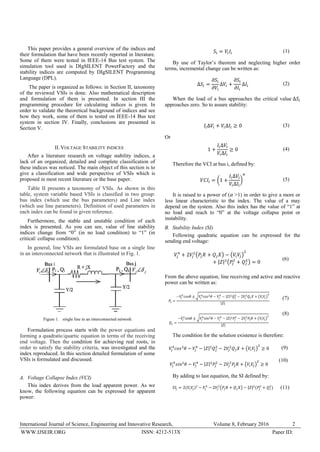
this paper and the network is simulated in DIgSILENT. Fig.3
illustrated single line diagram of this network.
B. Simulation result
VSIs calculation algorithm executed for considered case
study. Here the increase of reactive power in specific load bus
considered as the load pattern. In following some of plots and
results derived from executing programed algorithm are
presented.
International Journal of Science, Engineering and Innovative Research, Volume 8, February 2016 5
WWW.IJSEIR.ORG Paper ID:ISSN: 4212-513X
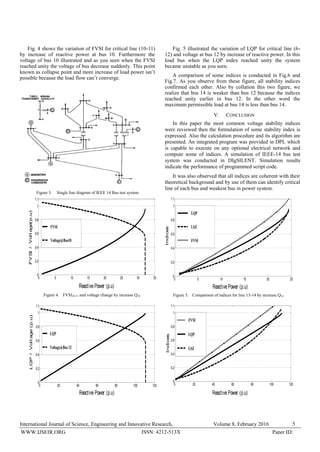
Fig. 4 shows the variation of FVSI for critical line (10-11)
by increase of reactive power at bus 10. Furthermore the
voltage of bus 10 illustrated and as you seen when the FVSI
reached unity the voltage of bus decrease suddenly. This point
known as collapse point and more increase of load power isn’t
possible because the load flow can’t converge.
Figure 3. Single line diagram of IEEE 14 Bus test system
Fig. 5 illustrated the variation of LQP for critical line (6-
12) and voltage at bus 12 by increase of reactive power. In this
load bus when the LQP index reached unity the system
became unstable as you seen.
A comparison of some indices is conducted in Fig.6 and
Fig.7. As you observe from these figure, all stability indices
confirmed each other. Also by collation this two figure, we
realize that bus 14 is weaker than bus 12 because the indices
reached unity earlier in bus 12. In the other word the
maximum permissible load at bus 14 is less than bus 14.
V. CONCLUSION
In this paper the most common voltage stability indices
were reviewed then the formulation of some stability index is
expressed. Also the calculation procedure and its algorithm are
presented. An integrated program was provided in DPL which
is capable to execute on any optional electrical network and
compute some of indices. A simulation of IEEE-14 bus test
system was conducted in DIgSILENT. Simulation results
indicate the performance of programmed script code.
It was also observed that all indices are coherent with their
theoretical background and by use of them can identify critical
line of each bus and weakest bus in power system.
Figure 4. FVSI10-11 and voltage change by increase Q10 Figure 5. Comparison of indices for line 13-14 by increase Q14
0 5 10 15 20 25 30 35
0
0.2
0.4
0.6
0.8
1
1.1
Reactive Power (p.u)
FVSI/Voltage(p.u)
FVSI
Voltage@Bus10
0 5 10 15 20 25
0
0.2
0.4
0.6
0.8
1
1.1
Reactive Power (p.u)
Indices
LQP
LSZ
FVSI
0 20 40 60 80 100 120
0
0.2
0.4
0.6
0.8
1
1.1
Reactive Power (p.u)
LQP/Voltage(p.u)
LQP
Voltage@Bus12
0 20 40 60 80 100 120
0
0.2
0.4
0.6
0.8
1
1.1
Reactive Power (p.u)
Indices
FVSI
LQP
LSZ
International Journal of Science, Engineering and Innovative Research, Volume 8, February 2016 6
WWW.IJSEIR.ORG Paper ID:ISSN: 4212-513X
Figure 6. QP6-12 and voltage change by increase Q12 Figure 7. Comparison of indices for line 6-12 by increase Q12
REFERENCES
[1] P. Kundur, Power system stability and control, New York: McGraw-
Hill, 1994.
[2] M.K. Jalboub, A.M. Ihbal, H.S. Rajamtani, and R.A. Abd-Alhameed,
“Determination of static voltage stability-margin of the power system
prior to voltage collapse”, International Multi-Conference on
Systems, Signals and Devices (SSD), Sousse, pp. 1-6, March 2011.
[3] V. Ajjarapu and B. Lee, “Bibliography on voltage stability”, IEEE
Transactions on Power Systems, vol. 13, no. 1, pp. 115-125, 1998.
[4] C. Reis, A. Andrade, and F.P. Maciel, “Line stability indices for
voltage collapse prediction”, International Conference on Power
Engineering, Energy and Electrical Drives, Lisbon, pp. 239-243,
March 2009.
[5] F.A. Athowibi, and M.W. Mustafa, “Line voltage stability
calculations in power systems”, IEEE International Conference on
Power and Energy (PE Con2010), Kuala Lampur, Malaysia, pp. 396-
401, Dec. 2010.
[6] L. Guo, Y. Zhang, and Zh. Gang Wu, “An algorithm for voltage
collapse point based on the theory of transversality in power
systems”, Transmission and Distribution Conference and Exhibition,
Dalian, pp. 1-5, 2005.
[7] M.K.M. Rabby, and A.H. Chowdhury, “Bifurcation analysis to
identify voltage collapse in Bangladesh power system”, International
Conference on Informatics, Electronics & Vision (ICIEV), Dhaka, pp.
1-5, May 2013.
[8] Lee CY, Tsai SH, Wu YK. “A new approach to the assessment of
steady-state voltage stability margins using the P–Q–V curve”,
International Journal of Electrical Power & Energy Systems, vol. 32,
no. 10, pp. 1091–1098, 2010.
[9] V. Ajjarapu and C. Christy, “The Continuation Power Flow: A Tool
for Steady State Voltage Stability Analysis”, IEEE Transactions on
Power Systems, vol. 7, no. 1, pp 416-423, February 1992.
[10] B. Gao, G.K. Morison, and P. Kundur, “Voltage stability evaluation
using modal analysis”, IEEE Transactions on Power Systems, vol. 7,
no. 4, November 1992.
[11] H. Pradeep, and N. Venugopalan, “A study of voltage collapse
detection for power systems”, International Journal of Emerging
Technology and Advanced Engineering, vol. 3, no. 1, pp. 325-331,
Jan. 2013.
[12] F. Karbalaei, H. Soleymani and S. Afsharnia, “A comparison of
voltage collapse proximity indicators”, IPEC 2010 Conference
Proceedings, pp. 429-432, 27-29 Oct. 2010.
[13] M. Cupelli, C. Doig Cardet, and A. Monti, “Comparison of line
voltage stability indices using dynamic real time simulation”, IEEE
PES International Conference and Exhibition on Innovative Smart
Grid Technologies (ISGT Europe), Berlin, pp. 1-8, Oct. 2012.
[14] H.D. Chiang and R.J. Jumeau, “Towards a practical performance
index for predicting voltage collapse in electrical power system”,
IEEE Transactions on Power Systems, vol. 10, no. 2, pp. 584-592,
May 1995.
[15] A. Berizzi, P. Finanzzi, D. Dorsi, P. Marannino and S. Corsi, “First
and second order methods for voltage collapse assessment and
security enhancement”, IEEE Transactions on Power Systems, vol.
13, no. 2, pp.543-551, May 1998.
[16] A.C.Z. de Souza, C. A. Cañizares and V. H. Quintana, “New
techniques to speed up voltage collapse computations using tangent
vectors”, IEEE Transactions on Power Systems, vol. 12, no. 3,
pp.1380-1387, Aug. 1997.
[17] N.D. Hatziargyriou and T. Van Cutsem, “Indices for predicting
voltage collapse including dynamic phenomena”, technical report TF-
38-02-11, CIGRE, 1994.
[18] P. Kessel and H. Glavitsch, “Estimating the voltage stability of a
power system”, IEEE Transactions on Power Delivery, vol. PWRD-1,
no. 3, pp. 346-353, July 1986.
[19] M.H. Haque, “Use of local information to determine distance to
voltage collapse”, The 8th
International Power Engineering
Conference IPEC 2007, pp. 407-411, 2007.
[20] U. Eminoglu and M.H. Hocaoglu, “A voltage stability index for radial
distribution networks”, UPEC, pp.408-413, 2007.
[21] V. Balamourougan, T.S. Sidhu and M.S. Sachdev, “Technique for
online prediction of voltage collapse”, IEE Proceedings-Generation,
Transmission and Distribution, vol. 151, no. 4, pp. 453-460, July
2004.
[22] M. Moghavvemi and F.M. Omar, “Technique for contingency
monitoring and voltage collapse prediction”, IEE Proceedings-
Generation, Transmission and Distribution, vol. 145, no. 6, pp. 634-
640, November 1998.
[23] H. Naishan et al., “The analysis of abundance index of voltage
stability based circuit theory”, Guangxi Electric Power, pp.12-14,
Feb. 2006.
[24] A. Mohamed, G.B. Jasmon and S. Yusoff, “A static voltage collapse
indicator using line stability factors”, Journal of Industrial
Technology, vol. 7, no. 1, pp. 73-85, 1989.
[25] I. Musirin, and T.K.A. Rahman, “On-line voltage stability based
contingency ranking using fast voltage stability index (FVSI)”,
Transmission and Distribution Conference and Exhibition, vol. 2,
Oct. 2002.
[26] M. Moghavvemi, and O. Faruque, “Real-time contingency evaluation
and ranking technique”, IEE Proceedings Generation, Transmission
and Distribution, vol. 145, no. 5, pp. 517-524, Aug. 2002.
[27] M. Jalboub, H.S. Rajamani, R. Abd-AlHameed, and A. Ihabal
“Investigation of Voltage Stability Indices to Identify Weakest Bus
(TBC)”, 6th International JCST Conference on Mobile Multimedia
Communications, Portugal, pp. 682-687, Sept. 2010.
[28] R. Kanimozhi and K. Selvi, “A Novel Line Stability Index for
Voltage Stability Analysis and Contingency Ranking in Power
International Journal of Science, Engineering and Innovative Research, Volume 8, February 2016 7
WWW.IJSEIR.ORG Paper ID:ISSN: 4212-513X
System Using Fuzzy Based Load Flow”, Journal of Electrical
Engineering and Technology, vol. 8, no. 4, pp. 694-703, 2013.
[29] R. Tiwari, K.R. Niazi, and V. Gupta, “Line collapse proximity index
for prediction of voltage collapse in power systems”, International
Journal of Electrical Power & Energy Systems, vol. 41, pp. 105-111,
2012.
[30] Power System Test Archive-UWEE, University of
Washington.<http://www.ee.washington.edu/research/p
stca>.
BIOGRAPHY
Ebrahim Saadati was born in Isfahan, Iran. He graduated
from Yazd University, Iran, with master
degree in electrical power engineering in
2015. He is familiar with specialized
software, including Matlab/ Simulink
and DIgSILENT.
Ahmad Mirzaei was born in Yazd, Iran. He received the
Ph.D. degree in electrical engineering
from the Isfahan University of
Technology, Iran. He is with the faculty
of ECE, Yazd University, where he was
an Assistant Professor.

Voltage Stability Indices: Taxonomy, Formulation and Calculation algorithm

  • 1.
    1 International Journal of Science,Engineering and Innovative Research Vol. 8, February 2016 Voltage Stability Indices Taxonomy, Formulation and Calculation algorithm Ebrahim Saadati1 , Ahmad Mirzaei2 1 Yazd University, Faculty of ECE 2 Yazd University, Faculty of ECE (1 ebrahim.saadati@gmail.com) Abstract- Modern power systems are operating closer to their limits, due to load growth and maximum efficiency of usage of transmission line capacity. Operation of power system under such condition may endangers the voltage stability of network and leads to voltage collapse. Voltage stability indices are used as an efficient, accurate and uncomplicated method in static voltage stability analysis. In this paper a review of most common line voltage stability indices which previously studied in literature, is provided. A model of IEEE-14 Bus System has been presented as case study. The simulation tool used was DIgSILENT PowerFactory and the indices were computed using the DPL. Simulation results approved the theoretical background of indices. Keywords- Voltage stability, Voltage collapse, Line stability index, Calculation algorithm, DIgSILENT Programming language I. INTRODUCTION Electricity consumption growth, complexity and cost of construction new transmission lines, causing power systems to be more vulnerable than ever. The more efficient use of transmission network has already led to a situation in which many power systems are operated more often longer and closer to voltage stability limits resulting in a higher probability of voltage instability or collapse [1]. IEEE defines voltage collapse as: the process by which voltage instability leads to loss of voltage in significant part of the power system [2]. In order to prevent a voltage collapse, there is a desperate need to identify the methods which is used for predict occurrence of this phenomenon. Even though voltage instability is known for long time, active work involving voltage stability started in 80’s [3] and attracted the attention of many researchers up to now. Although stability studies, in general require a dynamic model of the power system, the static approaches is used widely for assessment of voltage stability [4]. Static analysis is accurate and less complex as it requires low computation time to carry out system stability analysis [5]. Several analytical methods are available for measuring voltage stability margin and prediction of voltage collapse points. Static and dynamic bifurcation analysis [6,7], P-V and Q-V curves (also called nose curves) [2,8], continuation power flow (CPF) [9] and modal analysis [10,11], are popularly used in voltage stability research. Another set of papers have studied the voltage stability by define an index. Voltage stability indices (also called voltage collapse proximity/prediction indices), can used as a tool for identifying weakest area, critical lines and the power stability margin. VSIs can be used for online and offline purposes. Operators would be able to observe the monitored value of indices which change with system parameters and take the appropriate action. So the online value of VSIs is used to prevent voltage instability. Furthermore, before operation of power system, planner and designer would be able to used offline value of indices for network stability studies. As expressed in [12,13], VSIs classified in two main categories: jacobian matrix based and system variable based VSIs. Table I illustrates a comparison of these two groups. TABLE I. COMPARISON OF VOLTAGE STABILITY INDEX Jacobian based VSI System variable based Offline application Online application Planner/Designer use Operator use More computing time Less computing time Proximity to voltage collapse Determining weak area Jacobian matrix based VSIs can calculate the voltage collapse point or maximum loadability limit and determine the voltage stability margin, so the computation time is high and they are not suitable for online assessment. On the other hand, system variables based VSIs, which use the elements of the admittance matrix and some system variables such as bus voltages or power flow through lines, require less computation and therefore these VSIs are adequate for online monitoring.
  • 2.
    International Journal ofScience, Engineering and Innovative Research, Volume 8, February 2016 2 WWW.IJSEIR.ORG Paper ID:ISSN: 4212-513X This paper provides a general overview of the indices and their formulation that have been recently reported in literature. Some of them were tested in IEEE-14 Bus test system. The simulation tool used is DIgSILENT PowerFactory and the stability indices are computed by DIgSILENT Programming Language (DPL). The paper is organized as follows: in Section II, taxonomy of the reviewed VSIs is done. Also mathematical description and formulation of them is presented. In section III the programming procedure for calculating indices is given. In order to validate the theoretical background of indices and see how they work, some of them is tested on IEEE-14 Bus test system in section IV. Finally, conclusions are presented in Section V. II. VOLTAGE STABILITY INDICES After a literature research on voltage stability indices, a lack of an organized, detailed and complete classification of these indices was noticed. The main object of this section is to give a classification and wide perspective of VSIs which is proposed in most recent literature or the base paper. Table II presents a taxonomy of VSIs. As shown in this table, system variable based VSIs is classified in two group: bus index (which use the bus parameters) and Line index (which use line parameters). Definition of used parameters in each index can be found in given reference. Furthermore, the stable and unstable condition of each index is presented. As you can see, value of line stability indices change from “0” (in no load condition) to “1” (in critical/ collapse condition). In general, line VSIs are formulated base on a single line in an interconnected network that is illustrated in Fig. 1. Figure 1. single line in an interconnected network Formulation process starts with the power equations and forming a quadratic/quartic equation in terms of the receiving end voltage. Then the condition for achieving real roots, in order to satisfy the stability criteria, was investigated and the index reproduced. In this section detailed formulation of some VSIs is formulated and discussed. A. Voltage Collapse Index (VCI) This index derives from the load apparent power. As we know, the following equation can be expressed for apparent power: 𝑆𝑖 = 𝑉𝑖 𝐼𝑖 (1) By use of Taylor’s theorem and neglecting higher order terms, incremental change can be written as: ∆𝑆𝑖 = 𝜕𝑆𝑖 𝜕𝑉𝑖 ∆𝑉𝑖 + 𝜕𝑆𝑖 𝜕𝐼𝑖 ∆𝐼𝑖 (2) When the load of a bus approaches the critical value ∆𝑆𝑖 approaches zero. So to assure stability: 𝐼𝑖∆𝑉𝑖 + 𝑉𝑖∆𝐼𝑖 ≥ 0 (3) Or 1 + 𝐼𝑖∆𝑉𝑖 𝑉𝑖∆𝐼𝑖 ≥ 0 (4) Therefore the VCI at bus i, defined by: 𝑉𝐶𝐼𝑖 = (1 + 𝐼𝑖∆𝑉𝑖 𝑉𝑖∆𝐼𝑖 ) 𝛼 (5) It is raised to a power of (𝛼 >1) in order to give a more or less linear characteristic to the index. The value of a may depend on the system. Also this index has the value of “1” at no load and reach to “0” at the voltage collapse point or instability. B. Stability Index (SI) Following quadratic equation can be expressed for the sending end voltage: 𝑉𝑗 4 + 2𝑉𝑗 2 (𝑃𝑗 𝑅 + 𝑄𝑗 𝑋) − (𝑉𝑖 𝑉𝑗) 2 + |𝑍|2 (𝑃𝑗 2 + 𝑄𝑗 2 ) = 0 (6) From the above equation, line receiving end active and reactive power can be written as: 𝑃𝑗 = −𝑉𝑗 2 𝑐𝑜𝑠𝜃 ± √ 𝑉𝑗 4 𝑐𝑜𝑠2 𝜃 − 𝑉𝑗 4 − |𝑍|2 𝑄𝑗 2 − 2𝑉𝑗 2 𝑄𝑗 𝑋 + (𝑉𝑖 𝑉𝑗) 2 |𝑍| (7) 𝑄𝑗 = −𝑉𝑗 2 𝑠𝑖𝑛𝜃 ± √ 𝑉𝑗 4 𝑠𝑖𝑛2 𝜃 − 𝑉𝑗 4 − |𝑍|2 𝑃𝑗 2 − 2𝑉𝑗 2 𝑃𝑗 𝑅 + (𝑉𝑖 𝑉𝑗) 2 |𝑍| (8) The condition for the solution existence is therefore: 𝑉𝑗 4 𝑐𝑜𝑠2 𝜃 − 𝑉𝑗 4 − |𝑍|2 𝑄𝑗 2 − 2𝑉𝑗 2 𝑄𝑗 𝑋 + (𝑉𝑖 𝑉𝑗) 2 ≥ 0 (9) 𝑉𝑗 4 𝑠𝑖𝑛2 𝜃 − 𝑉𝑗 4 − |𝑍|2 𝑃𝑗 2 − 2𝑉𝑗 2 𝑃𝑗 𝑅 + (𝑉𝑖 𝑉𝑗) 2 ≥ 0 (10) By adding to last equation, the SI defined by: 𝑆𝐼𝑗 = 2(𝑉𝑖 𝑉𝑗)2 − 𝑉𝑗 4 − 2𝑉𝑗 2 (𝑃𝑗 𝑅 + 𝑄𝑗 𝑋) − |𝑍|2 (𝑃𝑗 2 + 𝑄𝑗 2 ) (11)
  • 3.
    International Journal ofScience, Engineering and Innovative Research, Volume 8, February 2016 3 WWW.IJSEIR.ORG Paper ID:ISSN: 4212-513X C. Line Collapse Proximity Index (LCPI) The relationship among the network parameters can be expressed as: Where A, B, C and D known as transmission parameters. The current at the receiving end of the line is expressed as: 𝐼𝑗 = 𝑃𝑗 − 𝑗𝑄𝑗 𝑉𝑗 ∗ = (𝑃𝑗 − 𝑗𝑄𝑗)/𝑉𝑗∠ − 𝛿𝑗 (13) Also the sending end voltage can be written as: 𝑉𝑖∠𝛿𝑖 = (𝐴∠𝛼)(𝑉𝑗∠𝛿𝑗) + (𝐵∠𝛽)(𝐼𝑗∠0) (14) By substituting the value of Eq. 13 into Eq. 14, we have: 𝑉𝑖∠𝛿𝑖 = (𝐴∠𝛼)(𝑉𝑗∠𝛿𝑗) + (𝐵∠𝛽)((𝑃𝑗 − 𝑗𝑄𝑗)/𝑉𝑗∠ − 𝛿𝑗) (15) TABLE II. TAXONOMY OF VOLTAGE STABILITY INDICES VSI Type Index Formula Stable Condition Unstable Condition Ref. JacobianMatrixbased 𝑡 𝑐𝑐 = |𝑒 𝑐 𝑇 𝐽 𝐽𝑐𝑐 −1 𝑒 𝑐| Quadratic Shape Linear Shape [14] 𝑖 = 1 𝑖0 𝜎 𝑚𝑎𝑥 𝑑𝜎 𝑚𝑎𝑥 𝑑𝜆 𝑡𝑜𝑡𝑎𝑙 ⁄ 0 ≤ 𝑖 ≤ 1 𝑖 = 0 [15] 𝑇𝑉𝐼𝑖 = | 𝑑𝑉𝑖 𝑑𝜆 | −1 𝑇𝑉𝐼𝑖 ≠ 0 𝑇𝑉𝐼𝑖 → 0 [16] 𝑉 𝑉0 ⁄ 𝑉 𝑉0 ⁄ = 1 𝑉 𝑉0 ⁄ = 0 [17] SystemVariablebased Bus Index 𝐿𝑗 = | 𝑆𝑗+ 𝑌𝑗𝑗+ ∗ 𝑉𝑗 2| 𝐿𝑗 < 1 𝐿𝑗 = 1 [18] 𝑉𝐶𝐼𝑖 = (1 + 𝐼𝑖∆𝑉𝑖 𝑉𝑖∆𝐼𝑖 ) 𝛼 𝑉𝐶𝐼𝑖 ≤ 1 𝑉𝐶𝐼𝑖 = 0 [19] 𝑆𝐼𝑗 = 2(𝑉𝑖 𝑉𝑗)2 − 𝑉𝑗 4 − 2𝑉𝑗 2 (𝑃𝑗 𝑅 + 𝑄𝑗 𝑋) − |𝑍|2 (𝑃𝑗 2 + 𝑄𝑗 2 ) 𝑆𝐼𝑗 ≥ 0 𝑆𝐼𝑗 < 0 [20] 𝑉𝐶𝑃𝐼 𝑘𝑡ℎ 𝑏𝑢𝑠 = |1 − ∑ 𝑉𝑚 𝑁 𝑚=1,𝑚≠𝑘 𝑉𝑘 | 𝑉𝐶𝑃𝐼𝑘𝑡ℎ < 1 𝑉𝐶𝑃𝐼𝑘𝑡ℎ = 1 [21] Line index 𝐿 𝑚𝑛 = 4𝑄𝑗 𝑋 (𝑉𝑖 sin(𝜃 − 𝛿))2 0 ≤ 𝐿 𝑚𝑛 < 1 𝐿 𝑚𝑛 = 1 [22] 𝐿𝑉𝑆𝐼 = 4𝑃𝑗 𝑅 (𝑉𝑖 cos(𝜃 − 𝛿))2 0 ≤ 𝐿𝑉𝑆𝐼 < 1 𝐿𝑉𝑆𝐼 = 1 [23] 𝐿𝑄𝑃 = 4 ( 𝑋 𝑉𝑖 2) ( 𝑋𝑃𝑖 2 𝑉𝑖 2 + 𝑄𝑗) 0 ≤ 𝐿𝑄𝑃 < 1 𝐿𝑄𝑃 = 1 [24] 𝐹𝑉𝑆𝐼 = 4𝑍2 𝑄𝑗 𝑉𝑖 2 𝑋 0 ≤ 𝐹𝑉𝑆𝐼 < 1 𝐹𝑉𝑆𝐼 = 1 [25] 𝑉𝐶𝑃𝐼(𝑃𝑜𝑤𝑒𝑟) = 𝑃𝑅 𝑃𝑅(𝑚𝑎𝑥) 0 ≤ 𝑉𝐶𝑃𝐼 < 1 𝑉𝐶𝑃𝐼 = 1 [26] 𝐿𝑆𝑍 = 2 |𝑍|. |𝑆𝑗| |𝑉𝑖|2 − 2|𝑍|(𝑃𝑗 cos 𝜃 + 𝑄𝑗 sin 𝜃) 0 ≤ 𝐿𝑆𝑍 < 1 𝐿𝑆𝑍 = 1 [27] 𝑉𝑄𝐼𝑙𝑖𝑛𝑒 = 4 𝑄𝑗 𝐵𝑖𝑗. |𝑉𝑖|2 0 ≤ 𝑉𝑄𝐼 < 1 𝑉𝑄𝐼 = 1 [5] 𝑁𝑉𝑆𝐼 = 2𝑋√ 𝑃𝑗 2 + 𝑄𝑗 2 2𝑄𝑗 𝑋 − 𝑉𝑖 2 0 ≤ 𝑁𝑉𝑆𝐼 < 1 𝑁𝑉𝑆𝐼 = 1 [28] [ 𝑉𝑖 𝐼𝑖 ] = [ 𝐴 𝐵 𝐶 𝐷 ] [ 𝑉𝑗 𝐼𝑗 ] (12)
  • 4.
    International Journal ofScience, Engineering and Innovative Research, Volume 8, February 2016 4 WWW.IJSEIR.ORG Paper ID:ISSN: 4212-513X 𝐿𝐶𝑃𝐼 = 4𝐴 cos 𝛼 (𝑃𝑗 𝐵 cos 𝛽 + 𝑄𝑗 𝐵 sin 𝛽) (𝑉𝑖 cos 𝛿)2 0 ≤ 𝐿𝐶𝑃𝐼 < 1 𝐿𝐶𝑃𝐼 = 1 [29] Separating Eq. 15 into real and imaginary parts and considering 𝛿𝑖 − 𝛿𝑗 = 𝛿 we obtain following quadratic equation from real part: 𝑉𝑗 2 (𝐴. cos 𝛼) − 𝑉𝑗(𝑉𝑖 cos 𝛿) + (𝑃𝑗 𝐵 cos 𝛽 + 𝑄𝑗 𝐵 sin 𝛽) = 0 (16) The roots of quadratic equation will be: 𝑉𝑗 = −𝑉𝑖 cos 𝛿 ± √(𝑉𝑖 cos 𝛿)2 − 4𝐴 cos 𝛼 (𝑃𝑗 𝐵 cos 𝛽 + 𝑄𝑗 𝐵 sin 𝛽) 2𝐴 cos 𝛼 (17) In order to satisfy the stability criteria, the discriminant of Eq. 17 must be greater than zero and the LCPI defined by: 𝐿𝐶𝑃𝐼 = 4𝐴 cos 𝛼 (𝑃𝑗 𝐵 cos 𝛽 + 𝑄𝑗 𝐵 sin 𝛽) (𝑉𝑖 cos 𝛿)2 (18) The value of LCPI change from “0” at no load to “1” at unstable condition. D. Novel Voltage Stability Index (NVSI) In lossless condition, the current of line can be expressed as: 𝐼𝑖𝑗 = 𝑉𝑖∠𝛿𝑖 − 𝑉𝑗∠𝛿𝑗 𝑗𝑋 (19) Also the apparent power can be written as: 𝑆𝑗 = 𝑉𝑗 ̅ 𝐼𝑖𝑗 ∗̅̅̅̅ (20) By substituting Eq. 19 in Eq. 20 we have a quartic equation in term of receiving end voltage that the discriminant must be greater than zero. So: (2𝑄𝑗 𝑋 − 𝑉𝑖 2 ) 2 − 4𝑋2 (𝑃𝑗 2 + 𝑄𝑗 2 ) ≥ 0 (21) And the NVSI defined as: 𝑁𝑉𝑆𝐼 = 2𝑋√𝑃𝑗 2 + 𝑄𝑗 2 2𝑄𝑗 𝑋 − 𝑉𝑖 2 ≤ 1 (22) III. CALCULATION PROCEDURE In order to find out effectiveness of line VSIs in a power system, we should increase the load of network. In each step we need to run a load flow and then by having the voltage, current and power, calculate the index by use of their formula. The flowchart of this algorithm is shown in Fig. 2. DIgSILENT programming language (DPL) is used for programming calculation procedure. The program is capable to run on any optional power test system and it will give a suitable conception from voltage stability of network based on VSIs. It’s necessary to mention that increase of load can be done in all loads of power system or in specific load bus. If use the second state, we can identify the weak bus in addition to the critical lines. Figure 2. VSIs calculation procedure algorithm IV. TEST SYSTEM AND SIMULATION RESULT A. Power system model IEEE-14 Bus test system, is considered as the case study in this paper and the network is simulated in DIgSILENT. Fig.3 illustrated single line diagram of this network. B. Simulation result VSIs calculation algorithm executed for considered case study. Here the increase of reactive power in specific load bus considered as the load pattern. In following some of plots and results derived from executing programed algorithm are presented.
  • 5.
    International Journal ofScience, Engineering and Innovative Research, Volume 8, February 2016 5 WWW.IJSEIR.ORG Paper ID:ISSN: 4212-513X Fig. 4 shows the variation of FVSI for critical line (10-11) by increase of reactive power at bus 10. Furthermore the voltage of bus 10 illustrated and as you seen when the FVSI reached unity the voltage of bus decrease suddenly. This point known as collapse point and more increase of load power isn’t possible because the load flow can’t converge. Figure 3. Single line diagram of IEEE 14 Bus test system Fig. 5 illustrated the variation of LQP for critical line (6- 12) and voltage at bus 12 by increase of reactive power. In this load bus when the LQP index reached unity the system became unstable as you seen. A comparison of some indices is conducted in Fig.6 and Fig.7. As you observe from these figure, all stability indices confirmed each other. Also by collation this two figure, we realize that bus 14 is weaker than bus 12 because the indices reached unity earlier in bus 12. In the other word the maximum permissible load at bus 14 is less than bus 14. V. CONCLUSION In this paper the most common voltage stability indices were reviewed then the formulation of some stability index is expressed. Also the calculation procedure and its algorithm are presented. An integrated program was provided in DPL which is capable to execute on any optional electrical network and compute some of indices. A simulation of IEEE-14 bus test system was conducted in DIgSILENT. Simulation results indicate the performance of programmed script code. It was also observed that all indices are coherent with their theoretical background and by use of them can identify critical line of each bus and weakest bus in power system. Figure 4. FVSI10-11 and voltage change by increase Q10 Figure 5. Comparison of indices for line 13-14 by increase Q14 0 5 10 15 20 25 30 35 0 0.2 0.4 0.6 0.8 1 1.1 Reactive Power (p.u) FVSI/Voltage(p.u) FVSI Voltage@Bus10 0 5 10 15 20 25 0 0.2 0.4 0.6 0.8 1 1.1 Reactive Power (p.u) Indices LQP LSZ FVSI 0 20 40 60 80 100 120 0 0.2 0.4 0.6 0.8 1 1.1 Reactive Power (p.u) LQP/Voltage(p.u) LQP Voltage@Bus12 0 20 40 60 80 100 120 0 0.2 0.4 0.6 0.8 1 1.1 Reactive Power (p.u) Indices FVSI LQP LSZ
  • 6.
    International Journal ofScience, Engineering and Innovative Research, Volume 8, February 2016 6 WWW.IJSEIR.ORG Paper ID:ISSN: 4212-513X Figure 6. QP6-12 and voltage change by increase Q12 Figure 7. Comparison of indices for line 6-12 by increase Q12 REFERENCES [1] P. Kundur, Power system stability and control, New York: McGraw- Hill, 1994. [2] M.K. Jalboub, A.M. Ihbal, H.S. Rajamtani, and R.A. Abd-Alhameed, “Determination of static voltage stability-margin of the power system prior to voltage collapse”, International Multi-Conference on Systems, Signals and Devices (SSD), Sousse, pp. 1-6, March 2011. [3] V. Ajjarapu and B. Lee, “Bibliography on voltage stability”, IEEE Transactions on Power Systems, vol. 13, no. 1, pp. 115-125, 1998. [4] C. Reis, A. Andrade, and F.P. Maciel, “Line stability indices for voltage collapse prediction”, International Conference on Power Engineering, Energy and Electrical Drives, Lisbon, pp. 239-243, March 2009. [5] F.A. Athowibi, and M.W. Mustafa, “Line voltage stability calculations in power systems”, IEEE International Conference on Power and Energy (PE Con2010), Kuala Lampur, Malaysia, pp. 396- 401, Dec. 2010. [6] L. Guo, Y. Zhang, and Zh. Gang Wu, “An algorithm for voltage collapse point based on the theory of transversality in power systems”, Transmission and Distribution Conference and Exhibition, Dalian, pp. 1-5, 2005. [7] M.K.M. Rabby, and A.H. Chowdhury, “Bifurcation analysis to identify voltage collapse in Bangladesh power system”, International Conference on Informatics, Electronics & Vision (ICIEV), Dhaka, pp. 1-5, May 2013. [8] Lee CY, Tsai SH, Wu YK. “A new approach to the assessment of steady-state voltage stability margins using the P–Q–V curve”, International Journal of Electrical Power & Energy Systems, vol. 32, no. 10, pp. 1091–1098, 2010. [9] V. Ajjarapu and C. Christy, “The Continuation Power Flow: A Tool for Steady State Voltage Stability Analysis”, IEEE Transactions on Power Systems, vol. 7, no. 1, pp 416-423, February 1992. [10] B. Gao, G.K. Morison, and P. Kundur, “Voltage stability evaluation using modal analysis”, IEEE Transactions on Power Systems, vol. 7, no. 4, November 1992. [11] H. Pradeep, and N. Venugopalan, “A study of voltage collapse detection for power systems”, International Journal of Emerging Technology and Advanced Engineering, vol. 3, no. 1, pp. 325-331, Jan. 2013. [12] F. Karbalaei, H. Soleymani and S. Afsharnia, “A comparison of voltage collapse proximity indicators”, IPEC 2010 Conference Proceedings, pp. 429-432, 27-29 Oct. 2010. [13] M. Cupelli, C. Doig Cardet, and A. Monti, “Comparison of line voltage stability indices using dynamic real time simulation”, IEEE PES International Conference and Exhibition on Innovative Smart Grid Technologies (ISGT Europe), Berlin, pp. 1-8, Oct. 2012. [14] H.D. Chiang and R.J. Jumeau, “Towards a practical performance index for predicting voltage collapse in electrical power system”, IEEE Transactions on Power Systems, vol. 10, no. 2, pp. 584-592, May 1995. [15] A. Berizzi, P. Finanzzi, D. Dorsi, P. Marannino and S. Corsi, “First and second order methods for voltage collapse assessment and security enhancement”, IEEE Transactions on Power Systems, vol. 13, no. 2, pp.543-551, May 1998. [16] A.C.Z. de Souza, C. A. Cañizares and V. H. Quintana, “New techniques to speed up voltage collapse computations using tangent vectors”, IEEE Transactions on Power Systems, vol. 12, no. 3, pp.1380-1387, Aug. 1997. [17] N.D. Hatziargyriou and T. Van Cutsem, “Indices for predicting voltage collapse including dynamic phenomena”, technical report TF- 38-02-11, CIGRE, 1994. [18] P. Kessel and H. Glavitsch, “Estimating the voltage stability of a power system”, IEEE Transactions on Power Delivery, vol. PWRD-1, no. 3, pp. 346-353, July 1986. [19] M.H. Haque, “Use of local information to determine distance to voltage collapse”, The 8th International Power Engineering Conference IPEC 2007, pp. 407-411, 2007. [20] U. Eminoglu and M.H. Hocaoglu, “A voltage stability index for radial distribution networks”, UPEC, pp.408-413, 2007. [21] V. Balamourougan, T.S. Sidhu and M.S. Sachdev, “Technique for online prediction of voltage collapse”, IEE Proceedings-Generation, Transmission and Distribution, vol. 151, no. 4, pp. 453-460, July 2004. [22] M. Moghavvemi and F.M. Omar, “Technique for contingency monitoring and voltage collapse prediction”, IEE Proceedings- Generation, Transmission and Distribution, vol. 145, no. 6, pp. 634- 640, November 1998. [23] H. Naishan et al., “The analysis of abundance index of voltage stability based circuit theory”, Guangxi Electric Power, pp.12-14, Feb. 2006. [24] A. Mohamed, G.B. Jasmon and S. Yusoff, “A static voltage collapse indicator using line stability factors”, Journal of Industrial Technology, vol. 7, no. 1, pp. 73-85, 1989. [25] I. Musirin, and T.K.A. Rahman, “On-line voltage stability based contingency ranking using fast voltage stability index (FVSI)”, Transmission and Distribution Conference and Exhibition, vol. 2, Oct. 2002. [26] M. Moghavvemi, and O. Faruque, “Real-time contingency evaluation and ranking technique”, IEE Proceedings Generation, Transmission and Distribution, vol. 145, no. 5, pp. 517-524, Aug. 2002. [27] M. Jalboub, H.S. Rajamani, R. Abd-AlHameed, and A. Ihabal “Investigation of Voltage Stability Indices to Identify Weakest Bus (TBC)”, 6th International JCST Conference on Mobile Multimedia Communications, Portugal, pp. 682-687, Sept. 2010. [28] R. Kanimozhi and K. Selvi, “A Novel Line Stability Index for Voltage Stability Analysis and Contingency Ranking in Power
  • 7.
    International Journal ofScience, Engineering and Innovative Research, Volume 8, February 2016 7 WWW.IJSEIR.ORG Paper ID:ISSN: 4212-513X System Using Fuzzy Based Load Flow”, Journal of Electrical Engineering and Technology, vol. 8, no. 4, pp. 694-703, 2013. [29] R. Tiwari, K.R. Niazi, and V. Gupta, “Line collapse proximity index for prediction of voltage collapse in power systems”, International Journal of Electrical Power & Energy Systems, vol. 41, pp. 105-111, 2012. [30] Power System Test Archive-UWEE, University of Washington.<http://www.ee.washington.edu/research/p stca>. BIOGRAPHY Ebrahim Saadati was born in Isfahan, Iran. He graduated from Yazd University, Iran, with master degree in electrical power engineering in 2015. He is familiar with specialized software, including Matlab/ Simulink and DIgSILENT. Ahmad Mirzaei was born in Yazd, Iran. He received the Ph.D. degree in electrical engineering from the Isfahan University of Technology, Iran. He is with the faculty of ECE, Yazd University, where he was an Assistant Professor.