International Research Journal of Engineering and Technology (IRJET) e-ISSN: 2395-0056
Volume: 05 Issue: 04 | Apr-2018 www.irjet.net p-ISSN: 2395-0072
© 2018, IRJET | Impact Factor value: 6.171 | ISO 9001:2008 Certified Journal | Page 339
Voltage Stability Analysis Using Voltage Stability Indices
Piyoosh K. kala1, Priyank R. Bhavsar2
1PG student, Department of Electrical Engineering, Sakalchand Patel College of Engineering, Gujarat, India
2Associate Professor, Department of Electrical Engineering, Sakalchand Patel College of Engineering,
Gujarat, India
---------------------------------------------------------------------***---------------------------------------------------------------------
Abstract - A Modern power systems are operating under
very stressed conditions and this is making the system to
operate closer to their operating limits. Since a couple of
decades ago voltage stability assessment has received an
increasing attention due to the complexity of power system.
With the increase in power demand andlimitedpowersources
has caused the system to operate at its maximum capacity.
Therefore, a study that is able to determine the maximum
capacity limit before voltage collapse must be carried out so
that necessary precaution can be taken to avoid system
capacity violation. This paper discuss a Fast Voltage Stability
Index (FVSI) for IEEE 30bus system. The FVSI is indicative in
predicting the occurrence of system collapse and hence
necessary action can be taken to avoid such incident. Here
simulation of FVSI has been done for IEEE 30-bus test system
to identify more sensitive method to detect the weakest line of
the system.
Key Words: Voltage stability, Line index, Fast Voltage
Stability index (FVSI), Reactive power
1. INTRODUCTION
For a good power system voltage stability should be
maintained within the safe limit. Voltage stability is defined
as “the ability of a power system to maintain acceptable
voltage in the system both under normal condition and also
after being subjected to a disturbance .voltage instability
arises when load dynamics try to restore power beyond the
capacity of transmission and generation system[1].The
progressive and uncontrollable decrease in voltage leads to
blackout in wide spread area or voltage collapse[2].There
are many methods to analyze voltage stability like line
stability index(Lmn),fast voltage stability index(FVSI). The
main objective of this indices is to identify the weak lines
which can lead to voltage collapse conditionforgiven busfor
small variation in reactive power loading at particular bus.
A main aim of this paper is by using FVSI to identify the
weakest line of the system and weakest bus of the system.
2. INDICES TO DETERMINE VOLTAGE STABILITY
Several methods have been proposed to assess the voltage
stability of a power system. In this section two voltage
stability indices are briefly described.
Voltage stability indices which provides an accurate
information about line and bus stability conditions are
studied for various loading scenarios. The different voltage
stability indices are calculated and compared for IEEE
standard 30 bus system.
The voltage stability indices are introduced in order to
evaluate the voltage stability limit. Theseindicescanbeused
on-line or offline to help operators in real time operation of
power system or in designing and planning operations.
These indices will be presented to show howclosetovoltage
instability a system can be operated and which could lead to
blackout in large parts of the interconnected power system.
The system can be operated in the stable region by
minimizing voltage stability index of buses and lines.
Indices are classified as a 1.Bus indices 2.Line indices. The
bus indices as an L-index, Voltage Collapse Prediction Index,
Impedance Matching Stability index (ISI), Simplified Voltage
Stability index (SVSI) etc. The line indices as a Line Stability
Index (Lmn), Fast Voltage Stability index (FVSI), Line
Stability Factor (LQP), Voltage Collapse Proximity index
(VCPI).
In this paper only line index FVSI is discussed.
Fast voltage stability index (FVSI)
Musirin [3] derived a voltage stability index based on a
power transmission concept in a single line.
The 2-bus power system model is shown in Figure1andthis
is used to derive FVSI.
Fig.-1:Two bus power system model [3]
The Symbols in Fig. (1) are as below:
Vs , Vr: voltage magnitude at the sending and receiving
buses, respectively.
Ps, Qs: active and reactive power at the sending bus.
Pr, Qr: active and reactive power at the receiving bus.
International Research Journal of Engineering and Technology (IRJET) e-ISSN: 2395-0056
Volume: 05 Issue: 04 | Apr-2018 www.irjet.net p-ISSN: 2395-0072
© 2018, IRJET | Impact Factor value: 6.171 | ISO 9001:2008 Certified Journal | Page 340
Ss, Sr: apparent power at the sending and receiving
buses, respectively.
δs, δr: voltage angle at the sending and receiving buses,
respectively.
Y: line shunt admittance.
R, X, θ: line resistance, line reactance and line impedance
angle.
The equation of,
XsV
rQZ
FVSI
2
24
 …………………… (1)
The line which have a FVSI closed to 1.00 implies that it is
approaching its instability point, one of the buses to
connected this line will experience a sudden voltage drop
leading to voltage collapse.
The FVSI of all the lines must be lower than 1 to assure the
stability of power system
3. SIMULATION AND RESULTS
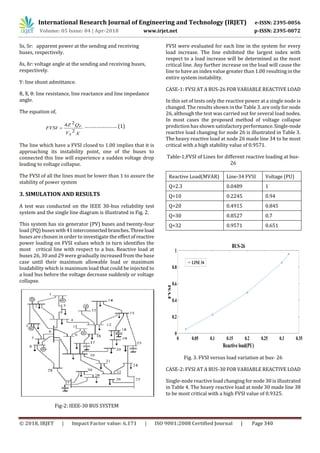
A test was conducted on the IEEE 30-bus reliability test
system and the single line diagram is illustrated in Fig. 2.
This system has six generator (PV) buses and twenty-four
load (PQ) buseswith41interconnected branches.Threeload
buses are chosen in order to investigate the effectof reactive
power loading on FVSI values which in turn identifies the
most critical line with respect to a bus. Reactive load at
buses 26, 30 and 29 were gradually increased from the base
case until their maximum allowable load or maximum
loadability which is maximum load that could be injected to
a load bus before the voltage decrease suddenly or voltage
collapse.
Fig-2: IEEE-30 BUS SYSTEM
FVSI were evaluated for each line in the system for every
load increase. The line exhibited the largest index with
respect to a load increase will be determined as the most
critical line. Any further increase on the load will cause the
line to have an index value greater than 1.00 resulting in the
entire system instability.
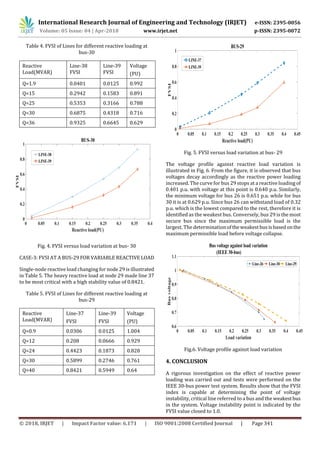
CASE-1: FVSI AT A BUS-26 FOR VARIABLE REACTIVE LOAD
In this set of tests only the reactive power at a single node is
changed. The results shown in the Table 3. are only for node
26, although the test was carried out for several load nodes.
In most cases the proposed method of voltage collapse
prediction has shown satisfactory performance.Single-node
reactive load changing for node 26 is illustrated in Table 3.
The heavy reactive load at node 26 made line 34 to be most
critical with a high stability value of 0.9571.
Table-1;FVSI of Lines for different reactive loading at bus-
26
Reactive Load(MVAR) Line-34 FVSI Voltage (PU)
Q=2.3 0.0489 1
Q=10 0.2245 0.94
Q=20 0.4915 0.845
Q=30 0.8527 0.7
Q=32 0.9571 0.651
Fig. 3. FVSI versus load variation at bus- 26
CASE-2: FVSI AT A BUS-30 FOR VARIABLE REACTIVE LOAD
Single-node reactive load changing for node 30 is illustrated
in Table 4. The heavy reactive load at node 30 made line 38
to be most critical with a high FVSI value of 0.9325.
International Research Journal of Engineering and Technology (IRJET) e-ISSN: 2395-0056
Volume: 05 Issue: 04 | Apr-2018 www.irjet.net p-ISSN: 2395-0072
© 2018, IRJET | Impact Factor value: 6.171 | ISO 9001:2008 Certified Journal | Page 341
Table 4. FVSI of Lines for different reactive loading at
bus-30
Reactive
Load(MVAR)
Line-38
FVSI
Line-39
FVSI
Voltage
(PU)
Q=1.9 0.0401 0.0125 0.992
Q=15 0.2942 0.1583 0.891
Q=25 0.5353 0.3166 0.788
Q=30 0.6875 0.4318 0.716
Q=36 0.9325 0.6645 0.629
Fig. 4. FVSI versus load variation at bus- 30
CASE-3: FVSI AT A BUS-29 FOR VARIABLE REACTIVE LOAD
Single-node reactive load changing for node 29 is illustrated
in Table 5. The heavy reactive load at node 29 made line 37
to be most critical with a high stability value of 0.8421.
Table 5. FVSI of Lines for different reactive loading at
bus-29
Reactive
Load(MVAR)
Line-37
FVSI
Line-39
FVSI
Voltage
(PU)
Q=0.9 0.0306 0.0125 1.004
Q=12 0.208 0.0666 0.929
Q=24 0.4423 0.1873 0.828
Q=30 0.5899 0.2746 0.761
Q=40 0.8421 0.5949 0.64
Fig. 5. FVSI versus load variation at bus- 29
The voltage profile against reactive load variation is
illustrated in Fig. 6. From the figure, it is observed that bus
voltages decay accordingly as the reactive power loading
increased. The curve for bus 29 stops at a reactive loading of
0.401 p.u. with voltage at this point is 0.640 p.u. Similarly,
the minimum voltage for bus 26 is 0.651 p.u. while for bus
30 it is at 0.629 p.u. Since bus 26 can withstand load of 0.32
p.u. which is the lowest compared to the rest, therefore it is
identified as the weakest bus. Conversely, bus 29 is the most
secure bus since the maximum permissible load is the
largest. The determinationof theweakestbusisbasedonthe
maximum permissible load before voltage collapse.
Fig.6. Voltage profile against load variation
4. CONCLUSION
A rigorous investigation on the effect of reactive power
loading was carried out and tests were performed on the
IEEE 30-bus power test system. Results show that the FVSI
index is capable at determining the point of voltage
instability, critical line referred to a bus and the weakestbus
in the system. Voltage instability point is indicated by the
FVSI value closed to 1.0.
International Research Journal of Engineering and Technology (IRJET) e-ISSN: 2395-0056
Volume: 05 Issue: 04 | Apr-2018 www.irjet.net p-ISSN: 2395-0072
© 2018, IRJET | Impact Factor value: 6.171 | ISO 9001:2008 Certified Journal | Page 342
5. REFERENCES
[1] Kundur P, Balu NJ, Lauby MG. Power system
stability and control. NewYork: McGraw-Hill; 1994
Jan 1.
[2] Van Cutsem T, Vournas C. Voltage stability of
electric power systems.SpringerScience&Business
Media; 1998 Mar 31.
[3] Musirin I, Rahman TA. Novel fast voltage stability
index (FVSI) for voltage stability analysis in power
transmissionsystem.InResearchandDevelopment,
SCOReD. Student Conference on 2002 (pp. 265-
268). IEEE.
[4] Moghavvemi, M., and F. M. Omar. "Technique for
contingency monitoring and voltage collapse
prediction."IEEE-Proceedings-Generation,
Transmission and Distribution 145, no. 6 (1998):
634-640.
[5] Kessel, P. and Glavitsch, H., 1986. Estimating the
voltage stability of a power system. IEEE
Transactions on Power Delivery, 1(3), pp.346-354.
[6] Pérez-Londoño, S., Rodríguez, L.F. and Olivar, G.,
2014. A simplified voltage Stability index (svsi).
International Journal of Electrical Power & Energy
Systems,63, pp.806-813
[7] Modarresi, Javad, Eskandar Gholipour, and Amin
Khodabakhshian. "A comprehensive review of the
voltage stability indices." Renewable and
Sustainable Energy Reviews 63 (2016): 1-12.
BIOGRAPHIES
Piyoosh K. Kala
M.Tech. research scholar
Department of EE,SPCE
Visnagar, Gujarat, India
Priyank R. Bhavsar
Associate professor
Department of EE,SPCE
Visnagar, Gujarat, India
hor
Photo
Author
Photo

IRJET- Voltage Stability Analysis using Voltage Stability Indices

  • 1.
    International Research Journalof Engineering and Technology (IRJET) e-ISSN: 2395-0056 Volume: 05 Issue: 04 | Apr-2018 www.irjet.net p-ISSN: 2395-0072 © 2018, IRJET | Impact Factor value: 6.171 | ISO 9001:2008 Certified Journal | Page 339 Voltage Stability Analysis Using Voltage Stability Indices Piyoosh K. kala1, Priyank R. Bhavsar2 1PG student, Department of Electrical Engineering, Sakalchand Patel College of Engineering, Gujarat, India 2Associate Professor, Department of Electrical Engineering, Sakalchand Patel College of Engineering, Gujarat, India ---------------------------------------------------------------------***--------------------------------------------------------------------- Abstract - A Modern power systems are operating under very stressed conditions and this is making the system to operate closer to their operating limits. Since a couple of decades ago voltage stability assessment has received an increasing attention due to the complexity of power system. With the increase in power demand andlimitedpowersources has caused the system to operate at its maximum capacity. Therefore, a study that is able to determine the maximum capacity limit before voltage collapse must be carried out so that necessary precaution can be taken to avoid system capacity violation. This paper discuss a Fast Voltage Stability Index (FVSI) for IEEE 30bus system. The FVSI is indicative in predicting the occurrence of system collapse and hence necessary action can be taken to avoid such incident. Here simulation of FVSI has been done for IEEE 30-bus test system to identify more sensitive method to detect the weakest line of the system. Key Words: Voltage stability, Line index, Fast Voltage Stability index (FVSI), Reactive power 1. INTRODUCTION For a good power system voltage stability should be maintained within the safe limit. Voltage stability is defined as “the ability of a power system to maintain acceptable voltage in the system both under normal condition and also after being subjected to a disturbance .voltage instability arises when load dynamics try to restore power beyond the capacity of transmission and generation system[1].The progressive and uncontrollable decrease in voltage leads to blackout in wide spread area or voltage collapse[2].There are many methods to analyze voltage stability like line stability index(Lmn),fast voltage stability index(FVSI). The main objective of this indices is to identify the weak lines which can lead to voltage collapse conditionforgiven busfor small variation in reactive power loading at particular bus. A main aim of this paper is by using FVSI to identify the weakest line of the system and weakest bus of the system. 2. INDICES TO DETERMINE VOLTAGE STABILITY Several methods have been proposed to assess the voltage stability of a power system. In this section two voltage stability indices are briefly described. Voltage stability indices which provides an accurate information about line and bus stability conditions are studied for various loading scenarios. The different voltage stability indices are calculated and compared for IEEE standard 30 bus system. The voltage stability indices are introduced in order to evaluate the voltage stability limit. Theseindicescanbeused on-line or offline to help operators in real time operation of power system or in designing and planning operations. These indices will be presented to show howclosetovoltage instability a system can be operated and which could lead to blackout in large parts of the interconnected power system. The system can be operated in the stable region by minimizing voltage stability index of buses and lines. Indices are classified as a 1.Bus indices 2.Line indices. The bus indices as an L-index, Voltage Collapse Prediction Index, Impedance Matching Stability index (ISI), Simplified Voltage Stability index (SVSI) etc. The line indices as a Line Stability Index (Lmn), Fast Voltage Stability index (FVSI), Line Stability Factor (LQP), Voltage Collapse Proximity index (VCPI). In this paper only line index FVSI is discussed. Fast voltage stability index (FVSI) Musirin [3] derived a voltage stability index based on a power transmission concept in a single line. The 2-bus power system model is shown in Figure1andthis is used to derive FVSI. Fig.-1:Two bus power system model [3] The Symbols in Fig. (1) are as below: Vs , Vr: voltage magnitude at the sending and receiving buses, respectively. Ps, Qs: active and reactive power at the sending bus. Pr, Qr: active and reactive power at the receiving bus.
  • 2.
    International Research Journalof Engineering and Technology (IRJET) e-ISSN: 2395-0056 Volume: 05 Issue: 04 | Apr-2018 www.irjet.net p-ISSN: 2395-0072 © 2018, IRJET | Impact Factor value: 6.171 | ISO 9001:2008 Certified Journal | Page 340 Ss, Sr: apparent power at the sending and receiving buses, respectively. δs, δr: voltage angle at the sending and receiving buses, respectively. Y: line shunt admittance. R, X, θ: line resistance, line reactance and line impedance angle. The equation of, XsV rQZ FVSI 2 24  …………………… (1) The line which have a FVSI closed to 1.00 implies that it is approaching its instability point, one of the buses to connected this line will experience a sudden voltage drop leading to voltage collapse. The FVSI of all the lines must be lower than 1 to assure the stability of power system 3. SIMULATION AND RESULTS A test was conducted on the IEEE 30-bus reliability test system and the single line diagram is illustrated in Fig. 2. This system has six generator (PV) buses and twenty-four load (PQ) buseswith41interconnected branches.Threeload buses are chosen in order to investigate the effectof reactive power loading on FVSI values which in turn identifies the most critical line with respect to a bus. Reactive load at buses 26, 30 and 29 were gradually increased from the base case until their maximum allowable load or maximum loadability which is maximum load that could be injected to a load bus before the voltage decrease suddenly or voltage collapse. Fig-2: IEEE-30 BUS SYSTEM FVSI were evaluated for each line in the system for every load increase. The line exhibited the largest index with respect to a load increase will be determined as the most critical line. Any further increase on the load will cause the line to have an index value greater than 1.00 resulting in the entire system instability. CASE-1: FVSI AT A BUS-26 FOR VARIABLE REACTIVE LOAD In this set of tests only the reactive power at a single node is changed. The results shown in the Table 3. are only for node 26, although the test was carried out for several load nodes. In most cases the proposed method of voltage collapse prediction has shown satisfactory performance.Single-node reactive load changing for node 26 is illustrated in Table 3. The heavy reactive load at node 26 made line 34 to be most critical with a high stability value of 0.9571. Table-1;FVSI of Lines for different reactive loading at bus- 26 Reactive Load(MVAR) Line-34 FVSI Voltage (PU) Q=2.3 0.0489 1 Q=10 0.2245 0.94 Q=20 0.4915 0.845 Q=30 0.8527 0.7 Q=32 0.9571 0.651 Fig. 3. FVSI versus load variation at bus- 26 CASE-2: FVSI AT A BUS-30 FOR VARIABLE REACTIVE LOAD Single-node reactive load changing for node 30 is illustrated in Table 4. The heavy reactive load at node 30 made line 38 to be most critical with a high FVSI value of 0.9325.
  • 3.
    International Research Journalof Engineering and Technology (IRJET) e-ISSN: 2395-0056 Volume: 05 Issue: 04 | Apr-2018 www.irjet.net p-ISSN: 2395-0072 © 2018, IRJET | Impact Factor value: 6.171 | ISO 9001:2008 Certified Journal | Page 341 Table 4. FVSI of Lines for different reactive loading at bus-30 Reactive Load(MVAR) Line-38 FVSI Line-39 FVSI Voltage (PU) Q=1.9 0.0401 0.0125 0.992 Q=15 0.2942 0.1583 0.891 Q=25 0.5353 0.3166 0.788 Q=30 0.6875 0.4318 0.716 Q=36 0.9325 0.6645 0.629 Fig. 4. FVSI versus load variation at bus- 30 CASE-3: FVSI AT A BUS-29 FOR VARIABLE REACTIVE LOAD Single-node reactive load changing for node 29 is illustrated in Table 5. The heavy reactive load at node 29 made line 37 to be most critical with a high stability value of 0.8421. Table 5. FVSI of Lines for different reactive loading at bus-29 Reactive Load(MVAR) Line-37 FVSI Line-39 FVSI Voltage (PU) Q=0.9 0.0306 0.0125 1.004 Q=12 0.208 0.0666 0.929 Q=24 0.4423 0.1873 0.828 Q=30 0.5899 0.2746 0.761 Q=40 0.8421 0.5949 0.64 Fig. 5. FVSI versus load variation at bus- 29 The voltage profile against reactive load variation is illustrated in Fig. 6. From the figure, it is observed that bus voltages decay accordingly as the reactive power loading increased. The curve for bus 29 stops at a reactive loading of 0.401 p.u. with voltage at this point is 0.640 p.u. Similarly, the minimum voltage for bus 26 is 0.651 p.u. while for bus 30 it is at 0.629 p.u. Since bus 26 can withstand load of 0.32 p.u. which is the lowest compared to the rest, therefore it is identified as the weakest bus. Conversely, bus 29 is the most secure bus since the maximum permissible load is the largest. The determinationof theweakestbusisbasedonthe maximum permissible load before voltage collapse. Fig.6. Voltage profile against load variation 4. CONCLUSION A rigorous investigation on the effect of reactive power loading was carried out and tests were performed on the IEEE 30-bus power test system. Results show that the FVSI index is capable at determining the point of voltage instability, critical line referred to a bus and the weakestbus in the system. Voltage instability point is indicated by the FVSI value closed to 1.0.
  • 4.
    International Research Journalof Engineering and Technology (IRJET) e-ISSN: 2395-0056 Volume: 05 Issue: 04 | Apr-2018 www.irjet.net p-ISSN: 2395-0072 © 2018, IRJET | Impact Factor value: 6.171 | ISO 9001:2008 Certified Journal | Page 342 5. REFERENCES [1] Kundur P, Balu NJ, Lauby MG. Power system stability and control. NewYork: McGraw-Hill; 1994 Jan 1. [2] Van Cutsem T, Vournas C. Voltage stability of electric power systems.SpringerScience&Business Media; 1998 Mar 31. [3] Musirin I, Rahman TA. Novel fast voltage stability index (FVSI) for voltage stability analysis in power transmissionsystem.InResearchandDevelopment, SCOReD. Student Conference on 2002 (pp. 265- 268). IEEE. [4] Moghavvemi, M., and F. M. Omar. "Technique for contingency monitoring and voltage collapse prediction."IEEE-Proceedings-Generation, Transmission and Distribution 145, no. 6 (1998): 634-640. [5] Kessel, P. and Glavitsch, H., 1986. Estimating the voltage stability of a power system. IEEE Transactions on Power Delivery, 1(3), pp.346-354. [6] Pérez-Londoño, S., Rodríguez, L.F. and Olivar, G., 2014. A simplified voltage Stability index (svsi). International Journal of Electrical Power & Energy Systems,63, pp.806-813 [7] Modarresi, Javad, Eskandar Gholipour, and Amin Khodabakhshian. "A comprehensive review of the voltage stability indices." Renewable and Sustainable Energy Reviews 63 (2016): 1-12. BIOGRAPHIES Piyoosh K. Kala M.Tech. research scholar Department of EE,SPCE Visnagar, Gujarat, India Priyank R. Bhavsar Associate professor Department of EE,SPCE Visnagar, Gujarat, India hor Photo Author Photo