Proceedings of the 2nd International Conference on Current Trends in Engineering and Management ICCTEM -2014 
INTERNATIONAL JOURNAL OF ELECTRICAL ENGINEERING & 
17 – 19, July 2014, Mysore, Karnataka, India 
TECHNOLOGY (IJEET) 
ISSN 0976 – 6545(Print) 
ISSN 0976 – 6553(Online) 
Volume 5, Issue 8, August (2014), pp. 182-190 
© IAEME: www.iaeme.com/IJEET.asp 
Journal Impact Factor (2014): 6.8310 (Calculated by GISI) 
www.jifactor.com 
IJEET 
© I A E M E 
SELECTIVE LOCALIZATION OF CAPACITOR BANKS CONSIDERING 
STABILITY ASPECTS IN POWER SYSTEMS 
Nikhita S B, Suneetha M N 
ME student (P&ES), electrical engineering department, university vishweshwarariah college of 
engineering, Bangalore, India, 
Associate professor, electrical engineering department, university vishweshwarariah college of 
engineering, Bangalore, India. 
182 
ABSTRACT 
The issue of voltage stability has become predominant in larger power systems, since the 
system is operated close to its capabilities in recent years. Addressing this concern considering the 
economic constraints is a challenge .This draws attention towards the localization of the reactive 
components that can improve the overall voltage profile in the system. This paper discusses a 
methodology for suitable selection of position (bus) for the placement of capacitor bank wherein the 
injection of fixed amount of reactive power is made to depict a picture of the overall improved 
voltage in the system considering the stability aspect for respective injection at that bus. The reduced 
jacobian is used to determine the impact of reactive power injection in the form of system voltage 
improvement. 
Keywords: voltage stability index, continuous power flow, localization of capacitor bank, jacobian. 
INTRODUCTION 
The increase in demand for power and the increased dependency on continuous power supply 
has led to tremendous increase in complexity of the system that is forced to operate close to their 
limit of stability. Interconnected systems under heavily loaded conditions are much prone to collapse 
caused by minor or major disturbances which might lead to blackout. Several recent blackouts are 
being related to the voltage instability problems. Voltage instability is progressively uncontrollable 
variations in the voltage levels. Regular overloading and the lack of reactive power are the common 
grounds for voltage instability .The preventive measure to be taken in advance include reactive 
power compensation, which can be done with the help of components like the capacitors. These 
components being expensive and hence cannot be installed at every node.
Proceedings of the 2nd International Conference on Current Trends in Engineering and Management ICCTEM -2014 
17 – 19, July 2014, Mysore, Karnataka, India 
The idea of this paper is to point out the location (bus) capable of yielding the required 
voltage improvement for the overall system, even if it doesn’t answer the exact amount of 
compensation required. Main study in this paper involves injecting the unit amount of reactive power 
into each bus which in turn enhance the voltage profile at all buses. The static voltage stability 
analysis of the new voltage profile obtained at individual buses will count up to the basis of selecting 
the location, which will better fit than the others. 
The next section discusses the background of the technique, but they are noted in brief below: 
• Conventional load flow analysis is performed using newton raphson technique 
• The jacobian matrix is computed from conventional load flow. The reduced jacobian is 
determined. The inverted jacobian is used to depict the change in the voltage in terms of 
reactive power injection. 
• This inverted jacobian is used in later section to determine the location where placing the 
capacitor would yield maximum system voltage improvement. 
• The voltage stability indices are used to perform the static voltage stability analysis for the new 
183 
voltage profile obtained 
• The previous steps are repeated for a range of operating points using the continuation power 
flow method and procedure is applied to each of these points. 
The contribution of the proposed method lies in three major aspects firstly to determine the 
capacitor location for the best overall improvement, secondly isolation of the locations which 
are sure to not yield any significant improvement of the voltage and thirdly avoid the system 
reaching the instability by monitoring the static stability of the system at subsequent operating 
points. This procedure might turn out to be useful in situations where complete black out can be 
avoided and scenario like a brownout can be improved towards the normal operating condition. 
1. BACKGROUND THEORY 
1.1 Computation of the reduced Jacobian 
The jacobian obtained from newton raphson method is further reduced to evaluate the 
suitable bus for placement of capacitors as shown in the next section. The reduced jacobian [1] 
formulation is as shown below. 
The matrix model of the load flow studies is given by
P and Q are the active and reactive power injections, 
V and  are the state variable vectors, namely voltage magnitude and bus angle, respectively, 
P is the difference in active power injection, 
Q is the difference in reactive power injection, 
  is the change in bus angle, 
V is the change bus voltage magnitude, 
J1 represents
 
J2 represents f / V, 
J3 represents g / , 
J4 represents g / V. 
The reduced Jacobian used in this technique assumes that change in active load i.e. P = 0. 
Substituting this in (1), we get
Proceedings of the 2nd International Conference on Current Trends in Engineering and Management ICCTEM -2014 
17 – 19, July 2014, Mysore, Karnataka, India
184 
Putting  from (2) and (3) we get
Where JR is the reduced jacobain 
The reduced Jacobian would serve as the tool on which the proposed methodology, described 
in detail later in this paper, would yield the results regarding the capacitor location. 
1.2 Voltage stability 
Voltage stability refers to ability of power systems to sustain appropriate levels of voltage 
through minor and major disturbances. The voltage can be analyzed using static and dynamic 
analysis approaches .Static analysis methods consider a snapshot of system operation and utilize 
regular power flow equations and simulations to evaluate the maximum power transfer levels at 
varying load levels. The dynamic analysis gives are useful for fast voltage collapse situation. The 
dynamic analysis make use of models characterized by non linear algebraic and differential 
equations solved using numerical integration methods and are time consuming and complicated 
compared to that of static analysis method. Moreover it fails to provide the information on degree of 
stability. The detection of critical point becomes the main aim in static voltage stability analysis. The 
renowned methods of analysis are PV and QV curves, modal analysis methods, minimum singular 
value methods and sensitivity analysis methods. Two popular methods used are as explained below 
1.2.1 Voltage stability index 
This index is an approximate measure of the closeness of the system to voltage collapse. 
There are various methods of determining the voltage collapse proximity indicator. One such method 
is the L-index method proposed in Kessel and Glavitsch. It is based on load flow analysis. Its value 
ranges from 0 (no load condition) to 1 (voltage collapse). The bus with the highest L-index value will 
be the most vulnerable bus in the system. The L-index calculation for a power sys-tem is briefly 
discussed below. Consider an N-bus system in which there are Ng generators. The relationship 
between voltage and current can be expressed by the following expression: 
																													!#$  %#$#$ (5) 
By segregating the load buses (PQ) from generator buses (PV), Equation (5) can write as 
! 
!'  % 
%' 
%' 
%'' 
'						( 
Where IG, IL and VG , VL represent currents and voltages at the generator buses and load buses. 
Rearranging the above equation we get: 
)	*+ 	,-.  )/++ 0-+ 
1+- 2--.),+ *-.			(7) 
Where 
3'  4%''5	4%'5
Proceedings of the 2nd International Conference on Current Trends in Engineering and Management ICCTEM -2014 
17 – 19, July 2014, Mysore, Karnataka, India 
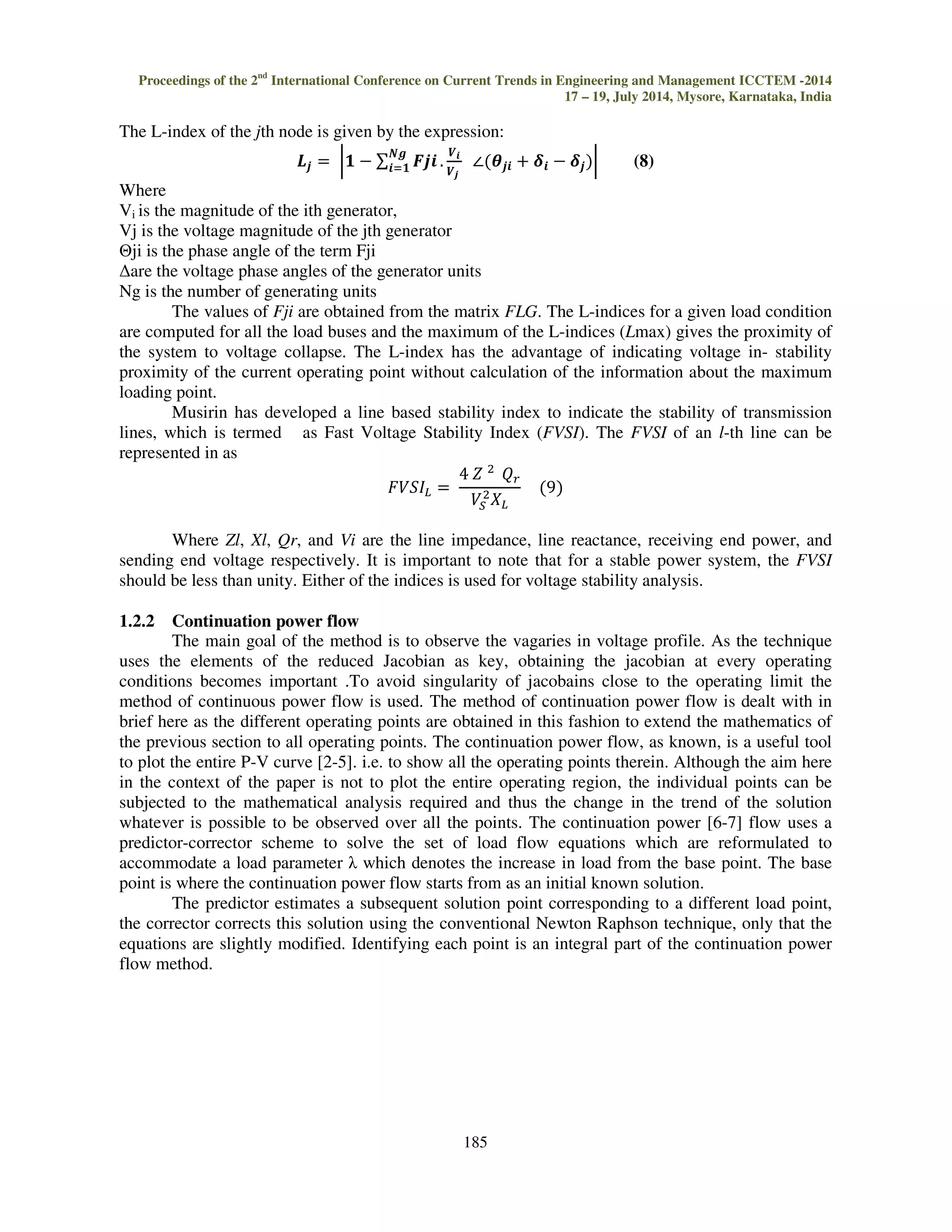
The L-index of the jth node is given by the expression: 
185 
?9 @ A 
67 	89  := ;7 
A7	 		BC7  D  D78 (8) 
Where 
Vi is the magnitude of the ith generator, 
Vj is the voltage magnitude of the jth generator 
ji is the phase angle of the term Fji 
are the voltage phase angles of the generator units 
Ng is the number of generating units 
The values of Fji are obtained from the matrix FLG. The L-indices for a given load condition 
are computed for all the load buses and the maximum of the L-indices (Lmax) gives the proximity of 
the system to voltage collapse. The L-index has the advantage of indicating voltage in- stability 
proximity of the current operating point without calculation of the information about the maximum 
loading point. 
Musirin has developed a line based stability index to indicate the stability of transmission 
lines, which is termed as Fast Voltage Stability Index (FVSI). The FVSI of an l-th line can be 
represented in as 
3E!' 	 	F			G 
$H' 				I 
Where Zl, Xl, Qr, and Vi are the line impedance, line reactance, receiving end power, and 
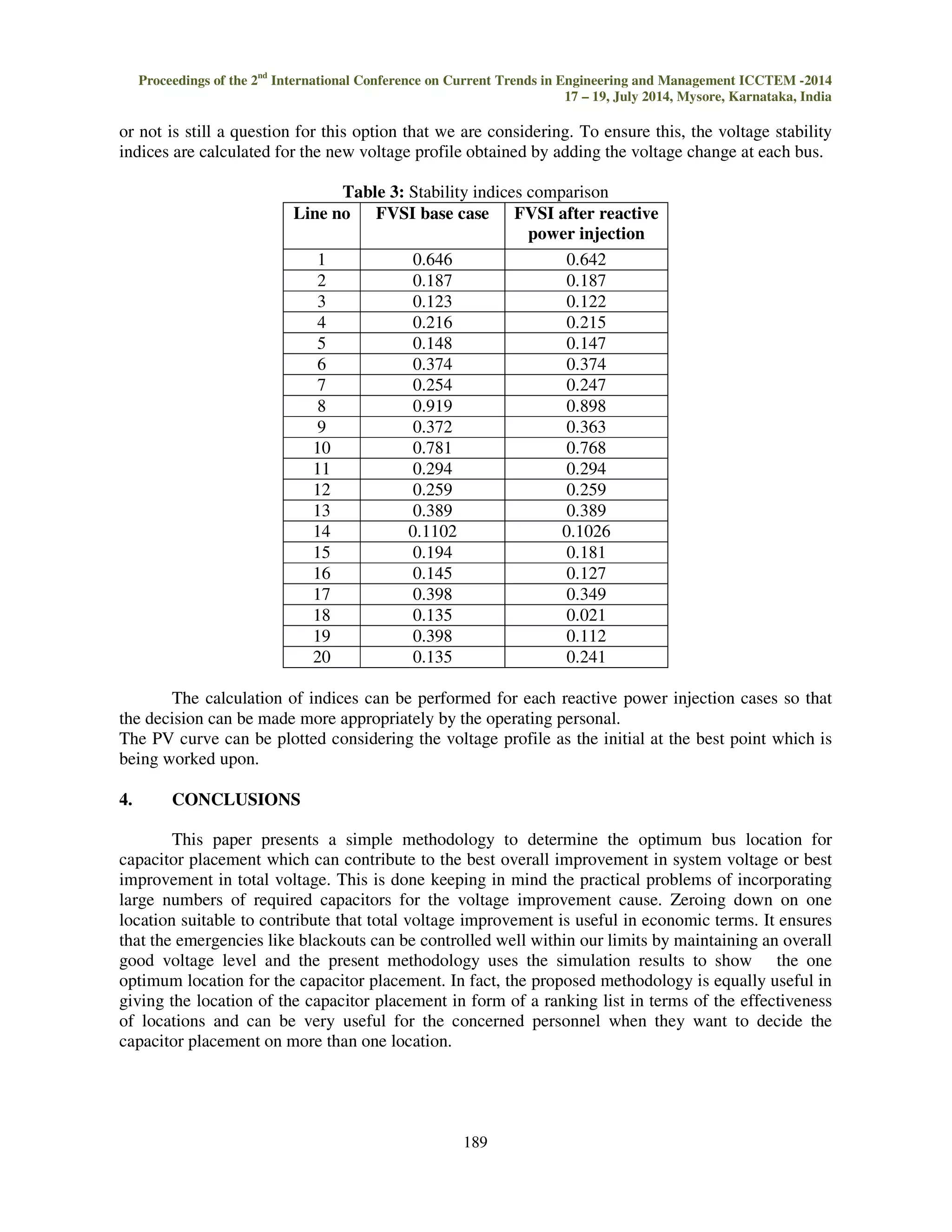
sending end voltage respectively. It is important to note that for a stable power system, the FVSI 
should be less than unity. Either of the indices is used for voltage stability analysis. 
1.2.2 Continuation power flow 
The main goal of the method is to observe the vagaries in voltage profile. As the technique 
uses the elements of the reduced Jacobian as key, obtaining the jacobian at every operating 
conditions becomes important .To avoid singularity of jacobains close to the operating limit the 
method of continuous power flow is used. The method of continuation power flow is dealt with in 
brief here as the different operating points are obtained in this fashion to extend the mathematics of 
the previous section to all operating points. The continuation power flow, as known, is a useful tool 
to plot the entire P-V curve [2-5]. i.e. to show all the operating points therein. Although the aim here 
in the context of the paper is not to plot the entire operating region, the individual points can be 
subjected to the mathematical analysis required and thus the change in the trend of the solution 
whatever is possible to be observed over all the points. The continuation power [6-7] flow uses a 
predictor-corrector scheme to solve the set of load flow equations which are reformulated to 
accommodate a load parameter  which denotes the increase in load from the base point. The base 
point is where the continuation power flow starts from as an initial known solution. 
The predictor estimates a subsequent solution point corresponding to a different load point, 
the corrector corrects this solution using the conventional Newton Raphson technique, only that the 
equations are slightly modified. Identifying each point is an integral part of the continuation power 
flow method.
Proceedings of the 2nd International Conference on Current Trends in Engineering and Management ICCTEM 
2. PROPOSED METHODOLOGY 
17 – 19, July 2014, Mysore, Karnataka, India 
The reduced jacobian JR gives the relationship describing 
describes V in terms of Q. The elements in each column of the inverse jacobian can be made to 
represent the change in voltage of every load bus for given injection of reactive power into 
corresponding to the column. 
Here JR 
-1 is the square matrix whose columns represent the partial derivatives of voltage of load 
buses of the system wrt reactive power at load bus i, 
Q represents the vector of change in reactive power modeled by a fixed amount of reactive power 
injection, 
V represents the vector of change in voltage. 
This implies that for studying the change in voltage 
injection into load buses separately or individually, the corresponding element of 
must be made 1 p.u. and the others 0. Upon implementing this, the corresponding column 
Directly gives V. Thus one needs to only study the elements of the particular colum 
reduced Jacobian to get the change in voltage as an effect of 1 p.u. reactive power injection at that 
bus i. 
186 
Q in terms of  
. V as a result of the reactive power 
eparately  
. -2014 
V. The inverse 
the bus 
Q, say Qi alone 
-1. 
i in JR 
column i of the
Proceedings of the 2nd International Conference on Current Trends in Engineering and Management ICCTEM -2014 
17 – 19, July 2014, Mysore, Karnataka, India 
-1 further gives the total improvement of system 
The sum of the elements of that column i of JR 
voltage Vtotali as an effect of the injection at the bus i. This is shown in (13). 
On comparison of the sums of all individual columns of JR 
187 
-1, the bus corresponding to the column i 
which yields maximum Vtotali is determined as the bus required. 
Corresponding to the matrix given in (10) , bus i is not the ith bus in the system but the ith 
load bus in the system as the buses involved in the analysis are only load buses. It should be noted 
that the term Voverall depicts the total improvement in system voltage where as the individual 
change in the bus voltage information come with the individual elements of JR 
-1.Now that the voltage 
change is known it is added to the actual voltage. The new voltage profile obtained is now made to 
undergo static voltage stability analysis using the stability index either the l index or the fast voltage 
stability index. Based on the value of the indices choice is made for the localization of the capacitor 
accordingly 
Further the PV curves can be drawn by conducting the continuation power flow for the range 
of operating points obtained from the predictor corrector method which explains the actual distance 
between the operating point and the stability limit. Here the indices are just to indicate whether the 
new voltage is stable enough but since indices does not have any physical interpretation the PV 
curves are used as the confirmation parameter to ensure the stability of the system. The strategy 
discussed so far need not yield the same result at every operating point which is exactly why it is 
quite essential to study the same aspects discussed just before at different operating points over a 
continuous range. The continuation power flow aids the purpose of extending the idea discussed 
before over that continuous range of operating points. The bus numbers deemed best by the 
technique for capacitor placement at the operating points plotted by the continuation power flow can 
be enlisted to serve as a picture to let know the same bus location is fit enough over a particular 
range of operation within which any voltage recovery is possible. The range is not necessarily 
required to be very near to the critical point as system recovery needing not wait till then. 
Some of the advantages of this method are: 
• The method is simple mathematically as it deals with 
Only the elements of the inverse of the reduced Jacobian directly. 
• The method gives the overall voltage improvement in 
System and it ensures that the optimum bus can be found so that a condition of blackout can be 
avoided and in such circumstances, some amount of voltage can be sustained in the system 
with the selected capacitor(s) connected. 
3. SIMULATION AND RESULTS 
The IEEE 14 bus system is taking as the test system for showcasing the results obtained. The 
single line diagram of 14 bus system is as shown below.

Selective localization of capacitor banks considering stability aspects in power systems 2

  • 1.
    Proceedings of the2nd International Conference on Current Trends in Engineering and Management ICCTEM -2014 INTERNATIONAL JOURNAL OF ELECTRICAL ENGINEERING & 17 – 19, July 2014, Mysore, Karnataka, India TECHNOLOGY (IJEET) ISSN 0976 – 6545(Print) ISSN 0976 – 6553(Online) Volume 5, Issue 8, August (2014), pp. 182-190 © IAEME: www.iaeme.com/IJEET.asp Journal Impact Factor (2014): 6.8310 (Calculated by GISI) www.jifactor.com IJEET © I A E M E SELECTIVE LOCALIZATION OF CAPACITOR BANKS CONSIDERING STABILITY ASPECTS IN POWER SYSTEMS Nikhita S B, Suneetha M N ME student (P&ES), electrical engineering department, university vishweshwarariah college of engineering, Bangalore, India, Associate professor, electrical engineering department, university vishweshwarariah college of engineering, Bangalore, India. 182 ABSTRACT The issue of voltage stability has become predominant in larger power systems, since the system is operated close to its capabilities in recent years. Addressing this concern considering the economic constraints is a challenge .This draws attention towards the localization of the reactive components that can improve the overall voltage profile in the system. This paper discusses a methodology for suitable selection of position (bus) for the placement of capacitor bank wherein the injection of fixed amount of reactive power is made to depict a picture of the overall improved voltage in the system considering the stability aspect for respective injection at that bus. The reduced jacobian is used to determine the impact of reactive power injection in the form of system voltage improvement. Keywords: voltage stability index, continuous power flow, localization of capacitor bank, jacobian. INTRODUCTION The increase in demand for power and the increased dependency on continuous power supply has led to tremendous increase in complexity of the system that is forced to operate close to their limit of stability. Interconnected systems under heavily loaded conditions are much prone to collapse caused by minor or major disturbances which might lead to blackout. Several recent blackouts are being related to the voltage instability problems. Voltage instability is progressively uncontrollable variations in the voltage levels. Regular overloading and the lack of reactive power are the common grounds for voltage instability .The preventive measure to be taken in advance include reactive power compensation, which can be done with the help of components like the capacitors. These components being expensive and hence cannot be installed at every node.
  • 2.
    Proceedings of the2nd International Conference on Current Trends in Engineering and Management ICCTEM -2014 17 – 19, July 2014, Mysore, Karnataka, India The idea of this paper is to point out the location (bus) capable of yielding the required voltage improvement for the overall system, even if it doesn’t answer the exact amount of compensation required. Main study in this paper involves injecting the unit amount of reactive power into each bus which in turn enhance the voltage profile at all buses. The static voltage stability analysis of the new voltage profile obtained at individual buses will count up to the basis of selecting the location, which will better fit than the others. The next section discusses the background of the technique, but they are noted in brief below: • Conventional load flow analysis is performed using newton raphson technique • The jacobian matrix is computed from conventional load flow. The reduced jacobian is determined. The inverted jacobian is used to depict the change in the voltage in terms of reactive power injection. • This inverted jacobian is used in later section to determine the location where placing the capacitor would yield maximum system voltage improvement. • The voltage stability indices are used to perform the static voltage stability analysis for the new 183 voltage profile obtained • The previous steps are repeated for a range of operating points using the continuation power flow method and procedure is applied to each of these points. The contribution of the proposed method lies in three major aspects firstly to determine the capacitor location for the best overall improvement, secondly isolation of the locations which are sure to not yield any significant improvement of the voltage and thirdly avoid the system reaching the instability by monitoring the static stability of the system at subsequent operating points. This procedure might turn out to be useful in situations where complete black out can be avoided and scenario like a brownout can be improved towards the normal operating condition. 1. BACKGROUND THEORY 1.1 Computation of the reduced Jacobian The jacobian obtained from newton raphson method is further reduced to evaluate the suitable bus for placement of capacitors as shown in the next section. The reduced jacobian [1] formulation is as shown below. The matrix model of the load flow studies is given by
  • 3.
    P and Qare the active and reactive power injections, V and are the state variable vectors, namely voltage magnitude and bus angle, respectively, P is the difference in active power injection, Q is the difference in reactive power injection, is the change in bus angle, V is the change bus voltage magnitude, J1 represents J2 represents f / V, J3 represents g / , J4 represents g / V. The reduced Jacobian used in this technique assumes that change in active load i.e. P = 0. Substituting this in (1), we get
  • 4.
    Proceedings of the2nd International Conference on Current Trends in Engineering and Management ICCTEM -2014 17 – 19, July 2014, Mysore, Karnataka, India
  • 5.
    184 Putting from (2) and (3) we get
  • 6.
    Where JR isthe reduced jacobain The reduced Jacobian would serve as the tool on which the proposed methodology, described in detail later in this paper, would yield the results regarding the capacitor location. 1.2 Voltage stability Voltage stability refers to ability of power systems to sustain appropriate levels of voltage through minor and major disturbances. The voltage can be analyzed using static and dynamic analysis approaches .Static analysis methods consider a snapshot of system operation and utilize regular power flow equations and simulations to evaluate the maximum power transfer levels at varying load levels. The dynamic analysis gives are useful for fast voltage collapse situation. The dynamic analysis make use of models characterized by non linear algebraic and differential equations solved using numerical integration methods and are time consuming and complicated compared to that of static analysis method. Moreover it fails to provide the information on degree of stability. The detection of critical point becomes the main aim in static voltage stability analysis. The renowned methods of analysis are PV and QV curves, modal analysis methods, minimum singular value methods and sensitivity analysis methods. Two popular methods used are as explained below 1.2.1 Voltage stability index This index is an approximate measure of the closeness of the system to voltage collapse. There are various methods of determining the voltage collapse proximity indicator. One such method is the L-index method proposed in Kessel and Glavitsch. It is based on load flow analysis. Its value ranges from 0 (no load condition) to 1 (voltage collapse). The bus with the highest L-index value will be the most vulnerable bus in the system. The L-index calculation for a power sys-tem is briefly discussed below. Consider an N-bus system in which there are Ng generators. The relationship between voltage and current can be expressed by the following expression: !#$ %#$#$ (5) By segregating the load buses (PQ) from generator buses (PV), Equation (5) can write as ! !' % %' %' %'' ' ( Where IG, IL and VG , VL represent currents and voltages at the generator buses and load buses. Rearranging the above equation we get: ) *+ ,-. )/++ 0-+ 1+- 2--.),+ *-. (7) Where 3' 4%''5 4%'5
  • 7.
    Proceedings of the2nd International Conference on Current Trends in Engineering and Management ICCTEM -2014 17 – 19, July 2014, Mysore, Karnataka, India The L-index of the jth node is given by the expression: 185 ?9 @ A 67 89 := ;7 A7 BC7 D D78 (8) Where Vi is the magnitude of the ith generator, Vj is the voltage magnitude of the jth generator ji is the phase angle of the term Fji are the voltage phase angles of the generator units Ng is the number of generating units The values of Fji are obtained from the matrix FLG. The L-indices for a given load condition are computed for all the load buses and the maximum of the L-indices (Lmax) gives the proximity of the system to voltage collapse. The L-index has the advantage of indicating voltage in- stability proximity of the current operating point without calculation of the information about the maximum loading point. Musirin has developed a line based stability index to indicate the stability of transmission lines, which is termed as Fast Voltage Stability Index (FVSI). The FVSI of an l-th line can be represented in as 3E!' F G $H' I Where Zl, Xl, Qr, and Vi are the line impedance, line reactance, receiving end power, and sending end voltage respectively. It is important to note that for a stable power system, the FVSI should be less than unity. Either of the indices is used for voltage stability analysis. 1.2.2 Continuation power flow The main goal of the method is to observe the vagaries in voltage profile. As the technique uses the elements of the reduced Jacobian as key, obtaining the jacobian at every operating conditions becomes important .To avoid singularity of jacobains close to the operating limit the method of continuous power flow is used. The method of continuation power flow is dealt with in brief here as the different operating points are obtained in this fashion to extend the mathematics of the previous section to all operating points. The continuation power flow, as known, is a useful tool to plot the entire P-V curve [2-5]. i.e. to show all the operating points therein. Although the aim here in the context of the paper is not to plot the entire operating region, the individual points can be subjected to the mathematical analysis required and thus the change in the trend of the solution whatever is possible to be observed over all the points. The continuation power [6-7] flow uses a predictor-corrector scheme to solve the set of load flow equations which are reformulated to accommodate a load parameter which denotes the increase in load from the base point. The base point is where the continuation power flow starts from as an initial known solution. The predictor estimates a subsequent solution point corresponding to a different load point, the corrector corrects this solution using the conventional Newton Raphson technique, only that the equations are slightly modified. Identifying each point is an integral part of the continuation power flow method.
  • 8.
    Proceedings of the2nd International Conference on Current Trends in Engineering and Management ICCTEM 2. PROPOSED METHODOLOGY 17 – 19, July 2014, Mysore, Karnataka, India The reduced jacobian JR gives the relationship describing describes V in terms of Q. The elements in each column of the inverse jacobian can be made to represent the change in voltage of every load bus for given injection of reactive power into corresponding to the column. Here JR -1 is the square matrix whose columns represent the partial derivatives of voltage of load buses of the system wrt reactive power at load bus i, Q represents the vector of change in reactive power modeled by a fixed amount of reactive power injection, V represents the vector of change in voltage. This implies that for studying the change in voltage injection into load buses separately or individually, the corresponding element of must be made 1 p.u. and the others 0. Upon implementing this, the corresponding column Directly gives V. Thus one needs to only study the elements of the particular colum reduced Jacobian to get the change in voltage as an effect of 1 p.u. reactive power injection at that bus i. 186 Q in terms of . V as a result of the reactive power eparately . -2014 V. The inverse the bus Q, say Qi alone -1. i in JR column i of the
  • 9.
    Proceedings of the2nd International Conference on Current Trends in Engineering and Management ICCTEM -2014 17 – 19, July 2014, Mysore, Karnataka, India -1 further gives the total improvement of system The sum of the elements of that column i of JR voltage Vtotali as an effect of the injection at the bus i. This is shown in (13). On comparison of the sums of all individual columns of JR 187 -1, the bus corresponding to the column i which yields maximum Vtotali is determined as the bus required. Corresponding to the matrix given in (10) , bus i is not the ith bus in the system but the ith load bus in the system as the buses involved in the analysis are only load buses. It should be noted that the term Voverall depicts the total improvement in system voltage where as the individual change in the bus voltage information come with the individual elements of JR -1.Now that the voltage change is known it is added to the actual voltage. The new voltage profile obtained is now made to undergo static voltage stability analysis using the stability index either the l index or the fast voltage stability index. Based on the value of the indices choice is made for the localization of the capacitor accordingly Further the PV curves can be drawn by conducting the continuation power flow for the range of operating points obtained from the predictor corrector method which explains the actual distance between the operating point and the stability limit. Here the indices are just to indicate whether the new voltage is stable enough but since indices does not have any physical interpretation the PV curves are used as the confirmation parameter to ensure the stability of the system. The strategy discussed so far need not yield the same result at every operating point which is exactly why it is quite essential to study the same aspects discussed just before at different operating points over a continuous range. The continuation power flow aids the purpose of extending the idea discussed before over that continuous range of operating points. The bus numbers deemed best by the technique for capacitor placement at the operating points plotted by the continuation power flow can be enlisted to serve as a picture to let know the same bus location is fit enough over a particular range of operation within which any voltage recovery is possible. The range is not necessarily required to be very near to the critical point as system recovery needing not wait till then. Some of the advantages of this method are: • The method is simple mathematically as it deals with Only the elements of the inverse of the reduced Jacobian directly. • The method gives the overall voltage improvement in System and it ensures that the optimum bus can be found so that a condition of blackout can be avoided and in such circumstances, some amount of voltage can be sustained in the system with the selected capacitor(s) connected. 3. SIMULATION AND RESULTS The IEEE 14 bus system is taking as the test system for showcasing the results obtained. The single line diagram of 14 bus system is as shown below.
  • 10.
    Proceedings of the2nd International Conference on Current Trends in Engineering and Management ICCTEM -2014 17 – 19, July 2014, Mysore, Karnataka, India Fig 2. 14 bus system The newton raphson method is used to perform the load flow and initial voltage and angles are considered as base then the reduced jacobain is calculated and the inverse of it is considered The change in voltage at each load buses when unit reactive power is injected at each bus is calculated. Here out of nine load buses only three buses are considered to demonstrate. Table1: Change in voltage for injection of reactive power at various buses Bus no. Injection at bus 4 Injection at bus 10 Injection at bus 14 4 0.0413 0.0155 0.0116 5 0.0257 0.0105 0.0080 7 0.0196 0.0501 0.0375 9 0.0187 0.0962 0.0719 10 0.0155 0.1495 0.0596 11 0.0081 0.0787 0.0314 12 0.0015 0.0077 0.0278 13 0.0028 0.0145 0.0505 14 0.0117 0.0606 0.2136 Table 2: Total change in voltage in the system due to injection Injection at bus 4 Injection at bus 10 Injection at bus 14 Overall system voltage change 0.1449 0.4833 1.159 As seen in table the overall voltage improvement is maximum when the reactive power injection is made at bus 14 than in other two buses considered and hence initially this can be considered as the better bus position to localize the capacitor bank. But whether the system is stable 188
  • 11.
    Proceedings of the2nd International Conference on Current Trends in Engineering and Management ICCTEM -2014 17 – 19, July 2014, Mysore, Karnataka, India or not is still a question for this option that we are considering. To ensure this, the voltage stability indices are calculated for the new voltage profile obtained by adding the voltage change at each bus. Table 3: Stability indices comparison Line no FVSI base case FVSI after reactive 189 power injection 1 0.646 0.642 2 0.187 0.187 3 0.123 0.122 4 0.216 0.215 5 0.148 0.147 6 0.374 0.374 7 0.254 0.247 8 0.919 0.898 9 0.372 0.363 10 0.781 0.768 11 0.294 0.294 12 0.259 0.259 13 0.389 0.389 14 0.1102 0.1026 15 0.194 0.181 16 0.145 0.127 17 0.398 0.349 18 0.135 0.021 19 0.398 0.112 20 0.135 0.241 The calculation of indices can be performed for each reactive power injection cases so that the decision can be made more appropriately by the operating personal. The PV curve can be plotted considering the voltage profile as the initial at the best point which is being worked upon. 4. CONCLUSIONS This paper presents a simple methodology to determine the optimum bus location for capacitor placement which can contribute to the best overall improvement in system voltage or best improvement in total voltage. This is done keeping in mind the practical problems of incorporating large numbers of required capacitors for the voltage improvement cause. Zeroing down on one location suitable to contribute that total voltage improvement is useful in economic terms. It ensures that the emergencies like blackouts can be controlled well within our limits by maintaining an overall good voltage level and the present methodology uses the simulation results to show the one optimum location for the capacitor placement. In fact, the proposed methodology is equally useful in giving the location of the capacitor placement in form of a ranking list in terms of the effectiveness of locations and can be very useful for the concerned personnel when they want to decide the capacitor placement on more than one location.
  • 12.
    Proceedings of the2nd International Conference on Current Trends in Engineering and Management ICCTEM -2014 17 – 19, July 2014, Mysore, Karnataka, India 190 6. REFERENCES 1. S. C. Srivastava, R. K. Varma and A. K. Tyagi, “Singularity of reduced Jacobian matrices for identifying voltage and angle instability”, Fourth International Conference on Advances in Power System Control,Operation and Management, 1997, APSCOM-97, vol. 2, 11-14 Nov. 1997,pp. 493 – 498. 2. T. Van Cutsem, “Voltage Instability: Phenomena, Countermeasures, and Analysis Methods”, Proceedings of the IEEE, vol. 88, Feb. 2000, pp. 208 – 227. 3. Carson W. Taylor, “Power System Voltage Stability”, McGraw-Hill, 1994. 4. Prabha Kundur, “Power System Stability and Control”, McGraw- Hill, 1994. 5. Haque M.H, “Determination of steady state state voltage limit using PQ curve”, Power Engineering Review, IEEE, vol.22, no. 4, pp. 71-72, April 2002. 6. Venkataramana Ajjarapu, Lowa State University, “Computational techniques for voltage stability assessment and control”, Springer, 2006. 7. V. Ajjarapu and C. Christy, “The continuation power flow: a tool for steady state voltage stability analysis”, IEEE Transactions on Power Systems, vol. 7, Feb. 1992, pp. 41