Unit 3
Module 1
VOLCANOES
What is a Volcano?
A volcano is a natural opening in the surface of the
Earth where molten rocks, hot gases, smoke, and
ash are ejected
How and Where Volcanoes
form?
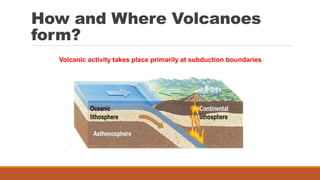
Volcanic activity takes place primarily at subduction boundaries
How and Where Volcanoes
form?
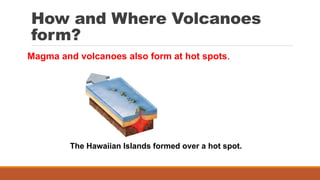
The Hawaiian Islands formed over a hot spot.
Magma and volcanoes also form at hot spots.
Hot spot volcanoes occur far from plate boundaries.
Because the hot spot is caused by mantle plumes that
exist below the tectonic plates, as the plates move,
the hot spot does not, and may create a chain of
volcanoes on the Earth’s surface. Neither the
Hawaiian Islands nor Yellowstone National Park are
near plate boundaries. Rather, the volcanoes that
form the Hawaiian Islands and the volcanic activity
at Yellowstone National Park are due to their
locations over hot spots.
Geologists estimate there are about 40 to 50 hot
spots around the world.
https://education.nationalgeographic.org/resource/hot-spots/
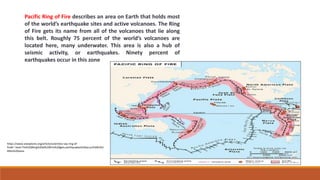
Pacific Ring of Fire describes an area on Earth that holds most
of the world’s earthquake sites and active volcanoes. The Ring
of Fire gets its name from all of the volcanoes that lie along
this belt. Roughly 75 percent of the world’s volcanoes are
located here, many underwater. This area is also a hub of
seismic activity, or earthquakes. Ninety percent of
earthquakes occur in this zone
https://www.snexplores.org/article/scientists-say-ring-of-
fire#:~:text=The%20Ring%20of%20Fire%20gets,earthquakes%20occur%20in%2
0this%20zone.
Classification of Volcanoes
TYPE OF VOLCANO DESCRIPTION EXAMPLES
1. ACTIVE VOLCANOES These are volcanoes which have erupted
within the last 10,000 years.
Taal Volcano at Batangas; Mayon
Volcano at Albay; Pinatubo at
Zambales; and Kanlaon at Negros
Oriental
2. DORMANT OR POTENTIALLY
ACTIVE VOLCANOES
These Volcanoes have no historical
records of eruption but can possibly
erupt in the future.
Apo at Kidapawan, Davao City;
Cuernos de Negros at Dumaguete
City; and Maripipi at Tacloban City.
3. EXTINCT OR INACTIVE
VOLCANOES
These volcanoes have no record of
eruption or volcanic activities and do not
show signs of possible eruption in the
future.
Arayat at Pampanga; Alligator at
Laguna; Boctong at Palawan; and
Batelian at Zamboanga del Sur
Volcanoes are classified according to:
A. Record of eruption
There are several ways by which volcanoes can be classified.
PHIVOLCS
have adapted a system where the Philippine volcanoes as active or
inactive. Active volcanoes are those that have a record of eruption
within the last 600 years or those that erupted 10, 000 years ago based
on analyses of their materials.
Inactive volcanoes, on the other hand, are those that have not
erupted for the last 10, 000 years and their physical form is being
changed by agents of weathering and erosion through formation of
deep and long gullies.
According to PHIVOLCS,our country has more than a hundred
volcanoes as of 2013. Twenty-three are active while the rest are
inactive. Some of these volcanoes will be mentioned in the next
activity.
Magma inside the volcano has high temperature. As the magma is
continuously heated, it goes up. As it rises, gas bubbles are developed.
The gas bubbles are trapped and expand causing the molten material to
swell also, resulting in a gradual increase in pressure within the volcano.
When the pressure exceeds the strength of the overlying rock, fracturing
occurs. The resulting breaks lead to a further drop in confining pressure,
which in turn causes even more gas bubbles to form. Lava may appear to
be the primary material ejected from a volcano, but this is not always the
case. Aside from lava, broken rocks, lava bombs, fine ash and dust
are also ejected.
What causes a volcano to erupt?
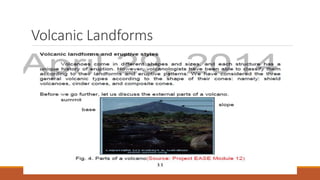
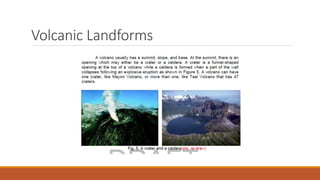
Volcanic Landforms
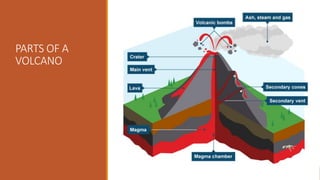
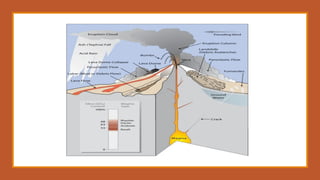
PARTS OF A
VOLCANO
ANATOMY OF A VOLCANO
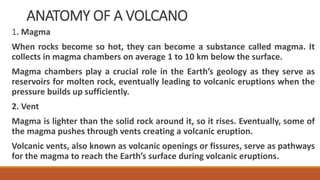
1. Magma
When rocks become so hot, they can become a substance called magma. It
collects in magma chambers on average 1 to 10 km below the surface.
Magma chambers play a crucial role in the Earth’s geology as they serve as
reservoirs for molten rock, eventually leading to volcanic eruptions when the
pressure builds up sufficiently.
2. Vent
Magma is lighter than the solid rock around it, so it rises. Eventually, some of
the magma pushes through vents creating a volcanic eruption.
Volcanic vents, also known as volcanic openings or fissures, serve as pathways
for the magma to reach the Earth’s surface during volcanic eruptions.
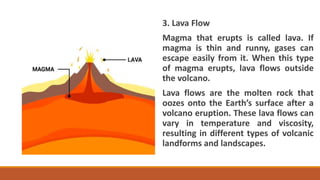
3. Lava Flow
Magma that erupts is called lava. If
magma is thin and runny, gases can
escape easily from it. When this type
of magma erupts, lava flows outside
the volcano.
Lava flows are the molten rock that
oozes onto the Earth’s surface after a
volcano eruption. These lava flows can
vary in temperature and viscosity,
resulting in different types of volcanic
landforms and landscapes.
4. Volcanic Bombs
Volcanic bombs, often ejected with great force, can travel
significant distances from the volcano before solidifying into
various shapes and sizes, contributing to the geologic features of
volcanic landscapes.
5. Lava Dome
Lava domes are fascinating geological features that can grow over
time as layers of lava accumulate. They often pose potential hazards
due to their instability and the potential for explosive eruptions
when pressure builds beneath them.
When lava is too thick and sticky, it piles up around the vent and
forms a dome. These circular mounds protrude from volcanoes
because of the slow release of viscous lava.
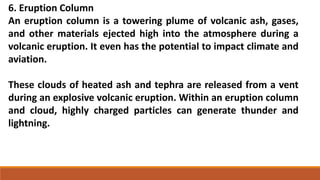
6. Eruption Column
An eruption column is a towering plume of volcanic ash, gases,
and other materials ejected high into the atmosphere during a
volcanic eruption. It even has the potential to impact climate and
aviation.
These clouds of heated ash and tephra are released from a vent
during an explosive volcanic eruption. Within an eruption column
and cloud, highly charged particles can generate thunder and
lightning.
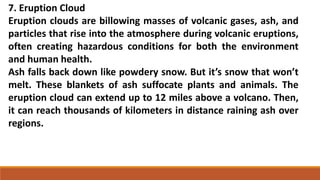
7. Eruption Cloud
Eruption clouds are billowing masses of volcanic gases, ash, and
particles that rise into the atmosphere during volcanic eruptions,
often creating hazardous conditions for both the environment
and human health.
Ash falls back down like powdery snow. But it’s snow that won’t
melt. These blankets of ash suffocate plants and animals. The
eruption cloud can extend up to 12 miles above a volcano. Then,
it can reach thousands of kilometers in distance raining ash over
regions.
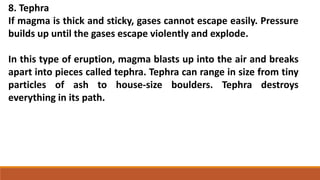
8. Tephra
If magma is thick and sticky, gases cannot escape easily. Pressure
builds up until the gases escape violently and explode.
In this type of eruption, magma blasts up into the air and breaks
apart into pieces called tephra. Tephra can range in size from tiny
particles of ash to house-size boulders. Tephra destroys
everything in its path.
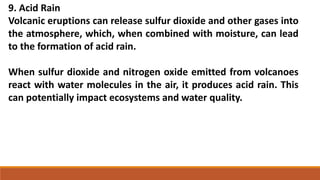
9. Acid Rain
Volcanic eruptions can release sulfur dioxide and other gases into
the atmosphere, which, when combined with moisture, can lead
to the formation of acid rain.
When sulfur dioxide and nitrogen oxide emitted from volcanoes
react with water molecules in the air, it produces acid rain. This
can potentially impact ecosystems and water quality.
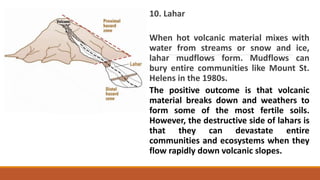
10. Lahar
When hot volcanic material mixes with
water from streams or snow and ice,
lahar mudflows form. Mudflows can
bury entire communities like Mount St.
Helens in the 1980s.
The positive outcome is that volcanic
material breaks down and weathers to
form some of the most fertile soils.
However, the destructive side of lahars is
that they can devastate entire
communities and ecosystems when they
flow rapidly down volcanic slopes.
11. Pyroclastic Flow
A pyroclastic flow is a fast-moving mixture of hot gas, volcanic
ash, and fragmented rock that can travel down the slopes of a
volcano at incredible speeds.
Pyroclastic flow moves away from a volcano and incorporates
tephra. When lava domes collapse, it can create hot pyroclastic
density currents. This poses a significant danger to anything in its
path.
12. Fumaroles
Holes, cracks, or fissures are on the surface near volcanoes.
Fumaroles are vents on a volcano’s surface where gases and
steam escape into the atmosphere.
They emit steam and volcanic gases, such as sulfur dioxide and
carbon dioxide. Fumaroles create pathways for rising heat,
volcanic gas, and magma. It often creates eerie landscapes
reminiscent of an alien world.
13. Crack
Cracks, also known as fissures or fractures, can form on a
volcano’s surface due to tectonic stresses, allowing magma to rise
and potentially leading to eruptions.
Openings stemming down into the pool of magma. Cracks and
fumaroles act like a window so scientists can get a glimpse of the
gases inside volcanoes.
https://earthhow.com/parts-of-a-volcano/
Volcanic Landforms
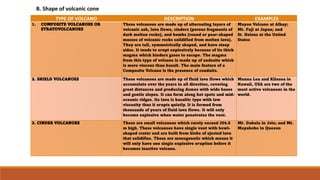
TYPE OF VOLCANO DESCRIPTION EXAMPLES
1. COMPOSITE VOLCANOES OR
STRATOVOLCANOES
These volcanoes are made up of alternating layers of
volcanic ash, lava flows, cinders (porous fragments of
dark molten rocks), and bombs (round or pear-shaped
masses of volcanic rocks solidified from molten lava).
They are tall, symmetrically shaped, and have steep
sides. It tends to erupt explosively because of its thick
magma which hinders gases to escape. The magma
from this type of volcano is made up of andesite which
is more viscous than basalt. The main feature of a
Composite Volcano is the presence of conduits.
Mayon Volcano at Albay;
Mt. Fuji at Japan; and
St. Helens at the United
States
2. SHIELD VOLCANOES These volcanoes are made up of fluid lava flows which
accumulate over the years in all direction, covering
great distances and producing domes with wide bases
and gentle slopes. It can form along hot spots and mid-
oceanic ridges. Its lava is basaltic type with low
viscosity thus it erupts quietly. It is formed from
thousands of years of fluid lava flows. It will only
become explosive when water penetrates the vent.
Mauna Loa and Kilauea in
Hawaii, USA are two of the
most active volcanoes in the
world.
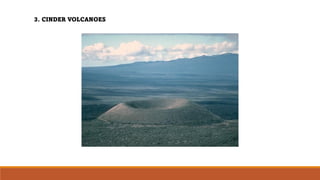
3. CINDER VOLCANOES These are small volcanoes which rarely exceed 304.8
m high. These volcanoes have single vent with bowl-
shaped crater and are built from blobs of ejected lava
that solidifies. These are monogenetic which means it
will only have one single explosive eruption before it
becomes inactive volcano.
Mt. Dakula in Jolo; and Mt.
Mayabobo in Quezon
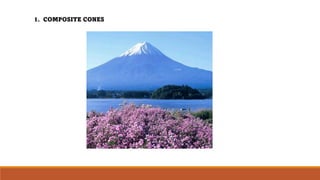
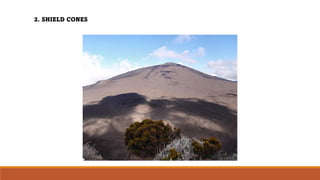
B. Shape of volcanic cone
1. COMPOSITE CONES
2. SHIELD CONES
3. CINDER VOLCANOES
A. Composition of magma
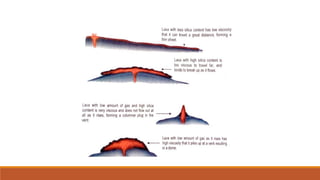
◦ Magmas with high silica content are more viscous
than those with low silica content. The magma
that contains less silica is relatively fluid and
travels far solidifying.
The shape of a volcanic cone depends on three factors,
namely:
B. Temperature of magma
◦ The viscosity of magma decreases with
temperature. The higher the temperature of
magma is, the lower its viscosity is. As lava
flows, it cools and begins to harden, its ability to
flow decreases and eventually stops
C. Amount of gas
◦ Gas(mainly water vapor) dissolved in magma
tends to increase its ability to flow. Therefore, in
near surface environments, the loss of gases
makes magma more viscous, forming a dome or a
columnar.
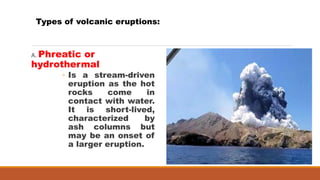
A. Phreatic or
hydrothermal
◦ Is a stream-driven
eruption as the hot
rocks come in
contact with water.
It is short-lived,
characterized by
ash columns but
may be an onset of
a larger eruption.
Types of volcanic eruptions:
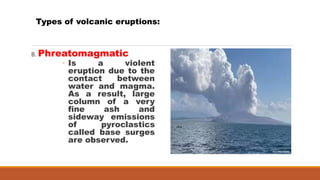
B. Phreatomagmatic
◦ Is a violent
eruption due to the
contact between
water and magma.
As a result, large
column of a very
fine ash and
sideway emissions
of pyroclastics
called base surges
are observed.
Types of volcanic eruptions:
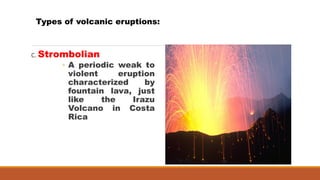
C. Strombolian
◦ A periodic weak to
violent eruption
characterized by
fountain lava, just
like the Irazu
Volcano in Costa
Rica
Types of volcanic eruptions:
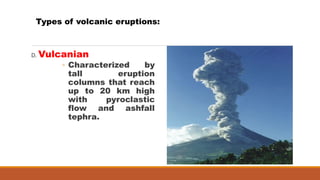
D. Vulcanian
◦ Characterized by
tall eruption
columns that reach
up to 20 km high
with pyroclastic
flow and ashfall
tephra.
Types of volcanic eruptions:
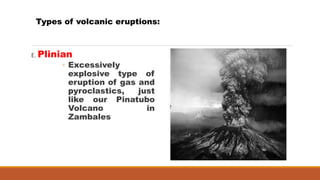
E. Plinian
◦ Excessively
explosive type of
eruption of gas and
pyroclastics, just
like our Pinatubo
Volcano in
Zambales
Types of volcanic eruptions:

TYPES-OF-VOLCANOES-AND-VOLCANIC-ERUPTIOn

  • 1.
  • 3.
    What is aVolcano? A volcano is a natural opening in the surface of the Earth where molten rocks, hot gases, smoke, and ash are ejected
  • 4.
    How and WhereVolcanoes form? Volcanic activity takes place primarily at subduction boundaries
  • 5.
    How and WhereVolcanoes form? The Hawaiian Islands formed over a hot spot. Magma and volcanoes also form at hot spots.
  • 6.
    Hot spot volcanoesoccur far from plate boundaries. Because the hot spot is caused by mantle plumes that exist below the tectonic plates, as the plates move, the hot spot does not, and may create a chain of volcanoes on the Earth’s surface. Neither the Hawaiian Islands nor Yellowstone National Park are near plate boundaries. Rather, the volcanoes that form the Hawaiian Islands and the volcanic activity at Yellowstone National Park are due to their locations over hot spots. Geologists estimate there are about 40 to 50 hot spots around the world. https://education.nationalgeographic.org/resource/hot-spots/
  • 7.
    Pacific Ring ofFire describes an area on Earth that holds most of the world’s earthquake sites and active volcanoes. The Ring of Fire gets its name from all of the volcanoes that lie along this belt. Roughly 75 percent of the world’s volcanoes are located here, many underwater. This area is also a hub of seismic activity, or earthquakes. Ninety percent of earthquakes occur in this zone https://www.snexplores.org/article/scientists-say-ring-of- fire#:~:text=The%20Ring%20of%20Fire%20gets,earthquakes%20occur%20in%2 0this%20zone.
  • 8.
    Classification of Volcanoes TYPEOF VOLCANO DESCRIPTION EXAMPLES 1. ACTIVE VOLCANOES These are volcanoes which have erupted within the last 10,000 years. Taal Volcano at Batangas; Mayon Volcano at Albay; Pinatubo at Zambales; and Kanlaon at Negros Oriental 2. DORMANT OR POTENTIALLY ACTIVE VOLCANOES These Volcanoes have no historical records of eruption but can possibly erupt in the future. Apo at Kidapawan, Davao City; Cuernos de Negros at Dumaguete City; and Maripipi at Tacloban City. 3. EXTINCT OR INACTIVE VOLCANOES These volcanoes have no record of eruption or volcanic activities and do not show signs of possible eruption in the future. Arayat at Pampanga; Alligator at Laguna; Boctong at Palawan; and Batelian at Zamboanga del Sur Volcanoes are classified according to: A. Record of eruption
  • 9.
    There are severalways by which volcanoes can be classified. PHIVOLCS have adapted a system where the Philippine volcanoes as active or inactive. Active volcanoes are those that have a record of eruption within the last 600 years or those that erupted 10, 000 years ago based on analyses of their materials. Inactive volcanoes, on the other hand, are those that have not erupted for the last 10, 000 years and their physical form is being changed by agents of weathering and erosion through formation of deep and long gullies. According to PHIVOLCS,our country has more than a hundred volcanoes as of 2013. Twenty-three are active while the rest are inactive. Some of these volcanoes will be mentioned in the next activity.
  • 10.
    Magma inside thevolcano has high temperature. As the magma is continuously heated, it goes up. As it rises, gas bubbles are developed. The gas bubbles are trapped and expand causing the molten material to swell also, resulting in a gradual increase in pressure within the volcano. When the pressure exceeds the strength of the overlying rock, fracturing occurs. The resulting breaks lead to a further drop in confining pressure, which in turn causes even more gas bubbles to form. Lava may appear to be the primary material ejected from a volcano, but this is not always the case. Aside from lava, broken rocks, lava bombs, fine ash and dust are also ejected. What causes a volcano to erupt?
  • 11.
  • 12.
  • 14.
    ANATOMY OF AVOLCANO 1. Magma When rocks become so hot, they can become a substance called magma. It collects in magma chambers on average 1 to 10 km below the surface. Magma chambers play a crucial role in the Earth’s geology as they serve as reservoirs for molten rock, eventually leading to volcanic eruptions when the pressure builds up sufficiently. 2. Vent Magma is lighter than the solid rock around it, so it rises. Eventually, some of the magma pushes through vents creating a volcanic eruption. Volcanic vents, also known as volcanic openings or fissures, serve as pathways for the magma to reach the Earth’s surface during volcanic eruptions.
  • 15.
    3. Lava Flow Magmathat erupts is called lava. If magma is thin and runny, gases can escape easily from it. When this type of magma erupts, lava flows outside the volcano. Lava flows are the molten rock that oozes onto the Earth’s surface after a volcano eruption. These lava flows can vary in temperature and viscosity, resulting in different types of volcanic landforms and landscapes.
  • 16.
    4. Volcanic Bombs Volcanicbombs, often ejected with great force, can travel significant distances from the volcano before solidifying into various shapes and sizes, contributing to the geologic features of volcanic landscapes. 5. Lava Dome Lava domes are fascinating geological features that can grow over time as layers of lava accumulate. They often pose potential hazards due to their instability and the potential for explosive eruptions when pressure builds beneath them. When lava is too thick and sticky, it piles up around the vent and forms a dome. These circular mounds protrude from volcanoes because of the slow release of viscous lava.
  • 17.
    6. Eruption Column Aneruption column is a towering plume of volcanic ash, gases, and other materials ejected high into the atmosphere during a volcanic eruption. It even has the potential to impact climate and aviation. These clouds of heated ash and tephra are released from a vent during an explosive volcanic eruption. Within an eruption column and cloud, highly charged particles can generate thunder and lightning.
  • 18.
    7. Eruption Cloud Eruptionclouds are billowing masses of volcanic gases, ash, and particles that rise into the atmosphere during volcanic eruptions, often creating hazardous conditions for both the environment and human health. Ash falls back down like powdery snow. But it’s snow that won’t melt. These blankets of ash suffocate plants and animals. The eruption cloud can extend up to 12 miles above a volcano. Then, it can reach thousands of kilometers in distance raining ash over regions.
  • 19.
    8. Tephra If magmais thick and sticky, gases cannot escape easily. Pressure builds up until the gases escape violently and explode. In this type of eruption, magma blasts up into the air and breaks apart into pieces called tephra. Tephra can range in size from tiny particles of ash to house-size boulders. Tephra destroys everything in its path.
  • 20.
    9. Acid Rain Volcaniceruptions can release sulfur dioxide and other gases into the atmosphere, which, when combined with moisture, can lead to the formation of acid rain. When sulfur dioxide and nitrogen oxide emitted from volcanoes react with water molecules in the air, it produces acid rain. This can potentially impact ecosystems and water quality.
  • 21.
    10. Lahar When hotvolcanic material mixes with water from streams or snow and ice, lahar mudflows form. Mudflows can bury entire communities like Mount St. Helens in the 1980s. The positive outcome is that volcanic material breaks down and weathers to form some of the most fertile soils. However, the destructive side of lahars is that they can devastate entire communities and ecosystems when they flow rapidly down volcanic slopes.
  • 22.
    11. Pyroclastic Flow Apyroclastic flow is a fast-moving mixture of hot gas, volcanic ash, and fragmented rock that can travel down the slopes of a volcano at incredible speeds. Pyroclastic flow moves away from a volcano and incorporates tephra. When lava domes collapse, it can create hot pyroclastic density currents. This poses a significant danger to anything in its path.
  • 23.
    12. Fumaroles Holes, cracks,or fissures are on the surface near volcanoes. Fumaroles are vents on a volcano’s surface where gases and steam escape into the atmosphere. They emit steam and volcanic gases, such as sulfur dioxide and carbon dioxide. Fumaroles create pathways for rising heat, volcanic gas, and magma. It often creates eerie landscapes reminiscent of an alien world.
  • 24.
    13. Crack Cracks, alsoknown as fissures or fractures, can form on a volcano’s surface due to tectonic stresses, allowing magma to rise and potentially leading to eruptions. Openings stemming down into the pool of magma. Cracks and fumaroles act like a window so scientists can get a glimpse of the gases inside volcanoes. https://earthhow.com/parts-of-a-volcano/
  • 25.
  • 26.
    TYPE OF VOLCANODESCRIPTION EXAMPLES 1. COMPOSITE VOLCANOES OR STRATOVOLCANOES These volcanoes are made up of alternating layers of volcanic ash, lava flows, cinders (porous fragments of dark molten rocks), and bombs (round or pear-shaped masses of volcanic rocks solidified from molten lava). They are tall, symmetrically shaped, and have steep sides. It tends to erupt explosively because of its thick magma which hinders gases to escape. The magma from this type of volcano is made up of andesite which is more viscous than basalt. The main feature of a Composite Volcano is the presence of conduits. Mayon Volcano at Albay; Mt. Fuji at Japan; and St. Helens at the United States 2. SHIELD VOLCANOES These volcanoes are made up of fluid lava flows which accumulate over the years in all direction, covering great distances and producing domes with wide bases and gentle slopes. It can form along hot spots and mid- oceanic ridges. Its lava is basaltic type with low viscosity thus it erupts quietly. It is formed from thousands of years of fluid lava flows. It will only become explosive when water penetrates the vent. Mauna Loa and Kilauea in Hawaii, USA are two of the most active volcanoes in the world. 3. CINDER VOLCANOES These are small volcanoes which rarely exceed 304.8 m high. These volcanoes have single vent with bowl- shaped crater and are built from blobs of ejected lava that solidifies. These are monogenetic which means it will only have one single explosive eruption before it becomes inactive volcano. Mt. Dakula in Jolo; and Mt. Mayabobo in Quezon B. Shape of volcanic cone
  • 27.
  • 28.
  • 29.
  • 30.
    A. Composition ofmagma ◦ Magmas with high silica content are more viscous than those with low silica content. The magma that contains less silica is relatively fluid and travels far solidifying. The shape of a volcanic cone depends on three factors, namely:
  • 31.
    B. Temperature ofmagma ◦ The viscosity of magma decreases with temperature. The higher the temperature of magma is, the lower its viscosity is. As lava flows, it cools and begins to harden, its ability to flow decreases and eventually stops
  • 32.
    C. Amount ofgas ◦ Gas(mainly water vapor) dissolved in magma tends to increase its ability to flow. Therefore, in near surface environments, the loss of gases makes magma more viscous, forming a dome or a columnar.
  • 34.
    A. Phreatic or hydrothermal ◦Is a stream-driven eruption as the hot rocks come in contact with water. It is short-lived, characterized by ash columns but may be an onset of a larger eruption. Types of volcanic eruptions:
  • 35.
    B. Phreatomagmatic ◦ Isa violent eruption due to the contact between water and magma. As a result, large column of a very fine ash and sideway emissions of pyroclastics called base surges are observed. Types of volcanic eruptions:
  • 36.
    C. Strombolian ◦ Aperiodic weak to violent eruption characterized by fountain lava, just like the Irazu Volcano in Costa Rica Types of volcanic eruptions:
  • 37.
    D. Vulcanian ◦ Characterizedby tall eruption columns that reach up to 20 km high with pyroclastic flow and ashfall tephra. Types of volcanic eruptions:
  • 38.
    E. Plinian ◦ Excessively explosivetype of eruption of gas and pyroclastics, just like our Pinatubo Volcano in Zambales Types of volcanic eruptions: