New Bobath Concept
(NDT)
Dr. Mohammad Khayatzadeh Mahani, Assistant Professor in OT
Ahvaz Jundishapur University of Medical Sciences
Tehran, Oct 2017
‫تخصصی‬ ‫کارگاه‬‫جدید‬ ‫رویکرد‬‫بوبات‬‫در‬
‫توانبخشی‬
‫مغزی‬ ‫فلج‬ ‫به‬ ‫مبتال‬ ‫کودکان‬
Origins of Theoretical Approach
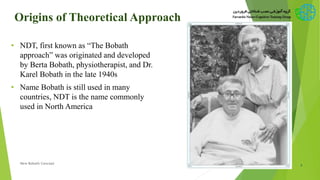
• NDT, first known as “The Bobath
approach” was originated and developed
by Berta Bobath, physiotherapist, and Dr.
Karel Bobath in the late 1940s
• Name Bobath is still used in many
countries, NDT is the name commonly
used in North America
2New Bobath Concept
NDT
 Advanced hands-on approach to the examination and treatment of
individuals with disturbances of function, movement and postural
control due to a lesion of the central nervous system (CNS)
 Used primarily with children who have cerebral palsy (CP) and
adults with cerebral vascular accidents (CVA)
 Practiced by OT, PT, SLP who completed advanced training in NDT
3New Bobath Concept
NDT Definition
 NDT is a holistic and interdisciplinary clinical practice model
informed by current and evolving research that emphasizes
individualized therapeutic handling based on movement analysis
for habilitation and rehabilitation of individuals with neurological
pathophysiology.
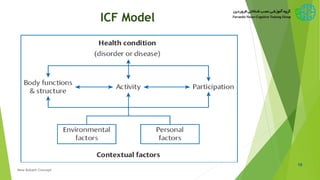
 The therapist uses the ICF model in a problem-solving approach
to assess activity and participation, thereby to identify and
prioritize relevant integrities and impairments as a basis for
establishing achievable outcomes with clients and caregivers.
4New Bobath Concept
Therapist’s Prerequisite skills in NDT
 Analytic skills, including the ability to see relationships
among participation, activity, and posture/movement
multi- and single-body system integrities under a variety
of contexts using basic and applied sciences, experience,
and expertise.
 Clinical reasoning skills.
 The ability to determine a range of prognoses, taking all
factors into account and correlating to outcomes.
 The ability to set functional and measurable outcomes for
intervention.
5New Bobath Concept
Therapist’s Prerequisite skills in NDT
 The ability to plan general intervention strategies that will
address participation restrictions, activity limitations, and
body system impairments.
 The ability to determine a realistic episode of care to meet the
outcomes.
 The ability to design a home program to reinforce and practice
effective posture and movements within daily routines.
 Knowledge of assistive technology that facilitates participation
and activity.
 The ability to work on a team and value the opinions and
priorities of others.
 The ability to plan reexamination, reevaluation, and
discharge. 6New Bobath Concept
NDT Subsystems
 An in-depth knowledge of the human movement system
and motor control
 Principles of motor learning
 Understanding of typical and atypical development
 Expertise in analyzing
 Postural control
 Movement
 Activity, and participation (ICF)
7New Bobath Concept
Philosophical Tents of Bobath Concept
 Therapy works
 Treat the Individual as a Whole
 The Purpose of Therapy Is to Increase the Individual’s Participation and Activity
 Build on the Individual’s Strengths while Addressing Impairments
 Individualize Intervention
 Treat in the Past, Present, and Future Simultaneously
 Teamwork Is Critical for Best Care
 Typical Development Provides an Important Framework for Examination and
Intervention
 Active Carryover throughout Daily Life Is Important for Best Care
 NDT Reflects a Hands-on Intervention Process to Enhance Outcomes
 The Living Concept: The Integration of Classic NDT Tenets with Current Scientific
Findings and Principles of Neuroplasticity, Motor Control, Motor Development, and Motor
Learning
8New Bobath Concept
Therapy works
 Evans-Rogers et al reported on outcomes of short-term intensive
NDT intervention based on parental perspectives and functional
outcomes
 Girolami and Campbell reported on the efficacy of NDT treatment
for infants born prematurely and found improved motor control
 Arndt et al report on the effectiveness in an NDT based trunk
protocol in infants.
 Tsorlakis et al showed the effectiveness of NDT and underline the
need for intensive application of the treatment.
9New Bobath Concept
NDT Critics
 Butler et al(2001)
 More intensive therapy did not seem to confer a
greater benefit
 There was also no clear evidence that NDT produced
other potential benefits such as enhancement of social–
emotional, language, or cognitive domains of
development, better home environments, improved
parent–child interactions, or greater parent satisfaction
 There was not consistent evidence that NDT changed
abnormal motoric responses, slowed or prevented
contractures, or that it facilitated more normal motor
development or functional motor activities
10New Bobath Concept
NDT Critics
 Diane L. Damiano(2009)
1. Therapies that involve multiple types of exercises, such
as NDT are an issue from a scientific standpoint because
they each have multiple components that are likely to
have varying degrees of evidence. These programs should
be dissected so that the active ingredients can be
identified and retained if superior to other alternatives
and ineffective ones discarded.
2. The fact that NDT has failed to demonstrate superiority
over any alternative treatments to which they have been
compared is also a concern
11New Bobath Concept
NDT Critics
 Novak et al(2013)
1. regarding contracture, high-quality RCTs showed
that casting was a superior treatment to NDT
2. regarding tone reduction, the highest quality evidence
suggested that NDT was ineffective for this indication
and other evidence shows BTX exists as a highly
effective alternative
3. NDT is time-consuming and expensive for families,
and, what is more, a high-quality RCT shows that
substantially better functional motor gains are
achieved from motor learning than from NDT at equal
doses
12New Bobath Concept
13
New Bobath Concept
14
New Bobath Concept
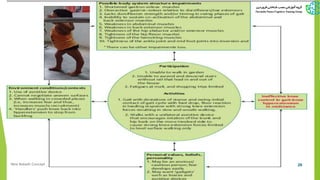
ICF Model
15
New Bobath Concept
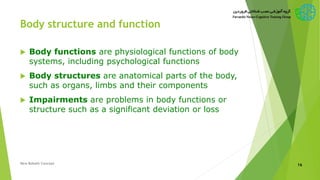
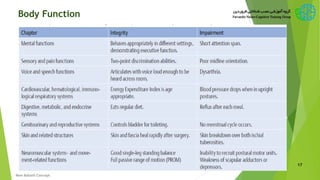
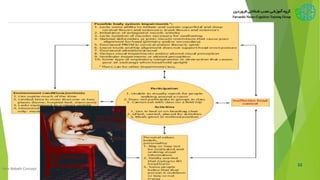
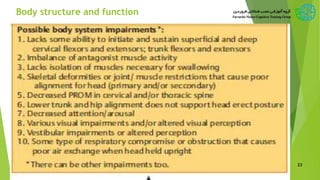
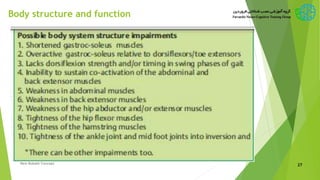
Body structure and function
 Body functions are physiological functions of body
systems, including psychological functions
 Body structures are anatomical parts of the body,
such as organs, limbs and their components
 Impairments are problems in body functions or
structure such as a significant deviation or loss
New Bobath Concept 16
Body Function
17
New Bobath Concept
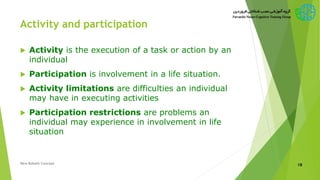
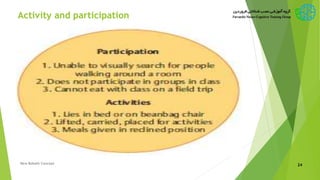
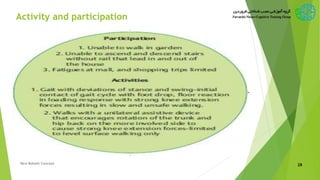
Activity and participation
 Activity is the execution of a task or action by an
individual
 Participation is involvement in a life situation.
 Activity limitations are difficulties an individual
may have in executing activities
 Participation restrictions are problems an
individual may experience in involvement in life
situation
New Bobath Concept 18
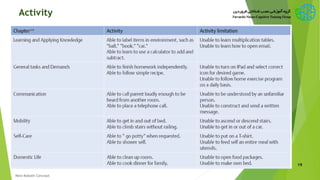
Activity
19
New Bobath Concept
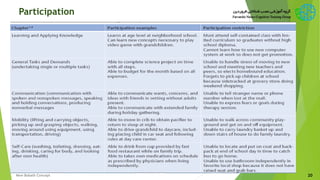
Participation
20New Bobath Concept
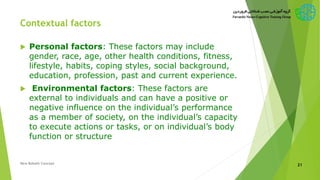
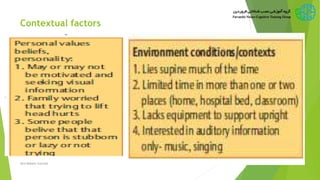
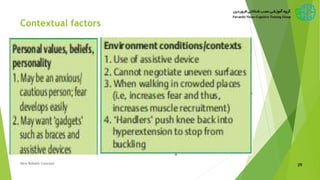
Contextual factors
 Personal factors: These factors may include
gender, race, age, other health conditions, fitness,
lifestyle, habits, coping styles, social background,
education, profession, past and current experience.
 Environmental factors: These factors are
external to individuals and can have a positive or
negative influence on the individual’s performance
as a member of society, on the individual’s capacity
to execute actions or tasks, or on individual’s body
function or structure
New Bobath Concept 21
22
New Bobath Concept
Body structure and function
New Bobath Concept 23
Activity and participation
New Bobath Concept 24
Contextual factors
New Bobath Concept 25
26New Bobath Concept
Body structure and function
New Bobath Concept 27
Activity and participation
New Bobath Concept 28
Contextual factors
New Bobath Concept 29
NDT Assumptions Based on Theories of Motor Control
 Movement is organized around functional activity.
 Human motor behavior/function emerges from ongoing
interactions among multiple internal systems of the individual,
the characteristics of the task, and the specific environmental
context.
 The critical systems to be addressed during examination and
intervention will vary client to client, as well as vary with the
same client in different environments or on different days..
 All individuals have elements on the health or wellness end of
the spectrum in all of the various domain described in the ICF.
30New Bobath Concept
NDT Assumptions Based on Theories of Motor Control
 A hallmark of human motor function is the variability of
posture and movement organization to meet functional
demands.
 The neural control for movement is distributed throughout
various levels of the central nervous system (CNS), all
contributing to the final motor outcome.
 Plasticity in all systems exists across the lifespan.
 The brain can maximize remaining functions and/or
compensate for the loss of function in the event of
neuropathology.
 The nervous system has the ability to reorganize in response
to intrinsic or extrinsic stimuli.
31New Bobath Concept
NDT Assumptions Based on Theories of Motor Control
 Intervention strategies can be designed to capitalize on the
brain’s ability to modify functions based on experience and the
environment.
 There are anatomically and functionally distinct yet overlapping
and interactive structures and function to control and
coordinate posture and movement during activity.
 The postural system provides the ability to maintain the
upright position against gravity through vertical lift. Postural
responses also maintain the center of mass (COM) over the base
of support (BOS). In addition to the whole body responses, the
postural system maintains the integrity of the joint structure.
 The term stability describes much of the goal of the postural
system. 32New Bobath Concept
NDT Assumptions Based on Theories of Motor Control
 The movement system is a primary controller to overcome
inertia and is also needed when a wider range and faster
speed of motor responses are required. The term mobility
describes the goal of the movement system.
 Posture and movement represent a continuum but are
organized by different descending systems. Posture is
organized through the medial descending systems and
movement through the lateral descending systems.
 There are distinctions between motor unit types as well as
muscle architecture that correlate with a postural versus
a movement system.
33New Bobath Concept
Motor Control Approaches
 Neuromaturational theories
1. Reflex/Hierarchical Theory
2. Generalized Motor Program Theory
 Dynamic System Theory
 Neuronal Group Selection Theory
34New Bobath Concept
Reflex/Hierarchical Theory
 This theory assumed that the structures of the brain were
organized and developed in a hierarchy and that there
was a fixed relationship between function and structure.
 Each successively higher level of brain structures
provided more precise movement integration. Therefore,
as these structures developed, function changed
accordingly.
35New Bobath Concept
Reflex/Hierarchical Theory
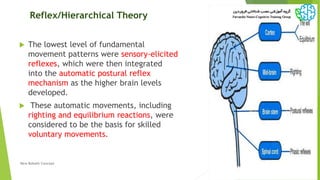
 The lowest level of fundamental
movement patterns were sensory-elicited
reflexes, which were then integrated
into the automatic postural reflex
mechanism as the higher brain levels
developed.
 These automatic movements, including
righting and equilibrium reactions, were
considered to be the basis for skilled
voluntary movements.
36New Bobath Concept
Reflex/Hierarchical Theory
 The R/HTs helped to explain the stereotypic
movements and postures seen in persons with
neuropathology.
 These were acceptable neural control models until the
late 1960s and, although they did offer explanations for
predictable movement seen in cerebral palsy (CP),
their limitation was that they did not account for
context-based movement, variability, individuality,
novelty, and context-based behaviors.
37New Bobath Concept
Generalized Motor Programs (GMPs)
 Instruction are specified by the CNS
 Control process is managed by a motor program
 Motor program organizes, initiates, and carries out
intended actions
 Linear changes in movement behavior
38New Bobath Concept
Generalized Motor Programs (GMPs)
 Keele proposed the existence of a set of commands in the
CNS named Generalized Motor Programs (GMPs) , which
were assembled and initiated without sensory input and
performed in the absence of peripheral feedback.
 GMPs contain the abstract representation of movement,
including the commands for movement, codes of action,
and general features of movement sequences as well as
the recruitment of appropriate agonists and synergists
with adjustment of antagonists of peripheral feedback.
39New Bobath Concept
Generalized Motor Programs (GMPs)
 There could be basic motor plans for reaching and
grasping and rhythmic movements for walking or speaking
that are assembled prior to the need to move.
 Simple sequences could then be linked together to
produce complex actions, such as walking down a slope or
singing.
 The richness of the GMPs developed from both
experience and learning.
40New Bobath Concept
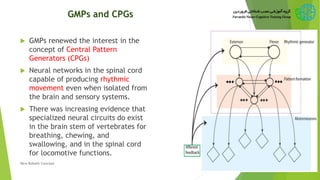
GMPs and CPGs
 GMPs renewed the interest in the
concept of Central Pattern
Generators (CPGs)
 Neural networks in the spinal cord
capable of producing rhythmic
movement even when isolated from
the brain and sensory systems.
 There was increasing evidence that
specialized neural circuits do exist
in the brain stem of vertebrates for
breathing, chewing, and
swallowing, and in the spinal cord
for locomotive functions.
41New Bobath Concept
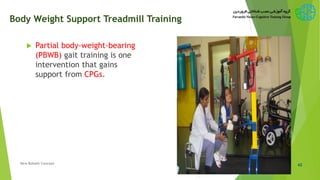
Body Weight Support Treadmill Training
 Partial body-weight-bearing
(PBWB) gait training is one
intervention that gains
support from CPGs.
42New Bobath Concept
Dynamic System Theory
 Movement is produced from the interaction of multiple
sub systems within the person, Task, and environment.
 No sub system is most important
 Dynamic system(DS) is complex
 Development is in a non-linear rate, not steady
 A movement pattern emerges (self-organizes) as a
function of the ever-changing constraints placed upon it.
43New Bobath Concept
Application in NDT
 The clinicians can identify constraints that limit functional
change and develop intervention strategies which directly target
these constraints.
 For example, in early infancy, the mass of the child’s head
relative to the size of the rest of the body places constraints on,
or limits, the rate at which head lifting and visual following can
occur.
 Delays in independent sitting constrain the foundations for
manual development, mother–infant face to face interactions,
and reaching behavior by 6-month-old infants.
 In adults with CP, moderate weakness, increased muscle tone,
bone and joint deformities, and progressive asymmetry in
posture are independently responsible for limitations in
independent ADL.
44New Bobath Concept
Transitions or phase shift
 Specific motor skills emerge from a series of states of
stability, instability, and phase shifts in which new
states become stable aspects of behavior.
 During development, as the subsystems of developing
systems change, motor behaviors can either become
more stable or destabilize. These periods of
destabilization are referred to as transition states.
 During these times, new forms of movement are most
likely to occur. These transitions are characterized
either by an increased latency in time to return to a
stable state after perturbation, or by increased
variability in behavior. 45
New Bobath Concept
Application in NDT
 As a child with hemiplegia experiences a normal growth
spurt at age 2, he may appear clumsy, fall more
frequently, stand with more of his weight on the less
involved side, or even walk without placing the heel (on
the more involved side) on the ground during the stance
phase.
 This is a time to increase the intensity of intervention to
take advantage of the variability in gait and balance
46New Bobath Concept
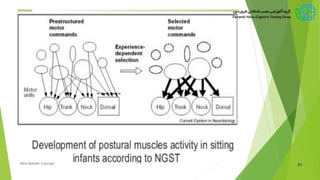
Neuronal Group Selection Theory
 When hundreds of thousands of strongly interconnected
neuronal circuits act as structural/ functional units, called
neuronal groups, they increase their effectiveness.
 Neural structures are determined by the competition
among neural elements to assure variation(Diversity) in
neuroanatomical structures.
 Primary motor repertoires are movements characterized
by variability and are not connected to either sensory
inputs(feedback) or function.
 These connected neuronal groups initially develop by
genetic encoding (Evolution).
47
New Bobath Concept
Primary motor repertoires
 Orienting the head and eyes to light and sound.
 Orienting the head to clear the airway when prone.
 Coordinating suck and swallow.
 Bringing the mouth to the hand.
 Following moving objects with the eyes.
 Projecting the arm toward objects.
 Reciprocal kicking.
 Sensory elicited reactions and responses (sometimes
referred to as primitive reflexes, such as head and body
righting, palmar grasp, rooting reaction, Moro reflex).
 General motility.
 Attachment to the human face
48
New Bobath Concept
Secondary Neuronal Repertoires
 Primary motor repertoires are basic to the infant’s
development, and if they are reinforced by a supportive
environment, people in it, and the infant’s success in
fulfilling his or her needs, they lead to an even richer,
purposeful secondary repertoire of responses.
 These early interactions between infants and their
environment must be coupled with success to reinforce
the selection of a particular set of behaviors.
 This success causes certain neural pathways to be
selected and strengthened and results ultimately in
infants with diverse ways of expressing needs and wants.
49New Bobath Concept
Change the PNR to SNR
 Transition occurs at function-specific ages
 All changes are not just changes in synaptic formation and
neural circuitry.
 The development of secondary repertoires also depends on
changes in the musculoskeletal system, perception,
experience, and a gradual change in agility, adaptability,
and the ability to make complex movement sequences.
 The development of successful reaching and grasping
emerges during the first 4 months, changing from
movements that are variable in path, speed, and accuracy,
and only grossly directed toward the object, to reaching
movements with mature kinematics involving fewer
movement units 50
New Bobath Concept
51New Bobath Concept
NDT Assumptions Based on Theories of Motor Learning
 Motor learning is organized around functional tasks that are valued by the
individual. Tasks or functional outcomes for a therapy session that the learner
selects as being meaningful and achievable are more likely to result in real motor
learning.
 An optimal state of readiness for motor learning in an individual includes specific
personal as well as environmental contextual factors.
 Motor learning can be enhanced by preparing the individual’s attentional,
physical, emotional, cognitive factors, among others. We learn best when in an
active alert state, but not one in which we are terrified or giddy.
 We learn better when the body is well positioned and well aligned for the task.
 We learn best if we know what we are going to learn.
52
New Bobath Concept
NDT Assumptions Based on Theories of Motor Learning
 Motor learning is enhanced when the learner is actively
involved in the process. It is not sufficient to passively go
through the activity. The level of active participation can
vary according to the ability of the individual. It is also
important to know that active movement does not refer
solely to consciously directed movements that are readily
observable. Anticipatory postural adjustments and the
compensatory postural adjustments performed as part of
skilled activities can represent the individual’s active
involvement in performing a new skill.
 Motor learning is improved with accurate instruction and
feedback. This includes both verbal and nonverbal
instruction and feedback, including handling and physical
prompting. 53
New Bobath Concept
NDT Assumptions Based on Theories of Motor Learning
 Handling can play an important role in motor learning,
especially during the early phases of learning.
 Hands-on guidance is a naturally occurring, motor
teaching strategy that influences motor learning and is
particularly useful when eliciting specific behavior or
when limiting the scope of error in performance aids
motor learning.
 Physical or verbal guidance during the task can be an
effective method for limiting movement errors during the
performance of a task and assists the learner through the
postural adjustments and movements needed for task
completion.
54New Bobath Concept
NDT Assumptions Based on Theories of Motor Learning
 Learning or relearning motor skills and improving
performance require both practice and experience. Motor
learning results as the individual gains experience and
practice in functional contexts.
 Repetition through practice is an important component in
motor learning. Activities that are task specific and that
the client repeats, both in an NDT therapeutic session and
in functional ways in other settings, have a better chance
of becoming part of the client’s movement repertoire.
 Practicing novel skills, with increasing degrees of
challenge, is important to motor learning.
 Changes in motor skills occur under conditions that most
closely resemble the conditions the client will normally
encounter during the performance of that skill. 55
New Bobath Concept
NDT Assumptions Based on Theories of Motor Development
 Motor development is a dynamic process that occurs
throughout the lifespan rather than a linear progression
and then a gradual decline.
 Motor development emerges from the cooperation and
changes in all of the body systems, which are influenced
by maturation, experience, and learning in various
contexts. Motor development is not dictated by the
maturation of the CNS alone. Body systems develop at
different rates, enhancing or constraining the
development of various motor behaviors.
56New Bobath Concept
NDT Assumptions Based on Theories of Motor
Development
 Understanding typical and atypical motor patterns
underlying motor function is used to recognize differences
in movement in both children and adults with CNS
pathology.
 The study of motor development provides guidelines for
creating intervention strategies that are age appropriate
and facilitate variation in movement and enhance motor
learning.
 Directionality of development, such as cephalocaudal and
proximodistal, is only a general schema; functional,
skilled movement is a composite of postural stability and
mobility patterns that support the observable function.
57New Bobath Concept
NDT Assumptions Based on Theories of Motor
Development
 There is not an ideal path or sequence across the years
that leads to optimal functional abilities and full
participation in life activities.
 Motor development is shaped by contextual factors, both
personal and environmental, and the integration of all the
maturing or changing body systems and functions.
 NDT recognizes that parents’ normal daily handling of
their infants influences motor development, as well as
affecting positive parent–infant relationships.
 Variability and competition among motor patterns are
essential components of motor development.
58New Bobath Concept
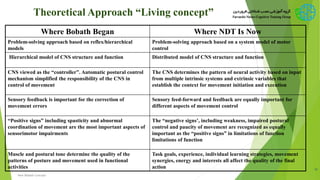
Theoretical Approach “Living concept”
Where Bobath Began Where NDT Is Now
Problem-solving approach based on reflex/hierarchical
models
Problem-solving approach based on a system model of motor
control
Hierarchical model of CNS structure and function Distributed model of CNS structure and function
CNS viewed as the “controller”. Automatic postural control
mechanism simplified the responsibility of the CNS in
control of movement
The CNS determines the pattern of neural activity based on input
from multiple intrinsic systems and extrinsic variables that
establish the context for movement initiation and execution
Sensory feedback is important for the correction of
movement errors
Sensory feed-forward and feedback are equally important for
different aspects of movement control
“Positive signs” including spasticity and abnormal
coordination of movement are the most important aspects of
sensorimotor impairments
The “negative signs’, including weakness, impaired postural
control and paucity of movement are recognized as equally
important as the “positive signs” in limitations of function
limitations of function
Muscle and postural tone determine the quality of the
patterns of posture and movement used in functional
activities
Task goals, experience, individual learning strategies, movement
synergies, energy and interests all affect the quality of the final
action 59
New Bobath Concept
Bobath concept today
 Spasticity is often only a small component of the
movement disorder, and in some cases can even be of
functional value to the client, e.g. standing.
 We should conclude that spasticity and hypertonia are not
the same.
 Spasticity is a part of hypertonia and of course they co-
exist, but velocity dependent hyperreflexia does not
usually in itself explain the clients movement disorder,
and therefore simply reducing spasticity is not the
solution for providing effective, evidence based
intervention.
60New Bobath Concept
Bobath concept today
 Inhibition physiologically is defined as a decrease in
transmitter release, and is present at all levels of the CNS.
 Therapists are effecting changes in both synapses
simultaneously, but their ‘inhibition’ also affects visco-
elastic properties of muscle and by improving muscle length
can gain a better biomechanical advantage for more efficient
muscle action for the performance of functional tasks.
 Handling via stretch will of course affect and reduce muscle
spindle firing and resultant abnormal reflex activity, but for
any lasting effect, the therapist must enable the client to
perform more effective, efficient functional activity.
61New Bobath Concept
Bobath concept today
 Recent evidence suggests that weakness is a problem
for the neurologically impaired adult and child.
 While therapists can work to increase strength by the
use of activity, repetition and weight bearing, it has
been shown that when used appropriately,
strengthening can improve function and does not
increase spasticity.
62New Bobath Concept
Bobath concept today
 The CNS is highly task oriented in its organization,
therefore movement patterns will not automatically
lead to function- the function must be practiced in the
correct context.
 There is no evidence to suggest that stopping a client
from moving will stop the development of spasticity.
While certain activities are not encouraged in some
cases, the idea of stopping a client from moving,
especially if they are motivated to do so, cannot be
supported on financial, moral or scientific grounds.
63New Bobath Concept
Bobath concept today
 If the CNS is damaged, there will of necessity be a
compensation by other parts of the system, which can be
either positive or negative, and can be shaped by
experience.
 The critical questions to ask are the following: how much
of that compensation is necessary and how much can be
avoided by training the affected body parts to function
more effectively.
 CIMT & Forced use of the lower limbs by treadmill
training
 The person can only enter this kind of regime if they have
sufficient activity to utilize. Forced use in clients who
have little or no activity may drive negative changes in the
CNS and result in further loss of neural tissue around the
original lesion site. 64
New Bobath Concept
Bobath concept today
 Muscles need to be at the best length for activation. It
is known that muscles generate the most efficient
active force at a mid-length.
 For this reason, it would seem important to gain
alignment. This may involve muscle stretching to
achieve length, perhaps we could call it tone reduction,
the judicious use of equipment and/or orthoses.
65New Bobath Concept
Bobath concept today
 The muscle needs sufficient activity to generate force
for action. In the case of reduced drive onto the motor
neuron pool, there might need to be stimulation of
muscle activity through the use of weight bearing,
resistance, sensory stimulation in appropriate postures
and patterns to enable the person to have a sufficient
basis for the training of functional tasks.
 Splinting and orthoses may also be indicated to gain
alignment, or a good weight-bearing base for improved
proximal and trunk activity
66New Bobath Concept
New Bobath Concept 67
‫تخصصی‬ ‫کارگاه‬
‫جدید‬ ‫رویکرد‬‫بوبات‬‫توانبخشی‬ ‫در‬
‫مغزی‬ ‫فلج‬ ‫به‬ ‫مبتال‬ ‫کودکان‬
‫سپاسگزاریم‬
www.farvardin-group.com
@farvardin_group_channel
@neuroscience4family
@farvardin_group96

New bobath concept

  • 1.
    New Bobath Concept (NDT) Dr.Mohammad Khayatzadeh Mahani, Assistant Professor in OT Ahvaz Jundishapur University of Medical Sciences Tehran, Oct 2017 ‫تخصصی‬ ‫کارگاه‬‫جدید‬ ‫رویکرد‬‫بوبات‬‫در‬ ‫توانبخشی‬ ‫مغزی‬ ‫فلج‬ ‫به‬ ‫مبتال‬ ‫کودکان‬
  • 2.
    Origins of TheoreticalApproach • NDT, first known as “The Bobath approach” was originated and developed by Berta Bobath, physiotherapist, and Dr. Karel Bobath in the late 1940s • Name Bobath is still used in many countries, NDT is the name commonly used in North America 2New Bobath Concept
  • 3.
    NDT  Advanced hands-onapproach to the examination and treatment of individuals with disturbances of function, movement and postural control due to a lesion of the central nervous system (CNS)  Used primarily with children who have cerebral palsy (CP) and adults with cerebral vascular accidents (CVA)  Practiced by OT, PT, SLP who completed advanced training in NDT 3New Bobath Concept
  • 4.
    NDT Definition  NDTis a holistic and interdisciplinary clinical practice model informed by current and evolving research that emphasizes individualized therapeutic handling based on movement analysis for habilitation and rehabilitation of individuals with neurological pathophysiology.  The therapist uses the ICF model in a problem-solving approach to assess activity and participation, thereby to identify and prioritize relevant integrities and impairments as a basis for establishing achievable outcomes with clients and caregivers. 4New Bobath Concept
  • 5.
    Therapist’s Prerequisite skillsin NDT  Analytic skills, including the ability to see relationships among participation, activity, and posture/movement multi- and single-body system integrities under a variety of contexts using basic and applied sciences, experience, and expertise.  Clinical reasoning skills.  The ability to determine a range of prognoses, taking all factors into account and correlating to outcomes.  The ability to set functional and measurable outcomes for intervention. 5New Bobath Concept
  • 6.
    Therapist’s Prerequisite skillsin NDT  The ability to plan general intervention strategies that will address participation restrictions, activity limitations, and body system impairments.  The ability to determine a realistic episode of care to meet the outcomes.  The ability to design a home program to reinforce and practice effective posture and movements within daily routines.  Knowledge of assistive technology that facilitates participation and activity.  The ability to work on a team and value the opinions and priorities of others.  The ability to plan reexamination, reevaluation, and discharge. 6New Bobath Concept
  • 7.
    NDT Subsystems  Anin-depth knowledge of the human movement system and motor control  Principles of motor learning  Understanding of typical and atypical development  Expertise in analyzing  Postural control  Movement  Activity, and participation (ICF) 7New Bobath Concept
  • 8.
    Philosophical Tents ofBobath Concept  Therapy works  Treat the Individual as a Whole  The Purpose of Therapy Is to Increase the Individual’s Participation and Activity  Build on the Individual’s Strengths while Addressing Impairments  Individualize Intervention  Treat in the Past, Present, and Future Simultaneously  Teamwork Is Critical for Best Care  Typical Development Provides an Important Framework for Examination and Intervention  Active Carryover throughout Daily Life Is Important for Best Care  NDT Reflects a Hands-on Intervention Process to Enhance Outcomes  The Living Concept: The Integration of Classic NDT Tenets with Current Scientific Findings and Principles of Neuroplasticity, Motor Control, Motor Development, and Motor Learning 8New Bobath Concept
  • 9.
    Therapy works  Evans-Rogerset al reported on outcomes of short-term intensive NDT intervention based on parental perspectives and functional outcomes  Girolami and Campbell reported on the efficacy of NDT treatment for infants born prematurely and found improved motor control  Arndt et al report on the effectiveness in an NDT based trunk protocol in infants.  Tsorlakis et al showed the effectiveness of NDT and underline the need for intensive application of the treatment. 9New Bobath Concept
  • 10.
    NDT Critics  Butleret al(2001)  More intensive therapy did not seem to confer a greater benefit  There was also no clear evidence that NDT produced other potential benefits such as enhancement of social– emotional, language, or cognitive domains of development, better home environments, improved parent–child interactions, or greater parent satisfaction  There was not consistent evidence that NDT changed abnormal motoric responses, slowed or prevented contractures, or that it facilitated more normal motor development or functional motor activities 10New Bobath Concept
  • 11.
    NDT Critics  DianeL. Damiano(2009) 1. Therapies that involve multiple types of exercises, such as NDT are an issue from a scientific standpoint because they each have multiple components that are likely to have varying degrees of evidence. These programs should be dissected so that the active ingredients can be identified and retained if superior to other alternatives and ineffective ones discarded. 2. The fact that NDT has failed to demonstrate superiority over any alternative treatments to which they have been compared is also a concern 11New Bobath Concept
  • 12.
    NDT Critics  Novaket al(2013) 1. regarding contracture, high-quality RCTs showed that casting was a superior treatment to NDT 2. regarding tone reduction, the highest quality evidence suggested that NDT was ineffective for this indication and other evidence shows BTX exists as a highly effective alternative 3. NDT is time-consuming and expensive for families, and, what is more, a high-quality RCT shows that substantially better functional motor gains are achieved from motor learning than from NDT at equal doses 12New Bobath Concept
  • 13.
  • 14.
  • 15.
  • 16.
    Body structure andfunction  Body functions are physiological functions of body systems, including psychological functions  Body structures are anatomical parts of the body, such as organs, limbs and their components  Impairments are problems in body functions or structure such as a significant deviation or loss New Bobath Concept 16
  • 17.
  • 18.
    Activity and participation Activity is the execution of a task or action by an individual  Participation is involvement in a life situation.  Activity limitations are difficulties an individual may have in executing activities  Participation restrictions are problems an individual may experience in involvement in life situation New Bobath Concept 18
  • 19.
  • 20.
  • 21.
    Contextual factors  Personalfactors: These factors may include gender, race, age, other health conditions, fitness, lifestyle, habits, coping styles, social background, education, profession, past and current experience.  Environmental factors: These factors are external to individuals and can have a positive or negative influence on the individual’s performance as a member of society, on the individual’s capacity to execute actions or tasks, or on individual’s body function or structure New Bobath Concept 21
  • 22.
  • 23.
    Body structure andfunction New Bobath Concept 23
  • 24.
  • 25.
  • 26.
  • 27.
    Body structure andfunction New Bobath Concept 27
  • 28.
  • 29.
  • 30.
    NDT Assumptions Basedon Theories of Motor Control  Movement is organized around functional activity.  Human motor behavior/function emerges from ongoing interactions among multiple internal systems of the individual, the characteristics of the task, and the specific environmental context.  The critical systems to be addressed during examination and intervention will vary client to client, as well as vary with the same client in different environments or on different days..  All individuals have elements on the health or wellness end of the spectrum in all of the various domain described in the ICF. 30New Bobath Concept
  • 31.
    NDT Assumptions Basedon Theories of Motor Control  A hallmark of human motor function is the variability of posture and movement organization to meet functional demands.  The neural control for movement is distributed throughout various levels of the central nervous system (CNS), all contributing to the final motor outcome.  Plasticity in all systems exists across the lifespan.  The brain can maximize remaining functions and/or compensate for the loss of function in the event of neuropathology.  The nervous system has the ability to reorganize in response to intrinsic or extrinsic stimuli. 31New Bobath Concept
  • 32.
    NDT Assumptions Basedon Theories of Motor Control  Intervention strategies can be designed to capitalize on the brain’s ability to modify functions based on experience and the environment.  There are anatomically and functionally distinct yet overlapping and interactive structures and function to control and coordinate posture and movement during activity.  The postural system provides the ability to maintain the upright position against gravity through vertical lift. Postural responses also maintain the center of mass (COM) over the base of support (BOS). In addition to the whole body responses, the postural system maintains the integrity of the joint structure.  The term stability describes much of the goal of the postural system. 32New Bobath Concept
  • 33.
    NDT Assumptions Basedon Theories of Motor Control  The movement system is a primary controller to overcome inertia and is also needed when a wider range and faster speed of motor responses are required. The term mobility describes the goal of the movement system.  Posture and movement represent a continuum but are organized by different descending systems. Posture is organized through the medial descending systems and movement through the lateral descending systems.  There are distinctions between motor unit types as well as muscle architecture that correlate with a postural versus a movement system. 33New Bobath Concept
  • 34.
    Motor Control Approaches Neuromaturational theories 1. Reflex/Hierarchical Theory 2. Generalized Motor Program Theory  Dynamic System Theory  Neuronal Group Selection Theory 34New Bobath Concept
  • 35.
    Reflex/Hierarchical Theory  Thistheory assumed that the structures of the brain were organized and developed in a hierarchy and that there was a fixed relationship between function and structure.  Each successively higher level of brain structures provided more precise movement integration. Therefore, as these structures developed, function changed accordingly. 35New Bobath Concept
  • 36.
    Reflex/Hierarchical Theory  Thelowest level of fundamental movement patterns were sensory-elicited reflexes, which were then integrated into the automatic postural reflex mechanism as the higher brain levels developed.  These automatic movements, including righting and equilibrium reactions, were considered to be the basis for skilled voluntary movements. 36New Bobath Concept
  • 37.
    Reflex/Hierarchical Theory  TheR/HTs helped to explain the stereotypic movements and postures seen in persons with neuropathology.  These were acceptable neural control models until the late 1960s and, although they did offer explanations for predictable movement seen in cerebral palsy (CP), their limitation was that they did not account for context-based movement, variability, individuality, novelty, and context-based behaviors. 37New Bobath Concept
  • 38.
    Generalized Motor Programs(GMPs)  Instruction are specified by the CNS  Control process is managed by a motor program  Motor program organizes, initiates, and carries out intended actions  Linear changes in movement behavior 38New Bobath Concept
  • 39.
    Generalized Motor Programs(GMPs)  Keele proposed the existence of a set of commands in the CNS named Generalized Motor Programs (GMPs) , which were assembled and initiated without sensory input and performed in the absence of peripheral feedback.  GMPs contain the abstract representation of movement, including the commands for movement, codes of action, and general features of movement sequences as well as the recruitment of appropriate agonists and synergists with adjustment of antagonists of peripheral feedback. 39New Bobath Concept
  • 40.
    Generalized Motor Programs(GMPs)  There could be basic motor plans for reaching and grasping and rhythmic movements for walking or speaking that are assembled prior to the need to move.  Simple sequences could then be linked together to produce complex actions, such as walking down a slope or singing.  The richness of the GMPs developed from both experience and learning. 40New Bobath Concept
  • 41.
    GMPs and CPGs GMPs renewed the interest in the concept of Central Pattern Generators (CPGs)  Neural networks in the spinal cord capable of producing rhythmic movement even when isolated from the brain and sensory systems.  There was increasing evidence that specialized neural circuits do exist in the brain stem of vertebrates for breathing, chewing, and swallowing, and in the spinal cord for locomotive functions. 41New Bobath Concept
  • 42.
    Body Weight SupportTreadmill Training  Partial body-weight-bearing (PBWB) gait training is one intervention that gains support from CPGs. 42New Bobath Concept
  • 43.
    Dynamic System Theory Movement is produced from the interaction of multiple sub systems within the person, Task, and environment.  No sub system is most important  Dynamic system(DS) is complex  Development is in a non-linear rate, not steady  A movement pattern emerges (self-organizes) as a function of the ever-changing constraints placed upon it. 43New Bobath Concept
  • 44.
    Application in NDT The clinicians can identify constraints that limit functional change and develop intervention strategies which directly target these constraints.  For example, in early infancy, the mass of the child’s head relative to the size of the rest of the body places constraints on, or limits, the rate at which head lifting and visual following can occur.  Delays in independent sitting constrain the foundations for manual development, mother–infant face to face interactions, and reaching behavior by 6-month-old infants.  In adults with CP, moderate weakness, increased muscle tone, bone and joint deformities, and progressive asymmetry in posture are independently responsible for limitations in independent ADL. 44New Bobath Concept
  • 45.
    Transitions or phaseshift  Specific motor skills emerge from a series of states of stability, instability, and phase shifts in which new states become stable aspects of behavior.  During development, as the subsystems of developing systems change, motor behaviors can either become more stable or destabilize. These periods of destabilization are referred to as transition states.  During these times, new forms of movement are most likely to occur. These transitions are characterized either by an increased latency in time to return to a stable state after perturbation, or by increased variability in behavior. 45 New Bobath Concept
  • 46.
    Application in NDT As a child with hemiplegia experiences a normal growth spurt at age 2, he may appear clumsy, fall more frequently, stand with more of his weight on the less involved side, or even walk without placing the heel (on the more involved side) on the ground during the stance phase.  This is a time to increase the intensity of intervention to take advantage of the variability in gait and balance 46New Bobath Concept
  • 47.
    Neuronal Group SelectionTheory  When hundreds of thousands of strongly interconnected neuronal circuits act as structural/ functional units, called neuronal groups, they increase their effectiveness.  Neural structures are determined by the competition among neural elements to assure variation(Diversity) in neuroanatomical structures.  Primary motor repertoires are movements characterized by variability and are not connected to either sensory inputs(feedback) or function.  These connected neuronal groups initially develop by genetic encoding (Evolution). 47 New Bobath Concept
  • 48.
    Primary motor repertoires Orienting the head and eyes to light and sound.  Orienting the head to clear the airway when prone.  Coordinating suck and swallow.  Bringing the mouth to the hand.  Following moving objects with the eyes.  Projecting the arm toward objects.  Reciprocal kicking.  Sensory elicited reactions and responses (sometimes referred to as primitive reflexes, such as head and body righting, palmar grasp, rooting reaction, Moro reflex).  General motility.  Attachment to the human face 48 New Bobath Concept
  • 49.
    Secondary Neuronal Repertoires Primary motor repertoires are basic to the infant’s development, and if they are reinforced by a supportive environment, people in it, and the infant’s success in fulfilling his or her needs, they lead to an even richer, purposeful secondary repertoire of responses.  These early interactions between infants and their environment must be coupled with success to reinforce the selection of a particular set of behaviors.  This success causes certain neural pathways to be selected and strengthened and results ultimately in infants with diverse ways of expressing needs and wants. 49New Bobath Concept
  • 50.
    Change the PNRto SNR  Transition occurs at function-specific ages  All changes are not just changes in synaptic formation and neural circuitry.  The development of secondary repertoires also depends on changes in the musculoskeletal system, perception, experience, and a gradual change in agility, adaptability, and the ability to make complex movement sequences.  The development of successful reaching and grasping emerges during the first 4 months, changing from movements that are variable in path, speed, and accuracy, and only grossly directed toward the object, to reaching movements with mature kinematics involving fewer movement units 50 New Bobath Concept
  • 51.
  • 52.
    NDT Assumptions Basedon Theories of Motor Learning  Motor learning is organized around functional tasks that are valued by the individual. Tasks or functional outcomes for a therapy session that the learner selects as being meaningful and achievable are more likely to result in real motor learning.  An optimal state of readiness for motor learning in an individual includes specific personal as well as environmental contextual factors.  Motor learning can be enhanced by preparing the individual’s attentional, physical, emotional, cognitive factors, among others. We learn best when in an active alert state, but not one in which we are terrified or giddy.  We learn better when the body is well positioned and well aligned for the task.  We learn best if we know what we are going to learn. 52 New Bobath Concept
  • 53.
    NDT Assumptions Basedon Theories of Motor Learning  Motor learning is enhanced when the learner is actively involved in the process. It is not sufficient to passively go through the activity. The level of active participation can vary according to the ability of the individual. It is also important to know that active movement does not refer solely to consciously directed movements that are readily observable. Anticipatory postural adjustments and the compensatory postural adjustments performed as part of skilled activities can represent the individual’s active involvement in performing a new skill.  Motor learning is improved with accurate instruction and feedback. This includes both verbal and nonverbal instruction and feedback, including handling and physical prompting. 53 New Bobath Concept
  • 54.
    NDT Assumptions Basedon Theories of Motor Learning  Handling can play an important role in motor learning, especially during the early phases of learning.  Hands-on guidance is a naturally occurring, motor teaching strategy that influences motor learning and is particularly useful when eliciting specific behavior or when limiting the scope of error in performance aids motor learning.  Physical or verbal guidance during the task can be an effective method for limiting movement errors during the performance of a task and assists the learner through the postural adjustments and movements needed for task completion. 54New Bobath Concept
  • 55.
    NDT Assumptions Basedon Theories of Motor Learning  Learning or relearning motor skills and improving performance require both practice and experience. Motor learning results as the individual gains experience and practice in functional contexts.  Repetition through practice is an important component in motor learning. Activities that are task specific and that the client repeats, both in an NDT therapeutic session and in functional ways in other settings, have a better chance of becoming part of the client’s movement repertoire.  Practicing novel skills, with increasing degrees of challenge, is important to motor learning.  Changes in motor skills occur under conditions that most closely resemble the conditions the client will normally encounter during the performance of that skill. 55 New Bobath Concept
  • 56.
    NDT Assumptions Basedon Theories of Motor Development  Motor development is a dynamic process that occurs throughout the lifespan rather than a linear progression and then a gradual decline.  Motor development emerges from the cooperation and changes in all of the body systems, which are influenced by maturation, experience, and learning in various contexts. Motor development is not dictated by the maturation of the CNS alone. Body systems develop at different rates, enhancing or constraining the development of various motor behaviors. 56New Bobath Concept
  • 57.
    NDT Assumptions Basedon Theories of Motor Development  Understanding typical and atypical motor patterns underlying motor function is used to recognize differences in movement in both children and adults with CNS pathology.  The study of motor development provides guidelines for creating intervention strategies that are age appropriate and facilitate variation in movement and enhance motor learning.  Directionality of development, such as cephalocaudal and proximodistal, is only a general schema; functional, skilled movement is a composite of postural stability and mobility patterns that support the observable function. 57New Bobath Concept
  • 58.
    NDT Assumptions Basedon Theories of Motor Development  There is not an ideal path or sequence across the years that leads to optimal functional abilities and full participation in life activities.  Motor development is shaped by contextual factors, both personal and environmental, and the integration of all the maturing or changing body systems and functions.  NDT recognizes that parents’ normal daily handling of their infants influences motor development, as well as affecting positive parent–infant relationships.  Variability and competition among motor patterns are essential components of motor development. 58New Bobath Concept
  • 59.
    Theoretical Approach “Livingconcept” Where Bobath Began Where NDT Is Now Problem-solving approach based on reflex/hierarchical models Problem-solving approach based on a system model of motor control Hierarchical model of CNS structure and function Distributed model of CNS structure and function CNS viewed as the “controller”. Automatic postural control mechanism simplified the responsibility of the CNS in control of movement The CNS determines the pattern of neural activity based on input from multiple intrinsic systems and extrinsic variables that establish the context for movement initiation and execution Sensory feedback is important for the correction of movement errors Sensory feed-forward and feedback are equally important for different aspects of movement control “Positive signs” including spasticity and abnormal coordination of movement are the most important aspects of sensorimotor impairments The “negative signs’, including weakness, impaired postural control and paucity of movement are recognized as equally important as the “positive signs” in limitations of function limitations of function Muscle and postural tone determine the quality of the patterns of posture and movement used in functional activities Task goals, experience, individual learning strategies, movement synergies, energy and interests all affect the quality of the final action 59 New Bobath Concept
  • 60.
    Bobath concept today Spasticity is often only a small component of the movement disorder, and in some cases can even be of functional value to the client, e.g. standing.  We should conclude that spasticity and hypertonia are not the same.  Spasticity is a part of hypertonia and of course they co- exist, but velocity dependent hyperreflexia does not usually in itself explain the clients movement disorder, and therefore simply reducing spasticity is not the solution for providing effective, evidence based intervention. 60New Bobath Concept
  • 61.
    Bobath concept today Inhibition physiologically is defined as a decrease in transmitter release, and is present at all levels of the CNS.  Therapists are effecting changes in both synapses simultaneously, but their ‘inhibition’ also affects visco- elastic properties of muscle and by improving muscle length can gain a better biomechanical advantage for more efficient muscle action for the performance of functional tasks.  Handling via stretch will of course affect and reduce muscle spindle firing and resultant abnormal reflex activity, but for any lasting effect, the therapist must enable the client to perform more effective, efficient functional activity. 61New Bobath Concept
  • 62.
    Bobath concept today Recent evidence suggests that weakness is a problem for the neurologically impaired adult and child.  While therapists can work to increase strength by the use of activity, repetition and weight bearing, it has been shown that when used appropriately, strengthening can improve function and does not increase spasticity. 62New Bobath Concept
  • 63.
    Bobath concept today The CNS is highly task oriented in its organization, therefore movement patterns will not automatically lead to function- the function must be practiced in the correct context.  There is no evidence to suggest that stopping a client from moving will stop the development of spasticity. While certain activities are not encouraged in some cases, the idea of stopping a client from moving, especially if they are motivated to do so, cannot be supported on financial, moral or scientific grounds. 63New Bobath Concept
  • 64.
    Bobath concept today If the CNS is damaged, there will of necessity be a compensation by other parts of the system, which can be either positive or negative, and can be shaped by experience.  The critical questions to ask are the following: how much of that compensation is necessary and how much can be avoided by training the affected body parts to function more effectively.  CIMT & Forced use of the lower limbs by treadmill training  The person can only enter this kind of regime if they have sufficient activity to utilize. Forced use in clients who have little or no activity may drive negative changes in the CNS and result in further loss of neural tissue around the original lesion site. 64 New Bobath Concept
  • 65.
    Bobath concept today Muscles need to be at the best length for activation. It is known that muscles generate the most efficient active force at a mid-length.  For this reason, it would seem important to gain alignment. This may involve muscle stretching to achieve length, perhaps we could call it tone reduction, the judicious use of equipment and/or orthoses. 65New Bobath Concept
  • 66.
    Bobath concept today The muscle needs sufficient activity to generate force for action. In the case of reduced drive onto the motor neuron pool, there might need to be stimulation of muscle activity through the use of weight bearing, resistance, sensory stimulation in appropriate postures and patterns to enable the person to have a sufficient basis for the training of functional tasks.  Splinting and orthoses may also be indicated to gain alignment, or a good weight-bearing base for improved proximal and trunk activity 66New Bobath Concept
  • 67.
    New Bobath Concept67 ‫تخصصی‬ ‫کارگاه‬ ‫جدید‬ ‫رویکرد‬‫بوبات‬‫توانبخشی‬ ‫در‬ ‫مغزی‬ ‫فلج‬ ‫به‬ ‫مبتال‬ ‫کودکان‬ ‫سپاسگزاریم‬ www.farvardin-group.com @farvardin_group_channel @neuroscience4family @farvardin_group96