Voice over Internet Protocol (VoIP) became one of
the most popular technologies that enable lots of
people around the world to communicate
seamlessly. VoIP refers to one of the newly
emerging technologies that replace the old public
switched telephone (PSTN) with IP based
technology.
The great things about the PSTN are its reliability,
stability, and accessibility, but the downside is that it
needs more cables to connect devices to each other.
Background
Voice over IP refers to the communication protocols ,
technologies, methodologies, and transmission
techniques involved in the delivery of voice
communication and multimedia over the internet.
IP telephony, Internet telephony, voice over
broadband , broadband telephony, IP
communications, and broadband phone are some
names called to identify the same technology.
VoIP technology
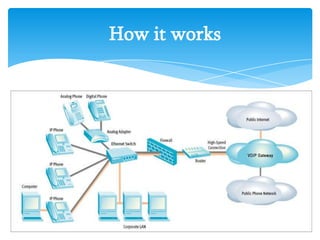
How it works
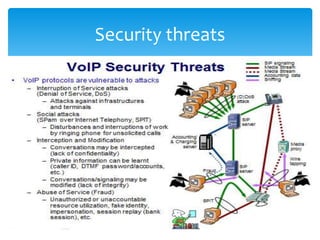
Due to flexibility and low-cost, VoIP has been seen
rapid uptake in both enterprise and consumer level
and like any other internet connected devices VoIP
systems are susceptible to attacks. Protocols and
products have been repeatedly found to certain
vulnerabilities that have been exploited. This means
that hackers who know about the vulnerabilities
(such as insecure password) can institute attacks such
as shown in next slide:
VOIP security
Security threats
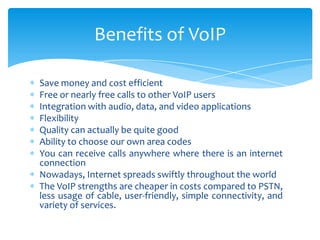
Save money and cost efficient
Free or nearly free calls to other VoIP users
Integration with audio, data, and video applications
Flexibility
Quality can actually be quite good
Ability to choose our own area codes
You can receive calls anywhere where there is an internet
connection
Nowadays, Internet spreads swiftly throughout the world
The VoIP strengths are cheaper in costs compared to PSTN,
less usage of cable, user-friendly, simple connectivity, and
variety of services.
Benefits of VoIP
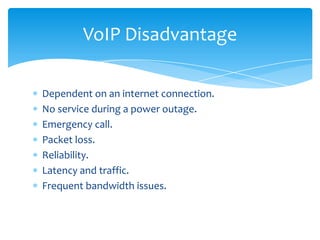
Dependent on an internet connection.
No service during a power outage.
Emergency call.
Packet loss.
Reliability.
Latency and traffic.
Frequent bandwidth issues.
VoIP Disadvantage
Call quality.
Cost of equipment.
Local directories listings.
Bandwidth difference.
Power differences.
Security issue.
Emergency call.
Legal issue.
Challenges of VOIP
Cisco Unified Communication manager is the solution to
increase the productivity by providing an easier access to
services. It is a system that provides traditionally telephony
features as well advanced capabilities such as video,
mobility, presence, preference and conferencing services.
The benefits of the system include easier access and
participation regardless the communication device,
network or service the customer use. It also helps to
ensure workers with consistent experience weather they
work from office, remote site or their home.
Cisco Unified Communication
Manager (Call Manager)
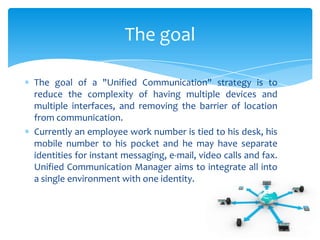
The goal of a "Unified Communication" strategy is to
reduce the complexity of having multiple devices and
multiple interfaces, and removing the barrier of location
from communication.
Currently an employee work number is tied to his desk, his
mobile number to his pocket and he may have separate
identities for instant messaging, e-mail, video calls and fax.
Unified Communication Manager aims to integrate all into
a single environment with one identity.
The goal
There are many key technologies involved with Unified
Communications such as:
Voice Over IP (VoIP) Presence
E-mail
Audio Conferencing
Web Conferencing
Telepresence
Voice/Video Mail
Instant Messaging
Data sharing
Fax, paging, whiteboards, e-commerce and various
forms of mobility
Technologies involved
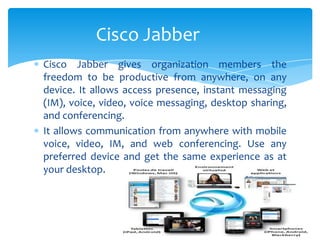
Cisco Jabber gives organization members the
freedom to be productive from anywhere, on any
device. It allows access presence, instant messaging
(IM), voice, video, voice messaging, desktop sharing,
and conferencing.
It allows communication from anywhere with mobile
voice, video, IM, and web conferencing. Use any
preferred device and get the same experience as at
your desktop.
Cisco Jabber
Voip.v1(1)

Voip.v1(1)

  • 2.
    Voice over InternetProtocol (VoIP) became one of the most popular technologies that enable lots of people around the world to communicate seamlessly. VoIP refers to one of the newly emerging technologies that replace the old public switched telephone (PSTN) with IP based technology. The great things about the PSTN are its reliability, stability, and accessibility, but the downside is that it needs more cables to connect devices to each other. Background
  • 3.
    Voice over IPrefers to the communication protocols , technologies, methodologies, and transmission techniques involved in the delivery of voice communication and multimedia over the internet. IP telephony, Internet telephony, voice over broadband , broadband telephony, IP communications, and broadband phone are some names called to identify the same technology. VoIP technology
  • 4.
  • 5.
    Due to flexibilityand low-cost, VoIP has been seen rapid uptake in both enterprise and consumer level and like any other internet connected devices VoIP systems are susceptible to attacks. Protocols and products have been repeatedly found to certain vulnerabilities that have been exploited. This means that hackers who know about the vulnerabilities (such as insecure password) can institute attacks such as shown in next slide: VOIP security
  • 6.
  • 7.
    Save money andcost efficient Free or nearly free calls to other VoIP users Integration with audio, data, and video applications Flexibility Quality can actually be quite good Ability to choose our own area codes You can receive calls anywhere where there is an internet connection Nowadays, Internet spreads swiftly throughout the world The VoIP strengths are cheaper in costs compared to PSTN, less usage of cable, user-friendly, simple connectivity, and variety of services. Benefits of VoIP
  • 8.
    Dependent on aninternet connection. No service during a power outage. Emergency call. Packet loss. Reliability. Latency and traffic. Frequent bandwidth issues. VoIP Disadvantage
  • 9.
    Call quality. Cost ofequipment. Local directories listings. Bandwidth difference. Power differences. Security issue. Emergency call. Legal issue. Challenges of VOIP
  • 10.
    Cisco Unified Communicationmanager is the solution to increase the productivity by providing an easier access to services. It is a system that provides traditionally telephony features as well advanced capabilities such as video, mobility, presence, preference and conferencing services. The benefits of the system include easier access and participation regardless the communication device, network or service the customer use. It also helps to ensure workers with consistent experience weather they work from office, remote site or their home. Cisco Unified Communication Manager (Call Manager)
  • 11.
    The goal ofa "Unified Communication" strategy is to reduce the complexity of having multiple devices and multiple interfaces, and removing the barrier of location from communication. Currently an employee work number is tied to his desk, his mobile number to his pocket and he may have separate identities for instant messaging, e-mail, video calls and fax. Unified Communication Manager aims to integrate all into a single environment with one identity. The goal
  • 12.
    There are manykey technologies involved with Unified Communications such as: Voice Over IP (VoIP) Presence E-mail Audio Conferencing Web Conferencing Telepresence Voice/Video Mail Instant Messaging Data sharing Fax, paging, whiteboards, e-commerce and various forms of mobility Technologies involved
  • 13.
    Cisco Jabber givesorganization members the freedom to be productive from anywhere, on any device. It allows access presence, instant messaging (IM), voice, video, voice messaging, desktop sharing, and conferencing. It allows communication from anywhere with mobile voice, video, IM, and web conferencing. Use any preferred device and get the same experience as at your desktop. Cisco Jabber