Downloaded 65 times


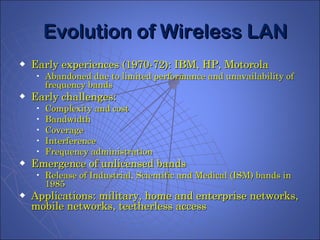


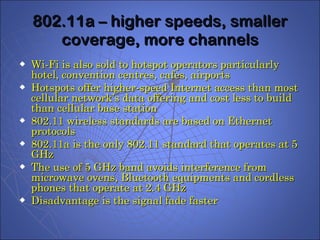







Wi-Fi technology evolved from early wireless LAN experiments in the 1970s that were later abandoned due to performance and regulatory issues. The emergence of unlicensed frequency bands in 1985 and IEEE 802.11 standards starting in 1990 drove the development and adoption of Wi-Fi for business, home, and mobile networks. 802.11 standards including a, b, g, and n improved speeds and compatibility while operating in the 2.4GHz or 5GHz bands, with later standards adding improvements like better coverage, increased speeds and capacity. While enterprises were initially the main users, residential adoption of Wi-Fi surpassed businesses due to lower costs and simpler installation, finding applications in healthcare, education, retail and warehousing


![WIFI[autosaved]](https://cdn.slidesharecdn.com/ss_thumbnails/e1autosaved-100912080400-phpapp01-thumbnail.jpg?width=640&height=640&fit=bounds)


