COMMUNICATION SKILL
Word Formation
In linguistics*, word formation is the creation of a new word
. Word formation is sometimes contrasted with 
semantic change, which is a change in a single word's
meaning. The boundary between word formation and 
semantic change** can be difficult to define: a new use of an
old word can be seen as a new word derived from an old one
and identical to it in form .Word formation can also be
contrasted with the formation of idiomatic expressions,
although words can be formed from multi-word phrases.
*Linguistics is the scientific study of human language.
**Semantic change  is the evolution of word usage — usually to the point that the modern meaning is radically different 
from the original usage.
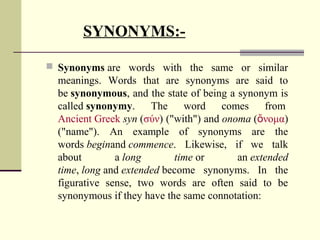
 Synonyms are words with the same or similar
meanings. Words that are synonyms are said to
be synonymous, and the state of being a synonym is
called synonymy. The word comes from
Ancient Greek syn (σύν) ("with") and onoma ( νομαὄ )
("name"). An example of synonyms are the
words beginand commence. Likewise, if we talk
about a long time or an extended
time, long and extended become synonyms. In the
figurative sense, two words are often said to be
synonymous if they have the same connotation:
SYNONYMS:-
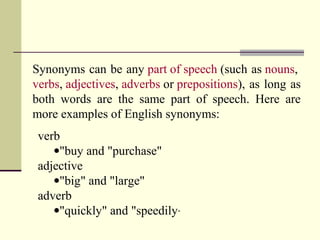
verb
•"buy and "purchase"
adjective
•"big" and "large"
adverb
•"quickly" and "speedily"
Synonyms can be any part of speech (such as nouns,
verbs, adjectives, adverbs or prepositions), as long as
both words are the same part of speech. Here are
more examples of English synonyms:
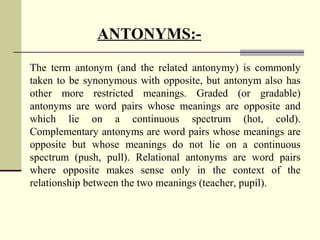
The term antonym (and the related antonymy) is commonly
taken to be synonymous with opposite, but antonym also has
other more restricted meanings. Graded (or gradable)
antonyms are word pairs whose meanings are opposite and
which lie on a continuous spectrum (hot, cold).
Complementary antonyms are word pairs whose meanings are
opposite but whose meanings do not lie on a continuous
spectrum (push, pull). Relational antonyms are word pairs
where opposite makes sense only in the context of the
relationship between the two meanings (teacher, pupil).
ANTONYMS:-
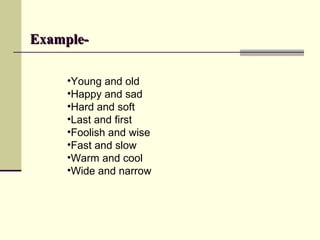
Example-Example-
•Young and old
•Happy and sad
•Hard and soft
•Last and first
•Foolish and wise
•Fast and slow
•Warm and cool
•Wide and narrow
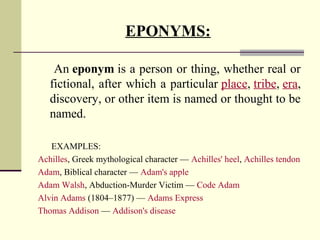
EPONYMS:
An eponym is a person or thing, whether real or
fictional, after which a particular place, tribe, era,
discovery, or other item is named or thought to be
named.
EXAMPLES:
Achilles, Greek mythological character — Achilles' heel, Achilles tendon
Adam, Biblical character — Adam's apple
Adam Walsh, Abduction-Murder Victim — Code Adam
Alvin Adams (1804–1877) — Adams Express
Thomas Addison — Addison's disease
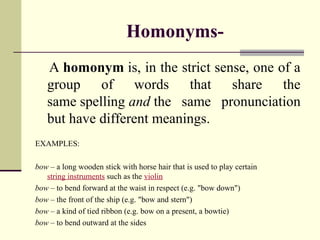
Homonyms-
A homonym is, in the strict sense, one of a
group of words that share the
same spelling and the same pronunciation
but have different meanings.
EXAMPLES:
bow – a long wooden stick with horse hair that is used to play certain
string instruments such as the violin
bow – to bend forward at the waist in respect (e.g. "bow down")
bow – the front of the ship (e.g. "bow and stern")
bow – a kind of tied ribbon (e.g. bow on a present, a bowtie)
bow – to bend outward at the sides
HOMOPHONES:
A homophone is a word that is pronounced the
same as another word but differs in meaning.
EXAMPLES:
• accessary, accessory
• ad, add
• ail, ale
• air, heir
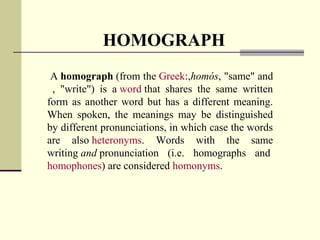
HOMOGRAPH
A homograph (from the Greek:,homós, "same" and
, "write") is a word that shares the same written
form as another word but has a different meaning.
When spoken, the meanings may be distinguished
by different pronunciations, in which case the words
are also heteronyms. Words with the same
writing and pronunciation (i.e. homographs and
homophones) are considered homonyms.
EXAMPLE-
• bat - a piece of sporting equipment used in
baseball/a winged animal associated with vampires
• bow - to bend at the waist/the front of a boat/a pair
of tied loops
• buffet - to hit, punch or slap/a self-serve food bar
• bustier - an undergarment/more busty
• compact - small/to make small/a small case for
holding makeup
• compound - to mix or combine/an enclosed area
with a building or group of buildings inside
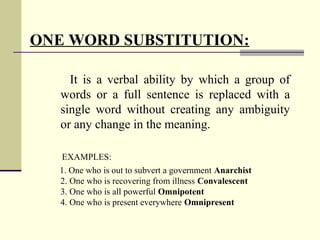
ONE WORD SUBSTITUTION:
It is a verbal ability by which a group of
words or a full sentence is replaced with a
single word without creating any ambiguity
or any change in the meaning.
EXAMPLES:
1. One who is out to subvert a government Anarchist
2. One who is recovering from illness Convalescent
3. One who is all powerful Omnipotent
4. One who is present everywhere Omnipresent
PHRASAL VERB:-
The term phrasal verb is commonly applied to two or three
distinct but related constructions in English: a verb and a
particle and/or a preposition co-occur forming a single
semantic unit. This semantic unit cannot be understood based
upon the meanings of the individual parts in isolation, but
rather it must be taken as a whole. In other words, the meaning
is non-compositional and thus unpredictable.[1]
Phrasal verbs
that include a preposition are known as prepositional
verbs and phrasal verbs that include a particle are also known
as particle verbs
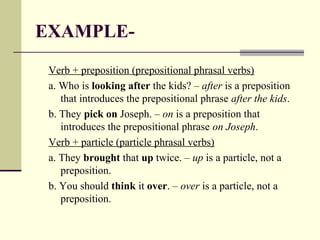
EXAMPLE-
Verb + preposition (prepositional phrasal verbs)
a. Who is looking after the kids? – after is a preposition
that introduces the prepositional phrase after the kids.
b. They pick on Joseph. – on is a preposition that
introduces the prepositional phrase on Joseph.
Verb + particle (particle phrasal verbs)
a. They brought that up twice. – up is a particle, not a
preposition.
b. You should think it over. – over is a particle, not a
preposition.
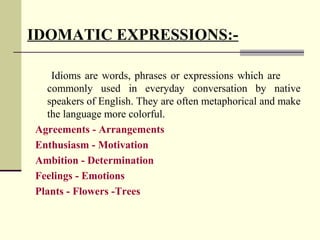
IDOMATIC EXPRESSIONS:-
Idioms are words, phrases or expressions which are
commonly used in everyday conversation by native
speakers of English. They are often metaphorical and make
the language more colorful.
Agreements - Arrangements
Enthusiasm - Motivation
Ambition - Determination
Feelings - Emotions
Plants - Flowers -Trees
 PROVERB 
          A proverb (from Latin: proverbium) is a simple and concrete saying, 
popularly  known  and  repeated, that expresses  a truth  based on  common 
sense or the practical experience of humanity. They are often metaphorical
. A proverb that describes a basic rule of conduct may also be known as a 
maxim.
                      Proverbs are often borrowed from similar languages and 
cultures, and sometimes come down to the present through more than one 
language.  Both  the  Bible  (including,  but  not  limited  to  the Book  of 
Proverbs) and medieval Latin (aided by the work of Erasmus) have played 
a considerable role in distributing proverbs across Europe, although almost 
every culture has examples of its own.
                                          The  study  of  proverbs  is 
called paremiology (from Greek παροιμία - paroimía,  "proverb,  maxim, 
saw"[1]
) and can be dated back as far as Aristotle. Paremiography, on the 
other hand, is the collection of proverbs.
EXAMPLE-
• Mustn't cry over spilled milk.
• You can catch more flies with honey than you can 
with vinegar.
• You can lead a horse to water, but you can't make 
him drink.
• Those who live in glass houses shouldn't throw 
stones.
• A bird in the hand is worth two in the bush.
• Everyone unto their own.

Word formation (communication skill)

  • 1.
  • 2.
    Word Formation In linguistics*, word formation isthe creation of a new word . Word formation is sometimes contrasted with  semantic change, which is a change in a single word's meaning. The boundary between word formation and  semantic change** can be difficult to define: a new use of an old word can be seen as a new word derived from an old one and identical to it in form .Word formation can also be contrasted with the formation of idiomatic expressions, although words can be formed from multi-word phrases. *Linguistics is the scientific study of human language. **Semantic change  is the evolution of word usage — usually to the point that the modern meaning is radically different  from the original usage.
  • 3.
     Synonyms arewords with the same or similar meanings. Words that are synonyms are said to be synonymous, and the state of being a synonym is called synonymy. The word comes from Ancient Greek syn (σύν) ("with") and onoma ( νομαὄ ) ("name"). An example of synonyms are the words beginand commence. Likewise, if we talk about a long time or an extended time, long and extended become synonyms. In the figurative sense, two words are often said to be synonymous if they have the same connotation: SYNONYMS:-
  • 4.
    verb •"buy and "purchase" adjective •"big"and "large" adverb •"quickly" and "speedily" Synonyms can be any part of speech (such as nouns, verbs, adjectives, adverbs or prepositions), as long as both words are the same part of speech. Here are more examples of English synonyms:
  • 5.
    The term antonym(and the related antonymy) is commonly taken to be synonymous with opposite, but antonym also has other more restricted meanings. Graded (or gradable) antonyms are word pairs whose meanings are opposite and which lie on a continuous spectrum (hot, cold). Complementary antonyms are word pairs whose meanings are opposite but whose meanings do not lie on a continuous spectrum (push, pull). Relational antonyms are word pairs where opposite makes sense only in the context of the relationship between the two meanings (teacher, pupil). ANTONYMS:-
  • 6.
    Example-Example- •Young and old •Happyand sad •Hard and soft •Last and first •Foolish and wise •Fast and slow •Warm and cool •Wide and narrow
  • 7.
    EPONYMS: An eponym isa person or thing, whether real or fictional, after which a particular place, tribe, era, discovery, or other item is named or thought to be named. EXAMPLES: Achilles, Greek mythological character — Achilles' heel, Achilles tendon Adam, Biblical character — Adam's apple Adam Walsh, Abduction-Murder Victim — Code Adam Alvin Adams (1804–1877) — Adams Express Thomas Addison — Addison's disease
  • 8.
    Homonyms- A homonym is,in the strict sense, one of a group of words that share the same spelling and the same pronunciation but have different meanings. EXAMPLES: bow – a long wooden stick with horse hair that is used to play certain string instruments such as the violin bow – to bend forward at the waist in respect (e.g. "bow down") bow – the front of the ship (e.g. "bow and stern") bow – a kind of tied ribbon (e.g. bow on a present, a bowtie) bow – to bend outward at the sides
  • 9.
    HOMOPHONES: A homophone isa word that is pronounced the same as another word but differs in meaning. EXAMPLES: • accessary, accessory • ad, add • ail, ale • air, heir
  • 10.
    HOMOGRAPH A homograph (fromthe Greek:,homós, "same" and , "write") is a word that shares the same written form as another word but has a different meaning. When spoken, the meanings may be distinguished by different pronunciations, in which case the words are also heteronyms. Words with the same writing and pronunciation (i.e. homographs and homophones) are considered homonyms.
  • 11.
    EXAMPLE- • bat -a piece of sporting equipment used in baseball/a winged animal associated with vampires • bow - to bend at the waist/the front of a boat/a pair of tied loops • buffet - to hit, punch or slap/a self-serve food bar • bustier - an undergarment/more busty • compact - small/to make small/a small case for holding makeup • compound - to mix or combine/an enclosed area with a building or group of buildings inside
  • 12.
    ONE WORD SUBSTITUTION: Itis a verbal ability by which a group of words or a full sentence is replaced with a single word without creating any ambiguity or any change in the meaning. EXAMPLES: 1. One who is out to subvert a government Anarchist 2. One who is recovering from illness Convalescent 3. One who is all powerful Omnipotent 4. One who is present everywhere Omnipresent
  • 13.
    PHRASAL VERB:- The termphrasal verb is commonly applied to two or three distinct but related constructions in English: a verb and a particle and/or a preposition co-occur forming a single semantic unit. This semantic unit cannot be understood based upon the meanings of the individual parts in isolation, but rather it must be taken as a whole. In other words, the meaning is non-compositional and thus unpredictable.[1] Phrasal verbs that include a preposition are known as prepositional verbs and phrasal verbs that include a particle are also known as particle verbs
  • 14.
    EXAMPLE- Verb + preposition(prepositional phrasal verbs) a. Who is looking after the kids? – after is a preposition that introduces the prepositional phrase after the kids. b. They pick on Joseph. – on is a preposition that introduces the prepositional phrase on Joseph. Verb + particle (particle phrasal verbs) a. They brought that up twice. – up is a particle, not a preposition. b. You should think it over. – over is a particle, not a preposition.
  • 15.
    IDOMATIC EXPRESSIONS:- Idioms arewords, phrases or expressions which are commonly used in everyday conversation by native speakers of English. They are often metaphorical and make the language more colorful. Agreements - Arrangements Enthusiasm - Motivation Ambition - Determination Feelings - Emotions Plants - Flowers -Trees
  • 16.
     PROVERB            A proverb (from Latin: proverbium) is a simple and concrete saying,  popularly  known  and repeated, that expresses  a truth  based on  common  sense or the practical experience of humanity. They are often metaphorical . A proverb that describes a basic rule of conduct may also be known as a  maxim.                       Proverbs are often borrowed from similar languages and  cultures, and sometimes come down to the present through more than one  language.  Both  the  Bible  (including,  but  not  limited  to  the Book  of  Proverbs) and medieval Latin (aided by the work of Erasmus) have played  a considerable role in distributing proverbs across Europe, although almost  every culture has examples of its own.                                           The  study  of  proverbs  is  called paremiology (from Greek παροιμία - paroimía,  "proverb,  maxim,  saw"[1] ) and can be dated back as far as Aristotle. Paremiography, on the  other hand, is the collection of proverbs.
  • 17.
    EXAMPLE- • Mustn't cry over spilled milk. • You can catch more flies with honey than you can  with vinegar. •You can lead a horse to water, but you can't make  him drink. • Those who live in glass houses shouldn't throw  stones. • A bird in the hand is worth two in the bush. • Everyone unto their own.