ca Opscenter 
Case Study: Vivo Automated IT Capacity 
Management to Optimize Usage of its Critical 
Infrastructure Environment 
Henio Aires Almeida 
Telefonica Vivo 
Telecom IT Capacity Manager 
OCX58S @henioaires #CAWorld
Abstract 
The main IT challenges in business today are to support new business 
offers and the fast implementation of new applications that the 
business requires. Vivo uses CA Capacity Management to monitor 
current capacity and assure the optimized usage of their critical 
infrastructure environments. This enables them to dispose of manual 
procedures and spreadsheets and reveals increased time to value and 
high speed to deliver, accelerating the resolution to business requests 
and helping the company to shorten strategic application and business 
initiatives’ time to market. The solution also allows Vivo to stay in 
compliance with local regulatory agencies. (See related session: Meet 
The Experts: Q&A for “Vivo Automated IT Capacity Management to 
Optimize Usage of its Critical Infrastructure Environment.") 
Henio Aires 
Almeida 
Telefonica Vivo 
Telecom IT Capacity 
Manager 
2 © 2014 CA. ALL RIGHTS RESERVED.
Agenda 
COMPANY INTRODUCTION 
CHALLENGES BEFORE/DURING DEPLOYMENT 
SUCCESS/BENEFITS AFTER DEPLOYMENT 
OUR IMPLEMENTED CAPMAN SOLUTION/GENERAL RECOMMENDATIONS 
OUR NEXT STEPS – WHERE WE’RE GOING & EXPECTED SUCCESSES 
1 
2 
3 
4 
5 
3 © 2014 CA. ALL RIGHTS RESERVED.
Company Introduction 
4 © 2014 CA. ALL RIGHTS RESERVED. 
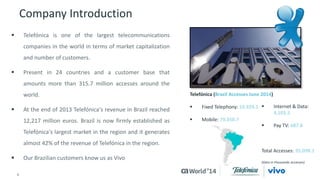
Telefónica (Brazil Accesses June 2014) 
 Fixed Telephony: 10,929.1 
 Mobile: 79,350.7 
 Telefónica is one of the largest telecommunications 
companies in the world in terms of market capitalization 
and number of customers. 
 Present in 24 countries and a customer base that 
amounts more than 315.7 million accesses around the 
world. 
 At the end of 2013 Telefónica's revenue in Brazil reached 
12,217 million euros. Brazil is now firmly established as 
Telefónica's largest market in the region and it generates 
almost 42% of the revenue of Telefónica in the region. 
 Our Brazilian customers know us as Vivo 
 Internet & Data: 
4,103.5 
 Pay TV: 687.8 
Total Accesses: 95,098.1 
(Data in thousands accesses)
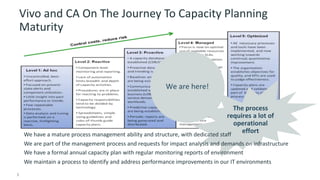
Vivo and CA On The Journey To Capacity Planning 
Maturity 
We are here! 
We have a mature process management ability and structure, with dedicated staff 
We are part of the management process and requests for impact analysis and demands on infrastructure 
We have a formal annual capacity plan with regular monitoring reports of environment 
5 © 2014 CA. ALL RIGHTS RESERVED. 
The process 
requires a lot of 
operational 
effort 
We maintain a process to identify and address performance improvements in our IT environments
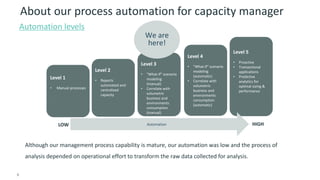
About our process automation for capacity manager 
Automation levels 
Level 1 
• Manual processes 
Level 2 
• Reports 
automated and 
centralized 
capacity 
We are 
here! 
Level 3 
• "What-if” scenario 
modeling 
(manual) 
• Correlate with 
volumetric 
business and 
environments 
consumption 
(manual) 
LOW HIGH 
6 © 2014 CA. ALL RIGHTS RESERVED. 
Level 4 
• "What-if“ scenario 
modeling 
(automatic) 
• Correlate with 
volumetric 
business and 
environments 
consumption 
(automatic) 
Level 5 
• Proactive 
• Transactional 
applications 
• Predictive 
analytics for 
optimal sizing & 
performance 
Automation 
Although our management process capability is mature, our automation was low and the process of 
analysis depended on operational effort to transform the raw data collected for analysis.
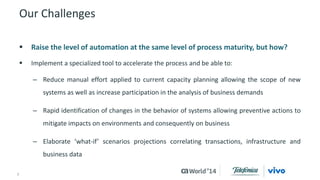
Our Challenges 
 Raise the level of automation at the same level of process maturity, but how? 
 Implement a specialized tool to accelerate the process and be able to: 
– Reduce manual effort applied to current capacity planning allowing the scope of new 
systems as well as increase participation in the analysis of business demands 
– Rapid identification of changes in the behavior of systems allowing preventive actions to 
mitigate impacts on environments and consequently on business 
– Elaborate ‘what-if’ scenarios projections correlating transactions, infrastructure and 
business data 
7 © 2014 CA. ALL RIGHTS RESERVED.
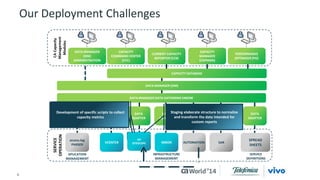
Our Deployment Challenges 
CURRENT CAPACITY 
REPORTER (CCR) 
CAPACITY 
COMMAND CENTER 
(CCC) 
CA Capacity 
Management 
Modules 
DATA MANAGER 
(DM) 
ADMINISTRATION 
CAPACITY DATABASE 
DATA MANAGER (DM) 
DATA MANAGER DATA GATHERING ENGINE 
Development of specific scripts to collect 
DATA 
ADAPTER 
capacity metrics 
8 © 2014 CA. ALL RIGHTS RESERVED. 
DATA 
ADAPTER 
DATA 
ADAPTER 
DATA 
ADAPTER 
DATA 
ADAPTER 
DATA 
ADAPTER 
DATA 
ADAPTER 
access.log 
PARSER 
PERFORMANCE 
OPTIMIZER (PO) 
SPREAD 
SHEETS 
SERVICE 
OPERATION 
APLICATION 
MANAGEMENT 
VCENTER NMON AUTOMATION SAR 
INFRASTRUCTURE 
MANAGEMENT 
SERVICE 
DEFINITIONS 
CAPACITY 
MANAGER 
(CAPMAN) 
STAGING 
ARHEPA 
SITESCOPE 
Staging elaborate structure to normalize 
and transform the data intended for 
custom reports 
Challenge: Replacing the basic data 
collection infrastructure tool during the 
project
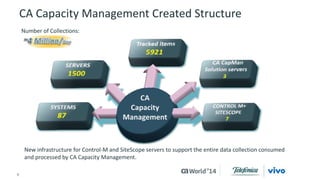
CA Capacity Management Created Structure 
CA 
Capacity 
Management 
Number of Collections: 
New infrastructure for Control-M and SiteScope servers to support the entire data collection consumed 
and processed by CA Capacity Management. 
9 © 2014 CA. ALL RIGHTS RESERVED.
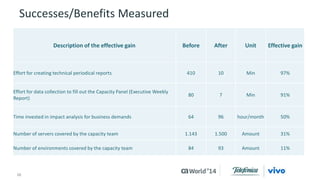
Successes/Benefits Measured 
Description of the effective gain Before After Unit Effective gain 
Effort for creating technical periodical reports 410 10 Min 97% 
Effort for data collection to fill out the Capacity Panel (Executive Weekly 
Report) 
10 © 2014 CA. ALL RIGHTS RESERVED. 
80 7 Min 91% 
Time invested in impact analysis for business demands 64 96 hour/month 50% 
Number of servers covered by the capacity team 1.143 1.500 Amount 31% 
Number of environments covered by the capacity team 84 93 Amount 11%
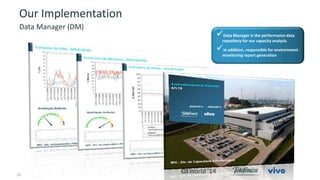
Our Implementation 
11 © 2014 CA. ALL RIGHTS RESERVED. 
 
Data Manager is the performance data 
repository for our capacity analysis 
 
In addition, responsible for environment 
monitoring report generation 
Data Manager (DM)
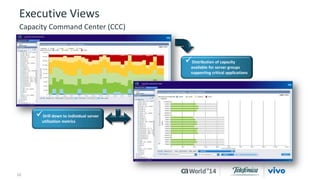
Executive Views 
Capacity Command Center (CCC) 
12 © 2014 CA. ALL RIGHTS RESERVED. 
 
Distribution of capacity 
available for server groups 
supporting critical applications 
 
Drill down to individual server 
utilization metrics
Standard Reporting 
Current Capacity Reporter (CCR) 
13 © 2014 CA. ALL RIGHTS RESERVED. 
 
VMware cluster CPU trends 
 
CCR display capacity data in 
various dashbaord formats 
 
CPU Heatmap 
 
Usage graph & projected CPU 
consumption
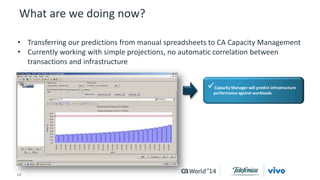
What are we doing now? 
• Transferring our predictions from manual spreadsheets to CA Capacity Management 
• Currently working with simple projections, no automatic correlation between 
14 © 2014 CA. ALL RIGHTS RESERVED. 
 
Capacity Manager will predict infrastructure 
performance against workloads 
transactions and infrastructure
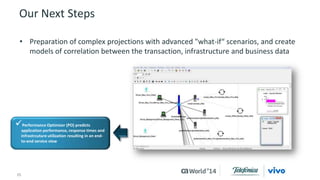
Our Next Steps 
• Preparation of complex projections with advanced "what-if“ scenarios, and create 
 
models of correlation between the transaction, infrastructure and business data 
Performance Optimizer (PO) predicts 
application performance, response times and 
infrastrcuture utilization resulting in an end-to- 
end service view 
15 © 2014 CA. ALL RIGHTS RESERVED.
General Recommendations 
 Before implementing the tool 
– create a formal process for capacity analysis and implement the tool to support this 
process with a dedicated team 
– have a structured method for data collection 
 Start with critical environments first 
 Take part of the management demand process for impact analysis on infrastructure 
 Make periodic analysis of current consumption vs projections 
 Have a process for dealing with identified deviations 
16 © 2014 CA. ALL RIGHTS RESERVED.
For More Information 
Insert appropriate screenshot and text overlay 
from following “More Info Graphics” slide here; 
DevOps 
ensure it links to correct page 
To learn more about DevOps, please visit: 
http://bit.ly/1wbjjqX 
17 © 2014 CA. ALL RIGHTS RESERVED.
For Informational Purposes Only 
© 2014 CA. All rights reserved. All trademarks referenced herein belong to their respective companies. 
This presentation provided at CA World 2014 is intended for information purposes only and does not form any type of warranty. Content 
provided in this presentation has not been reviewed for accuracy and is based on information provided by CA Partners and Customers. 
Terms of this Presentation 
18 © 2014 CA. ALL RIGHTS RESERVED.

Case Study: Vivo Automated IT Capacity Management to Optimize Usage of its Critical Infrastructure Environment

  • 1.
    ca Opscenter CaseStudy: Vivo Automated IT Capacity Management to Optimize Usage of its Critical Infrastructure Environment Henio Aires Almeida Telefonica Vivo Telecom IT Capacity Manager OCX58S @henioaires #CAWorld
  • 2.
    Abstract The mainIT challenges in business today are to support new business offers and the fast implementation of new applications that the business requires. Vivo uses CA Capacity Management to monitor current capacity and assure the optimized usage of their critical infrastructure environments. This enables them to dispose of manual procedures and spreadsheets and reveals increased time to value and high speed to deliver, accelerating the resolution to business requests and helping the company to shorten strategic application and business initiatives’ time to market. The solution also allows Vivo to stay in compliance with local regulatory agencies. (See related session: Meet The Experts: Q&A for “Vivo Automated IT Capacity Management to Optimize Usage of its Critical Infrastructure Environment.") Henio Aires Almeida Telefonica Vivo Telecom IT Capacity Manager 2 © 2014 CA. ALL RIGHTS RESERVED.
  • 3.
    Agenda COMPANY INTRODUCTION CHALLENGES BEFORE/DURING DEPLOYMENT SUCCESS/BENEFITS AFTER DEPLOYMENT OUR IMPLEMENTED CAPMAN SOLUTION/GENERAL RECOMMENDATIONS OUR NEXT STEPS – WHERE WE’RE GOING & EXPECTED SUCCESSES 1 2 3 4 5 3 © 2014 CA. ALL RIGHTS RESERVED.
  • 4.
    Company Introduction 4© 2014 CA. ALL RIGHTS RESERVED. Telefónica (Brazil Accesses June 2014)  Fixed Telephony: 10,929.1  Mobile: 79,350.7  Telefónica is one of the largest telecommunications companies in the world in terms of market capitalization and number of customers.  Present in 24 countries and a customer base that amounts more than 315.7 million accesses around the world.  At the end of 2013 Telefónica's revenue in Brazil reached 12,217 million euros. Brazil is now firmly established as Telefónica's largest market in the region and it generates almost 42% of the revenue of Telefónica in the region.  Our Brazilian customers know us as Vivo  Internet & Data: 4,103.5  Pay TV: 687.8 Total Accesses: 95,098.1 (Data in thousands accesses)
  • 5.
    Vivo and CAOn The Journey To Capacity Planning Maturity We are here! We have a mature process management ability and structure, with dedicated staff We are part of the management process and requests for impact analysis and demands on infrastructure We have a formal annual capacity plan with regular monitoring reports of environment 5 © 2014 CA. ALL RIGHTS RESERVED. The process requires a lot of operational effort We maintain a process to identify and address performance improvements in our IT environments
  • 6.
    About our processautomation for capacity manager Automation levels Level 1 • Manual processes Level 2 • Reports automated and centralized capacity We are here! Level 3 • "What-if” scenario modeling (manual) • Correlate with volumetric business and environments consumption (manual) LOW HIGH 6 © 2014 CA. ALL RIGHTS RESERVED. Level 4 • "What-if“ scenario modeling (automatic) • Correlate with volumetric business and environments consumption (automatic) Level 5 • Proactive • Transactional applications • Predictive analytics for optimal sizing & performance Automation Although our management process capability is mature, our automation was low and the process of analysis depended on operational effort to transform the raw data collected for analysis.
  • 7.
    Our Challenges Raise the level of automation at the same level of process maturity, but how?  Implement a specialized tool to accelerate the process and be able to: – Reduce manual effort applied to current capacity planning allowing the scope of new systems as well as increase participation in the analysis of business demands – Rapid identification of changes in the behavior of systems allowing preventive actions to mitigate impacts on environments and consequently on business – Elaborate ‘what-if’ scenarios projections correlating transactions, infrastructure and business data 7 © 2014 CA. ALL RIGHTS RESERVED.
  • 8.
    Our Deployment Challenges CURRENT CAPACITY REPORTER (CCR) CAPACITY COMMAND CENTER (CCC) CA Capacity Management Modules DATA MANAGER (DM) ADMINISTRATION CAPACITY DATABASE DATA MANAGER (DM) DATA MANAGER DATA GATHERING ENGINE Development of specific scripts to collect DATA ADAPTER capacity metrics 8 © 2014 CA. ALL RIGHTS RESERVED. DATA ADAPTER DATA ADAPTER DATA ADAPTER DATA ADAPTER DATA ADAPTER DATA ADAPTER access.log PARSER PERFORMANCE OPTIMIZER (PO) SPREAD SHEETS SERVICE OPERATION APLICATION MANAGEMENT VCENTER NMON AUTOMATION SAR INFRASTRUCTURE MANAGEMENT SERVICE DEFINITIONS CAPACITY MANAGER (CAPMAN) STAGING ARHEPA SITESCOPE Staging elaborate structure to normalize and transform the data intended for custom reports Challenge: Replacing the basic data collection infrastructure tool during the project
  • 9.
    CA Capacity ManagementCreated Structure CA Capacity Management Number of Collections: New infrastructure for Control-M and SiteScope servers to support the entire data collection consumed and processed by CA Capacity Management. 9 © 2014 CA. ALL RIGHTS RESERVED.
  • 10.
    Successes/Benefits Measured Descriptionof the effective gain Before After Unit Effective gain Effort for creating technical periodical reports 410 10 Min 97% Effort for data collection to fill out the Capacity Panel (Executive Weekly Report) 10 © 2014 CA. ALL RIGHTS RESERVED. 80 7 Min 91% Time invested in impact analysis for business demands 64 96 hour/month 50% Number of servers covered by the capacity team 1.143 1.500 Amount 31% Number of environments covered by the capacity team 84 93 Amount 11%
  • 11.
    Our Implementation 11© 2014 CA. ALL RIGHTS RESERVED.  Data Manager is the performance data repository for our capacity analysis  In addition, responsible for environment monitoring report generation Data Manager (DM)
  • 12.
    Executive Views CapacityCommand Center (CCC) 12 © 2014 CA. ALL RIGHTS RESERVED.  Distribution of capacity available for server groups supporting critical applications  Drill down to individual server utilization metrics
  • 13.
    Standard Reporting CurrentCapacity Reporter (CCR) 13 © 2014 CA. ALL RIGHTS RESERVED.  VMware cluster CPU trends  CCR display capacity data in various dashbaord formats  CPU Heatmap  Usage graph & projected CPU consumption
  • 14.
    What are wedoing now? • Transferring our predictions from manual spreadsheets to CA Capacity Management • Currently working with simple projections, no automatic correlation between 14 © 2014 CA. ALL RIGHTS RESERVED.  Capacity Manager will predict infrastructure performance against workloads transactions and infrastructure
  • 15.
    Our Next Steps • Preparation of complex projections with advanced "what-if“ scenarios, and create  models of correlation between the transaction, infrastructure and business data Performance Optimizer (PO) predicts application performance, response times and infrastrcuture utilization resulting in an end-to- end service view 15 © 2014 CA. ALL RIGHTS RESERVED.
  • 16.
    General Recommendations Before implementing the tool – create a formal process for capacity analysis and implement the tool to support this process with a dedicated team – have a structured method for data collection  Start with critical environments first  Take part of the management demand process for impact analysis on infrastructure  Make periodic analysis of current consumption vs projections  Have a process for dealing with identified deviations 16 © 2014 CA. ALL RIGHTS RESERVED.
  • 17.
    For More Information Insert appropriate screenshot and text overlay from following “More Info Graphics” slide here; DevOps ensure it links to correct page To learn more about DevOps, please visit: http://bit.ly/1wbjjqX 17 © 2014 CA. ALL RIGHTS RESERVED.
  • 18.
    For Informational PurposesOnly © 2014 CA. All rights reserved. All trademarks referenced herein belong to their respective companies. This presentation provided at CA World 2014 is intended for information purposes only and does not form any type of warranty. Content provided in this presentation has not been reviewed for accuracy and is based on information provided by CA Partners and Customers. Terms of this Presentation 18 © 2014 CA. ALL RIGHTS RESERVED.