Justifying IT
Capacity
Management Efforts
Bill Hammond | Director, Product Marketing
Denise Tabor | Senior Product Management Director
Today’s Topics
• 2024 Capacity Management Trends
• Rationale for Capacity Management
• Capacity Management Stakeholders
• ROI for Capacity Management
• Real-world customer story
• Q & A
2
2024 Trends
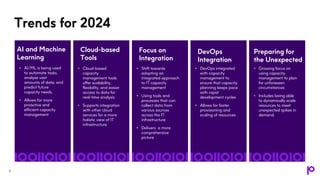
Trends for 2024
4
AI and Machine
Learning
• AI/ML is being used
to automate tasks,
analyze vast
amounts of data, and
predict future
capacity needs.
• Allows for more
proactive and
efficient capacity
management
Cloud-based
Tools
• Cloud-based
capacity
management tools
offer scalability,
flexibility, and easier
access to data for
real-time analysis
• Supports integration
with other cloud
services for a more
holistic view of IT
infrastructure
Focus on
Integration
• Shift towards
adopting an
integrated approach
to IT capacity
management
• Using tools and
processes that can
collect data from
various sources
across the IT
infrastructure
• Delivers a more
comprehensive
picture
DevOps
Integration
• DevOps integrated
with capacity
management to
ensure that capacity
planning keeps pace
with rapid
development cycles
• Allows for faster
provisioning and
scaling of resources
Preparing for
the Unexpected
• Growing focus on
using capacity
management to plan
for unforeseen
circumstances
• Includes being able
to dynamically scale
resources to meet
unexpected spikes in
demand.
Why Capacity
Management is important
Precisely Blog – What is Capacity Management? - January 18, 2022
6
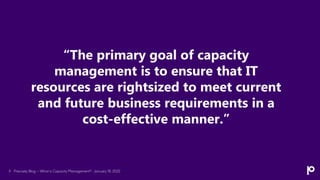
“The primary goal of capacity
management is to ensure that IT
resources are rightsized to meet current
and future business requirements in a
cost-effective manner.”
Costs of ineffective
capacity management
• Performance bottlenecks and application
slowdowns leading to user frustration and
lost productivity.
• Increased risk of outages and downtime due
to unexpected spikes in demand.
• Overprovisioning of resources leading to
wasted expenditure on unused capacity.
• Inability to scale effectively to meet
changing business needs.
7
8
Without proper planning, IT
resources can become
stretched thin during peak
usage periods.
This leads to slowdowns,
application crashes, and
frustrated users. Formal
Capacity Management
ensures resources are
allocated effectively to meet
demand, resulting in smooth
performance and a positive
user experience.
Optimizes
Performance and
User Experience
9
Unforeseen spikes in
demand or hardware failures
can cripple unprepared IT
systems.
Capacity Management
practices like monitoring and
forecasting help identify
potential bottlenecks and
plan for increased usage.
This proactive approach
minimizes downtime and
ensures system reliability.
Prevents Outages
and Downtime
10
Overprovisioning of
resources, a common pitfall
without formal Capacity
Management, leads to
wasted expenditure.
By accurately understanding
capacity needs,
organizations can optimize
resource allocation,
potentially reducing
hardware, software, and
cloud service costs
Reduces Costs
11
Formal Capacity
Management provides
valuable insights into
resource utilization and
future needs.
This allows IT to plan for
growth initiatives, new
projects, and technological
advancements with
confidence.
They can proactively scale
resources to meet future
demands and support the
evolving business landscape
Enables Effective
Strategic Planning
12
Data-driven insights gained
through Capacity
Management empower
informed decision-making.
IT leaders can prioritize
resource allocation, justify
investments in new
technologies, and optimize
resource allocation based on
real data instead of
guesswork.
Improves Decision-
Making
13
By proactively managing
capacity, IT organizations
can anticipate potential
issues and take preventive
measures.
This reduces the risk of
outages, security breaches,
and data loss associated
with overloaded systems.
Mitigates Risk
Who is concerned about
capacity management?
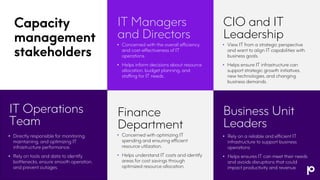
Capacity
management
stakeholders
IT Managers
and Directors
CIO and IT
Leadership
• Concerned with the overall efficiency
and cost-effectiveness of IT
operations.
• Helps inform decisions about resource
allocation, budget planning, and
staffing for IT needs.
• View IT from a strategic perspective
and want to align IT capabilities with
business goals.
• Helps ensure IT infrastructure can
support strategic growth initiatives,
new technologies, and changing
business demands.
Finance
Department
Business Unit
Leaders
• Concerned with optimizing IT
spending and ensuring efficient
resource utilization.
• Helps understand IT costs and identify
areas for cost savings through
optimized resource allocation.
• Rely on a reliable and efficient IT
infrastructure to support business
operations
• Helps ensures IT can meet their needs
and avoids disruptions that could
impact productivity and revenue.
Presentation name
15
• Directly responsible for monitoring,
maintaining, and optimizing IT
infrastructure performance.
• Rely on tools and data to identify
bottlenecks, ensure smooth operation,
and prevent outages.
IT Operations
Team
Demonstrating ROI for
capacity management
Managing costs while meeting
demands of the business today and
in the future yields significant ROI
• Fewer costly and unplanned/panic
purchases means budgets are easier to
set and easier to meet
• Less physical and virtual sprawl leads
to lower hardware and software costs
as well as better control of the
environment
• Preventing costly performance and
capacity-related outages saves the
business considerable money
Meeting SLAs in dynamic
environments requires a planned
approach to capacity and
performance
• Best practice-aligned process
ensures there’s adequate capacity
now and, in the future
• Business forecasts and historical
data allow for key adjustments and
recommendations
• Mature process leads to a more
proactive and less reactive
organization
Effective capacity
management means...
17
Business drivers for effective
capacity management
• Prevent missed SLAs and service outages through proactive planning
• Manage capacity to meet the ever-shifting demand
• Reduce Mean Time to Identify (MTTI) and Mean Time to Resolve
(MTTR)
• Single view of capacity across the business
• Consolidation and/or replacement of displaced toolsets
• Protection against expertise leaving the organization
• Avoiding regulation & compliance issues and their financial
impacts
• Manage capacity across complex environments
• On-premises datacenter
• Public cloud
• Private Cloud
• Hybrid
Syncsort Capacity Management Return-on-Investment
Automation
• Savings on people costs around manual report
production
Downtime and Slow time
• Avoiding outages and performance degradation
(Hours x Cost/hour)
System Administration
• Identify potential issues or faster resolution of
problems (Fault Time + Reporting Time) x Cost/Hour
Accurate Reporting
• Having the right information in the hands of the right
people at the right time yields better decisions
Hardware Purchase Deferral
• Not overspending on capacity because you can’t
accurately predict needed resources
Software Replacement
• Single product for all your computing environments
can replace cost using multiple point products
Workload Optimization
• Handle higher volume of work by having the right
level of computing resources
19
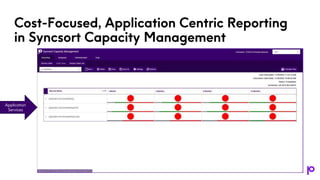
Cost-Focused, Application Centric Reporting
in Syncsort Capacity Management
Application
Services
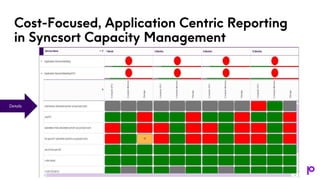
Details
Cost-Focused, Application Centric Reporting
in Syncsort Capacity Management
Sharing capacity management
data with stakeholders
22
• Business, service and application owners need relevant, targeted capacity
management details to do their jobs effectively
• They may be used to consuming these similar IT metrics in a centralized
analytics platform like Splunk or ServiceNow
• By integrating the Capacity Management metrics with these analytic
platforms, service and application owners can instantly see long term and
what-if scenario-based capacity health Days to Breach (DTL) forecasts
• Additionally, users could integrate these predicted capacity health results into
pre-existing Business and Service dashboards and tables using custom
searches and leveraging the indexed data.
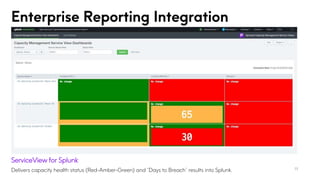
Enterprise Reporting Integration
ServiceView for Splunk
Delivers capacity health status (Red-Amber-Green) and “Days to Breach” results into Splunk. 23
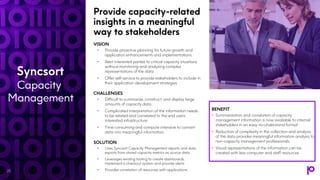
Real-world success story
Provide capacity-related
insights in a meaningful
way to stakeholders
VISION
• Provide proactive planning for future growth and
application enhancements and implementations
• Alert interested parties to critical capacity situations
without monitoring and analysing complex
representations of the data
• Offer self-service to provide stakeholders to include in
their application development strategies
CHALLENGES
• Difficult to summarize, construct, and display large
amounts of capacity data.
• Complicated interpretation of the information needs
to be related and correlated to the end users’
interested infrastructure
• Time consuming and compute intensive to convert
data into meaningful information
SOLUTION
• Uses Syncsort Capacity Management reports and data
exports from stored capacity metrics as source data
• Leverages existing tooling to create dashboards,
implement a checkout system and provide alerts
• Provides correlation of resources with applications
BENEFIT
• Summarization and correlation of capacity
management information is now available to internal
stakeholders in an easy-to-understand format
• Reduction of complexity in the collection and analysis
of the data provides meaningful information analysis to
non-capacity management professionals
• Visual representations of the information can be
created with less computer and staff resources
25
Syncsort
Capacity
Management
Q & A
Justifying Capacity Managment Webinar 4/10

Justifying Capacity Managment Webinar 4/10

  • 1.
    Justifying IT Capacity Management Efforts BillHammond | Director, Product Marketing Denise Tabor | Senior Product Management Director
  • 2.
    Today’s Topics • 2024Capacity Management Trends • Rationale for Capacity Management • Capacity Management Stakeholders • ROI for Capacity Management • Real-world customer story • Q & A 2
  • 3.
  • 4.
    Trends for 2024 4 AIand Machine Learning • AI/ML is being used to automate tasks, analyze vast amounts of data, and predict future capacity needs. • Allows for more proactive and efficient capacity management Cloud-based Tools • Cloud-based capacity management tools offer scalability, flexibility, and easier access to data for real-time analysis • Supports integration with other cloud services for a more holistic view of IT infrastructure Focus on Integration • Shift towards adopting an integrated approach to IT capacity management • Using tools and processes that can collect data from various sources across the IT infrastructure • Delivers a more comprehensive picture DevOps Integration • DevOps integrated with capacity management to ensure that capacity planning keeps pace with rapid development cycles • Allows for faster provisioning and scaling of resources Preparing for the Unexpected • Growing focus on using capacity management to plan for unforeseen circumstances • Includes being able to dynamically scale resources to meet unexpected spikes in demand.
  • 5.
  • 6.
    Precisely Blog –What is Capacity Management? - January 18, 2022 6 “The primary goal of capacity management is to ensure that IT resources are rightsized to meet current and future business requirements in a cost-effective manner.”
  • 7.
    Costs of ineffective capacitymanagement • Performance bottlenecks and application slowdowns leading to user frustration and lost productivity. • Increased risk of outages and downtime due to unexpected spikes in demand. • Overprovisioning of resources leading to wasted expenditure on unused capacity. • Inability to scale effectively to meet changing business needs. 7
  • 8.
    8 Without proper planning,IT resources can become stretched thin during peak usage periods. This leads to slowdowns, application crashes, and frustrated users. Formal Capacity Management ensures resources are allocated effectively to meet demand, resulting in smooth performance and a positive user experience. Optimizes Performance and User Experience
  • 9.
    9 Unforeseen spikes in demandor hardware failures can cripple unprepared IT systems. Capacity Management practices like monitoring and forecasting help identify potential bottlenecks and plan for increased usage. This proactive approach minimizes downtime and ensures system reliability. Prevents Outages and Downtime
  • 10.
    10 Overprovisioning of resources, acommon pitfall without formal Capacity Management, leads to wasted expenditure. By accurately understanding capacity needs, organizations can optimize resource allocation, potentially reducing hardware, software, and cloud service costs Reduces Costs
  • 11.
    11 Formal Capacity Management provides valuableinsights into resource utilization and future needs. This allows IT to plan for growth initiatives, new projects, and technological advancements with confidence. They can proactively scale resources to meet future demands and support the evolving business landscape Enables Effective Strategic Planning
  • 12.
    12 Data-driven insights gained throughCapacity Management empower informed decision-making. IT leaders can prioritize resource allocation, justify investments in new technologies, and optimize resource allocation based on real data instead of guesswork. Improves Decision- Making
  • 13.
    13 By proactively managing capacity,IT organizations can anticipate potential issues and take preventive measures. This reduces the risk of outages, security breaches, and data loss associated with overloaded systems. Mitigates Risk
  • 14.
    Who is concernedabout capacity management?
  • 15.
    Capacity management stakeholders IT Managers and Directors CIOand IT Leadership • Concerned with the overall efficiency and cost-effectiveness of IT operations. • Helps inform decisions about resource allocation, budget planning, and staffing for IT needs. • View IT from a strategic perspective and want to align IT capabilities with business goals. • Helps ensure IT infrastructure can support strategic growth initiatives, new technologies, and changing business demands. Finance Department Business Unit Leaders • Concerned with optimizing IT spending and ensuring efficient resource utilization. • Helps understand IT costs and identify areas for cost savings through optimized resource allocation. • Rely on a reliable and efficient IT infrastructure to support business operations • Helps ensures IT can meet their needs and avoids disruptions that could impact productivity and revenue. Presentation name 15 • Directly responsible for monitoring, maintaining, and optimizing IT infrastructure performance. • Rely on tools and data to identify bottlenecks, ensure smooth operation, and prevent outages. IT Operations Team
  • 16.
  • 17.
    Managing costs whilemeeting demands of the business today and in the future yields significant ROI • Fewer costly and unplanned/panic purchases means budgets are easier to set and easier to meet • Less physical and virtual sprawl leads to lower hardware and software costs as well as better control of the environment • Preventing costly performance and capacity-related outages saves the business considerable money Meeting SLAs in dynamic environments requires a planned approach to capacity and performance • Best practice-aligned process ensures there’s adequate capacity now and, in the future • Business forecasts and historical data allow for key adjustments and recommendations • Mature process leads to a more proactive and less reactive organization Effective capacity management means... 17
  • 18.
    Business drivers foreffective capacity management • Prevent missed SLAs and service outages through proactive planning • Manage capacity to meet the ever-shifting demand • Reduce Mean Time to Identify (MTTI) and Mean Time to Resolve (MTTR) • Single view of capacity across the business • Consolidation and/or replacement of displaced toolsets • Protection against expertise leaving the organization • Avoiding regulation & compliance issues and their financial impacts • Manage capacity across complex environments • On-premises datacenter • Public cloud • Private Cloud • Hybrid
  • 19.
    Syncsort Capacity ManagementReturn-on-Investment Automation • Savings on people costs around manual report production Downtime and Slow time • Avoiding outages and performance degradation (Hours x Cost/hour) System Administration • Identify potential issues or faster resolution of problems (Fault Time + Reporting Time) x Cost/Hour Accurate Reporting • Having the right information in the hands of the right people at the right time yields better decisions Hardware Purchase Deferral • Not overspending on capacity because you can’t accurately predict needed resources Software Replacement • Single product for all your computing environments can replace cost using multiple point products Workload Optimization • Handle higher volume of work by having the right level of computing resources 19
  • 20.
    Cost-Focused, Application CentricReporting in Syncsort Capacity Management Application Services
  • 21.
    Details Cost-Focused, Application CentricReporting in Syncsort Capacity Management
  • 22.
    Sharing capacity management datawith stakeholders 22 • Business, service and application owners need relevant, targeted capacity management details to do their jobs effectively • They may be used to consuming these similar IT metrics in a centralized analytics platform like Splunk or ServiceNow • By integrating the Capacity Management metrics with these analytic platforms, service and application owners can instantly see long term and what-if scenario-based capacity health Days to Breach (DTL) forecasts • Additionally, users could integrate these predicted capacity health results into pre-existing Business and Service dashboards and tables using custom searches and leveraging the indexed data.
  • 23.
    Enterprise Reporting Integration ServiceViewfor Splunk Delivers capacity health status (Red-Amber-Green) and “Days to Breach” results into Splunk. 23
  • 24.
  • 25.
    Provide capacity-related insights ina meaningful way to stakeholders VISION • Provide proactive planning for future growth and application enhancements and implementations • Alert interested parties to critical capacity situations without monitoring and analysing complex representations of the data • Offer self-service to provide stakeholders to include in their application development strategies CHALLENGES • Difficult to summarize, construct, and display large amounts of capacity data. • Complicated interpretation of the information needs to be related and correlated to the end users’ interested infrastructure • Time consuming and compute intensive to convert data into meaningful information SOLUTION • Uses Syncsort Capacity Management reports and data exports from stored capacity metrics as source data • Leverages existing tooling to create dashboards, implement a checkout system and provide alerts • Provides correlation of resources with applications BENEFIT • Summarization and correlation of capacity management information is now available to internal stakeholders in an easy-to-understand format • Reduction of complexity in the collection and analysis of the data provides meaningful information analysis to non-capacity management professionals • Visual representations of the information can be created with less computer and staff resources 25 Syncsort Capacity Management
  • 26.

Editor's Notes

  • #16 Capacity Management benefits different stakeholders across the organization. Ensures efficient use of resources, minimizes disruptions, and ultimately contributes to achieving business goals