How to prepare for your viva voce:
Passing the oral defence of your PhD thesis
free@thefreeschool.education
12 tips for passing your viva voce
Objective
This presentation offers constructive advice to aid
you to prepare for your viva voce exam so that you
may pass this examination.
Preliminary reading
Trafford, V., & Leshem, S. (2008). Stepping
stones to achieving your doctorate: By focusing
on your viva from the start: Focusing on your
viva from the start. McGraw-Hill Education
(UK).
263 pages quality textbook.
Available via Google Scholar (free)
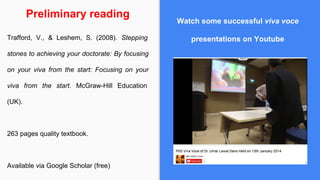
Watch some successful viva voce
presentations on Youtube
12 Points
Recommendations
1. Expert frame-of-mind
2. Health and wellbeing
3. Practice your presentation
4. Research your examiners
5. Structure your presentation
6. Anticipate difficult questions
7. Revisit supervisor’s feedback
8. Consult with your supervisors and others
9. Regulations and mandatory requirements
10. Revisit your thesis with a deeply critical mindset
Optional
11. Digital presentation
12. Dress for success
Retrieve your feedback chapters
Revisit the feedback provided by your supervisors on your draft chapters.
Some of the comments provided by your supervisors may be years old.
It is possible that you have forgotten the limitations that are inherent in your work.
This feedback is important. It has been provided by your peers who know the most
about your thesis.
Reassess these comments even if you have overcome the limitations and if you
have a convincing explanation about how you have neutered these.
These are the sorts of critical questions your examiners are likely to pose.
Health and wellbeing
Tip 1
Make sure you get
plenty of rest prior to
your examination,
especially the night
before.
Take annual leave
from work for a few
days if you require this
time to prepare.
Tip 2
Do not let stress interfere
with the preparation of
your viva voce or the
delivery of this
examination.
Consult with your
university’s health
service if stress is an
issue.
Tip 3
Aim to arrive at your
examination early so that you
can inspect the audio visual
equipment, and be sure you
are in the right seminar room.
Do everything in your power
to make sure you do not
arrive late. If you arrive in a
timely manner, then you
should feel relaxed when
presenting.
.
Suggested format (1 hour presentation)
1. Introduction (5 minutes)
Abstract, objective, scope, research question,
contribution to knowledge, grand conclusion.
2. Body (25 minutes)
If you follow the order of your data chapters,
you should constantly make reference to the
interconnectivity of the grand body of work. Do
not treat each chapter as an isolated idea.
3. Conclusion (5 minutes)
Rearticulate your thesis in a fresh way.
Questions from examiners (25 minutes)
Conclude: thank your committee and audience.
Structure
It is important that your presentation has a
logical structure, even if this requirement is
not stipulated as being mandatory.
A random structure may come across to
your examiners as an incoherent argument.
Inquire if the exam committee is permitted to
ask questions throughout the exam. If the
choice is yours, consider whether you prefer
to take questions only at the conclusion.
Limiting questions to the end enables your
presentation to be smoother as there is no
interruption. However, delayed questions out
of context may be more difficult to answer.
No doctoral thesis is perfect
If you consult with experienced
academics, you might concur with my
argument that there is a consensus
among academics that no doctoral
thesis can be perfect.
Knowledge is contested. The number of
research paradigms on offer to
students who pursue similar thesis
questions supports this argument.
I suggest that you read this text prior to
preparing for your viva voce. It might
reassure you of this argument.
See Trafford & Lesham (2008, pp. 46 & 56).
‘Tricky’ questions
It is likely that at least one examiner will ask
you at least one question that may come
across complex, tricky, unfair or hostile.
This is not uncommon. You should not let this
upset you in the exam if it happens.
The examinations process is fair. Each panel
member has one vote and they must act in
accordance with university regulations.
It is possible that the person asking a tricky
question has already concluded that your
written dissertation component is excellent.
If you have prepared for your viva voce in a
diligent manner you should remain confident.
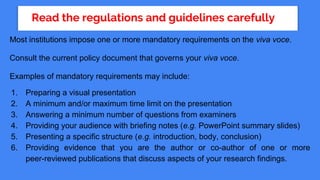
Read the regulations and guidelines carefully
Most institutions impose one or more mandatory requirements on the viva voce.
Consult the current policy document that governs your viva voce.
Examples of mandatory requirements may include:
1. Preparing a visual presentation
2. A minimum and/or maximum time limit on the presentation
3. Answering a minimum number of questions from examiners
4. Providing your audience with briefing notes (e.g. PowerPoint summary slides)
5. Presenting a specific structure (e.g. introduction, body, conclusion)
6. Providing evidence that you are the author or co-author of one or more
peer-reviewed publications that discuss aspects of your research findings.
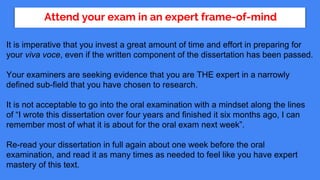
Attend your exam in an expert frame-of-mind
It is imperative that you invest a great amount of time and effort in preparing for
your viva voce, even if the written component of the dissertation has been passed.
Your examiners are seeking evidence that you are THE expert in a narrowly
defined sub-field that you have chosen to research.
It is not acceptable to go into the oral examination with a mindset along the lines
of “I wrote this dissertation over four years and finished it six months ago, I can
remember most of what it is about for the oral exam next week”.
Re-read your dissertation in full again about one week before the oral
examination, and read it as many times as needed to feel like you have expert
mastery of this text.
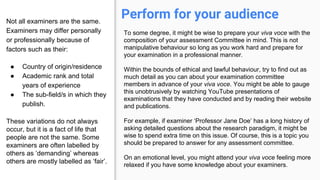
Perform for your audienceNot all examiners are the same.
Examiners may differ personally
or professionally because of
factors such as their:
● Country of origin/residence
● Academic rank and total
years of experience
● The sub-field/s in which they
publish.
These variations do not always
occur, but it is a fact of life that
people are not the same. Some
examiners are often labelled by
others as ‘demanding’ whereas
others are mostly labelled as ‘fair’.
To some degree, it might be wise to prepare your viva voce with the
composition of your assessment Committee in mind. This is not
manipulative behaviour so long as you work hard and prepare for
your examination in a professional manner.
Within the bounds of ethical and lawful behaviour, try to find out as
much detail as you can about your examination committee
members in advance of your viva voce. You might be able to gauge
this unobtrusively by watching YouTube presentations of
examinations that they have conducted and by reading their website
and publications.
For example, if examiner ‘Professor Jane Doe’ has a long history of
asking detailed questions about the research paradigm, it might be
wise to spend extra time on this issue. Of course, this is a topic you
should be prepared to answer for any assessment committee.
On an emotional level, you might attend your viva voce feeling more
relaxed if you have some knowledge about your examiners.
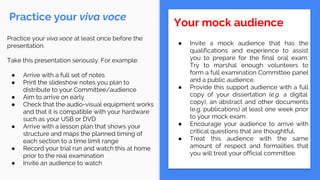
Practice your viva voce
Your mock audience
● Invite a mock audience that has the
qualifications and experience to assist
you to prepare for the final oral exam.
Try to marshal enough volunteers to
form a full examination Committee panel
and a public audience.
● Provide this support audience with a full
copy of your dissertation (e.g. a digital
copy), an abstract and other documents
(e.g. publications) at least one week prior
to your mock exam.
● Encourage your audience to arrive with
critical questions that are thoughtful.
● Treat this audience with the same
amount of respect and formalities that
you will treat your official committee.
Practice your viva voce at least once before the
presentation.
Take this presentation seriously. For example:
● Arrive with a full set of notes
● Print the slideshow notes you plan to
distribute to your Committee/audience
● Aim to arrive on early
● Check that the audio-visual equipment works
and that it is compatible with your hardware
such as your USB or DVD
● Arrive with a lesson plan that shows your
structure and maps the planned timing of
each section to a time limit range
● Record your trial run and watch this at home
prior to the real examination
● Invite an audience to watch
Consult your supervisors and others
I Do not underestimate how much quality support you can receive from faculty
and others prior to your viva voce.
It is likely that your doctoral supervisors have passed a viva voce and
attended oral examination committees as observers and as examiners.
If you have any questions about the requirements of the viva voce exam you
should feel comfortable to ask in advance.
Try to do as much research as you can prior to asking any questions and
make this background investigation clear to those whom you seek help from.
People are more likely to offer you support if you have done the groundwork
and you are not just looking to take short-cuts or have an easy exam.
Read your thesis one more time. Adopt a mindset that
is deeply suspicious and critical of your own work.
Do you believe that your
doctoral thesis provides a
substantially original
contribution to scholarly
knowledge, and if so,
why do you hold this
opinion?
What are the major
limitations of this
study?
How have you adapted
your methodological
design in order to
maximise the quality of
your data collection and
data analysis?
Is this the only suitable
paradigm that you might have
selected to pursue your
research objective?
For a “No” answer consider
this follow-up question?
What was the other
paradigm/s and why did you
not choose this one/these?
Reconsider the opposite argument of your thesis and why you reject this view.
Could you answer these general questions if they were put to you in an exam?
Dress for success: this advice is optional
For some, first impressions count. Dress for your oral exam the same way that you would
dress for a professional job interview. Visualise yourself as a guest lecturer at a respected
college. An ethical examiner cannot fail your viva voce because you look untidy.
However, it is strongly advised that you look polished and professional. These are two core
attributes about your work that you wish to convey to your examiners.
Dressing like a successful businessperson will not result in you passing your viva voce if
your work has no substance and you are not well prepared.
Take note of what other scholars have worn at successful defences.
Elika https://www.youtube.com/watch?v=hWJyFvXhyC0
Sultan https://www.youtube.com/watch?v=XxDaeX0Ao44
Rana https://www.youtube.com/watch?v=Hzvn4jCphmo
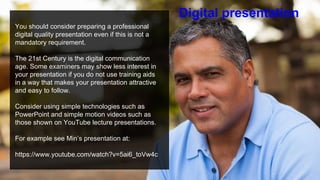
You should consider preparing a professional
digital quality presentation even if this is not a
mandatory requirement.
The 21st Century is the digital communication
age. Some examiners may show less interest in
your presentation if you do not use training aids
in a way that makes your presentation attractive
and easy to follow.
Consider using simple technologies such as
PowerPoint and simple motion videos such as
those shown on YouTube lecture presentations.
For example see Min’s presentation at:
https://www.youtube.com/watch?v=5ai6_toVw4c
Digital presentation
A few final comments
A main difference between the written dissertation and the viva voce, is that
the oral exam subjects you to questions in real-time. Rarely do doctoral
examiners seek written clarification from the candidate whilst they are
examining the thesis. If you cannot answer a question or you make a mistake
during your viva voce, it is essential that you do not allow this to undermine
your confidence during the remainder of the presentation. Examiners
understand that diligent scholars may not be able to recall some facts when
they are on the stage before an audience. If you cannot answer a question but
later feel confident about answering that question, do not hesitate to revisit
that conversation and provide the answer at a later time during the
presentation. It is normally acceptable to say “I had a mental blank when you
asked a question 10 minutes ago, but I am clear about my answer now.”
A few final comments … continued
During your candidature you should try to attend a few viva voce exams
that are open to the public as well as invitation only events. As a
doctoral candidate, you should expand your network of associates and
so it should not be difficult to receive at least one invite from a
colleague, friend or acquaintance. The viva voce exam is less daunting if
you have witnessed one in real life. It is not uncommon to witness the
primary supervisor introducing their PhD candidate with passion and
enthusiasm. Some examiners make flattering comments about the
thesis and presentation to the open room. If you cannot attend a public
viva voce, there are numerous positive examples of real oral exams on
YouTube. I suggest that you use the “PhD viva voce” search string.
free@thefreeschool.education
http://thefreeschool.education
Please share this slideshow
with your peers.
Free peer to-peer-tutor support from research students and PhD
qualified academic staff:
http://chat.thefreeschool.education
http://chat.thefreeschool.education/forum55.html
Further reading
This website has several sub-pages. The advice about structure and format are typical of the viva voce exam
process conducted by most universities. Most universities annex the requirements for their viva voce online.
University of Leicester (2016), The viva exam - What to expect and how to prepare,
<http://www2.le.ac.uk/departments/gradschool/training/eresources/study-guides/viva>. Accessed 9 July 2016.
Trafford, V., and Leshem, S. (2008), Stepping stones to achieving your doctorate: By focusing on your viva
from the start, London, England: McGraw-Hill Education.
<http://www.academia.edu/download/29694538/Stepping_Stones_to_Achieving_your_Doctorate.pdf>.
Accessed 9 July 2016. This is a 263 page quality digital open-access textbook. I suggest that you access it now
before it disappears as an open access resource.
To cite this presentation
Jericho, J. (2016), How to prepare for your viva voce: Passing the oral defence of your thesis, Toronto, Canada:
College Professor Publications.

Preparing for your viva voce dissertation defence.

  • 1.
    How to preparefor your viva voce: Passing the oral defence of your PhD thesis free@thefreeschool.education
  • 2.
    12 tips forpassing your viva voce Objective This presentation offers constructive advice to aid you to prepare for your viva voce exam so that you may pass this examination.
  • 3.
    Preliminary reading Trafford, V.,& Leshem, S. (2008). Stepping stones to achieving your doctorate: By focusing on your viva from the start: Focusing on your viva from the start. McGraw-Hill Education (UK). 263 pages quality textbook. Available via Google Scholar (free) Watch some successful viva voce presentations on Youtube
  • 4.
    12 Points Recommendations 1. Expertframe-of-mind 2. Health and wellbeing 3. Practice your presentation 4. Research your examiners 5. Structure your presentation 6. Anticipate difficult questions 7. Revisit supervisor’s feedback 8. Consult with your supervisors and others 9. Regulations and mandatory requirements 10. Revisit your thesis with a deeply critical mindset Optional 11. Digital presentation 12. Dress for success
  • 5.
    Retrieve your feedbackchapters Revisit the feedback provided by your supervisors on your draft chapters. Some of the comments provided by your supervisors may be years old. It is possible that you have forgotten the limitations that are inherent in your work. This feedback is important. It has been provided by your peers who know the most about your thesis. Reassess these comments even if you have overcome the limitations and if you have a convincing explanation about how you have neutered these. These are the sorts of critical questions your examiners are likely to pose.
  • 6.
    Health and wellbeing Tip1 Make sure you get plenty of rest prior to your examination, especially the night before. Take annual leave from work for a few days if you require this time to prepare. Tip 2 Do not let stress interfere with the preparation of your viva voce or the delivery of this examination. Consult with your university’s health service if stress is an issue. Tip 3 Aim to arrive at your examination early so that you can inspect the audio visual equipment, and be sure you are in the right seminar room. Do everything in your power to make sure you do not arrive late. If you arrive in a timely manner, then you should feel relaxed when presenting. .
  • 7.
    Suggested format (1hour presentation) 1. Introduction (5 minutes) Abstract, objective, scope, research question, contribution to knowledge, grand conclusion. 2. Body (25 minutes) If you follow the order of your data chapters, you should constantly make reference to the interconnectivity of the grand body of work. Do not treat each chapter as an isolated idea. 3. Conclusion (5 minutes) Rearticulate your thesis in a fresh way. Questions from examiners (25 minutes) Conclude: thank your committee and audience. Structure It is important that your presentation has a logical structure, even if this requirement is not stipulated as being mandatory. A random structure may come across to your examiners as an incoherent argument. Inquire if the exam committee is permitted to ask questions throughout the exam. If the choice is yours, consider whether you prefer to take questions only at the conclusion. Limiting questions to the end enables your presentation to be smoother as there is no interruption. However, delayed questions out of context may be more difficult to answer.
  • 8.
    No doctoral thesisis perfect If you consult with experienced academics, you might concur with my argument that there is a consensus among academics that no doctoral thesis can be perfect. Knowledge is contested. The number of research paradigms on offer to students who pursue similar thesis questions supports this argument. I suggest that you read this text prior to preparing for your viva voce. It might reassure you of this argument. See Trafford & Lesham (2008, pp. 46 & 56). ‘Tricky’ questions It is likely that at least one examiner will ask you at least one question that may come across complex, tricky, unfair or hostile. This is not uncommon. You should not let this upset you in the exam if it happens. The examinations process is fair. Each panel member has one vote and they must act in accordance with university regulations. It is possible that the person asking a tricky question has already concluded that your written dissertation component is excellent. If you have prepared for your viva voce in a diligent manner you should remain confident.
  • 9.
    Read the regulationsand guidelines carefully Most institutions impose one or more mandatory requirements on the viva voce. Consult the current policy document that governs your viva voce. Examples of mandatory requirements may include: 1. Preparing a visual presentation 2. A minimum and/or maximum time limit on the presentation 3. Answering a minimum number of questions from examiners 4. Providing your audience with briefing notes (e.g. PowerPoint summary slides) 5. Presenting a specific structure (e.g. introduction, body, conclusion) 6. Providing evidence that you are the author or co-author of one or more peer-reviewed publications that discuss aspects of your research findings.
  • 10.
    Attend your examin an expert frame-of-mind It is imperative that you invest a great amount of time and effort in preparing for your viva voce, even if the written component of the dissertation has been passed. Your examiners are seeking evidence that you are THE expert in a narrowly defined sub-field that you have chosen to research. It is not acceptable to go into the oral examination with a mindset along the lines of “I wrote this dissertation over four years and finished it six months ago, I can remember most of what it is about for the oral exam next week”. Re-read your dissertation in full again about one week before the oral examination, and read it as many times as needed to feel like you have expert mastery of this text.
  • 11.
    Perform for youraudienceNot all examiners are the same. Examiners may differ personally or professionally because of factors such as their: ● Country of origin/residence ● Academic rank and total years of experience ● The sub-field/s in which they publish. These variations do not always occur, but it is a fact of life that people are not the same. Some examiners are often labelled by others as ‘demanding’ whereas others are mostly labelled as ‘fair’. To some degree, it might be wise to prepare your viva voce with the composition of your assessment Committee in mind. This is not manipulative behaviour so long as you work hard and prepare for your examination in a professional manner. Within the bounds of ethical and lawful behaviour, try to find out as much detail as you can about your examination committee members in advance of your viva voce. You might be able to gauge this unobtrusively by watching YouTube presentations of examinations that they have conducted and by reading their website and publications. For example, if examiner ‘Professor Jane Doe’ has a long history of asking detailed questions about the research paradigm, it might be wise to spend extra time on this issue. Of course, this is a topic you should be prepared to answer for any assessment committee. On an emotional level, you might attend your viva voce feeling more relaxed if you have some knowledge about your examiners.
  • 12.
    Practice your vivavoce Your mock audience ● Invite a mock audience that has the qualifications and experience to assist you to prepare for the final oral exam. Try to marshal enough volunteers to form a full examination Committee panel and a public audience. ● Provide this support audience with a full copy of your dissertation (e.g. a digital copy), an abstract and other documents (e.g. publications) at least one week prior to your mock exam. ● Encourage your audience to arrive with critical questions that are thoughtful. ● Treat this audience with the same amount of respect and formalities that you will treat your official committee. Practice your viva voce at least once before the presentation. Take this presentation seriously. For example: ● Arrive with a full set of notes ● Print the slideshow notes you plan to distribute to your Committee/audience ● Aim to arrive on early ● Check that the audio-visual equipment works and that it is compatible with your hardware such as your USB or DVD ● Arrive with a lesson plan that shows your structure and maps the planned timing of each section to a time limit range ● Record your trial run and watch this at home prior to the real examination ● Invite an audience to watch
  • 13.
    Consult your supervisorsand others I Do not underestimate how much quality support you can receive from faculty and others prior to your viva voce. It is likely that your doctoral supervisors have passed a viva voce and attended oral examination committees as observers and as examiners. If you have any questions about the requirements of the viva voce exam you should feel comfortable to ask in advance. Try to do as much research as you can prior to asking any questions and make this background investigation clear to those whom you seek help from. People are more likely to offer you support if you have done the groundwork and you are not just looking to take short-cuts or have an easy exam.
  • 14.
    Read your thesisone more time. Adopt a mindset that is deeply suspicious and critical of your own work. Do you believe that your doctoral thesis provides a substantially original contribution to scholarly knowledge, and if so, why do you hold this opinion? What are the major limitations of this study? How have you adapted your methodological design in order to maximise the quality of your data collection and data analysis? Is this the only suitable paradigm that you might have selected to pursue your research objective? For a “No” answer consider this follow-up question? What was the other paradigm/s and why did you not choose this one/these? Reconsider the opposite argument of your thesis and why you reject this view. Could you answer these general questions if they were put to you in an exam?
  • 15.
    Dress for success:this advice is optional For some, first impressions count. Dress for your oral exam the same way that you would dress for a professional job interview. Visualise yourself as a guest lecturer at a respected college. An ethical examiner cannot fail your viva voce because you look untidy. However, it is strongly advised that you look polished and professional. These are two core attributes about your work that you wish to convey to your examiners. Dressing like a successful businessperson will not result in you passing your viva voce if your work has no substance and you are not well prepared. Take note of what other scholars have worn at successful defences. Elika https://www.youtube.com/watch?v=hWJyFvXhyC0 Sultan https://www.youtube.com/watch?v=XxDaeX0Ao44 Rana https://www.youtube.com/watch?v=Hzvn4jCphmo
  • 16.
    You should considerpreparing a professional digital quality presentation even if this is not a mandatory requirement. The 21st Century is the digital communication age. Some examiners may show less interest in your presentation if you do not use training aids in a way that makes your presentation attractive and easy to follow. Consider using simple technologies such as PowerPoint and simple motion videos such as those shown on YouTube lecture presentations. For example see Min’s presentation at: https://www.youtube.com/watch?v=5ai6_toVw4c Digital presentation
  • 17.
    A few finalcomments A main difference between the written dissertation and the viva voce, is that the oral exam subjects you to questions in real-time. Rarely do doctoral examiners seek written clarification from the candidate whilst they are examining the thesis. If you cannot answer a question or you make a mistake during your viva voce, it is essential that you do not allow this to undermine your confidence during the remainder of the presentation. Examiners understand that diligent scholars may not be able to recall some facts when they are on the stage before an audience. If you cannot answer a question but later feel confident about answering that question, do not hesitate to revisit that conversation and provide the answer at a later time during the presentation. It is normally acceptable to say “I had a mental blank when you asked a question 10 minutes ago, but I am clear about my answer now.”
  • 18.
    A few finalcomments … continued During your candidature you should try to attend a few viva voce exams that are open to the public as well as invitation only events. As a doctoral candidate, you should expand your network of associates and so it should not be difficult to receive at least one invite from a colleague, friend or acquaintance. The viva voce exam is less daunting if you have witnessed one in real life. It is not uncommon to witness the primary supervisor introducing their PhD candidate with passion and enthusiasm. Some examiners make flattering comments about the thesis and presentation to the open room. If you cannot attend a public viva voce, there are numerous positive examples of real oral exams on YouTube. I suggest that you use the “PhD viva voce” search string.
  • 19.
    free@thefreeschool.education http://thefreeschool.education Please share thisslideshow with your peers. Free peer to-peer-tutor support from research students and PhD qualified academic staff: http://chat.thefreeschool.education http://chat.thefreeschool.education/forum55.html
  • 20.
    Further reading This websitehas several sub-pages. The advice about structure and format are typical of the viva voce exam process conducted by most universities. Most universities annex the requirements for their viva voce online. University of Leicester (2016), The viva exam - What to expect and how to prepare, <http://www2.le.ac.uk/departments/gradschool/training/eresources/study-guides/viva>. Accessed 9 July 2016. Trafford, V., and Leshem, S. (2008), Stepping stones to achieving your doctorate: By focusing on your viva from the start, London, England: McGraw-Hill Education. <http://www.academia.edu/download/29694538/Stepping_Stones_to_Achieving_your_Doctorate.pdf>. Accessed 9 July 2016. This is a 263 page quality digital open-access textbook. I suggest that you access it now before it disappears as an open access resource. To cite this presentation Jericho, J. (2016), How to prepare for your viva voce: Passing the oral defence of your thesis, Toronto, Canada: College Professor Publications.