Importance of
Vitamin B2 for
Your Pooch
HELLO!
I am Dr. Preethi Sudarshanie Dassanayake (B.
V. Sc., M.Sc., MBA) from Veterinary Teaching
Hospital, University of Peradeniya, Sri Lanka.
2
Vitamin B2  Commonly known as riboflavin,Vitamin G ,
lactoflavin, hepatoflavin, & ovoflavin.
 Water-soluble.
 Yellow color organic compound.
 Easily destroyed by light.
 Heat stable.
 Roasting and steaming preserves more
riboflavin.
3
o Riboflavin is d-Ribitol & it’s
hydroxyl group at position 5
is substituted by a 7,8-
dimethyl-2,4-dioxo-3,4-
dihydrobenzo[g]pteridin-
10(2H)-yl moiety.
o Formula –C17 H20 N4 O6
4
Structure of
Riboflavin
FMN & FAD ◎ Riboflavin is present in the food as free
riboflavin, FAD & FMN.
◎ Riboflavin is a precursor of the two
coenzymes.
-Flavin mononucleotide (FMN).
◎ - Flavin adeno dinucleotide (FAD).
◎ - FMN & FAD are cofactors for several
enzymes (oxidoreductases) that present in
your pet.
5
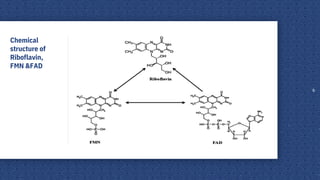
Chemical
structure of
Riboflavin,
FMN &FAD
6
Digestion &
Absorption
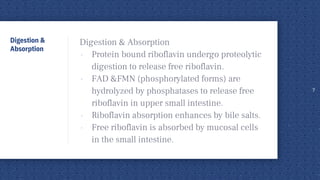
Digestion & Absorption
• Protein bound riboflavin undergo proteolytic
digestion to release free riboflavin.
• FAD &FMN (phosphorylated forms) are
hydrolyzed by phosphatases to release free
riboflavin in upper small intestine.
• Riboflavin absorption enhances by bile salts.
• Free riboflavin is absorbed by mucosal cells
in the small intestine.
7
Absorption &
Transport
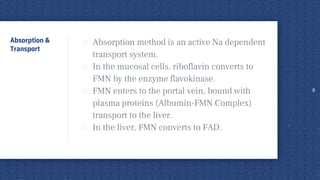
◎ Absorption method is an active Na dependent
transport system.
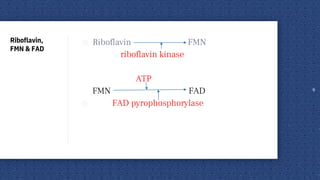
◎ In the mucosal cells, riboflavin converts to
FMN by the enzyme flavokinase.
◎ FMN enters to the portal vein, bound with
plasma proteins (Albumin-FMN Complex)
transport to the liver.
◎ In the liver, FMN converts to FAD.
8
Riboflavin,
FMN & FAD
◎ Riboflavin FMN
riboflavin kinase
ATP
FMN FAD
◎ FAD pyrophosphorylase
9
Excretion
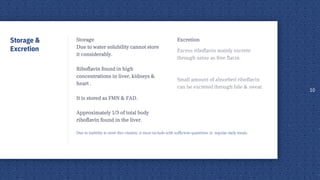
Excess riboflavin mainly excrete
through urine as free flavin.
Small amount of absorbed riboflavin
can be excreted through bile & sweat.
Storage
Due to water solubility cannot store
it considerably.
Riboflavin found in high
concentrations in liver, kidneys &
heart .
It is stored as FMN & FAD.
Approximately 1/3 of total body
riboflavin found in the liver.
Due to inability to store this vitamin, it must include with sufficient quantities in regular daily meals.
10
Storage &
Excretion
Functions  Production of red blood cells.
 Supports production of antibodies.
 Helps prevent cataract.
 Supports energy production (ATP)by the
cells.
 Maintains mucus membranes healthy.
11
Functions  Helps absorption of vitamin B6 &iron in the
intestines.
 Supports metabolism of fats, proteins &
carbohydrates.
 Supports conversion of tryptophan into
niacin.
 Helps activate vitamin B6 & folic acid.
 Acts as a coenzyme in many cells.
12
Riboflavin
requirements
for dogs
◎ According to NRC (2006)- For all life stages
of dogs is 5.3mg per Kg of diet.
◎ The Association of American Feed Control
Officials (AAFCO, 2007) – For all classes of
dogs, 2.2mg per Kg of diet.
13
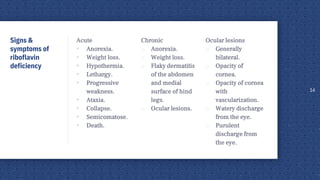
Signs &
symptoms of
riboflavin
deficiency
Acute
 Anorexia.
 Weight loss.
 Hypothermia.
 Lethargy.
 Progressive
weakness.
 Ataxia.
 Collapse.
 Semicomatose.
 Death.
Chronic
o Anorexia.
o Weight loss.
o Flaky dermatitis
of the abdomen
and medial
surface of hind
legs.
o Ocular lesions.
Ocular lesions
o Generally
bilateral.
o Opacity of
cornea.
o Opacity of cornea
with
vascularization.
o Watery discharge
from the eye.
o Purulent
discharge from
the eye.
14
Place your screenshot here
15
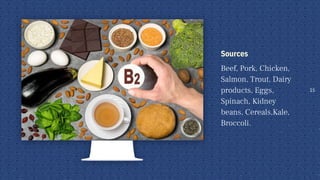
Sources
Beef, Pork, Chicken,
Salmon, Trout, Dairy
products, Eggs,
Spinach, Kidney
beans, Cereals,Kale,
Broccoli.
16
THANKS!
Any questions?
You can find me at
dassanayakepreethi@gmail.com.
CREDITS Special thanks to all the people who made and
released these awesome resources for free:
◎ Presentation template by SlidesCarnival
◎ Photographs by Google image.
17

Vitamin b2

  • 1.
  • 2.
    HELLO! I am Dr.Preethi Sudarshanie Dassanayake (B. V. Sc., M.Sc., MBA) from Veterinary Teaching Hospital, University of Peradeniya, Sri Lanka. 2
  • 3.
    Vitamin B2 Commonly known as riboflavin,Vitamin G , lactoflavin, hepatoflavin, & ovoflavin.  Water-soluble.  Yellow color organic compound.  Easily destroyed by light.  Heat stable.  Roasting and steaming preserves more riboflavin. 3
  • 4.
    o Riboflavin isd-Ribitol & it’s hydroxyl group at position 5 is substituted by a 7,8- dimethyl-2,4-dioxo-3,4- dihydrobenzo[g]pteridin- 10(2H)-yl moiety. o Formula –C17 H20 N4 O6 4 Structure of Riboflavin
  • 5.
    FMN & FAD◎ Riboflavin is present in the food as free riboflavin, FAD & FMN. ◎ Riboflavin is a precursor of the two coenzymes. -Flavin mononucleotide (FMN). ◎ - Flavin adeno dinucleotide (FAD). ◎ - FMN & FAD are cofactors for several enzymes (oxidoreductases) that present in your pet. 5
  • 6.
  • 7.
    Digestion & Absorption Digestion &Absorption • Protein bound riboflavin undergo proteolytic digestion to release free riboflavin. • FAD &FMN (phosphorylated forms) are hydrolyzed by phosphatases to release free riboflavin in upper small intestine. • Riboflavin absorption enhances by bile salts. • Free riboflavin is absorbed by mucosal cells in the small intestine. 7
  • 8.
    Absorption & Transport ◎ Absorptionmethod is an active Na dependent transport system. ◎ In the mucosal cells, riboflavin converts to FMN by the enzyme flavokinase. ◎ FMN enters to the portal vein, bound with plasma proteins (Albumin-FMN Complex) transport to the liver. ◎ In the liver, FMN converts to FAD. 8
  • 9.
    Riboflavin, FMN & FAD ◎Riboflavin FMN riboflavin kinase ATP FMN FAD ◎ FAD pyrophosphorylase 9
  • 10.
    Excretion Excess riboflavin mainlyexcrete through urine as free flavin. Small amount of absorbed riboflavin can be excreted through bile & sweat. Storage Due to water solubility cannot store it considerably. Riboflavin found in high concentrations in liver, kidneys & heart . It is stored as FMN & FAD. Approximately 1/3 of total body riboflavin found in the liver. Due to inability to store this vitamin, it must include with sufficient quantities in regular daily meals. 10 Storage & Excretion
  • 11.
    Functions  Productionof red blood cells.  Supports production of antibodies.  Helps prevent cataract.  Supports energy production (ATP)by the cells.  Maintains mucus membranes healthy. 11
  • 12.
    Functions  Helpsabsorption of vitamin B6 &iron in the intestines.  Supports metabolism of fats, proteins & carbohydrates.  Supports conversion of tryptophan into niacin.  Helps activate vitamin B6 & folic acid.  Acts as a coenzyme in many cells. 12
  • 13.
    Riboflavin requirements for dogs ◎ Accordingto NRC (2006)- For all life stages of dogs is 5.3mg per Kg of diet. ◎ The Association of American Feed Control Officials (AAFCO, 2007) – For all classes of dogs, 2.2mg per Kg of diet. 13
  • 14.
    Signs & symptoms of riboflavin deficiency Acute Anorexia.  Weight loss.  Hypothermia.  Lethargy.  Progressive weakness.  Ataxia.  Collapse.  Semicomatose.  Death. Chronic o Anorexia. o Weight loss. o Flaky dermatitis of the abdomen and medial surface of hind legs. o Ocular lesions. Ocular lesions o Generally bilateral. o Opacity of cornea. o Opacity of cornea with vascularization. o Watery discharge from the eye. o Purulent discharge from the eye. 14
  • 15.
    Place your screenshothere 15 Sources Beef, Pork, Chicken, Salmon, Trout, Dairy products, Eggs, Spinach, Kidney beans, Cereals,Kale, Broccoli.
  • 16.
    16 THANKS! Any questions? You canfind me at dassanayakepreethi@gmail.com.
  • 17.
    CREDITS Special thanksto all the people who made and released these awesome resources for free: ◎ Presentation template by SlidesCarnival ◎ Photographs by Google image. 17