VITAMIN B2-RIBOFLAVIN
Name-Vedant Sawant
Roll no-19FET107
Introduction
 Riboflavin was first isolated by Blyth in 1872 from
whey, and is water soluble, yellow, fluorescent
material.
 According to IUPAC rules,riboflavin is called 7,8-
dimethyl-10-(d-1’-ribityl)isoalloxazine .It is also
called lactoflavin.
 Formula: C17H20N4O6
 Molar mass: 376.36 g/mol
 It emits yellow fluorescence.
 Visually, it imparts color to vitamin supplements.
Structure
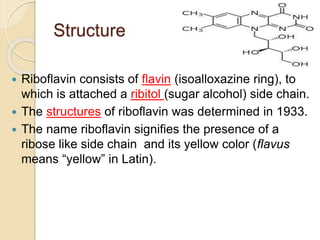
 Riboflavin consists of flavin (isoalloxazine ring), to
which is attached a ribitol (sugar alcohol) side chain.
 The structures of riboflavin was determined in 1933.
 The name riboflavin signifies the presence of a
ribose like side chain and its yellow color (flavus
means “yellow” in Latin).
COENZYME FORMS
 Riboflavin has two coenzymes. Both are nucleotides and
integral part of enzymes. Such enzymes are called
flavoproteins.
1. Flavin mononucleotide(FMN)=Flavin-ribityl-
phosphate(phosphate group attached to ribityl alcoholic
group at position 5).
2. Flavin Adenine dinucleotide(FAD)=Flavin-ribityl-phosphate-
phosphate-ribose-adenine
 In FAD, adenine nucleotide is attached to FMN by
pyrophosphate linkage.
 FAD is converted to form various tissue flavoproteins (mainly
complexed with flavoprotein dehydrogenases and oxidases)
and thus it is the predominant flavoenzyme present in tissue.
 These coenzymes participate in many essential enzyme-
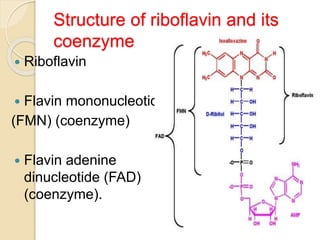
Structure of riboflavin and its
coenzyme
 Riboflavin
 Flavin mononucleotide
(FMN) (coenzyme)
 Flavin adenine
dinucleotide (FAD)
(coenzyme).
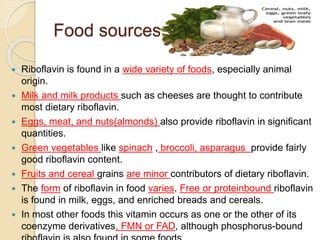
Food sources
 Riboflavin is found in a wide variety of foods, especially animal
origin.
 Milk and milk products such as cheeses are thought to contribute
most dietary riboflavin.
 Eggs, meat, and nuts(almonds) also provide riboflavin in significant
quantities.
 Green vegetables like spinach , broccoli, asparagus provide fairly
good riboflavin content.
 Fruits and cereal grains are minor contributors of dietary riboflavin.
 The form of riboflavin in food varies. Free or proteinbound riboflavin
is found in milk, eggs, and enriched breads and cereals.
 In most other foods this vitamin occurs as one or the other of its
coenzyme derivatives, FMN or FAD, although phosphorus-bound
RDA(Recommended dietary
allowance)
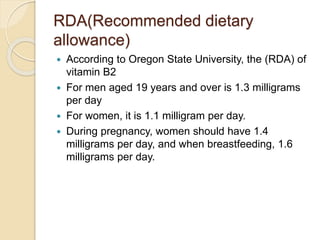
 According to Oregon State University, the (RDA) of
vitamin B2
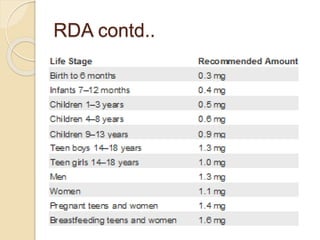
 For men aged 19 years and over is 1.3 milligrams
per day
 For women, it is 1.1 milligram per day.
 During pregnancy, women should have 1.4
milligrams per day, and when breastfeeding, 1.6
milligrams per day.
RDA contd..
Functions
 Metabolism of carbohydrates, proteins and fats.
 Normal growth and development.
 Improves eye vision, reduces eye fatigue, prevents
cataracts.
 Repairs and maintain healthy hair,skin,nails.
 Higher doses( roughly 200-400 times the RDA) can
reduce both attack frequency and number of days
with migrane. Not severity.
 Required for activation/support of vitamin
b6,folate,niacin,vitamin k.
 Helps in red blood cell production.
 Riboflavin is present in foods mostly (80–90%) as
FAD and FMN cofactors of proteins.
 ABSORPTION-
1. Riboflavin is present in food as FAD,FMN and
free riboflavin.
2. FMN and FAD are hydrolysed to free form in upper
small intestine.
3. Free form is absorbed by intestinal mucosal cells
by sodium dependent transport system.
 TRANSPORT-
1. In intestinal mucosal cells riboflavin is converted
into FMN by the action of flavokinase in presence
of ATP.
2. FMN enters the portal circulation.
 In the plasma it is transported as Albumin-FMN
complex.
 FMN complex enter the tissues including liver.
 In the tissues it is converted into FAD.
 STORAGE-
1. Riboflavin is mainly stored in liver.
2. It is stored as FMN and FAD.
 EXCRETION-
1. Mainly excreted in urine.
DEFICIENCY OF RIBOFLAVIN:
ARIBOFLAVINOSIS
 Rarely occurs in isolation but most often is
accompanied by other nutrient deficits.
 Clinical symptoms of deficiency after almost 4
months of inadequate intake include lesions on
the outside of the lips (cheilosis) and corners of
the mouth (angular stomatitis), inflammation of
the tongue (glossitis), and swollen (edema)
mouth/oral cavity, an inflammatory skin condition
seborrheic dermatitis, anemia and eye disorders
like corneal vascularization.
 Severe deficiency of riboflavin may diminish the
synthesis of the coenzyme form of vitamin B6
and the synthesis of niacin (NAD) from
tryptophan.
Toxicity
 Toxicity associated with large oral doses of
riboflavin has not been reported, and no tolerable
upper intake level for riboflavin has been
established.
 Trials have shown use of large amounts of this
vitamin would be effective in treating migraine
headaches without side effects.
 High-dose riboflavin therapy has been found to
intensify urine color to a bright yellow (flavinuria),
but this is a harmless side effect.
 However, Studies in cell culture indicate that
excess riboflavin may increase the risk
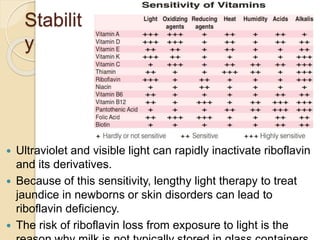
Stabilit
y
 Ultraviolet and visible light can rapidly inactivate riboflavin
and its derivatives.
 Because of this sensitivity, lengthy light therapy to treat
jaundice in newborns or skin disorders can lead to
riboflavin deficiency.
 The risk of riboflavin loss from exposure to light is the
THANK
YOU..

VITAMIN B2-RIBOFLAVIN.pptx

  • 1.
  • 2.
    Introduction  Riboflavin wasfirst isolated by Blyth in 1872 from whey, and is water soluble, yellow, fluorescent material.  According to IUPAC rules,riboflavin is called 7,8- dimethyl-10-(d-1’-ribityl)isoalloxazine .It is also called lactoflavin.  Formula: C17H20N4O6  Molar mass: 376.36 g/mol  It emits yellow fluorescence.  Visually, it imparts color to vitamin supplements.
  • 3.
    Structure  Riboflavin consistsof flavin (isoalloxazine ring), to which is attached a ribitol (sugar alcohol) side chain.  The structures of riboflavin was determined in 1933.  The name riboflavin signifies the presence of a ribose like side chain and its yellow color (flavus means “yellow” in Latin).
  • 4.
    COENZYME FORMS  Riboflavinhas two coenzymes. Both are nucleotides and integral part of enzymes. Such enzymes are called flavoproteins. 1. Flavin mononucleotide(FMN)=Flavin-ribityl- phosphate(phosphate group attached to ribityl alcoholic group at position 5). 2. Flavin Adenine dinucleotide(FAD)=Flavin-ribityl-phosphate- phosphate-ribose-adenine  In FAD, adenine nucleotide is attached to FMN by pyrophosphate linkage.  FAD is converted to form various tissue flavoproteins (mainly complexed with flavoprotein dehydrogenases and oxidases) and thus it is the predominant flavoenzyme present in tissue.  These coenzymes participate in many essential enzyme-
  • 5.
    Structure of riboflavinand its coenzyme  Riboflavin  Flavin mononucleotide (FMN) (coenzyme)  Flavin adenine dinucleotide (FAD) (coenzyme).
  • 6.
    Food sources  Riboflavinis found in a wide variety of foods, especially animal origin.  Milk and milk products such as cheeses are thought to contribute most dietary riboflavin.  Eggs, meat, and nuts(almonds) also provide riboflavin in significant quantities.  Green vegetables like spinach , broccoli, asparagus provide fairly good riboflavin content.  Fruits and cereal grains are minor contributors of dietary riboflavin.  The form of riboflavin in food varies. Free or proteinbound riboflavin is found in milk, eggs, and enriched breads and cereals.  In most other foods this vitamin occurs as one or the other of its coenzyme derivatives, FMN or FAD, although phosphorus-bound
  • 7.
    RDA(Recommended dietary allowance)  Accordingto Oregon State University, the (RDA) of vitamin B2  For men aged 19 years and over is 1.3 milligrams per day  For women, it is 1.1 milligram per day.  During pregnancy, women should have 1.4 milligrams per day, and when breastfeeding, 1.6 milligrams per day.
  • 8.
  • 9.
    Functions  Metabolism ofcarbohydrates, proteins and fats.  Normal growth and development.  Improves eye vision, reduces eye fatigue, prevents cataracts.  Repairs and maintain healthy hair,skin,nails.  Higher doses( roughly 200-400 times the RDA) can reduce both attack frequency and number of days with migrane. Not severity.  Required for activation/support of vitamin b6,folate,niacin,vitamin k.  Helps in red blood cell production.
  • 10.
     Riboflavin ispresent in foods mostly (80–90%) as FAD and FMN cofactors of proteins.  ABSORPTION- 1. Riboflavin is present in food as FAD,FMN and free riboflavin. 2. FMN and FAD are hydrolysed to free form in upper small intestine. 3. Free form is absorbed by intestinal mucosal cells by sodium dependent transport system.  TRANSPORT- 1. In intestinal mucosal cells riboflavin is converted into FMN by the action of flavokinase in presence of ATP. 2. FMN enters the portal circulation.
  • 11.
     In theplasma it is transported as Albumin-FMN complex.  FMN complex enter the tissues including liver.  In the tissues it is converted into FAD.  STORAGE- 1. Riboflavin is mainly stored in liver. 2. It is stored as FMN and FAD.  EXCRETION- 1. Mainly excreted in urine.
  • 12.
    DEFICIENCY OF RIBOFLAVIN: ARIBOFLAVINOSIS Rarely occurs in isolation but most often is accompanied by other nutrient deficits.  Clinical symptoms of deficiency after almost 4 months of inadequate intake include lesions on the outside of the lips (cheilosis) and corners of the mouth (angular stomatitis), inflammation of the tongue (glossitis), and swollen (edema) mouth/oral cavity, an inflammatory skin condition seborrheic dermatitis, anemia and eye disorders like corneal vascularization.  Severe deficiency of riboflavin may diminish the synthesis of the coenzyme form of vitamin B6 and the synthesis of niacin (NAD) from tryptophan.
  • 13.
    Toxicity  Toxicity associatedwith large oral doses of riboflavin has not been reported, and no tolerable upper intake level for riboflavin has been established.  Trials have shown use of large amounts of this vitamin would be effective in treating migraine headaches without side effects.  High-dose riboflavin therapy has been found to intensify urine color to a bright yellow (flavinuria), but this is a harmless side effect.  However, Studies in cell culture indicate that excess riboflavin may increase the risk
  • 14.
    Stabilit y  Ultraviolet andvisible light can rapidly inactivate riboflavin and its derivatives.  Because of this sensitivity, lengthy light therapy to treat jaundice in newborns or skin disorders can lead to riboflavin deficiency.  The risk of riboflavin loss from exposure to light is the
  • 15.