a more insidious type of deficiency
caused by eating food that is cheap and filling
but deficient in essential vitamins and micronutrients.
The ‘hidden hunger’ due to micronutrient deficiency does not produce hunger as we
know it. It might not be felt in the belly,
but it strikes at the core of our health and vitality.
Causes of Hidden hunger
Continuous consumption of starchy food
Lack of balanced diet
Less diversity in food
Not fulfilling the increased micronutrient demand in certain period of life ,such as
pregnancy, lactation etc.
Health disease such as infection.
Phenotypes of
hunger
Hunger: distress related to lack of food
Malnutrition: an abnormal physiological condition, typically
due to eating the wrong amount and/or kinds of foods
Undernutrition: deficiencies in energy, protein, and/or
micronutrients
Micronutrient deficiency (also known as hidden hunger):
a form of undernutrition that occurs when intake or absorption
of vitamins and minerals is too low to sustain good health and
development.
Undernourishment: chronic calorie deficiency, with
consumption of less than 1,800 kilocalories a day.
Micronutrient
deficiency
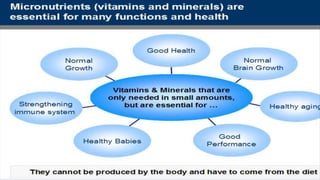
Micronutrient deficiency is the lack of essential
vitamin and mineral required in small amount by
the body for proper growth and development.
Common macronutrient are vitamin A, B, C and D,
calcium, folate, iodine and iron.
Why micronutrient deficiency referred to as
Hidden hunger
While clinical signs of hidden hunger, such as night blindness due to
vitamin A deficiency and goiter from inadequate iodine intake, become
visible once deficiencies become severe, the health and development of a
much larger share of the population is affected by less obvious “invisible”
effects. That is why micronutrient deficiencies are often referred to as
hidden hunger.
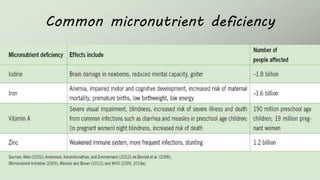
Common micronutrient deficiency
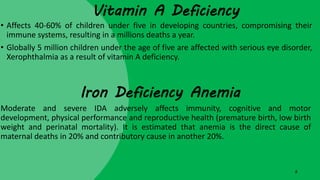
Vitamin A Deficiency
• Affects 40-60% of children under five in developing countries, compromising their
immune systems, resulting in a millions deaths a year.
• Globally 5 million children under the age of five are affected with serious eye disorder,
Xerophthalmia as a result of vitamin A deficiency.
8
Iron Deficiency Anemia
Moderate and severe IDA adversely affects immunity, cognitive and motor
development, physical performance and reproductive health (premature birth, low birth
weight and perinatal mortality). It is estimated that anemia is the direct cause of
maternal deaths in 20% and contributory cause in another 20%.
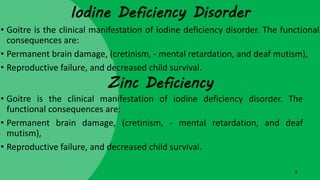
Iodine Deficiency Disorder
• Goitre is the clinical manifestation of iodine deficiency disorder. The functional
consequences are:
• Permanent brain damage, (cretinism, - mental retardation, and deaf mutism),
• Reproductive failure, and decreased child survival.
9
Zinc Deficiency
• Goitre is the clinical manifestation of iodine deficiency disorder. The
functional consequences are:
• Permanent brain damage, (cretinism, - mental retardation, and deaf
mutism),
• Reproductive failure, and decreased child survival.
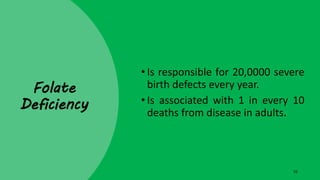
Folate
Deficiency
• Is responsible for 20,0000 severe
birth defects every year.
• Is associated with 1 in every 10
deaths from disease in adults.
10
1. Especially vulnerable populations I:Women, Pregnant women
2. Especially vulnerable populations II: Lactating women, elderly person
3. Especially vulnerable populations III:children
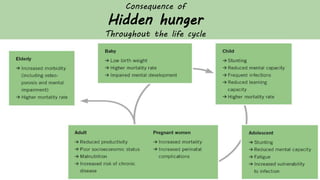
Consequence of
Hidden hunger
Throughout the life cycle
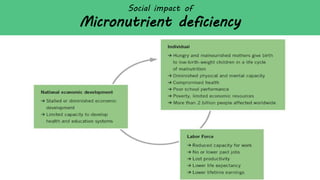
Social impact of
Micronutrient deficiency
Economic impact of
Hidden hunger
• Poor people are more likely than others to suffer from
micronutrient malnutrition
• GDP loses about .9% due to iron deficiency
• The loss of economy due to anemia is around 5 billion US dollar
• GDP loses about 3%-4% due to iodine deficiency
• Maternal death increase between 20%-22% due to maternal
anemia
The nutrition situation in the case of poverty is calculated by daily intake of
food measured by kilocalories (kcal). According to FAO the average minimum
daily energy requirement is about 1,800 kilocalories (7,500 kJ) per person.
There are two common approaches used to measure poverty in terms of
food intake.
1. Direct Calorie Intake (DCI)
2. Food Energy Intake (FEI)
Bangladesh has achieved the level of food energy intake by 2250 kcal,
Initiatives to remedy the
micronutrient deficiencies
1. National Nutrition Services (NNS)
2. Food Sovereignty on nutrition
3. Agro ecological Challenges
4. Community Food System
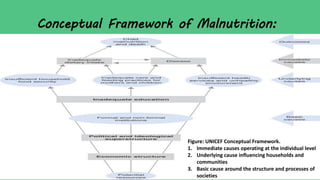
Conceptual Framework of Malnutrition:
Figure: UNICEF Conceptual Framework.
1. Immediate causes operating at the individual level
2. Underlying cause influencing households and
communities
3. Basic cause around the structure and processes of
societies
The effect of hidden hunger in MDGs
• Goal 1: Eradicated extreme hunger and
poverty.
• Goal 4: Reduce child mortality.
• Goal 5: Improve maternal health.
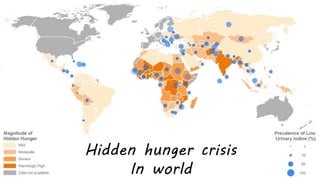
Hidden hunger crisis
In world
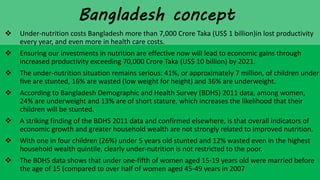
 Under-nutrition costs Bangladesh more than 7,000 Crore Taka (US$ 1 billion)in lost productivity
every year, and even more in health care costs.
 Ensuring our investments in nutrition are effective now will lead to economic gains through
increased productivity exceeding 70,000 Crore Taka (US$ 10 billion) by 2021.
 The under-nutrition situation remains serious: 41%, or approximately 7 million, of children under
five are stunted, 16% are wasted (low weight for height) and 36% are underweight.
 According to Bangladesh Demographic and Health Survey (BDHS) 2011 data, among women,
24% are underweight and 13% are of short stature, which increases the likelihood that their
children will be stunted.
 A striking finding of the BDHS 2011 data and confirmed elsewhere, is that overall indicators of
economic growth and greater household wealth are not strongly related to improved nutrition.
 With one in four children (26%) under 5 years old stunted and 12% wasted even in the highest
household wealth quintile, clearly under-nutrition is not restricted to the poor.
 The BDHS data shows that under one-fifth of women aged 15-19 years old were married before
the age of 15 (compared to over half of women aged 45-49 years in 2007
Strategies for addressing
Micronutrient
malnutrition
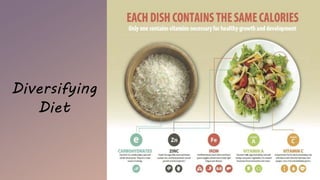
1.Diversifying diet
2.Fortifying commercial food
3.Bio fortification
4.Supplementation
5.Behavioral change
Diversifying
Diet
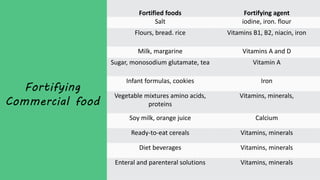
Fortifying
Commercial food
Fortified foods Fortifying agent
Salt iodine, iron. flour
Flours, bread. rice Vitamins B1, B2, niacin, iron
Milk, margarine Vitamins A and D
Sugar, monosodium glutamate, tea Vitamin A
Infant formulas, cookies Iron
Vegetable mixtures amino acids,
proteins
Vitamins, minerals,
Soy milk, orange juice Calcium
Ready-to-eat cereals Vitamins, minerals
Diet beverages Vitamins, minerals
Enteral and parenteral solutions Vitamins, minerals
Supplementation
• Vitamin A capsule
• Iron folate tablet
• Micronutrient powder
• Lipid base supplement
Behavioral
change Lifestyle
change
Personal hygiene
Mohammad Hasan Chowdhury
Dept. of Food Technology & Nutrition Science
Noakhali Science & Technology University
Noakhali-3814, Bangladesh.
E-mail:mdhsnchowdhury@gmail.com

Micronutrient Malnutrition (Hidden Hunger)

  • 2.
    a more insidioustype of deficiency caused by eating food that is cheap and filling but deficient in essential vitamins and micronutrients. The ‘hidden hunger’ due to micronutrient deficiency does not produce hunger as we know it. It might not be felt in the belly, but it strikes at the core of our health and vitality. Causes of Hidden hunger Continuous consumption of starchy food Lack of balanced diet Less diversity in food Not fulfilling the increased micronutrient demand in certain period of life ,such as pregnancy, lactation etc. Health disease such as infection.
  • 3.
    Phenotypes of hunger Hunger: distressrelated to lack of food Malnutrition: an abnormal physiological condition, typically due to eating the wrong amount and/or kinds of foods Undernutrition: deficiencies in energy, protein, and/or micronutrients Micronutrient deficiency (also known as hidden hunger): a form of undernutrition that occurs when intake or absorption of vitamins and minerals is too low to sustain good health and development. Undernourishment: chronic calorie deficiency, with consumption of less than 1,800 kilocalories a day.
  • 4.
    Micronutrient deficiency Micronutrient deficiency isthe lack of essential vitamin and mineral required in small amount by the body for proper growth and development. Common macronutrient are vitamin A, B, C and D, calcium, folate, iodine and iron.
  • 5.
    Why micronutrient deficiencyreferred to as Hidden hunger While clinical signs of hidden hunger, such as night blindness due to vitamin A deficiency and goiter from inadequate iodine intake, become visible once deficiencies become severe, the health and development of a much larger share of the population is affected by less obvious “invisible” effects. That is why micronutrient deficiencies are often referred to as hidden hunger.
  • 7.
  • 8.
    Vitamin A Deficiency •Affects 40-60% of children under five in developing countries, compromising their immune systems, resulting in a millions deaths a year. • Globally 5 million children under the age of five are affected with serious eye disorder, Xerophthalmia as a result of vitamin A deficiency. 8 Iron Deficiency Anemia Moderate and severe IDA adversely affects immunity, cognitive and motor development, physical performance and reproductive health (premature birth, low birth weight and perinatal mortality). It is estimated that anemia is the direct cause of maternal deaths in 20% and contributory cause in another 20%.
  • 9.
    Iodine Deficiency Disorder •Goitre is the clinical manifestation of iodine deficiency disorder. The functional consequences are: • Permanent brain damage, (cretinism, - mental retardation, and deaf mutism), • Reproductive failure, and decreased child survival. 9 Zinc Deficiency • Goitre is the clinical manifestation of iodine deficiency disorder. The functional consequences are: • Permanent brain damage, (cretinism, - mental retardation, and deaf mutism), • Reproductive failure, and decreased child survival.
  • 10.
    Folate Deficiency • Is responsiblefor 20,0000 severe birth defects every year. • Is associated with 1 in every 10 deaths from disease in adults. 10
  • 11.
    1. Especially vulnerablepopulations I:Women, Pregnant women 2. Especially vulnerable populations II: Lactating women, elderly person 3. Especially vulnerable populations III:children
  • 12.
  • 13.
  • 14.
    Economic impact of Hiddenhunger • Poor people are more likely than others to suffer from micronutrient malnutrition • GDP loses about .9% due to iron deficiency • The loss of economy due to anemia is around 5 billion US dollar • GDP loses about 3%-4% due to iodine deficiency • Maternal death increase between 20%-22% due to maternal anemia
  • 15.
    The nutrition situationin the case of poverty is calculated by daily intake of food measured by kilocalories (kcal). According to FAO the average minimum daily energy requirement is about 1,800 kilocalories (7,500 kJ) per person. There are two common approaches used to measure poverty in terms of food intake. 1. Direct Calorie Intake (DCI) 2. Food Energy Intake (FEI) Bangladesh has achieved the level of food energy intake by 2250 kcal,
  • 16.
    Initiatives to remedythe micronutrient deficiencies 1. National Nutrition Services (NNS) 2. Food Sovereignty on nutrition 3. Agro ecological Challenges 4. Community Food System
  • 17.
    Conceptual Framework ofMalnutrition: Figure: UNICEF Conceptual Framework. 1. Immediate causes operating at the individual level 2. Underlying cause influencing households and communities 3. Basic cause around the structure and processes of societies
  • 18.
    The effect ofhidden hunger in MDGs • Goal 1: Eradicated extreme hunger and poverty. • Goal 4: Reduce child mortality. • Goal 5: Improve maternal health.
  • 19.
  • 20.
     Under-nutrition costsBangladesh more than 7,000 Crore Taka (US$ 1 billion)in lost productivity every year, and even more in health care costs.  Ensuring our investments in nutrition are effective now will lead to economic gains through increased productivity exceeding 70,000 Crore Taka (US$ 10 billion) by 2021.  The under-nutrition situation remains serious: 41%, or approximately 7 million, of children under five are stunted, 16% are wasted (low weight for height) and 36% are underweight.  According to Bangladesh Demographic and Health Survey (BDHS) 2011 data, among women, 24% are underweight and 13% are of short stature, which increases the likelihood that their children will be stunted.  A striking finding of the BDHS 2011 data and confirmed elsewhere, is that overall indicators of economic growth and greater household wealth are not strongly related to improved nutrition.  With one in four children (26%) under 5 years old stunted and 12% wasted even in the highest household wealth quintile, clearly under-nutrition is not restricted to the poor.  The BDHS data shows that under one-fifth of women aged 15-19 years old were married before the age of 15 (compared to over half of women aged 45-49 years in 2007
  • 21.
    Strategies for addressing Micronutrient malnutrition 1.Diversifyingdiet 2.Fortifying commercial food 3.Bio fortification 4.Supplementation 5.Behavioral change
  • 22.
  • 23.
    Fortifying Commercial food Fortified foodsFortifying agent Salt iodine, iron. flour Flours, bread. rice Vitamins B1, B2, niacin, iron Milk, margarine Vitamins A and D Sugar, monosodium glutamate, tea Vitamin A Infant formulas, cookies Iron Vegetable mixtures amino acids, proteins Vitamins, minerals, Soy milk, orange juice Calcium Ready-to-eat cereals Vitamins, minerals Diet beverages Vitamins, minerals Enteral and parenteral solutions Vitamins, minerals
  • 25.
    Supplementation • Vitamin Acapsule • Iron folate tablet • Micronutrient powder • Lipid base supplement
  • 26.
  • 27.
    Mohammad Hasan Chowdhury Dept.of Food Technology & Nutrition Science Noakhali Science & Technology University Noakhali-3814, Bangladesh. E-mail:mdhsnchowdhury@gmail.com