GENERAL CHARACTERISTICS OF YEAST
 Yeast are eukaryotic single-celled
microorganisms.
 Size : 3-4 micrometer.
 Reproduce asexually by mitosis and usually
show
Budding.
 Ability to ferment sugers for the production
of ethanol
 They are usually unicellular and exist as
colonies and used in baking process.
GENERAL CHARACTERISTICS OF YEAST
 Budding yeast referred as the "true
yeasts" are members of the phylum
ascomycota and order
saccharomycetals.
 Minimum aw for growth of yeast lies
between 0.88 and 0.94.
 Optimum temperature for yeast growth
lies between 25C and 30C.
 Acid eenvironment (pH 4.5 - 6.0) will
favor the yeast growth.
COMMON CAUSES OF YEAST INFECTIONS
Medicines -
 Antibiotics: Tetracycline or amoxicillin
antibiotics.
 Corticosteroids: Inhaled corticosteroids for
asthma is linked to oral candidiasis.
 Dentures: People who wear dentures, may
be likely to get thrush.
 Hormones: The change in estrogen and
progesteron levels in women can lead to
vaginal
infection.
COMMON CAUSES OF YEAST INFECTIONS
 Clothing : Wearing underwear that doesn't
breathe can increase body heat and
moisture in the vagina.
 Diaper Rash: Change babies diapers often,
soiled and wet diapers can lead to diaper
rash.
Other medical causes -
 Diabetes: If diabetes isn't well - controlled,
the increase in sugar in the mucous
membranes can create a fertile environment.
 Weakened immune system: If we have HIV /
AIDS or other condition that hampers our
ASSOCIATION WITH FOOD
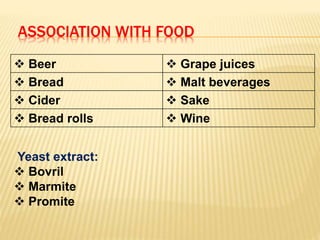
 Beer  Grape juices
 Bread  Malt beverages
 Cider  Sake
 Bread rolls  Wine
Yeast extract:
 Bovril
 Marmite
 Promite
ASSOCIATION WITH FOOD
These food may contain yeast :
Cakes Soy sauce
Fruit – over ripe Chocolate
Soup – prepared or
canned
Certain foods are said to be a trigger for
candida infestations and should be avoided:
Sweets or food containing high sugar
levels.
Dairy products.
Dried fruit.
Smoked meat.
Pasta.
SOME DISEASES
 Aspergillosis: Caused by fungus aspergillus
and
usually occurs in people with lung diseases.
 Candidiasis: Caused by the yeast candida.
Candidiasis can occur in the mouth and throat,
vagina or the bloodstream.
 Eye infections: Different types of fungi can
cause eye
infections.These are rare but can develop after
an eye injury.
SOME DISEASES
 Pneumocystis pneumonia: Caused by the
fungus pneumocystis jirovecii and mainly
affects people with weekened immune
systems.
 C.Neoformans infections: Caused by
cryptococcus neoformanes, which can
infect in the brain in people with HIV/AIDS.
 Blastimycosis: Caused by the fungus
Blastomyces which lives in moist soil in
parts of the united states and canada.
ECOLOGY OF YEAST
 Yeasts are very common in the environment
and isolated from sugar rich
materials.Examples innclude naturally
occuring yeasts on the skins of fruits and
berries and exodates from plants.
 Some yeasts are found in association with
soil and insects.
 Yeasts, including Candida albicans,
Rhodotorula rubra, Turolopsis and
Trichosporon cutaneum, have been found
living in between peoples toes as part of
their skin flora.
ECOLOGY OF YEAST
 Yeasts are also found in the gut flora of
mammals and some insects and even deep-
sea environments host an array of yeasts.
 A black yeasts has been recorded as a
partner in a complex relationship between
ants, their mutualistic fungus,a fungal
parasite of the fungus and a bacterium that
kills the parasite.
 The yeast has a negative effect on the
bacteria that normally produce antibiotics to
kill parasite, so may effects the ants health
by allowing the parasite to spread.
ECOLOGY OF YEAST
 Certain strains of some species of yeasts
produce proteins called yeast killer toxins that
allow them to eliminate competing strains.
 This can cause problems for the winemaking
but could potentially also be used to advantage
by using killer toxin- producing strains to make
the wine.
 Yeasts killer toxin may also have medical
applications in treating yeast infections.
MODE OF TRANSMISSION
Endogenous spread (part of normal human flora)
 By contact with excretion of mouth, skin and
feces from patient or carriors.
 From mother to infant during child birth.
MODE OF ACTION (Beauveria
Bassiana) These fungi usually attach to the external
body surface of insects in the form of
microscopic spores.
 Under permissive conditions of temperature
& moisture, these spores germinate, grow as
hyphae & colonize the insects cuticle;
eventually they bore through it & reach the
MODE OF ACTION (BEAUVERIA
BASSIANA)
Then, the fungal cells proliferate in the body
cavity, usually as walled hyphae or in the forms
of wall-less protoplast ( depending on the
fungus involved).
 After sometime the insect is usually killed
(sometimes by fungal toxin) & new propagules
(spores) are formed on the insects if
environment conditions are again permissive;
usually high humidity is required for
sporulation.
NATURAL HABITATS
 Yeasts are widely dispersed in nature
with a wide variety of habitats.
 They are commonly found on plant
leaves,flowers and fruits as well as in
soil.
 Yeast are also found on the surface of the
skin and in the intestinal tracts of warm-
blooded animals where they may live
symbiotically or as parasites.
 The common yeast infections is typically
caused by Candida albicans.
SYMPTOMS OF YEAST INFECTIONS
Symptoms can vary depending on where the
yeast infection is.
Vagina:
 Itching, swelling or red color inside and outside
in vagina.
 A burning sensation, especially during
intercourse or while urinating.
 Vaginal pain or soreness.
 Vaginal rash.
 Watery vaginal discharge.
SYMPTOMS OF YEAST INFECTIONS
Penis:
 Itching, rash,swelling or red colour on the tip
of penis.
 Pain when we have sex.
 Burning when we urinate.
Mouth:
 White coating on the tongue.
 Inflammation of the mouth.
DIAGNOSIS OF YEAST INFECTION
 Doctor will ask about medical history.This
about whether have had yeast infections
before or about STI.
 The next step is pelvic exam. Doctor will
examine the patient vagina walls and cervix.
Doctors will also look at the surrounding
area are for external signs of innfection.
 Doctor may collect some cells from the
patient vagina.This cells will go to a lab for
examination.
TREATMENT OF YEAST INFECTION
Goals of Treatment :
 Treat infection.
 Prevent complications.
Treatment of vaginal symptoms :
 First choice: Vaginal insert or oral treatment.
 Vaginal insert: Clotrimazole or miconazole
vaginal innsert or cream.
or,
 Oral treatment: Fluconazole 150 mg tablet PO in
a single dose.
TREATMENT OF YEAST INFECTION
 Alternate Treatment : Intravaginal
capsule :oboric acid 600 mg once per
day for 14 days.
Treatment of external symptoms :
 First choice: Topical cream
 Clotrimazole topical cream applied
twice daily for 01 to 14 days.
or,
 Miconazole topical cream applied twice
daily for 10 to 14 days.
PREVENTION OF YEAST INFECTIONS
 Do not use pads,tampons or bath products
that are perfumed or coloured.
 Wear unbleached, cotton underwear during
the day.Its better not to wear underwear
when sleep.
 Avoid tight fitting pants,tights or nylons.
 Do not douche or use feminine hygiene
sprays, wips or soaps.
PREVENTION OF YEAST INFECTIONS
 Change out of our wet bathing suit or sweaty
exercise clothes.
 Avoid lubricants that are made from glycerin.
Glycerin may contribute to overgrowth.
 Get planty of sleep, exercise and healthy
foods. This will help keep the immune
system strong to prevent yeast infections.
 Using probiotics either orally or vaginally
may help prevent yeast infections.
COMMON USES OF YEAST
 Bread: The most common use of yeast has
been in the making of bread.The yeast reacts
with oxygen and helps leaven bread or make it
rise.
 Alcoholic drinks: Browning wine and beer has
also used yeast for centuries to fement the
mixture to make it alcoholic.
 Non alcoholic drinks: Root beers annd other
soft drinks use yeast to add flavor but the
fermentation process is stopped before the
drink bocome alcoholic.This means the drinks
are much sweater than their alcoholic
counterparts and contain more carbon dioxide.
COMMON USES OF YEAST
 Biofuel: Most recently yeast has been used in
the production of bioduels.This is because the
yeast turns sugar into ethanol which can be
used as a diesel substitute in vehicles.
 Probiotics: Many of the probiotic drinks
available now use yeast as a supplement. Many
vegetarians use yeast as a supplement due to
low protein and vitamin amounts in their normal
diet.
 Yeast extract: Yeast can also be processed to
create yeast extract. This is then used in a
variety of food products such as marmite &
vegemite.
Yeast

Yeast

  • 2.
    GENERAL CHARACTERISTICS OFYEAST  Yeast are eukaryotic single-celled microorganisms.  Size : 3-4 micrometer.  Reproduce asexually by mitosis and usually show Budding.  Ability to ferment sugers for the production of ethanol  They are usually unicellular and exist as colonies and used in baking process.
  • 3.
    GENERAL CHARACTERISTICS OFYEAST  Budding yeast referred as the "true yeasts" are members of the phylum ascomycota and order saccharomycetals.  Minimum aw for growth of yeast lies between 0.88 and 0.94.  Optimum temperature for yeast growth lies between 25C and 30C.  Acid eenvironment (pH 4.5 - 6.0) will favor the yeast growth.
  • 4.
    COMMON CAUSES OFYEAST INFECTIONS Medicines -  Antibiotics: Tetracycline or amoxicillin antibiotics.  Corticosteroids: Inhaled corticosteroids for asthma is linked to oral candidiasis.  Dentures: People who wear dentures, may be likely to get thrush.  Hormones: The change in estrogen and progesteron levels in women can lead to vaginal infection.
  • 5.
    COMMON CAUSES OFYEAST INFECTIONS  Clothing : Wearing underwear that doesn't breathe can increase body heat and moisture in the vagina.  Diaper Rash: Change babies diapers often, soiled and wet diapers can lead to diaper rash. Other medical causes -  Diabetes: If diabetes isn't well - controlled, the increase in sugar in the mucous membranes can create a fertile environment.  Weakened immune system: If we have HIV / AIDS or other condition that hampers our
  • 6.
    ASSOCIATION WITH FOOD Beer  Grape juices  Bread  Malt beverages  Cider  Sake  Bread rolls  Wine Yeast extract:  Bovril  Marmite  Promite
  • 7.
    ASSOCIATION WITH FOOD Thesefood may contain yeast : Cakes Soy sauce Fruit – over ripe Chocolate Soup – prepared or canned Certain foods are said to be a trigger for candida infestations and should be avoided: Sweets or food containing high sugar levels. Dairy products. Dried fruit. Smoked meat. Pasta.
  • 8.
    SOME DISEASES  Aspergillosis:Caused by fungus aspergillus and usually occurs in people with lung diseases.  Candidiasis: Caused by the yeast candida. Candidiasis can occur in the mouth and throat, vagina or the bloodstream.  Eye infections: Different types of fungi can cause eye infections.These are rare but can develop after an eye injury.
  • 9.
    SOME DISEASES  Pneumocystispneumonia: Caused by the fungus pneumocystis jirovecii and mainly affects people with weekened immune systems.  C.Neoformans infections: Caused by cryptococcus neoformanes, which can infect in the brain in people with HIV/AIDS.  Blastimycosis: Caused by the fungus Blastomyces which lives in moist soil in parts of the united states and canada.
  • 10.
    ECOLOGY OF YEAST Yeasts are very common in the environment and isolated from sugar rich materials.Examples innclude naturally occuring yeasts on the skins of fruits and berries and exodates from plants.  Some yeasts are found in association with soil and insects.  Yeasts, including Candida albicans, Rhodotorula rubra, Turolopsis and Trichosporon cutaneum, have been found living in between peoples toes as part of their skin flora.
  • 11.
    ECOLOGY OF YEAST Yeasts are also found in the gut flora of mammals and some insects and even deep- sea environments host an array of yeasts.  A black yeasts has been recorded as a partner in a complex relationship between ants, their mutualistic fungus,a fungal parasite of the fungus and a bacterium that kills the parasite.  The yeast has a negative effect on the bacteria that normally produce antibiotics to kill parasite, so may effects the ants health by allowing the parasite to spread.
  • 12.
    ECOLOGY OF YEAST Certain strains of some species of yeasts produce proteins called yeast killer toxins that allow them to eliminate competing strains.  This can cause problems for the winemaking but could potentially also be used to advantage by using killer toxin- producing strains to make the wine.  Yeasts killer toxin may also have medical applications in treating yeast infections.
  • 13.
    MODE OF TRANSMISSION Endogenousspread (part of normal human flora)  By contact with excretion of mouth, skin and feces from patient or carriors.  From mother to infant during child birth. MODE OF ACTION (Beauveria Bassiana) These fungi usually attach to the external body surface of insects in the form of microscopic spores.  Under permissive conditions of temperature & moisture, these spores germinate, grow as hyphae & colonize the insects cuticle; eventually they bore through it & reach the
  • 14.
    MODE OF ACTION(BEAUVERIA BASSIANA) Then, the fungal cells proliferate in the body cavity, usually as walled hyphae or in the forms of wall-less protoplast ( depending on the fungus involved).  After sometime the insect is usually killed (sometimes by fungal toxin) & new propagules (spores) are formed on the insects if environment conditions are again permissive; usually high humidity is required for sporulation.
  • 15.
    NATURAL HABITATS  Yeastsare widely dispersed in nature with a wide variety of habitats.  They are commonly found on plant leaves,flowers and fruits as well as in soil.  Yeast are also found on the surface of the skin and in the intestinal tracts of warm- blooded animals where they may live symbiotically or as parasites.  The common yeast infections is typically caused by Candida albicans.
  • 16.
    SYMPTOMS OF YEASTINFECTIONS Symptoms can vary depending on where the yeast infection is. Vagina:  Itching, swelling or red color inside and outside in vagina.  A burning sensation, especially during intercourse or while urinating.  Vaginal pain or soreness.  Vaginal rash.  Watery vaginal discharge.
  • 17.
    SYMPTOMS OF YEASTINFECTIONS Penis:  Itching, rash,swelling or red colour on the tip of penis.  Pain when we have sex.  Burning when we urinate. Mouth:  White coating on the tongue.  Inflammation of the mouth.
  • 18.
    DIAGNOSIS OF YEASTINFECTION  Doctor will ask about medical history.This about whether have had yeast infections before or about STI.  The next step is pelvic exam. Doctor will examine the patient vagina walls and cervix. Doctors will also look at the surrounding area are for external signs of innfection.  Doctor may collect some cells from the patient vagina.This cells will go to a lab for examination.
  • 19.
    TREATMENT OF YEASTINFECTION Goals of Treatment :  Treat infection.  Prevent complications. Treatment of vaginal symptoms :  First choice: Vaginal insert or oral treatment.  Vaginal insert: Clotrimazole or miconazole vaginal innsert or cream. or,  Oral treatment: Fluconazole 150 mg tablet PO in a single dose.
  • 20.
    TREATMENT OF YEASTINFECTION  Alternate Treatment : Intravaginal capsule :oboric acid 600 mg once per day for 14 days. Treatment of external symptoms :  First choice: Topical cream  Clotrimazole topical cream applied twice daily for 01 to 14 days. or,  Miconazole topical cream applied twice daily for 10 to 14 days.
  • 21.
    PREVENTION OF YEASTINFECTIONS  Do not use pads,tampons or bath products that are perfumed or coloured.  Wear unbleached, cotton underwear during the day.Its better not to wear underwear when sleep.  Avoid tight fitting pants,tights or nylons.  Do not douche or use feminine hygiene sprays, wips or soaps.
  • 22.
    PREVENTION OF YEASTINFECTIONS  Change out of our wet bathing suit or sweaty exercise clothes.  Avoid lubricants that are made from glycerin. Glycerin may contribute to overgrowth.  Get planty of sleep, exercise and healthy foods. This will help keep the immune system strong to prevent yeast infections.  Using probiotics either orally or vaginally may help prevent yeast infections.
  • 23.
    COMMON USES OFYEAST  Bread: The most common use of yeast has been in the making of bread.The yeast reacts with oxygen and helps leaven bread or make it rise.  Alcoholic drinks: Browning wine and beer has also used yeast for centuries to fement the mixture to make it alcoholic.  Non alcoholic drinks: Root beers annd other soft drinks use yeast to add flavor but the fermentation process is stopped before the drink bocome alcoholic.This means the drinks are much sweater than their alcoholic counterparts and contain more carbon dioxide.
  • 24.
    COMMON USES OFYEAST  Biofuel: Most recently yeast has been used in the production of bioduels.This is because the yeast turns sugar into ethanol which can be used as a diesel substitute in vehicles.  Probiotics: Many of the probiotic drinks available now use yeast as a supplement. Many vegetarians use yeast as a supplement due to low protein and vitamin amounts in their normal diet.  Yeast extract: Yeast can also be processed to create yeast extract. This is then used in a variety of food products such as marmite & vegemite.